Forecasting The NSIDC News
By Steven Goddard and Anthony Watts
Barring an about face by nature or adjustments, it appears that for the first time since 2001, Arctic Sea ice will hit the “normal” line as defined by the National Snow and Ice Data Center (NSIDC) for this time of year.
NSIDC puts out an article about once a month called the Sea Ice News. It generally highlights any bad news they can find about the disappearance of Arctic ice. Last month’s news led with this sentence.
In February, Arctic sea ice extent continued to track below the average, and near the levels observed for February 2007.
But March brought good news for the Polar Bears, and bad news for the Catlin Expedition and any others looking for bad news. Instead of ice extent declining through March like it usually does, it continued to increase through the month and is now at the high (so far) for the year.
If it keeps this trend unabated, in a day or two it will likely cross the “normal” line.

The Danish Meteorological Institute shows Arctic ice extent at the highest level in their six year record.

The Norwegians (NORSEX) show Arctic ice area above the 30 year mean.

And the NORSEX Ice Extent is not far behind, within 1 standard deviation, and similar to NSIDC’s presentation. Note that is hit normal last year, but later.

And JAXA, using the more advanced AMSR-E sensor platform on the AQUA satellite, shows a similar uptick now intersecting the 2003 data line.

Source: IARC-JAXA
WUWT asked NSIDC scientist Dr. Walt Meir about this event to which he responded via email:
It’s a good question about the last time we’ve been above average. It was May 2001. April-May is the period when you’re starting to get into the peak of the melt season for the regions outside of the Arctic Ocean (Bering Sea, Hudson Bay) and the extent tends to have lower variability compared to other parts of the year as that thinner ice tends to go about the same time of year due to the solar heating. Even last year, we came fairly close to the average in early May.
He also mused about a cause:
Basically, it is due primarily to a lot more ice in the Bering Sea, as is evident in the images. The Bering ice is controlled largely by local winds, temperatures are not as important (though of course it still need to be at or at least near freezing to have ice an area for any length of time). We’ve seen a lot of northerly winds this winter in the Bering, particularly the last couple of weeks.
As we’ve been saying on WUWT for quite some time, wind seems to be a more powerful factor in recent sea ice declines than temperature. Recent studies agree.
See: Winds are Dominant Cause of Greenland and West Antarctic Ice Sheet Losses and also NASA Sees Arctic Ocean Circulation Do an About-Face
You can watch wind patterns in this time lapse animation, note how the ice has been pushed by winds and flowing down the east coast of Greenland:

Dr. Meier also wrote:
This has very little implication for what will happen this summer, or for the long-term trends, since the Bering Sea ice is thin and will melt completely well before the peak summer season.
There’s certainly no reason to disagree with the idea that much of the Bering Sea ice will melt this summer, it happens every year and has for millenia. But with a strong negative Arctic Oscillation this year, and a change in the wind, it is yet to be determined if Arctic Sea ice minimum for 2010 is anomalously low, and/or delayed from the usual time.
In 2009, WUWT noted it on September 15th: Arctic sea ice melt appears to have turned the corner for 2009
Dr. Mark Serreze of NSIDC offered some hopeful commentary in a press release back on October 6th 2009, but still pushes that “ice free summer” meme:
“It’s nice to see a little recovery over the past couple of years, but there’s no reason to think that we’re headed back to conditions seen in the 1970s,” said NSIDC Director Mark Serreze, also a professor in CU-Boulder’s geography department. “We still expect to see ice-free summers sometime in the next few decades.”
Remember this 2007 prediction from The Naval Postgraduate School?
Arctic summers ice-free ‘by 2013’
|
By Jonathan Amos
Science reporter, BBC News, San Francisco |

 |
 Arctic summer melting in 2007 set new records
|

 More details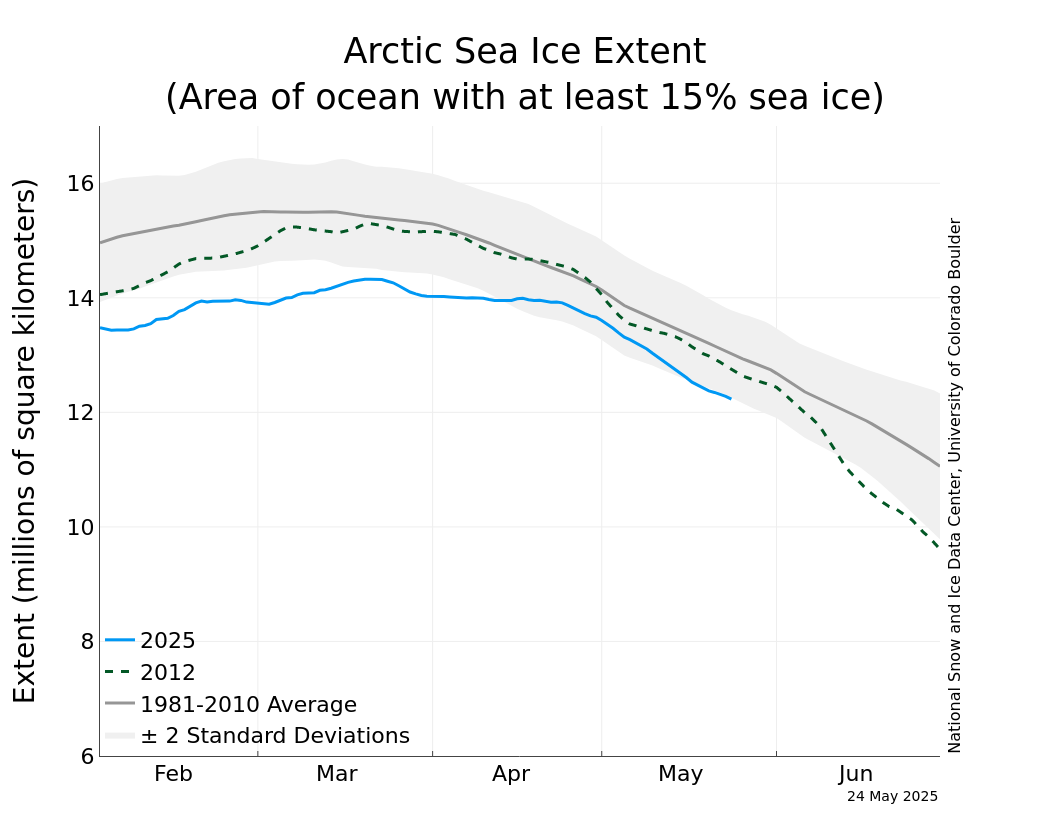

Scientists in the US have presented one of the most dramatic forecasts yet for the disappearance of Arctic sea ice.
Their latest modelling studies indicate northern polar waters could be ice-free in summers within just 5-6 years.
Professor Wieslaw Maslowski told an American Geophysical Union meeting that previous projections had underestimated the processes now driving ice loss.
Summer melting this year reduced the ice cover to 4.13 million sq km, the smallest ever extent in modern times.
Remarkably, this stunning low point was not even incorporated into the model runs of Professor Maslowski and his team, which used data sets from 1979 to 2004 to constrain their future projections.
|
 In the end, it will just melt away quite suddenly In the end, it will just melt away quite suddenly  Professor Peter Wadhams
|
“Our projection of 2013 for the removal of ice in summer is not accounting for the last two minima, in 2005 and 2007,” the researcher from the Naval Postgraduate School, Monterey, California, explained to the BBC.”So given that fact, you can argue that may be our projection of 2013 is already too conservative.”
========================================
Joe Romm wrote up a clever piece last year on this subject:
Exclusive: New NSIDC director Serreze explains the “death spiral” of Arctic ice, brushes off the “breathtaking ignorance” of blogs like WattsUpWithThat
June 5, 2009
I interviewed by email Dr. Mark Serreze, recently named director of The National Snow and Ice Data Center. Partly I wanted him to explain his “death spiral” metaphor for Arctic ice
So now that Arctic ice has returned to normal extent and area, we eagerly await the explanation from the experts about how that fits into the “death spiral” theory. Richard Feynman famously said “Science is the belief in the ignorance of the experts.”
Time will tell. 2010 is looking promising for sea ice recovery again. After all, who wouldn’t want the Arctic Sea ice to recover? WUWT is predicting a recovery again this year, which we started mentioning as a prediction last fall.
So given what we know today, what will NSIDC highlight in their April Sea Ice News?
And even more importantly, will the MSM cover it like they do the ‘terrible’ minimums?
NOTE: The poll code got messed up, duplicating an entry, press REFRESH if you see a double entry. -A
Forecasting The NSIDC News
NSIDC puts out an article about once a month called the Sea Ice News. It generally highlights any bad news they can find about the disappearance of Arctic ice. Last month’s news led with this sentence.
In February, Arctic sea ice extent continued to track below the average, and near the levels observed for February 2007.
But March brought good news for the Polar Bears, and bad news for the Catlin Expedition and any others looking for bad news. Instead of ice extent declining through March like it usually does, it continued to increase through the month and is now at the high (so far) for the year.
http://nsidc.org/data/seaice_index/images/daily_images/N_stddev_timeseries.png
The Danish Meteorological Institute shows Arctic ice extent at the highest level in their six year record.
The Norwegians (NORSEX) show Arctic ice area above the 30 year mean.
Joe Romm wrote up a clever piece last year on this subject:
Exclusive: New NSIDC director Serreze explains the “death spiral” of Arctic ice, brushes off the “breathtaking ignorance” of blogs like WattsUpWithThat
June 5, 2009
I interviewed by email Dr. Mark Serreze, recently named director of The National Snow and Ice Data Center. Partly I wanted him to explain his “death spiral” metaphor for Arctic ice
So now that Arctic ice has returned to normal extent and area, I eagerly await the explanation from the experts about how that fits into the “death spiral” theory. Richard Feynman famously said “Science is the belief in the ignorance of the experts.”
So what will NSIDC highlight in their April Sea Ice News?
-
The increase in both ice extent and quantity of multi-year ice
-
The long-term downwards linear trend line
-
The lack of 4+ year old ice
Sponsored IT training links:
Get free resources including 642-972 tutorial and 1z0-048 dumps questions for guaranteed success in JN0-532 exam.
Why are the 2nd and third voting choices the same?
Be carefull. The graph looks simple. We can check the opinions of the wandering troobadors with Team Catlin think. They reported a lot of open waters. Of course that makes sense since they reported 45 degrees below zero and -75 windchill.
This does by the way prove it is warming as predicted.
Weather is not climate.
And last but not least, Obama says:
Let me perfectly clear, Things left by Bush were much worse than we were told.
Jolly inconvenient if you ask me.
Back in 2008, it seems to me that the fall refreeze in Sept started off about two weeks earlier than usual, and then sort of retraced to 2007 climb (but two weeks earlier); so now we have the summer (in California) melt -off delayed for maybe two weeks.
But I did notice that the DMI Arctic temperature graph is now on a somewhat oscillatory climb back towards just plain cold.
Well you know that weather ain’t climate anyway.
What will it say?
Just because we can’t measure it, doesn’t mean it’s not melting.
– and –
It’s worse than we thought.
What will they say? That’s an easy one: Global Warming is causing the Arctic to dangerously ‘ice up’. Only by drastically changing our lifestyles, economies, and VOTING patterns can disaster be averted. P.S. we need more funding.
Glad you posted about this, (not that you’d ever ignore it). Been following closely everyday with glee as the extent keeps increasing past the historical peak date.
I’m really excited to see the min this fall.
undoubtedly all “rotten” ice!
Just speculating here
When the data for the period 2000 – 2010 is finally included in the average, I would think that the recent rebound will even seem more profound.
I understand that the NSIDC begin using the 1989 – 2010 20 year period for the average at some point in the next year. It may even result in a leveling off or reversal of the long term linear declining trend.
Anyone with more time and capacity to do an analysis as to what adding the 2000 – 2010 data will result in?
Some dynamic systems have preferential modes of stability, like rubber which can be slack or stretched to a maximum stable length. This is true at every scale, from atomic “orbits” to the true interacting orbits of the planets. Maybe Arctic sea ice also has preferred modes, and we are seeing a crossover back to the higher-volume mode of the 1979-2000 mean.
Their “agenda” doen’t allow for any information that undermines the “consensus”.
Agnthropogenic Global Warming is real an we have to act immediately!
Anthony, you should be commended for your ability to stay professional in the face of comments such as: “Exclusive: New NSIDC director Serreze explains the “death spiral” of Arctic ice, brushes off the “breathtaking ignorance” of blogs like WattsUpWithThat”.
I’m sure they will claim that this ice is still more rotten than the average normal ice was in the past.
Good to see ice near normal. A fairly stable climate is easiest for mankind to live in.
See here the last eight years, the number of km2 on the 30th of march
03,30,2003,14533906 km2
03,30,2004,13977969 km2
03,30,2005,13586563 km2
03,30,2006,13267500 km2
03,30,2007,13479063 km2
03,30,2008,14122969 km2
03,30,2009,13996250 km2
03,30,2010,14405781 km2
This year the 30th of march gave the higest number of km2 of the whole season, so maybe it will rise the next days…
Yes, what will they say???
Seppie.
The abstract reads
“Understanding Arctic temperature variability is essential for assessing possible future melting of the Greenland ice sheet, Arctic sea ice and Arctic permafrost. Temperature trend reversals in 1940 and 1970 separate two Arctic warming periods (1910-1940 and 1970-2008) by a significant 1940-1970 cooling period. Analyzing temperature records of the Arctic meteorological stations we find that (a) the Arctic amplification (ratio of the Arctic to global temperature trends) is not a constant but varies in time on a multi-decadal time scale, (b) the Arctic warming from 1910-1940 proceeded at a significantly faster rate than the current 1970-2008 warming, and (c) the Arctic temperature changes are highly correlated with the Atlantic Multi-decadal Oscillation (AMO) suggesting the Atlantic Ocean thermohaline circulation is linked to the Arctic temperature variability on a multi decadal time scale.”
The odd thing is that it is still going up way past when (~10 March) it should have been going down.
The Green Daily does report on this though they don’t like the word “normal.”
http://www.thedailygreen.com/environmental-news/arctic-sea-ice-0330
Chylek Petr, Chris K. Folland, Glen Lesins, Manvendra K. Dubeys, and Muyin Wang: 2009: “Arctic air temperature change amplification and the Atlantic Multidecadal Oscillation”. Geophysical Research Letters
“Understanding Arctic temperature variability is essential for assessing possible future melting of the Greenland ice sheet, Arctic sea ice and Arctic permafrost. Temperature trend reversals in 1940 and 1970 separate two Arctic warming periods (1910-1940 and 1970-2008) by a significant 1940-1970 cooling period. Analyzing temperature records of the Arctic meteorological stations we find that (a) the Arctic amplification (ratio of the Arctic to global temperature trends) is not a constant but varies in time on a multi-decadal time scale, (b) the Arctic warming from 1910-1940 proceeded at a significantly faster rate than the current 1970-2008 warming, and (c) the Arctic temperature changes are highly correlated with the Atlantic Multi-decadal Oscillation (AMO) suggesting the Atlantic Ocean thermohaline circulation is linked to the Arctic temperature variability on a multi decadal time scale.”
It is clear that global warming is causing ice from the Antarctic to migrate to the Arctic and that this will cause more catastrophes like the Titanic.
Please,please report on the Catlin expedition to brighten the mood after yesterday’s whitewash.
They couldn’t be bothered to look.
Hopefully, stories like this will make them think and even blush a little at their complete dereliction of duty, that they owed to the public who pay their salaries.
Obviously they’ll say this is an isolated event and can’t be used to make any assertion about ‘Arctic Ice loss’.
The most annoying thing about the key players in the climate change racket, is that they always want to fit all climate patterns to a linear trend – based on the theory that CO2 concentration overwhelms all other variables and causes positive feedbacks.
But geologic history shows us unequivocally that climate is cyclical and dominated by negative feedbacks.
Now that the arctic is near normal…..
MSM Headline, Antarctic ice now heading below normal values, Global Warming to blame….
The NSIDC April Sea Ice News will focus not on ice extent, but the ‘alarming’ reduction in ice thickness.
What is also interesting is that the peak is so late this year. Jaxa’s data shows March 30th as the highest sea ice extent so far in the season.
Only two other years (since 1972) have a peak this late – 1995 on March 30th and 1999 with March 31st.
It probably only reflects that fact that the sea ice areas which normally melt this time of year, Hudson Bay, Bering Sea, Barents Sea have been cooler than average for the past few weeks (and there is no ice in the St. Lawrence region to melt which means other areas are higher than normal).
We can expect to see at least two things:
1) Between now and September, any time the ice extent dips below any previous year, those who can’t face the reality of what’s happening will loudly tout how the ice is melting faster than _____(pick the year), and
2) When there’s more ice (extent and volume) in September’s minimum, the new refrain will be how it’s “rotten ice.”
A belief system’s a terrible thing to waste, so they’ll keep on blindly marching to their out of tune march of climate change.
BTW, if this ice recovery keeps on progressing, in the next few years it could put a damper on the eco-tourism trade.
And when the Catlin kiddies reach the pole, there are sure to follow tales of how bad is its condition.