Via Eurekalert – New study debunks myths about Amazon rain forests – They may be more tolerant of droughts than previously thought
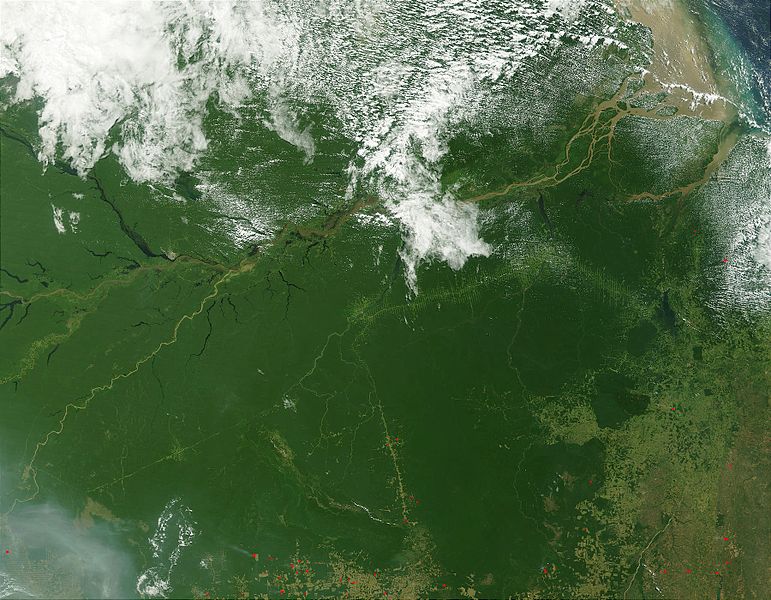
(Boston) — A new NASA-funded study has concluded that Amazon rain forests were remarkably unaffected in the face of once-in-a-century drought in 2005, neither dying nor thriving, contrary to a previously published report and claims by the Intergovernmental Panel on Climate Change.
“We found no big differences in the greenness level of these forests between drought and non-drought years, which suggests that these forests may be more tolerant of droughts than we previously thought,” said Arindam Samanta, the study’s lead author from Boston University.
The comprehensive study published in the current issue of the scientific journal Geophysical Research Letters used the latest version of the NASA MODIS satellite data to measure the greenness of these vast pristine forests over the past decade.
A study published in the journal Science in 2007 claimed that these forests actually thrive from drought because of more sunshine under cloud-less skies typical of drought conditions. The new study found that those results were flawed and not reproducible.
“This new study brings some clarity to our muddled understanding of how these forests, with their rich source of biodiversity, would fare in the future in the face of twin pressures from logging and changing climate,” said Boston University Prof. Ranga Myneni, senior author of the new study.
The IPCC is under scrutiny for various data inaccuracies, including its claim – based on a flawed World Wildlife Fund study — that up to 40% of the Amazonian forests could react drastically and be replaced by savannas from even a slight reduction in rainfall.
“Our results certainly do not indicate such extreme sensitivity to reductions in rainfall,” said Sangram Ganguly, an author on the new study, from the Bay Area Environmental Research Institute affiliated with NASA Ames Research Center in California.
“The way that the WWF report calculated this 40% was totally wrong, while [the new] calculations are by far more reliable and correct,” said Dr. Jose Marengo, a Brazilian National Institute for Space Research climate scientist and member of the IPCC.
Founded in 1839, Boston University is an internationally recognized private research university with more than 30,000 students participating in undergraduate, graduate, and professional programs. BU consists of 17 colleges and schools along with a number of multi-disciplinary centers and institutes which are central to the school’s research and teaching mission.
Geophysical Research Letters article citation: Samanta, A., S. Ganguly, H. Hashimoto, S. Devadiga, E. Vermote, Y. Knyazikhin, R. R. Nemani, and R. B. Myneni (2010), Amazon forests did not green‐up during the 2005 drought, Geophys. Res. Lett., 37, L05401, doi:10.1029/2009GL042154.
ABSTRACT: Amazon forests did not green-up during the 2005 drought
Paper available here (PDF)
The sensitivity of Amazon rainforests to dry-season droughts is still poorly understood, with reports of enhanced tree mortality and forest fires on one hand, and excessive forest greening on the other. Here, we report that the previous results of large-scale greening of the Amazon, obtained from an earlier version of satellite-derived vegetation greenness data – Collection 4 (C4) Enhanced Vegetation Index (EVI), are irreproducible, with both this earlier version as well as the improved, current version (C5), owing to inclusion of atmosphere-corrupted data in those results. We find no evidence of large-scale greening of intact Amazon forests during the 2005 drought – approximately 11%–12% of these drought-stricken forests display greening, while, 28%–29% show browning or no-change, and for the rest, the data are not of sufficient quality to characterize any changes. These changes are also not unique – approximately similar changes are observed in non-drought years as well. Changes in surface solar irradiance are contrary to the speculation in the previously published report of enhanced sunlight availability during the 2005 drought. There was no co-relation between drought severity and greenness changes, which is contrary to the idea of drought-induced greening. Thus, we conclude that Amazon forests did not green-up during the 2005 drought.
h/t to Dr. Leif Svalgaard
Sponsored IT training links:
Join pass4sure for absolute JN0-342 exam solution and get guaranteed success using F50-531 dumps and 642-359 study guide.
“A new NASA-funded study has concluded that Amazon rain forests were remarkably unaffected in the face of once-in-a-century drought in 2005, neither dying nor thriving, contrary to a previously published report and claims by the Intergovernmental Panel on Climate Change”
Surprise? Of course not!
Read “The Meteorology and Climate of Tropical Africa”, by Marcel Leroux, Springer Verlag, Springer-Praxis books in Environmental Sciences, London, NY, 548 pp + CD: 300 pp, 250 charts, 2001, ISBN: 978-3-540-42636-3
Follow-up: just in case someone suggests my geography is left to be desired, I wish to point out the analogy between Africa and the Amazon forest is their equatorial position and their influence over weather parameters.
It is funny, because history shows that ALL vital organisms (if they are going to survive) adapt to extremes….as their quest for life is the driving force.
Rain forests are no exception.
More WWF crap to get behind us. It is a shame because I think these organizations like the WWF and Greenpeace and others, were started with good intentions.
But now they are the new “Establishment.”
They were hijacked. And now we need to start over.
No worries….us starting over or not….the trees will be there….doing their thing.
Chris
Norfolk, VA, USA
Patterns of tornado production related to 18.6 year lunar declinational patterns understood well enough to forecast using new method. Resultant cycles of interactions due to harmonic interactions of Solar and planetary cycles coupled through the moon’s declinational tides show up when plotted.
http://research.aerology.com/severe-weather/lunar-declinational-affects-tornado-production/
It is important to remember that we are talking about a natural drought. The devastation caused by fires and the clearing of forests for such artificial constructs as Brasilia have cause enormous damage, although there does seem to be some mitigation over time. In other words, junk science does not obliterate the real problem of environmental destruction.
Awesome picture of the Amazon!
We find no evidence of large-scale greening of intact Amazon forests during the 2005 drought – approximately 11%–12% of these drought-stricken forests display greening, while, 28%–29% show browning or no-change, and for the rest, the data are not of sufficient quality to characterize any changes.
You have to love the way they parse this. What percentage of browning
and what percentage of no change?
Fantasy is easy; science is hard, especially when you are called upon to leave preconceived notions and belief systems at the lab door.
What’s that sound I hear? Fragile egos chipping and cracking?
There’s been a lot of “once-in-a-century” weather recently, not just the drought in the Amazon in 2005:
Once-in-a-century storm hits Melbourne
March 7, 2010
Snowstorm of the Century hits Dallas
Feb 13, 2010
flood of the century hits St. George, Southwest Queensland
Feb 13, 2010
Once in a century iceberg set to hit Australia
Dec 11, 2009
Once in a century downpour kills 20 in Turkey
Sept 9, 2009
etc.
Maybe “once-in-a-century” doesn’t mean what it used to mean, anymore.
Now didn’t it occur to the paleo people that they could check the sensitivity of trees to drought by ring widths? I am sure they could correlate reduced sedimentation to growth by way of a bit of statistical coercion.
It would appear that it is only the ego’s of leading climate scientists that are more sensitive than we first thought. The probability of a few emotional melt downs are worse than the models are predicting!
Another declaration /reguritation from CSIRO – Australian government body – they don’t give up easily.
http://www.cmar.csiro.au/e-print/open/image/Image49.gif
hughb
well we are just 9.2 years into this new century short enough period to be having the first of a lot of things…..
This false WWF warning is yet another example of ‘Conservation Biologists’ at work. They begin with the doomsday premise and assemble the chosen research to fit. Glad to see another one of their scary stories exposed.
Lest we forget the ‘endangered’ polar bear, the poster child of the AGW cause.
Isn’t it pretty obvious? All growing things adapt to the circumstances they face.
Some animals hibernate in winter, others move to somewhere warmer and some put on a woolly cardigan and throw another log on the fire.
My cousin moved to Spain from England. It’s hotter by several degrees centigrade all year long. He stopped wearing a thick coat and now wears a thin coat.
Plants do the same. When the winter is long and hard a plant that might usually be expected to sprout in March does so in April instead. Rhododendrons in their native Orient grow at different rates and flower at different times than those that have been imported to England.
Animals and plants have an instinct to stay alive and do the best they can in the conditions they face. Those conditions always change and have always changed. Any suggestion that huge swathes of forest are endangered by a change of average temperature of a few degrees or a change in rainfall of a few centimeters (or even inches) a year is purely fanciful. Of course temperature and rainfall affect how plants grow from one year to the next, but they don’t give up growing until the circumstances are beyond their wide capacity for adaptation.
Why do we spend loads of taxpayers’ finest on projects researching into the bleeding obvious?
What many people think of as “pristine” Amazon rainforest has actually been occupied by humanity for thousands of years. The residents burned the “jungle” in order to induce savanna conditions which were far more amenable to human survival.
From SB Hecht. 2009. Kayapó Savanna Management: Fire, Soils, and Forest Islands in a Threatened Biome. Chapter 7 IN Amazonian Dark Earths: Wim Sombroek’s Vision, William Woods et al (eds), Springer.
The Cerrado, the complex of wooded savannas ranging from almost open grasslands to the mostly closed canopy Cerradão and semi deciduous tropical forests was far more extensive in New World landscapes until about 5,000 years ago when the warmer and moister Holocene climate contributed to the extension of tropical forests into these more open woodland formations (Mayle et al. 2000, 2007). Human occupation within Brazil is thought to be at least 11,000 years old and burning profiles suggest that people have affected this biome since their advent (Miranda et al. 2002). Cerrado vegetation is thought to embrace close to 10,000 species (Ratter et al. 1997; Ratter and Bridgewater 2006) and is composed of very complex patch ecologies and matrices with other forest types (for example, riparian, tropical semi deciduous forests, palm formations, as well as the floras of regional biogeographies) that reflect fire histories, edaphic factors, successions, biogeographies, animal and human interventions, as well as larger scale macro climatic change and disequilibria.
The modern myth of an untouched land subject to vagaries of Ma Nature belie the real truth — that human beings have been caretakers and key vegetation manipulators of Amazonia for millennia, during far greater swings in climate than we are experiencing today. Amazonia is not a fragile ecological web. It is human homeland of great antiquity and resilient to disturbance.
It’s very good news to hear about the resilience of the rainforest against droughts. This is good science meeting UNIPCC + WWF lies.
It will take a while to weed out all the UNIPCC misinformation but science will survive this corruption.
While this is interesting and helpful I don’t think it answers questions about climate change. The short span of time ought to make this a weather issue, not climate. In what is posted here we do not learn what a once-in-a-century drought involves but what if this continued for half of a century? I suspect that some tree species would fare better than others. I agree the IPCC claim doesn’t hold up so we have another instance when they found an item that fit their agenda and then stopped looking. No surprise there.
Also from Brazil, from the the “you couldn’t make this one up” department:
Rio de Janeiro had a violent storm last weekend. An agreement with a medium/spirit (see english site at: http://www.fccc.org.br/en/) had expired late February. They blamed the storm on the fact that the agreement had expired. Rio de Janeiro’s Mayor had to rush to renew the agreement this week! The medium states (from their site): “The Fccc is guided by Cacique Cobra Coral a spirit believed to have been Galileo Galilei and Abraham Lincoln.”
Translation from Brazil’s biggest Media group:
http://translate.google.pt/translate?u=http%3A%2F%2Foglobo.globo.com%2Frio%2Fmat%2F2010%2F03%2F09%2Fapos-temporal-paes-renova-convenio-com-medium-da-fundacao-cacique-cobra-coral-916021225.asp&sl=pt&tl=en&hl=&ie=UTF-8
One can imagine what the weather will be for Rio de Janeiro’s Olympic Games 😉
Ecotretas
http://ecotretas.blogspot.com/2010/03/magia-do-tempo.html
Anu (22:20:15) :
“There’s been a lot of “once-in-a-century” weather recently, not just the drought in the Amazon in 2005:”
Uhmm, I live in an area that has a flood about every 30-40 yrs, that doesn’t mean it doesn’t flood anywhere else. It snowed(heavy) on Christmas day when I lived in El Paso, 1975 or there about (I don’t think it had before or since), but that doesn’t mean it didn’t snow in Tempe on a Christmas last century.
Interesting
The WWF report cited a peer reviewed study by Nepstad et al. Nepstad and others have written several studies before and since supporting the general thrust of the WWF study – the WWF’s crime was if anything, citing the least relevent of the Nepstad studies.
So now another study contests Nepstad. Good. That’s how science works. contesting views and data being sorted through.
But this quote “The way that the WWF report calculated this 40% was totally wrong” from one of the authors supposedly. WWF didn’t calculate it, they reported it. Nepstad et al calculated it. So why is this author, supposedly’ gunning for the WWF.
It couldn’t possibly be that his comment has been taken out of context could it. Or may be he has some sort of axe to grind.
Consider; an IPCC report uses multiple peer reviewed science but commits the minor faux pas of doing it indirectly via a non peer-reviewed source and its a MYTH. Another single bit of peer-reviewed science has a differeing opinion and it has DEBUNKED the MYTH.
Ah, humanity is saved, balanced and unbiased journalism has finally returned.
The study was titled …..
Amazon forests did not green‐up during the 2005 drought
But the report on the study was titled …..
Another WWF assisted IPCC claim debunked: Amazon more drought resistant than claimed
Why ?
Anu (22:20:15) :
“There’s been a lot of “once-in-a-century” weather recently, not just the drought in the Amazon in 2005:”
Nothing new here, freak weather events are normal, with many documented events happening over the past centuries. Our climate is driven by deterministic chaos and boundary effects cause turbulence which is expressed as short term local phenomena – extreme weather events.
However, as climate is defined, in our reference frame, as long-term changes to weather these events, energetic though they are, have no measurable effect of climate and provide no indication of change.
Good article here about using Captains Logs to examine the past:-
http://www.timesonline.co.uk/tol/news/environment/article4449527.ece
“The IPCC is under scrutiny for various data inaccuracies, including its claim – based on a flawed World Wildlife Fund study — that up to 40% of the Amazonian forests could react drastically and be replaced by savannas from even a slight reduction in rainfall.”
The IPCC assertion was really irritation for it’s deliberate backwards logic. There is always a dry season in the Amazon, but it is a reduction in rain forest that can bring about, and has brought about reductions and disruption to rainfall.
Anu (22:20:15) :
An event that happened in 1999 was LAST century – so if it happens again in THIS century, then it’s “once in a century” (so far).
..really irritating…