By Steven Goddard
Last month we discussed how NASA continues to spread worries about the Antarctic warming and melting.
A January 12, 2010 Earth Observatory article warns that Antarctica
“has been losing more than a hundred cubic kilometers (24 cubic miles) of ice each year since 2002” and that “if all of this ice melted, it would raise global sea level by about 60 meter (197 feet).“
[Note that is continental ice, not sea ice, – Anthony]

NASA’s 1982-2007 map showing Antarctica warming

But NSIDC seems to be thinking differently in their March 3, 2010 newsletter. They say Antarctica is cooling and sea ice is increasing (makes sense – ice is associated with cold.)
Sea ice extent in the Antarctic has been unusually high in recent years, both in summer and winter. Overall, the Antarctic is showing small positive trends in total extent. For example, the trend in February extent is now +3.1% per decade. However, the Amundsen and Bellingshausen Seas show a strong negative trend in extent. These overall positive trends may seem counterintuitive in light of what is happening in the Arctic. Our Frequently Asked Questions section briefly explains the general differences between the two polar environments. A recent report (Turner, et. al., 2009) suggests that the ozone hole has resulted in changes in atmospheric circulation leading to cooling and increasing sea ice extents over much of the Antarctic region.
The NSIDC graph below shows the upwards trend in Antarctic Sea Ice. Some recent years have shown anomalies as high as +30%.

http://nsidc.org/data/seaice_index/images/s_plot_hires.png
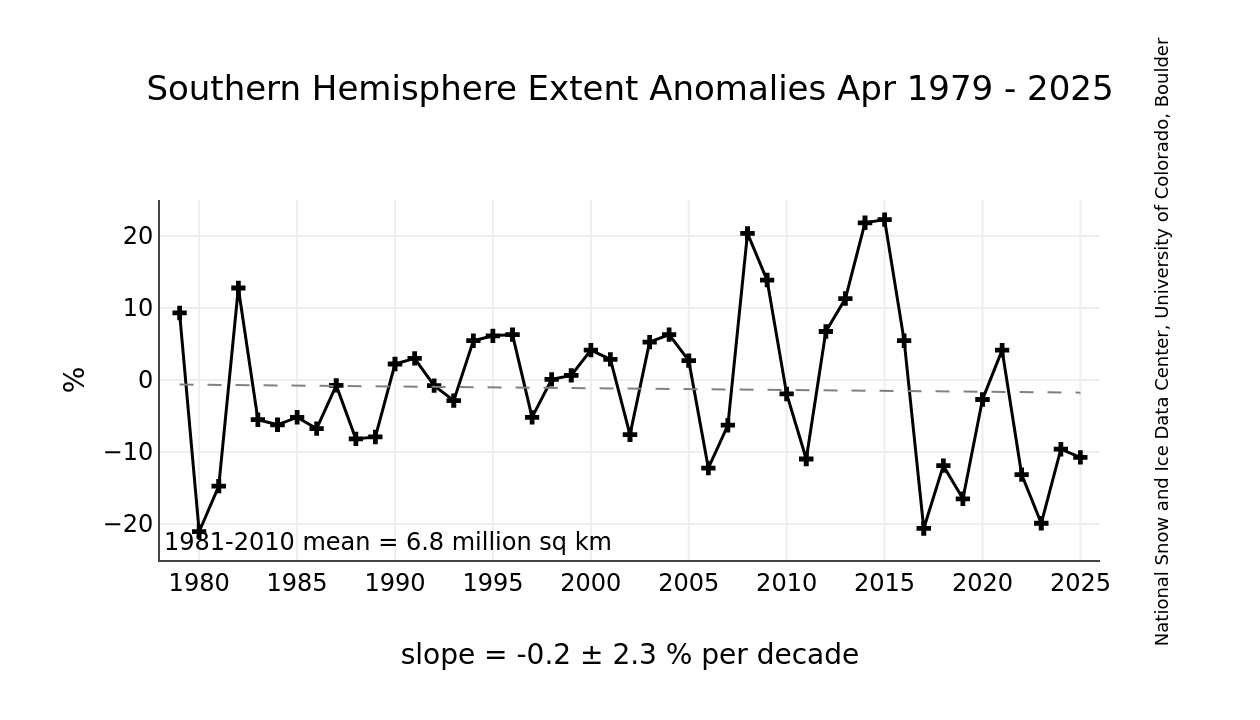
UAH satellite data also shows Antarctica cooling, as seen in their map below. (This map is dated November, 2006 – if anyone knows where to get a more recent version, please let me know.)


UAH 25 Year Temperature Trends
Perhaps NASA should have stuck with their original 2004 map below, showing Antarctica’s interior cooling?

NASA’s 1982-2004 map showing Antarctica cooling

While there’s no dispute that there’s some sea ice loss in the Antarctic peninsula, all signs seem to point in the opposite direction of what some what have you believe about Antarctica as a continent.
Sponsored IT training links:
We offer self paced 312-50 training with up to date 642-611 dumps and 70-450 practice test to provide guaranteed success in first dive.
I can’t believe I’m among the first to comment!
Cooling Antarctica? Warming Arctic? So what? Perhaps we should just take the “Global” out of “Climate Change” and “Warming”, then we could all agree that climate does change, and warming can occur, but at different times and rates in different places. Climate is regional.
A good slogan might be- Climate Change- not new, not much, and not scary!
Nice one Steve:
This does show the cherry picking going on, now to get this across to the politics in Washington.
One thing u forgot was to mention the “error bars” that THEY left out!
the scale is -.1 to +.1 but the error factor is +/- .05!!!!!!
no significant warming over this time frame!!!!!
good luck
Tim L
OPPS should read statistical not significant .
doh!
What happened to the tag line about how NASA understands the Earth and everything else – or some such? Do I have the wrong agency in mind? Where is that statement? It applies to this post.
I’m thoroughly convinced climate scientists absolutely positively don’t know much of anything with any degree of certainty except that they are uncertain.
@John Hultquist – That is NOAA that understands changes in Earth from the tips of its toes to up above its nose.
@Steven Goddard – Is this also consistent with models?
FLASH!!
NSIDC confirms RealClimate conclusions of a cooling Antarctica and ice increasing!
The Arctic is NOT warming: some regions warm other cool. Just as in Antarctica where the WAIS is warming while eastern Antarctica is slightly cooling.
Darn it! How is the ocean going to rise 20 feet and flood everthing per Al Gore if Antarctica doesn’t hurry up and melt! Maybe Al should spend some of his carbon credit booty spreading soot over the Antarctic ice cap so that he can actually be right about something for once in his life.
Sorry but I couldn’t get past the first little bit.
“has been losing more than a hundred cubic kilometers (24 cubic miles) of ice each year since 2002” and that “if all of this ice melted, it would raise global sea level by about 60 meter (197 feet).“
where did all the ice go? If it didn’t melt does that mean its floating in the ocean? Last time I checked floating ice has to displace a larger volume then if it melted ( else it would sink and still displace sea water raising the seas). Or did it evaporate at such a rate it escaped earths gravity?
Must be that Mann-made hole from CFC’s…
But NSIDC seems to be thinking differently
The NASA article and NSIDC are talking about different things. The land-supported ice shelf and the floating sea ice. In fact, the NASA article says that sea ice is increasing.
While this increase in Antarctic sea ice is interesting, it as strong an upward slope as the downward slope in the Arctic sea has been since 1978 or so. Still, in merits watching. Every AGW model shows that at some point, Antarctic sea ice will follow along with the Arctic sea ice and show a decline by sometime later this century. The Ozone hole issue may be causing some of this growth, or it could be something else entirely. I will watch the Antarctic sea ice closely in the next few years, and if the increase continues, or the Arctic Sea ice begins to grow again (on an annualized basis), over several seasons, my faith in the AGW hypothesis will be diminished.
Meanwhile, at 14,000 ft. in the troposphere, global temps have set new 20 year record highs every day in March, and 2010 remains on track to be the warmest year on instrument record. Along with the long term condition of Arctic and Antarctic sea ice, these kinds of troposheric records I watch closely. I’m sure AGW skeptics would say it is all El Nino related, for it certainly isn’t a super-active sun. But it is exactly in line with AGW models, so this too, must be considered by an honest observer.
Dave F, Thanks, it is NOAA. And I found it.
“NOAA understands and predicts changes in the Earth’s environment, from the depths of the ocean to the surface of the sun, and conserves and manages our coastal and marine resources.”
The radius of Earth is 6400km so the surface area is 3.14*4*6400^2 or 5e8 sq km. if 70% is ocean thats 3.5e8 sqkm of ocean surface. 100 cubic km of ice per year will raise the sea level by 100/3.5e8 km = 2.9e-7km which equals 0.29mm per year. Since 2002 is 8 years so a total rise of 2.3 mm.
I realise the initial report is countermanded by the later one but even if it were correct the rise of 60 meters at the rate indicated would take a while:- say about 200,000 years!!!!
Seems a shame they missed that little tidbit.
I would caution you to distinguish between Antarctic *continental* ice — which the first article you cite claims to be decreasing — and Antarctic sea ice, which has been increasing. Sea level is affected by the first, unaffected by the second.
NASA’s Explanation
January 12, 2010
“There has been lots of talk lately about Antarctica and whether or not the continent’s giant ice sheet is melting. One new paper 1, which states there’s less surface melting recently than in past years, has been cited as “proof” that there’s no global warming. Other evidence that the amount of sea ice around Antarctica seems to be increasing slightly 2-4 is being used in the same way. But both of these data points are misleading. Gravity data collected from space using NASA’s Grace satellite show that Antarctica has been losing more than a hundred cubic kilometers (24 cubic miles) of ice each year since 2002. The latest data reveal that Antarctica is losing ice at an accelerating rate, too. How is it possible for surface melting to decrease, but for the continent to lose mass anyway? The answer boils down to the fact that ice can flow without melting.”
For more on the subject, see
http://earthobservatory.nasa.gov/Newsroom/view.php?id=42399
The bottom line is that there is no long term discernible trend towards warming at all in the Antarctic. The hypothesis of AGW requires that rapid global warming be obvious (“robust”, ahem) and all the IPCC-approved climate models show rapid warming at both poles.
What does one call a hypothesis that fails to yield useful predictions of observed data?
Guess Steig, et al., were wrong about the warming Antarctic after all, claims of advanced math notwithstanding.
Jeff id was right, to wit, “There it is, we can now say conclusively that the positive trend in the Antarctic reconstruction comes primarily from the well known peninsula warming trend .”
And now the NSIDC apparently agrees. Who’d have predicted that?
Of course NASA’s data probably includes ‘correction’ for…. the ozone layer?
The hits keep on coming — a regular hits’ parade.
Antarctica is getting cooler and ice is expanding.
AGW is melting like the wicked witch of the West in the Wizard of OZ.
And all it took was a pale of water — in this case facts and evidence — who would have thunk it…
wes george (21:38:17) :
The bottom line is that there is no long term discernible trend towards warming at all in the Antarctic. The hypothesis of AGW requires that rapid global warming be obvious (“robust”, ahem) and all the IPCC-approved climate models show rapid warming at both poles.
What does one call a hypothesis that fails to yield useful predictions of observed data?
=======
Sea ice is only part of the story
“Gravity data collected from space using NASA’s Grace satellite show that Antarctica has been losing more than a hundred cubic kilometers (24 cubic miles) of ice each year since 2002. Gravity data collected from space using NASA’s Grace satellite show that Antarctica has been losing more than a hundred cubic kilometers (24 cubic miles) of ice each year since 2002. The latest data reveal that Antarctica is losing ice at an accelerating rate, too. How is it possible for surface melting to decrease, but for the continent to lose mass anyway? The answer boils down to the fact that ice can flow without melting.”
For more on the subject, see
http://earthobservatory.nasa.gov/Newsroom/view.php?id=42399“
Isn’t most of the ice in Antarctica land-based, not sea-ice? So, isn’t it more important to monitor the mass of the land-based ice.? How has that been changing?
Sea ice forms at lower latitudes and lower elevations (i.e. warmer places) than the continental ice, which exists at colder places closer to the pole and at higher elevations.
This article is about sea ice, but it should be apparent that it would be impossible for a region of sea ice to be growing and nearby continental ice to be melting.
Sea ice also freezes at lower temperatures than freshwater continental ice.