From Spaceweather.com with apologies to Linus and Charles Schulz

The Solar and Heliospheric Observatory (SOHO) is tracking an enormous magnetic filament on the sun. It stretches more than one million kilometers from end to end, which makes it an easy target for backyard solar telescopes. For the seventh day in a row, an enormous magnetic filament is hanging suspended above the surface of the sun’s southern hemisphere. The Solar and Heliospheric Observatory (SOHO) has a great view. How long can it last? Solar filaments are unpredictable. If this one collapses and hits the stellar surface, the impact could produce a powerful Hyder flare.
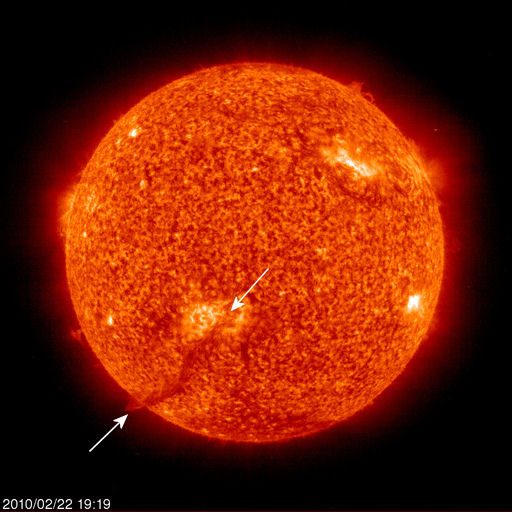


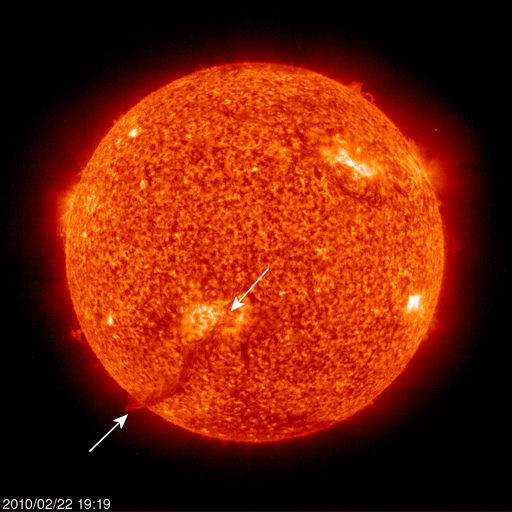
The most recent SOHO image is here
Hyder Flares: from Australian IPS 1. What is a Hyder flare?
Flares are intense brightenings that occur in the solar chromosphere. Flares are generally observed from Earth using narrow band filters, typically with a bandwidth of less than 0.1 nm, and often centred on the Hydrogen-Alpha wavelength of 656.3 nm. (Flares also have counterparts, that is, sudden outbursts, in the radio and X-ray spectrum).
Most flares occur around active regions associated with sunspot groups. However, occasionally a flare (sudden brightening) is observed well away from an active region or sunspot group. These flares are invariably associated with the sudden disappearance of a large (thick, long, ‘bushy’) dark solar filament, and are termed Hyder flares.
2. Why are Hyder flares so named?
Max Waldmeier wrote a paper in 1938 which described the phenomenon of suddenly disappearing filaments (disparition brusque), and mentioned that these can be associated with flare-like brightenings, but it was left to Charles Hyder to postulate the first comprehensive mechanism for the such flares.
Following on work from his doctoral thesis with the University of Colorado in Boulder (1964), Hyder published two papers in the second volume of the journal Solar Physics (1967) in which the mechanism by which Hyder flares might occur was discussed in detail. Hyder was then on the staff of the (US) Air Force Cambridge Research Laboratories at the Sacramento Peak Observatory in New Mexico.
It was these papers in Solar Physics by which Hyder’s name became associated with the flares in question, even though he was by no means the first to observe them.
3. What are the characteristics of Hyder flares?
As previously mentioned, the name Hyder flare is given to a flare that occurs away from an active region or sunspot group and that is associated with the sudden disappearance of a dark filament. The appearance of these flares can range from a string of bright knots on one or both sides of the filament (or rather, the position previously occupied by the filament, sometimes called the filament channel), to a single or double ribbon flare. The ribbons are parallel to the filament channel. If only one ribbon is present, it will lie to one side of the channel, whereas if two parallel ribbons occur, one ribbon will lie on one side of the filament channel, and the other ribbon will lie on the opposite side.
One interesting characteristic of Hyder flares is that they usually develop or rise to maximum brightness much more slowly than do the more common flares associated with active regions. The larger Hyder flares may take 30 to 60 minutes to rise to a peak intensity, and then they may last for several hours. Although they may attain a large area, they usually have a relatively low intensity. Thus, classifications for a large Hyder flare may read 2F, 2N or possibly even 3F. This contrasts to an active region flare in which 3F is very rare. An active region flare that attains sufficient area to put it into the importance class 3, will invariably have either a Normal or more usually a Brilliant brightness classification.
X-ray flares and radio (microwave) bursts associated with the optical Hyder flare, are also generally long lived phenomenon and are classified as the gradual rise and fall type of event (in contrast to the impulsive and complex events associated with large active region flares).
Generally Hyder flares are not associated with energetic particle emission or geomagnetic storms (implying that they may not be associated with a coronal mass ejection). However, this is not always the case, as a large halo CME observed by the LASCO solar coronagraph on board the SOHO spacecraft was most definitely associated with a Hyder flare (2N/M1) observed on 12 September 2000. This same complex also appeared to have produced energetic protons at geosynchronous orbit with energies in excess of 100 MeV, and in substantial numbers at energies of 10 MeV. It is believed that the sudden storm commencement observed at 0450UT 15 September, and the subsequent minor geomagnetic storm was produced by this particular CME.
4. What produces Hyder flares?
Hyder’s explanation of the flare type now named after him depended on the observational evidence that (1) often the flare was a parallel ribbon flare with one ribbon each side of the filament channel, and (2) that geomagnetic storms were not associated with these flares. This led to the speculation that the filamentary material was not ejected far into the corona, but in fact fell back to the chromosphere producing the flare.
Stable or quiescent filaments are believed to lie in and along a magnetic trough. It is thought that the sudden disappearance of such a filament is due to a reconfiguration of the field. In essence, the magnetic trough becomes a magnetic ridge (the bottom of the trough elevating in a period of tens of minutes to become the peak of the ridge). In this process, the filamentary material (cooler gas) is thought to be accelerated into the corona. Hyder’s explanation is that, in the case of the Hyder flare, some or even most of the filament material, instead of suffering acceleration and ejection, falls down the sides of the magnetic ridge and interacts with the lower chromospheric material producing the flare. If the infall process is symmetrical, then the double parallel ribbon flare will result, if asymmetrical, then only one ribbon results. If the infall is sporadic, or the material insufficient, then only bright knots of flare are produced. Hyder did calculations to show that the kinetic energy of the infalling material should be sufficient to provide the required flare energy release observed.
Of late, the Hyder mechanism has come into question. Some people (notably Zirin) have questioned whether infall occurs, stating that the magnetic reconfiguration must always produce ejection. The respective roles of flares and CME’s in solar active processes has also been hotly debated, and this has implications for the exact mechanism of Hyder flares. We certainly have enough observational evidence to show that Hyder flares can be associated with both CME’s and energetic particle production. For the moment, the question of Hyder flare production mechanism appears unresolved, and will probably be sidelined until the more significant (and undoubtedly related) issue of CME – flare production mechanism is sorted out.
The bottom line is that at this stage in solar physics we do not really know what produces a flare nor what produces a CME. There are competing theories, but all tend to have deficiencies with respect to matching the observational evidence. We certainly believe that they all depend on the reconfiguration of magnetic fields as their primary energy source, but in the final analysis, we really only believe this because we can conceive of no other solar energy source of sufficient magnitude.

I can see where this filament can be unpredictable at best.
What is it going to do?
Anyone know if these filaments more common when the solar magnetic field is relatively strong?
weak ? doesn’t matter? sunspot max or minimums?
Have we ever in our current lifetime experienced a solar minimum as extended as our current one? I mean, since you and me have been alive on the planet?
I wonder if the Solar Dynamics Observatory has been able to take a peek?
Very interesting, we always are surprised by our star-sometimes unpleasantly…
It reminds me of Nobel Prize winner Alfven’s secondary currents in his electric sun model.
http://lh6.ggpht.com/_KzR8on8Tdmw/R4C-iYbAtSI/AAAAAAAAC9Q/Q35XgsRWfMw/s400/SolarCircuit.jpg
Many thanks for the continuing education program. Fascinating.
O/T but want to post this before going offline, as Prospect is a respected centre left magazine, and this is pretty good:
24 Feb: Roddy Campbell: Too hot to handle
But there are problems, even if you do this carefully. The first is urbanisation. Ideally, thermometers would be in the same place for long periods and unaffected by people. Yet they are often placed near airports, for example, where they are susceptible to an “urban heat island” (UHI) effect, as traffic increases or runways expand…..
The good news is that now, post-climategate, the CRU and the Met Office have released data they had claimed was protected by copyright, or subject to confidentiality agreements. So the scandal has encouraged greater openness. But it has done less to solve a second problem, which arises when you try to deduce temperatures going back thousands of years. Palaeoclimatology (climate study of the history of the Earth) is harder than short term measurements, as there are no records. Temperature changes must be inferred through tree rings or ice cores. Yet some tree cores, for instance, suggest different histories from one side of the tree to the other, while their growth is changed by rainfall and CO2 as well as temperature. Another problem comes with the infamous “hockey stick” graph, devised by US climatologist Michael Mann and featured prominently in Al Gore’s film An Inconvenient Truth. This used tree ring data from Russia and the US to show temperatures gently falling for most of the last 1,000 years, then shooting up from the middle of the 20th century, like the end of a hockey stick. Yet the graph seemed to miss two crucial periods: the “medieval warm period” from the turn of the last millennium to the 15th century, and the “little ice age” at the start of the 17th century, when the Thames regularly froze. Mann claimed these periods were local in nature; sceptics, meanwhile, suspected that the techniques used to create graphs like the hockey stick had been designed to favour the idea that warming in the second half of the 20th century was unprecedented.
There is no conspiracy here. But the scientists involved in climate research for the past 30 years may have enjoyed their golden age too much. Research grants have flowed freely, although not, of course, as freely to scientists with contrary views. I am far from being a climate change denier. It seems perfectly likely that we are having, or will have, an effect on warming through the higher concentrations of greenhouse gases. But the evidence is not yet clear; there were, for example, periods of warming in the 19th century almost identical to the modest warming we seem to have experienced since 1975. We cannot rely on highly imperfect climate models as a basis for policy initiatives that cost billions and change how we live. An accurate and unbiased temperature record is critical.
http://www.prospectmagazine.co.uk/2010/02/too-hot-to-handle/
Is it me or do parts of the sun look a bit deformed in that picture?
Wow TX for the post.
and the other websites say WUWT is not scientific pift.
Fascinating, the sun is certainly “an enigma wrapped in a mystery.” We are all humbled by a study of it’s awesome displays. I wonder how many earths could ride that filament?
but in the final analysis, we really only believe this because we can conceive of no other
The difference between this team and the AGW “team” is that the former has tried to conceive of other causes, while the latter has not recognized falsification of their only idea and ignore all other suggestions regardless of source.
I enjoyed this one and hope the great filament does something extraordinary where we can observe it. In these wavelengths a great pumpkin does come to mind. The other EIT images, not so much.
Get the popcorn on.
And a pretty heavy snowstorm coming to the north east:
http://www.accuweather.com/regional-news-story.asp?region=eastusnews
And there are likely coincidental manifestations that account for some of the anomalies.
That looks like a giant “s”. This proves that there must be life on the sun. Well at least if we us the logic that was used by some when a rock with what looked like a giant “b” was found on mars. Similar sort of logic is also used by climate alarmists.
So much for another Maunder.
It’s been a long time coming, but now that it’s started, is this ramp up typical so far?
For hi-res movie, go to this link:
http://sohodata.nascom.nasa.gov/cgi-bin/data_query
Select EIT 304, under Image Type.
Select 1024 under Resolution.
Select Movie under Display.
Punch in 2010-01-14 and 2010-02-23 for Start and End dates.
Click on Search.
Hit F11 for full screen view.
Sit back and enjoy the show.
There’s a new article on http://scienceofdoom.com
Here Comes the Sun – looks at what we do and don’t know about the changes in the TSI (or solar “constant” as it used to be known before it turned out not to be constant!) for the last few hundred years.
I wish they would put an earth size circle/sphere to scale, away in a corner of each pic, so I can really judge the magnitude of the various solar disturbances that occur.
McMillan: Before the Dalton and Maunder minimums, there was one more relatively weak cycle. And in the Dalton minimum there were still cycles, just weak ones.
I hope it’s still there in the morning. Viewing has been terrible this winter in the southeast- focuser getting rusty…
Of course the advertisement that appeared just below the article graphic “The Hyder Mechanism” was a video ad for the Blu-Ray DVD of the movie “2012”!
Sweet zombie jesus, maybe this filament will melt the Earth’s crust as Al Gore believes with it being millions of degrees a few miles below the surface of the Earth’s crust… melting now due to modified neutrinos from the filament heating The Core (another fantastic yet unobtainium film). Ok, maybe not… back to reality from the Al Gore 2012 melting crust soothsaying we’re all doomed zone.
This is a really cool filament, unless it bakes us that is. It is there to remind us that the sun Sol is a never changing constant that can’t influence the climate or weather outside of the known measurements – as if the sun Sol obeys our knowledge of it.
Clearly Sol beats to a different drummer with a more complex chaotic dynamic symphony that we likely can even ever full imagine or know.
[:)]
OT but delicious. The Catlin comedians are at it again for our amusement:
http://www.chinadaily.com.cn/world/2010-02/25/content_9502110.htm
It sounds like a Hyder flare can (although not usually) be associated with a coronal mass ejection, if I understand this article correctly. Does that mean it is something that could disrupt Earth’s magnetic field to the point where it would screw up cell phones, computers, satellite dishes, and other electronic devices?
It collapsed around 17:00 UTC yesterday after what have may been interaction with the formation flying at about the 11:30 position just above the sun on this LASCO C2 image taken 17:06 UTC. You can clearly see the flare shooting under it.
http://sohowww.nascom.nasa.gov//data/REPROCESSING/Completed/2010/c2/20100224/20100224_1706_c2_1024.jpg
The most prominent body in the formation is the one with a small tail under and there are 5 bodies around it of which one is under the flare.