Leif Svalgaard has been saying for sometime now that Solar Cycle 24 seems to be getting underway. Seeing sunspot group 1024 today, I’m tending to agree.

The magnetic polarity (seen on the SOHO magnetogram) of the spot group combined with the middle latitude indicates it is a cycle 24 spot.
From Spaceweather.com
The most active sunspot of the year so far is emerging in the sun’s southern hemisphere: movie. Sunspot 1024 has at least a dozen individual dark cores and it is crackling with B-class solar flares. This morning, amateur astronomer David Tyler caught one of the flares in action from his backyard solar observatory in England:

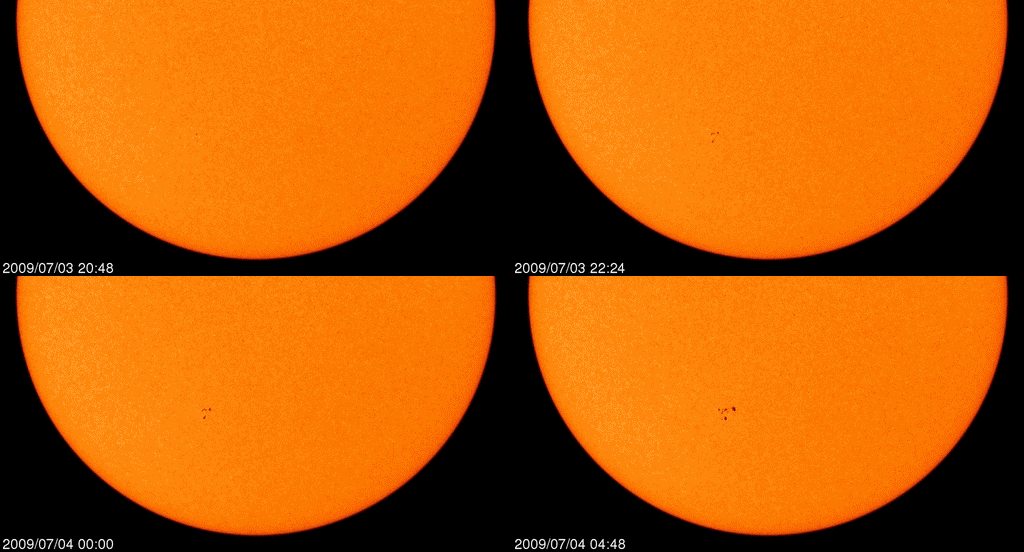
The magnetic polarity of sunspot 1024 identifies it as a member of new Solar Cycle 24. Its rapid emergence on July 3rd and 4th continues the recent (few-month) trend of intensifying new-cycle activity. This sunspot is the best offering yet from the young solar cycle.
I agree. This one looks like a “normal” sunspot. The question now is: how long will it last? Many promising cycle 24 sunspots have fizzed just as quickly as they arrived. Cycle 24 has not yet shown any indications of spot stamina.
In other news, the SOHO satellite has developed a problem with its pointing motor for the high gain antenna.
This is a serious concern, and data outages are already happening due to limited pointing ability. There is a backup spacecraft for SOHO in the pipeline, the Solar Dynamics Observatory, set for a November 2009 launch date. It has recently been shipped to Cape Canaveral. Lets hope the didn’t use the US postal service or DHL.
In other solar satellite news…
Goodbye Ulysses (July 3, 2009)

Hi-res TIF image (4.6M)
Upon receipt of the last command from Earth, the transmitter on Ulysses switched off on June 30, 2009, bringing one of the most successful and longest missions in spaceflight and solar study history to an end. After 18.6 years in space and defying several earlier expectations of its demise, the joint ESA/NASA solar orbiter Ulysses achieved ‘end of mission’. The craft is nearly out of hydrazine fuel for its stabilizing thrusters, and there’s not enough money to continue the mission for another year. A final communication pass with a ground station enabled the final command to be issued to switch the satellite’s radio communications into ‘monitor only’ mode. No further contact with Ulysses is planned.
Ulysses is the first spacecraft to survey the environment in space over the poles of the Sun in the four dimensions of space and time. Among many other ground-breaking results, the hugely successful mission showed that the Sun’s magnetic field is carried into the solar system in a more complicated manner than previously believed. Particles expelled by the Sun from low latitudes can climb up to high latitudes and vice versa, even unexpectedly finding their way down to planets. Regions of the Sun not previously considered as possible sources of hazardous particles for astronauts and satellites must now be carefully monitored. “Ulysses has taught us far more than we ever expected about the Sun and the way it interacts with the space surrounding it,” said Richard Marsden, ESA’s Ulysses Project Scientist and Mission Manager.
So farewell, and congratulations on a job exceedingly well done.
Potentially good news, hope the spot stays a few days.
Is there somewhere a graph comparing the number of sun spots of the last few cycles? Something like an overlay of the individual cycles?
Wishing you good luck on you cap and trade, we unfortunately already have one in Europe
Old Sol is just saying Happy Birthday, America!
right back at ya, Sol! Hope you enjoy our fireworks too!
Let’s just hope the Watts Effect doesn’t kick in and kill this spot. It looked like it was about to fizzle out when it suddenly exploded to life.
Speaking of the Watts Effect, a variant of it has kicked in at DMI. As soon as that widget went up, so did those flat Arctic temps.
“Th Sun”? Y’all misspelled “Teh” 🙂
Too bad about SOHO. There are ways around the problem but it probably means going off-sun with attitude slews. The lower opportunity for recorder dumps could mean lost data.
The solar flux hasn’t ramped up yet so the current activity may fizzle.
This bums me out, (technically speaking).
I was truly hoping for a sufficiently extreme solar cycle to force the climate community to acknowledge the need to conduct further research into the relationship between the Sun and climate change.
With respect to the “colder temperatures would be worse than warmer temperatures” argument, while I agree it is correct, I think both sides are selling short the adaptive capabilities of the human species (all species for that matter). To date, we have done a pretty good job of living in almost any environmental condition and migrating when desirable.
This looks like the largest group of sun spots we have seen in a long time!
We need a good continuum imaging platform out there @ur momisugly twice the resolution of SOHO. I hope SDO can fit that bill. Looking over what it does, I didn’t find any reference to visible light spectrum. Maybe they didn’t list it.
Richard deSousa (09:18:53)
The spots formed very fast. It’s a bit improved over yesterday, with one medium spot, one smaller spot, and 4 Tiny Tims.
According to SWPC, 1024 is now the largest event to date.
Sunspot Area 10E-6 Hemis. = 100 (so far – it could get larger today). The last ‘biggie’ happened June 1 when the area maxed out at 80.
imapopulist writes:
“With respect to the “colder temperatures would be worse than warmer temperatures” argument, while I agree it is correct, I think both sides are selling short the adaptive capabilities of the human species (all species for that matter). To date, we have done a pretty good job of living in almost any environmental condition and migrating when desirable.”
The problem is that, while can adapt, can our food supply? Considerable amounts of grain are grown in northern latitudes that are just marginally warm enough. A little cooling could do severe damage to Canadian (and maybe northern US) wheatlands. It is my understanding that global food supply and global population are close to balance and that global grain stocks are getting perilously low.
IanM
“Leif Svalgaard has been saying for sometime now that Solar Cycle 24 seems to be getting underway.”
What Leif had to say about the solar jet stream article stating that cycle 24 was probably about to start:
Leif Svalgaard 6/17/ 09 (21:18:13) :
“This press release is just NASA PR-machine hype”
Which is it?
You hit on what I believe is the root of the issue. Crops to not grow well in cold, as is evident by several famine events of history, all during cold periods (ie: LIA). Problem two stems from our bizarre behavior of growing fuel instead of food. I believe it is the BIO fuel issue that is going to severely compound the first issue, should we be thrust into a little cooler world. Environmentalism seems to be ensuring that we cut our own throats.
At the bottom of the page:
http://www.robertb.darkhorizons.org/DeepSolarMin5.htm
you’ll find a visibility index of SOHO 512×512 res image cutouts.
It’s what I project in my 70mm F/10 to a 4″ circle (Wolf Class Scope).
What SWPC is using to calculate Hemis. area might be problematic:
Study of differences between sunspot area data determined
from ground-based and space-borne observations
L. Gy}ori a,*, T. Baranyi b, M. Turmon c, J.M. Pap d
After reading this and spending some time doing it myself, I agree with the paper.
“The problem is that, while (we) can adapt, can our food supply? ”
Yes. We do not farm nearly as intensively in North American as is done in Europe . The current inventory imbalance has more to do with last year’s $145 a barrel oil and massive shifts to ethanol.
We (for the time being) still live in a free market. If the climate cools and harvests fall, food prices will rise resulting in more land being put into production, more intensive farming practices in place and shifts to more temperate locations.
With continuous advances in technology, while we don’t know specifically how we will adapt, we do know that we can and will adapt.
This is one of the biggest fallacies of the AGW doomsday scenario. It assumes that mankind is some kind of static beast who cannot adapt. That a planet which has changed and evolved forever must now somehow be frozen on time.
imapopulist (09:29:18) :
“I was truly hoping for a sufficiently extreme solar cycle to force the climate community to acknowledge the need to conduct further research into the relationship between the Sun and climate change. ”
I find myself too wishing for this. I think it may be the only way for enough people to realize the truth about AGW to wake up and kill the entire concept.
Syl: Shush… we hide our fireworks from the Sun.
“This is one of the biggest fallacies of the AGW doomsday scenario. It assumes that mankind is some kind of static beast who cannot adapt. ”
Hmm I wonder if the problem here is that the alarmists are aware that they are too stupid to evolve so they have to keep the climate just like it was…
You can see it in the sun thumbnail on the side bar, that’s about the most visible group of cycle 24 yet as I would recall.
At least if cycle 24 is a normal cycle and climate is sun-dependent we won’t have to worry about our walnut trees or early/late flowering plants being hit hard by freezes that come too early/too late in the season, same with the wheat and corn crop here and it may mean a nicer crop of tomatos and cucumbers from our pair of upside-down vegetable plants.
What would you pick if you had to choose between a continued warm natural warm period or massive famine and plant/animal death even in wealthy countries because of a little (or bigger) ice age?
So now we know – the Sun likes a good party! (Do you think old Sol prefers hot funk or chillout music?)
We’ve cut way back on planted acres, and will have one of the largest crops in history this year. Yields will, probably, set a record (in spite of a slow, rainy start.)
Corn is down to about $0.06/lb. Stocks are high in the U.S., and the only thing affecting exports is the worldwide recession, and transportation costs. Also, China is back on track with a big crop (they’re the world’s 2nd largest corn producer. Wheat is plentiful, and Australia is back on track after the disastrous drought two years, ago.
We’re fine for food; worry about oil.
Richard Lindzen brought up an interesting point. It seems that in the past when the sun was much less powerful temps on Earth were about the same as now. Why?
REPLY: Read up on the faint sun paradox – A
Frank Hll (09:56:36) :
“Leif Svalgaard has been saying for sometime now that Solar Cycle 24 seems to be getting underway.”
What Leif had to say about the solar jet stream article stating that cycle 24 was probably about to start:
Leif Svalgaard 6/17/ 09 (21:18:13) :
“This press release is just NASA PR-machine hype”
Which is it?
Solar cycle 24 started last year. The issue is whether it has stared ramping up to a huge cycle or slowly climb to a small cycle. The latter seems the more probable to me, that is it.
david atlan (09:01:33) :
Is there somewhere a graph comparing the number of sun spots of the last few cycles? Something like an overlay of the individual cycles?
page 4 of:
http://leif.org/research/Most%20Recent%20IMF,%20SW,%20and%20Solar%20Data.pdf
These new spots, while the most active of 24 thus far, still don’t show the normal umbra/penumbra structure. What does this mean? hell if I know.
http://www.solarcycle24.com/pictures/timmermans.jpg
http://science.nasa.gov/headlines/y2008/30oct_ftes.htm
I am sure Leif will be by, if he hasn’t already. Is NASA going to monitor these as the spots come about to see what happens to them when sunspot activity picks up?