Guest post by Steve Goddard
Yesterday, Dr. Walt Meier from NSIDC again graciously updated us about the NSIDC sensor problem, and also about his current thinking with respect to polar ice trends. The key concepts being that Arctic ice continues to decline, and that Arctic and Antarctic ice are separate entities – so the current near normal global sea ice area “has no meaning in terms of climate change.” This article examines both of those concepts.
NSIDC is still having sensor problems on their satellite, as seen below on 2/28/09. Note the speckled white areas, and the large dark gray sliver in the Sea of Okhotsk near the top.
http://nsidc.org/data/seaice_index/images/daily_images/N_daily_extent_hires.png
Fortunately there is another ice extent data source, AMSR-E which has not suffered sensor problems and their data is unaffected. NSIDC also explains on their web site that “AMSR-E has a lower absolute error” than the NSIDC sensors, even when functioning properly. AMSR-E (below) has been recording sea ice since 2002. The maximum ice extent for 2009 (red) and 2008 (orange) are both in the top three on the AMSR-E record, at more than 14M km2. The only year which had greater ice extent than the last two years was 2003. So clearly we are on a recent trend of higher Arctic ice maximums, which is a fact that is rarely if ever reported by the main stream media. Also note in the NSIDC map above, all of the ice basins are close to the 1979-2000 normal.
If there is a dramatic downwards trend in maximum Arctic extent, it certainly isn’t visible in either the map or the graph.
 http://www.ijis.iarc.uaf.edu/seaice/extent/AMSRE_Sea_Ice_Extent.png
The NSIDC graph below also shows Arctic ice extent nearly back to the 1979-2000 mean.

http://nsidc.org/data/seaice_index/images/daily_images/N_timeseries.png
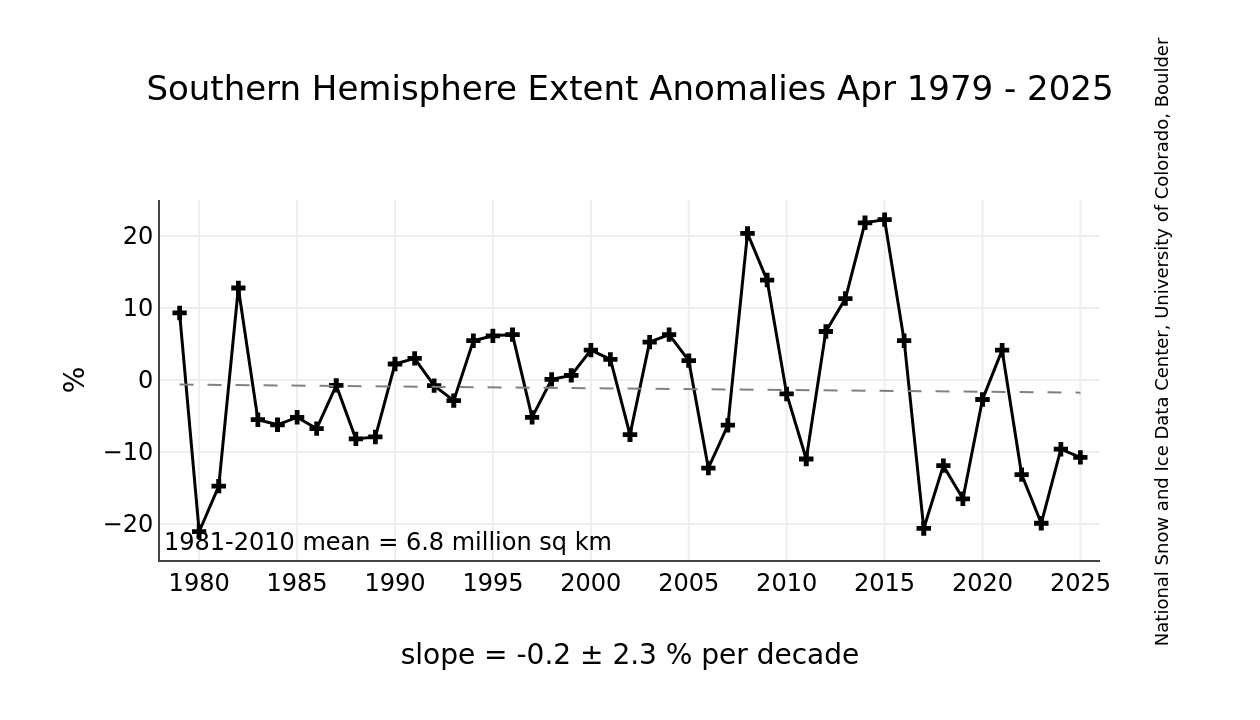
Turning our attention to Antarctica. Dr, Hansen predicted in 1980 that ice loss in Antarctica would be symmetrical to the Arctic. But the current thinking, as expressed by Dr. Meier, indicates that view is no longer valid. In fact, NSIDC data shows that Antarctic ice extent has actually increased substantially, as seen below.

http://www.epa.gov/climatechange/effects/downloads/Challenge_chapter2.pdf
It was reported last week that the IPY (International Polar Year) released a study claiming that both polar ice caps are melting “faster than expected.” Given that NSIDC shows Antarctica gaining ice at a rapid pace, I find myself surprised that IPY would release a study saying exactly the opposite. But then again, an IPY official reportedly forecast that last summer (2008) might have an “ice free Arctic.”
Columnist George Will reported that overall global sea ice area is normal, and was correct. Dr. Meier confirmed that on January 1 global sea ice levels were normal.
Walt Meier (16:04:59)
1. He (George Will) was factually incorrect on the date that he reported his “daily
global ice” number. However, he was merely out-of-date with his facts
(it was true on Jan 1, but wasn’t 6 weeks later).
The UIUC graph shows global ice levels well within one standard deviation of the 1979-2000 mean. Dr. Hansen was correct that according to global warming theory, both poles should be losing ice – though we know now it theoretically should be happening more slowly in the Antarctic. Yet 20 years later we actually see the Antarctic gaining ice, which is contrary to Dr. Hansen’s theory, contrary to IPY claims, and probably contrary to Steig’s questionable temperature analysis .
The main trend I see in polar ice is an increasing disconnect between hype and reality. Given that the AO (Arctic Oscillation) has been neutral this winter and polar drift has been less than last year, I forecast that the summer Arctic ice minimum in 2009 will show more ice than either of the last two years. What do you think?
Discover more from Watts Up With That?
Subscribe to get the latest posts sent to your email.
A small correction, Steve. In your text you say 2008 is shown with a red line, and 2009 with an orange one. This should, of course, be the other way round – as is shown in the key of the graphic.
The essence of the post was expressed in the short 4th paragraph: “If there is a dramatic downwards trend in maximum Arctic extent, it certainly isn’t visible . . .”
It draws attention to the unbridled use of hyperbole in the climate debate. Dr. Meier wrote recently here, while emphasizing his #1 of two major points, “The ice extent is declining significantly . . .”
Charged words like “significantly,” “dramatic,” “fastest in history,” and so on, as well as inappropriate ad hominem arguments have supplanted the necessary exercise of comparing data and rigorous studies.
Turning our attention to Antarctica. Dr, Hansen predicted in 1980 that ice loss in Antarctica would be symmetrical to the Arctic
No he did not, that paper is a discussion of distribution of climate sensitivity, and the temperature change (not ice) distribution is after a doubling of CO2, which we are some way off. I’ve pointed this out to you before.
The Arctic is almost totally surrounded by land, which constrains how much the maximum extent can change – simplistically put the whole thing basically freezes over each winter, so the smaller trend in maxima is unsurprising and insignificant. I am sure Dr Hansen is as aware as Dr Meier that a long term ice loss in the land-locked Arctic coupled with modest ice gain in the ocean-surrounded Antarctic are exactly consistent with GHG-forced global warming.
Thanks for the review.
Can you add a “Don’t know” option?
Golly these things are so hard to forecast and lay folks like me would be guessing. I think it will be more than the low of 2007.
Clive
Alberta Canada
The once frozen great plains of Alberta where it will be about 10C° warmer than DC today. ☺
I think you should be a little more careful in your statements. Yes, the Arctic ice is above it’s lows but I don’t see any clear trend to the upside. I see ice levels moving in a narrow range. Talk to me when it gets above the 1979-2000 average. Here’s hoping it gets there.
Thanks for this update. Wouldn’t it be nice if more of this discussion were conducted in the manner adopted by Dr. Meier and yourself?
I was amazed by the response in what I consider the ‘liberal’ blogosphere–Brad DeLong, Mark Kleiman, etc. (I’m a flaming liberal myself who just happens not to be convinced by the IPCC political summaries of their documents.) I offer some thoughts on my own weblog here: http://newsfan.typepad.co.uk/pestle/2009/03/george-will-and-the-madness-of-bloggers.html
I guess the key quote from my post would be: “And because of all this froth, we put off to yet another distant day the serious discussion about global climate change, green technology and Obama’s energy plan that we so sorely need to have. Much in the style of Karl Rove, the news cycle got hijacked in the service of jihad. We are all poorer as a result.”
If Dr. Meier is basing his predictions of the future for the Arctic ice based on Hansen’s data, he’s in for a surprise.
What interested me in Dr. Meier’s reply was his comment on ice thickness. I was wondering how, exactly, satellites can measure the thickness of the ice.
I expect this year’s ice to be something like 2006’s but there is still a dearth of “old” ice so that might not come to pass. What ice survived last year was probably thin. It will be in better shape to survive next winter, though, as this year’s summer sun works even more salt out of it.
Quote: “What do you think?”
Does it matter what we think? The 2009 Arctic Sea Ice Extent will be what it will be.
Unfortunately, there are no incentives for being right, nor disincentives for being wrong in the climate game. The only positive incentives seem to involve research funding, ease of publication and academic collegiality which result only when forecasts are for gloom and doom.
I wonder if the experts’ forecasts for melting Arctic ice would change if a ten million dollar prize was offered for the forecast that came closest to the actual result.
As we stated in our post last week, we are accounting for missing data when we produce our daily total extent plot. So it will be consistent with AMSR-E and more consistent with pre-2002 data than AMSR-E is.
The reason why the maximum extent doesn’t get as much as attention is because it doesn’t deserve as much. The maximum is not expected to decline like the minimum and does not have the impacts on climate, people, and wildlife like summer sea ice. Regardless, while 2008 is relatively high compared to recent years, it is still 500,000 to 1,000,000 square kilometers below the long-term average.
What is of interest in winter is the ice thickness – how much is thick old ice vs. how much is thinner first-year ice. And that has been decreasing substantially in recent years.
walt
You would need to define normal.
In the Summer of 1944 Henry Larsen took the St. Roch from Nova Scotia to Vancouver, B.C. through the Northern Route of the NW Passage. A few years later he tried and was unable to enter the Northern route of the NW Passage. It had froze up solid and a US icebreaker also tried and could not proceed any farther than Resolute. History is just repeating. I always find it interesting that the scientists so easily dismiss the past evidence.
I work as a quality engineer, one of the many methodologies that are used in the field is Measurement System Analysis (MSA). When you are measuring various features of a product or process, it is important to understand the variability and accuracy of the measurement system being used as they can have a profound effect on the conclusions that can be drawn from the data gathered.
There are a variety of “classic” errors that a measurement methodology can suffer from. Examples can include “Bias” errors, this can be thought of as an instrument that is not properly zeroed, if a set of calipers reads .001 mm when closed, every measurement will be off by that amount. Another example is “lineararity” errors, 1.000 mm reads 1.001, 2.000 mm reads 2.002, and so on. These types of errors are “calibration” errors. There are other types of errors that are related to the methodology itself that give rise to repeatability and reproducability issues.
I cannot help but wonder about statements coming from NSIDC concerning their desire to continue using the less accurate method of measurement because they are interested in long term trends. In general, the many types errors either give you wrong results, or the results have more variability. I could understand the desire, if the error was known to be of the calibration type, as trend information would be consistant, even if the absolute measurements themselves weren’t accurate. The problem is they are obviously working with calibrations due to the sensor drift. In other words, given the nature of the problem, no faith can be put in the long term trends at this point anyway. If the AMSR-E measurements are more accurate due to the other concerns, then there is no reason not to switch to the better method.
I sometimes wonder if the PhDs that work in climate science understand some of the basic tools that we mere BS types take for granted.
Walt,
Thanks for the input. What is a good source for real time ice thickness data? Do you have a prediction for the summer you can share with us?
John Philip,
Figure 2-4 in Dr. Hansen’s 1980 paper shows symmetrical albedo changes at both poles. It certainly does not predict increasing ice in Antarctica.
Paulus,
I did get the red/orange swapped, thanks. But it doesn’t change the point I was making about recent increases in maximum extent.
I saw the IPY statement in the paper a few days ago and was amazed-outraged that they could state that the polar melt is accelerating. Maybe that was true a few years ago and then only in the Arctic (Yet they make a stink about Will’s statement being incorrect because he was a few weeks off???)
The argument used to be that the Antarctic was not warming like the Arctic because there a relatively greater extent of ocean that was supposedly absorbing the heat. But that just doesn’t square with increased trend for Antarctic ice. If the ocean’s were absorbing heat how do we get more sea ice?
So now the push that Antarctica has really been warming? And even if Steig’s questionable statistics show a slight warming in Antarctica that trend only holds when cherry picking the start date. The more relevant time period is the last 25 years and even Steig’s data shows Antarctica has been cooling. Yet still Nature hyped the story. It is a sad time for science when hype overwhelms even the simplest evidence.
There needs to be a discussion on what is the appropriate time period to use trend data. And also the dangers and fallacies of using trends to predict the future.
Thanks again to Walt Meier.
My recollection is that the Arctic ice thickness was about 2/3 of its former value as of sometime last year. This IS a “significant” decrease. I’m not aware of more recent measurements. But I won’t get excited about it until the polar bears start punching holes through it, and maybe not even then. I’ve already promised my kayak to someone on another site. I might even let him have the paddle.
John Philip (09:44:36) : “The Arctic is almost totally surrounded by land, which constrains how much the maximum extent can change – simplistically put the whole thing basically freezes over each winter, so the smaller trend in maxima is unsurprising and insignificant.”
Good point John. Measuring maximum Arctic ice extent will be underestimated and thus biased. So perhaps we should focus on the increase of Antarctic sea ice.
Is there a public dataset available that shows this? I’d like to be able to see the data like I can with extent or area.
Thanks,
tim
I know nothing about Arctic ice except what I observe regularly on all links shown in this post. Observing the erratic increase for late 2008 and early 2009 my guess is that compaction will contribute to a slight reduction of ice melt this year.
I will watch events with interest. Especially the current “ice thickness expedition”.
http://news.bbc.co.uk/1/hi/sci/tech/7917266.stm
Ever since I coloured a policeman purple in Grade 2 I have found colours to be quite frustrating! The AMSR graph is informative but as relating to which years are which, I do get the red-green-yellow ones mixed up. I do get the point that not much of this data is as alarming as the AGW’s think. It looks quite stable and I would be alarmed if it was the same every year.
Would anyone know how much ice there was during the many Northwest passages that have occured?
In response to Dr. Meier, the reason maximum is of interest to me, is that I feel it must be correlated with the next year’s minimum. I agree that ice thickness is a vital factor. Ice thickness, particularly for annual ice, must be highly correlated with winter temperatures. My instinct tells me that maximum ice area is also correlated with winter temperatures. Therefore, I believe maximum sea ice area is a proxy for ice thickness; particularly for annual ice. And so maximum ice area tells us a little about what may happen at next year’s minimum. Obviously, what happens to temperature over the next 6 months or so will have a larger effect. But winter temperatures, and therefore maximum ice area, cannot, IMHO, have no effect.
Walt (09:59:52) :
“What is of interest in winter is the ice thickness – how much is thick old ice vs. how much is thinner first-year ice. And that has been decreasing substantially in recent years.”
According to Davis et al, the overall trend in East and West Antarctic ice is thickening at the rate of 1.4 ± 0.3 cm/year. (1) And according to Van de Berg et al, SMB integrated over the grounded ice sheet (GIS) exceeds previous estimates by as much as 15%. Specifically, they say that “the calibrated SMB equals a total mass input to Antarctica of 2.08 ± 0.03 x 10¹⁵ kg yr-1 for the GIS and 2.52 ± 0.03 x 10¹⁵ kg yr-1 for the whole of Antarctica including ice shelves.” (2)
Would you comment on the benefit/liability of “first year ice?” If the overall mass increases, how does age of added ice affect an overall view that icecaps are growing, not receding?
(1) Davis, C.H., Li, Y., McConnell, J.R., Frey, M.M. and Hanna, E. 2005. Snowfall-driven growth in East Antarctic Ice Sheet mitigates recent sea-level rise.
(2) Van de Berg, W.J., van den Broeke, M.R., Reijmer, C.H. and van Meijgaard, E. 2006. Reassessment of the Antarctic surface mass balance using calibrated output of a regional atmospheric climate model. Journal of Geophysical Research 111: 10.1029/2005JD006495.
“The reason why the maximum extent doesn’t get as much as attention is because it doesn’t deserve as much. The maximum is not expected to decline like the minimum and does not have the impacts on climate, people, and wildlife like summer sea ice.”
Sorry Dr. Meier, I just don’t buy that. That sounds like someone just simply made that up to rationalize why maximum extents are not dropping off.
Question:
How can they argue that ‘global warming’ affects sea ice but then say well that Arctic and Antarctic sea ice are just such different animals that you can’t and shouldn’t count them together? I’m all for proper breakdown of stats, but they can’t have it both ways. Either the Earth is one system with many different parts, similar to the human body, or it’s not. Either climate change, however one chooses to define it, is global in effect or it is not. It simply is not valid to argue ‘global warming’ is global in effect but sea ice is not. Which is it?
Hmmm, but wait a minute. Aren’t we told that global average temperatures have meaning in terms of climate change.
I think the Cheshire Cat has been talking to these people.