While I said a couple of days a go that “La Nina is back” it appears I mistook a strong PDO cool signature for the La Nina signature. As JPL’s Patzert says in the article below “This multi-year Pacific Decadal Oscillation ‘cool’ trend can cause La Niña-like impacts around the Pacific basin,”.
This PDO shift will be longer term event, and it appears that California will see some significant changes along with the many other parts of the planet. – Anthony (h/t to Allan)
PRESS RELEASE
JPL/NASA, 9 December 2008
http://www.jpl.nasa.gov/news/news.cfm?release=2008-231
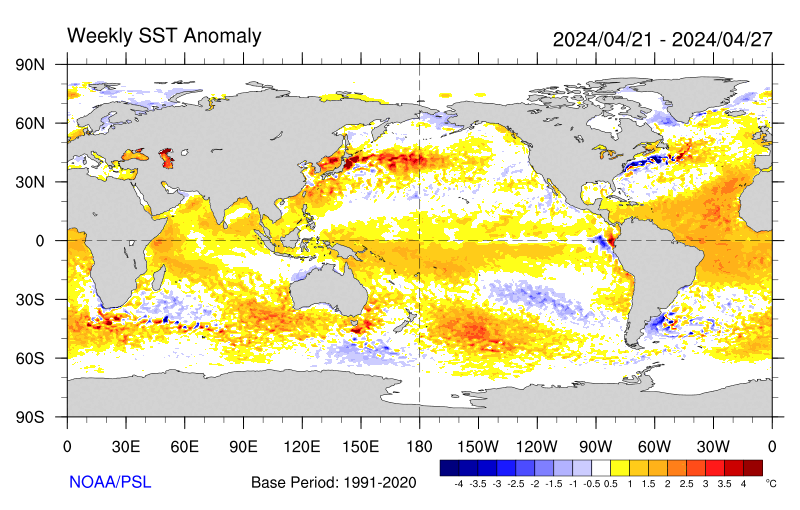
PASADENA, Calif. — The latest image of sea-surface height measurements from the U.S./French Jason-1 oceanography satellite shows the Pacific Ocean remains locked in a strong, cool phase of the Pacific Decadal Oscillation, a large, long-lived pattern of climate variability in the Pacific associated with a general cooling of Pacific waters. The image also confirms that El Niño and La Niña remain absent from the tropical Pacific.

The new image is available online at: http://www.nasa.gov/topics/earth/features/20081209.html
The image is based on the average of 10 days of data centered on Nov. 15, 2008, compared to the long-term average of observations from 1993 through 2008. In the image, places where the Pacific sea-surface height is higher (warmer) than normal are yellow and red, and places where the sea surface is lower (cooler) than normal are blue and purple. Green shows where conditions are near normal. Sea-surface height is an indicator of the heat content of the upper ocean.
The Pacific Decadal Oscillation is a long-term fluctuation of the Pacific Ocean that waxes and wanes between cool and warm phases approximately every five to 20 years. In the present cool phase, higher-than-normal sea-surface heights caused by warm water form a horseshoe pattern that connects the north, west and southern Pacific. This is in contrast to a cool wedge of lower-than-normal sea-surface heights spreading from the Americas into the eastern equatorial Pacific. During most of the 1980s and 1990s, the Pacific was locked in the oscillation’s warm phase, during which these warm and cool regions are reversed. For an explanation of the Pacific Decadal Oscillation and its present state, see: http://jisao.washington.edu/pdo/ and http://www.esr.org/pdo_index.html
Sea-surface temperature satellite data from the National Oceanic and Atmospheric Administration mirror Jason sea-surface height measurements, clearly showing a cool Pacific Decadal Oscillation pattern, as seen at: http://www.cdc.noaa.gov/map/images/sst/sst.anom.gif
“This multi-year Pacific Decadal Oscillation ‘cool’ trend can cause La Niña-like impacts around the Pacific basin,” said Bill Patzert, an oceanographer and climatologist at NASA’s Jet Propulsion Laboratory, Pasadena, Calif. “The present cool phase of the Pacific Decadal Oscillation will have significant implications for shifts in marine ecosystems, and for land temperature and rainfall patterns around the Pacific basin.”
According to Nathan Mantua of the Climate Impacts Group at the University of Washington, Seattle, whose research contributed to the early understanding of the Pacific Decadal Oscillation, “Even with the strong La Niña event fading in the tropics last spring, the North Pacific’s sea surface temperature anomaly pattern has remained strongly negative since last fall. This cool phase will likely persist this winter and, perhaps, beyond. Historically, this situation has been associated with favorable ocean conditions for the return of U.S. west coast Coho and Chinook salmon, but it translates to low odds for abundant winter/spring precipitation in the southwest (including Southern California).”
Jason’s follow-on mission, the Ocean Surface Topography Mission/Jason-2, was successfully launched this past June and will extend to two decades the continuous data record of sea surface heights begun by Topex/Poseidon in 1992. The new mission has produced excellent data, which have recently been certified for operational use. Fully calibrated and validated data for science use will be released next spring.
JPL manages the U.S. portion of the Jason-1 mission for NASA’s Science Mission Directorate, Washington. JPL is managed for NASA by the California Institute of Technology in Pasadena.
Media contact: Alan Buis 818-354-0474
Jet Propulsion Laboratory, Pasadena, Calif.
It’s sea surface height an indication of the heat content of the entire stack of water below? Granted, the lower levels don’t change temperature much, but when they warm, the sea level will rise.
So the oceans are cooling, huh? Doesn’t that negate the argument by the global warming folks that the recent cooling is due to the oceans taking up the heat?
And the beat goes on: click
Interesting stuff, huh Mary?
=================
Dr. Tim Ball has question.
Pre-industrial CO2 levels were about the same as today. How and why we are told otherwise?
http://canadafreepress.com/index.php/article/6855
Proponents of human induced warming and climate change told us that an increase in CO2 precedes and causes temperature increases. They were wrong. They told us the late 20th century was the warmest on record. They were wrong. They told us, using the infamous “hockey stick” graph, the Medieval Warm Period (MWP) did not exist. They were wrong. They told us global temperatures would increase through 2008 as CO2 increased. They were wrong. They told us Arctic ice would continue to decrease in area through 2008. They were wrong. They told us October 2008 was the second warmest on record. They were wrong. They told us 1998 was the warmest year on record in the US. They were wrong it was 1934. They told us current atmospheric levels of CO2 are the highest on record. They are wrong. They told us pre-industrial atmospheric levels of CO2 were approximately 100 parts per million (ppm) lower than the present 385 ppm. They are wrong. This last is critical because the claim is basic to the argument that humans are causing warming and climate change by increasing the levels of atmospheric CO2 and have throughout the Industrial era. In fact, pre-industrial CO2 levels were about the same as today, but how did they conclude they were lower?
The EPA is planning to declare CO2 a toxic substance and a pollutant. Governments are preparing to create carbon taxes and draconian restrictions that will cripple economies for a completely non-existent problem. It appears that a multitude of failed predictions, discredited assumptions and pieces of incorrect data are required before an idea loses credibility. Credibility should have collapsed but political control and insanity prevail.
Jim,
And so that begs the question, what warmed up the oceans to begin with?
Sorry, mistyped above, should have been:
Isn’t sea surface height an indication of the heat content of the entire stack of water below? Granted, the lower levels don’t change temperature much, but when they warm, the sea level will rise won’t it?
Anthony,
Cool PDO has been largely ignored until recently as a major climate driver. With PDO occuring in roughly 30 year cycles, it dives me absolutely crazy that the NWS uses a 30 year average for temperatures. When plotting the data for seasonal (winter) forecasting at my location, PDO impacts jump off the page. Temps / precip / snowfall… etc. have very close correlations with PDO here.
P.S. – Did you see that you turned up in a senate report along with more details on PDO and Global warming blowback.
Report: Sea Level rise ‘has stumbled since 2005’ – Meteorologist Anthony Watts – December 5, 2008 Excerpt: We’ve been waiting for the UC web page to be updated with the most recent sea level data. It finally has been updated for 2008. It looks like the steady upward trend of sea level as measured by satellite has stumbled since 2005.
http://epw.senate.gov/public/index.cfm?FuseAction=Minority.Blogs&ContentRecord_id=2158072e-802a-23ad-45f0-274616db87e6
I guess that means you are the man!
Patrick Powell
CBM
Be careful how you interpret the PDO. The PDO, as stated above, is a “pattern of climate variability in the Pacific associated with a general cooling of Pacific waters.” It is not SST anomaly for the North Pacific. The following is a graph of North Pacific SST anomalies from November 1981 to November 2008.
http://i36.tinypic.com/1yp9bc.jpg
As you can see, overall, the North Pacific SST anomalies have been cooling since ~2005, which has a direct impact on the calculation of global temperature anomaly. The South Pacific (next graph) has been dropping “steadily” since ~2001.
http://i36.tinypic.com/x5dzzq.jpg
The graphs are part of my monthly updates from December 3:
http://bobtisdale.blogspot.com/2008/12/november-2008-sst-update.html
Matt N asked the best question:
“…….what warmed up the oceans to begin with?”
Answer that question and the GW issue can be put to rest.
These thirty year-odd cycles certainly have a major impact on mountain precipitation in Europe too. Since 1978, snowfalls have been later in the year, hence staying less time and with it, more glacier melt.
This seems to have shifted in the past few years. Last year, over a metre of snow fell in the first week of November and stayed, giving excellent winter snow. This year, we’ve already had incredible early snow in the French, Swiss and Italian Alps with good ones in Austria and Germany as well. The Pyrenees are way ahead as is the Sierra Nevada in Southern Spain. First big snowfalls end of October (melted of course), then another major one at the end of November and now a third mega fall about to happen. No shortage of snowmelt in Europe’s rivers this year I feel. And Spanish drought is also looking less terrible.
It would be interesting to have data on sunspot minima in cool NAO phase to test the hypothesis that these are the snowiest early winters. We’d need data back 500 years and it simply doesn’t exist!
Time will tell, but I think these multi-decadal oscillations provide the context to shorter-term variations and propensity towards La Nina (cool phase of PDO) vs El Nino (warm phase of PDO). If so, we may be in for a bout of global cooling again.
Maybe time for Barack Obama to instigate water management programmes in California if droughts are expected in the next 30 years?
If the sea level average height has dropped 2mm, and the limits of the upper atmosphere are controlled independently of the lower atmosphere/sea surface boundary, would not a 2mm drop in sea level create an additional input of volumetric cooling by operation of the gas laws?
Hurricanes raise sea level with local low pressure, so volumetric feedbacks between the ocean and atmosphere are by no means trivial. Constant pressure volume increase results in cooling by dropping the lower boundary (unless the upper boundary is directly compensatory, but the mechanisms of the two boundaries are so radically different it is not obvious how they woudl be .
Has anyone ever calculated that effect or whether there are compensatory mechanisms that limit its impact?
So the PDO ‘cool’ phase is roughly equivalent to a 30 year long mild LaNina and the ‘warm’ phase is mild El Nino?
Did man cause the PDO? What power man has!
The question is . . . how many times will you go to a fortune teller when each time you have gone before the fortune teller has predicted a wrong fortune for you? How many times does it take before you determine that the fortune teller is a fraud?
I notice that CA state government is going to run out of money to pay its bills in either Feb or Mar, 2009. The residents of CA are going to deserve the misery they are about to get, for listening to these eco-whackos to begin with.
CA has decidedly become a “Deal faster, I am losing.” state.
joshv (07:54:30) :
It’s sea surface height an indication of the heat content of the entire stack of water below?
Well, no, not necessarily. Check out this ocean temperature profile:
http://www.windows.ucar.edu/tour/link=/earth/Water/images/temperature_depth_jpg_image.html&edu=high
With this profile, any temperature rise below 1000 meters will cause the height of the ocean to lower, as the water below 1000 meters would become more dense until it hit 4 Centigrade.
Hey man, love the blog, even if I’m not really intelligent enough to understand it all!
So is this pacific cooling caused by the lack of solar activity of late or because of global warming and the oceans melting? This probably seems like a stupid question but I kind of need it broken down to basics so my mind can deal with it! 🙂
Oceans melting??? I meant ‘icecaps’ melting… duh
Forget: La-Niña … BUT…IS BACK.
Forget: El-Niño (also)
Forget: SUN
Forget: GRC
Forget: CO2
Forget: IPCC-4 , 5, 6. and132.
Forget: Models
I think it’s time to study meteorology.
Mary ; Accept a hot coffee. (Winds)
Ed Scott,
In answer to your question – I’ve been re-reading Critchton’s book “Airframe”
In the flyleaf he quotes
“The irony of the Information Age is that it has given new respectability to uninformed opinion.”
Veteran report John Lawton, speaking to the American Associatio of Broadcast Journalists in 1995.
I think he would be agast at what is happening today…
MJB
By the way
“he” refers to Lawson, we already know what Michael thought…
Mike
The PDO and AMO are major “drivers” of climatic phenomena. Click here for an exmaination of major climatic effects (temperatures, droughts, rainfall, hurricanes) associated with these oceanic oscillations.
UN Blowback: More Than 650 International Scientists Dissent Over Man-Made Global Warming Claims
http://epw.senate.gov/public/index.cfm?FuseAction=Minority.Blogs&ContentRecord_id=2158072e-802a-23ad-45f0-274616db87e6
Set for release this week, a newly updated U.S. Senate Minority Report features the dissenting voices of over 650 international scientists, many current and former UN IPCC scientists, who have now turned against the UN.
A hint of what the upcoming report contains:
“I am a skeptic…Global warming has become a new religion.” – Nobel Prize Winner for Physics, Ivar Giaever.
“Since I am no longer affiliated with any organization nor receiving any funding, I can speak quite frankly….As a scientist I remain skeptical.” – Atmospheric Scientist Dr. Joanne Simpson, the first woman in the world to receive a PhD in meteorology and formerly of NASA who has authored more than 190 studies and has been called “among the most preeminent scientists of the last 100 years.”
Warming fears are the “worst scientific scandal in the history…When people come to know what the truth is, they will feel deceived by science and scientists.” – UN IPCC Japanese Scientist Dr. Kiminori Itoh, an award-winning PhD environmental physical chemist.
“The IPCC has actually become a closed circuit; it doesn’t listen to others. It doesn’t have open minds… I am really amazed that the Nobel Peace Prize has been given on scientifically incorrect conclusions by people who are not geologists,” – Indian geologist Dr. Arun D. Ahluwalia at Punjab University and a board member of the UN-supported International Year of the Planet.
“The models and forecasts of the UN IPCC “are incorrect because they only are based on mathematical models and presented results at scenarios that do not include, for example, solar activity.” – Victor Manuel Velasco Herrera, a researcher at the Institute of Geophysics of the National Autonomous University of Mexico
“It is a blatant lie put forth in the media that makes it seem there is only a fringe of scientists who don’t buy into anthropogenic global warming.” – U.S Government Atmospheric Scientist Stanley B. Goldenberg of the Hurricane Research Division of NOAA.
“Even doubling or tripling the amount of carbon dioxide will virtually have little impact, as water vapour and water condensed on particles as clouds dominate the worldwide scene and always will.” – . Geoffrey G. Duffy, a professor in the Department of Chemical and Materials Engineering of the University of Auckland, NZ.
“After reading [UN IPCC chairman] Pachauri’s asinine comment [comparing skeptics to] Flat Earthers, it’s hard to remain quiet.” – Climate statistician Dr. William M. Briggs, who specializes in the statistics of forecast evaluation, serves on the American Meteorological Society’s Probability and Statistics Committee and is an Associate Editor of Monthly Weather Review.
“For how many years must the planet cool before we begin to understand that the planet is not warming? For how many years must cooling go on?” – Geologist Dr. David Gee the chairman of the science committee of the 2008 International Geological Congress who has authored 130 plus peer reviewed papers, and is currently at Uppsala University in Sweden.
“Gore prompted me to start delving into the science again and I quickly found myself solidly in the skeptic camp…Climate models can at best be useful for explaining climate changes after the fact.” – Meteorologist Hajo Smit of Holland, who reversed his belief in man-made warming to become a skeptic, is a former member of the Dutch UN IPCC committee.
“Many [scientists] are now searching for a way to back out quietly (from promoting warming fears), without having their professional careers ruined.” – Atmospheric physicist James A. Peden, formerly of the Space Research and Coordination Center in Pittsburgh.
“Creating an ideology pegged to carbon dioxide is a dangerous nonsense…The present alarm on climate change is an instrument of social control, a pretext for major businesses and political battle. It became an ideology, which is concerning.” – Environmental Scientist Professor Delgado Domingos of Portugal, the founder of the Numerical Weather Forecast group, has more than 150 published articles.
“CO2 emissions make absolutely no difference one way or another….Every scientist knows this, but it doesn’t pay to say so…Global warming, as a political vehicle, keeps Europeans in the driver’s seat and developing nations walking barefoot.” – Dr. Takeda Kunihiko, vice-chancellor of the Institute of Science and Technology Research at Chubu University in Japan.
“The [global warming] scaremongering has its justification in the fact that it is something that generates funds.” – Award-winning Paleontologist Dr. Eduardo Tonni, of the Committee for Scientific Research in Buenos Aires and head of the Paleontology Department at the University of La Plata.
The chorus of scientific voices skeptical grow louder as a steady stream of peer-reviewed studies, analyses and real world data challenge the UN and former Vice President Al Gore’s claims that the “science is settled” and there is a “consensus.”
Bummer. We need the rain.
Ed Scott, I loved your post, but here’s a related issue (okay, related off at a tangent): if we can find viable alternatives to sending trillions of dollars to regimes in Russia, Saudi Arabia and Iran, I think perhaps we should. If this bad science cloud does have a silver lining, this will be it.