While I said a couple of days a go that “La Nina is back” it appears I mistook a strong PDO cool signature for the La Nina signature. As JPL’s Patzert says in the article below “This multi-year Pacific Decadal Oscillation ‘cool’ trend can cause La Niña-like impacts around the Pacific basin,”.
This PDO shift will be longer term event, and it appears that California will see some significant changes along with the many other parts of the planet. – Anthony (h/t to Allan)
PRESS RELEASE
JPL/NASA, 9 December 2008
http://www.jpl.nasa.gov/news/news.cfm?release=2008-231
PASADENA, Calif. — The latest image of sea-surface height measurements from the U.S./French Jason-1 oceanography satellite shows the Pacific Ocean remains locked in a strong, cool phase of the Pacific Decadal Oscillation, a large, long-lived pattern of climate variability in the Pacific associated with a general cooling of Pacific waters. The image also confirms that El Niño and La Niña remain absent from the tropical Pacific.

The new image is available online at: http://www.nasa.gov/topics/earth/features/20081209.html
The image is based on the average of 10 days of data centered on Nov. 15, 2008, compared to the long-term average of observations from 1993 through 2008. In the image, places where the Pacific sea-surface height is higher (warmer) than normal are yellow and red, and places where the sea surface is lower (cooler) than normal are blue and purple. Green shows where conditions are near normal. Sea-surface height is an indicator of the heat content of the upper ocean.
The Pacific Decadal Oscillation is a long-term fluctuation of the Pacific Ocean that waxes and wanes between cool and warm phases approximately every five to 20 years. In the present cool phase, higher-than-normal sea-surface heights caused by warm water form a horseshoe pattern that connects the north, west and southern Pacific. This is in contrast to a cool wedge of lower-than-normal sea-surface heights spreading from the Americas into the eastern equatorial Pacific. During most of the 1980s and 1990s, the Pacific was locked in the oscillation’s warm phase, during which these warm and cool regions are reversed. For an explanation of the Pacific Decadal Oscillation and its present state, see: http://jisao.washington.edu/pdo/ and http://www.esr.org/pdo_index.html
Sea-surface temperature satellite data from the National Oceanic and Atmospheric Administration mirror Jason sea-surface height measurements, clearly showing a cool Pacific Decadal Oscillation pattern, as seen at: http://www.cdc.noaa.gov/map/images/sst/sst.anom.gif
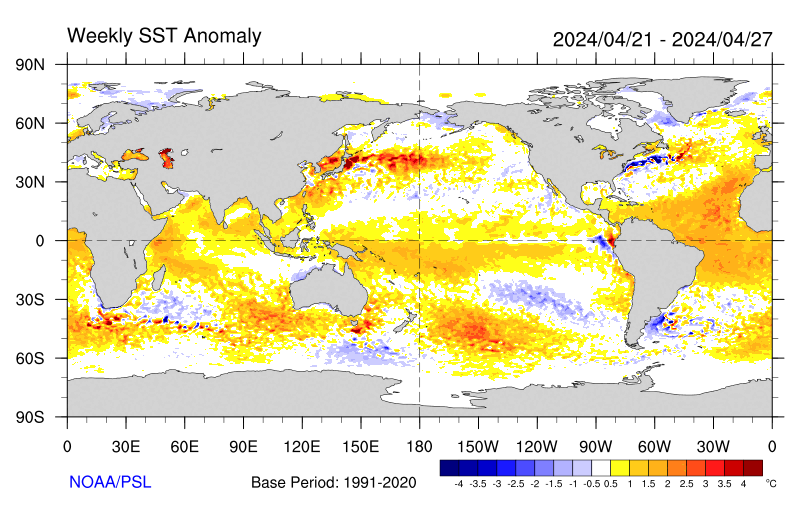
“This multi-year Pacific Decadal Oscillation ‘cool’ trend can cause La Niña-like impacts around the Pacific basin,” said Bill Patzert, an oceanographer and climatologist at NASA’s Jet Propulsion Laboratory, Pasadena, Calif. “The present cool phase of the Pacific Decadal Oscillation will have significant implications for shifts in marine ecosystems, and for land temperature and rainfall patterns around the Pacific basin.”
According to Nathan Mantua of the Climate Impacts Group at the University of Washington, Seattle, whose research contributed to the early understanding of the Pacific Decadal Oscillation, “Even with the strong La Niña event fading in the tropics last spring, the North Pacific’s sea surface temperature anomaly pattern has remained strongly negative since last fall. This cool phase will likely persist this winter and, perhaps, beyond. Historically, this situation has been associated with favorable ocean conditions for the return of U.S. west coast Coho and Chinook salmon, but it translates to low odds for abundant winter/spring precipitation in the southwest (including Southern California).”
Jason’s follow-on mission, the Ocean Surface Topography Mission/Jason-2, was successfully launched this past June and will extend to two decades the continuous data record of sea surface heights begun by Topex/Poseidon in 1992. The new mission has produced excellent data, which have recently been certified for operational use. Fully calibrated and validated data for science use will be released next spring.
JPL manages the U.S. portion of the Jason-1 mission for NASA’s Science Mission Directorate, Washington. JPL is managed for NASA by the California Institute of Technology in Pasadena.
Media contact: Alan Buis 818-354-0474
Jet Propulsion Laboratory, Pasadena, Calif.
We all saw, at the end of the 20th century, when the PDO was in its positive phase how it favored and seemed to strengthen El Niño events and repressed La Niña events. And perhaps that is what helped drive temperatures over land to higher levels. Now, with the PDO in its negative phase, we should see just the opposite happening with fewer and weaker El Niño events and stronger and more frequest La Niña events. Perhaps that will help bring temperatures over land down somewhat. Coupled with such weak recent solar activity we may see at least a couple decades of cooler temperatures. And it won’t be just WUWT where we’ll be seeing snow falling…
Anyone else think that the pic looks like the Pacific Ocean has a set of angry eyes?
Bob:
“The graphs are part of my monthly updates from December 3:”
We appreciate your work Bob.
So let’s get this straight:
The sea surface temps are just like a La Nina
The SOI is just like a La Nina
The weather impacts are just like a La Nina
but it isn’t a La Nina.
Pointless hair-splitting?
La Nina, PDO, ENSO, WMO, AMO, any other oscillations you want to make up a name for; well they come and they go, and they may influence how some thermal energy moves around some parts of the planet.
But just try to disconnect from that big orange ball up there at your own peril.
I’m glad that a lot of people can make a living out of ocean currents and winds; that’s wonderful; but without that big blowtorch up there, it doesn’t mean a thing.
If you want to call it La Nina Anthony, that’s Ok with me; who says they can’t both occur at once. But It is good that JPL jumps in with some comment. It seems that sometimes you can’t get any data from our taxpayer funded work force except by sticking your neck out, so they have to come to the rescue.
No demerits on that one Anthony; I liked the pictures anyway. Between watching the unspotted sun, and the Pacific blues, not to mention the aborted North Polar Kayak trips, it has been a very interesting year so far, and just think, in two days or thereabouts, our President Select, may actually become our President Elect. I guess he and Algore have already decided to diss everything you’ve been noting here, and ban carbonated drinks.
Anthony
Easy mistake to make. Look here
http://www.bom.gov.au/climate/enso/
Here’s a plot of PDO cycles at Digital Diatribes from Dec 4
http://digitaldiatribes.wordpress.com/2008/12/04/pacific-decadal-oscillation-pdo-index-back-into-the-negative/
There are a lot of issues in this name change.
One is that the El and La Nina’s should perhaps be seen as part of the larger PDO process.
Another is to in effect obfuscate the failure of the Hansen & co. predictions by blaming the cooling we are likely to experience for the coming years as due to the PDO negative phase over whelming the wickedness of AGW.
IOW, for the AGW community, there is no amount of negative feedback or natural variability that will shake their basic assertion. Warm- AGW. Cooling? AGW masked by natural variability.
“it translates to low odds for abundant winter/spring precipitation”: what does he mean? Does he mean “long odds against” – i.e. that it is unlikely? Does he mean it’s “odds on” – i.e. likely?
Bill Patzert needs to go back to school. Sea level does not change in this fashion due to heat content, it changes due to surface winds. He is as wrong here as he was when he was giving the Science Dude source information on the Santa Ana temperature record.
OT
It’s snowing in Houston.
Patrick Powell (09:26:52) : “With PDO occuring in roughly 30 year cycles, it dives me absolutely crazy that the NWS uses a 30 year average for temperatures.”
A consistent feature in the entire world of AWG promotions is starting the data set at a moment in time that best supports the argument. A good standard to follow is reach back the same period of time prior to the start date to see if the arguments still hold.
I don’t think you need a PhD to understand that the earth’s weather and climate is controlled in order of importance by:
1. The sun
2. The Oceans
3. The Atmosphere
There may be a lot of 12 year old’s who can’t discuss el nino, la nina, and PDO, but, if they haven’t been corrupted by Al Gore’s movie and the BS being peddled on the networks, will tell you that the sun drives it all.
“and a little child will lead them.”
Sorry to bore anyone who has heard from me on this before but for newcomers I’d just like to point out that this fits perfectly with the stuff I’ve been producing since April 2008.
Combine sun and oceans and all observed 20th Century temperature changes are explicable without CO2.
http://co2sceptics.com/news.php?tag=stephen+wilde
Especially note the ‘Top five most read articles’ referred to.
Robinson
We are not “sending” trillions of dollars to the regimes in Russia, Saudi Arabia and Iran. We are buying a product which our economy requires – an exchange if you will.
Solar, wind and ethanol have been around since the ’60s when Mother Earth News was publishing do-it-yourself articles about those energy sources. These sources of energy all require subsidies.
It seems that electric cars will soon be mandated. Electric cars are dependent upon an external power source – gasoline and diesel cars do not.
Alternative energy is the latest catch phrase. Who can tell you what that might be? I have not seen any fueling stations selling alternative fuel. T. Boone Pickens believes methane to be the alternative fuel of the future. Considering his vast holdings in methane, one might suspect a profit motive in his touting methane as the “alternate” fuel.
The United States has un-tapped deposits of petroleum. Why is it being saved and for whom? The use of petroleum is not causing AGW and CO2 is not a pollutant and, in consideration of Dr. Pachauri’s concerns, neither is CH4.
Robinson (12:32:18) :
if we can find viable alternatives to sending trillions of dollars to regimes in Russia, Saudi Arabia and Iran, I think perhaps we should.
But, Robinson, all you have to avoid that is drill for the oil in the US of A. It has been Verbotten for 30 years. Why? Those who brought in this ban should be made to ryuntreadmills to generate energy.
It seems as tho earth would be large enough to maintain a temp like an anvil sitting on the wood stove, if we find it varies drasticly its only because we are not able to accurately measure its overall temperature.
Whats the old saw about the group of blind men describing an elephant by what each could feel?
A warm upwelling here, a dip there, sorry mother nature, bend over we need to put a thermometer where the sun don’t shine.
Jim Grieg: You asked, “So the oceans are cooling, huh?”
Mary Hinge: You replied, “No, they are not, a portion of the Pacific cooling (while this happens other parts of the Pacific warm) does not constitute global ocean cooling. It is a shame to see JPl still using the outdated and misleading ‘cool’ phase instead of the now accepted and more accurate ‘negative’ or ‘postive’ phase.”
To both, in answer to Jim’s question, it depends on the data set. If we consider Ocean Heat Content, it has not increased in the past few years. It just appears to be cycling back and forth. But a couple of little down ticks in a few years doesn’t constitute a decrease. It’s unfortunate that the data isn’t available online for the different oceans or on a gridded basis.
http://i36.tinypic.com/im46e8.jpg
Discussed here:
http://bobtisdale.blogspot.com/2008/11/revised-ocean-heat-content.html
However, looking at SST, Northern Hemisphere SSTs have been cooling for 3 years.
http://i38.tinypic.com/2hnp8c0.jpg
And Southern Hemisphere SSTs have been cooling since 2002.
http://i35.tinypic.com/mijjoz.jpg
Also note, Mary, the linked graphs of the North and South Pacific SST anomalies in my comment above. Both Pacific data sets have cooled over the past few years. SST anomalies in the Pacific (and their residuals) bear little resemblance to the PDO.
The links to most of my posts on SST are here:
http://bobtisdale.blogspot.com/2008/06/smith-and-reynolds-sst-posts.html
Regards
here’s the SOI over the past years as it effects Australia.
http://www.weatherzone.com.au/climate/indicator_enso.jsp?c=soi&p=monthly
true to form we had a drought through the el nino and now we’ve swung back to a la nina we’ve had record rainfall.
http://www.weatherzone.com.au/climate/recent.jsp?lt=wzcountry&lc=aus&c=rain_decile
BTW – the http://epw.senate.gov site has been down all morning.
I guess everybody missed the peer reviewed study, revealed at the IPCC shindig in Poland, that says at least 50 % of the 30 years warming trend is explained by the changes in the PDO and AMNO, and NOT GHG’s. I have no idea how they managed to get the study in the door, but there it is.
More at my blog.
Anthony: Take a look at the animation of subsurface equatorial Pacific temperature anomaly (cross-section view to 450m). If that large subsurface pool of cool water continues its rise to the surface, your statement, “La Nina Is Back” will be correct.
http://www.cpc.noaa.gov/products/analysis_monitoring/enso_update/wkxzteq.shtml
Or it’s because it actually does vary drastically.
Robert Wood states:
“With this profile, any temperature rise below 1000 meters will cause the height of the ocean to lower, as the water below 1000 meters would become more dense until it hit 4 Centigrade.”
Mr. Wood, please check out the properties of SALT WATER as opposed to PURE WATER for expansion and density. I believe you will find that the anomalous (compared to other matter) “bottom” for volume of water at 4c disappears in salt water and drops to freezing, which is below 0c for salt water and dependent on the “saltiness” and other impurities.