While I said a couple of days a go that “La Nina is back” it appears I mistook a strong PDO cool signature for the La Nina signature. As JPL’s Patzert says in the article below “This multi-year Pacific Decadal Oscillation ‘cool’ trend can cause La Niña-like impacts around the Pacific basin,”.
This PDO shift will be longer term event, and it appears that California will see some significant changes along with the many other parts of the planet. – Anthony (h/t to Allan)
PRESS RELEASE
JPL/NASA, 9 December 2008
http://www.jpl.nasa.gov/news/news.cfm?release=2008-231
PASADENA, Calif. — The latest image of sea-surface height measurements from the U.S./French Jason-1 oceanography satellite shows the Pacific Ocean remains locked in a strong, cool phase of the Pacific Decadal Oscillation, a large, long-lived pattern of climate variability in the Pacific associated with a general cooling of Pacific waters. The image also confirms that El Niño and La Niña remain absent from the tropical Pacific.

The new image is available online at: http://www.nasa.gov/topics/earth/features/20081209.html
The image is based on the average of 10 days of data centered on Nov. 15, 2008, compared to the long-term average of observations from 1993 through 2008. In the image, places where the Pacific sea-surface height is higher (warmer) than normal are yellow and red, and places where the sea surface is lower (cooler) than normal are blue and purple. Green shows where conditions are near normal. Sea-surface height is an indicator of the heat content of the upper ocean.
The Pacific Decadal Oscillation is a long-term fluctuation of the Pacific Ocean that waxes and wanes between cool and warm phases approximately every five to 20 years. In the present cool phase, higher-than-normal sea-surface heights caused by warm water form a horseshoe pattern that connects the north, west and southern Pacific. This is in contrast to a cool wedge of lower-than-normal sea-surface heights spreading from the Americas into the eastern equatorial Pacific. During most of the 1980s and 1990s, the Pacific was locked in the oscillation’s warm phase, during which these warm and cool regions are reversed. For an explanation of the Pacific Decadal Oscillation and its present state, see: http://jisao.washington.edu/pdo/ and http://www.esr.org/pdo_index.html
Sea-surface temperature satellite data from the National Oceanic and Atmospheric Administration mirror Jason sea-surface height measurements, clearly showing a cool Pacific Decadal Oscillation pattern, as seen at: http://www.cdc.noaa.gov/map/images/sst/sst.anom.gif
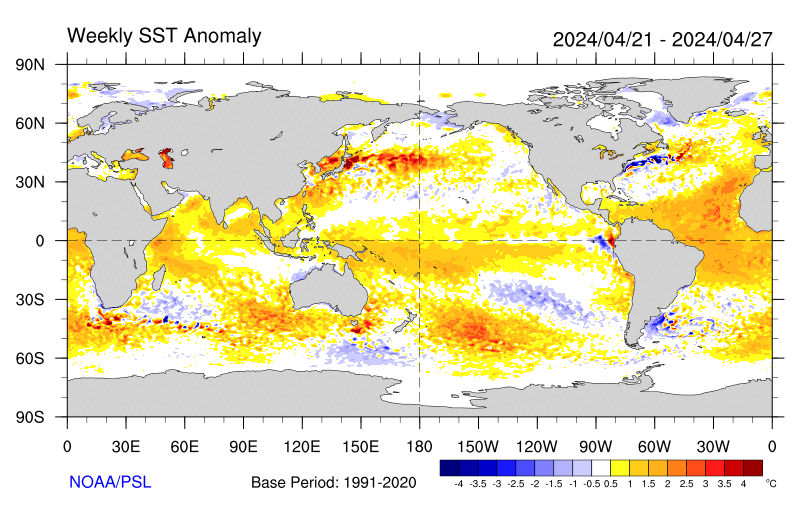
“This multi-year Pacific Decadal Oscillation ‘cool’ trend can cause La Niña-like impacts around the Pacific basin,” said Bill Patzert, an oceanographer and climatologist at NASA’s Jet Propulsion Laboratory, Pasadena, Calif. “The present cool phase of the Pacific Decadal Oscillation will have significant implications for shifts in marine ecosystems, and for land temperature and rainfall patterns around the Pacific basin.”
According to Nathan Mantua of the Climate Impacts Group at the University of Washington, Seattle, whose research contributed to the early understanding of the Pacific Decadal Oscillation, “Even with the strong La Niña event fading in the tropics last spring, the North Pacific’s sea surface temperature anomaly pattern has remained strongly negative since last fall. This cool phase will likely persist this winter and, perhaps, beyond. Historically, this situation has been associated with favorable ocean conditions for the return of U.S. west coast Coho and Chinook salmon, but it translates to low odds for abundant winter/spring precipitation in the southwest (including Southern California).”
Jason’s follow-on mission, the Ocean Surface Topography Mission/Jason-2, was successfully launched this past June and will extend to two decades the continuous data record of sea surface heights begun by Topex/Poseidon in 1992. The new mission has produced excellent data, which have recently been certified for operational use. Fully calibrated and validated data for science use will be released next spring.
JPL manages the U.S. portion of the Jason-1 mission for NASA’s Science Mission Directorate, Washington. JPL is managed for NASA by the California Institute of Technology in Pasadena.
Media contact: Alan Buis 818-354-0474
Jet Propulsion Laboratory, Pasadena, Calif.
“Robinson (12:32:18) :
Ed Scott, I loved your post, but here’s a related issue (okay, related off at a tangent): if we can find viable alternatives to sending trillions of dollars to regimes in Russia, Saudi Arabia and Iran, I think perhaps we should. If this bad science cloud does have a silver lining, this will be it”
There are many alternatives. Shale oil in Wyoming? ANWR? Everytime someone tells me we can’t possible drill in ANWR, I ask them the last time they were there?…Never been?…when are you going?…no plans?…hmmmm.
Seen pictures?…no. Damn. Any idea how big the oil field is?…no.
I really believe that the energy situation we’re in now is all about some people wanting desperately to exert some kind of control over some OTHER people…period.
Mary,
Let me understand what you’re saying. The Pacific is cooling, the Arctic ice is growing larger/faster than it did last year, the Antarctic is colder…buy you say the oceans are warming?…must all be in the Atlantic then?…cuz it sure seems like every other ocean I read about is cooler…where the heck is all the heat that has to be offsetting everything else hanging out at?
JimB
As more and more of this research gets published, we are starting to see that ocean cycles have more impact on temperatures than was previously believed.
We all know the 1997-98 El Nino produced a big temporary jump in temperatures but the warmers have been happy to leave that temporary jump in the record and let increasing CO2 get the credit for the temp increase.
Now that the ocean cycles are starting to turn negative (everything from the 2007-08 La Nina to the returning to normal AMO to the negative PDO to the declining southern ocean temperatures), the warmers are again happy producing their 5-year moving average temp trendlines which still are moving up as long as they ignore the drop in temps in 2008.
Eventually, there will be some crow to eat (but then the warmers will just find another explanation to keep us off track for another 10 years.)
Just focus on the current temperature numbers and take into account the impact La Ninas or El Ninos or a negative PDO or an AMO has on the natural cycles in the climate.
How many times does it take before you determine that the fortune teller is a fraud?
Exactly, but what the AGW crowd is trying to do is just get one right regarding GW no matter what its cause, thereby “proving” the AGW hypotheses, and then hoping no one will notice the actual record – where perhaps the exception in fact proves the rule opposite to what AGW claims. This is a classic tactic used by Psychics: everyone is stunned by the one correct prediction, not the 999 incorrect guesses.
The fact that AGW theory hasn’t gotten anything right is troubling in more ways than one, i.e., it almost looks like the atmosphere simply must be cooling – except that, of course, the fact that the ipcc “science” is not science does lessen the certainty of even this deduction.
Robert Wood (16:46:29) :
“But, Robinson, all you have to avoid that is drill for the oil in the US of A.”
Robert …. if it were only so simple.
I have made a career of exactly this – as an exploration geologist / geophysicist looking for new discoveries. Don’t fool yourself into thinking we have enough oil & that all we have to do is go “drill for it”. Yes, there are areas with untapped potential, but their potential compared to our demand is small. The industry is very mature & the odds of finding a new province that can supply a substantial part of our oil demand are remote – at best. As far as what’s currently off-limits, offshore California holds the best potential by far. But even in a maximum success scenario, it’s probably less than 10% of our daily consumption. Helpful, yes. A solution, no. ANWR is a pipe dream. Although spatially close to the core of North Slope production, the geology is significantly different in ANWR & is likely to be poor in oil & rich in natural gas – which has no pipeline & no market on the North Slope – and little present value to us as a country. ANWR is just a political football for politicians & environmentalists. Notice how no oil companies are involved in that debate. It’s because any company who has studied it quickly comes to the same conclusion I stated above. To an explorer, it is really pretty obvious. I can say all of this with confidence as my company is an expert on the North Slope & came up with the exploration idea for the latest North Slope discovery at Oooguruk. See links :
http://www.adn.com/money/story/435149.html
http://www.youtube.com/watch?v=ZWW4DbUjGVQ (A crew shift change video at the production island – I take huge pride that all these guys have jobs because we were able to make this discovery)
I love this one because it shows how the wildlife really could give a rats arse about our operations in the area, despite enviros protests to the contrary.
Please check these links out.
Anyway, note from the 1st link that peak production is a minor 20,000 BOPD, compared to US daily consumption of over 20 million BOPD (1/10 of 1 %) – and this is a very significant discovery / addition to our countries production. Our gas resources are much greater than our oil resources with new technology able to unlock resources that were previously unrecoverable. So, T. Boone will make some money with the “Picken Plan” but he is actually pretty on point with it all.
So, four key points:
1) We really do need all the energy we can get – regardless of source. If “alternatives” can contribute, great. Bring it on. The more energy we can produce as a country, the better off we will be – again, regardless of source. Let’s drill everything we can but realize that we have to do more than that.
2) I am sure there are plenty who read this blog who don’t “believe” in AGW & don’t “believe” in alternative energy. Well, I am here to tell you, these are two separate issues & that “belief” should have nothing to do with either – only science & scientific reasoning should be determining factors. The AGW crowd has “faith” in their religion; the skeptics have science. The scientific data says be skeptical of AGW & be skeptical of the idea that we can drill our way to energy independence. The whole point here is we are after data driven conclusions, not political or faith-based conclusions – regardless of what part of the political spectrum you reside in.
3) No, I am not a shill for big energy. I work for a small company of 16 people. We are proud of the work we do trying to find our country new energy & the jobs that come along with it. Also, beyond my degrees in the geosciences, I took a substantial amount of course work in meteorology because as an undergrad, I was torn between getting degrees in meteorology or geology.
4) Not everyone in oil & gas is evil. ;))
JimB (19:13:42) :
Shale oil in Wyoming?
– forgot that one in the last post – possible, as long as you don’t mind paying at least $4 to $5 / gal at the pump. Technology is in it’s infancy. Not that we shouldn’t be pursuing it, but commercial viability is years away & only with high product prices. Even if commercialized, the rate at which the oil will come out is slow because of the low permeability of shale. Helpful, yes. A solution, no.
“ANWR? Everytime someone tells me we can’t possible drill in ANWR, I ask them the last time they were there?…Never been?…when are you going?…no plans?”
I HAVE been there. It’s not about ability to drill. It’s about what you will find – see previous post. Also see comment on “belief” vs science in previous post. Important so you aren’t painted with the same brush as the AGW’s that simply ignore data, because it doesn’t fit their belief system.
The PDO and other ocean oscillations can not, by themselves, add heat to the ocean/atmospheric system, but they can transfer heat from one area to another. In this way, they can and do cause warming and cooling of the atmosphere in multidecadal cycles.
If the warming crisis advocates (WCAs) use these cycles to explain the global cooling of recent years, and the lack of warming over the last 8 years, then they no longer have the argument on which their house of cards is built. Recall that the sole ‘data-related’ argument put fourth by the IPCC is that the temperature trend of the 20th century can not be explained by any natural variability, so it must be man-made.
In the past, they have not recognized any mechanism, other than a large volcanic eruption, that could overcome the warming influence of increasing CO2 for any multi-year time span. If they now concede that the negative phase of the PDO can override the warming influence of CO2, then they must acknowledge the other side of the coin. In science, one can not pretend that only half of a cycle exists. The positive phase of the PDO must have added to the warming of the late 20th century! In fact, if the negative phase of the PDO can overide the warming effects of increasing CO2 and cause cooling, then the positive phase of the PDO should produce warming that is greater than the CO2 induced warming (same magnitued/opposite sign). This would account for the majority of the warming of the late 20th century, invalidating the IPCCs only ‘real world’ argument.
If the WCAs do not use the ocean cycles to explain the current temperature trends, than they can not explain the trend at all and look like the do not know what they are talking about. If they invoke the ocean cycles to explain the cooling, then they must admit that the opposite part of the cycle causes warming, which largely invalidates their “we can only explain the warming with increasing greenhouse gases’ argument.
The bottom line is that there is no looming global warming crisis. In the past, ’tilting at windmills’ was a practice confined to individuals, small groups and ocassionally…nations. Now, in this disinformation age, the whole world can attack imaginary enemies together, and suffer the slings and arrows of our own delusions in ‘global’ solidarity!
Scary! Ain’t it?
OT
It’s snowing in Houston.
Uh Oh! This must mean that “The Day After Tomorrow” was right after all!!!!! 🙂
The first Klotbach/Gray hurricane forecast for 2009 is out, see http://hurricane.atmos.colostate.edu/Forecasts/ . The abstract:
Heres a question for you. The hawaiian islands sit upon the tallest mountain range in the world. Currently the volcanic activity there is building another new island from the sea floor up…. how much water does that displace?
It really looks like the remaining warm ocean spots are active volcanic areas…. http://www.volcano.si.edu/world/find_regions.cfm
And a second question. If Co2 is an overwhelming greenhouse gas in the small amounts man contributes, then why isnt Mars, with its higher concentrations of Co2 a very warm planet?
heheh.
FYI: It snowed in Houston Texas today!
Ed Scott,
Just a quick ‘thank you’ for your excellent series of quotes from the Senate report which I have purloined, with acknowledgement, for use over at my place. I shall be interested to see how much publicity it receives in the MSM.
It hasn’t and is rising rapidly
No they aren’t, La Ninas can occur during positive phases and El Nina’s during negative phases. As discussed above the terms ‘warm’ and ‘cool’ phase are incorrect as the warm and cool anomolies switch between phases. There is no net increase or decrease in ocean temperatures though there are global effects due to changes in currents, jet streams etc.. There is more likelyhood of La Nina’s during negative phases and of El Nino’s during positive phases. It is these events that cause the global temperature changes.
Sorry Fernando, it isn’t. Latest NINO 3 indices are at 0.0 centigrade, as neutral as you can get! Thanks for the coffe invite though ;-).
No it isn’t, the SST’s look quite different during a La Nina event, contrast the lastest SST map http://www.osdpd.noaa.gov/PSB/EPS/SST/data/anomnight.12.8.2008.gif
with one from last year when the La Nina was in full swing http://www.osdpd.noaa.gov/PSB/EPS/SST/data/anomnight.12.31.2007.gif
You will notice the cooler waters off South America and the much colder equatorial Pacific waters. |Contrast that with the warmer waters off South America, an El Nino next SH summer is a realpossibility. Another point is that the negative PDO phase was much more defined a year ago and was a text book illustration of a negative PDO. Today it is much less defined and will probably return to a positive phase later next year.
Why is Mars not that hot? Maybe that’s because it’s 50% further from the sun than earth? Or because it is a very dry place?
Jeff L says,
ANWR is a pipe dream. Although spatially close to the core of North Slope production, the geology is significantly different in ANWR & is likely to be poor in oil & rich in natural gas – which has no pipeline & no market on the North Slope – and little present value to us as a country. ”
As some one who has worked in the energy business for 45 years (not the oil upstream side), I must say that you make a lot of good points which I agree with. I am surprised however at your comment on ANWR particularly since ANWR oil is close to the existing pipeline and oil can be easily shipped. I would like your take on the numerous studies and reports that there is approximately 10 billion barrels of recoverable oil in ANWR. Several government reports are referenced below. Note that the administration was pushing this in 2003 and if they are right we could have avoided the oil price crisis this year had we acted then.
http://www.doi.gov/news/03_News_Releases/030312.htm
“The Administration firmly believes that we can develop energy at home while protecting the environmental values we all hold dear,” Secretary Norton said. “The Coastal Plain of ANWR’s 1002 area is the nation’s single greatest onshore oil reserve. The USGS estimates that it contains a mean expected value of 10.4 billion barrels of technically recoverable oil. To put that into context, the potential daily production from ANWR’s 1002 area is larger than the current daily onshore oil production of any of the lower 48 states.”
http://www.oilfield.com/info/energy.shtml
The AAPG believes that the 1002 area of the Arctic National Wildlife Refuge (ANWR), and the similar coastal plain area of the National Petroleum Reserve-Alaska (NPRA), should be opened to exploration and development. A study recently released by the United States Geological Survey (March, 1998) cites potential economically recoverable oil resources beneath the ANWR Coastal Zone 1002 Area of 5.7 to 16 billion barrels of crude oil, with a mean expected resource of 10.3 billion BO. Mean peak production rates of 1.0 to 1.35 million BOPD are expected. The 1002 Area represents only 8% of ANWR’s 19 million acres. Less than 1 percent of the land within the 1002 area would be affected by petroleum exploration and development activities. Parts of the coastal plain of the NPRA, held back by the Bureau of Land Management (BLM) from the 1999 lease sale at the instruction of the Secretary of the Interior, contain an estimated minimum of 1.5 billion barrels. ”
A pipeline to the US is not needed to move natural gas to the lower 48. I have worked on both LNG and projects to convert gas to liquid fuels and both technologies are sufficiently developed. Several years ago one oil company studied using gas to liquid plants in Alaska to move fuels to the lower 48. The technology exists so it depends on economics especially the price of the gas.
Also I would like to point out that the technology has existed since the 80’s to commercially recover significant oil from shale. These large scale projects were cancelled when the Arabs lowered the price of oil (from about $40/bbl) to kill development of competitive oil supply in the US. The price may be $4/gallon now but that is still a lot cheaper than trying to “grow” alternative fuels.
The current “promise” of the “fossil carbon haters” that we can meet our liquid fuel needs from corn or cellulosic feedstocks is a diversion to mislead people into believing that in the near term there is a viable alternative and we can rid ourselves of dependence on fossil fuels. It is somewhat like the exaggerated AGW claims. There is not one commercial operating plant in the US that converts wood, grass or other cellulosic feedstock to ethanol. The first plant is scheduled to come on stream the end of next year. These remain to be demonstrated technologies and their capacity is a drop in the bucket when compared with our needs. I believe it is irresponsible to risk the security and our economy of our country on un-demonstrated technology. Even with continuing government subsidies the cost for these fuel sources will exceed the cost of oil recovered from shale. Also, don’t be fooled by the “green fuel” label the politicians put on alternative fuels. Since they are derived from the soil they have to contend with the same nasty elements that coal has to deal with including ash to collect and dispose. Lots of scrubbers and other clean up equipment will drive up the plant costs and energy consumption and of course it is never 100% removed.
I’m not sure if anyone has already covered this but here it is anyway:
There is No La NIna at present.
From NOAA page
“La Niña:characterized by a negative ONI less than or equal to -0.5°C. By historical standards, to be classified as a full-fledged El Niño or La Niña episode,these thresholds must be exceeded for a period of at least 5 consecutive overlapping 3-month seasons.”
The ONI for the most recent 3 month period (i.e. Sep-Oct-Nov) is -0.1 which is still above the La NIna threshold. Now let’s suppose the ONI for Oct-Nov-Dec (OND) period is -0.5 then we still won’t have an official La Nina. That will only happen if NDJ and DJF are also less than or equal to -0.5.
In other words we need to wait at least 3 months (and probably longer) before knowing whether we have a La Nina or not.
You might argue that the La Nina definition is somewhat arbitrary but that’s the way it is. At the moment (last 5 months) ENSO status is almost as close to neutral as is possible.
Flanagan; got it in 2; the sun and water; and that’s why AGW is just a gleam in Jimmy Hansen’s eye and padding in Al Gore’s wallet.
There’s a great plot in one of the weblinks referred to by:
Alan Cheetham (11:31:16) :
which computes ‘PDO + AMO’ against temperature variations in the US. Below that plot is a similar one for carbon dioxide and temperature variations.
results: PDO+AMO has a remarkable fit for 80 years, whereas carbon dioxide only fits for the post 1980 warming period.
The only question which therefore arises is: ‘has the PDO+AMO data been fudged to fit the data curve? Or has the temperature data been fudged to fit the PDO+AMO curve?’
If the answer to that is NO and NO, then I think, in all seriousness, we should assume, until proven otherwise, that US temperature variations are a direct function of a combination of the PDO+AMO signal.
The logical question to follow would be: ‘what drives the PDO and AMO signals (they have similar cycle lengths but non-conjoining amplitudes and short-term variabilities) and hence US climate?’
Any chance of THAT being discussed in Poznan, Davos or anywhere else?
If not, why not?
Does anyone know if the PDO cycle follows the sunspot intensity cycles? Is there a correlation that might point toward implied causality?
From Robinson (12:32:18) :
if we can find viable alternatives to sending trillions of dollars to regimes in Russia, Saudi Arabia and Iran, I think perhaps we should.
-end quote
Sadly, we already have those alternatives, very well established technically, and the AGW religion would forbid their use. Specifically: CTL, GTL, et. al.
One of my hot buttons is that we have all the technology needed to kiss off OPEC oil, but we don’t use it. We do hear endlessly about the need for more research to find a solution, however… Especially into hydrogen, even though hydrogen is more of a battery than an energy source. Show me the hydrogen wells…
The most common Coal to Liquids process is called Fischer Tropsch (FT) and provides much of the liquid fuel used in South Africa (from SASOL the South African Synthetic Oil Company – ticker SSL). There are other companies with similar technologies (Synthesis Energy Company SYMX, Syntroleum SYNM, Rentech RTK). The U.S. firms are on very hard times due to the present low oil price and Obama’s rejection of coal.
SYMX is building facilities in China, however. (I think SSL is as well…) We can look forward to exporting our coal to China and buying it back as gasoline and Diesel oil… But we will have reduced “our” carbon footprint since the production CO2 will be in China…
RTK has a facility in Los Angeles area turning garbage into motor fuels. They also produced the fuel used by the U.S. Air Force to demonstrate synthetic jet fuel and to certify aircraft for it. At least the USAF has clue. Hopefully it will survive the new regime.
SSL has at least 30+ years of production experience. The technology has at least 80+ years, starting in Germany in the 1920’s. It later powered the Nazi war machine. I’d say that it’s proven…
The same or very similar techniques can be used to run Gas To Liquids plants. These are being done by Chevron CVX, Conoco Phillips COP, and several other oil majors along with some oil minors 😉 such as MRO Marathon Oil (they have a fascinating alternative technology using bromine as a catalyst/reactant…) Anybody with excess or stranded natural gas.
“Latest NINO 3 indices are at 0.0 centigrade.’
You mean the equatorial waters in the mid-Pacific are about to freeze? I assume you mean that the index is neutral. Still, both the thirty and ninety day SOI indices remain consistently positive, between 12 and 16.
Isn’t there a crucial difference between temperature anomalies in the tropics and those at higher latitudes? One degree at higher temperatures represents greater kinetic energy than one degree at lower temps
“Why is Mars not that hot? Maybe that’s because it’s 50% further from the sun than earth? Or because it is a very dry place?”
Also, the atmosphere is low on greenhouse gasses.
“Contrast that with the warmer waters off South America, an El Nino next SH summer is a realpossibility”
But that streak of positive anomalies stretching west from the coast of Ecuador, seems to be breaking up lately compared to how it looked last summer.
Take a look at the Multivariate ENSO Index.
http://www.cdc.noaa.gov/ENSO/enso.mei_index.html
Notice the dominance of La Nina events up until 1977, and the predominance of El Nino events from 1977 to 2000.
Rhys Jagger:
PDO+AMO has a remarkable fit for 80 years, whereas carbon dioxide only fits for the post 1980 warming period. Any chance of THAT being discussed in Poznan, Davos or anywhere else?
Yes, we covered it. See here and here. This paper somehow got through the doors at the Poland meeting.
PDO index…..november….2008….-1.25
PDO index…..november….2007….-1.08
http://jisao.washington.edu/pdo/PDO.latest
NOAA: NIÑO3-4…..12/08/2008……-0,5ºC
FM