While I said a couple of days a go that “La Nina is back” it appears I mistook a strong PDO cool signature for the La Nina signature. As JPL’s Patzert says in the article below “This multi-year Pacific Decadal Oscillation ‘cool’ trend can cause La Niña-like impacts around the Pacific basin,”.
This PDO shift will be longer term event, and it appears that California will see some significant changes along with the many other parts of the planet. – Anthony (h/t to Allan)
PRESS RELEASE
JPL/NASA, 9 December 2008
http://www.jpl.nasa.gov/news/news.cfm?release=2008-231
PASADENA, Calif. — The latest image of sea-surface height measurements from the U.S./French Jason-1 oceanography satellite shows the Pacific Ocean remains locked in a strong, cool phase of the Pacific Decadal Oscillation, a large, long-lived pattern of climate variability in the Pacific associated with a general cooling of Pacific waters. The image also confirms that El Niño and La Niña remain absent from the tropical Pacific.

The new image is available online at: http://www.nasa.gov/topics/earth/features/20081209.html
The image is based on the average of 10 days of data centered on Nov. 15, 2008, compared to the long-term average of observations from 1993 through 2008. In the image, places where the Pacific sea-surface height is higher (warmer) than normal are yellow and red, and places where the sea surface is lower (cooler) than normal are blue and purple. Green shows where conditions are near normal. Sea-surface height is an indicator of the heat content of the upper ocean.
The Pacific Decadal Oscillation is a long-term fluctuation of the Pacific Ocean that waxes and wanes between cool and warm phases approximately every five to 20 years. In the present cool phase, higher-than-normal sea-surface heights caused by warm water form a horseshoe pattern that connects the north, west and southern Pacific. This is in contrast to a cool wedge of lower-than-normal sea-surface heights spreading from the Americas into the eastern equatorial Pacific. During most of the 1980s and 1990s, the Pacific was locked in the oscillation’s warm phase, during which these warm and cool regions are reversed. For an explanation of the Pacific Decadal Oscillation and its present state, see: http://jisao.washington.edu/pdo/ and http://www.esr.org/pdo_index.html
Sea-surface temperature satellite data from the National Oceanic and Atmospheric Administration mirror Jason sea-surface height measurements, clearly showing a cool Pacific Decadal Oscillation pattern, as seen at: http://www.cdc.noaa.gov/map/images/sst/sst.anom.gif
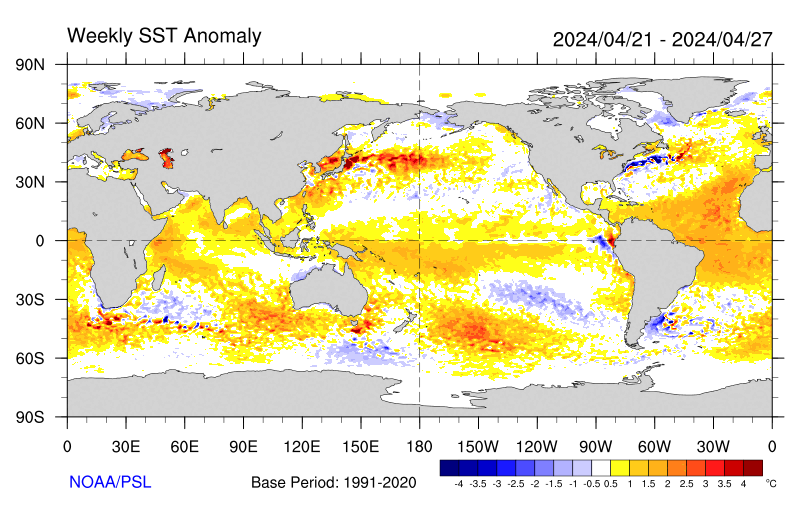
“This multi-year Pacific Decadal Oscillation ‘cool’ trend can cause La Niña-like impacts around the Pacific basin,” said Bill Patzert, an oceanographer and climatologist at NASA’s Jet Propulsion Laboratory, Pasadena, Calif. “The present cool phase of the Pacific Decadal Oscillation will have significant implications for shifts in marine ecosystems, and for land temperature and rainfall patterns around the Pacific basin.”
According to Nathan Mantua of the Climate Impacts Group at the University of Washington, Seattle, whose research contributed to the early understanding of the Pacific Decadal Oscillation, “Even with the strong La Niña event fading in the tropics last spring, the North Pacific’s sea surface temperature anomaly pattern has remained strongly negative since last fall. This cool phase will likely persist this winter and, perhaps, beyond. Historically, this situation has been associated with favorable ocean conditions for the return of U.S. west coast Coho and Chinook salmon, but it translates to low odds for abundant winter/spring precipitation in the southwest (including Southern California).”
Jason’s follow-on mission, the Ocean Surface Topography Mission/Jason-2, was successfully launched this past June and will extend to two decades the continuous data record of sea surface heights begun by Topex/Poseidon in 1992. The new mission has produced excellent data, which have recently been certified for operational use. Fully calibrated and validated data for science use will be released next spring.
JPL manages the U.S. portion of the Jason-1 mission for NASA’s Science Mission Directorate, Washington. JPL is managed for NASA by the California Institute of Technology in Pasadena.
Media contact: Alan Buis 818-354-0474
Jet Propulsion Laboratory, Pasadena, Calif.
Arthur
It is partly due to distance, however without an atmosphere the Earth would also be pretty cold, perhaps frozen. Mars lacks a magnetosphere and as a result the solar wind strips away the atmosphere leaving it at a level that is 1% of the surface pressure as earth. Without atmosphere no moisture gets held in the air and thus no “greenhouse” effect. What gets missed in the discussion of globabl warming on this planet is that 90% of the Earthly green house effect is a result of water vapor and clouds. Hope that helps.
Jim Clark,
The WCA’s you refer to (I call them AGW promoters) are mostly satisfied that their social capital protects them from serious scrutiny. They will not try to explain anything. As we see already, the AGW promoters simply speak more loudly and harshly as the lack of evidence for their apocalypse piles up.
Edward,
I think Mars has a magnetosphere it is just very weak.
“” kuhnkat (18:19:16) :
Robert Wood states:
“With this profile, any temperature rise below 1000 meters will cause the height of the ocean to lower, as the water below 1000 meters would become more dense until it hit 4 Centigrade.”
Mr. Wood, please check out the properties of SALT WATER as opposed to PURE WATER for expansion and density. I believe you will find that the anomalous (compared to other matter) “bottom” for volume of water at 4c disappears in salt water and drops to freezing, which is below 0c for salt water and dependent on the “saltiness” and other impurities. “”
The 3.98 deg C temperature of maximum water density, is a property of FRESH WATER ONLY.
With the addition of salts of the general types present in the oceans, the temperature of maximum density falls below 4deg C, and also the freezing temperature drops, but the maximum density temperature falls faster, so when the salinity reaches 2.47%, the density reaches its maximum at the freezing point which I believe is around -2.5 deg C (I would have to look that up).
But normal ocean salinity is very close to 3.5% virtually everywhere on earth, so ocean water has NO MAXIMUM DENSITY before it freezes. So the turnover mechanism that works in freshwater lakes does not operate in the oceans.
Also when the salt water freezes, there is a segregation coefficient for the concentration of salts in the liquid phase versus the solid phase, that works to virtually exclude the salt from the solid phase; so as a result the ice that is formed is very pure fresh water.
This means that the salts that were contained in the water that froze, get pushed out into the surrounding water, so the boundary layer of water in contact with the ice, is abnormally salty, which further depresses the freezing point, and also increases the density temperature gradient.
The only place for the latent heat of freezing to go is into the atmosphere. It can’t be going down into the deeper water, because that would imply that deeper water was colder, in which case it would freeze before the surface freezes.
So the freezing can only take place if there is a sufficient loss of heat to a colder atmosphere. That DOES NOT heat the atmosphere, but it will slow down the further cooling of the atmosphere, which is the process that started the freezing phase in the first place.
On the other hand when floating ice melting takes place, the 80 calories per gram of latent heat required to melt the ice, must come from the surrounding warmer ocean water. (thermal conductivity to water is very much higher than to air). So the result of melting is to cool a very large amount of surrounding ocean water. Melting one gram of ice can cool 80 grams of water by 1 deg C or 10 grams of water by 8 deg C. So that would be an 80 cm column of water cooling 1 deg, or a 10 cm column cooling 8 deg C. Assuming that the temperature coefficient of expansion of water (in that temperature range) was linear, then the total reduction in column lenght would be the same. 80 cm of water cooling 1 deg shrinks examctly the same distance as does 10 cem of water cooling 8 degrees.
It shoiuld be obvious then that it doesn’t matter what the temperature cooling distribution is, the total drop in the surface height will be independent of that distribution.
And no; I don’t have any idea what that drop distance is; but that would be an interesting calculation for some 8th grade high school student to calculate.
Mcates
I agree. Even though Mars internal dynamo has shut down, studies have shown that there is residual magnetism locally. You can see maps of the surface of mars from the Global Surveyor where certain areas “hang on” to more of their atmosphere than other areas.
Arthur Glass (06:25:32) :
Also, the atmosphere is low on greenhouse gasses.
The Martian atmosphere is 95% CO2, so according to “settled science” some people (not me) should really expect Mars to be warm.
In reality, the pressure is very low and water vapor is virtually zero. Add the other reasons given here and you get the cold Mars we know.
David Duff
The U. S. Senate Committee on Environment and Public Works has released U.S. Senate Minority Report Update: More Than 650 International Scientists Dissent Over Man-Made Global Warming Claims.
The report is available at: http://epw.senate.gov/public/index.cfm?FuseAction=Minority.Blogs&ContentRecord_id=2674e64f-802a-23ad-490b-bd9faf4dcdb7
The full 231 page printable pdf report is at: http://epw.senate.gov/public/index.cfm?FuseAction=Files.View&FileStore_id=37283205-c4eb-4523-b1d3-c6e8faf14e84
Dr. Spencer from NASA was on Coast-to-Coast AM Tuesday night for 30 minutes and mentioned that minority report, which host George Noory also stressed.
“Jeff L (21:16:45) :
JimB (19:13:42) :
Shale oil in Wyoming?
– forgot that one in the last post – possible, as long as you don’t mind paying at least $4 to $5 / gal at the pump. Technology is in it’s infancy. Not that we shouldn’t be pursuing it, but commercial viability is years away & only with high product prices. Even if commercialized, the rate at which the oil will come out is slow because of the low permeability of shale. Helpful, yes. A solution, no.”
Jeff…thanks for your response. It’s great to have someone from the industry present some insight into some of these problems.
What’s the difference between our shale oil and Canada’s? I know they’re going like gangbusters up there…something like 100,000 people employed, boom town, no housing available, flying people in daily on chartered jets, etc.
JimB
The coolade blogosphere has already dissed that entire 650 list. some Canadian Lawyer Kooks who claim they have no interest in debating the science; but just want to publicly destroy any and all AGW dissenters (didn’t say why though) have a list that has 15 very famous scientists on their list of experts available for you to debate with if you like. James Hansen and Michael Mann (I think) are on the list; the other thirteen are far too famous for me to have heard of, but a couple of Colorado snow and ice folks I think; well all these institutions are having problerms with getting government funding these days; why don’t they just go begging with their hat in hand to Congress, like honest deadbeats do these days. Drive that solar cell powered automobile from Colorado to Washington though so you don’t leave any carbon footprints.
Well a couple of lawyers wouldn’t recognise the truth if it ran them down in the street. Imagine having to post a notice of intent to perform measurment experiments out in your backyard, before reading your owl box thermometer.
Straw man debating is passe now; first crucify the persons bringing the news; then accuse them of not standing up for their beliefs.
It would be like the moon, hot on the sunny side, extremely cold on the dark side.
A minute amount that is balanced by subduction.
Are you suggesting that the active volcanic areas move around the sea bed? Check temperature anomolies from last year to see how the anomolies shift.
Distance from the sun and very low atmospheric pressure make it cold but it is still very much warmer than the surface of Phobus (180C or so more) so there is still a pronounced greenhous effect.
What about Venus? 97% CO2 and very hot!! Off course the pressure is about 93 times more than the earth and it is closer to the sun.
George E. Smith (11:05:44) :
An excellent piece on the properties of salt water. If there was one plausible argument for creationism, it would be the properties of water. It really is amazing stuff.
JimB (16:04:15) :
What’s the difference between our shale oil and Canada’s? I know they’re going like gangbusters up there…something like 100,000 people employed, boom town, no housing available, flying people in daily on chartered jets, etc.
Canada’s stuff is often called tar sands. More bitumin in less (and looser) fill. Our oil shale is just that, mostly shale (very fine structure bound together) with the bitumen in it. Less “good stuff” and more rock. This is all a gross generalization since there are many different deposits of many different sorts in both countries, but it’s OK as a generalization.
I’ve handled some of our oil shale. It will burn in a fire, but not too well, and smells somewhat of oil. It still looked and acted far more like shale than anything else… like you had spilled a bit of motor oil on a chunk of fine sandstone or mudstone and it had soaked in.
These difference contribute to the different break evan points for extraction. Some of the Canadian works at about $25/bbl equivalent (I think IMO Imperial Oil and SU Suncor each have some of that). While the U.S. stuff takes more like $50/bbl to $90/bbl to break even (more heat is wasted heating rock, just to be thrown away). The exact figures vary with the individual deposits. Israel has some deposits too, as does Jordan. I think the Jordanian was break even at about $20/bbl.
Many of the synthetic oils from coal and trash are cost competitive in the $50 to $80/bbl range. Can you guess why OPEC is having “trouble” restricting supply enough to get the oil price back above $50/bbl?… Usually it takes them about 6 months to a year. Just about the time it takes to bankrupt the alternatives companies that crop up during the oil price spikes…
Extraction of oil from sands and shales is very water and heat (usually from natural gas) intensive. The expansion of production is water limited and constrained by the price of natural gas. I’d vote for using GTL rather than burning the nat gas to cook rocks, but that’s just me… Nuclear process heat would be a better alternative in some ways.
“The Martian atmosphere is 95% CO2, so according to “settled science” some people (not me) should really expect Mars to be warm.”
Absolutely right; it is the overall thinness of the Martian atmosphere, as well as the distance from the sun that is key to the low temps.
This is an informative site in re a comparison of the atmospheres of Venus, Earth and Mars.
http://zebu.uoregon.edu/~soper/Mars/atmosphere.html
George E. Smith wrote: “The coolade blogosphere has already dissed that entire 650 list. some Canadian Lawyer Kooks … have a list that has 15 very famous scientists on their list of experts available for you to debate with if you like. James Hansen and Michael Mann (I think) are on the list.”
What I think ought to be suggested by our side is not merely a three-hour-or-so debate before the public or a scientific conference of mildly interested observers, but a really intense and thorough (week-long, video-recorded) debate by a panel of a half-dozen experts on both sides before a prestigious 40-member panel of judges. (E.g., from the NAS, NSF, and editorial boards of relevant scientific journals.) A condensed version of the justifications of each member for his/her decision will be permanently posted on a website devoted to recording their judgment for posterity. I think this would concentrate their minds.
Such a debate would allow dissenters to bring out the full wobbliness of the hotheads case and the fishiness of some of their behavior before a panel of judges wise in the subterfuges of scientists on a mission. And putting the judges in the position of rendering a formal, considered, permanently publicized opinion on the AGW claim (as opposed to offering a horseback opinion of it with no real “due diligence” and no real downside to their being wrong) will encourage them to look at this controversy from every angle and make a more responsible judgment. Even if they waffle and say “more studies are needed” and “better data sharing is needed” and “the case is unproven,” that will take the steam out of the hotheads’ crusade and knock them off their high-horse about “the science is settled,” etc.
OTOH, if Official Science IS willing to endorse the alarmists, then that will be, in time, a fatal blow to scientism. (“Science, and only science, can speak with authority about truth.”) That debunking will almost be worth the expense and disruption the hotheads will create in the interim. (Will Rogers said, “It’s almost worth the Depression to see how little our bigshots really knew.”)
Ed Scott (11:33:43) :
UN Blowback: More Than 650 International Scientists Dissent Over Man-Made Global Warming Claims
Ed, you missed my personal favorite:
Norway: Geologist/Geochemist Dr. Tom V. Segalstad, a professor and head of the Geological Museum at the University of Oslo and formerly an expert reviewer with the UN IPCC: “It is a search for a mythical CO2 sink to explain an immeasurable CO2 lifetime to fit a hypothetical CO2 computer model that purports to show that an impossible amount of fossil fuel burning is heating the atmosphere. It is all a fiction.”
Seems like all Nordic people(s) with last names beginning with S are proficient in English ;<).
Apparently, none of the pre-2000 atmospheric warming was attributed to the PDO, but all the post-2000 cooling will be.
I am perplexed about how the PDO impacts global temperatures. As Mary mentioned the terms warm phase and cool phase should be phased out.
The warm phase was meant to refer to temperatures along the Pacific Coast of North America, and is not a description of any kind of global effect on the Pacific Ocean.
If you check out the maps of the so called warm phase, versus the cold phase, you can see that the cold phase seems to have a larger or at least equal area of warm water than the cold phase.
http://jisao.washington.edu/pdo/
After looking at the map, I am puzzled about how the PDO warm phase versus cool phase can explain global temperatures. It seems like a buzz word that really has little meaning when you look into it.
On the other hand the ENSO oscillation has a real effect on global temperatures because there is a real change in the temperature of the South Pacific Ocean.
Eric (19:50:26) :
I am perplexed about how the PDO impacts global temperatures.
Perhaps because the thermometers are not evenly distributed over the earth surface so local changes become ‘global’ once ‘averaged’… Part of why I think the satellite data are the way to go.