It’s Time. Doomsday Is Tomorrow. Science Magazine

Charles Rotter

On November 4, 1960, Science published a paper by Heinz von Foerster, Patricia M. Mora and Lawrence W. Amiot under the title “Doomsday: Friday, 13 November, A.D. 2026.” The subtitle laid out the premise, that on this date “human population will approach infinity if it grows as it has grown in the last two millenia.”

That date is tomorrow, and The Conversation, bless it, noticed in September and asked whether we should be worried.

Von Foerster was a physicist and cybernetics pioneer at the University of Illinois, and Mora and Amiot were his students. Their method was simple: they collected 24 estimates of world population running from the time of Christ to 1958, threw out the ones that looked like copies of each other, and fitted a curve by least squares. The curve that fit best was a hyperbola, and hyperbolas have the unfortunate habit of going vertical.

The fitted equation was N = 1.79 × 10¹¹ / (2026.87 − t)^0.99, where N is the number of people and t is the year. When t reaches 2026.87, the denominator hits zero and the population hits infinity. The paper put the uncertainty on that date at plus or minus 5.5 years, which is a charmingly precise error bar for the end of the world. In the authors’ words, that is the date when “the clever population annihilates itself.”

Time covered it on November 14, 1960, and quoted the paper:

Our great-great-grandchildren will not starve. They will be squeezed to death.

https://time.com/archive/6647875/science-doomsday-in-2026-a-d/

To be fair to von Foerster, Time reported that he did not literally expect humanity to breed itself into a solid block by 2026. The equation was an attention-getter meant to show where accelerating growth leads. Then came the policy pitch, which Time paraphrased as a “peoplo-stat” to hold population at a desired level, enforced by such “comparatively painless methods” as heavy taxation on families with more than two children. Time closed its story with a deadpan line that has aged better than the equation: “Dr. von Foerster is the father of three.”

The hyperbola did track reality for decades. In a 1987 letter to Science, Stuart Umpleby pointed out that the world was still running ahead of schedule, with 4.414 billion people in 1980 against the equation’s 3.969 billion. According to The Conversation, the run of good luck ended “around 1993, halfway to the predicted ‘doomsday,’ when the global population began falling behind its forecasts.”

The gap has widened every year since.

Plug mid-2024 into the formula and you get about 76 billion people. The UN’s World Population Prospects 2024 counts about 8.2 billion. By Friday the curve demands somewhere north of a trillion, then infinity a few hours later, while the UN expects the real number to keep climbing slowly to a peak of about 10.3 billion in the mid-2080s and then decline.

World population growth peaked at about 2.3 percent a year in 1963 and was down to about 0.9 percent by 2023, under 40 percent of its peak, with the UN projection crossing zero around 2084. A hyperbola needs the growth rate to keep rising as the population rises, but the growth rate turned around in 1963, three years after the paper was published.

The curve assumed people would keep doing what they had done for two thousand years. Instead farmers grew more food, children stopped dying, parents stopped having six of them, and women went to school and work and had fewer babies by choice. A curve fitted to population estimates ending in 1958 had no term for any of that.

Von Foerster at least made his prediction with a sense of humour, which is more than can be said for the people who picked up his method.

Eight years later Paul Ehrlich opened The Population Bomb with “The battle to feed all of humanity is over,” followed by the promise that hundreds of millions would starve to death in the 1970s in spite of any crash programs. They did not, and Ehrlich went on collecting honours and airtime for another half century, as the Failed Prediction Timeline on this site records alongside a long list of other expired apocalypses.

Then in 1972 the Club of Rome gave us The Limits to Growth, in which an MIT team “fed data” on population, food, resources, industry and pollution “into a global computer model” and watched civilization overshoot and collapse. It had a computer and a bigger budget than von Foerster’s pencil and graph paper, and it made the same assumption: that humans are bacteria in a petri dish, unable to notice what they are doing and change it.

The climate business has used the same assumption on a much larger scale. RCP8.5 was built as a high-end scenario, a world of runaway coal burning with little technological progress, and somewhere along the way it became “business as usual” in thousands of impact studies and press releases. Even Zeke Hausfather and Glen Peters, writing in Nature in 2020, said plainly that the business-as-usual label was misleading. I have written before about how those spherical cows got loose, and they are still wandering through the literature, producing headlines about doom in 2100 from an emissions path the world is not on.

RCP8.5 follows the same recipe as the 1960 paper, extrapolating a trend as if nobody will respond to it and putting a scary date on the far end, except that von Foerster wrote “doomsday” with tongue in cheek and the modern versions come with policy demands.

Tomorrow, when the hyperbola reaches its singularity, about 8.3 billion people will get up, go to work, argue about the weather and find room on the bus. Which of today’s confident end dates will look as quaint in 2092 as this one does now?

As of today, this failed prognostication has been added to WUWT’s Failed Prediction Timeline. Or maybe we should have waited until tomorrow to make sure.
5 4 votes
Article Rating
Subscribe
Notify of
13 Comments
November 12, 2026 10:34 am

The same clueless curve fitting is what gots us an exponential Covid-19 end of society.

November 12, 2026 10:34 am

In the above article:

“The curve that fit best was a hyperbola, and hyperbolas have the unfortunate habit of going vertical.
“The fitted equation was N = 1.79 × 10¹¹ / (2026.87 − t)^0.99, where N is the number of people and t is the year. When t reaches 2026.87, the denominator hits zero and the population hits infinity.”

Actually, that is NOT the correct mathematical equation for a hyperbola (aka, a hyperbolic function). A hyperbola approaches an asymptotic line but never reaches it, and thus cannot ever hit a value of “infinity”.
(see https://flexbooks.ck12.org/cbook/ck-12-math-analysis-concepts/section/6.7/primary/lesson/hyperbolas-and-asymptotes-mat-aly/ )

Each of the paper’s authors (von Foerster, Mora and Amiot) and the publisher Science should have known this fact, but as the saying goes “bad news sells” and that’s especially true if it involves a “Friday, the 13th” (hah!).

Don’t expect any apologies tomorrow from any of these parties.

Editor
Reply to  ToldYouSo
November 12, 2026 11:43 am

You’re playing with conic equations like what we use for ellipses. Hyperbolas also come from forms like x * y = C or y = C / x if you prefer, which has the X and Y axes as the asymptotes.

Visit https://www.desmos.com/calculator and have it plot y = 5 / x, or y = 10000 / (x – 2026.87) and scroll over to the X range for the 17th – 25th century.

Sparta Nova 4
November 12, 2026 10:35 am

We’re all doomed.

Fortunately I have a bucket of popcorn, a six pack of lager, and a pack of cigarettes to enjoy the end of the world tomorrow!

w00t

rovingbroker
November 12, 2026 10:39 am

Will you be sending a copy of this to the New York Times for publication? There’s not much room for increased population in Manhattan. They’ll need to plan ahead.

Milo
Reply to  rovingbroker
November 12, 2026 10:41 am

Tents in Central Park?

November 12, 2026 10:40 am

“It’s Time. Doomsday Is Tomorrow. Science Magazine”
Reminds me of the seafood restaurant that had painted on it’s wall, “Free Crabs Tomorrow!”.
I doubt if anyone that went there the next day got free crabs but the sign still read, “Free Crabs Tomorrow!”. 😎

Neil Lock
Reply to  Gunga Din
November 12, 2026 11:38 am

As Lewis Carroll put it, jam yesterday, jam tomorrow, but never jam today. (He wasn’t talking about traffic). It isn’t Friday 13th yet here, so maybe I’ll get jam the day before yesterday.

November 12, 2026 10:57 am

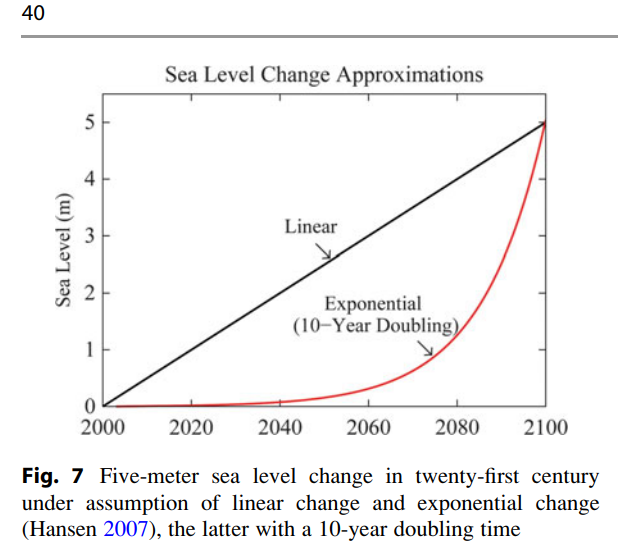
Exponential doomsday projections from the climate cult is not a rarity:

comment image

from:

Paleoclimate Implications for Human-Made Climate Change
James E. Hansen and Makiko Sato 2012 LINK

By 2100 that projection has sea level increasing a millimeter per day.

Sean2828
November 12, 2026 11:11 am

They forgot the effect of wealth on birthrate. As wealth increases in an economy, the fertility rate falls. If we look at the money supply in the US at the beginning of each decade it is:

Year_____M2 Money supply _____US Birth Rate per 1000 people
1960 ____$300 billion _____________21
1970 ____$600 billion _____________17
1980 ____$1.5 trillion ______________15
1990 ____$3.2 trillion ______________14
2000 ____$4.7 trillion ______________14
2010 ____$8.5 trillion _______________12
2020 ____$16 trillion _______________11
2026 ____$23 trillion _______________10.5

Apparently, getting rich has saved the world!

Richard Voss
November 12, 2026 11:27 am

Knowing that statistical analysis in those days required tedious matrix algebra, I usually bend over backward to give such researchers a pass for sheer exhaustion. They are not the only ones to draw nonsensical conclusions from pure data extrapolation. But no real scientist thinks that a trend can have any meaning without proper theory to explain it. Curvilinear extrapolations do bend into the stratosphere (or down into the dirt) from time to time. It just takes a little more thinking to adjust the projection’s algorithm to fit reality. Besides, Malthus already tried this.

Editor
November 12, 2026 11:32 am

In 1993, Vernor Vinge popularized the concept of an impending singularity tied to an ever-increasing rate of development in computer power.

During the periods when disk drive capacity was increasing at a doubling time that was shrinking, I took a look comparing steady exponential growth (a fixed doubling time) with hyperbolic growth that had a vertical asymptote. The two tracked pretty well until just a few years before the singularity – just like disk drive capacity was increasing.

Of course, those capacity increases were due to employing “giant magnetoresistance (GMR)” effect read head, so the rate of progress would likely decline. Indeed, issues logic density was approaching physical limits – electrical circuits need to be more than one atom wide! I wasn’t too concerned about the singularity, but it made for some fun science fiction.

See https://frc.ri.cmu.edu/~hpm/book98/com.ch1/vinge.singularity.html for Vinge’s essay where he notes:

Large computer networks and their associated users may “wake up” as superhumanly intelligent entities.

Computer/human interfaces may become so intimate that users may reasonably be considered superhumanly intelligent.

Biological science may provide means to improve natural human intellect.

The first three possibilities depend on improvements in computer hardware. Progress in hardware has followed an amazingly steady curve in the last few decades. Based on this trend, I believe that the creation of greater-than-human intelligence will occur during the next thirty years. (Charles Platt has pointed out that AI enthusiasts have been making claims like this for thirty years. Just so I’m not guilty of a relative-time ambiguity, let me be more specific: I’ll be surprised if this event occurs before 2005 or after 2030.)

Chris Hanley
November 12, 2026 11:54 am

In 1996 the United Nations Environment Programme was predicting that by 2100 the global average temperature will also be approaching infinity:
comment image