Charles Blaisdell, PhD ChE
Abstract
The earth’s evaporation rate (mass/time/unit area) of water from oceans is higher than from land (2.4x). This evaporation rate from land includes water from vegetation, ground, dew, as well as liquid water and is referred to as EvapoTranspiration, ET. Ocean’s global annual ET(ga) rate is relatively constant while land’s rate can change with local changes in EvapoTranspiration. Because of this difference in ocean vs land the earth’s global annual ET(ga) is dependent on the size of the land and/or the amount of land under the sun’s zenith (both of which currently do not change). Historically scientists say the size of land and axis did change. This essay will propose a theory that calculates all three sources of the earth’s ET(ga) change and what could have happened to cloud fraction and the earth’s temperature.
A sigmoidal relationship is proposed for vapor pressure deficit, VPD(ga) vs global annual enthalpy, En(ga), and global annual cloud fraction, CF(ga), A model shows possible global temperature change from changes in the earth’s land mass, axis, local ET, and combinations of all 3.
A psychrometric chart will picture the two-step math in this natural climate change process to better understand the complex math.
Introduction
The four fundamental variables of atmospheric science are temperature, specific humidity (SH), pressure, and radiation. The first three variables are used by the Clausius Clapeyron law to describe their energy (Enthalpy, En) and their relative humidity, RH, etc. On a global daily basis these variables are quite hectic and are called weather. On a global annual basis things calm down to not much change except climate change. The Clausius Clapeyron law works for both daily and global annual data and can be seen in a psychrometric chart that somewhat simplifies this complicated relationship.
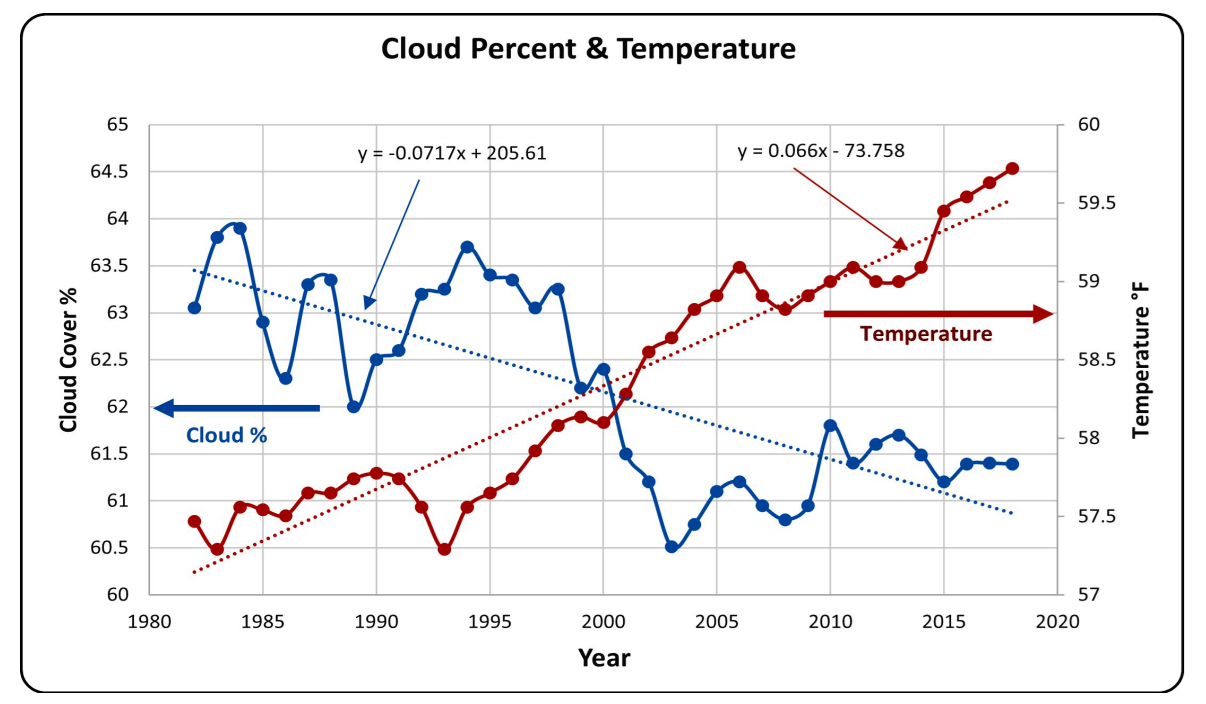
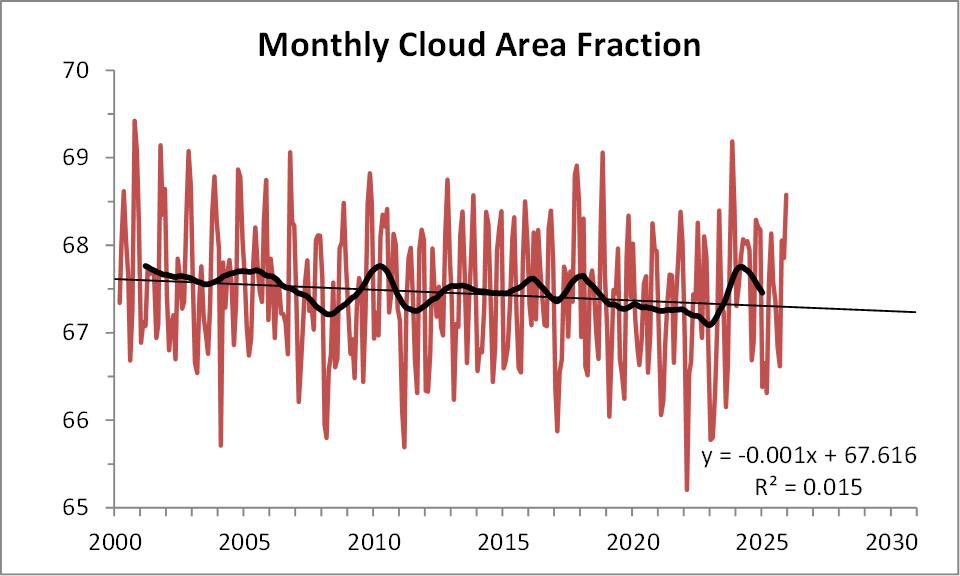
There is a consensus in the scientific community that the cloud fraction is the biggest uncertainty in climate change. The earth’s (about 60%) cloud fraction reflects about 50% of the sun rays. Prior to about 1980 little change in cloud fraction could be observed or measured it was assumed global cloud fraction was constant. Satellite data since about 1980 suggested that cloud fraction may be decreasing. A Cloud Reduction Global Warming, CRGW, theory (8) has been proposed to show how a natural sequence of related atmospheric processes can explain the cloud reduction and account for the observed increase in temperature, increase in specific humidity, and decrease in relative humidity.
From temperature and specific humidity, SH, the global annual Vapor Pressure Deficit, VPD(ga), can be calculated (8). VPD(ga) is a number that expresses how close the water concentration in the atmosphere is to the dew point, zero being the dew point (clouds highly probable) and the larger the number the less likely clouds will form somewhere on the earth.
Cloud fraction, CF(ga), measurement includes partly cloudy, high thin clouds, highly reflective rain clouds, and a lot of other cloud types with varying degrees of reflectivity. Enthalpy, En(ga) is a better indicator of non-reflectivity and is also correlates to CF(ga). VPD(ga) vs En(ga) does not have the baggage of CF(ga) and will be used in the model. Total enthalpy of the atmosphere has been shown to be equal to long wave radiation out (10) and at all altitudes including the surface data is proportional to long wave radiation out, see (10). Furthermore, ET(ga) is proportional to SH(ga), such that a change in ET(ga) = a change in SH(ga) and vs-vs.
Trenberth et al (2011) (12) documents total water evaporated/yr (Figure 9 in (12) ) from oceans, 413 (1000km^3/yr) and land at 73 (1000km^3/yr). The ocean data includes ice and clouds (62%) (both oceans and land). These measurements can be converted to ET(ga) per unit of earth’s surface area (1141(mm/yr/% of earth) for oceans and 494 (mm/yr/% of earth) for land), a 2.4 x higher ET rate from oceans. This difference in ocean vs land ET implies that any change in the earth’s land area, or percentage land under the sun’s zenith, or just land ET change may via CRGW theory change global temperature. This ocean vs land difference was observed in (18).
The Model
This is a first principles model not a statical model to show understanding of the proposed theory.
The model starts out with a reference year since ET(ga) and SH(ga) are proportional they need a real starting point (NOAA data between 1975 and 2024) . Next, a case study is chosen from any one or combination of: 1. change land size, 2. change axis shift of land under suns zenith, 3. change the ET of the land. Each case study calculates the ET(ga) (per year per unit area of earth’s surface) change from the ocean (and ice) and land ETs above (1141 and 494). Check the excel model attached for calculations. Table 1 gives some examples case from the model. Table 2 gives the input parameters and calculated ET(ga)s.
The model uses Clausius-Clapeyron derived Psychometric equations (see (8) for equations) and a sigmoidal graph of VPD(ga) vs Enthalpy, En(ga). The strategy of the model follows the path shown in Figure 1 and Figure 4. This path follows the adiabatic (constant En) line for increasing ET (SH) (to the left) or decreasing ET (SH) (to the right) to the point of SH(ga) change. Then follows the constant VPD(ga) line to the En(ga) predicted by Figure 2. (Follow VPD(ga) up for decreasing SH path, down for increasing SH path), see Figure 4 for a larger view of the path.
In Figure 2 the middle of the graph is NOAA data from (15) 1975 to 2024. The high and low asymptotes (all clouds and no clouds En(ga)) were calculated from Dubal (16) and Loeb (17) albedo data ratioed to known enthalpy data (adjusted for ocean and land area), all data at the same year. The parameters in the sigmoidal equation were then (by trial and error) fit to the data (20). Special attention was given to the sigmoidal fit matching the linear NOAA data. The sigmoidal graph allowed the model to work outside of the narrow NOAA range of VPDs.

Figure 1. Psychrometric chart showing the two-step process in the CRGW theory.

Figure 2. Sigmoidal fit of combined NOAA and CERES data.
The curious results of this model are that an initial decrease in earth’s ET(ga) will result in an increase ET(ga). This behavior can be seen on the psychrometric chart where the SH(ga) first decrease (for a -ET(ga)) on the adiabatic En line then increases on the constant VPD line per Figure 2. CRGW climate change is a two-step mathematical process where any time spent in the first step is only long enough to establish a new VPD to begin adjustment in cloud fraction. (Psychrometric charts are used by HVAC technicians to design air-conditioning systems, this is the first time constant VPD lines have been added to a Psychrometric chart to explain climate change, see Figure 4). The two-step process happens in yearly cycles leaving a trail of data on a diagonal with the two-step path from the starting point to the end point, if the change in ET is + or – or no change the observed data will be on the diagonal line, At either end of the sigmoidal graph this may change. At the end of the two-step path the resulting temperature and SH(ga must be solved by a convergence routine since the psychrometric equation contains mixed functions (log and linear). See attached model for equations.
The VPD(ga) vs cloud fraction is also a sigmoidal graph see Figure 3.

Figure 3. Sigmoidal graph of VPD vs Cloud Percent.

Figure 4. +/- ET(ga) change paths in the Model.
Other Model variables
Plumes occur over hot land and reach cloud level and can spread to cover areas larger than the surface they came from including the oceans. The hotter the more they spread. Plumes with low SH retard cloud formation (like a black parking lot). Plumes with high SH can make clouds (like a cooling tower). See (6) for more on plumes. The model uses plumes factors from 1x to 4x. Little research is done on global plumes other than we know they exist. The model shows plume factors can have a big effect on global temperature. The plume factors are set at 1x for size of land cases, and 2x for land under the sun’s zenith changes (for the expected hotter air), and 4x for special parcels where larger plumes are expected, see (6). The model applies the plume factor to the whole earth.
ET of special parcels like UHIs (urban heat Islands), land changes like forest to crop, or surface mining, see (8) for more on special parcels were estimated based on data from Mazrooei, et al (2021) (19). ET changes from +10 to -50 can be used.
Special parcel size is estimated at about 5 to 15% of the earth’s total land mass and growing, see (19) and (7) for more this.


Not in the model
Variations in the sun’s radiation to the earth. Easy to add just did not do it.
Volcanos also have historical climatic effects but appear to be short lived. Math like this essay may be applicable to volcanic effects on climate. Wet volcanoes (ones that have a lot of water in their plumes) cool the earth. Dry volcanoes (ones with just hot gas in the plumes) destroy clouds.
While CO2’s climatic effects are not discussed in this essay. CO2’s increase or decrease can be an indicator of changes in ET(ga) from vegetation. Decreasing CO2 indicates that vegetation is increasing the ET(ga) (more clouds, cooler), vs-vs. Current monitoring of CO2 concentration shows variation CO2 with the growing seasons.
Model results
The case studies in tables 1,2,3 show the earth’s temperature is very sensitive to axis rotation and land size. To the point that glaciers could be encouraged to grow or shrink with changes in the amount of land under the sun’s zenith (axis rotation), see (11), or change in the amount of land. Either one could be accented by vegetation changes.
The amount of increase in ET(ga) from cloud reduction seems to be related to the ratio of ET rate from oceans vs ET rate from land, for current data this ratio is 2-3 :1.
The historical coming and going of glaciers cloud be related to a series of cases like the following: Start at today’s conditions and rotate the earth so that less of the earth’s land is under the sun, (more clouds) the earth will cool. The earth’s vegetation will become more tropical near the sun’s zenith; (more clouds) the earth will cool more. Glaciers will grow, oceans will shrink, more land will appear, CO2 will decrease. Finaly enough land has appeared so that global ET increases (less clouds). The earth rotates back to more land under the sun’s zenith (less clouds). The earth becomes less tropical (less clouds) and the glaciers start to melt, seas rise and the earth returns to near current conditions.
Adding water to the atmosphere could return climate to 1975 conditions, but it is a lot of water.
Don’t worry about any of the cases, they will not happen in our time!
Discussion
Why wasn’t this theory already discovered (or has someone already proposed it and the author has not found it)? The answer could be simple: history could not see cloud change. The current climate change opened our eyes to the possible existence of this natural theory waiting to be discovered.
This expansion of the CRGW theory is intended to be a possible tool in the investigation of historical climate change to explore what did cloud fraction do as the earth changed over time and what future changes in the earth’s land mass might do to cloud fraction.
To the scientist that study earth’s changes over time: How well does this theory fit possible historic climate change vs earth’s land changes?
Thank You Anthony
For promoting diversity of thought
Bibliography
Author’s Papers
- Where have all the Clouds gone and why care? – Watts Up With That?
- CO2 is Innocent but Clouds are Guilty. New Science has Created a “Black Swan Event”** – Watts Up With That?
- More on Cloud Reduction. CO2 is innocent but Clouds are guilty (2023). – Watts Up With That?
- An Unexplored Source of Climate Change: Land Evapotranspiration Changes Over Time. – Watts Up With That?
- VPD, Vapor Pressure Deficit a Correlation to Global Cloud Fraction? – Watts Up With That?
- Soundings, Weather Balloons, and Vapor Pressure Deficit – Watts Up With That?
- Not that ET! The Terrestrial ET: EvapoTranspiration, the Unexplored Source of Climate Change – Watts Up With That?
- CRGW 101. A Competitive Theory to CO2 Related Global Warming – Watts Up With That?
- More Evidence on Vapor Pressure Deficit, Cloud Reduction, and Climate Change – Watts Up With That?
- Can Annual Irradiance = Annual Enthalpy? If So, What Does It Show About Climate Change – Watts Up With That?
- Slicing the earth to study Cloud Fraction and VPD. – Watts Up With That?
Bibliography continued
- Atmospheric Moisture Transports from Ocean to Land and Global Energy Flows in Reanalyses (2011) by Kevin E. Trenberth, John T. Fasullo, and Jessica Mackaro web link Atmospheric Moisture Transports from Ocean to Land and Global Energy Flows in Reanalyses in: Journal of Climate Volume 24 Issue 18 (2011)
- “HUMIDITY CONVERSION FORMULAS” by Vaisala Oyj (2013) web link Humidity_Conversion_Formulas_B210973EN-F (hatchability.com)
- Climate Explorer web site Climate Explorer: Select a monthly field (knmi.nl) .
- Physical Science Laboratory Monthly Mean Timeseries: NOAA Physical Sciences Laboratory
- “Radiative Energy Flux Variation from 2001–2020” (2021) by Hans-Rolf Dübal and Fritz Vahrenholt web link: Atmosphere | Free Full-Text | Radiative Energy Flux Variation from 2001–2020 | HTML (mdpi.com)
- Norman G. Loeb,Gregory C. Johnson,Tyler J. Thorsen,John M. Lyman,Fred G. Rose,Seiji Kato web link Satellite and Ocean Data Reveal Marked Increase in Earth’s Heating Rate – Loeb – 2021 – Geophysical Research Letters – Wiley Online Library
- Figure 4 in 5 above and Met Office Climate Dashboard web Link Humidity | Climate Dashboard (metoffice.cloud)
- . “Urbanization Impacts on Evapotranspiration Across Various Spatio-Temporal Scales” (2021) by Amir Mazrooei, Meredith Reitz, Dingbao Wang, A. Sankarasubramanian web link Urbanization Impacts on Evapotranspiration Across Various Spatio‐Temporal Scales – Mazrooei – 2021 – Earth’s Future – Wiley Online Library
- StackOverlow Q and A scipy – Fit sigmoid function (“S” shape curve) to data using Python – Stack Overflow