The Week That Was: 2026-03-07 (March 7, 2026)
Brought to You by SEPP (www.SEPP.org)
The Science and Environmental Policy Project
Quote of the Week: “…science as a method of finding things out. This method is based on the principle that observation is the judge of whether something is so or not. All other aspects and characteristics of science can be understood directly when we understand that observation is the ultimate and final judge of the truth of an idea.”— Richard Feynman, “The Uncertainty of Science” in The Meaning of It All: Thoughts of a Citizen-Scientist
Number of the Week: 80%
THIS WEEK:
By Ken Haapala, President, Science and Environmental Policy Project (SEPP)
Scope: This TWTW begins by noting the US withdrawal from the UNFCCC. It mentions Howard Hayden’s essay that the IPCC has made no effort to understand the greenhouse effect. TWTW discusses the findings by Roger Pielke Jr., that parts of the Climate chapter of the new US Reference Manual on Scientific Evidence may have been ghost written. TWTW discusses that the balance of the manual is incomplete and excluded the scientific method. TWTW concludes with a suggestion of what we know about the greenhouse effect based on physical evidence.
*********************
Withdrawal: The parent organizations of the UN Intergovernmental Panel on Climate Change (IPCC) are the World Meteorological Organization (WMO) and the United Nations Environment Programmme (UNEP). In 1992 under President G.H.W. Bush, the US joined the United Nations Framework Convention on Climate Change (UNFCCC) which is a formal treaty that was ratified by the Senate. It is questionable whether the ratification had conditions that were not met. (Later that year President Bush lost the election to William Clinton).
According to the UNFCCC web site, the UNFCCC:
“Sets a lofty but specific goal.
The ultimate objective of the Convention is to stabilize greenhouse gas concentrations ‘at a level that would prevent dangerous anthropogenic (human induced) interference with the climate system.’ It states that ‘such a level should be achieved within a time-frame sufficient to allow ecosystems to adapt naturally to climate change, to ensure that food production is not threatened, and to enable economic development to proceed in a sustainable manner.’
How do we know what is ‘dangerous anthropogenic interference’? See IPCC’s Reports.”
This implies that the IPCC reports have an internal incentive of ensuring that human emissions of carbon dioxide and other greenhouse gases are considered to be dangerous. But the dominant greenhouse gas is water vapor, yet it is not discussed at all.
The UNFCCC is involved in other activities:
“UNFCCC and the Rio Convention
The UNFCCC is a “Rio Convention”. Its sister Rio Conventions are the UN Convention on Biological Diversity and the UN Convention to Combat Desertification. The three are intrinsically linked. It is in this context that the Joint Liaison Group was set up to boost cooperation among the three Conventions, with the ultimate aim of developing synergies in their activities on issues of mutual concern.
More information about the 3 Rio Conventions can be found here.”
Comment: It is ironic that the UN group to Comat Desertification does not consider that increasing carbon dioxide concentrations improve plant water efficiency, resulting in a greening of the deserts.
“UN Conference on Sustainable Development, Rio+20, 2012
2012 marked the 20th anniversary of the Rio Earth Summit. In the birthplace of the three Rio Conventions, the Rio 2012 summit took place on 4 to 6 June 2012. It focused on two themes: a green economy in the context of sustainable development and poverty eradication; and the institutional framework for sustainable development. [Boldface added here]
Read more about it, and about the follow-up, at the Rio 2012 website.”
Writing in WUWT, Anthony Watts states:
“According to the UN, the U.S. will officially be out of the UNFCCC on February 27, 2027. A withdrawal takes effect one year after the UN’s receipt of the notification of withdrawal (which in this case was February 27, 2026) or on a later date specified in the notification.”
The body of the letter states:
“UNITED NATIONS FRAMEWORK CONVENTION ON CLIMATE CHANGE
NEW YORK, 9 MAY 1992
UNITED STATES OF AMERICA: WITHDRAWAL
The Secretary-General of the United Nations, acting in his capacity as depositary, communicates the following:
The above action was affected on 27 February 2026.
The action shall take effect for the United States of America on 27 February 2027 in accordance with paragraphs 1 and 2 of article 25 of the Convention, which read as follows:
“1. At any time after three years from the date on which the Convention has entered into force for a Party, that Party may withdraw from the Convention by giving written notification to the Depositary.
2. Any such withdrawal shall take effect upon expiry of one year from the date of receipt by the Depositary of the notification of withdrawal, or on such later date as may be specified in the notification of withdrawal.”
No doubt this will lead to a big political fight in Washington. But unless the Supreme Court rules that the President exceeded his authority, it is doubtful that any near future president will rejoin the treaty which requires ratification of two-thirds of the senators voting. The hoops that President Obama made other nations’ delegates jump through to ensure the Paris Agreement was not a treaty demonstrated that ratification would be highly unlikely.
See links under Science, Policy, and Evidence and https://unfccc.int/process-and-meetings/united-nations-framework-convention-on-climate-change for the UNFCCC website.
*********************
No Effort to Understand the Greenhouse Effect: Several readers of TWTW had difficulty following the essay by Howard “Cork” Hayden “A Secret Unwittingly Revealed” on greenhouse gases and the greenhouse effect. The key point Hayden made is that the IPCC and the global climate modelers have made no effort to understand the greenhouse effect and how changing carbon dioxide concentrations influence global temperatures. Carbon dioxide is being demonized as a result.
This is important because the greenhouse effect is vital for most life on land masses because it slows the cooling of Earth at night, preventing a deep freeze that would kill growing plants. Further. carbon dioxide is essential for photosynthesis, the process that uses energy from the sun to chemically breakdown carbon dioxide and water and recombine them to form carbohydrates and oxygen. The carbohydrates are the food source for most complex life on Earth and oxygen is needed for all animals.
For Hayden’s essay see https://www.sepp.org/science_papers.cfm. The essay may not come up in Chrome.
*********************
Disturbing Findings: Last week TWTW discussed the possibility of a bitter fight over what constitutes scientific evidence in the Federal Court system. As discussed in the February 14 TWTW, the National Academies of Sciences, Engineering, and Medicine (NASEM) together with the Federal Judicial Center, wrote the new US Reference Manual on Scientific Evidence. Even though the Chapter on Climate Change has been thankfully dropped, the Manual contains assertions that are highly questionable in the fields of physical science. Such assertions include sections in the chapter “How Science Works.” H. Sterling Burnett of The Heartland Institute exposed a program lasting years to mislead Federal judges on the causes of climate change.
Roger Pielke Jr. has traced down that the Climate Change Chapter may have been largely ghost written by a person heavily involved in litigation by municipalities and states against oil and other fossil fuel companies. If Pielke is correct, and it appears he is, such involvement is disgraceful to NASEM and the Federal Judicial Center (FJC). After introducing the conflict over the Climate Change Chapter, Pielke writes [references omitted here]:
In reality, the FJC Manual represents a failure of scientific integrity. Let’s take a look.
Ghost authorship refers to when a substantial intellectual contributor to a work is unacknowledged as an author. The International Committee of Medical Journal Editors (ICMJE) — whose authorship standards are a reference point across scientific publishing — is explicit: any individual who made a substantial contribution to a work, drafted, and critically reviewed intellectual content, gave final approval, or accepts accountability for it must be credited as an author.
Relegating such a person to the acknowledgments is not a technicality. It is a violation of publication ethics. The Committee on Publication Ethics (COPE) treats ghost authorship as a form of research misconduct requiring correction of the authorship record.
The reason ghost authorship is taken seriously — in medicine, in the sciences, across research fields — is that authorship is not merely about credit, but accountability. Readers, peer reviewers, and the public rely on the author list to assess who performed the work resulting in publication, what their expertise and perspectives are, and what interests they may bring to the effort. Strip that information out and you undermine a central basis for trust in science and science as applied to policy.
Before getting to the ghost author, the chapter’s two named authors, Jessica Wentz and Radley Horton, were curious choices by the NASEM to be authors of a chapter on climate change and the law — in a supposedly neutral judicial reference guide.
Wentz and Horton are both affiliated with Columbia University’s Sabin Center for Climate Change Law, an institution whose mission is to advance climate litigation:
“The Sabin Center develops legal techniques to combat the climate crisis and advance climate justice . . . “
Wentz, a legal scholar, and Sabin Center non-resident senior fellow, has published extensively promoting climate litigation, co-authored a piece titled, “Holding Fossil Fuel Companies Accountable.” Horton is a research professor at Columbia’s Lamont-Doherty Earth Observatory and a long-time collaborator on the Sabin Center’s work in support of climate litigation.
The decision by the NASEM to select Wentz and Horton to co-author the chapter deserves scrutiny, independent of any other issues of substance or process.
However, the issues do not stop there — this is just the tip of the iceberg.
The FJC Manual’s chapter on climate change footnote 77 on p. 1586 notes curiously that its,
‘…discussion of attribution research has been adapted, and, in some cases, excerpted from the authors’ prior publications on this topic.’
The footnote references a 185-page law review article published in 2020, that Wentz and Horton co-authored with a third co-author — The Law and Science of Climate Change Attribution, published in the Columbia Journal of Environmental Law.
The lead author of that 2020 article was Michael Burger, the Sabin Center’s Executive Director. That article explicitly addressed how attribution science can be used in climate litigation and concluded that the body of attribution research was “sufficiently robust to support the adjudication of certain types of legal disputes.”
Using Claude AI, I conducted an analysis comparing the text of the FJC climate chapter with Burger et al. (2020).
The findings are unambiguous — Significant parts of the FJC chapter were taken from Burger et al. 2020, with quantitative details in the table below. [Table not shown here.]
Exact word-for-word matches of ten or more consecutive words and lightly reworded passages account for 41–48% of overlap in the Detection & Attribution Methods and Extreme Event Attribution sections of the chapter — arguably the most relevant to climate litigation.
A spreadsheet at the bottom of this post includes dozens of examples of overlapping text between the two documents. [Spreadsheet not shown here.]
The data are not ambiguous: Michael Burger co-drafted the source text that comprises nearly half of the chapter’s most substantive sections related to climate litigation, and he is acknowledged in the paper as a pre-publication reviewer of the chapter, meaning that he satisfies two independent authorship criteria as outlined by the ICMJE.
Clearly, he should have been listed as a co-author of the chapter.
Regardless of who Michael Burger is — or what any of us think about climate change or climate litigation — ghost authorship is a violation of scientific integrity.
But who Michael Burger actually is makes this much, much worse.
Michael Burger is Of Counsel at the law firm Sher Edling LLP, the law firm representing most of the cities and counties currently suing fossil fuel companies, and counsel of record for Honolulu in its active climate lawsuit. Further, according to its website, the Sabin Center he leads at Columbia University has been funded by ClimateWorks Foundation, the Rockefeller Family Fund, and others in support of climate litigation. [Boldface added here.]
Given these roles, inclusion of his name in the FJC climate chapter author list would have triggered an immediate and obvious red flag. Instead, the ghost authorship — which seems fairly obvious, despite footnote 77 — was missed in the extensive peer review process overseen by the NASEM.
Burger’s role as a ghost author of the FJC climate chapter is a sufficient basis for its retraction.
The peer review shortfall does not stop here. The FJC climate chapter includes an egregious misrepresentation of a finding of the Intergovernmental Panel on Climate Change (IPCC). The chapter asserts that the IPCC expressed “confidence in extreme-event attribution.”
However, the IPCC did no such thing.”
Pielke gives three examples of assertions in the chapter that are false.
“This brings us to NASEM, which is where the failures of scientific integrity described above should have been identified and mitigated, long before the FJC Manual was written and distributed to federal judges. However, the evidence suggests that the NASEM did not just fail to notice these failures but was (and continues to be) complicit in them.
For today, I’ll leave the last words to Jessica Weinkle, who has followed this issue as close as anyone over at Conflicted:
‘The Reference Manual controversy suggests NASEM is as good as captured by its philanthropic funders and their political agenda. If one wanted to move the needle on this sad situation and rebuild public trust in science to improve societal stability, then holding the FJC and NASEM to account is an ideal place to dig in. The end game should be to identify and scrutinize undesirable conduct and processes that clash with public expectations of an ethical research enterprise. Both entities are created by Congressional statute, so it is well within legislators’ purview to demand and deliver a public account of what is happening in science’s dark corners.’”
This is a sad phase in American science, but scientific integrity needs to be restored. and it appears that the leadership of NASEM cannot do so. See links under Challenging the Orthodoxy, for the opinion on the Climate chapter by the Wall Street Journal see Article # 1.
*********************
More on How Science Works: In “Muddling the Judiciary’s Understanding of Science” Sharon Camp of the CO2 Coalition wrote in part:
“The ‘How Science Works’ chapter of the ‘Reference Manual on Scientific Evidence’ allows for an overreliance on the unproven assumptions of computer models and an acceptance of ‘consensus’ as proof even when contradicted by empirical evidence.
This violates tenets of the hundreds-year-old Scientific Method that require data obtained through experimentation or observation of the physical world as the means of supporting scientific conclusions. The undue regard for models and consensus is emblematic of climate alarmists whose claims fail scrupulous examination and whose views are shared by at least one of the chapter’s authors.
Along these lines, the chapter even says that science cannot ‘disprove hypotheses,’ although science has done so many times. A famous example is geocentricism that was supplanted in the 1500s by the heliocentric theory of Copernicus. Others include phrenology, eugenics, spontaneous generation, and miasma theory of disease. All were embraced by much of the scientific community of their time – a consensus – until proven false. German scientist Alfred Wegener was dead for 30 years – and rejected by a consensus of his peers – before his theory of plate tectonics gained support in the last half of the 20th century.
The authors may misunderstand the Scientific Method. Or perhaps they believe that computer models relying on unproven assumptions that fail to explain or predict outcomes should be accepted over the extensive experimentation and observation required by the Scientific Method.”
The Manual has chapters on Statistics, Survey Research, Estimation on Economic Damages, Exposure Science, Epidemiology, Toxicology Medical Testimony, Neuroscience, Mental Health, Engineering, Computer Science, and Artificial Intelligence. However, there is nothing on the scientific method and the importance of physical evidence. It is as if physical science no longer exists. See link under Challenging the Orthodoxy.
*********************
What We Know: The biased Reference Manual on Scientific Evidence has prompted TWTW to begin lists on the greenhouse effect and the endangerment finding based on physical evidence: What we know; What we do not know; and What we know is not so (false). Reader suggestions are welcome. This week begins with What We Know:
- In the early 19th century astronomers wondered why Earth is warm enough to support life given its distance from the sun.
- Using early spectroscopy instruments measuring the interaction of light and matter, by 1861 John Tyndall identified that certain atmospheric gases are transparent to most electromagnetic energy (light) but block (delay) infrared energy. All objects absorb and emit electromagnetic energy. It is infrared energy that planets such as Earth (and our bodies) emit to space.
- By 1863, Tyndall identified that water vapor (aqueous vapor) was the dominant gas that keeps the land masses of Earth warm enough at night to prevent freezing of plants.
- Subsequent scientists misunderstood Tyndall’s experiments and assumed carbon dioxide was equivalent to water vapor, namely Savante Arrhenius in 1896. In 1906, Arrhenius repudiated much of what he wrote in 1896.
- Previous EPA assertions were based, in part, on the false assumptions of Arrhenius and others and false assumptions in global climate modeling.
- There is no justification for the previous EPA to ignore that water vapor is the dominant greenhouse gas.
- Under conditions of clear skies, we can calculate the greenhouse effect. Assuming no feedbacks, a doubling of CO2 will cause a warming of about 0.75ºC.
- The greenhouse effect is vital for most life on Earth – it prevents nighttime freezing of the surface.
- The greenhouse effect is self-limiting, subject to the law of diminishing returns.
- The two major greenhouse gases, primarily water vapor and secondarily carbon dioxide, are vital for most life on Earth. Through photosynthesis, green plants use the energy of the sun to chemically break down liquid water and carbon dioxide; then recombine the atoms to create a) carbohydrates, needed for all complex life, and b) oxygen needed for all animal life.
- To declare that increasing the greenhouse effect (namely carbon dioxide) endangers life, demands extraordinary evidence. The previous EPA had none.
- Subsequent to their primary calculations, global climate modelers add in water vapor which inflates the temperature influence of CO2, without physical evidence to support the addition. Water vapor is a critical part of Earth’s atmosphere influencing the temperature effects of other greenhouse gases. All of Earth’s atmosphere has water vapor, it must be a critical part of any global climate models, not an add-on.
- With water vapor in Earth’s atmosphere the greenhouse effect of methane and nitrous oxide are miniscule.
New research since the 2009 Endangerment Finding.
- Research published in Science magazine (2020) of 67 million years of deep ocean sediment data in numerous locations shows Earth going from Hothouse Earth to Icehouse Earth (terms used in Science) and that temperature changes are mostly unrelated to CO2 concentration changes (which the article cleverly covered up).
- Plate tectonics has changed the configuration of Earth’s land masses over millions of years. Any calculations of ocean temperatures going back further than the closing of the Caribbean Seaway (about 3 million years ago) need to include estimates of changing ocean circulation.
- Atmospheric temperature trends contradict model forecasts.
- Modern observational evidence based on spectroscopy instruments on weather balloons and satellites contradict the models and supports that CO2 emissions at most will cause a very modest increase in temperature (unnoticeable).
- NASA’s CERES project (from 2000 to 2023) recognized that 21st century warming came from increasing sunlight reaching Earth’s surface, not from increasing greenhouse effect. (Infrared energy emissions from Earth to space have increased, not declined.)
*********************
Number of the Week: 80%. Passed in 1970, the National Environmental Policy Act (NEPA) seemed like a good idea. But it was so vaguely written that it soon became a justification for delaying or stopping major improvement projects — including energy projects and projects designed to protect human life. Perhaps the most egregious example was using NEPA to stop a Corps of Engineers plan to build a movable barrier system along I-10; that would prevent a storm surge from a hurricane that hit east of New Orleans from flooding Lake Pontchartrain, then flooding the city. Environmental organizations such as Save Our Wetland, Inc., successfully sued to stop the project and bragged about their success. Then came Hurricane Katrina in 2005, which hit east of the city, flooding Lake Pontchartrain and overwhelming poorly constructed levees — which flooded about 80% of the city and killed over 650 people in the city. (Later, the Mayor of New Orleans was convicted for diverting Federal funds for the levees to political purposes.) The ads heralding the stopping the Corps of Engineers project disappeared.
The Department of the Interior has announced major reforms to the NEPA regulations:
“The reforms, led by Interior Secretary Doug Burgum and part of a whole-government approach, reaffirm the rescission of more than 80% of Interior’s prior NEPA regulations, with the majority of those regulations moved into a streamlined Departmental NEPA Handbook of Implementing Procedures. The regulations that remain govern when and how to comply with NEPA and which of the NEPA processes that should be used in the various decision-making processes and protect the ability of state and local governments to be part of the analysis process as required by NEPA itself.” [Boldface added]
See links under Washington’s Control of Energy and for the estimated deaths: https://ldh.la.gov/assets/docs/katrina/deceasedreports/KatrinaDeaths_082008.pdf
NEWS YOU CAN USE:
Commentary: Is the Sun Rising?
Stefani on the Sun vs. CO2 as climate drivers
By Andy May, WUWT, Mar 3, 2026
Challenging the Orthodoxy — NIPCC
Climate Change Reconsidered II: Physical Science
Idso, Carter, and Singer, Lead Authors/Editors, Nongovernmental International Panel on Climate Change (NIPCC), 2013
Summary: https://www.heartland.org/_template-assets/documents/CCR/CCR-II/Summary-for-Policymakers.pdf
Climate Change Reconsidered II: Biological Impacts
Idso, Idso, Carter, and Singer, Lead Authors/Editors, Nongovernmental International Panel on Climate Change (NIPCC), 2014
http://climatechangereconsidered.org/climate-change-reconsidered-ii-biological-impacts/
Climate Change Reconsidered II: Fossil Fuels
By Multiple Authors, Bezdek, Idso, Legates, and Singer eds., Nongovernmental International Panel on Climate Change, April 2019
http://climatechangereconsidered.org/climate-change-reconsidered-ii-fossil-fuels/
Why Scientists Disagree About Global Warming
The NIPCC Report on the Scientific Consensus
By Craig D. Idso, Robert M. Carter, and S. Fred Singer, Nongovernmental International Panel on Climate Change (NIPCC), Nov 23, 2015
http://climatechangereconsidered.org/why-scientists-disagree-about-global-warming/
Nature, Not Human Activity, Rules the Climate
S. Fred Singer, Editor, NIPCC, 2008
http://www.sepp.org/publications/nipcc_final.pdf
Challenging the Orthodoxy – Radiation Transfer
The Role of Greenhouse Gases in Energy Transfer in the Earth’s Atmosphere
By W.A. van Wijngaarden and W. Happer, Preprint, Mar 3, 2023
Dependence of Earth’s Thermal Radiation on Five Most Abundant Greenhouse Gases
By W.A. van Wijngaarden and W. Happer, Preprint, December 22, 2020
Net Zero Averted Temperature Increase
By Richard Lindzen, William Happer, and William A. van Wijngaarden, CO2 Coalition, June 2024
Radiation Transport in Clouds
By W.A. van Wijngaarden and W. Happer, Klimarealistene, Science of Climate Change, January 2025
Challenging the Orthodoxy
Who Actually Wrote the Climate Manual for Federal Judges
A textbook violation of scientific integrity standards
By Roger Pielke Jr., His Blog, Mar 5, 2026 [H/t Bernie Kepshire]
Link to: Reference Manual on Scientific Evidence, Fourth Edition
By Elena Kagan, et al., Federal Judicial Center, Dec 31, 2025
The Federal Judicial Center distributes hard copies of the Reference Manual on Scientific Evidence to the federal judiciary.
Ghostwriters for the Courts: The Climate Litigation Network Behind a Withdrawn Judicial Manual
By Charles Rotter, WUWT, Mar 6, 2026
Muddling the Judiciary’s Understanding of Science
By Sharon Camp, CO2 Coalition, Mar 3, 2026
#DoEDeepDive: Tornadoes, flooding and droughts, oh my!
By John Robson, Climate Discussion Nexus, Mar 4, 2026
Tornado strength is measured by the amount of damage done, and if a weak tornado passed through a rural area without damaging anything it may well not have been reported and possibly not even observed. Now, with radar covering everywhere, not to mention cell phones everywhere, any time a funnel cloud forms someone sees it and mentions it so even the weakest tornadoes are logged. But strong to violent tornadoes were always noticed so the count of those should indicate if there are trends.
Decarbonization and climate change hysteria died this winter: And no one cared.
By Alex Berenson, His Blog, Mar 3, 2026 [H/t Bernie Kepshire]
Defending the Orthodoxy
Reference Manual on Scientific Evidence
Fourth Edition. Washington, DC: The National Academies Press, December 2025
Global Warming Has Accelerated Significantly
By G. Foster, S. Rahmstorf, Geophysical Research Letters, Mar 6, 2026 [H/t Bernie Kepshire]
From the abstract: We remove the estimated influence of three main natural variability factors: El Niño, volcanism, and solar variation. The resulting adjusted and thus less “noisy” data show that there has been acceleration with over 98% confidence, with faster warming over the last 10+ years than during any previous decade. [Boldface added]
[SEPP Comment: Ignores the increase in solar energy hitting Earth’s surface, which the CERES project asserts was the primary reason for the warming during 2013-2023 as compared with the decade 2000-2010.]
2025 was hotter than it should have been – 5 influences and a dirty surprise offer clues to what’s ahead
By Michael Wysession. Professor of Earth, Environmental, and Planetary Sciences, Washington University in St. Louis, The Conversation, Mar 5, 2026 [H/t Bernie Kepshire]
If greenhouse gas emissions continue at a high rate, humanity may look back at 2025 as one the coolest years globally in the rest of our lives.
[SEPP Comment: Does recognize a decrease in air pollution, increasing solar energy hitting Earth’s surface, but gives a far greater importance to increasing CO2. However, as the CERES project showed, outgoing infrared radiation increased, not decreased, contradicting that increasing CO2 was the cause.]
Defending the Orthodoxy – Bandwagon Science
US lawmakers introduce marine carbon dioxide removal bill
By Nathan Strout, Seafood Source, Environment and Sustainability, Mar 3, 2026 [H/t Bernie Kepshire]
[SEPP Comment: The legislation failed in the last Congress, and it will again. Pure showmanship. Most sea life evolved when atmospheric CO2 concentrations where far higher than today.]
Questioning the Orthodoxy
Climate alarmists howl after EPA rescinds ‘Endangerment Finding’
By Paul Driessen, CFACT, Feb 23, 2026
Any actual endangerment to our health and welfare does not arise from using fossil fuels — and possibly adding a smidgeon to adverse (or beneficial) climate and weather changes. It comes from eliminating fossil fuels, relying on “renewable” energy that’s missing when most needed, and denying humanity thousands of essential petrochemical products.
If 1°C Destroys 20% of GDP, Why Did Nobody Notice?
By Charles Rotter, WUWT, Mar 1, 2026
Link to working paper: The Macroeconomic Impact of Climate Change: Global vs. Local Temperature
By Adrien Bilal and Diego R. Känzig, National Bureau of Economic Research, January 2026
Ten trillion here, ten trillion there
By John Robson, Climate Discussion Nexus, Mar 4, 2026
So the idea would be to spend $16 trillion more every two years starting in 2024, so we’d already have done it and be roaring toward $20 trillion total, while planning to get through hundreds of trillions more by 2050, all to fail to achieve something symbolic. (Indeed, Phil Jones of the infamous Climate Research Unit at the University of East Anglia said in 2007 that the then-crucial limit of 2°C was “pulled out of thin air”. As for 1.5, it was conjured up by politicians at COP21 in Paris without even a pretense of science.)
Run screaming: Rising CO2 has been detected in human blood!
By Jo Nova, Her Blog, Mar 3, 2026
Link to paper: Carbon dioxide overload, detected in human blood, suggests a potentially toxic atmosphere within 50 years
By Alexander N. Larcombe & Phil N. Bierwirth, Air Quality, Atmosphere & Health, Feb 26, 2026
[SEPP Comment: Jo Nova appropriately ridicules this paper presented in last week’s TWTW.]
Repeal of CO2 Rule Is a Return to Commonsense
By Vijay Jayaraj, CO2 Coalition, Mar 2, 2026
Critics of the Endangerment Finding point to its lack of a scientific basis for treating a beneficial gas like CO2 as hazardous. Hardly anything speaks to the absurdity more than the fact that everybody exhales daily two pounds of carbon dioxide.
Trump smashes the sacred climate totems, and no one even whimpers
By Jo Nova, Her Blog, Mar 5, 2026
Tidbits
By John Robson, Climate Discussion Nexus, Mar 4, 2026
Unfortunately, Willis Eschenbach chimes in with a claim that the CET [Central England Temperature record] is simply not standardized enough to draw long-term conclusions.
15 more inches of global warming
By John Robson, Climate Discussion Nexus, Mar 4, 2026
Even Copernicus, the European institution not the dead astronomer, concedes that:
“It seems counterintuitive that the colder LIA climate would generate more powerful midlatitude Atlantic cyclones than in the modern era, yet historical records show the LIA to be generally “stormier” with unusually powerful midlatitude hurricanes despite conditions that dampen hurricane energy.”
Energy & Environmental Review: March 2, 2026
By John Droz, Jr., Master Resource, Mar 2, 2026
Problems in the Orthodoxy
Climate Scientists Demand “A Global Assessment” of Risks
By Eric Worrall, WUWT, Mar 1, 2026
If we don’t act quickly, the tropical city of Belém in the Amazon Jungle might become uninhabitable!
Climate change is making climate change worse
By John Robson, Climate Discussion Nexus, Mar 4, 2026
Oh, and put it down to our puckish sense of humor. But we did an online search for whether Brazil is warming faster than the global average and you do not win anything for guessing that yes, it supposedly is, like everywhere else.
[SEPP Comment: See link immediately above.]
Can “The Silent Majority” and Media Intervention Drag Climate Action Back onto the Global Agenda?
By Eric Worrall, WUWT, Feb 28, 2026
China: the worlds biggest “polluter” misses target, aims lower, wants to govern everyone, and the crowd cheers?
By Jo Nova, Her Blog, Mar 6, 2026
Headline in Bloomberg, Mar 5, 2026: China Backs Paris Agreement, Aims to Lead Climate Governance
Social Benefits of Carbon Dioxide
We heard it through the grapevine
By John Robson, Climate Discussion Nexus, Mar 4, 2026
From the CO2Science archive.
Seeking a Common Ground
IEA’s 2026 Ministerial Meeting Was Its Most Consequential
By Neil Atkinson, Real Clear Energy, Mar 4, 2026
The IEA has done much excellent work in the past half century. With demand for all forms of energy certain to grow into the foreseeable future the IEA should have a key role to play in informing global society what is actually happening today and what is realistically likely to happen in the future. The days when aspirational, unrealistic, scenarios were hugely influential in guiding energy investment decisions are over. If the IEA listens to its critics, this will mean that the U.S. and other governments continue to support it. I hope this is the case.
Science, Policy, and Evidence
PUT ON NOTICE: The U.S. is Officially Pulling out of the U.N. Climate Cabal
By Anthony Watts, WUWT, Mar 3, 2026
US Withdraw from the United Nations Framework Convention Climate Change, New York, 9 May 1992
By The Secretary General UN, Feb 27, 2026
Make Forests Manageable Again
By Harriet Hageman, Real Clear Energy, Mar 3, 2026
The United States Forest Service created an environmental catastrophe when it issued the “Roadless Rule” in the final ten days of the Clinton administration. The lame-duck decree, which has now been in effect for over a quarter century, unilaterally roped off nearly 60 million acres of federal lands from effective management, including 3.2 million acres in Wyoming.
The consequence of this move was as predictable as it has been destructive. Road restrictions have created overgrown and monolithic forests that are more vulnerable to beetle outbreaks and other insect infestations, while excess fuels have been building up massive tinder boxes just waiting for predictable lightning strikes in our arid regions.
Measurement Issues — Surface
New computation method for climate extremes: Researchers reveal 10-fold increase in heat over Europe
Press Release, University of Graz, Via Phys.org, Mar 1,2026 [H/t Bernie Kepshire]
Link to paper: A new class of climate hazard metrics and its demonstration: revealing a ten-fold increase of extreme heat over Europe
By Gottfried Kirchengast, et al., Weather and Climate Extremes, March 2026
From abstract: Here we introduce a new class of threshold-exceedance-amount metrics that consistently track changes in event frequency, duration, magnitude, area, and timing aspects like daily exposure and seasonal shift—as separate metrics, partially compound (e.g., average event severity), and as compound total events extremity (TEX). Building on daily temperature datasets over 1961 to 2024, we applied the new metrics to extreme heat events at local-to country-scale (example Austria) and across Europe, demonstrating their utility through this use.
[SEPP Comment: How does the heat compare with that of 9000 years ago, or even the Roman Warm Period?]
Measurement Issues — Atmosphere
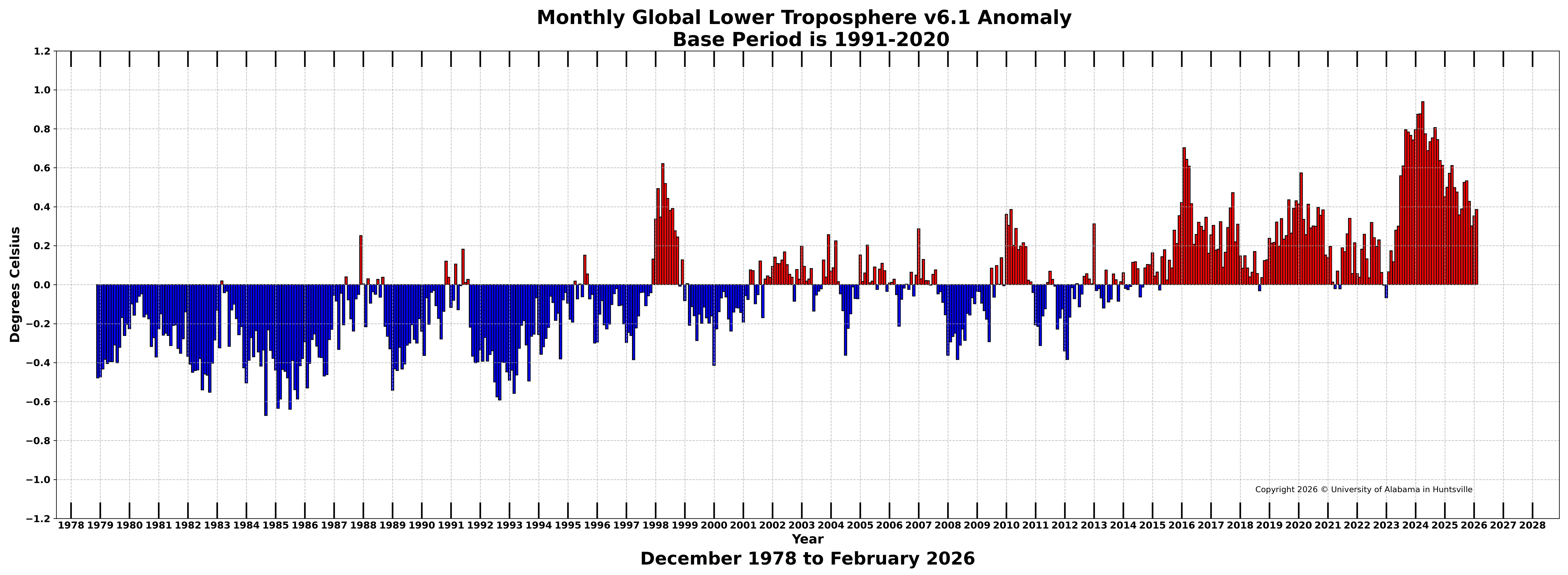
UAH v6.1 Global Temperature Update for February 2026: +0.39 deg. C
By Roy Spencer, His Blog, Mar 3, 2026
The Version 6.1 global area-averaged linear temperature trend (January 1979 through February 2026) remains at +0.16 deg/ C/decade (+0.22 C/decade over land, +0.13 C/decade over oceans).
Global Temperature Report
By Earth System Science Center, UAH, February 2026
Map: https://www.nsstc.uah.edu/climate/2026/202602_Map.png
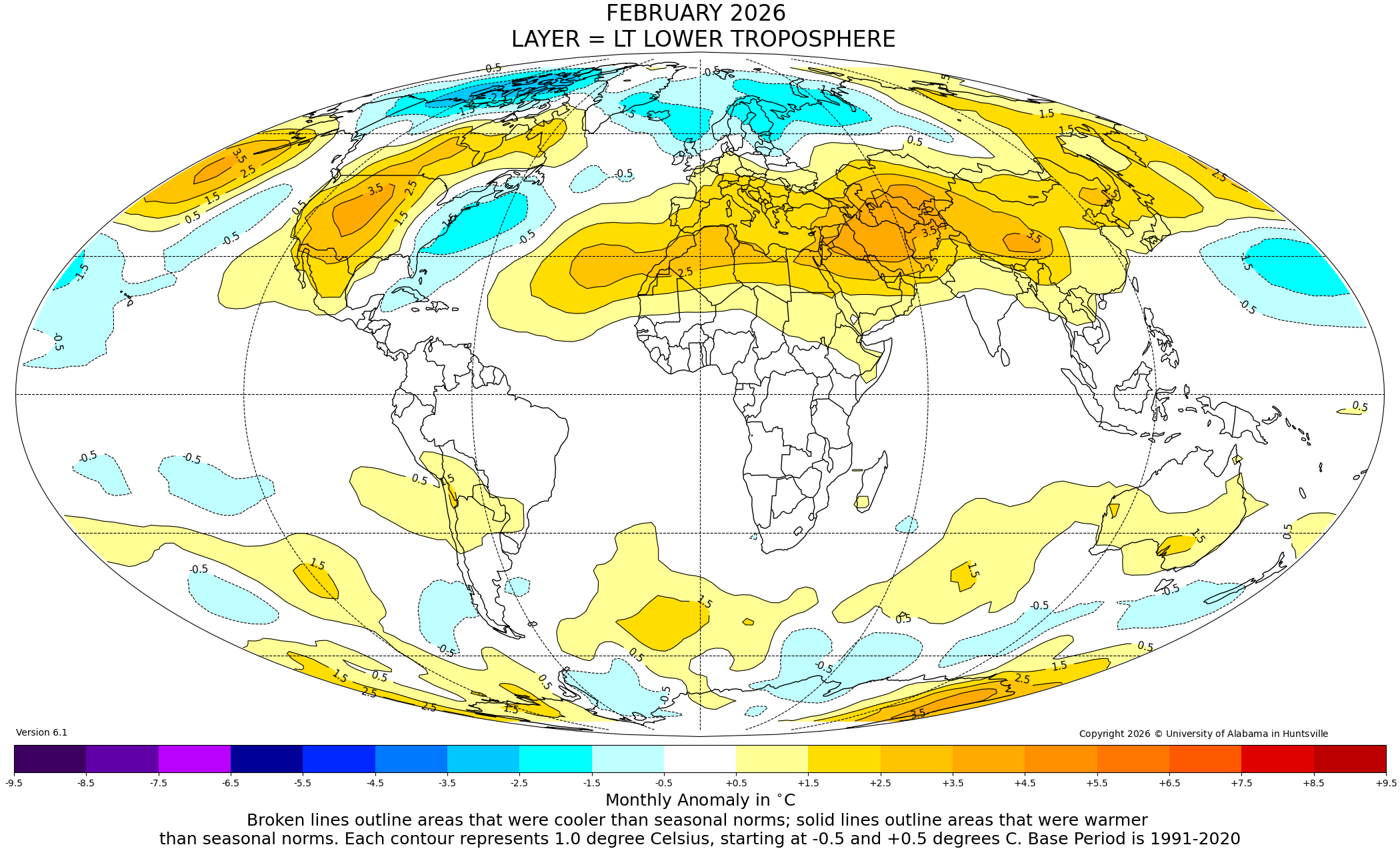
Chart: https://www.nsstc.uah.edu/climate/2026/202602_Bar.png
Text
By Robert Junod, John Christy, and Roy Spencer, Mar 5, 2026
Changing Climate
Matthew Wielicki on natural climate variability
By John Robson, Climate Discussion Nexus, Mar 4, 2026
Link to post: Natural Variability Is Larger Than Advertised
By Matthew Wielinki, Hs Blog, Feb 23, 2026
It gets worse… for the orthodox view. Within the Greenland ice core record itself the proxy record can be analyzed down to high time resolution showing that large climate changes happened and were abrupt. Wielicki notes:
“Many abrupt warmings unfolded over decades to a century, with some transitions occurring extremely rapidly. Yet there was no single, repeatable ‘script’ governing these events…. The authors conclude that this diversity reflects variability inherent to the climate system itself, not noise in the archive.”
New Study: A Century Warming Of 1.1°C Is ‘Commonplace’ And ‘Not Unusual’ During This Interglacial
By Kenneth Richard, No Tricks Zone, Mar 5, 2026
Link to latest paper: Is a 1.1°C Rise in a Century Unusual? A Study of Interglacials in the Epica-Vostok Dataset
By Les Hatton, Science of Climate Change, Accepted Jan 15, 2026
Changing Cryosphere – Land / Sea Ice
Glaciers Worldwide Are Suddenly Surging, Experts Blame Warming!
By P Gosselin, No Tricks Zone, Feb 28, 2026
[SEPP Comment: Glaciers surging, glaciers shrinking, all caused by CO2?]
Glacial cooling and climate sensitivity revisited
By Jessica E. Tierney, et al., Nature, Aug 26, 2020
From abstract: Our assimilated product provides a constraint on global mean LGM cooling of −6.1 degrees Celsius (95 per cent confidence interval: −6.5 to −5.7 degrees Celsius). Given assumptions concerning the radiative forcing of greenhouse gases, ice sheets and mineral dust aerosols, this cooling translates to an equilibrium climate sensitivity of 3.4 degrees Celsius (2.4–4.5 degrees Celsius), a value that is higher than previous LGM-based estimates but consistent with the traditional consensus range of 2–4.5 degrees Celsius.
[SEPP Comment: Using CO2 to estimate temperatures during last glacial maximum. The lack of CO2 caused widespread glaciation? See link immediately above.]
Vortex Slows Arctic Ice Recovery 2026 February End
By Ron Clutz, His Blog, Mar 1, 2026
Changing Earth
New Study: ‘Internal Noise’ And Volcanic Forcing Can Trigger 10-15°C Warming Within Decades
By Kenneth Richard, No Tricks Zone, Mar 3, 2026
Link to paper: Volcanism-induced collapse and recovery of the Atlantic meridional overturning circulation under glacial conditions
By Guido Vettoretti, et al., AAAS Science Advances, Geophysics, Feb 4, 2026
From the abstract: Here we incorporate realistic volcanic forcing into a large ensemble of glacial era–coupled atmosphere-ocean model simulations. These simulations are constrained by sulfate records from ice cores, which help estimate the timing of past major eruptions. We investigate how volcanic eruptions may have occasionally triggered abrupt climate change during the last glacial period. Our results show that very large equatorial eruptions can induce large changes in the Atlantic Meridional Overturning Circulation [AMOC] via atmospheric and ocean circulation changes and air-sea buoyancy fluxes, potentially pushing the climate system between persistent warm and cold states lasting millennia. A simplified perspective of the dynamics shows how unforced natural climate variability may exert a stabilizing influence decades after an eruption, especially as the system nears a tipping point.
[SEPP Comment: The study is an effort to explain D-O events based in Greenland but which occur worldwide. The temperature changes cited are from the North Greenland Ice Core Project (NGRIP). They are local, not worldwide. The paper suggests that the AMOC diffuses and transports the temperature changes worldwide.]
Changing Seas
The Sediments Don’t Support the 1.5°C Panic
By Charles Rotter, WUWT, Mar 2, 2026
Link to paper: Resilient tropical marine ecosystems during early Eocene global warming events
By Chris D. Fokkema, et al., Geology, Feb 25, 2026
From the abstract: Pacific. We conclude that tropical early Eocene phytoplankton communities were resilient to multimillennial-scale warming of up to ∼1.5 °C.
[SEPP Comment: Rotter’s comments are for VIP and Premium Subscribers only. According to the 2020 Westerhold study of deep ocean sediments, temperatures were up to 12 °C higher than today.]
Communicating Better to the Public – Use Yellow (Green) Journalism?
Media Say ‘Climate Change’ Caused the Deadly Lake Tahoe Avalanche. They’re Wrong.
By Anthony Watts, Climate Realism, Mar 3, 2026
The variety of headlines cataloged demonstrates something important: much of the media simply do not distinguish between atmospheric variability and long-term climate attribution. Instead, tragedy becomes narrative fuel.
Another Confusing Story Highlights Why Climate Hysteria and Far-Left Media Are Reaching Their End
By Gary Abernathy, Real Clear Energy, Mar 5, 2026
ABC’s Unscientific Attack on Trump and CO2
By Just Facts, Mar 4, 2026
Per the U.S. National Energy Technology Laboratory, CO2 is a “clear gas” that “occurs naturally” in the “Earth’s atmosphere,” is “part of the air that humans breathe,” is “essential to plant life,” and is “stable, inert, and non-toxic” at “standard temperature and pressure conditions.” https://netl.doe.gov/carbon-management
Communicating Better to the Public – Exaggerate, or be Vague?
The sea is higher than we thought and millions more are at risk, study finds
By Seth Borenstein and Annika Hammerschlag, AP, Via The Hill, Mar 4 2026
Link to paper: Sea level much higher than assumed in most coastal hazard assessments
By Katharina Seeger & Philip S. J. Minderhoud, Nature, Mar 4, 2026
From abstract: Here we show that more than 99% of the evaluated impact assessments handled sea-level and land elevation data inadequately, thereby misjudging sea level relative to coastal elevation. Based on our literature evaluation, 90% of the hazard assessments assume coastal sea levels based on geoid models, rather than using actual sea-level measurements. Our meta-analyses on global scale show that measured coastal sea level is higher than assumed in most hazard assessments (mean offsets [standard deviation] of 0.27 m [0.76 m] and 0.24 m [0.52 m] for two commonly-used geoids).
From article: Adjusting to a more accurate coastal height baseline means that if seas rise by a little more than 3 feet (1 meter) — as some studies suggest will happen by the end of the century — waters could inundate up to 37% more land and threaten 77 million to 132 million more people, the study said. Regionally, predominantly in the Global South, measured mean sea level can be more than 1 m above global geoids, with the largest differences in the Indo-Pacific.
[SEPP Comment: In areas without systematic measurement, the actual sea level may be higher than what was assumed. That does not mean that sea levels are rising faster.]
Communicating Better to the Public – Make things up.
Potsdam: Climate Change will Cut Sheep, Goat and Cattle Farming in Half by 2100
By Eric Worrall, WUWT, Mar 4, 2026
Link to press release: Climate change could halve areas suitable for cattle, sheep and goat farming by 2100
By Staff, Potsdam Institute for Climate Impact Research, Feb 9, 2026
Link to paper: Climate change drives a decline in global grazing systems
By Chaohui Li, et al., PNAS, Feb 9, 2026
From abstract: Here, we apply the safe climatic space framework to assess how changes in core climatic drivers of grazing suitability, including temperature, precipitation, humidity, and wind speed, will reshape global grassland-based grazing systems. [Boldface added]
[SEPP Comment: No comment on how the “safe climatic space framework” was determined. CO2 is essential for photosynthesis; increasing CO2 will reduce it?]
Communicating Better to the Public – Use Propaganda
Luvvie Does Not Know Difference Between Gigabytes and Gigawatts!
By Paul Homewood, Not a Lot of People Know That, Feb 28, 2026
[SEPP Comment: According to the Britannica Dictionary a luvvie is “someone (such as an actor or actress) who is very friendly in a way that does not seem sincere.”
The climate change course for people with learning disabilities
By Louise Cullen, BBC News, Mar 6, 2026
What is climate change training?
Climate change training teaches people about how their choices affect the planet and how they can do things differently to reduce their impact.
The plastic bag levy has been used to fund the training, provided by Keep Northern Ireland Beautiful.
Communicating Better to the Public – Use Propaganda on Children
Televised! Leading German Political Candidate Tells Schoolchildren CO2 Makes Sun Hotter!
By P Gosselin, No Tricks Zone, Mar 6, 2026
The incident particularly gained traction because candidate Hagel was positioned as an authority figure educating children, and the fact that he taught them incorrect information and didn’t know what he was talking about is particularly embarrassing.
Communicating Better to the Public – Protest
Mass Protests Planned Over AI “putting the UK’s climate targets at risk”
By Eric Worrall, WUWT, Mar 2, 2026
Green Jobs
Bad Bets: Massive EV Subsidies Not Paying Off
By James Varney, WUWT, Mar 1, 2026
The future was supposed to have arrived this year in a cluster of counties just east of Atlanta in the form of a state-of-the-art factory that would churn out 400,000 electric vehicles a year. But when JoEllen Artz looks about her lifetime neighborhood, all she sees are holes.
“Those shovel holes they made in the ground? That’s it,” she said of the planned site of a Rivian manufacturing plant. “It’s awful, awful.”
The problem is not a lack of funds. On the promise of thousands of jobs, elected officials in Washington, D.C., and Atlanta have pledged some $8 billion to the project, including a $6.5 billion loan the Biden administration green-lit in its final hours.
Litigation Issues
Climate Change Litigation: What a Nuisance!
By Barbara Pfeffer Billauer, ACSH, Mar 2, 2026
However, a new type of case is brewing in which one state (or locality) sues a private actor for harm to residents and their property.
Subsidies and Mandates Forever
Ethanol Mandates are Dead, Long Live SAF (Sustainable Aviation Fuel)
By Eric Worrall, WUWT, Mar 2, 2026
Link to proposed legislation: S.144 – Farm to Fly Act of 2025
Summary by CRS: Sponsor: Sen. Moran, Jerry [R-KS] (Introduced 01/16/2025)
From CRS Summary: Specifically, this bill includes sustainable aviation fuel as an advanced biofuel for the purposes of several USDA bioenergy programs that primarily provide support and incentives for renewable energy projects.
Energy Issues – Australia
Aussie Climate Minister’s “Let them eat cake” Moment
By Eric Worrall, WUWT, Mar 3, 2026
Bowen suggested Aussies should replace fossil fuel use with electricity, if they are worried about the impact of the Iran conflict on gasoline prices.
Energy Issues — US
Trump signs agreement with Big Tech to cover data center electricity costs
By Rachel Frazin and Miranda Nazzaro, The Hill, Mar 4, 2026
Mark Wolfe, the executive director of the National Energy Assistance Directors’ Association, told The Hill that the announcement was “a step in the right direction.”
“The details are important, though,” he added, specifically noting that the details of the rates that companies negotiate will matter.
Hochul Blinks When It Comes to Climate Act Costs
By Roger Caiazza, WUWT, Mar 2, 2026
The Climate Act mandates an electric system that relies on wind, solar, and energy storage. Wind and solar are diffuse, intermittent, and correlated resources that never will reduce costs for ratepayers, but clean energy advocates refuse to acknowledge facts. Diffuse resources require additional transmission and ancillary service investments, intermittent resources require costly energy storage, and correlated resources require DEFR technologies that are not proven so costs are unknown.
New York, Get Ready for Higher Energy Bills and Rolling Blackouts
Unless Governor Kathy Hochul can change course, the 2019 Climate Act’s unrealistic targets threaten the grid’s reliability.
By Ken Girardin, City Journal, Mar 5, 2026
In December, the state’s utility regulator, the Public Service Commission (PSC), ordered the city’s electric utility, Con Edison, to address the shrinking margin between peak electricity demand and supply. But because of the Climate Act, the PSC told the company to look only at “non-emitting solutions”—i.e., those that didn’t create additional greenhouse gases. It remains unclear how Con Edison will handle the next sweltering weekday afternoon.
Meanwhile, customer rates have surged across New York. As of November, bills were up an average of 7 percent over last year, and up a whopping 47 percent since 2019 on average.
AI Can Help Deliver America’s Next Phase of Energy Dominance
By Duncan Wood, WUWT, Mar 3, 2026
Energy dominance is not simply about resource abundance. It is about the ability to build infrastructure at the speed of market demand. When permitting timelines stretch into multi-year review cycles, projects face higher financing costs, regulatory uncertainty, and litigation risk. Even economically viable projects can stall.
Power the Future: Why America Must Win the AI Race
No delay. No hesitation. Only courage and determination to Power The Future for freedom.
By Daniel Turner, Real Clear Energy, Mar 2, 2026
Washington’s Control of Energy
Energy Exploration Is Under Attack, and Here’s What Needs to Change
By Thomas J. Pyle, Real Clear Energy, Mar 4, 2026
Link to press release: Trump Administration Delivers Historic NEPA Reform, Unleashing Resources on America’s Public Lands
Reforms cut red tape, accelerate approvals and restores NEPA as a procedural law.
By US Department of the Interior, Feb 23, 2026
Oil and Natural Gas – the Future or the Past?
Energy Dominance 2.0: LNG Edition, Part Deux
By David Middleton, WUWT, Feb 28,2026
The vast majority (85%) of the pipeline capacity built in 2025 will take Haynesville natural gas to Gulf Coast LNG export terminals.
Nuclear Energy and Fears
Trump II’s ‘Nuclear Renaissance”: A Government Play
By Robert Bradley Jr., Master Resource, Mar 4, 2026
Nuclear at 70: Federal Subsidies and Regulation Did Not Work
By Robert Bradley Jr., Master Resource, Mar 3, 2026
Sorry for the bad news. But the underlying fact is, nuclear fission is the most complicated, fraught, expensive way to boil water to produce steam to drive electrical turbines.
I invite any nuclear expert or energy scholar to challenge any of the above points or to reach a different conclusion about imminent competitiveness. After all, I am energy-and-technology neutral, thus not “for” or “against” nuclear fission (or fusion) per se. May the best energies win.
Alternative, Green (“Clean”) Solar and Wind
Energy Demand Is Rising. It’s Time to Let America Build.
By Lisa Jacobson , Heather Reams, Real Clear Energy, Mar 3, 2026
Link to report: Sustainable Energy in America 2026 Factbook
By Staff, Business Council for Sustainable Energy, 2026
[SEPP Comment: What is sustainable about electricity sources that fail repeatedly?]
Google Data Center in Minnesota Would Be Powered by Wind, Energy Storage
By Darrell Proctor, Power Mag, Mar 3, 2026
Link to: Energy Forward, The Next Chapter
By Staff, Minnesota Power, Accessed Mar 5, 2026
Minnesota has a law to ensure existing electricity customers do not pay the costs associated with connecting a large-load customer to the power grid.
Minnesota Power on Tuesday said the energy for the data center will come from 300 MW of wind power, and 400 MW of battery storage. [Boldface added.]
[SEPP Comment: Apparently Power Mag does not understand that batteries do not store power. They store energy. Battery systems should be given three ratings: The amount of energy they can store, the rate (power) at which they can be charged, and the rate at which they can supply power. If the battery system stores 400MW of energy and delivers 300MW of power, it will be depleted in less than 1.5 hours.]
Waste from “clean energy” piles up across the U.S.
By Bonner Cohen, CFACT, Mar 3, 2026
Solar Panels Replace Spanish Olive Trees
By Ron Clutz, His Blog, Mar 3, 2026
Wind farms push up household energy bills by £70 [a year]
By Paul Homewood, Not a Lot of People Know That, Mar 6, 2026
Alternative, Green (“Clean”) Vehicles
The EV Tax Bombshell Coming Down The Road
By Paul Homewood, Not a Lot of People Know That, Mar 1, 2026
Fuel duties currently bring in £26 billion a year, so we are looking at an eventual shortage of about £18 billion.
The only real answer is to phase in a tripling of pay-per-mile tax between now and 2030. EV owners need acquainting with real world realities. And it is easier to do that while they still drive petrol, as they will see they are no better or worse off when they go electric.
California Dreaming
Building the Abundant Water Coalition
By Edward Ring, Californians for Energy and Water Abundance, Mar 4, 2026
Link to: California Water Plan Update 2023
By Staff, California Department of Water Resources, 2023
With regulatory relief, safe harbor from litigation, and modular off-the-shelf plant designs that incorporate innovative new technologies, the capital cost to build seawater desalination plants with a total capacity of 800,000 AF/year [acre-feet per year about 987,000,000 cubic meters per year] could be under $15 billion. The financing cost of $837/AF (4%, 20 years) would be paid by ratepayers in Arizona and Nevada in exchange for Colorado River water, and the remaining operating cost, around $500/AF, would be easily absorbed by ratepayers in Southern California.
California will be a national security risk for the entire country!
By Ronald Stein P.E. and Michael Mische, America Outloud News, Mar 20, 2026
With no crude oil pipelines over the Sierra Mountains, California is an energy island separated from the crude oil supply and the infrastructure of oil refineries from the other 49 States.
[SEPP Comment: Pipelines connecting Southern California to Arizona and Nevada and beyond do not cross the Sierra Mountains which are north of the Mojave Desert.]
Health, Energy, and Climate
The price of stupidity
By John Robson, Climate Discussion Nexus, Mar 4, 2026
When it comes to quantifying the health costs of actual air pollution, there is a reason Britain took decisive action after the last monstrous “Great Smog” in 1952. Or rather, three reasons.
First, the smog was deadly. Second, the country was rich enough that the resources necessary to stop smog, including foregone activities as well as pollution abatement devices installed, was well worth it. Third, the wealth came from the same source as the pollution; without the massive increase in power generation due to the Industrial Revolution driven by coal then oil, there would have been neither the need nor the capacity to do anything.
Environmental Industry
The Radical Left’s Green Scam Is Running Out of Fuel
By Sydney Rodman, Real Clear Energy, Mar 3, 2026
BELOW THE BOTTOM LINE
The desolation of smug
By John Robson, Climate Discussion Nexus, Mar 4, 2026
News broke recently that our per capita income has fallen behind that of Alabama, a shock to the many Canadians who have long regarded the US south with self-satisfied derision. Chris Selley wrote in the National Post, “At least we’re richer than Alabama in complacency.”
‘Peak Rock’: The ONION Goes Neo-Malthusian (Fixity/ depletion curse expands)
By Robert Bradley Jr, Master Resource, Mar 6, 2026
Hairdressers could be a secret weapon in tackling climate change, new research finds
By Jo Nova, Her Blog, Mar 4, 2026
Link to press release: Hairdressers could be a secret weapon in tackling climate change, new research finds
By University of Bath’s Center for Climate Change and Social Transformations (CAST), Phys.org, Mar 3, 2026
Link to paper: Public engagement and climate change: exploring the role of hairdressers as everyday influencers
By Briony Latter, et al., Humanities and Social Sciences Communications, Feb 26, 2026
From press release: “…reveals that hair salons are hubs of trust, community and conversation where climate action can take root and spread.”
Abstract
Public engagement has a key role in the social transformations needed to address climate change, one form of which is climate conversations. This research focuses on a widespread and conversational space – hair salons. It engaged with sustainable salons across the United Kingdom and Republic of Ireland to explore these conversations in two studies. Thirty salon owners/directors were interviewed about hairdressers’ engagement with clients about climate change and sustainability (GoZero), and an intervention was conducted with 25 salons using eco-tips on mirrors to prompt sustainable hair care conversations (Mirror Talkers). The results show that hairdressers already have a strong understanding of public engagement, are able to ‘read’ clients and maintain trusting relationships. Climate and sustainability conversations are happening in sustainable salons and impacting clients’ mindset and behavior, with the intervention viewed positively. This paper argues that hairdressers are a prime example of ‘everyday influencers’ on climate change, but their potential has not been fully realized.
[SEPP Comment: Are the authors of the paper candidates to be authors of the next US Reference Manual on Scientific Evidence.]
Stop The War, Cos Global Warming!!!!!
By Paul Homewood, Not a Lot of People Know That, Mar 3, 2026
Libs Promise to Cut £600 Energy Bills by £800!
By Paul Homewood, Not a Lot of People Know That, Mar 5, 2026
ARTICLES
1. A Climate Manual Bait and Switch
The Federal Judicial Center’s biased crusade lives on.
By The Editorial Board, WSJ, Mar 2, 2026
TWTW Summary: The editorial begins with:
We told you recently about the Federal Judicial Center’s retraction of its biased chapter on climate science, and now the plot thickens. While the FJC said it had ditched the environmentalist portion of the manual for federal judges, the chapter lives on, published by the National Academy of Sciences (NAS).
On Feb. 6, the Federal Judicial Center director, Judge Robin L. Rosenberg, wrote in a letter to West Virginia Attorney General John McCuskey that ‘the Federal Judicial Center has omitted the climate science chapter from the Reference Manual on Scientific Evidence, Fourth Edition.’
Yet as of Tuesday the chapter still existed on the website of the NAS, where it continues to carry the name of the Federal Judicial Center. Judges may use it as a reference, without a disclaimer from the research and education arm of the federal court system.
In a Feb. 19 letter to National Academy of Sciences President Marcia McNutt and President-elect Neil Shubin, 21 state Attorneys General wrote that the chapter puts an official gloss on partisan climate-change policies. ‘Providing information to judges containing these significant issues,’ they write, ‘undermines the constitutional guarantee to an independent and impartial judiciary.’
Same goes for the FJC, whose authority comes from its role as an adviser to the federal court system, not a progressive research shop trying to push judges toward preferred rulings. The Fourth Edition’s climate chapter relies on the views of progressive climate lawyers and partisan ‘experts.’
The Gordon and Betty Moore Foundation partly funded the manual’s fourth edition, which includes a disclaimer that any ‘opinions, findings, conclusions, or recommendations’ in the report ‘do not necessarily reflect the views’ of funders. But the foundation has also donated money to the Collective Action Fund for Accountability, Resilience, and Adaptation, which makes grants to fund climate litigation.
FJC Foundation board member Elizabeth Cabraser and her firm, Lieff, Cabraser, Heimann & Bernstein, represent California in a suit claiming energy companies have been lying about their role in climate change. In 2020 the FJC Foundation’s website shows that ‘funds from the Environmental Law Institute paid the travel expenses for judges to attend a seminar on climate science.’
The article concludes with asserting that the connections show how the biased Manual found easy Oks at FJC and NAS. Since these organizations receive government funding they need Congressional oversight.