The geniuses who are planning New York’s energy future think that they can make intermittent wind and solar generators work to power the electrical grid by the simple device of providing some battery storage. The idea is that when there is abundant wind and sun, they can store up the power for use during those calm and dark periods in the winter. How much battery storage will that take? It’s a simple arithmetic calculation, but none of our supposed experts have taken the trouble to crunch the numbers.
Nevertheless, without any kind of feasibility study of whether this will work, they soldier forth building large grid-scale battery storage facilities. The battery building program is under way, at least to some degree, and a few such facilities are actually complete and operating out in the rural parts of the state. Meanwhile, there are plans for some much larger such facilities in New York City, including right in some of its most densely-populated sections. Is there any problem with this that we ought to know about?
In a post back in March 2024, I reported on the progress of our two “climate leader” states with developing grid-scale battery storage. It turned out that the big problem was that these facilities were subject to large and dangerous fires on a regular basis. In some cases the same facility would catch fire multiple times. That post reported on major fires in California at a site called Valley Center in San Diego County in September 2023, and at another one called Moss Landing south of San Francisco in September 2022. In January 2025, the Moss Landing facility had another major fire. From the EPA website:
On January 16, 2025, the Moss Landing 300 battery energy storage system at the Moss Landing Vistra power plant (Monterey County, Calif.) caught fire.
- The 300-megawatt system held about 100,000 lithium-ion batteries.
- About 55 percent of the batteries were damaged by the fire.
There were prior fires at the Moss Landing facility in September 2021 and February 2022.
Back here in New York, my March 2024 post reported on no fewer than three major fires at grid battery storage facilities in this state that had taken place during 2023. The following quote came from a piece at Canary Media from August 2023:
New York state is grappling with how to adjust its ambitious buildout of clean energy storage after fires broke out at three separate battery projects between late May and late July [2023]. . . . First, on May 31, a battery that NextEra Energy Resources had installed at a substation in East Hampton caught fire. . . . Then, on June 26, fire alarms went off at two battery units owned and operated by Convergent Energy and Powerin Warwick, Orange County; one of those later caught fire. On July 27, a different Convergent battery at a solar farm in Chaumont caught fire and burned for four days straight.
Might you have the idea that these fires are becoming less frequent over time? If so, that’s only because these fires are one of those things — like the Somali welfare fraud in Minnesota — that the liberal media just don’t choose to report. It turns out that the Convergent Energy facility in Warwick, New York had another big fire just last week. From Etica AG, December 22:
Late on the evening of December 19, 2025, a fire occurred at the Church Street Battery Storage Facility in Warwick, New York, operated by Convergent Energy & Power. While no injuries were reported and the fire was confined to a single container, the incident remained active into the following day and prompted a multi-agency response, air quality monitoring, and renewed scrutiny of battery energy storage system (BESS) safety in the community. For Warwick residents and local leaders, the fire carried added weight. The town has experienced multiple battery storage incidents in recent years, and each new event raises difficult questions about risk, emergency response, and whether existing BESS designs are suitable for locations near homes, schools, and small businesses.
I can’t find any mention of this battery fire at the New York Times or at major media sites like CNN or the major television networks.
The Convergent Energy Warwick energy storage facility has a capacity of 12 MW and 57 MWh. Meanwhile, back here in New York City, there are plans, well advanced (although not quite yet under construction), to build a much larger grid battery storage facility in Ravenswood, Queens. That would be right on the East River, directly across from East Midtown and the Upper East Side of Manhattan:

You can see on the map how close much of Manhattan is to this facility. To be fair, the wind usually blows the other way, but the parts of Queens near this facility are also very densely populated. Something called Queensbridge Houses — the largest public housing project in the country — is immediately adjacent.
The planned capacity of the battery storage facility in Ravenswood is 316 MW/2528 MWh — some 25 or more times the size of the facility in Warwick that has now caught fire at least twice.
A New York agency going by the name NYSERDA (New York State Energy Research and Development Authority) is leading the charge to build these energy storage facilities, including in densely populated areas like Queens. On their website, they have a page touting the new battery storage project at the Ravenswood location. Believe it or not, their sales pitch is that the new battery facility is cleaner and greener than the prior natural gas power plants on the site. Here is a quote they take from Queens Borough President Donovan Richards:
“The days of environmental and economic injustice in Western Queens, especially for our historically marginalized public housing families, are coming to an end. As we prepare to transform the Ravenswood Generating Station into a clean energy producer, it’s critical that the surrounding community reaps the benefits of that transition,” said Borough President Richards.
Somehow, both NYSERDA and Donovan omit to mention the issue of the fires.
What they would need to do is to replicate the Twin Towers (in size) with 2 buildings containing 100 floors each with each floor containing some 30 mega pack batteries. They could paint the bottom 2/3 of the Mega-Batterys with Black and the top 1/3 with Copper. Then place them in Battery Park.
The Copper top battery.
And make a special trap door, so that when they catch fire, the whole complex can be dropped to the Earth’s core.
Just place each battery pack in its own vault lined with silicon carbide or high-alumina bricks are typically required to reach temperature ratings of up to 4000°F.
That way only 1 can Flambé at a time
The idea was floated more than fifty years ago that gigantic gravity-weight energy storage towers be constructed in which huge lead weights were to be suspended from cables hanging inside of the tower’s cable shafts. Four or more cable shafts would be present inside of each tower.
During periods of low demand and excess power capacity at night, reversible motor-generator units would raise these massive lead weights to the top of the towers, and then recover the energy during the day when demand increased.
How many of these gravity-weight towers would be needed to replace all of NYC’s peaker plants, the elimination of which Zohran Mamdani and the NYC City Council want to see accomplished by 2030?
There are a half-dozen or so of these Rube Goldberg type ideas. They have in common with large-scale Lithium batteries that they are bad ideas.
You have hit the nail on the head–float them! if they catch fire, cut the lines and send them out to sea to the bottom of the Atlantic.
Out to sea?
Don’t we have enough marine life fatalities due to WTGs?
Why would you want to poison the ocean?
Better yet, build them in the “air rights” over Gracie Mansion in NYC and the governor’s mansion in Albany.
When they catch fire, drop them on the mansions so the idiots who think these are great ideas can suffer some of the consequences for a change.
Just eliminate the peaker plants immediately, because they are responsible for harming the “underserved.” That’ll show them, especially during the blackout caused by not having peaker plants.
BTW, I did a quick search for houses for sale in Queens and found a number of starter homes for the “underserved” for sale at $1,000,000+.
1 GW-hr is equal to 367 billion kg-m. So the Twin Towers, which were 415 meters tall, would have had to lift a total of 880 million kg to be able to return 1 GW-hr to the grid. New York City consumes an average of 153 GW-hr per day (according to Grok). So one day’s worth energy storage would require a mass of 135 billion kg falling from 415 m, or the equivalent of 1,350 USS Gerald R. Ford aircraft carriers. Not very practical.
Bryan A, here is another idea for copper top batteries …. a 12-unit grid-scale battery setup for NYC’s Battery Park, grouped into three four-unit battery packs.
The units are grouped into packs so that when a fire inevitably breaks out in one of the copper top units, only one of the three packs will initially be destroyed.
Presumably New York suffers from dunkelflaute-type conditions as we do in the UK, these periods often lasting a week or more?
If yes, what generation would be lost while wind and solar deliver precisely nothing?
Knowing that, it’s not difficult to work out what the weight and cost of the batteries required would be . . . and at that point it will be immediately apparent that the New York authorities are just as bloody stupid as the UK authorities.
Since the math skills in the US are declining rapidly–incoming freshmen at major universities have the skills of the average 8 year old–nothing involving math will be immediately apparent to anyone in New York.
So much for the show… “Are You Smarter Than A Fifth Grader?” They’ll need to change it to … “Are You Smarter Than The Average Congressman?”
I figured once, to totally energize NY City (Manhattan Island anyway) replacing all Heating Cooking and Transportation with Electric, and allow for backup storage recharging, would require an area the side of Connecticut to be completely covered with Solar Panels to energize the island by Solar. Allowing for a four hour window every 24 hours to harvest solar energy and with the potential winter decline in average production. Now there will still be numerous days every year especially in winter when the sun is uncooperative and battery storage will be depleted.
Hhhhmmm.
You know, maybe those nuclear power plants aren’t so threatening as we were always told after all, compared with battery storage compounds.
I know which one I would rather be near.
The plans for the nuclear plants that were going to be installed at Ravenswood are probably still lying around in a document vault somewhere. Maybe they could be revived and construction started.
Well said, Francis! Thank you.
Any o’ you call me Francis, and I’ll kill ya.
Sorry, watched Stripes again recently.
OK, Psycho.
For Leftists, if things are not reported in their Media, then they simply do not exist and never happened.
Battery storage facilities have hundreds of thousands of tightly packed batteries and all it takes is one to go into thermal runaway and the rest will follow. What do fire inspectors think of that scenario?
Incoming mayor Zohran Mamdani is appointing a new FDNY commissioner to head the department. It remains to be seen whether she will, or she won’t, acknowledge the dangers posed by grid-scale batteries being installed in and around NYC, and take action to deal with those dangers.
Her orders will be to totally ignore any such risk.
Of course it’ll be a “she”. 🙂 Probably a lesbian too.
Not necessarily. Could be “she” is a trans-gender identifying female.
You are correct on both counts. She is also an EMT not a firefighter, so she probably has no clue.
Mamdummy’s appointee has zero experience at fighting fires.
But she’s a star in the LGBTQetc. “community,” so that trumps such minor nits in terms of job qualifications in the empty minds of Democratic Socialists.
She has considerable experience in EMT response, but not in firefighting per se. If and when a seriously toxic cloud of smoke erupts from a fire in one of these NYC grid-scale battery farms, that experience will be sorely tested. However, she is not likely to be proactive in objecting to the installation of these in-city battery farms. Because if she did, she would be instantly fired.
And the fire fighters who’d likely be injured by the extremely toxic smoke of such a fire.
A prior review of Li-ion cells provided by the manufacturer claimed the failure rate was 5 ppb (5 x 10^-9). The failure rate is for the life of the cell. There was no time related metric offered.
It is well known that the failure rate increases will age and is affected by temperature. No one is revealing that data for these newly produced firebombs.
Current world production is several billion per year.
There will be fires.
There will be thermal runaway effects.
There will be disasters of unimaginable magnitude.
Welcome to the Nut Zero future.
A fire like Moss Landing, in a dense urban site? I would call allowing that sort of situation depraved indifference.
Munitions storage would be rather
safer.
I have been to Moss Landing and it is surrounded by wide-open spaces on the west side of the mountains. That may be why the locals have not gathered their torches and pitchforks in protest.
Having a job that deals with ordnance, large solid fuel rocket motors are classified as ordnance, the munitions storage is much, much safer.
Not so fun factoid. My fiancé and I visited Moss Landing over Labor Day weekend (she is an avid wildlife photographer, and we were going out into Monteray Bay humpback whale watching). Moss Landing harbor is where the famed Elkhorn Slough estuary meets Monterey Bay.
The battery complex at Vistra is about a mile inland, just south of Elkhorn Slough. In the battery fire, almost the entire Elkhorn Slough was badly chemically contaminated. Real present concerns that these poisons will be uptaken by the shellfish and fish that are the prime food sources there for the recovering sea otters, eventually poisoning the otters. Too early to tell how bad it will be.
For NYC, a battery storage facility fire would be the equivalent of the Paris Notre Dame fire whose fire destroyed lead sheathed roof contaminated the entire arrondissement.
Google AI has this to say about the fire:
The Notre Dame fire contaminated areas in Paris’s 1st, 4th, 5th, and 6th Arrondissements, particularly downwind (the Left Bank) and immediately around the cathedral, with hazardous lead dust from the melted roof, leading to clean-up efforts in schools and businesses in these districts.
Key Affected Areas:
Contamination Details:
BB,
But has any person been admitted to hospital, or pronounced dead, as a consequence of this elevated lead in Paris?
The US allows diagnosis of Lead poisoning not traditionally on clinical symptoms appearing, but on the level of Lead in the blood being above a prescribed number. This number, being a subjective guess, can be considered fairly useless if it sends hordes of well people to hospital or alternatively fails to send people to hospital when they need care. One problem is that individuals have not been shown to have a uniform response to Lead ingestion so that some folk can swallow larger amounts than others without harm. Put another way, people can be not sick, a little sick or rather sick, all while having the same level of blood Lead.
The alarmist community celebrates Lead as the poster child for metal toxicity, about the same as Mercury. Yet, like many activist causes, the basis for hysteria fails when the science is treated fully and carefully.
For example, the number of death certificates issued with Lead poisoning in the US each year is about 15. Many of these are from drinking illegal moonshine distilled through pipes with Lead solder joins.
I have prepared a “hard” science review of Lead toxicity including research from former global go-to experts here in Australia, but nobody seems to want to read it in its packed 60-page form. It appears that it is something of a personal inconvenience to volunteer to update your ideas about contentious subjects, like it is too much mental effort so why bother? So the public mostly goes along with the woke mob rather than face neutral reasoning from cold hard data. We live in sad times. Geoff S
Indeed, Geoff. Show me the bodies.
One young socialist that I talked to back in college declared that he didn’t want to be relatively safe, he wanted to be safe.
He wanted a guarantee that nothing bad would ever happen to him, and he felt that he was entitled to this guarantee.
Tell him to take up residence on a desert island and learn how to fish.
You need to mix and stir with AI then send it to Climate Central for media distribution.
/sarcasm
Did they use lead when they rebuilt it?
had to google “arrondissement”
It will be worse that the Notre Dame fire. That fire did not spread.
I seem to recall that the reason NYC went for Tesla’s AC, which could be transmitted over long distances, is that Edison’s DC would have required lots of small generators close to the consumers, which necessitated much shorter transmission links coupled with the combustible fuel infrastructure. We seem to be heading back in time, only this time with added combustion.
Does anyone get the impression that the bozos running NYC electricity supply are just downright f’n clueless?
A bunch of MadManis
Mamdummies
As The Rocketeer was noted to say…
I like it
Or just plain old fashioned crooked…or Democrats. Follow the money maybe?
It’s all part of the plan.
The primary reason Edison’s DC generation did not gain traction is to efficiently transmit DC current across great distances required very high voltage (>> 1 kVdc). AC can have the voltage boosted by transformers. The AC losses in transmission are somewhat higher than DC, but the simplicity of generation and transmission had real economical advantages pointing to AC. Safety, too.
Yes, my rule of thumb when talking to students is to say that DC starts becoming cost effective at distances over 1000km when the savings in reactive power losses outweigh the costs of converting AC-DC and DC-AC, unless you’re talking of back-to-back connection of networks with different frequencies.
LOL! This will be a ticking time bomb in NYC and will likely lead to severe curtailment in this ‘renewables’ experiment.
The long term health consequences of those that live near these battery storage farms should be significant.
The big question that I have is how many fires in NYC will it take before the morons abandon this half baked idea.
The New York battery facility will be perfectly placed for viewing the fire from all of New York City.
Everyone in New York City will get educated on the disadvantages of battery storage facilities.
I think battery facilities have a bad reputation already. There are groups in my area (Oklahoma) protesting the building of such things. It will be interesting to see how the people of New York City will react to these battery facilities.
“Everyone in New York City will get educated on the disadvantages of battery storage facilities.”
I suppose you mean those that survive the toxins released and did not end up in homeless shelters begging for food on the streets.
” As we prepare to transform the Ravenswood Generating Station into a clean energy producer,”
Producer? I don’t think so. Maybe I missed the producer part.
Batteries do not generate or produce electricity !
Technically speaking electrochemical cells do produce/output D.C. current when a load is attached. Electricity in its common definition is A.C.
You are correct in that they do not generate electricity.
For that matter, they don’t even store that much…
Only if you fill it with millions of coppertops.
Since they clear have zero concern for the people of NYC perhaps it should be pointed out the toxic plume emitted by these fires will kill thousands of marine animals/fish. Oh, yea, they don’t give a shyte about them, either. Never mind.
Didn’t or doesn’t NYC dump vast amounts of its garbage offshore? And that area is now 100% dead.
They dumped massive amounts of it on Staten Island, if that’s what you mean by “offshore.” 😉
Years ago I recall seeing a video of huge barges full of NYC trash. I think they went out some distance from the city but not very far. It said there were many square miles of sea bottom totally dead.
From Google AI:
When Lithium Iron Phosphate (LFP) batteries catch fire or experience thermal runaway, they release a complex mixture of toxic gases, flammable vapors, and hazardous particulates. While LFP batteries are generally considered safer than other lithium-ion chemistries due to their high thermal stability, they still emit significant hazards when compromised.
Primary Gaseous Emissions
Often detected in smoke from burning electrolyte and battery components.
Particulate and Chemical Fallout
Health Symptoms of Exposure
Exposure to these fumes, even briefly, can result in immediate or delayed health issues:
I should add that Hydrofluoric Acid, HF is insanely toxic and dangerous. It has no known safe exposure level. To put these batteries 200 yards from the most densely populated public housing project in the US is criminally negligent.
Not only in the immediate vicinity either, hydrogen fluoride, carbon monoxide are both less dense than air and being heated would mean a potentially lethal gas cloud, including denser sulphur dioxide and hydrogen cyanide could envelop a large portion of the city. If it happened to be raining then hydrofluoric acid and sulphurous acid could contaminate a significant area.
To build these thing when they are 100% unnecessary is criminally negligent no matter where they build them.
And in such a densely built area, you know they will be involved in a fire from a nearby structure, even if the battery facility itself is not the source of the fire.
LFP is one of a half dozen or so Lithium secondary (rechargeable) chemistries. I do not recall seeing which was to be used in the horror show.
Back in the early 1980s, due to my mistake, a lithium thionyl chloride (Li-SOCl₂) battery vented. I have a scar on my leg from this. Had the injury been a few inches to the left I would never have fathered children.
The cloud of gasses released shut the lab down. It took 4 hours to ventilate. The acid that formed when the gases interacted with water caused several co-workers to have sore throats.
That was a single D-cell.
The scale of the disaster waiting to happen is mind-boggling.
Can anyone point me to a simple explanation that compares energy (kW) and power (kWh)… we keep seeing “this battery facility can power 250,000 houses” or some such…but for how long.
here in NW Europe we are about to het an extended cold snap, with low wind speeds and low solar (by definition at this latitude at this time of year)
and still we get the push for batteries….
I ain’t buying it but need a simple calc I can share in comments….
I did a ChatGPT3 search for “A generalized statement like “this (battery) facility can power 250,000 houses” can be found in a lot of articles. Generally speaking what “KW” and “KWH” figures are used in these types of discussions?”. I got a wonderful and understandable response. Copy the question and do your own search. Generally, “Rule of thumb used by journalists & planners:
Any time you see a statement indicating that a ‘wind farm,’ a ‘solar farm,’ or a battery *storage* facility can “power xxx,xxx homes,” with the “xxx,xxx” being ANY NUMBER GREATER THAN ZERO, it is a BLATANT LIE.
None of that worse-than-useless crap can provide power for anything without 100% backup.
Joke from the 70’s: “Guess what happened: the East River caught fire and burned to the ground!”
Resistance is futile. You will be assimilated.
The insanity will continue until sufficient
damagesfatalities are accrued.There is a special section of hell for people who trade in terms like ‘environmental injustice’. Or perhaps they are just dumbfeks.
THE HORNSDALE POWER RESERVE; LARGEST BATTERY SYSTEM IN AUSTRALIA
http://www.windtaskforce.org/profiles/blogs/the-hornsdale-power-reserve-largest-battery-system-in-australia
The Hornsdale Power Reserve, HPR, battery system, 100 MW/129 MWh, in Australia, was the largest battery in the world in 2017. It is located near a 315-MW, French-owned wind turbine plant.
In 2017, various capital costs of the system were mentioned. About 1.5 y later, documents revealed the turnkey capital cost was about 56 million euros, about US$ 66 million, or 66 million/129,000 = $512/kWh; this was a low price, because Tesla was eager to obtain the contract. The URLs show the turnkey capital cost and an aerial photo of the system on a 10-acre site.
In 2019, the HPR rating was increased to 150 MW/193.5 MWh
https://www.mercurynews.com/2017/12/26/teslas-enormous-battery-in-australia-just-weeks-old-is-already-responding-to-outages-in-record-time/
https://en.wikipedia.org/wiki/Hornsdale_Wind_Farm
https://reneweconomy.com.au/revealed-true-cost-of-tesla-big-battery-and-its-government-contract-66888/
https://en.wikipedia.org/wiki/Hornsdale_Power_Reserve
NOTE:
– It is important to specify battery capacities, such as the capacity of 100 MW/129 MWh for the HPR. One without the other makes no sense.
– Prices of just the batteries is one thing, turnkey capital cost of an entire system is quite another.
– Tesla had to airship the entire Tesla supply from the US to Australia to comply with tight schedules.
Modes of Operation
The HPR revenues are derived from its primary functions, which are:
– The FCAS market, i.e., grid regulation. The battery rapidly performs small charging/discharging to help maintain grid frequency within narrow ranges, as specified by the grid operator. This service provides most of the revenues.
– Daily charging when wholesale prices are low, daily discharging when wholesale prices are high, a.k.a., arbitrage. This service provides a minor part of the revenues. See URL.
https://wattsupwiththat.com/2019/04/05/grid-scale-battery-nonsense-2019/#comment-2675705
If called on by the grid operator, the battery may serve to:
– Help mitigate the effects of load-shedding blackouts.

– Help provide stability to the grid during times when other generators are started, during times when sudden wind output decreases occur, or during times other network issues occur.
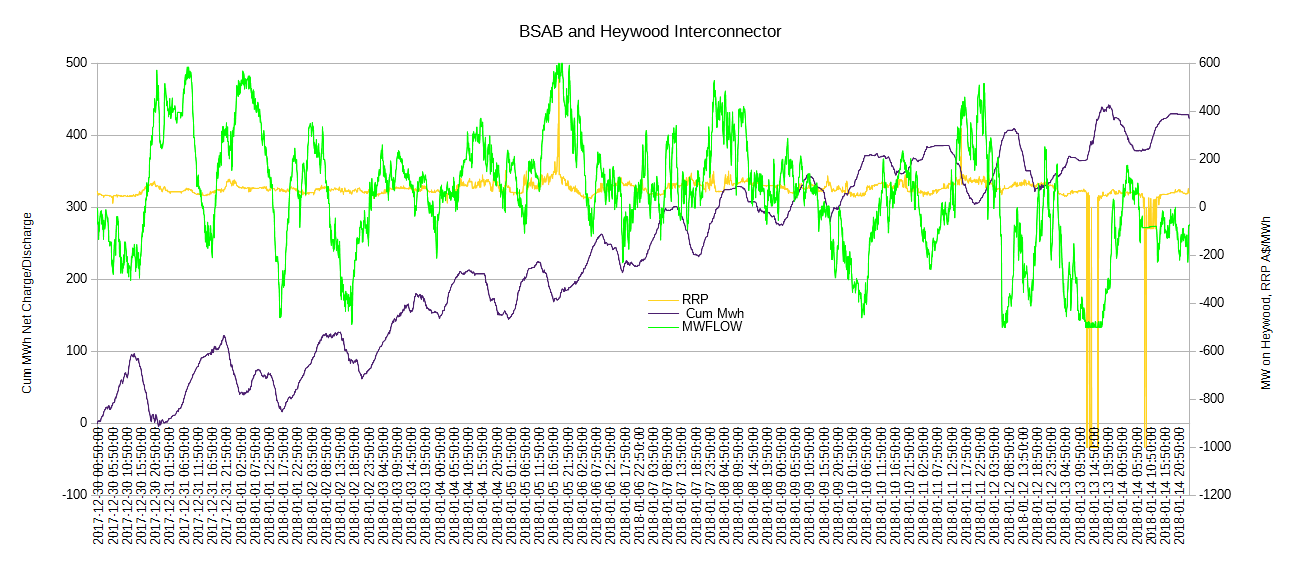
This chart shows cumulative net charge/discharge of the battery vs flows on the Heywood interconnector and the regional reference price (the actual flows on the battery are the rate of change of the cumulative position, which reveals losses in the system as it increases to a multiple of the capacity over the period). At the time, Heywood was thermally limited to 600 MW import, 500 MW export.
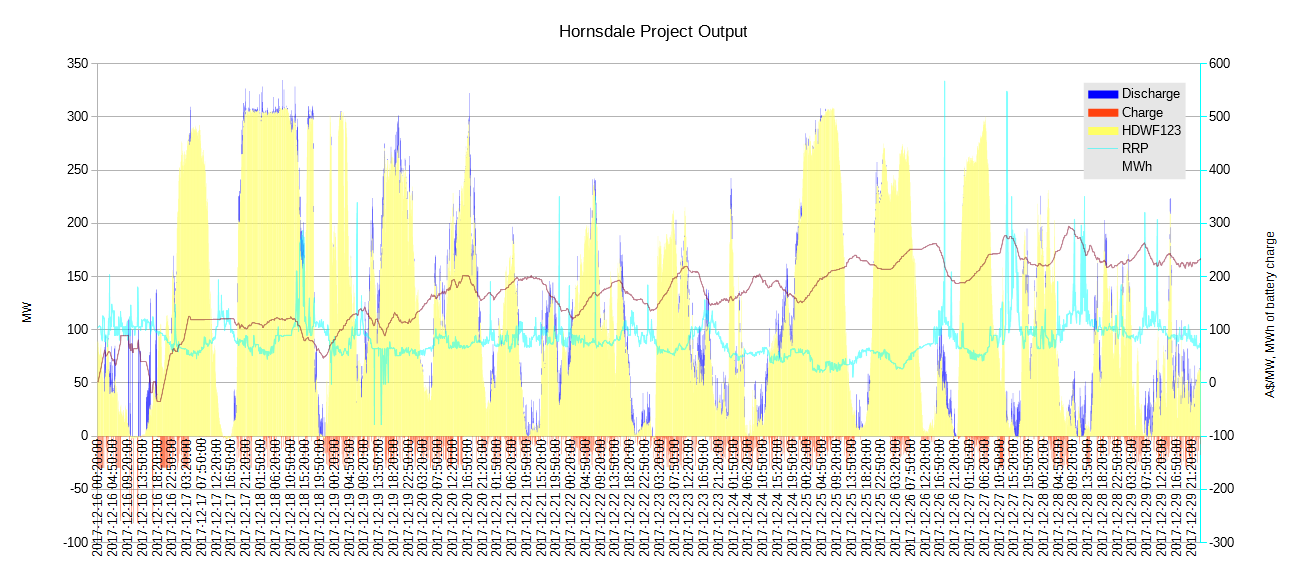
This chart shows the output from the Hornsdale wind plant and the charge/discharge of the battery (both as flows, and cumulatively)
It is evident HPR is not used to stabilize/smooth the highly variable wind plant output. It is primarily used for response to frequency deviations on the grid – the so-called FCAS market – a service which provides its day-to-day income.
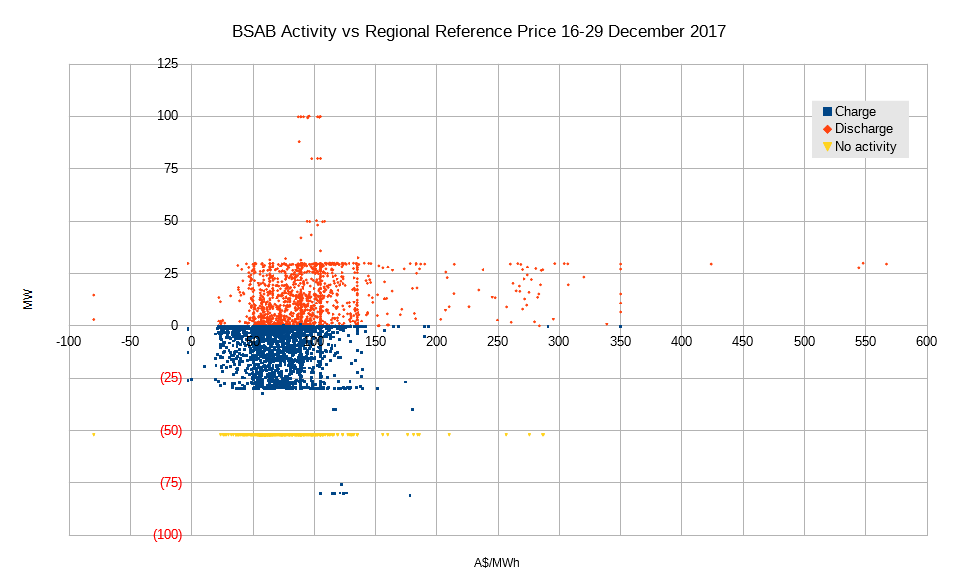
The monthly charge and discharge volumes give some indication of the modes of operation. The reality has been that the battery has made out like a bandit from FCAS grid stabilization revenues, which have often far exceeded energy arbitrage profits.
You can see the latest week’s operations at 5-minute resolution here:
https://opennem.org.au/facility/au/NEM/HORNSDPR/?range=7d&interval=5m
It seems, they had 2-3 days of shutdown. Perhaps they are installing some new Megapacks again – performance was dropping.
Because the battery spends a significant portion of its effort on grid frequency support, it performs small charging/discharging, 24/7/365, but, at the same time, it performs daily major charging/discharging for arbitrage purposes.
Strange.
We’re warned not throw dead 1.5 volt AA batteries in the trash to prevent fires yet they build AAAAAAAAA…etc. batteries within city limits.
Here is an article about two fires taking place at a very large battery system in Australia
THE HORNSDALE POWER RESERVE; LARGEST BATTERY SYSTEM IN AUSTRALIA
http://www.windtaskforce.org/profiles/blogs/the-hornsdale-power-reserve-largest-battery-system-in-australia
The Hornsdale Power Reserve, HPR, battery system, 100 MW/129 MWh, in Australia, was the largest battery in the world in 2017. It is located near a 315-MW, French-owned wind turbine plant.
In 2017, various capital costs of the system were mentioned. About 1.5 y later, documents revealed the turnkey capital cost was about 56 million euros, about US$ 66 million, or 66 million/129,000 = $512/kWh; this was a low price, because Tesla was eager to obtain the contract. The URLs show the turnkey capital cost and an aerial photo of the system on a 10-acre site.
In 2019, the HPR rating was increased to 150 MW/193.5 MWh
https://www.mercurynews.com/2017/12/26/teslas-enormous-battery-in-australia-just-weeks-old-is-already-responding-to-outages-in-record-time/
https://en.wikipedia.org/wiki/Hornsdale_Wind_Farm
https://reneweconomy.com.au/revealed-true-cost-of-tesla-big-battery-and-its-government-contract-66888/
https://en.wikipedia.org/wiki/Hornsdale_Power_Reserve
Addition
General Comments
The below image shows the efficiency (yellow line) decreasing from about 82% from Nov 2017 to about 75% (a loss of 25%) in April 2023, likely due to 5.5 years of aging.
The rapid aging may be due to the battery system being discharged and charged almost every day to maximize arbitrage revenues.
The HORNSDALE Power Reserve is one of the largest batteries in Australia
Almost all days, it is charged when rates are low and discharged when they are high; arbitrage mode.
Daily records show about a 20% round-trip loss; High voltage to High voltage
In early years, the batteries were charged to 90 to 100% and discharged to 10 to 0%.
It turned out, such a wide range of charge caused rapid aging, and increased round trip losses to more than 20%
Subsequently, Tesla recommended charging to at most 80% and discharging to no less than 20%, but the damage had been done. The
battery had been compromised.
NOTE: In non-arbitrage mode, such as grid regulation, the throughput is much less, at most 5%, and battery systems will last about 20 years.
The battery system capacity was expanded, and the entire system, old and new, is operated as one system.
The daily graphs show about a 20% loss, but capacity is still decreasing, due to rapid aging.
Hornsdale is one of the few to provide daily graphs to some people, but not the general public
Others carefully hide their data
On top of this misery, the battery systems, in arbitrage mode, last at most 15 years, before recycling/replacement is required.
The 2023 turnkey prices of large systems are about $550 to $600 per kWh, delivered as AC.
With high inflation and high interest rates, there is near-zero prospect of these prices decreasing in the near term, say at least 5 years.
https://www.windtaskforce.org/profiles/blogs/battery-system-capital-costs-losses-and-aging
There is no way, the rich part of the rich world can afford to go that route.
The poor part of the rich world just says, “adios”.
The poor part of the world, say no thank you.
We will stick with fossil, nuclear and hydro, for as much, and as long, as we can
Annual Revenues

Renew-economy has some analysis that benefits from some insider revenue information not available to the public. See URLs
https://reneweconomy.com.au/tesla-big-battery-it-earned-a-lot-more-money-in-second-quarter-80892/
https://reneweconomy.com.au/tesla-big-battery-turns-one-celebrates-50-million-in-grid-savings-95920/
Annual Operating Costs
A detailed spreadsheet analysis of the cash flow of HPR was not made for this article, because of a lack of public information. Various items of information would be required, such as:
– Return on Investment: Investors likely would require a return on investment of at about 10% per year.
– Bank Loan Interest: Bank loans likely would be at about 4% to 5% for 15 years. If $40 million were bank loans, amortizing at 5% per year for 15 years would require annual payments to the bank of $3.8 million per year.
https://www.myamortizationchart.com/15-year/5000-dollars/5_00-percent/
– Battery Life time: The life of the battery system would be about 15 years
– Battery Degradation: There would be battery degradation due to aging and use, i.e., more resistance to charging, less storage capacity, more resistance to discharging, which would be affected by the average level of daily throughput.
– Battery Charging/Discharging Loss: Battery charging/discharging loss in year 1 would be about 20%, on a high voltage AC to high voltage AC basis; higher in subsequent years. See image.
– Other Costs: Other costs would occur, such as for insurance, maintenance, operation, and HVAC of the batteries, which need to be kept at about 70F for best operation and longer life.
– Direct and Indirect Subsidies: There would be financial benefits to owners from indirect subsidies, such as accelerated depreciation under MARCS (in the US), deduction bank loan interest, etc., and from direct subsidies, such as federal investment tax credit, FTC, state investment tax credit, STC, waiving of sales taxes, waiving of property taxes, etc. See Appendix.
This articles shows, fires or not, battery systems are absolutely not the way to store large quantities of electricity. At 40% annual average throughput, nearly impossible to achieve, the cost would be 38.1 c/kWh.
BATTERY SYSTEM CAPITAL COSTS, OPERATING COSTS, ENERGY LOSSES, AND AGING
https://www.windtaskforce.org/profiles/blogs/battery-system-capital-costs-losses-and-aging
by Willem Post
.
If we used wind, we would be dependent on Europe
If we used solar, we would be dependent on China
We would be screwed up and down and sideways with high cost/kWh energy
We would be totally uncompetitive on domestic and world markets
No energy dominance ever!!
.
Utility-scale, battery system pricing usually not made public, but for this system it was.
Neoen, in western Australia, turned on its 219 MW/ 877 MWh Tesla Megapack battery, the largest in western Australia.
Ultimately, a 560 MW/2,240 MWh battery system, $1,100,000,000/2,240,000 kWh = $491/kWh, delivered as AC, late 2024 pricing. Smaller capacity systems cost much more than $500/kWh
.
Annual Cost of Megapack Battery Systems; 2023 pricing
Assume 45.3 MW/181.9 MWh; turnkey cost $104.5 million; 104,500,000/181,900 = $574/kWh, per Example 2
Amortize bank loan, 50% of $104.5 million, at 6.5%/y for 15 years, $5.484 million/y
Pay Owner return, 50% of $104.5 million, at 10%/y for 15 years, $6.765 million/y (10% due to high inflation)
Lifetime (Bank + Owner) payments 15 x (5.484 + 6.765) = $183.7 million
Assume battery daily usage, 15 years at 10%; loss factor = 1 / (0.9 *0.9)
Battery lifetime output = 15 y x 365 d/y x 181.9 MWh x 0.1, usage x 1000 kWh/MWh = 99,590,250 kWh to HV grid; 122,950,926 kWh from HV grid; 233,606,676 kWh loss
(Bank + Owner) payments, $183.7 million / 99,590,250 kWh = 184.5 c/kWh
Less 50% subsidies (tax credits, 5-y depreciation, loan interest deduction, etc.) is 92.3c/kWh
Subsidies shift costs from project Owners to ratepayers, taxpayers, government debt.
.
Excluded costs/kWh: 1) O&M; 2) system aging, 1.5%/y, 3) loss factor 1 / (0.9*0.9), HV grid-to-HV grid, 4) grid extension/reinforcement to connect battery systems, 5) downtime of parts of the system, 6) decommissioning in year 15, i.e., disassembly, reprocessing, storing at hazardous waste sites. Excluded costs would add at least 15 c/kWh
COMMENTS ON CALCULATION
Almost all existing battery systems operate at less than 10%, see top URL, i.e., new systems would operate at about 92.4 + 15 = 107.4 c/kWh. They are used to stabilize the grid, i.e., frequency control and counteracting up/down W/S outputs. If 40% throughput, 23.1 + 15 = 38.1 c/kWh.
That is on top of the cost/kWh of the electricity taken from the HV grid to charge the batteries
Up to 40% could occur by absorbing midday solar peaks and discharging during late-afternoon/early-evening, in sunny California and other such states. The more solar systems, the greater the midday peaks.
See top URL for Megapacks required for a one-day wind lull in New England
40% throughput is close to Tesla’s recommendation of 60% maximum throughput, i.e., not charge above 80% and not discharge below 20%, to perform 24/7/365 service for 15 y, with normal aging.
Owners of battery systems with fires, likely charged above 80% and discharged below 20% to maximize profits.
Tesla’s recommendation was not heeded by the Owners of the Hornsdale Power Reserve in Australia. They excessively charged/discharged the system. After a few years, they added Megapacks to offset rapid aging of the original system, and added more Megapacks to increase the rating of the expanded system.
http://www.windtaskforce.org/profiles/blogs/the-hornsdale-power-reserve-largest-battery-system-in-australia
Regarding any project, Banks and Owners have to be paid, no matter what. I amortized the Bank loan and Owner’s investment
Divide total payments over 15 years by the throughput during 15 years, to get c/kWh, as shown.
Loss factor = 1 / (0.9 *0.9), from HV grid to 1) step-down transformer, 2) front-end power electronics, 3) into battery, 4) out of battery, 5) back-end power electronics, 6) step-up transformer, to HV grid, i.e., draw about 50 units from HV grid to deliver about 40 units to HV grid. That gets worse with aging.
A lot of people do not like these c/kWh numbers, because they have been misled by self-serving folks, that “battery Nirvana is just around the corner”.
.
NOTE: EV battery packs cost about $135/kWh, before it is installed in the car. Such packs are good for 6 to 8 years, used about 2 h/d, at an average speed of 30 mph. Utility battery systems are used 24/7/365 for 15 years
Very nice Francis, you are dealing with monsters who have no sense of accountability.