A recent article in the New York Times (NYT), “Cases of Mosquito-Borne Chikungunya Virus Are Surging Globally: What to Know,” claims climate change is causing the the spread of mosquito-borne diseases by expanding mosquitoes’ ranges. This is a scientifically unsubstantiated claim. The truth, grounded in actual data and entomological science, is that the spread of mosquitoes—and the viruses they sometimes carry—is closely tied to human activity, urbanization, and global transportation than to incremental changes in temperature and climate.
“A mosquito-borne virus that can leave infected people debilitated for years is spreading to more regions of the world, as climate change creates new habitats for the insects that carry it,” writes the NYT. “Climate change is driving the spread of chikungunya-carrying mosquitoes.
“A warmer, wetter world provides more suitable habitat,” continues the NYT. “And extreme weather events can cause more breeding in floods—or displace people, who cluster in areas with poor water and sanitation supply,” the NYT says.
It sounds dramatic, but the evidence undercuts this simplistic narrative. Let’s look at the facts.
First, let’s dispense with the notion that mosquitoes are creatures of the tropics alone, kept in check only by the beneficent hand of a stable, cool, climate. Global average temperatures are not a limiting factor for mosquitoes, and the recent modest change in the global average temperatures hasn’t opened up new areas for colonization that weren’t amenable to mosquito habitation previously.
There are more than 3,500 species of mosquitoes, many of which are perfectly at home in cold climates. In fact, mosquitoes exist as far north as the Arctic Circle. As documented by the Alaska Department of Fish and Game, there are over 35 species of mosquitoes in Alaska alone, some of which are legendary for their size and abundance. The notorious Aedes communis mosquito is found well into northern Canada and Alaska, where summer temperatures remain cool. If climate were the limiting factor, Alaska would be a mosquito-free paradise. Instead, anyone who has camped there in June knows better.
Malaria carrying mosquitoes were endemic to North America and Europe, spreading the disease, until modern interventions, primarily the use of DDT, ended the domestic spread of the disease. The vast body of scientific literature detailed in Chapter Four of Climate Change Reconsidered II: Fossil Fuels, including studies from Africa, to England and Wales, to North and South America, to Thailand and beyond find no link between human climate change and the spread of malaria, Dengue fever, West Nile virus, and other vector-borne diseases.
Even the Aedes albopictus (“Asian tiger mosquito”) and Aedes aegypti—the supposed climate-driven villains in the NYT story—long ago adapted to temperate zones. The Aedes albopictus is found in parts of Europe, including southern Germany, Switzerland, and even Paris. Meanwhile, Aedes vexans, another common vector, is found from the subtropics to Scandinavia.
If warming were truly the driving factor, we would not see mosquitoes comfortably inhabiting places with chilly summers and freezing winters. Instead, mosquitoes survive cold months as eggs or larvae in frozen water, hatching out when temperatures rise above 50°F (10°C)—that huge seasonal temperature swing is far greater than any climate induced temperature change.
The real reasons for the spread of mosquitoes and mosquito borne diseases are urbanization, infrastructure, transportation, pest-control measures (or lack thereof), and globalization.
Epidemiological and vector studies repeatedly show that mosquito range and the spread of mosquito-borne disease are closely tied to human movement and the expansion of urban areas. Mosquitoes, especially Aedes aegypti, thrive in cities where standing water collects in artificial containers—discarded tires, flowerpots, gutters, and neglected infrastructure such as seen below.

This urban mosquito is a product of globalization and poor city planning, not climate change.
In fact, Aedes albopictus—found across much of Europe and the U.S.—made its way from Asia in shipments of used tires and ornamental plants. The Centers for Disease Control and Prevention (CDC) note that the spread of this species to new regions “was primarily through the international trade in used tires” by way of human commerce.
Even the World Health Organization (WHO) recognizes that increased travel and trade are responsible for the global spread of chikungunya and other arboviruses. As Climate Realism highlights in multiple articles, “the principal drivers of expanding mosquito range are not temperature or rainfall, but rather the global shipping industry, the proliferation of artificial water containers in urban environments, and ineffective public health measures.”
Furthermore, Climate at a Glance points out that “the resurgence of mosquito-borne diseases in recent decades has much more to do with reduced mosquito control efforts, population growth, and increased urbanization than with any small change in climate.”
The NYT, as with many other mainstream media outlets, defaults to climate change as the cause of any global health phenomenon, because it advances their preconceived belief such phenomena stem from human greenhouse gas emissions causing dangerous climate change. Rather than dig into the messy details of urban water management, the tire trade, the eradication of the powerful but safe insecticide DDT, and failing mosquito control programs, the NYT simply hoists the “warming climate” flag and moves on.
The NYT ignores the real culprits responsible for the expansion and in some cases resurgence of mosquito-borne diseases in Northern latitudes, the well-documented roles of: global transportation; international trade, especially in used tires; the discontinuation of effective chemical eradication efforts; and urbanization.
The facts are out there, free for the taking, if one cares to look. The NYT could have talked to any number of entomologists, epidemiologists, or even—heaven forbid—read the CDC or WHO reports, and they would have discovered that “climate change” is, at best, a minor player in this story.
History and science show mosquitoes and the diseases they spread will always find a way—regardless of the global thermometer reading. History also shows that direct eradication and prevention efforts can be effective in suppressing mosquitoes and the diseases they can spread. By contrast, attempting to halt the spread of mosquito-borne diseases indirectly, by suppressing fossil fuel use to cut carbon dioxide emissions in the vain hope this will control future temperatures, will do nothing to save lives today or in the future. If the NYT had made this point, it would have done a true public service to its readers.
The real reasons for the spread of mosquitoes and mosquito borne diseases are urbanization, infrastructure, transportation, pest-control measures (or lack thereof), and globalization.
Or put simply, opportunities are taken. Isn’t that what life is all about, finding that niche? Life finds a way. Can we call the Grauniad a sister rag of the NYT? The 6th formers have a novel new answer, one you might call lethally enforced rewilding…
Radical green strategies #94 – How to save wildlife from the human race:
Landmines have become the greatest protectors’: how wildlife is thriving in the Korean DMZ
“It’s so peaceful,” says the director of the DMZ Ecology Research Institute. “Over there, it used to be an artillery range, but since they stopped firing, the nature has become so beautiful.”
…
the DMZ is anything but demilitarised. It remains one of the world’s most heavily fortified borders, strewn with landmines and flanked by military installations on both sides.
Yet, in the 72 years since the war ended, this forbidden strip has become an accidental ecological paradise.
https://www.theguardian.com/environment/2025/aug/21/north-south-korea-war-demilitarised-zone-dmz-ecology-endangered-wildlife-aoe
Kim Seung-ho
Must be a contender for the Parncutt prize, surely?
Well, Chernobyl is also a nature haven. Perhaps they should move there?
Chernobyl may be a haven, but it is a rather radiological one. The DMZ isn’t accidental.
The stupid Russians had some some of its invading soldiers stay at the site.
The Russians – back in the day – built their nukes with next to no protection.
They have (and always have had) a very different view, their idea of health and safety where it exists would not correlate with the west. How many are they prepared to sacrifice for Donbas and Crimea? As many as it takes.
I vaguely recall reading that when Pete The Great built St. Petersburg, a vast number of construction workers died. Putin idolizes Pete, hoping to go down in history as Putin the Great, his ultimate objective.
For some reason as far as the media is concerned, history in the region began in the 21st century. When Russia moved to take Crimea.
The history is incredibly complex and the problems go back to Stalin at the very least. Pogroms, deportations, gulags, executions etc.
If an invading army lifted that yoke off you would you call it a liberator?
Nobody saw 1989 coming in 1954
https://soviethistory.msu.edu/1954-2/the-gift-of-crimea/the-gift-of-crimea-texts/transfer-of-crimea/
The ethnic Russian question.
It goes back to the Kiev Rus, the conquering of that part of the world by the Vikings (Varangian (Viking) chieftain Rurik).
According to Ukrainian folklore, the Duchy of Muscovy was established by an exiled Ukrainian prince.
The debates continue. Winners get to rewrite history, but folklore remains.
Unfortunately, ever nation has a dirty history they’d like to forget. We’re not that different from bands of chimps who attack nearby bands. 🙂
When I was in college- I took a course in the history of the Russian Revolution and later read several histories of that nation and a few biographies of Stalin- so I have a good sense of that region- though of course I forgot most of what I read. We can only wonder how the region might have developed if it hadn’t been for the Mongols. No wonder the Russians wanted to conquer and repress central Asia.
Every shrunken Empire tries to make a comeback- sometimes successful, more often not.Justinian tried to revive the Roman Empire but that effort did great damage to Italy.
Most of the exclusion zone isn’t dangerous.
“how wildlife is thriving in the Korean DMZ”
Yuh, but will a mine explode if a large animal steps on it?
I wondered about that. But then this is the Guardian, and I wouldn’t expect the kids to say any animal was blown to bits by a landmine in this “accidental ecological paradise“, even if many were.
After all, they keep quiet about birds, bats, whales etc and all in a good cause…
Isn’t the mosquito the State Bird of Maine? That’s pretty cold at times!
Alaska, too.
It was a fantastic aeroplane…
Some years ago in September we took a Cruise America motorhome from Anchorage to San Francisco. They told us that the mossies were so big that they would lift us up and carry us off and come back later for the vehicle. We spent a fortune on insect repellant.
In 5 weeks we saw one mossie.
Sounds like the timing (September+?) of your trip was fortuitous.
https://alaskaadventurers.com/alaska-mosquitoes/
You got lucky.
These people need to get out more. I learned about the mosquito life cycle as a kindergartener playing around the wading pool and puddles in our back yard. It was fun to watch the larvae swim from the surface, where they breathed, to the bottom where they fed, and back again. And just a tiny amount of oil covering the water surface killed them.
Perhaps the NYT staff should spend some time at the American Museum of Natural History at 200 Central Park West.
Well, maybe not …
https://www.amnh.org/exhibitions/climate-change/changing-land/disease-and-climate-change
How much complete BS can they produce? Wasn’t one of the largest malarial outbreaks in Siberia?
MS Copilot AI tells us …
Historical Context
So while Siberia isn’t a malaria hotspot, it has seen outbreaks—especially in unusual conditions like forced labor camps or during warmer-than-average seasons.
That museum is one of my favorite places. There is a science museum in Bah-stin, but it sucks by comparison.
Story Tip>>>Climate change will cost Gulf Coast tens of billions by 2050
In the UK it’s costing us an arm and a leg, and we haven’t even had any climate change, only natural variation.
DDT, people, DDT.
What a terrible shame if some idiot caused it to be banned, eh?
Much like CO2 and CFCs, the “studies” that are used to justify the attacks on DDT have been shown to be completely bogus.
““A warmer, wetter world provides more suitable habitat,” continues the NYT.”
It’s been a hot, dry summer here in Wokeachusetts. So far I’ve seen ONE mosquito and I’m an outdoors man! I don’t miss them either. And, I’ve had only ONE tick on me. Lots of bees though because on my one acre of mixed lawn, gardens, and forest- I have a wide diversity of flowering plants and the bees love it. I don’t use any pesticides to kill weeds. The worst of the weeds, like the invasive, Oriental Bittersweet, I pull by hand. I’m now drowning in tomatoes- so many I’m giving them to neighbors. It was also a good year for raspberries and fantastic for pears and my one apple tree. The blueberries didn’t do so well. I think they prefer cool, wet weather like on mountain sides. So, overall, though it was dam hot- it was a good summer. Next year might be cool and wet, as I’ve seen in some recent years.
This is a small contributor: In the USA there has been a set of regulations to protect and promote wetlands and to return water to places from where it was drained. Within cities there are now “infiltration basins” for new developments.
Below the article is a March 17, 2018, similar entry. There are others. It seems all the usual outlets run such a claim about once a year. It is getting old.
Belief in AGW seems to be causing a lot of mental illness.
Not that my location is the most extreme in the world but in winter I regularly get to -15°F (-26°C ) and in summer to 100°F (38°C).
If there were no mosquitoes here what would the indigenous bats, birds, and dragonflies eat?
Lets not forget ugly noisy windmills killing literally BILLIONS of birds and bats that used to eat mosquitoes. Might have something to do with it.
“Malaria carrying mosquitoes were endemic to North America and Europe, spreading the disease, until modern interventions, primarily the use of DDT, ended the domestic spread of the disease.”
Draining swamps also played a part.
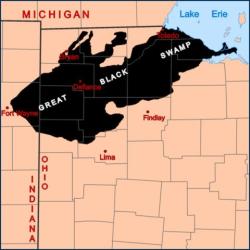
https://www.shoresandislands.com/blog/post/a-short-history-of-the-great-black-swamp-in-the-shores-islands-ohio-region/
An excerpt:
“Along with the mud and wet, another obstacle was the mosquitoes and the diseases they carried. Many new settlers would catch (and even die from) “the shakes.” We now know this as malaria, and it was rampant through the Great Black Swamp region. Death and disease were so common that the Maumee City Express newspaper in 1937 published:
There’s a funeral every day,without a hearse or pall;They tuck them in the groundwith breeches, coats and all”