The California Independent System Operator (CAISO), the grid operator for most of the state, is increasingly curtailing solar- and wind-powered electricity generation as it balances supply and demand amidst rapid renewables capacity growth.
Grid operators must balance supply and demand to maintain a stable electric system. The output of wind and solar generators is reduced either through price signals or, rarely, through an order to reduce output during periods of:
Congestion, when power lines don’t have enough capacity to deliver available energy
Oversupply, when generation exceeds customer electricity demand
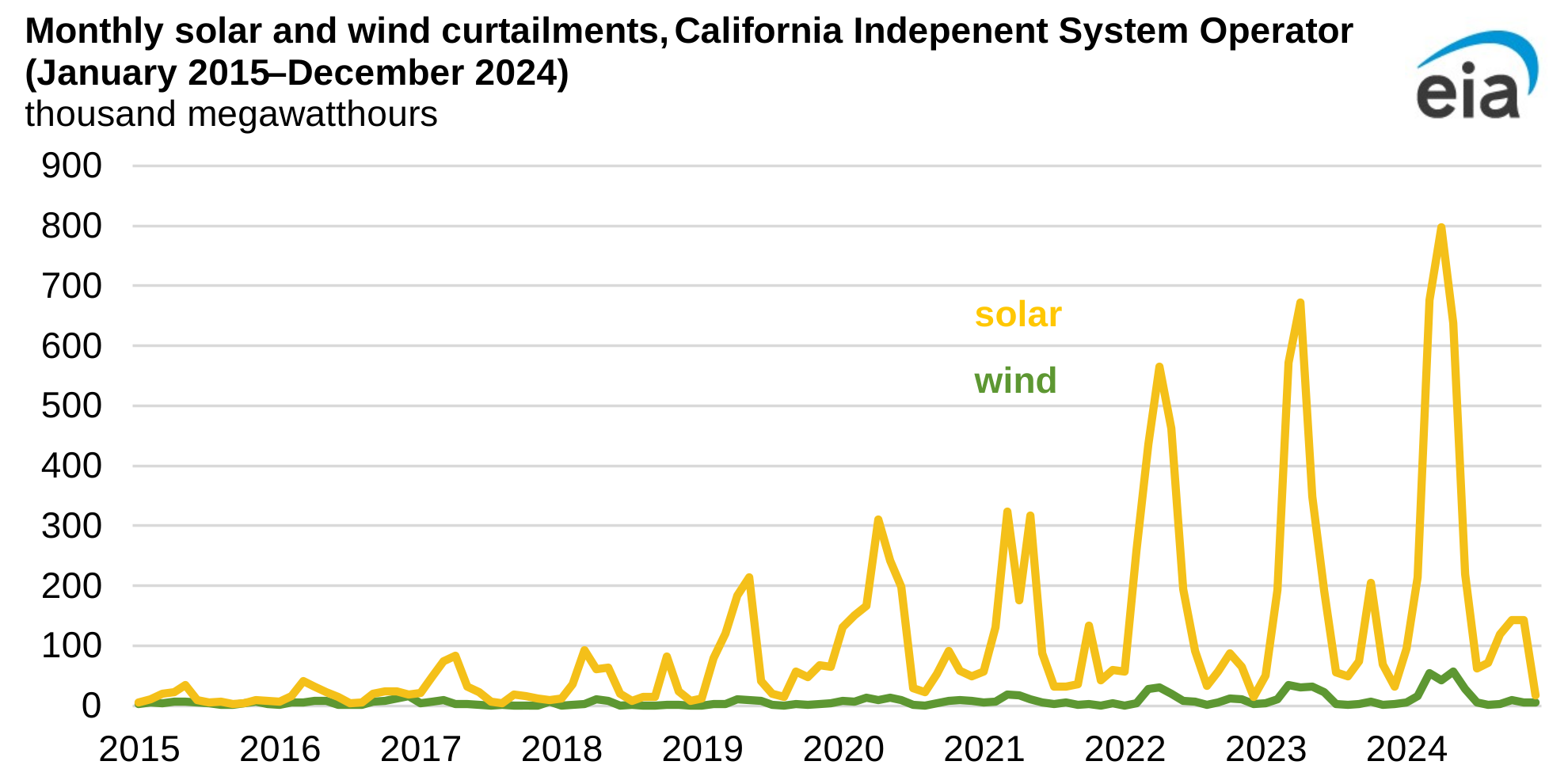
In 2024, CAISO curtailed 3.4 million megawatthours (MWh) of utility-scale wind and solar output, a 29% increase from the amount of electricity curtailed in 2023.
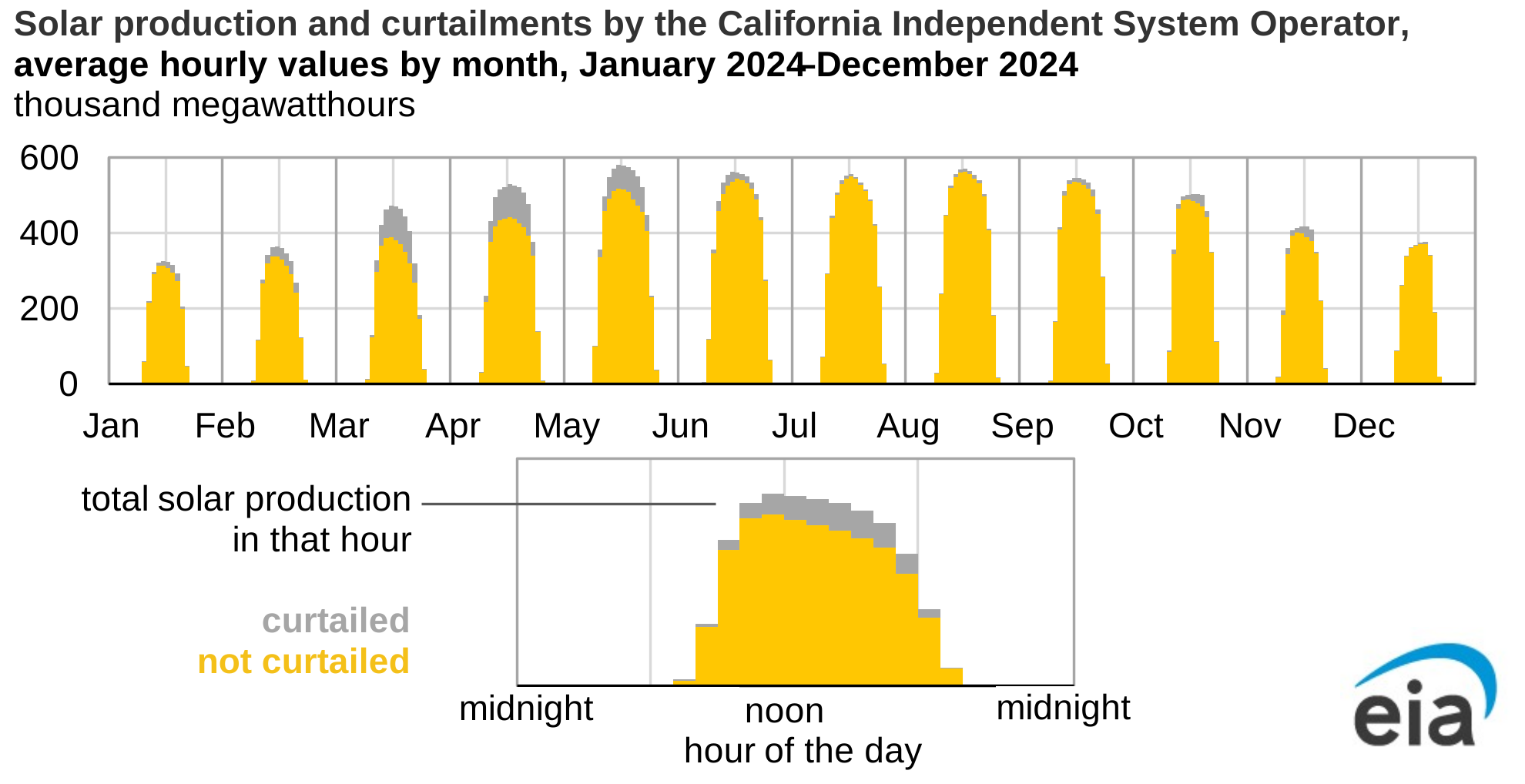
Solar accounted for 93% of all the energy curtailed in CAISO in 2024. CAISO curtailed the most solar in the spring, when solar output was relatively high and electricity demand was relatively low, because moderate spring temperatures meant less demand for space heating or air conditioning.
In 2014, a combined 9.7 gigawatts (GW) of wind and solar photovoltaic capacity had been built in California. By the end of 2024, that number had grown to 28.2 GW.
CAISO also curtails solar generation to leave room for natural gas generation. A certain amount of natural gas generation must stay online throughout the day to comply with North American Electric Reliability Corporation (NERC) reliability standards and to have generation online in time to ramp up in the evening hours.
Solar energy supplies almost half of CAISO’s electricity demand between the hours of 8:00 a.m. and 4:00 p.m., but demand increases in the later evening hours when people come home from work and turn up air conditioners or electric heaters and turn on lights, ovens, computers, and televisions. This need is especially apparent on hot summer evenings after the sun has set and no longer produces solar power overnight.
CAISO is trying to reduce curtailments in several ways:
Trading with neighboring balancing authorities to try to sell excess solar and wind power
Incorporating battery storage into ancillary services, energy, and capacity markets
In addition, starting this year, companies are planning to use excess renewable energy to make hydrogen, some of which will be stored and mixed with natural gas for summer generation at the Intermountain Power Project’s new facility scheduled to come online in July.
The Western Energy Imbalance Market (WEIM) is a real-time market that allows participants outside of CAISO to buy and sell energy to balance demand and supply. In 2024, more than 274,000 MWh of curtailments were avoided by trading within the WEIM, equivalent to about 8% of the electricity curtailed that year. The Extended Day-Ahead Market (EDAM) is expected to be operational by May 2026 and will allow CAISO another outlet to sell solar energy.
To further reduce renewable curtailments and increase the stability of the grid, CAISO is promoting the addition of flexible resources that can quickly respond to sudden increases and decreases in demand. Battery storage, recently the key flexible resource to come online, allows some renewable energy to be stored and used 4-8 hours later in the day. Batteries can charge using excess solar power at midday and then discharge that energy when the sun is going down, providing electricity during hours when it is most needed. Battery capacity in CAISO increased by 45% in 2024, from 8.0 GW in 2023 to 11.6 GW in 2024 according to our survey of recent and planned capacity changes. However, in the spring, more solar energy than can be used within a day is often produced. Without more transmission capacity or a long-term storage solution, high curtailments during this time of year can still occur.
“CAISO curtailed 3.4 million MWh of utility-scale wind and solar output”
At 26¢/kWh, that’s nearly $900 million worth of electricity generation!
Setting side the hydrogen fantasy and the notion of California forcing other states to buy their excess solar generation, the obvious solution (apart from pulling the plug on solar power) is…. Batteries.
SACRAMENTO, CA – U-Haul has named Governor Gavin Newsom its Salesperson of the Year for the third year in a row after a record-setting sales quarter.
“We are astounded by the growth we’ve seen in California,” said U-Haul’s Western Regional Director Fennick Buggstein. “Thanks to Gavin Newsom, literally every middle-class family has moved out of the state! It’s been impossible to keep up with demand! Also, most of our workers left the state too, which kind of stinks.”
“The sequel to 1989’s Batman prominently featured both the Penguin and Catwoman, but the additional player, Schreck, played by the incomparable Walken, had a distinctly non-supervillain plan. He worked to build an enormous capacitor to siphon and store Gotham’s excess energy, under the guise of building a power plant.”
I think this is what frosts my ass the most about all this bullshit:
CAISO is trying to reduce curtailments in several ways:
Over and over and over, government meddles with markets, disrupts them, confuses them, mangles them, then screams “market failure” as an excuse for more meddling, disruption, confusion, and mangling — when if they’d just butted out and stayed out, markets would solve the problem, faster and more cheaply and with fewer side effects.
You know what would really reduce curtailments, CAISO? Not mandating unreliable energy sources in the first place.
Nick Stokes
June 6, 2025 3:27 pm
“At 26¢/kWh, that’s nearly $900 million worth of electricity generation!”
So what? Sunlight is free. Switching off a solar farm is no different to switching off a gas generator when demand drops. You don’t tot up all the money the gas generators might have made when idle.
Sunlight is free but harvesting it is damned expensive and acreage intensive AND it’s generally unavailable during peak demand time so pretty much useless when most needed
Nick,
Ivanpah – a failure that was forecast by competent, neutral engineers and economists.
Why was it allowed to be built, apart from greed of subsidy miners?
Geoff S
Nothing lays waste to good farmland like a coal mine.
Except solar PV collectors, based on farmland area “wasted” per dispatchable watt generated. Or wind farms possibly, as evidence emerges about previously unknown adverse side effects to livestock. Quite apart from the inadvertent destruction of birdlife. Good if you prefer your eagles dead, not so good if you don’t.
Coal is merely stored sunshine, anyway. What’s not to like?
Here’s an interesting factoid… Surface mining of Coal in the US has been estimated to require 162.9 acres per million tons nationwide. About 314.1 acres per million tons outside of Wyoming, while in Wyoming it’s 13.3 acres per million tons! In terms of electricity generation, a million tons of coal could produce approximately 546 million kilowatt-hours (KWh). So, in Wyoming, a Coal Mine producing a million tons of Coal covers the same area as Two 2MW Wind Turbines which produce 48 MWh if the wind blows just right all day and night. In 2024, Topaz Solar Subsidy Farm produced 66,881MWh in Jan and 123,491 MWh in August so can’t guarantee a set production any month. It’s Nameplate Capacity is 550MW but with a capacity factor of.26.6% only produces 146MW or 0.031MW/acre so that.same 13.3/acres will produce a meager 0.41MW per hour. If you’re going to render the land otherwise unusable for agriculture you get FAR more bang for your buck with a Coal Mine. And, as an added bonus, you don’t need the required increase in other surface mines (Copper, Quartz, Molybdenum, Neodymium, etc) that’s necessary to increase production of electrified transportation, heating and shipping. Besides those Wind Turbines and Solar Subsidy Farms still require Coal Mining for their existence.
Surface mining only takes land out of agricultural use for a few years. The topsoil and subsoil are separated and stored while the rest of the overburden is removed. The coal seam is extracted and everything put back in reverse order. No harm, no foul. Solar needs to be dismantled and replaced every 25 years. But realistically 50 years from now no one anywhere will be installing that junk and much of the solar will be left to rot because removal is orders of magnitude more costly than any salvage value. Terrible stuff.
California has plenty of sunny land that is not used for farming.
It certainly makes sense that the 49ers snapped up all the worst arable land first in order to be sure that subsequent generations would have access to even better land.
How does curtailment effect LCOE? Hint, it reduces the capacity factor.
Now you know why its not free, and why its different from gas.
You’re intelligent enough to figure it out for yourself. Just stop repeating these silly mantras and slogans and do the analysis.
Imagine your are presenting to the finance committee of a wind or solar company, and the question of profitability comes up. ROI. Are we going to make any money out of this.
Do you think you might be asked about the number of billable hours of generation?
No, LCOE adds up the costs. Whether you can sell it is another matter.
Yes, curtailment reduces profitability, just as does any situation where you could generate (with gas or whatever) but there just isn’t the demand. But the first thing about making money is to have product. Too little is bad; too much is bad.
So LCOE doesn’t cover any selling costs? Aren’t Selling Costs an important part of the equation? Everything has a cost, otherwise you wouldn’t need marketers..
“Alternatively, the levelized cost of energy can be thought of as the average minimum price at which the electricity generated by the asset is required to be sold in order to offset the total costs of production over its lifetime”
But with Gas curtailment you aren’t using fuel at the full burn rate it gets reserved … you can always use it later in the evening. But with Solar, curtailment literally burns daylight (free fuel) and you can’t make use of it later in the evening, it simply becomes unavailable … it vanishes.
When you do LCOE (or ROI for that matter) you calculate the NPV of all the costs over the life of the installation. You then need to figure out the cost per unit of electricity generated to have a figure to compare with other installations using other technologies. So you divide by the expected units of production over the life of the system and get a unit cost of power produced.
What do you divide by? What units? How many? Standard practice has been to divide by the expected number of units produced. And curtailment seems not to affect that.
This however is a key error. The right number to divide by is one curtailment affects, and its why wind and solar are different from gas, and is one reason (among many) why LCOE as usually done is not a valid comparator.
It is only correct to divide by the units actually saleable. So if your installation has faceplate of 100 units, and you expect it to deliver a 35% capacity factor, you may stop there and just divide the NPV by 35. Despite the fact that you know that 10 of these units will be produced when they are unusable and unsaleable.
This would be wrong. Because some of these 35 units are being produced when they cannot be used. To do it properly you can only divide by the number of saleable units, in this example 25, and this means that your unit cost will rise and the profitability of the installation will fall.
Try claiming profitability by dividing costs by units which cannot be sold, in front of any finance committee of any large Western company, and you’d be shown the door, and if the company actually did it in its reports, jail for accounting fraud would be on the way.. ‘Stuffing the pipeline’ is one standard way of trying it, usually picked up on audits and admitted in inventory writeoffs.
This is part of the way intermittency of technologies affects the cost of using them to generate power to meet a demand which requires dispatchable sources.
The same issue exists for gas or coal or nuclear. But it does not have the same effect. The reason is that, as you point out, a much higher proportion of the lifetime costs of a wind or solar installation is fixed capital. Whereas with gas a much higher proportion is variable, in the form of fuel. This means that the gas installation can adjust its output and only incur the variable costs when it is producing billable units. It can get closer to selling all it can produce (though not all the way there) and it will be able to reduce its costs when lower demand means it lowers production.
The problem is well known, and it seems to be dealt with in one of two ways. The UK model is that you guarantee the profitability of the renewable operator. You have mandatory purchase for everything they can produce. When this rises over what is usable, you pay them for it, but turn production down. This costs whoever funds the purchases – in the end, the consumer or taxpayer. They are preserving the business model of the generator by paying for power they cannot use. There is one notorious wind farm in the UK which is being paid not to produce 2/3 of the time.
And no, its not the fault of the buyer or the grid etc. Its a fundamental problem with the application of this technology to this market, its a fundamental problem with intermittency. It produces when it cannot be used, and it also fails to produce when there is high demand, and these two things (among others), which do not apply to gas, raise its cost over that of gas.
The other way to do it is to just turn it down and not pay. This lowers billable hours and thus raises unit costs, which will in turn have to be passed on to the buyer.
Whatever you do, there is a fundamental problem with wind and solar: intermittency. This, accounted for correctly, will raise the relative unit costs of using their products in the electricity supply market as it is.
So no, its not like gas at all, and the wind or sun being free is irrelevant. Accouinting 101.
I didn’t bother getting into this last night, but now seem to have been lured into it. This is like explaining to a true believer that in human biology parthogenesis is impossible. Why does one bother?
The final item to be looked at is the cost to the purchaser, i.e., the customer. No one believes their bills have reduced in the last decade regardless of how free the fuel (wind/solar) is. That is the end result of mandating inefficient electricity providers be attached to the grid.
Sunlight costs far more to harvest than Gas costs to burn.
Sunlight costs, in land usage alone, to the tune of about 4000 acres per 125MW production (about 500MWh of daily (4 hours) generation).
The typical gas generation facility is over 800MW and only needs about 40 acres to produce 3,200MWh in the same 4 hours or 19,800MWh daily.
To produce 19,800MWh a day (24 hour equivalent) solar would require 6x (space for 750MW potential) + 6x (4 hour periods in a 24 hour day) 36×4000 acres 144,000 acres to do the same thing as a single 750MW gas facility can do on 40 acres and potentially require 19,300MWh of 100% usable storage (battery) to make that generation available over the same 24 hour period.
Solar is DAMNED EXPENSIVE
Yes. It won’t do any good explaining it, though. Its like when someone keeps telling you beetroot is cheaper than oranges. Yes, maybe, you say, but one is a fruit and the other a vegetable,. They are not the same product. You cannot do the same things with them, you can’t make the same dishes with either one, they don’t have the same food value.
Yes, he keeps saying, but beetroot is cheaper.
As if that somehow was going to persuade you that you can just substitute one for the other and save money on ingredients.
Intermittent electricity generated offshore is not the same product as dispatchable electricity generated close to where demand is.
But none of this is ever going to convince the climate fanatics.
Lazard makes it very clear that because of the difference in “performance characteristics” (weather dependent and intermittent) wind and solar cannot on a cost basis be “directly compared to dispatchable sources”. They’ve added a few features that help explain the issues: LCOE is a false metric when comparing dispatchable sources to non-dispatchable wind and solar. Definitions:
LCOE (Levelized Cost of Energy): Represents the average cost per unit of energy generated, taking into account all costs over the lifetime of the project. (Please keep in mind what is reported above, you can compare wind to solar, and gas to coal, but you can’t compare gas to wind, or gas to solar. Low information bloggers struggle with that simple fact (or more likely ignore it because it doesn’t fit their preconceived notions). In simplest terms, the capital costs for wind and solar are greater than the fuel saving, and forcing natural gas into on/off/hot standby/cold standby/<full output reduces CCGT utilization factor/aka capacity factor from a potential 90+% mode to 60%
LACE (Levelized Avoided Cost of Energy): Represents the economic value of energy produced by a generator, based on the cost of avoiding alternative sources of energy.
ELCC (Effective Load Carrying Capacity): A measure of the contribution of a power plant to meet the reliability requirements of the electric system by accounting for its capacity to deliver energy during peak demand periods.
LCOE as method is fine, its just a variant on NPV calculations. But like NPV, it can be done wrongly or fraudulently. The usual way with LCOE is to leave out half the costs. But it also wrongly bases unit cost on total production, even production at times when it cannot be used and is turned off by constraint. You can do NPV wrong too, overestimate revenues, underestimate costs… Which sadly one has seen over and over again, which is why there is a sadly familiar smell of fish about all LCOE calculations.
Ruud Istvan did it properly (though even he left out over production adjustment) at Climate Etc:
Averages don’t provide a clear picture of systems that have to be able to supply peaks in demand and where failure is catastrophic . The average cost of something that cannot respond to demand is meaningless.
The public discussion seems to be fixated on averages.
No, they switch them off. And they switch off solar too. Neither requires storage.
The thing is, solar when disconnected could, at no extra cost, deliver power that could be used. That is a benefit, not a burden. Finding a use is optional.
As usual, Nick tries to confuse people by playing stupid.
Batteries are used to provide power when the power plant can’t.
This isn’t a problem with fossil fuel plants, it is only a problem with wind and solar.
Since the changes in demand over time are well known and very predictable, it’s easy for fossil fuel plants to plan ahead of time how much fuel to feed the plants to keep them operating efficiently.
Wind and solar have a nasty habit of dropping out with little to no notice and they do so frequently.
You crazies are trying to get rid of those other sources coal, gas diesel and nukes you claim are all bad and you want them gone by 2050. So what other sources are you going to use pedal power?
You have some explaining to do about these other sources.
And sites suitable for hydro’ are rare because the best sites were developed decades ago. California is taking out dams on the Klamath River. Similarly, most of the better sites in California were developed for wind decades ago. That ‘free’ energy ruins the vistas and reduces the raptor and bat populations. It seems like a high price to pay for something that is free.
Where the alternative generator costs are never included in the direct costs of wind and solar. Doing so only penalizes the consumer not the solar and wind provider. That is market manipulation by the government. Why do you think MAGA and Trump is winning?
The trick with solar, is that you need a 4-6;hour lead time from generation to delivery… Which, in California’s case, would cost more than $1 trillion.
Solar is Great for recharging Batteries … provided you don’t need to deplete those batteries every night because you just might not be able to recharge them every day
Yes, the battery storage concept assumes that the weather is clear and sunny every day and that there are no seasons. Weather and seasons render them useless, like solar panels.
That reminds me. It’s too bad that Greta and so many other youngsters have turned their attention to other causes on the Left. Perhaps some of the leading lights in the alarm-o-sphere could come up with some catchy slogans to bring them back into the fold, such as:
Free! Free! Energy!
Free solar energy!
From the Sierras to the Sea,
Solar energy will be Free
This has been explained to you a dozen times, at least. It’s almost as if you refuse to deal with reality.
Just because a gas plant is not producing power, does not prove that it isn’t burning gas.
In reality, it will be burning gas, in fact almost as much gas as it was burning while producing power.
It has to in order to keep the burners warm so that it can start producing power again once the demand for power picks up.
Do solar farms in California get constraint payments like wind farms do in the UK?
In its relatively short life the Seagreen offshore wind farm in the North Sea has received £104m for generating and £262m for switching off. These numbers are now several months old but the wind is certainly not free!
No, actually the capital cost of plant is included cost accounting. Whether it is a solar plant or a coal plant. It costs money to be idle. Solar plant has limited possible generation. Curtailment at peaks reduces the output that the cost is spread out on.
Can someone please enlighten me re. how curtailments happen? Who has to disconnect from the grid, who has to pay, or not get paid, do the ‘roof top solar’ owners still get paid, etc.?
Ok. I guess my question was something like does CAL-ISO do any planning, say in the day-ahead market, and, if so, what happens when the schedule goes to hell, as it inevitably will due to the intermittency of solar, etc.
Weather-dependent electricity is rather dependent on weather foercasting… 😎
Edward Katz
June 6, 2025 6:08 pm
These curtailments might be only the start of a wave in not only i the US but also worldwide as governments who have been pressured into subsidizing their initial costs have come to realize that wind and solar just can’t deliver until large-capacity storage battery facilities are developed. So the reality is that fossil fuels, hydro and nuclear will continue to provide consistent and reliable energy supplies, while renewables will be a lingering pipe dream. .End of story.
Lark
June 6, 2025 10:09 pm
1.0-1.7 trillion dollars for batteries. Just as an unworkable way to “solve” curtailments.
Not including other wastage.
Not including extra costs forced onto other producers, taxpayers and electricity buyers.
Not including the massive environmental damage from solar, wind and batteries.
Not taking into account that batteries don’t last long.
And the number is going up by hundreds of billions every year.
That’s a problem which is too big to solve the way Socialists always solve problems — by making other people pay for it and pretending it’s free (see Nick Stokes above) — but it’s not so big that they’ve had to stop looting the treasury to make it bigger. Not yet.
.Vistra and Tesla installed 932GW of batteries at Moss Landing. The power level is based on a runtime of 4 hours, meaning Ms. Antiti was correct to quote the batteries in GW since the runtime is commonly assumed to BE 4 hours. It is a way for a battery company to hide details of their product if you do not know the convention. The100% discharge energy then is 3.7 GWh. Except – if the batteries are used in that fashion, their operational life is shortened. The optimum is the usual 80 charge-20 discharge, so 2.2 GWh would be available for optimum usage.
But, let’s be generous and assume 100% discharge.
Charging and discharging are not cost-free operations. At least 10% is lost on the way in and another 10% on the way out, a bit more for charging via PV. 4.1 GWh is then required to charge to 100%, nominally, but only 3.3 GWh of useful electricity reaches the grid in return. The rest is lost.
Another item that is well hidden is the cost of the batteries and their installation. I notice above a cost between 1.1 and 1.7 $billion. My summing came to 1.2 $ billion, so it is the right ball park.
Of course, we no longer have to be concerned about a 20 year operational life since this facility had two fires in 2021, one in 2022, and the whopper in Jan. 2025 which I am not certain is yet out. The $100 million projected cost savings during its 20 year life will not materialize.
The bottom line is that CA bought 3.3 GWh of potentially usable energy storage for 1.2 $billion, even though the potential is unrealized.
How well did they do, assuming no fires? The answer is easily construed. The Bath County facility in Virginia has been in operation for 40 years. It can discharge 34 million m3 of water over 11 hours at 3 GW power out, totaling 33.6 GWh of energy, achieving an 80% RT efficiency, very similar to the Moss Landing battery above. The cost in 2025$ was 4.7 $billion for 10X the energy storage, and already has worked for twice the anticipated life of the battery pack which halves the comparative cost again; IF the battery pack had actually survived so long. The pumped hydro is NOT a fire risk, just the opposite, there is a local flooding risk (Tam Sauk Event). It is easy to see that CA could have achieved 10X the backup storage, at the same real cost, if ONLY CA had mountains and needed reservoirs to put out fires and a governor who knew a little physics. The first two are factual.
John XB
June 7, 2025 3:19 am
Any business that cannot match supply with demand isn’t a business; at best it’s a hobby.
Petey Bird
June 7, 2025 8:18 am
I am curious about how the curtailment is achieved. Are the solar operators paid for the curtailed power? Or do they pay penalties for excess?


“The sequel to 1989’s Batman prominently featured both the Penguin and Catwoman, but the additional player, Schreck, played by the incomparable Walken, had a distinctly non-supervillain plan. He worked to build an enormous capacitor to siphon and store Gotham’s excess energy, under the guise of building a power plant.”
California – land of fruits and nuts.
Not surprised.Given the black-out in Spain recently, these operators are taking notice. Good for them.
Ms Anititi did not notice she was using the wrong units for batteries. GW is a unit for power, not storage. Maybe Giga Watt Hours?
She was referring to generation output.
I think this is what frosts my ass the most about all this bullshit:
Over and over and over, government meddles with markets, disrupts them, confuses them, mangles them, then screams “market failure” as an excuse for more meddling, disruption, confusion, and mangling — when if they’d just butted out and stayed out, markets would solve the problem, faster and more cheaply and with fewer side effects.
You know what would really reduce curtailments, CAISO? Not mandating unreliable energy sources in the first place.
“At 26¢/kWh, that’s nearly $900 million worth of electricity generation!”
So what? Sunlight is free. Switching off a solar farm is no different to switching off a gas generator when demand drops. You don’t tot up all the money the gas generators might have made when idle.
Sunlight is free but harvesting it is damned expensive and acreage intensive AND it’s generally unavailable during peak demand time so pretty much useless when most needed
Correct Bryan. By the same logic coal oil and gas are equally free, just laying around in the ground waiting to be harvested.
On the other hand, wind and solar farm leases are not free, and permanently lay waste to good farmland.
Nothing lays waste to good farmland like a coal mine.
California has plenty of sunny land that is not used for farming.
Story tip:
Here’s an interesting item on the cost of harvesting “free sunshine” Nick, both dollars and environment. Please comment.
https://youtu.be/y-Nrdib1OmU?si=cou6ZFN1oSuzFG9h
Yes, we know Ivanpah did not work out. PV solar collectors got cheap and are much better.
Nick,
Ivanpah – a failure that was forecast by competent, neutral engineers and economists.
Why was it allowed to be built, apart from greed of subsidy miners?
Geoff S
Allowed by ignorant politicians and naive enviros.
What does “much better” mean? The supply of sunlight is free, isn’t it, so “efficiency” at converting it into useable electricity is irrelevant?
Commercial PV cells are maybe 20% efficient. Coal power better than 30%.
How much good farmland is wasted by PV manufacturing plants, and the associated toxic waste products? Everything has a cost.
Except solar PV collectors, based on farmland area “wasted” per dispatchable watt generated. Or wind farms possibly, as evidence emerges about previously unknown adverse side effects to livestock. Quite apart from the inadvertent destruction of birdlife. Good if you prefer your eagles dead, not so good if you don’t.
Coal is merely stored sunshine, anyway. What’s not to like?
WRONG.
Coal mining allows for the creation of FAR more energy per land area used than solar ever can.
It is great that you say that solar panels should never be set-up on farmland though !!
Now tell basically every solar developer that.. particularly in the UK. !
Here’s an interesting factoid…
Surface mining of Coal in the US has been estimated to require 162.9 acres per million tons nationwide. About 314.1 acres per million tons outside of Wyoming, while in Wyoming it’s 13.3 acres per million tons! In terms of electricity generation, a million tons of coal could produce approximately 546 million kilowatt-hours (KWh). So, in Wyoming, a Coal Mine producing a million tons of Coal covers the same area as Two 2MW Wind Turbines which produce 48 MWh if the wind blows just right all day and night.
In 2024, Topaz
SolarSubsidy Farm produced 66,881MWh in Jan and 123,491 MWh in August so can’t guarantee a set production any month. It’s Nameplate Capacity is 550MW but with a capacity factor of.26.6% only produces 146MW or 0.031MW/acre so that.same 13.3/acres will produce a meager 0.41MW per hour.If you’re going to render the land otherwise unusable for agriculture you get FAR more bang for your buck with a Coal Mine. And, as an added bonus, you don’t need the required increase in other surface mines (Copper, Quartz, Molybdenum, Neodymium, etc) that’s necessary to increase production of electrified transportation, heating and shipping. Besides those Wind Turbines and
SolarSubsidy Farms still require Coal Mining for their existence.Coal mines are remediated once the coal has been removed.
But then you already knew that.
The old strip pits along the Kansas/Missouri border were remediated decades ago and offer some of the best fishing I’ve seen.
Nick, not all coal mines are open cast. Many mines in the eastern US are deep tunnel mines – little disruption at the surface.
Surface mining only takes land out of agricultural use for a few years. The topsoil and subsoil are separated and stored while the rest of the overburden is removed. The coal seam is extracted and everything put back in reverse order. No harm, no foul. Solar needs to be dismantled and replaced every 25 years. But realistically 50 years from now no one anywhere will be installing that junk and much of the solar will be left to rot because removal is orders of magnitude more costly than any salvage value. Terrible stuff.
Not much good farmland in “coal country”.
It certainly makes sense that the 49ers snapped up all the worst arable land first in order to be sure that subsequent generations would have access to even better land.
How does curtailment effect LCOE? Hint, it reduces the capacity factor.
Now you know why its not free, and why its different from gas.
You’re intelligent enough to figure it out for yourself. Just stop repeating these silly mantras and slogans and do the analysis.
Imagine your are presenting to the finance committee of a wind or solar company, and the question of profitability comes up. ROI. Are we going to make any money out of this.
Do you think you might be asked about the number of billable hours of generation?
“Hint, it reduces the capacity factor.”
No, LCOE adds up the costs. Whether you can sell it is another matter.
Yes, curtailment reduces profitability, just as does any situation where you could generate (with gas or whatever) but there just isn’t the demand. But the first thing about making money is to have product. Too little is bad; too much is bad.
Yes, to bad there’s not a source you can turn up and down to match demand in real time, eh.
LCOE pretends to add up costs. The fact that it completely fails to add up these costs accurately has been well documented.
So LCOE doesn’t cover any selling costs? Aren’t Selling Costs an important part of the equation? Everything has a cost, otherwise you wouldn’t need marketers..
“Alternatively, the levelized cost of energy can be thought of as the average minimum price at which the electricity generated by the asset is required to be sold in order to offset the total costs of production over its lifetime”
https://corporatefinanceinstitute.com/resources/valuation/levelized-cost-of-energy-lcoe/
But with Gas curtailment you aren’t using fuel at the full burn rate it gets reserved … you can always use it later in the evening. But with Solar, curtailment literally burns daylight (free fuel) and you can’t make use of it later in the evening, it simply becomes unavailable … it vanishes.
Yes, gas costs, so it is good to be able to save it. Sunlight doesn’t cost, so if it vanishes you have lost nothing.
Except the electricity, 🙂
This is the basic error. Basic accounting.
When you do LCOE (or ROI for that matter) you calculate the NPV of all the costs over the life of the installation. You then need to figure out the cost per unit of electricity generated to have a figure to compare with other installations using other technologies. So you divide by the expected units of production over the life of the system and get a unit cost of power produced.
What do you divide by? What units? How many? Standard practice has been to divide by the expected number of units produced. And curtailment seems not to affect that.
This however is a key error. The right number to divide by is one curtailment affects, and its why wind and solar are different from gas, and is one reason (among many) why LCOE as usually done is not a valid comparator.
It is only correct to divide by the units actually saleable. So if your installation has faceplate of 100 units, and you expect it to deliver a 35% capacity factor, you may stop there and just divide the NPV by 35. Despite the fact that you know that 10 of these units will be produced when they are unusable and unsaleable.
This would be wrong. Because some of these 35 units are being produced when they cannot be used. To do it properly you can only divide by the number of saleable units, in this example 25, and this means that your unit cost will rise and the profitability of the installation will fall.
Try claiming profitability by dividing costs by units which cannot be sold, in front of any finance committee of any large Western company, and you’d be shown the door, and if the company actually did it in its reports, jail for accounting fraud would be on the way.. ‘Stuffing the pipeline’ is one standard way of trying it, usually picked up on audits and admitted in inventory writeoffs.
This is part of the way intermittency of technologies affects the cost of using them to generate power to meet a demand which requires dispatchable sources.
The same issue exists for gas or coal or nuclear. But it does not have the same effect. The reason is that, as you point out, a much higher proportion of the lifetime costs of a wind or solar installation is fixed capital. Whereas with gas a much higher proportion is variable, in the form of fuel. This means that the gas installation can adjust its output and only incur the variable costs when it is producing billable units. It can get closer to selling all it can produce (though not all the way there) and it will be able to reduce its costs when lower demand means it lowers production.
The problem is well known, and it seems to be dealt with in one of two ways. The UK model is that you guarantee the profitability of the renewable operator. You have mandatory purchase for everything they can produce. When this rises over what is usable, you pay them for it, but turn production down. This costs whoever funds the purchases – in the end, the consumer or taxpayer. They are preserving the business model of the generator by paying for power they cannot use. There is one notorious wind farm in the UK which is being paid not to produce 2/3 of the time.
And no, its not the fault of the buyer or the grid etc. Its a fundamental problem with the application of this technology to this market, its a fundamental problem with intermittency. It produces when it cannot be used, and it also fails to produce when there is high demand, and these two things (among others), which do not apply to gas, raise its cost over that of gas.
The other way to do it is to just turn it down and not pay. This lowers billable hours and thus raises unit costs, which will in turn have to be passed on to the buyer.
Whatever you do, there is a fundamental problem with wind and solar: intermittency. This, accounted for correctly, will raise the relative unit costs of using their products in the electricity supply market as it is.
So no, its not like gas at all, and the wind or sun being free is irrelevant. Accouinting 101.
I didn’t bother getting into this last night, but now seem to have been lured into it. This is like explaining to a true believer that in human biology parthogenesis is impossible. Why does one bother?
The final item to be looked at is the cost to the purchaser, i.e., the customer. No one believes their bills have reduced in the last decade regardless of how free the fuel (wind/solar) is. That is the end result of mandating inefficient electricity providers be attached to the grid.
Great post Michel.
Unfortunately you have made these points to Nick before and he just ignores them – too wedded to unreliables to see the truth.
Sunlight costs far more to harvest than Gas costs to burn.
Sunlight costs, in land usage alone, to the tune of about 4000 acres per 125MW production (about 500MWh of daily (4 hours) generation).
The typical gas generation facility is over 800MW and only needs about 40 acres to produce 3,200MWh in the same 4 hours or 19,800MWh daily.
To produce 19,800MWh a day (24 hour equivalent) solar would require 6x (space for 750MW potential) + 6x (4 hour periods in a 24 hour day) 36×4000 acres 144,000 acres to do the same thing as a single 750MW gas facility can do on 40 acres and potentially require 19,300MWh of 100% usable storage (battery) to make that generation available over the same 24 hour period.
Solar is DAMNED EXPENSIVE
Yes. It won’t do any good explaining it, though. Its like when someone keeps telling you beetroot is cheaper than oranges. Yes, maybe, you say, but one is a fruit and the other a vegetable,. They are not the same product. You cannot do the same things with them, you can’t make the same dishes with either one, they don’t have the same food value.
Yes, he keeps saying, but beetroot is cheaper.
As if that somehow was going to persuade you that you can just substitute one for the other and save money on ingredients.
Intermittent electricity generated offshore is not the same product as dispatchable electricity generated close to where demand is.
But none of this is ever going to convince the climate fanatics.
An Interesting analogy … I’ll have to remember that one.🤔
You have lost nothing…except your ability to generate electricity when you need it most.
Lazard makes it very clear that because of the difference in “performance characteristics” (weather dependent and intermittent) wind and solar cannot on a cost basis be “directly compared to dispatchable sources”. They’ve added a few features that help explain the issues: LCOE is a false metric when comparing dispatchable sources to non-dispatchable wind and solar.
Definitions:
LCOE as method is fine, its just a variant on NPV calculations. But like NPV, it can be done wrongly or fraudulently. The usual way with LCOE is to leave out half the costs. But it also wrongly bases unit cost on total production, even production at times when it cannot be used and is turned off by constraint. You can do NPV wrong too, overestimate revenues, underestimate costs… Which sadly one has seen over and over again, which is why there is a sadly familiar smell of fish about all LCOE calculations.
Ruud Istvan did it properly (though even he left out over production adjustment) at Climate Etc:
https://judithcurry.com/2015/05/12/true-costs-of-wind-electricity/
Averages don’t provide a clear picture of systems that have to be able to supply peaks in demand and where failure is catastrophic . The average cost of something that cannot respond to demand is meaningless.
The public discussion seems to be fixated on averages.
So what? The cost of the battery capacity required to render the $900 worth of curtailed solar generation useful, is north of $1 trillion.
That would be true for the idle gas generators too.
So don’t do it.
The gas generators don’t generate most of their electricity when it’s not needed. Gas, other fossil fuels and nuclear power don’t require storage.
No, they switch them off. And they switch off solar too. Neither requires storage.
The thing is, solar when disconnected could, at no extra cost, deliver power that could be used. That is a benefit, not a burden. Finding a use is optional.
Solar requires storage IF you want to have the production available when It’s Needed which generally isn’t when it’s “Free Fuel” is available
As usual, Nick tries to confuse people by playing stupid.
Batteries are used to provide power when the power plant can’t.
This isn’t a problem with fossil fuel plants, it is only a problem with wind and solar.
Since the changes in demand over time are well known and very predictable, it’s easy for fossil fuel plants to plan ahead of time how much fuel to feed the plants to keep them operating efficiently.
Wind and solar have a nasty habit of dropping out with little to no notice and they do so frequently.
“Batteries are used to provide power when the power plant can’t.”
No, they are not.
Other power sources are used.
You crazies are trying to get rid of those other sources coal, gas diesel and nukes you claim are all bad and you want them gone by 2050. So what other sources are you going to use pedal power?
You have some explaining to do about these other sources.
Invest in hamster futures!
How can you not see that the difference is that solar is ‘switched off’ when it is needed?
You need batteries to provide power when the power plant can’t produce it.
This is only a problem with solar, it isn’t a problem with gas and coal.
You just need an alternative power source. Wind, hydro, gas.
Woah I thought you couldn’t have gas it’s got to be gone by 2050. Isn’t that what the whole anti woodside stuff is all about?
And sites suitable for hydro’ are rare because the best sites were developed decades ago. California is taking out dams on the Klamath River. Similarly, most of the better sites in California were developed for wind decades ago. That ‘free’ energy ruins the vistas and reduces the raptor and bat populations. It seems like a high price to pay for something that is free.
Where the alternative generator costs are never included in the direct costs of wind and solar. Doing so only penalizes the consumer not the solar and wind provider. That is market manipulation by the government. Why do you think MAGA and Trump is winning?
But it works really well at night, Nicholas.
The trick with solar, is that you need a 4-6;hour lead time from generation to delivery… Which, in California’s case, would cost more than $1 trillion.
Solar is Great for recharging Batteries … provided you don’t need to deplete those batteries every night because you just might not be able to recharge them every day
Yes, the battery storage concept assumes that the weather is clear and sunny every day and that there are no seasons. Weather and seasons render them useless, like solar panels.
‘Sunlight is free.’
That reminds me. It’s too bad that Greta and so many other youngsters have turned their attention to other causes on the Left. Perhaps some of the leading lights in the alarm-o-sphere could come up with some catchy slogans to bring them back into the fold, such as:
Free! Free! Energy!
Free solar energy!
From the Sierras to the Sea,
Solar energy will be Free
Seems Greta and her band of virtue-seeking phonies trying to get to Gaza, got scared by a drone, and immediately radioed for help. !
Hilarious.. 🙂
WTH did they think was going to happen if the tried to get past the IDF blockade.!!
Mantras & slogans chanted in the streets are always the solutions for physics & energy generation challenges.
Why wasn’t this realised before civilisation discovered how to exist on windmills and cutting down forests for cooking & heating?
This has been explained to you a dozen times, at least. It’s almost as if you refuse to deal with reality.
Just because a gas plant is not producing power, does not prove that it isn’t burning gas.
In reality, it will be burning gas, in fact almost as much gas as it was burning while producing power.
It has to in order to keep the burners warm so that it can start producing power again once the demand for power picks up.
Do solar farms in California get constraint payments like wind farms do in the UK?
In its relatively short life the Seagreen offshore wind farm in the North Sea has received £104m for generating and £262m for switching off. These numbers are now several months old but the wind is certainly not free!
No, actually the capital cost of plant is included cost accounting. Whether it is a solar plant or a coal plant. It costs money to be idle. Solar plant has limited possible generation. Curtailment at peaks reduces the output that the cost is spread out on.
Stokes is probably the most reliable commenter here. One nearly always knows what he is going to say before he even types it.
Yes you do: and you end up paying them a capacity market payment for it.
Can someone please enlighten me re. how curtailments happen? Who has to disconnect from the grid, who has to pay, or not get paid, do the ‘roof top solar’ owners still get paid, etc.?
If there’s insufficient demand, the solar generators have to disconnect from the grid.
Ok. I guess my question was something like does CAL-ISO do any planning, say in the day-ahead market, and, if so, what happens when the schedule goes to hell, as it inevitably will due to the intermittency of solar, etc.
Weather-dependent electricity is rather dependent on weather foercasting… 😎
These curtailments might be only the start of a wave in not only i the US but also worldwide as governments who have been pressured into subsidizing their initial costs have come to realize that wind and solar just can’t deliver until large-capacity storage battery facilities are developed. So the reality is that fossil fuels, hydro and nuclear will continue to provide consistent and reliable energy supplies, while renewables will be a lingering pipe dream. .End of story.
1.0-1.7 trillion dollars for batteries. Just as an unworkable way to “solve” curtailments.
Not including other wastage.
Not including extra costs forced onto other producers, taxpayers and electricity buyers.
Not including the massive environmental damage from solar, wind and batteries.
Not taking into account that batteries don’t last long.
And the number is going up by hundreds of billions every year.
That’s a problem which is too big to solve the way Socialists always solve problems — by making other people pay for it and pretending it’s free (see Nick Stokes above) — but it’s not so big that they’ve had to stop looting the treasury to make it bigger. Not yet.
.Vistra and Tesla installed 932GW of batteries at Moss Landing. The power level is based on a runtime of 4 hours, meaning Ms. Antiti was correct to quote the batteries in GW since the runtime is commonly assumed to BE 4 hours. It is a way for a battery company to hide details of their product if you do not know the convention. The100% discharge energy then is 3.7 GWh.
Except – if the batteries are used in that fashion, their operational life is shortened. The optimum is the usual 80 charge-20 discharge, so 2.2 GWh would be available for optimum usage.
But, let’s be generous and assume 100% discharge.
Charging and discharging are not cost-free operations. At least 10% is lost on the way in and another 10% on the way out, a bit more for charging via PV. 4.1 GWh is then required to charge to 100%, nominally, but only 3.3 GWh of useful electricity reaches the grid in return. The rest is lost.
Another item that is well hidden is the cost of the batteries and their installation. I notice above a cost between 1.1 and 1.7 $billion. My summing came to 1.2 $ billion, so it is the right ball park.
Of course, we no longer have to be concerned about a 20 year operational life since this facility had two fires in 2021, one in 2022, and the whopper in Jan. 2025 which I am not certain is yet out. The $100 million projected cost savings during its 20 year life will not materialize.
The bottom line is that CA bought 3.3 GWh of potentially usable energy storage for 1.2 $billion, even though the potential is unrealized.
How well did they do, assuming no fires? The answer is easily construed. The Bath County facility in Virginia has been in operation for 40 years. It can discharge 34 million m3 of water over 11 hours at 3 GW power out, totaling 33.6 GWh of energy, achieving an 80% RT efficiency, very similar to the Moss Landing battery above. The cost in 2025$ was 4.7 $billion for 10X the energy storage, and already has worked for twice the anticipated life of the battery pack which halves the comparative cost again; IF the battery pack had actually survived so long. The pumped hydro is NOT a fire risk, just the opposite, there is a local flooding risk (Tam Sauk Event). It is easy to see that CA could have achieved 10X the backup storage, at the same real cost, if ONLY CA had mountains and needed reservoirs to put out fires and a governor who knew a little physics. The first two are factual.
Any business that cannot match supply with demand isn’t a business; at best it’s a hobby.
I am curious about how the curtailment is achieved. Are the solar operators paid for the curtailed power? Or do they pay penalties for excess?
A new measure is required – ‘reliability factor’.
Their promoters would score High in “Stupidity Factor”
If California had built its high speed to go one way out of CA, it might have paid for itself.