Essay by Eric Worrall
“… We might even be currently living at what would have been the onset of this next glacial period …”
We now know how much emissions have delayed the next glacial period
Changes in Earth’s orbit drive long-term glacial cycles, but a new forecast suggests this ancient pattern is being disrupted for tens of thousands of years due to human-induced global warming
By James Dinneen
27 February 2025
…
Where previous studies tried to link changes in orbit to specific periods like the onset of an ice age, Stephen Barker at Cardiff University, UK and his colleagues took a new tack. They looked at the overall patterns of how glacial periods, also called ice ages, fade and return during the intervening “interglacials”. This enabled them to link changes in orbit with changes in ice – despite fuzziness in the ice record over the past million years.
…The phasing of obliquity and precession that preceded the Holocene suggests glaciation would be likely to be well underway between 4300 and 11,100 years from now. We might even be currently living at what would have been the onset of this next glacial period. “Of course, that’s only in a natural scenario,” says Barker.
The more than 1.5 trillion tonnes of carbon dioxide humans have emitted into the atmosphere since the industrial revolution are expected to cause enough warming to disrupt this long-term glacial cycle.
Read more: https://www.newscientist.com/article/2470262-we-now-know-how-much-emissions-have-delayed-the-next-glacial-period/
The abstract of the study;
Distinct roles for precession, obliquity, and eccentricity in Pleistocene 100-kyr glacial cycles
STEPHEN BARKER, LORRAINE E. LISIECKI, GREGOR KNORR, SOPHIE NUBER AND POLYCHRONIS C. TZEDAKIS
Abstract
Identifying the specific roles of precession, obliquity, and eccentricity in glacial-interglacial transitions is hindered by imprecise age control. We circumvent this problem by focusing on the morphology of deglaciation and inception, which we show depends strongly on the relative phasing of precession versus obliquity. We demonstrate that although both parameters are important, precession has more influence on deglacial onset, whereas obliquity is more important for the attainment of peak interglacial conditions and glacial inception. We find that the set of precession peaks (minima) responsible for terminations since 0.9 million years ago is a subset of those peaks that begin (i.e., the precession parameter starts decreasing) while obliquity is increasing. Specifically, termination occurs with the first of these candidate peaks to occur after each eccentricity minimum. Thus, the gross morphology of 100-thousand-year (100-kyr) glacial cycles appears largely deterministic.
Read more: https://www.science.org/doi/10.1126/science.adp3491
I’m a bit suspicious about claims elevated CO2 levels have disrupted the natural glaciation cycle, because there is no need for the CO2 to be transformed into something else in order to affect a radical change in atmospheric CO2 content.
The amount of CO2 dissolved in sea water is 16x greater than all the CO2 in the air, so current atmospheric CO2 levels are insignificant compared to total ocean CO2 content, even when you include all the CO2 we have added to the atmosphere.
CO2 solubility in water changes rapidly with changing ocean temperature. If Milankovitch insolation changes were to cool a large patch of sea water, the atmospheric CO2 level would plummet, just like it did during the last glacial maximum. A cooler ocean would have no trouble swallowing anthropogenic CO2 in addition to natural CO2, because the carrying capacity of the ocean is so much greater than the amount of CO2 in the atmosphere.
Let’s hope the coal doesn’t run out. We might need it.
This is good news. I don’t like ice ages. The Neanderthals perished during the last one.
We’re still around.
Proud surviving ice age deniers.
“You have Neanderthal DNA that may influence your traits”
Like posting blog comments?
Yes I do believe I had a GEICO commercial flashback …
Ice ages give me the chills
Ice ages are so easy a caveman could do it,
John
My wife would disagree with you
All will perish in due time.
Neanderthals died out as we were coming out of the last ice age.
“CO2 Emissions have Delayed the Next Glacial Period”
So, even if you accept the scientifically unsupportable conjecture of incremental CO2 causing warming… and that CO2 climate models are anything but low-end computer games….
… enhanced atmospheric CO2 is ABSOLUTELY BENEFICIAL !
A new ice age would be a real problem for much of mankind. !
That’s what I’ve been saying bnice.
We need a PRO-LIFE, PRO-CO2 COALITION
Without CO2 there is no flora and fauna, there is no life on earth
Net Zero by 2050 is a suicide pact conjured up by insane, bought-and-paid-for idiots, leading the IPCC, who claim they own the science, deny the Little Ice Age, support fraudulent computer temperature projections, and are using the USAiD-subsidized Corporate Media to cow/control/brainwash the people, already for 35 years
CO2 is a RARE, WEAK absorber of a small part of low-energy IR photons.
CO2 has near-zero influence on world surface temperatures
Fossil fuels are good, because they make possible our civilizations, plus they provide extra CO2 to increase crop yields to feed hungry people
Drill, baby, drill
This is one of the fundamental contradictions I see with climate alarmists is their stance on CO₂ and global temperatures. We know that we are near the end of the current interglacial period, meaning that in the next major climate phase, temperatures will decline significantly.
Given that reality, anything that they believe helps delay that descent should be considered beneficial—yet they oppose increasing atmospheric CO₂, which they say could contribute to maintaining a warmer climate.
Additionally, as we move toward the next ice age, humanity will require vast amounts of energy for large-scale heating. Wind and solar will never be able to meet this demand. Not only are the sheer energy requirements beyond their capacity, but these so-called “renewables” are better described as “unreliables” in extreme cold climates where energy stability is critical.
Their position simply doesn’t add up.
Well said, diggs – you summarized something I’ve been thinking for years.
Or use nukes to cook limestone?
I like HCl as it works at ambient temperature. You could use nuke power though to make the HCl from sea water, and the calcium chloride formed from limestone is a useful deicer.
I don’t deny that enhancing the natural GHE may be possible, but reversing the natural glaciation cycles is an absurd idea. The Holocene will unfortunately end eventually, no matter what we do.
Doing a really wide sea level canal at Panama would change ocean circulation patterns. The closing of the Panama seaway set off this cycle of glaciation.
Ambitious, but cheaper than another glaciation.
“cheaper than another glaciation.”
Also cheaper than all the nut zero boondoggles rammed down our throats the past 25 years.
Yes, but don’t forget that those nitwits actually want to make it cooler, not warmer.
Influencing any natural cycle is absurd, as is denying the Little Ice Age
Denying LIA is just one of many examples of rewriting history for political reasons, not any more absurd than any others, and as far as treatment of history is concerned, more of a rule than exception.
Influencing natural cycles does not violate laws of thermodynamics. Open questions would be correctness of assumptions, methods, and having enough energy.
For any given approximately 100,000-year-long period between successive interglacial peak global temperatures or between successive glacial minimum global temperatures, one can draw a horizontal line midway between those maximum and minimum values (on a temperature versus time chart for the last million years) to obtain a median valve for each cycle. Using the median value, one can then determine the average time of each cycle that is above median (“warm”) and the average time of each cycle that is below median (“cool”). Doing such reveals that, on average over Earth’s last ten glacial-interglacial cycles, about 35,000 years in each cycle is spent on the warm side and about 65,000 years is spent on the cool side.
Since we exited the last glacial period only some 13,000–12,000 years ago, if climate history is any indication Earth should still have some 20,000+ years of interglacial warmth before entering the next phase of cool temperature (albeit, “momentary” +/- variations of 500 to several thousand years duration, like the cooling of Little Ice Age and warming of Dansgaard-Oeschger events, are frequently seen as variations on the longer overall cyclic trends).
There is NO paleoclimatology evidence to support the assertion by Stephen Barker and his colleagues at Cardiff University that “the phasing of obliquity and precession that preceded the Holocene suggests glaciation would be likely to be well underway between 4300 and 11,100 years from now“.
It’s a pity that Javier Vinos has not commented on this thread. Some of his work, relating to that of Tzedakis, shows that glacial inception, which is a long slippery slope (ha!), starts when the obliquity falls below 23 degrees, which is going to happen in 3500 years’ time. So we really are due an ice age then, though it would take 10,000 years after that to get really nasty. The question of whether we can burn enough fossil fuels to stave it off is very interesting to me, and very important to my descendants in about 100 generations time. Someone else has commented that cooling oceans have huge capacity to absorb our CO2 – if they start cooling.
The way the obliquity effect works is that both poles cool simultaneously, because there is less solar power in each hemisphere’s summer to melt the previous winter’s ice sheets.
During the last glaciation, the place where I am sitting right now was covered by a mile of ice. Maybe we should be happy about avoiding that outcome.
During the low period of the last glaciation, about 26,000 YBP, there were at most 5 million people in the entire world, mostly in central Africa.
During the next glaciation Sahara desert and many other deserts will be covered by forests. Humans will shift accordingly.
As they did before
Of course there were not many people to shift
Thus if Russians and Canadians believe in AGW they should be building 100s of coal plants.
These would be ultra-super-critical coal plants, 47% efficient, loaded with modern air pollution control systems, 44% efficient, as are hundreds of new coal plants in China, while it shuts down older coal plants.
From H.H. Lamb p. 660
Much research has been devoted in the (1960’s) Soviet Union to the possibility of removing the Arctic sea ice and the probable effects of such action on the climates of the northern landmasses, as well as to the question of whether the ice would form again.
…The object would be to raise the temperature of the northern lands and so to open up great regions to human settlement and cultivation.
I guess they found it wouldn’t work as they are still building icebreakers.
Let’s all party like it’s the end of the Holocene interglacial; because some century soon it WILL be! Plumb the oceans and the depths of space; it’s time to throw off the depredations of the Marxist mind virus; M. climastrologeae to the cognoscenti!
The climate models are blind to solar power. It may be close to constant at the sun but it changes dramatically annually in any location on earth and the precession cycle gradually shifts the annual location of the peak solar power over a substantial range of 80W/m^2.
The observed climate change over past millennia right to the present time is consistent with the changing precession cycle. What the climate prognosticators attribute to CO2 is just what the precession cycle is doing.
400ka as the peak solar power in the NH started to climb, Earth experienced a drop in sea level by 30m over that rise in NH solar intensity.
The conditions now are close to identical with 400ka with the peak solar power in the NH hitting the bottom of the cycle in 1582; the last time perihelion occurred before the austral summer solstice.
image-57.png
Snow starts life in the ocean. Warm oceans beget more snow. Only Greenland and few northern slopes near the Arctic Ocean are gaining permanent ice but the warming of the NH oceans has only just started. There is a lot more warming to come and the snowfall would be increasingly overwhelming the snow melt. Land covered in ice stays cold irrespective of the amount of sunlight. You only need to observe the ice above 5000m in the tropics to appreciate that.
Climate models do not mass balance the water cycle so they are also blind to increasing snowfall being linked to increasing atmospheric water.
Climate change is primarily about land ice gain and loss. Earth has just started its slide into the next cycle of glaciation.
There were hundreds of new daily snowfall records in the past boreal summer. And there are a number of new seasonal records. No climate model predicted these records or that the ice extent on Greenland would be trending up in the 21st century.
Yawwnnnn…. Zzzzz, the math doesn’t add up.
Hmmm, whether or not CO2 is driving temperatures, if it does to a point AND the current emissions load is sufficient to eliminate the next glaciation THEN why is that a BAD THING???
I like to be a bit more blunt.
Even if this nonsense was 100% carved-in-stone fact, WHAT IDIOT would think this is a BAD thing?!
If in fact we have delayed the next glaciation period are they lamenting it? Well the last one was a real bear. Most of Canada was buried under 1km of ice. That ice sheet covered some of the northern states too. I:f it happened again 35 million people in Canada would be homeless. So would millions more from Michigan, New York, North Dakota and other states.
Too true
Glaciation will occur slowly enough allowing people to migrate to tropics. Also, deserts globally will get more moisture and become livable for quite a long while.
Yes but the ice needn’t come that fast for crop yields to take a big hit as the climate cools. Remember in The Little Ice Age *millions* starved to death because sufficient food could not be produced.
And that was *not* a full-blown glaciation.
And that was when the human population was maybe *one* billion.
And we now have *eight* billion to feed.
As long as there is permanent ice at both poles, geologically we are in an ice age. We have been in one since the closing of the isthmus of Panama. We are in an interglacial stage right now.
I’ve played around a bit with glaciation cycles. It turns out the last 800kyr can be represented with three fundamental cycles. The 23kyr precession cycle is involved, but it doesn’t play a significant role. Here’s a 3-cycle harmonic model that seems to work pretty well. The last point in the (red) prediction in the second plot is 18,000 years from now. The dots in the spectrum plot show the model magnitude and frequency.
Adding more cycles brings us up to a 11-term model. This primarily sharpens the details a bit by accounting for what I suspect are inter-modulation products introduced by nonlinearities. In the expanded third plot, you can see that the transition is very slow relative to human time scales.
The precession cycle is the cause of change in solar intensity that drives glaciation and de-glaciation.
The precession cycle shows a dominant spike in the Fourier analysis of the change in sea level:
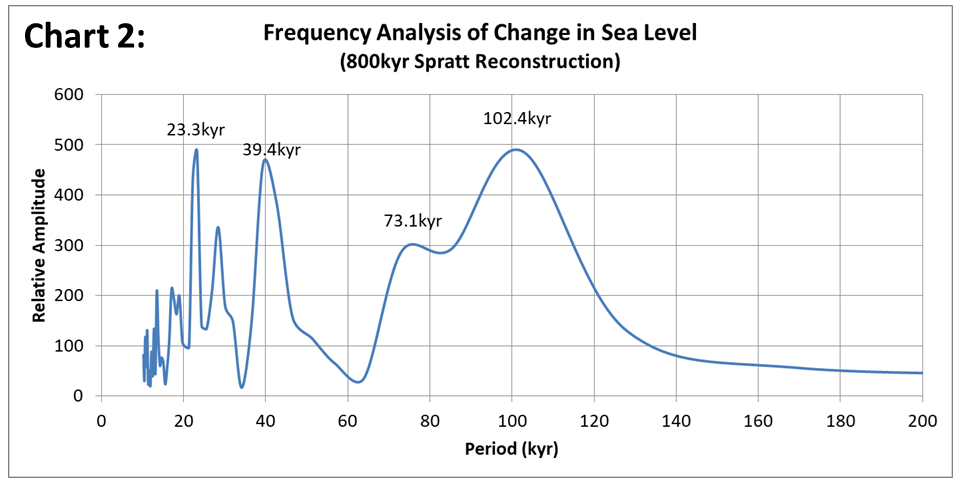
The precession cycle is modulated by both eccentricity and obliquity; although obliquity only influence high latitudes.
Every interglacial in the last 800kyr has ended with the peak solar power in the northern hemisphere increasing as occurred beginning 1582 in the present cycle. The observed climate trends are all following the precession cycle. No climate model has the capability of cooling the Southern Ocean, which has been an observed trend for the entire satellite era.
Oceans started rising due to increasing temperature about 200 years ago one hundred or so years after the NH solar power started increasing. The moderate rise will continue until snowfall overtakes snow melt.
Current glaciation is multiples of the precession cycle. The sea level falls when the solar power in the NH is increasing. It stalled when the solar power is falling. It will rise rapidly when the solar power is increasing if the land has reached the limit of its ice carrying capacity causing glacier calving and iceberg formation to rapidly cool the NH oceans despite the increasing solar power.
Sea level is a far better indicator of the state of the climate than temperature:

Thanks, Rick. In your plot it appears that sea levels follow temperature, much as CO2. How would you explain the lack of sensitivity to the 400kyr cycle? I’m not surprised that sea level would be more sensitive to shorter cycles if for no other reason than thermal expansion should be relatively fast.
The same planetary forces acting on Earth’s orbit, also influence the Sun with the same periodicity, but obviously not in the same way. The reason I was looking at glacial cycles is that I suspect solar activity may play a role.
Earlier you said something to the effect of solar output being constant. I don’t think it is, and I don’t think Earth’s orbital variations can explain this result where Neptune, Uranus and the Jupiter-Saturn synodic period affect temperature, with Neptune having the largest impact after the 900-cyear cycle and friends.
The 900-year cycle dominates the GISP2 ice-core temperature proxy, but one possible source of this cycle, which can be found affecting Jupiter’s orbit,is fading over the 20kyr shown. So the question is, does this relate in any way to the end of the Holocene?
Another 18k years until transition to mild glacial would make this a particularly long interglacial – up there with MIS11.
What is ”expected” is that this throw-away, unprovable, speculative, inconsequential mind fart will disappear into the ether never to be seen or heard from again, just like the million other frail prophecies vomited out over the last 40 years.
Those guys are on a sinking ship.
[[story tip]]
Hundreds cut from NOAA workforce.
Hundreds of NOAA employees laid off in latest cuts to federal workforce – CBS News
Gut NOAA of waste, fraud (temperature data) & abuse (climate catastrophe).
DOGE the NOAA.
I hope that includes 100% of GISS. !
Most of them were new hires, trainees
They’ll be asking if you want “fries with that” in a few weeks…putting many English-as-a-second-language order window clerks out of work and on the deportation list.
It is part of MAGA, to put legal Americans to work in the jobs vacated by illegals, who are deported, and not allowed to come back, because they committed a federal felony coming across the border without documents.
This paper does NOT determine that CO2 prolongs interglacials. It refers to two other papers, refs. 29 and 31, which appear to be largely speculation which appears from time to time.
A quick perusal leaves me wondering why this paper was written. The analysis covers the same ground of half a dozen earlier papers as far back as 1974, but with fancier graphics.
It does not even reference the statistical analysis of nearly twice as much data (10.1093/climsys/dzx002) by one of the authors from the referenced “LR04” for benthic cores. The numerology – often seen in Milankovich cycle predictions – refers to the ‘morphology’ of MIS 1, MIS 11 and MIS 19, apparently the qualitative appearance and tries to make predictions. Only the first part of MIS 1 is known to us. How, when, and if MIS 1 will terminate are only guesses – but far enough into the future that the publication will be lost electrons long since.
Get the grant money before Trump guys it
And get as much bullshit ‘published as possible so that it can be touted as “The Science (TM)”
We’ve got no more than a few hundred years of fossil fuel production at the current rate. After that, any ‘excess’ atmospheric CO2 will disappear very rapidly with a half-life of only a few years. The idea that our fossil fuel use could alter the length of the Holocene is to my mind ridiculous. If we use nuclear fusion to generate really serious amounts of CO2 from chalk and limestone, maybe we could stave off the next glacial period for a while, but realistically if there is a solution it hasn’t been thought of yet.
We could spread black soot over any ice like Soviet scientists suggested back in the 1960’s.
That black soot would come from……?
Climatologists self combusting from frustration at trying to get their models to work?
That was their problem too.
It’s fun to dream.
Oh no – not another ice age! The last one seemed to go on forever and I hated every minute of it.
Correct me if I’m wrong, but I’m pretty sure that if we burned every last stick and drop of combustible material on the planet it wouldn’t delay the next glaciation for 1 second.
I’ve never understood the line of reasoning anyway about human impact lasting so far into the future. Surely if rising CO2 represents such an existential threat to humanity, then no more humans on the planet means no more fossil fuel burning, farting, methane producing domestic stock, etc, etc… generally no more nasty human influence to contaminate the the atmosphere with the dreaded CO2 building block of life…. And therefore, no undue delay to the next glacial advance, several thousand years hence…. the prospect of which represents a much greater existential threat than any amount of CO2.
I’ll appeal to the authority of various geophysicists and geologists who opine that the Earth is cooling at a present rate of between one and four millionths of a Kelvin per annum.
Predictions of the freezing of equatorial oceans, creating an “ice ball Earth” seem delusional, requiring that ice form on water receiving 1000 W/m2 of energy from the sun, on water with a surface temperature of 30 C or so.
Anything is possible I suppose, but I’ll bet against it!
Climate is simultaneously warming and cooling, depending on a chosen time interval. While accurate measurements of global temperatures are problematic, an undeniable sign of colling will be drop in the ocean levels, or at least a prolonged extremum with zero growth.
So they are saying this as if were a bad thing. Wonder if they have a poster of the Doom Goblin in their bedroom?
Eric, a question for you. Given all that we know about the various astrophysical cycles, from our solar orbital cycles, sun spots and solar energy output, are we not able to issue a summary of where we are and when the next glaciation is likely to begin?
Also, do we have a firm understanding of how and why the current Pleistocene cycle of glaciations began 2.6 MYA, and how, why, and when it ends and we enter a much more stable climate regime?
Twenty or more years ago, the New Scientist was a technical/scientific mag, worth reading.
Now it’s descended into comic status, along with the Daily Mirror, Sun and Star.