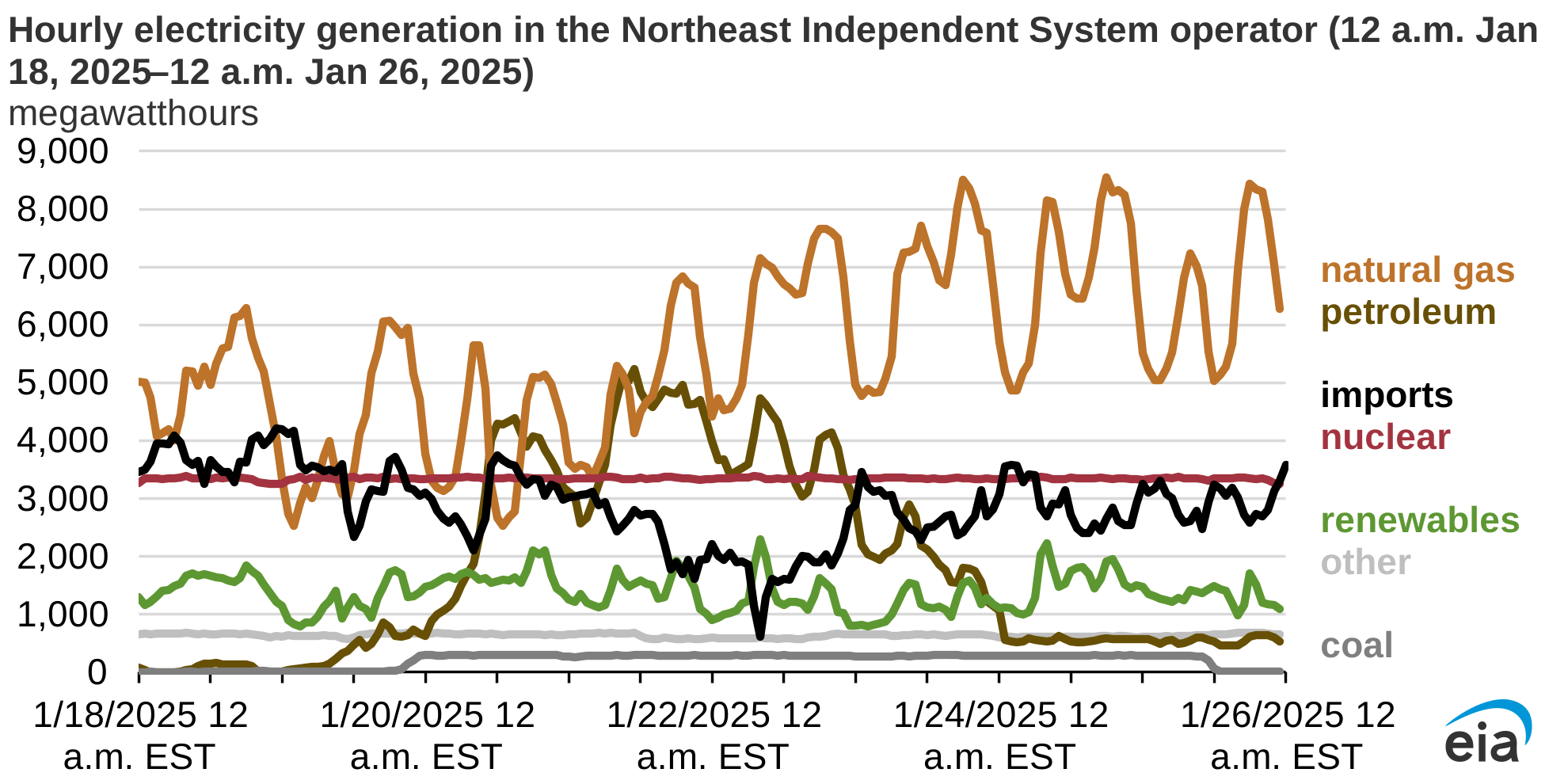
Data source: U.S. Energy Information Administration, Hourly Electric Grid Monitor Note: EST=eastern standard time
Below average temperatures in the eastern United States during the week of January 19, 2025, resulted in high demand for electricity. On January 21 at 6:00 p.m. eastern time, ISO-New England (ISO-NE), the organization operating an integrated grid in Maine, Vermont, New Hampshire, Massachusetts, Rhode Island, and Connecticut, recorded peak hourly demand of 19,600 megawatts (MW). Although demand was elevated, it was lower than the 20,308 MW that ISO-NE forecast peak demand would be in its 2024/2025 winter assessment published on November 7, 2024. Temperatures were more moderate in New England than in the Midwest, which tempered electricity demand somewhat in New England.
Although the grid had sufficient generating capacity to satisfy demand, a significant share of that supply came from sources that rarely operate. The grid required running older thermal generating plants that burn oil and coal. Between the hours of 11:00 a.m. and 4:00 p.m. eastern time on January 20, 2025, and between the hours of 10:00 a.m. and 1:00 p.m. on January 21, 2025, thermal plants that burn oil provided more electricity to the ISO-NE electricity grid than plants that burn natural gas, which is relatively uncommon. On January 21, 2025, the same group of thermal plants in ISO-NE provided more than 4,000 MW of electricity per hour to the grid between 7:00 a.m. and 11:00 p.m. At the same time, one of the two remaining coal-fired plants that burns coal in the region, the Merrimack facility in New Hampshire, supplied close to 300 MW to the grid from the evening of January 19 to the morning of January 25.
Oil and coal offset curtailed generation from natural gas-fired power plants from January 18 to January 22. Prices for natural gas were high, and supplies were short during this period because of more demand for natural gas from other consumers, such as homes and businesses. Later in the week, more natural gas was made available, including supply received from a liquefied natural gas (LNG) import terminal in Everett, Massachusetts. This supply helped boost generation from natural gas-fired power plants beginning on January 22.
Two other major sources of electricity in New England were steady suppliers during the cold snap. The region’s three nuclear reactors steadily provided 3,350 MW of power throughout the period, joined by consistent imports of power from Canada. At 11:00 p.m. on January 18, imports of electricity from Canada surpassed 4,200 MW and averaged 2,886 MW per hour between midnight on January 18 and midnight on January 26.
Principal contributors: Kimberly Peterson, Sue Smith
I prefer to use stacked area plots to evaluate the contributions of different generation sources.
Figure 1. ISO New England electricity generation by source 1/18/2025 – 1/26/2025. US EIA
Nuclear power provided a stable baseload. Coal ramped up to reinforce that baseload. Natural gas ramped up and down with demand. Petroleum-fired power plants ramped up to cover the demand gas couldn’t keep up with. Hydroelectric and pumped storage wallowed on top of the waves. While solar, wind and battery power remained largely invisible.
How many ways to count the irony?
Irony #1
The first irony is the fact that New England had to import foreign liquified natural gas (LNG) because they steadfastly resist the construction of natural gas pipelines.
Even with New England’s relative proximity to the Marcellus and Utica shale gas basins in Pennsylvania, West Virginia, and Ohio, the rise in production from these areas has not been matched by pipeline infrastructure to deliver fuel supplies to the region. Complicating matters for New England is a lack of underground storage that could be used to help smooth out seasonal demand spikes.[3]
The Northeast is also effectively cut off from domestic LNG supplies. While the US exports LNG from terminals on the Gulf Coast and Cove Point, Maryland, cargoes from these locations and other US ports cannot be delivered to New England as a result of the Jones Act, which restricts maritime commerce between US ports. (The Jones Act is discussed in greater depth later in this piece.)
Demand for natural gas in the region has grown over the last decade as a result of new, gas-fired power plants, coal and nuclear plant retirements, and residential users switching from heating oil to natural gas.[4] Nearly half of New England’s power plants now use natural gas as their primary fuel (about 15,000 MW)[5] and 46 percent of homes in the region use natural gas for heating.[6]
The region is served by two LNG import terminals in Massachusetts: the Everett and the Northeast Gateway terminals. In addition, Maryland’s Cove Point Terminal and Georgia’s Elba Terminal can import additional supplies to make up regional shortfalls when they occur.
Oil and coal offset curtailed generation from natural gas-fired power plants from January 18 to January 22. Prices for natural gas were high, and supplies were short during this period because of more demand for natural gas from other consumers, such as homes and businesses. Later in the week, more natural gas was made available, including supply received from a liquefied natural gas (LNG) import terminal in Everett, Massachusetts. This supply helped boost generation from natural gas-fired power plants beginning on January 22.
Nuclear, oil, and coal generators are critical on the coldest winter days when natural gas supply is constrained (as shown below). Coal- and oil-fired resources also make valuable contributions on the hottest days of summer when demand is very high or major resources are unavailable. As more and more conventional, thermal generation facilities that store fuel on site retire, the system is increasingly made up of generating facilities that run on “just-in-time” energy sources: natural gas (from pipelines and LNG deliveries), wind, and solar energy.
With limited options for storing natural gas, most natural-gas-fired plants rely on just-in-time fuel delivered to New England through interstate pipelines. However, interstate pipeline infrastructure has only expanded incrementally over the last several decades, even as reliance on natural gas for home heating and for power generation has grown significantly. During cold weather, most natural gas is committed to local utilities for residential, commercial, and industrial heating. As a result, during severe winter weather many power plants in New England cannot obtain fuel to generate electricity. Liquefied natural gas (LNG), brought to New England by ship from overseas, can help fill the gap—but regional LNG storage and sendout capability is limited, and its timely arrival depends on long-term weather forecasts, global market prices, and other logistical challenges.
New England’s largely left-wing enviro-nitwit governments are betting big on wind and solar power.
New England states move forward with three giant offshore wind farms
By Reuters
September 6, 2024
NEW YORK, Sept 6 (Reuters) – Massachusetts and Rhode Island are moving ahead with three offshore wind projects totaling 2.9 gigawatts (GW), or enough electricity to power about 1.6 million homes, government officials announced on Friday.
The project selections, following a joint solicitation in March for wind farms to be built off of New England’s shores, move Massachusetts and Rhode Island closer to state renewable energy goals aimed at combating the effects of climate change.
[…]
Federal and state climate pledges have largely centered around decarbonizing electrical grids by replacing fossil-fired power with renewable wind and solar. Massachusetts aims to slash its power sector’s carbon emissions by 50% by 2030 and 100% by 2050. The much smaller Rhode Island has set a goal to use all renewables by 2033.
Winter also poses the greatest challenges for solar output in New England due to snow, clouds, and shortened daylight hours. In addition, shortened winter days means consumers use the most electricity after sunset, and therefore solar doesn’t reduce winter peak demand. While offshore wind experiences its highest production during winter, winter storms that limit solar power can also significantly limit the output of wind generation if high wind speeds force plant operators to shut down in order to protect equipment. This type of variability is a n understandable challenge in meeting the states’ decarbonization goals through greater renewable, weather-dependent technologies, and it poses new technical challenges to the grid’s reliability.
Solar power works best when it’s least needed in New England.
Figure 2. This graph shows the effect of distributed solar power (rooftop panels, etc.) on grid demand, The yellow curve depicts a “duck curve”. On sunny days, distributed solar arrays reduce grid demand, The gray curve is what happens when the Sun doesn’t shine. The ducks only work on sunny days, ISO New England
Irony #3
During the recent cold snap, peak demand occurred at 0800 on January 22.
Figure 3. ISO New England electricity generation by source 1/18/2025 – 1/26/2025, with peak demand highlighted.
Fossil fuels and nuclear power provided 83% of the power generation. Hydroelectric and pumped storage covered 13%. Wind accounted for 1%, Solar and battery storage delivered zero-point-zero percent of the generation.
Figure 4. ISO New England electricity generation by source 0800 1/22/2025.
Irony #4
The final irony is that I was born (1958), raised, went to college and earned a geoscience degree (1980) in Connecticut back during The Ice Age Cometh era.
I had just finished my sophomore year of college when this In Search Of episode aired in May 1978.
Since 1981, I’ve been a geophysicist/geologist in the oil & gas industry in Texas… Helping provide the oil & gas that keeps New Englanders from freezing in the dark… And, I guess, also contributing to some degree to the global warming, that saved them from The Ice Age Cometh.
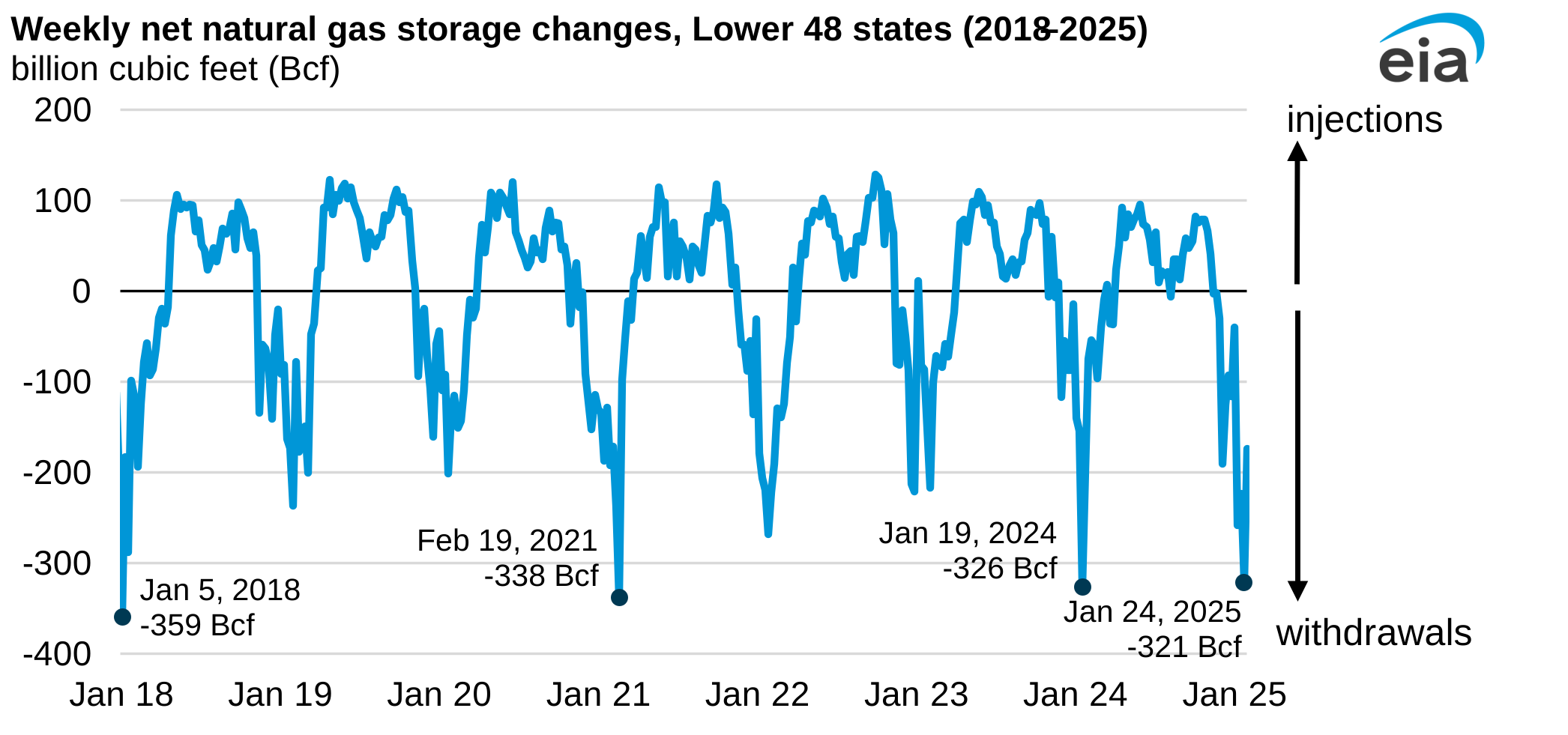
Fortunately for those affected by adverse weather (like really cold nights), the oil & gas industry produces natural gas, with very few exceptions, 24/7/365. We inject it into subsurface storage facilities when production exceeds demand, so that it can be withdrawn when demand exceeds production.
Oh good. Not only did I benefit from that NH’s coal plant, you cite that old Science News issue that sure got my attention when it arrived in my mailbox.
To add to the stupidity of it all, the electricity produced by the Bow NH coal-powered plant, which now only gets used in emergency situations is way more expensive than it needs to be. It has to be on standby 24/7, meaning it is operating at its lowest possible level without shutting it down, thus using power instead of generating it.
The Kinder Morgan gas pipeline was well on its way to getting built before the enviro/carbon fascist nutcases shut it down. I doubt they even care about any of this. Quite proud of themselves in fact, I suspect.
NEW ENGLAND ELECTRICITY 100% FROM WIND AND SOLAR by 2050?
In New England, we have Net Zero nut cases. They know nothing about energy systems, but spout lots of nonsense.
“Keep it in the ground”, they say. “All electricity from wind and solar”, they say.
When presented with numbers and facts their eyes glaze over
Here is a simple analysis, if no fossil fuels, no nuclear, and minimal other sources of electricity https://www.windtaskforce.org/profiles/blogs/vermont-example-of-electricity-storage-with-tesla-powerwall-2-0s
.
It is assumed, 1) all W/S output, based on historic weather data, is loaded into batteries, 2) all demand is drawn from batteries, based on historic load on the grid, as published by ISO-NE.
An annual storage balance was created, which needed to stay well above zero; the batteries are not allowed to “run dry” in bad W/S years. The balance was used to determine the wind and solar capacities needed to achieve it.
.
New England would need a battery storage system with a capacity of about 10 TWh of DELIVERABLE electricity from batteries to the HV grid.
Daily W/S output would be fed to the batteries, 140 TWh/y
Daily demand would be drawn from the batteries, 115 TWh/y in 2024
Battery system roundtrip loss, HV to HV, would be 25 TWh/y, more with aging
Transmission and Distribution to users incur additional losses of about 8%, or 0.08 x 115 = 9.2 TWh
The battery system would cover any multi-day W/S lulls throughout the year
Batteries would supplement W/S output, as needed, 24/7/365
W/S would charge excess output into the batteries, 24/7/365
Tesla recommends not charging to more than 80% full and not discharging to less than 20% full, to achieve normal life of 15 years and normal aging at 1.5%/y.
The INSTALLED battery capacity would need to be about 10 TWh / (0.6, Tesla factor x aging factor x 0.9, outage factor) = 18.5 TWh, delivered as AC at battery outlet.
The turnkey cost would be about $600/installed kWh, delivered as AC at battery outlet, 2024 pricing, or $600/kWh x 18.5 billion kWh = $11.1 trillion, about every 15 years.
I did not mention annually increasing insurance costs of risky W/S projects.
If 50% were borrowed from banks, the cost of amortizing $5.5 trillion at 6% over 15 years = $557 billion/y
If 50% were from Owners, the cost of amortizing $5.5 trillion at 10% over 15 years = $708 billion/y https://www.windtaskforce.org/profiles/blogs/battery-system-capital-costs-losses-and-aging
High Costs/kWh of Wind and Solar Foisted onto a Brainwashed Public
US subsidies are:
1) Federal and state tax credits, up to 50%
– Community tax credit of 10 percent
– Base tax credit of 30 percent
– State tax credit and other incentives of up to 10%
2) 5-y Accelerated Depreciation write off of the entire project
3) Deduction of interest of borrowed money
.
The subsidies reduce the owning and operating cost of a project by 50%, which means electricity can be sold at 50% less than it costs to produce.
Utilities pay 15 c/kWh, wholesale, after 50% subsidies, for electricity from fixedoffshore wind systems
Utilities pay 18 c/kWh, wholesale, after 50% subsidies, for electricity from floating offshore wind
Utilities pay 12 c/kWh, wholesale, after 50% subsidies, for electricity from larger solar systems
. Excluded costs, at a future 30% W/S annual penetration on the grid, the current UK level:
– Onshore grid expansion/reinforcement to connect distributed W/S systems, about 2 c/kWh
– Traditional power plants to quickly counteract W/S variable output, on a less than minute-by-minute basis, 24/7/365, about 2 c/kWh
– Traditional power plants providing electricity during 1) low-wind periods, 2) high-wind periods, when rotors are locked in place, and 3) low solar periods during mornings, evenings and at night, about 2 c/kWh
– W/S electricity that could have been produced, if not curtailed, about 1 c/kWh
– Importing electricity at high prices, when W/S output is low, 1 c/kWh
– Exporting electricity at low prices, when W/S output is high, 1 c/kWh
– Disassembly on land and at sea, reprocessing and storing at hazardous waste sites, about 2 c/kWh Some of these values exponentially increase as more wind and solar systems are added to the grid
.
The economic/financial insanity and environmental damage of it all is off the charts.
No wonder Europe’s near-zero, real-growth economy is in such big do-do
That economy has been tied into knots by inane people.
YOUR tax dollars are building these projects so YOU will have much higher electric bills.
Remove YOUR tax dollars and none of these projects would be built, and YOUR electric bills would be lower
Watch the YouBoob video he did of his custom Beverly Hills home, and I think you’ll understand the transition he went through. It looks from here like he drank and partied himself out of his blue collar roots and into mediocrity!
The NE is constrained in natural gas, as stated, due to vocal opposition to any new pipelines. So when the price of natural gases rises, it can become cheaper to for some simple and combined cycle plant to use #2 oil, if they have on-site storage. That accounts for some of the increase in oil use.
SCInotFI
February 12, 2025 6:31 am
Unfortunately the “no pain, no gain” path to wisdom will be operational in New England for the foreseeable future…some “dreams” die hard. Reality will be their teach but many will suffer along the way. I’m a New Englander, disgusted by the waste(s) generated by this green energy BS, and looking at the silver lining of recent weather events as bringing us closer to rational solutions (like nuclear).
Good article, David. It shows how close to the edge our electrical grids are with the climate alarmists adding windmills and solar and subtracting reliable generation like coal, oil, natural gas and nuclear.
At least New England has sufficient backup at the moment, but if they continue adding windmills and solar and subtracting reliable generation, they are eventually going to cripple their grid.
Other grids around the nation are in the same sad shape, and they don’t have as many backup options as the New England grid has.
Windmills and Solar are a Cancer on our Electric Grids. The more windmills and solar, the closer we come to blackouts and the prices for electricity go sky high. Just exactly what we are seeing in every case, all around the world.
It looks as if the sensible thing to do would be for New England to double up on nuclear to provide a stable base load, and then use other sources of electricity that are cheapest to make up to demand.
In the same way the UK should increase nuclear to give a base load of 20GW and make up to demand with the cheapest alternatives.
We should have done it 10 years ago but Nick Clegg of the Liberal Democrats (who were in a coalition with Conservatives then) put the mockers on building new nuclear by saying that it would take ten years before they were completed.
If only! Could SMRs help?
Try to put a new nuke in New England. Similar to NG pipelines, they will be automatically opposed by the screaming meemies. Indian Point? Kaput. Vermont Yankee? Down the tubes. And those were the viable, profitable ones.
SteveE
February 12, 2025 7:22 am
At least there are some signs that not everybody is buying into the wind farm model.
Connecticut bailed on committing to 400MW of the Vineyard Wind 2 project. This led the developer to withdraw at teh end of December 2024.
Brian
February 12, 2025 7:37 am
I’m always proud my state is the last operator of nuclear power as well. Honestly I want two more nuke plants built so we can be future proof and sell our excess to our idiot neighbors.
I was mistaken. Apparently, Millstone 2 and Millstone 3 in Connecticut are still operating, although well below their nameplate capacity for some reason.
Probably the idiotic “prioritizing” of worse-than-useless wind and solar power, I expect.
John Hultquist
February 12, 2025 7:38 am
Coal, like wood for my stove, can be store on site unlike wind, solar, and usually even gas.
The NE is cold again, or still, I don’t pay much attention.
Check the forecast for KMPV – Montpelier VT.
There are tens of million of acres of mostly unmanaged (or mismanaged) forest in New England that could have the “junk wood” harvested for energy. But nooooo… the forestry haters won’t allow it. And if all that junk wood was harvested- the best trees that are left would produce billions of dollars of quality timber and wood products every year. But no, import wood and furniture from thousands of miles away- you know, like Ikea. One town here in north Central Wokeachusetts, Gardner, calls itself “the chair making capital of America”- from back in the days when forestry here was respected.
Bruce Cobb
February 12, 2025 7:49 am
And the stupidometer pegs when it comes to having to rely on extremely expensive LNG, sometimes shipped thousands of miles (even from Russia). But don’t build a pipeline because that would be “BAD”.
“This former Connecticut Yankee geology student, now naturalized Texan petroleum geologist…”
I got a good laugh at that one. This former NJ/PA/NY engineering student “emigrated” to TX ’78 and stayed until ’80. Great people. It took me a while though to appreciate that “Yankee” was a separate word. All in good fun.
I had a bit of an advantage. My Dad was born in Georgia and grew up on a farm in North Central Florida. Most of the Middleton side of the family still live in Florida. I grew up eating grits and cornbread… And wore a gray kepi to school until 2nd or 3rd grade. As far as I know, I was the only ZZ Top fan in my high school. Oddly enough my high school’s team name was the Rebels. The New Fairfield, Connecticut Rebels… Irony can be so ironic.
As a side note. Years ago home heating oil was used in a substantial portion of New England homes. To combat rising yearly heating cost states demanded a got companies to give “locked in pricing” for heating oil customers. Many locked in at the highs of oil prices and when prices nose dived states started demanding companies cancel “locked in pricing” contracts.
New England’s stupidity over gas pipelines makes them very vulnerable.
No pipeline is pretty stupid considering New England has a high percentage of people who use natural gas in their homes. Natural-gas-heated homes reduce the electrical demand on the grid.
KevinM
February 12, 2025 8:32 am
The “Nuclear” line in every electricity production time series chart is the happiest boring flat line for decades and decades. I wonder when the world will notice.
You’ve got me beat by a few years. I think anti-nuke tried to reenact the Chernobyl buzz with Fukushima but couldn’t find an audience. It made people ask inconvenient questions like how horrible is Chernobyl 30 years later?
Some mass-media memories stick. My mass media memories are the Challenger explosion, gulf war 1 smart bombings narrated by Colin Powell and the World Trade Center airplanes – I still remember the footage. Other generations have their own things – I’m just theorizing that the generations for whom TMI was a big deal (your peers?) have mostly lost interest. Candy Crush and Dancing with Stars seem much bigger draws. Generational memory might be relevant because lack of interest equals less political will to sabotage that industry.
Erik Magnuson
February 12, 2025 8:32 am
If my memory is correct, the reason that New England has to “import” LNG is that New York State will not allow pipelines to be built across the state to serve New England. NYS also has a lot of shale gas reserves that aren’t being developed.
I suspect the opposition to both comes mainly from NYC and its suburbs, and that a lot of upstate folks would love to cut off down state.
I agree that NYS stopped pipelines going through the state but I think that once the pipeline got to New England it would have been stopped anyway. Idiots
The completed section of pipeline had already reached Mass., so that is where most of the opposition stemmed from. However, Kinder Morgan gave, as the ultimate reason for shutting it down, the fact that not enough large potential customers (utility companies, manufacturers etc.) were signing on the dotted line. The question is why weren’t they, and for that, one only need look at the politics surrounding it. Yes, I suspect some smoke-filled dimly lit rooms were involved.
Even with New England’s relative proximity to the Marcellus and Utica shale gas basins in Pennsylvania, West Virginia, and Ohio
Irony #1a:Note what is conspicuously missing from the list, the Marcellus basin in New York, which is much closer than the other three states. I wonder why…
KevinM
February 12, 2025 8:37 am
Irony #2 chart needs a title to say what the yellow and gray lines mean.
“Figure 2. This graph shows the effect of distributed solar power (rooftop panels, etc.) on grid demand, The yellow curve depicts a “duck curve”. On sunny days, distributed solar arrays reduce grid demand, The gray curve is what happens when the Sun doesn’t shine. The ducks only work on sunny days, ISO New England”
There is a new facility at the electricitymaps website to show an overlay of solar intensity. Today’s was very striking. If you wanted solar at 13:00Z you better be in South America.
mleskovarsocalrrcom
February 12, 2025 10:28 am
One would think at some point people would notice how reliable the nuclear contribution is to providing energy for them to live.
The French had over 75% nuclear, a working breeder (Phenix), and are now trying to ruin it all. From highly reliable to highly stupid. IQs in the West began to droop below 80 after 1960.
So New England is just as stupid as Old England. Ed Miliband’s brother lives in the US, if he is in New England that would explain a lot.
abolition man
February 12, 2025 1:37 pm
“Thank you!” from a stupid wannabe hippie who sobered up enough to get most of a college degree, and eventually escaped far enough from Commifornia to be your neighbor!
As an avid fan of Mark Twain, your use of humor and irony is always appreciated; but promise that if you ever do a podcast, you will let us know and that you’ll use ‘Sharp Dressed Man’ as your bumper! Dr. Zharkova is now claiming that we are entering a Grand Solar Minimum. The ultimate irony would be seeing that play out when Trump is in power and can act accordingly!
“Sharp Dressed Man”? My wife says I dress like a park ranger. If I ever did a podcast, I think my intro music would have to be AC/DC… Highway to Hell, Back in Black or Thunderstruck. If I went with ZZ Top, it would be La Grange, Tush or Heard it on the X… :;)
I was introduced to ZZ Top back in the 70s – the album Tejas – especially the track “Driving while blind” (iirc!).
This was courtesy of the crew from a US Coastguard station on the Shetland Islands….we didn’t think that was the full story but they were a great bunch!
Dr.Zharkova focuses on the solar cycle since that is her game, however, the solar minimum is predicted only by extrapolating what happened previously and then watching for an early or delayed peak. The present cycle 25 has already doubled the sunspot number of cycle 24 which is contrary to the original extrapolation. Who knows what to expect? The extrapolations are a bet that nothing will change from the previous cycle. This is obvious in the series of predictions of cycle 24 from 2006 to 2010, which were closer and closer as the 2014 peak approached, but still too high even then. However, GSM or not, the previous 150 year climate trend can go either way at any time since we really understand NONE of the variables quantitatively. That is why ‘pathways’ like Net Zero 2050 are utterly moronic for dozens of obvious reasons.


Oh good. Not only did I benefit from that NH’s coal plant, you cite that old Science News issue that sure got my attention when it arrived in my mailbox.
BTW, the best link to the story is https://www.sciencenews.org/wp-content/uploads/1975/03/00368423.ap071683.07a00180.pdf
To add to the stupidity of it all, the electricity produced by the Bow NH coal-powered plant, which now only gets used in emergency situations is way more expensive than it needs to be. It has to be on standby 24/7, meaning it is operating at its lowest possible level without shutting it down, thus using power instead of generating it.
The Kinder Morgan gas pipeline was well on its way to getting built before the enviro/carbon fascist nutcases shut it down. I doubt they even care about any of this. Quite proud of themselves in fact, I suspect.
As Ron White says…
Great article.
I need more than just one drink
NEW ENGLAND ELECTRICITY 100% FROM WIND AND SOLAR by 2050?
In New England, we have Net Zero nut cases. They know nothing about energy systems, but spout lots of nonsense.
“Keep it in the ground”, they say. “All electricity from wind and solar”, they say.
When presented with numbers and facts their eyes glaze over
Here is a simple analysis, if no fossil fuels, no nuclear, and minimal other sources of electricity
https://www.windtaskforce.org/profiles/blogs/vermont-example-of-electricity-storage-with-tesla-powerwall-2-0s
.
It is assumed, 1) all W/S output, based on historic weather data, is loaded into batteries, 2) all demand is drawn from batteries, based on historic load on the grid, as published by ISO-NE.
An annual storage balance was created, which needed to stay well above zero; the batteries are not allowed to “run dry” in bad W/S years. The balance was used to determine the wind and solar capacities needed to achieve it.
.
New England would need a battery storage system with a capacity of about 10 TWh of DELIVERABLE electricity from batteries to the HV grid.
Daily W/S output would be fed to the batteries, 140 TWh/y
Daily demand would be drawn from the batteries, 115 TWh/y in 2024
Battery system roundtrip loss, HV to HV, would be 25 TWh/y, more with aging
Transmission and Distribution to users incur additional losses of about 8%, or 0.08 x 115 = 9.2 TWh
The battery system would cover any multi-day W/S lulls throughout the year
Batteries would supplement W/S output, as needed, 24/7/365
W/S would charge excess output into the batteries, 24/7/365
Tesla recommends not charging to more than 80% full and not discharging to less than 20% full, to achieve normal life of 15 years and normal aging at 1.5%/y.
The INSTALLED battery capacity would need to be about 10 TWh / (0.6, Tesla factor x aging factor x 0.9, outage factor) = 18.5 TWh, delivered as AC at battery outlet.
The turnkey cost would be about $600/installed kWh, delivered as AC at battery outlet, 2024 pricing, or $600/kWh x 18.5 billion kWh = $11.1 trillion, about every 15 years.
I did not mention annually increasing insurance costs of risky W/S projects.
If 50% were borrowed from banks, the cost of amortizing $5.5 trillion at 6% over 15 years = $557 billion/y
If 50% were from Owners, the cost of amortizing $5.5 trillion at 10% over 15 years = $708 billion/y
https://www.windtaskforce.org/profiles/blogs/battery-system-capital-costs-losses-and-aging
High Costs/kWh of Wind and Solar Foisted onto a Brainwashed Public
US subsidies are:
1) Federal and state tax credits, up to 50%
– Community tax credit of 10 percent
– Base tax credit of 30 percent
– State tax credit and other incentives of up to 10%
2) 5-y Accelerated Depreciation write off of the entire project
3) Deduction of interest of borrowed money
.
The subsidies reduce the owning and operating cost of a project by 50%, which means electricity can be sold at 50% less than it costs to produce.
Utilities pay 15 c/kWh, wholesale, after 50% subsidies, for electricity from fixedoffshore wind systems
Utilities pay 18 c/kWh, wholesale, after 50% subsidies, for electricity from floating offshore wind
Utilities pay 12 c/kWh, wholesale, after 50% subsidies, for electricity from larger solar systems
.
Excluded costs, at a future 30% W/S annual penetration on the grid, the current UK level:
– Onshore grid expansion/reinforcement to connect distributed W/S systems, about 2 c/kWh
– Traditional power plants to quickly counteract W/S variable output, on a less than minute-by-minute basis, 24/7/365, about 2 c/kWh
– Traditional power plants providing electricity during 1) low-wind periods, 2) high-wind periods, when rotors are locked in place, and 3) low solar periods during mornings, evenings and at night, about 2 c/kWh
– W/S electricity that could have been produced, if not curtailed, about 1 c/kWh
– Importing electricity at high prices, when W/S output is low, 1 c/kWh
– Exporting electricity at low prices, when W/S output is high, 1 c/kWh
– Disassembly on land and at sea, reprocessing and storing at hazardous waste sites, about 2 c/kWh
Some of these values exponentially increase as more wind and solar systems are added to the grid
.
The economic/financial insanity and environmental damage of it all is off the charts.
No wonder Europe’s near-zero, real-growth economy is in such big do-do
That economy has been tied into knots by inane people.
YOUR tax dollars are building these projects so YOU will have much higher electric bills.
Remove YOUR tax dollars and none of these projects would be built, and YOUR electric bills would be lower
The Tater Salad show was fabulous. Each subsequent Ron White hour has been a little less funny.
Yep… He got less funny and more raunchy over the years. But Tater Salad is hilarious.
The Fonz just got less funny…until he jumped the shark.
Watch the YouBoob video he did of his custom Beverly Hills home, and I think you’ll understand the transition he went through. It looks from here like he drank and partied himself out of his blue collar roots and into mediocrity!
The NE is constrained in natural gas, as stated, due to vocal opposition to any new pipelines. So when the price of natural gases rises, it can become cheaper to for some simple and combined cycle plant to use #2 oil, if they have on-site storage. That accounts for some of the increase in oil use.
Unfortunately the “no pain, no gain” path to wisdom will be operational in New England for the foreseeable future…some “dreams” die hard. Reality will be their teach but many will suffer along the way. I’m a New Englander, disgusted by the waste(s) generated by this green energy BS, and looking at the silver lining of recent weather events as bringing us closer to rational solutions (like nuclear).
David, typo: just above Figure 2 is: “lease” which should be “least”.
Fixed
Good article, David. It shows how close to the edge our electrical grids are with the climate alarmists adding windmills and solar and subtracting reliable generation like coal, oil, natural gas and nuclear.
At least New England has sufficient backup at the moment, but if they continue adding windmills and solar and subtracting reliable generation, they are eventually going to cripple their grid.
Other grids around the nation are in the same sad shape, and they don’t have as many backup options as the New England grid has.
Windmills and Solar are a Cancer on our Electric Grids. The more windmills and solar, the closer we come to blackouts and the prices for electricity go sky high. Just exactly what we are seeing in every case, all around the world.
And that with existing usage. Just wait for more virtue signaling EV users and AI to increase the load.
ISO-NE burns about a billion dollars of oil during each of these winter events.
Maybe somebody who knows how to use AI can get it to generate an image of a power plant burning a billion dollars.
It looks as if the sensible thing to do would be for New England to double up on nuclear to provide a stable base load, and then use other sources of electricity that are cheapest to make up to demand.
In the same way the UK should increase nuclear to give a base load of 20GW and make up to demand with the cheapest alternatives.
We should have done it 10 years ago but Nick Clegg of the Liberal Democrats (who were in a coalition with Conservatives then) put the mockers on building new nuclear by saying that it would take ten years before they were completed.
If only! Could SMRs help?
Chernobyl was 1986… in Ukraine. Thirty-nine years later it’s still a better climate to live than Siberia.
Try to put a new nuke in New England. Similar to NG pipelines, they will be automatically opposed by the screaming meemies. Indian Point? Kaput. Vermont Yankee? Down the tubes. And those were the viable, profitable ones.
At least there are some signs that not everybody is buying into the wind farm model.
Connecticut bailed on committing to 400MW of the Vineyard Wind 2 project. This led the developer to withdraw at teh end of December 2024.
I’m always proud my state is the last operator of nuclear power as well. Honestly I want two more nuke plants built so we can be future proof and sell our excess to our idiot neighbors.
I was mistaken. Apparently, Millstone 2 and Millstone 3 in Connecticut are still operating, although well below their nameplate capacity for some reason.
Probably the idiotic “prioritizing” of worse-than-useless wind and solar power, I expect.
Coal, like wood for my stove, can be store on site unlike wind, solar, and usually even gas.
The NE is cold again, or still, I don’t pay much attention.
Check the forecast for KMPV – Montpelier VT.
There are tens of million of acres of mostly unmanaged (or mismanaged) forest in New England that could have the “junk wood” harvested for energy. But nooooo… the forestry haters won’t allow it. And if all that junk wood was harvested- the best trees that are left would produce billions of dollars of quality timber and wood products every year. But no, import wood and furniture from thousands of miles away- you know, like Ikea. One town here in north Central Wokeachusetts, Gardner, calls itself “the chair making capital of America”- from back in the days when forestry here was respected.
And the stupidometer pegs when it comes to having to rely on extremely expensive LNG, sometimes shipped thousands of miles (even from Russia). But don’t build a pipeline because that would be “BAD”.
“Stupidometer.” I like it. Can I use it?
“This former Connecticut Yankee geology student, now naturalized Texan petroleum geologist…”
I got a good laugh at that one. This former NJ/PA/NY engineering student “emigrated” to TX ’78 and stayed until ’80. Great people. It took me a while though to appreciate that “Yankee” was a separate word. All in good fun.
I had a bit of an advantage. My Dad was born in Georgia and grew up on a farm in North Central Florida. Most of the Middleton side of the family still live in Florida. I grew up eating grits and cornbread… And wore a gray kepi to school until 2nd or 3rd grade. As far as I know, I was the only ZZ Top fan in my high school. Oddly enough my high school’s team name was the Rebels. The New Fairfield, Connecticut Rebels… Irony can be so ironic.
https://youtu.be/h9AqbDtSFNU
No mention of what the new Trump administration’s policies will do here in New
EnglandWokeland?Well stripping away the taxpayer subsidies should put a hard brake on wind and solar “development,” we hope.
If only the grid could be powered by irony.
If only the grid could be powered by anger and outrage. The dems would have an unlimited power supply.
As a side note. Years ago home heating oil was used in a substantial portion of New England homes. To combat rising yearly heating cost states demanded a got companies to give “locked in pricing” for heating oil customers. Many locked in at the highs of oil prices and when prices nose dived states started demanding companies cancel “locked in pricing” contracts.
New England’s stupidity over gas pipelines makes them very vulnerable.
No pipeline is pretty stupid considering New England has a high percentage of people who use natural gas in their homes. Natural-gas-heated homes reduce the electrical demand on the grid.
The “Nuclear” line in every electricity production time series chart is the happiest boring flat line for decades and decades. I wonder when the world will notice.
(people alive for TMI are over 50 now)
Was going to argue with you, then realized I’m over 60.
You’ve got me beat by a few years. I think anti-nuke tried to reenact the Chernobyl buzz with Fukushima but couldn’t find an audience. It made people ask inconvenient questions like how horrible is Chernobyl 30 years later?
Over 45. I’m 65 and was in college when TMI happened.
Some mass-media memories stick. My mass media memories are the Challenger explosion, gulf war 1 smart bombings narrated by Colin Powell and the World Trade Center airplanes – I still remember the footage. Other generations have their own things – I’m just theorizing that the generations for whom TMI was a big deal (your peers?) have mostly lost interest. Candy Crush and Dancing with Stars seem much bigger draws. Generational memory might be relevant because lack of interest equals less political will to sabotage that industry.
If my memory is correct, the reason that New England has to “import” LNG is that New York State will not allow pipelines to be built across the state to serve New England. NYS also has a lot of shale gas reserves that aren’t being developed.
I suspect the opposition to both comes mainly from NYC and its suburbs, and that a lot of upstate folks would love to cut off down state.
Dang, should have read through first. Anyway, my comment below follows on to yours quite well.
I agree that NYS stopped pipelines going through the state but I think that once the pipeline got to New England it would have been stopped anyway. Idiots
The completed section of pipeline had already reached Mass., so that is where most of the opposition stemmed from. However, Kinder Morgan gave, as the ultimate reason for shutting it down, the fact that not enough large potential customers (utility companies, manufacturers etc.) were signing on the dotted line. The question is why weren’t they, and for that, one only need look at the politics surrounding it. Yes, I suspect some smoke-filled dimly lit rooms were involved.
Irony #1
Irony #1a:Note what is conspicuously missing from the list, the Marcellus basin in New York, which is much closer than the other three states. I wonder why…
Irony #2 chart needs a title to say what the yellow and gray lines mean.
MW delivered to consumers on cloudy (gray) and sunny (yellow) days. The “duck curve” is due to distributed solar power. There’s link in the caption.
Assumes a familiarity – suggest adding a title like “The Duck Curve” or “Solar Power Delivered”
I’ll add somethin in the caption.
“Figure 2. This graph shows the effect of distributed solar power (rooftop panels, etc.) on grid demand, The yellow curve depicts a “duck curve”. On sunny days, distributed solar arrays reduce grid demand, The gray curve is what happens when the Sun doesn’t shine. The ducks only work on sunny days, ISO New England”
Perfect
NE escaped this time. But eventually their foolishness will catch up with them. Relying on old coal standby is not a winning long term gamble.
Only divine intervention can save the UK
Not even god can replace the coal fired power plants the government blew up.
Which god? Allah? Yahweh is proving stronger and more intelligent…
If you believe that stuff.
Yahwei is Elohim or Allah, which is the same thing. Allah is a variant of spelling of Elohim.
There is a new facility at the electricitymaps website to show an overlay of solar intensity. Today’s was very striking. If you wanted solar at 13:00Z you better be in South America.
One would think at some point people would notice how reliable the nuclear contribution is to providing energy for them to live.
The French had over 75% nuclear, a working breeder (Phenix), and are now trying to ruin it all. From highly reliable to highly stupid. IQs in the West began to droop below 80 after 1960.
So New England is just as stupid as Old England. Ed Miliband’s brother lives in the US, if he is in New England that would explain a lot.
“Thank you!” from a stupid wannabe hippie who sobered up enough to get most of a college degree, and eventually escaped far enough from Commifornia to be your neighbor!
As an avid fan of Mark Twain, your use of humor and irony is always appreciated; but promise that if you ever do a podcast, you will let us know and that you’ll use ‘Sharp Dressed Man’ as your bumper! Dr. Zharkova is now claiming that we are entering a Grand Solar Minimum. The ultimate irony would be seeing that play out when Trump is in power and can act accordingly!
“Sharp Dressed Man”? My wife says I dress like a park ranger. If I ever did a podcast, I think my intro music would have to be AC/DC… Highway to Hell, Back in Black or Thunderstruck. If I went with ZZ Top, it would be La Grange, Tush or Heard it on the X… :;)
I was introduced to ZZ Top back in the 70s – the album Tejas – especially the track “Driving while blind” (iirc!).
This was courtesy of the crew from a US Coastguard station on the Shetland Islands….we didn’t think that was the full story but they were a great bunch!
La Grange would be my pick. 🙂
With Mexican Blackbird being right out! 😉
Dr.Zharkova focuses on the solar cycle since that is her game, however, the solar minimum is predicted only by extrapolating what happened previously and then watching for an early or delayed peak. The present cycle 25 has already doubled the sunspot number of cycle 24 which is contrary to the original extrapolation.
Who knows what to expect? The extrapolations are a bet that nothing will change from the previous cycle. This is obvious in the series of predictions of cycle 24 from 2006 to 2010, which were closer and closer as the 2014 peak approached, but still too high even then.
However, GSM or not, the previous 150 year climate trend can go either way at any time since we really understand NONE of the variables quantitatively.
That is why ‘pathways’ like Net Zero 2050 are utterly moronic for dozens of obvious reasons.