By Vijay Jayaraj
Modern warming of the climate, contrary to the popular – though waning – narrative, has contributed to the flourishing of human civilization to unprecedented levels.
About 10,000 years ago at the end of the last glacial advance, our relatively warm Holocene era began and allowed for the development of agriculture and ever more complex technologies. This warmth is destined to end upon arrival of the next continental masses of ice at a time yet to be announced by nature.
Even though the post-glacial warmth is generally regarded as positive, climate alarmists would have us believe that future warming will be catastrophic to ecosystems.
Poppycock.
Firstly, there is no available scientific evidence to show that warming of the past seven decades or so – since industrial activity markedly raised concentrations of atmospheric carbon dioxide – has increased extreme weather events or adversely affected human life.
Secondly, such projections about the future do not account for palaeoclimatological records that fail to establish CO2 as a major determinate of global temperatures. In fact, rising temperatures often appear to be the cause of higher CO2, not the reverse.
Earth’s history poses all kinds of interesting questions. For example, the Antarctic was once a teeming rainforest supporting many life forms. Today, it is the planet’s most desolate, forbidding continent. Who is to say which is better? It is a terrible location for a beach vacation but a habitat well suited for penguins.
Yet, climate alarmists point to Earth’s poles as a source of worry. Melting ice supposedly will raise sea level to the point of flooding coastal cities. But the truth is that the creeping pace of sea-level rise, which started with the retreat of the continental glaciers, poses no danger to human civilization. Besides, we have long-tested and successful coping mechanisms already employed in places like the Netherlands, whose dike systems have been holding back the seas for centuries.
In the Arctic, melting sea ice, the fearmongers would have us believe, threaten polar bears. Yet, bear numbers have actually increased.
Even as alarmists fret about melting ice, data show that ice volumes are relatively high and governments are spending millions of dollars breaking up the Arctic’s ice to facilitate world shipping.
It is ironic that tax dollars finance massive icebreakers plowing through the Arctic ice while commuters are told foolishly to abandon the technology of the internal combustion engine that drives some of the ships.
While headlines fixate on melting Arctic ice, the more substantive story is the engineering of new trade routes through the frozen region. This breaking up of sea ice for navigation is a historic endeavor that countries like Russia and the U.S. support to create shorter trade routes, which are used mainly for transporting oil and natural gas.
The Arctic’s Northern Sea Route (NSR) slashes 4,970 miles from the traditional Suez Canal passage, offering a 30-40% shorter path between Europe and Asia. The NSR provides a dramatic reduction in time and fuel consumption for world shipping.
Nuclear Powered Icebreakers
Russia envisions the future of global shipping by way of an icy “silk road” that would redraw trade maps between Eurasia and Asia-Pacific, bypassing traditional southern routes at the Suez Canal and the Cape of Good Hope. The country seeks to increase cargo traffic to 240 million metric tons (mmt) by 2035 from 36 mmt in 2023.
Studies on ship navigability project the NSR to be extremely lucrative in the next seven decades for Russia and other nations bordering the Arctic circle.
Russia has the dominant icebreaker fleet, with six nuclear-powered ships that place high in global rankings. Among these is the Arktika, the largest and most powerful icebreaker in the world. With 33,530 metric tons of displacement, this giant storms through open waters at 22 knots and methodically penetrates 9-foot-thick ice.
But it’s not just Russia. Earlier this year, Canada, the U.S. and Finland united to form an “Ice Pact” to challenge Russia and China’s icebreaker dominance, signaling a new power play in Arctic waters. The pact is expected to fund as many as 90 new icebreakers.
While climate alarmists obsess over melting ice and a faux threat of rising waters, the more substantive story is the purposeful business of engineering new trade routes through the frozen Arctic to serve the transportation needs and energy demands of world commerce.
Perhaps present-day climate alarmism will more widely be seen as a frivolous – and wasteful – distraction without foundation, allowing for more attention to be paid to such serious work as that of nations working in the Arctic toward positive ends.
This commentary was first published at Toronto Sun on November 29, 2024.
Vijay Jayaraj is a Science and Research Associate at the CO2 Coalition, Arlington, Virginia. He holds an M.S. in environmental sciences from the University of East Anglia and a postgraduate degree in energy management from Robert Gordon University, both in the U.K., and a bachelor’s in engineering from Anna University, India.
Number two on the list:
1. More rain is not a problem.
2. Warmer weather is not a problem.
3. More arable land is not a problem.
4. Longer growing seasons is not a problem.
5. CO2 greening of the earth is not a problem.
6. There isn’t any Climate Crisis.
More rain is not a problem.
Tell that to the people of North Carolina.
I see you are confusing weather with climate.
I wonder if the people of western North Carolina are worried about the difference?
A warmer atmosphere holds more water vapor, which must be precipitated out.
This rainfall is going to get worse and worse for the US and globally.
A blind man on a galloping horse can see this.
Wrong, there is absolutely zero evidence of any human causation for the recent hurricanes.
Both hurricanes, in a basically NORMAL year, where well down the historic list of wind speed, damage and flooding.
Hurricane intensity etc data shows hurricanes are DECREASING
You have absolutely ZERO CLUE if rainfall will get worse, globally or in the USA.. that is fantasy gibberish, as per usual.
The people of southern Spain may not agree with this one.
They have NOT had more rain than they have had on occasions in the past. !
There have been worse floods there in the past. Diverting rivers and building on floodplains doesn’t help.
Climate change has caused a ‘c’ to evaporate from ‘Arctic’.
Will these changes in ‘c’ levels ever stop?
It is very hard to articulate, 😉
When they accurately go to “K”.
Arctic, not “Artic” in the title.
Artic means articulated truck.
or it could be short for art critic 🙂
Shows you the class of article this ridiculous site is prepared to stoop to.
Mutt, anyone can make a simple typo.
As opposed to you being WRONG about basically everything all of the time.
Notice you cannot argue about anything else in the article.
No it doesn’t and your continued posting of gibberish continues to show what a fkn idiot you are. Are you really a grown-up, in human years? I’ve been thinking you were a 20-year old kid for all the months I’ve been reading your sh!te.
“20-year old kid”
You are massively over-estimating its mental age. !
You just called yourself classless for coming here and reading the article.
🙂
Who was the idiot who wrote the headline?
He put his name to it; one Vijay Jayaraj.
Take a bow, Vijay.
Almost certainly English as second language..
Stop being a loser racist, fungal. !
Let he who has never made a typo cast the first typeset.
But, don’t forget Mark Serreze’s :Arctic Dearh Spiral” – you know, the one where the year 2030 could be the one with no Arctic ice in Summer, and then the permafrost all melts and a “methane bomb” goes off – wait, maybe that was Wadham’s thing. Oh well. Seen one Climate Alarmist, seen Yamal. Oh, and for fun, here’s a video “showing” said “death spiral”:
And then of course, once the Arctic goes, we’re goners. Done. The oceans boil, and we can all have lobster, but then we’re done because there’s no more planet, and it’s all our fault.
Well .. NO..
The Arctic has had a LOT LESS sea ice than now for nearly all of the last 8000+ years !!
Only the LIA had more sea ice.
I hear the Vikings grew tomatoes on Greenland a few centuries ago.
Is that true too, benasty (my wee mate)?
Showing your ignorance, AS ALWAYS, hey mutt.
More actual SCIENCE showing that current levels are way higher than most of the last 8000+ years
The Barents Sea Was Seasonally Ice Free For Much Of The Holocene…Today It’s Ice-Covered Year-Round
Try to learn something so you don’t continue to look like a gormless and ignorant cretin.
No, but they certainly grew oats and rye on fields which are now under permafrost.
The IPCC never forecast that the Arctic would be ice-free in summer by 2030.
Only someone trying to misrepresent the IPCC forecasts would say such a thing.
No, but many of your yelping climate kook mates have forecast much earlier dates..
… and have been WRONG EVERY TIME.
Mark Serreze is “reckoned” by climate kooks to be an “Arctic Expert”
In 2007, Serreze said that given the increasingly rapid rate at which Arctic ice has been melting, he thought it was “very reasonable” to expect the Arctic to be ice-free by 2030.
Let’s not forget you mate Al Gore and his forecasts.. roflmao at them. 😉
And Peter Wadham who in 2014 predicted that by 2020 “summer sea ice to disappear,”
How did that work out for him. 😉
Sea ice extent in the north polar region is highly variable year to year and within the seasons of the year. I find it rather difficult to believe that even if more ice melts in the future than it is today that all of a sudden it is going to become a viable transport route. Ship owners and insurers are extremely sensitive to 1) risk and 2) delays. Any ship that gets impeded by more than the expected ice, or in a worst case actually gets completely stopped due to ice can suffer both catastrophic damages as well as intolerable delays in passage.
Also, it is not as if the Arctic Ocean could ever conceivably become a hospitable warm environment, not even with the most horrendously overestimated warming predicted by the most hysterical warmunists. The Arctic coasts are a wasteland with little development except in Russia, and then only at a relatively small scale.
It may be true that Russia may benefit from a more open route along the northern coastline of Russia and around into the North Sea and/or North Atlantic, but I don’t see it benefiting any other nation much since the rest of the shipping powers already have extensive open waters and port infrastructure.
Can you define this is some way?
It is variable, but within expected parameters.
The trend over the measured period is statistically significantly downward.
Let’s pick relevant periods shall we. The trend over thousands of years is upwards, the trend since 2007 is upwards (unfortunately if we’re using climate crackpot science as a proxy for holocene temperatures.Hint, scientists use thermometers and satellite-measured oxygen brightness).
Don’t you think that it’s time for your cognitive dissonance to fess up and tell you that your silly hypothesis is wrong. You know, that climate crisis hypothesis that neither you nor anyone else has ever articulated. I used to give you a pass, because I thought you were a young stupid kid, as that’s what you sound like. Now you told us all you’re actually an old fart who should know better, no more.
I was referring to Arctic sea ice extent.
The person I was replying to suggested that the observed variations in Arctic sea ice extent are “highly variable”.
Over the period of measurement, whilst they vary, they are contained within statistical norms, as everything else is.
Arctic sea ice extent has reduced beyond these limits, to a statistically significant extent, over the period of measurement.
I will sincerely miss your “pass”.
Arctic sea ice is still in the top 5% or so of the extent of the last 8000+ years.
Yes it was higher during “new ice age scare” period, but it has now recovered to levels which are still are higher than most of the Holocene and has levelled off since 2006, as you would expect as the AMO starts to slowly head downwards.
Seem you are totally ignorant about Arctic sea ice, just like are about everything else.
Don’t you have any friends – like anyone who can tap you on the shoulder and tell you that you look like you have some kind of psychiatric disorder. Don’t you have a wife, or a daughter who can see you at the keyboard and smack you with a cricket bat, and then drive you to a therapist?
You, despite being asked many, many times have never, ever made a post showing that carbon dioxide levels going from 280ppm to what they are today has had any effect on any global climate parameter.
My falsifiable hypothesis is that you can’t.
Falsify that, or STFU ……. {middle finger icon}
If you start at the coldest point of time in the last 100 years.
Thing is, mutt, the current sea ice extent is FAR HIGHER than it it has been for nearly all the last 8000+ years.
Only time its been higher is during the LIA, and the cold period around 1979.
Time to once again lay out my thoughts on the driver of the 60 year cycle: Arctic sea ice.
The Arctic Ocean is fairly well separated from global ocean currents. It gets a little water from the North Atlantic as well as a small flow through the Bering Strait. However, it is mostly self contained. This allows the Arctic Ocean to experience it’s own warming and cooling cycle independent of what’s happening on the rest of the planet.
It’s not complicated. When sea ice levels are low, the water has open access to the atmosphere and radiates energy away. This cools the water. It takes 30-35 years to exhaust enough energy to allow ice to increase.
At this time the Arctic ocean is cold enough for ice to form an insulating cover over the water. The ocean water slowly warms up due to this property of ice. Again it takes 30-35 years for the water to gain enough energy to start melting the ice once again.
The cycle repeats.
This cycle appears to directly affect global temperature by allowing more/less cold air to develop over the ice, especially in the winter months. It also appears to influence global cloudiness. The cold air and cloud changes find their way into northern lower latitudes affecting the temperature over a much larger area. This is what drives the AMO index.
The last AMO phase change occurred in the mid 1990s (95-97). The last 3 phases averaged 31.3 years in length. Assuming some lag between sea ice changes and the AMO index, we could see increases in the Arctic sea ice starting as soon as 2025 with 2027 the most likely date.
My hypothesis will be supported if the sea ice changes occur prior to the AMO index changes and cloud changes.
The cycle of nonsense repeats; yes it does.
The cycle of denial of reality.
It repeats loud and clear.
Your cycle of nonsense and denial of reality is about to come to an abrupt end, as you will have fewer and fewer libtard chants to cut and paste. Your heroes are going to have to go pro bono.
‘Let’s stop measuring the temperature so that the warming will stop’, eh?
It won’t stop warming just because we stop measuring it.
There is no evidence that humans have caused any atmospheric warming whatsoever.
Let’s watch you run away again or produce absolutely ZERO real science
1… Please provide empirical scientific evidence of warming by atmospheric CO2.
2… Please show the evidence of CO2 warming in the UAH atmospheric data.
3… Please state the exact amount of CO2 warming in the last 45 year, giving measured scientific evidence for your answer.
I should scroll down further before I respond to that nitwit.
Oh well, that’s two posts he won’t respond to, except possibly with some kind of drivel.
REALITY is something you have never come to grips with.
All you know of yourself is deliberate IGNORANCE, which you repeat and repeat.
Arctic sea ice is currently far higher than it has been for most of the last 8000+ years.
After a brief recovery from the debilitating high extent of the LIA and not dissimilar late 1970s, the Arctic sea ice has levelled off since 2006
Well the best culture to ever exist on the planet did come from the frozen realms, so maybe the AGW loonies have a point.
Italy’s not all that frozen. The Alps maybe.
There is much truth in the old adage “Time is money”. So as long as commercial “shipping vessels” have to significantly reduce their speeds in order to navigate sea ice in Arctic waters, there is small chance of such a concept being viable in reality.
Per the above article:
“The Arctic’s Northern Sea Route (NSR) slashes 4,970 miles from the traditional Suez Canal passage, offering a 30-40% shorter path between Europe and Asia.”
I daresay the speed of any existing commercial cargo or tanker vessels as they navigate any NSR route “opened” by icebreakers, will be much below 40% of their top speed in open ocean waters.
You see, even if icebreakers regularly ply established “shipping lanes” E-W or W-E through the Arctic ocean, they don’t remove large blocks of ice that can penetrate the hulls of commercial vessels that never were designed to hit such ice at any velocity.
As Thomas Huxley commented ” . . . the great tragedy of Science—the slaying of a beautiful hypothesis by an ugly fact.”
Indeed, and the longer fossil fuel interests can stretch out their BS on sites such as this the more money they can drag out, before the reality of the situation starts biting even them and theirs.
Which it will.
TFN, with that comment you evidence great familiarity with BS. Why am I not surprised?
And you will continue to support the fossil fuel industry with every breath, every step and every bite of food you eat.
You absolutely NEED fossil fuels to exist.
That is the actual reality.
“Even as alarmists fret about melting ice, data show that ice volumes are relatively high”
Actually near record low according to PIOMAS
PIOMAS shows zero trend since 2011,
Arctic sea ice extent is much higher than it has been for most of the last 8000+, probably in the top 5-10%
Your go Phil.
Phil and Toe Fungal Nail will simply invent more fake assertions, or “lies” as I prefer to call them.
What I said was “Actually near record low according to PIOMAS”
According to the data (see below) it was third lowest in the record ~4,000 km^3 compared with the 2000s average of ~9,000 and the 1980s average of ~14,500.
It’s not me that’s the liar!
https://forum.arctic-sea-ice.net/index.php?action=dlattach;topic=119.0;attach=420270;image
No, just not very intelligent.
You still haven’t figured out that the late 1970s was a period of extreme high extent of Arctic sea ice. The coldest years since the LIA.
Trying to make out that Arctic sea ice is currently “low” is just pure mantra IGNORANCE.
It is still much higher than it has been for most of the last 8000+ years.
And as the data shows, Piomas estimated volume has been zero trend since 2011
Your comment is what’s termed ‘cherry picking’, selecting a small part of the data to support a false assertion. As the whole of the PIOMAS data shows this year’s minimum was about 30% of the average of the 1980s!
Cherry picking.. you mean starting at the coldest point in 100 years.
You do know that there is currently FAR MORE ARCTIC SEA ICE NOW than there has been for nearly all the last 8000+ years
Or are you going to keep hiding behind your innate and brain-washed pig-ignorance. !
Now plot the same graph starting in, say, 1900 rather than 1980.
You won’t, will you?
As bnice2000 has pointed out, 1980 marked the high point of Arctic ice extent in the 20th Century, meaning that your graph is cherry-picked and thus grossly misleading. Oh, and it looks likely the decline ceased in 2009.
Can you now see why no one takes you seriously?
The PIOMAS data on ice volume using satellite data started in 1980 so it’s not possible to go back further in that dataset, note it’s volume that’s being discussed, two different parameters.
However the University of Washington has recently produced a graph of volume based on the historic logbooks of the coastguard service and that data does go back to 1901.
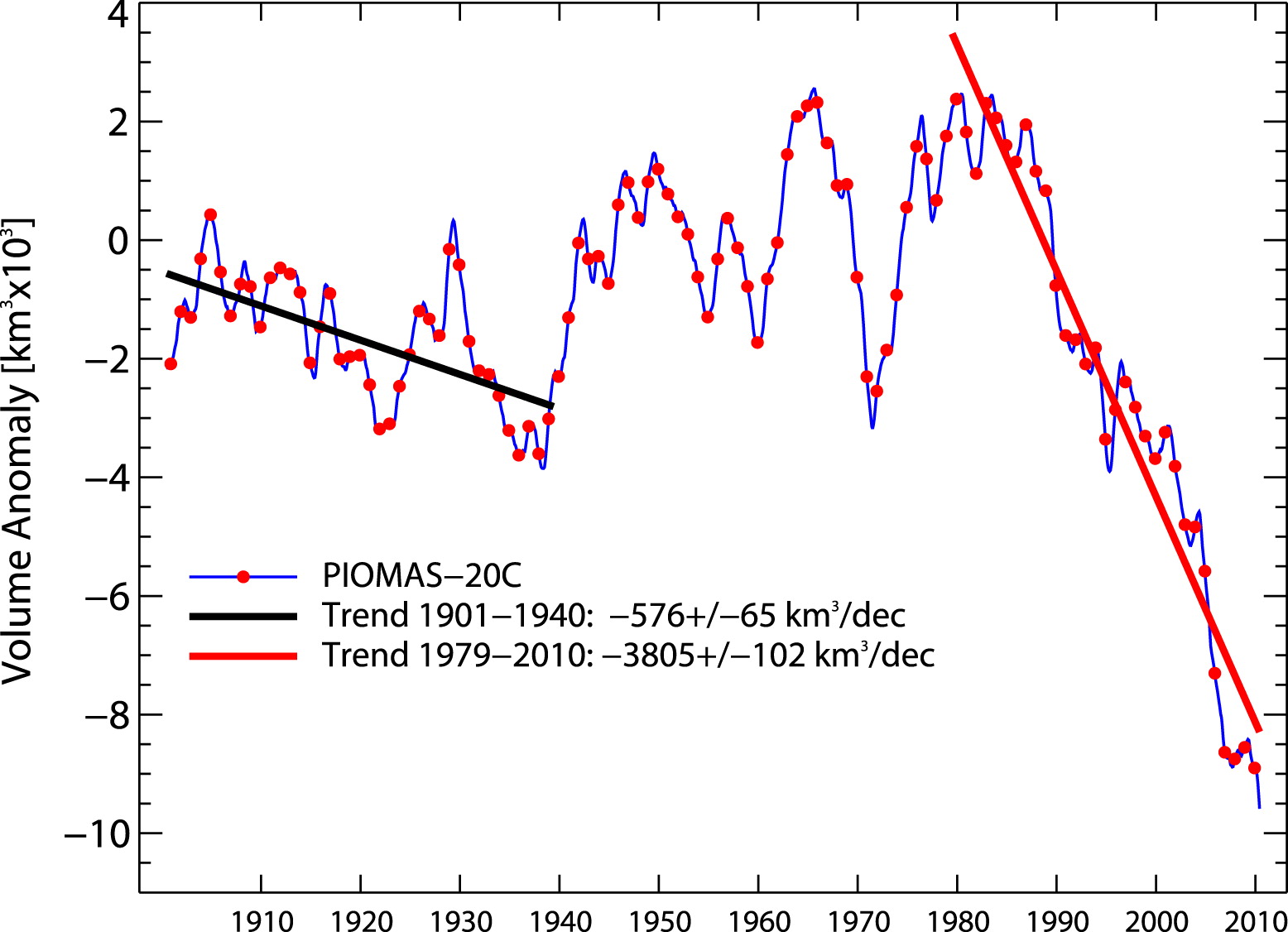
It shows that the current values are still substantially below the minimum in the 1930s.
This is not a good time for global warming climate change fearmongering. Try again in March.
. . . excluding, of course, all the AGW/CAGW alarmists located in the Southern hemisphere.
Where is Nick? Haven’t seen him in a while.
Maybe he wised up?
But you continue to come here to show everyone what a gormless, feckless idiot you are.
Oh no TFN, unlike you, Nick wised up a long time ago. His agenda is different from verbalizing random voices in his head.
Very nice.