By Kirby Schlaht

Is paleoclimate cyclic?
Does the climate model below (Fig 6) represent a real climate cycle that actually repeats every 675 million years? If so, might the galactic spiral structure with its accompanying cosmic radiation be responsible? Is the spiral structure of the Milky Way “stable”, such that we will encounter the same spiral arms and inter-arm regions over and over as we orbit the gravitational center of the galaxy?
The Story of Climate Change is based on the concept of atmospheric ionization by high energy cosmic rays initiating aerosol and cloud formation. This results in a warming or cooling planet Earth. This cloud albedo effect (Svensmark) is the first leg upon which The Story of Climate Change rests (https://thestoryofclimatechange.substack.com). Galactic cosmic rays, mostly high energy protons, play the central role in this process by ionizing atmospheric gases as they descend into the lower troposphere. Radio observations of exo-galaxies indicate that cosmic rays are galactic plane polarized and are confined to spiral arm structures. This means that during our solar system’s transit through the Milky Way spiral arms the cosmic ray flux will be modulated. High flux levels during spiral arm crossings result in cloudy and cooling climates while lower flux during inter-arm space crossings results in less cloudy and warming climates. These we can call geologic Ice House and Hot House epochs. Our planetary system’s galactic orbit is circular but oscillates in and out of plane manifesting a secondary high frequency cosmic ray flux modulation. This results in a periodic 30-million-year warming-then-cooling cycle (Veizer, Shaviv). These superimposed drivers can be visualized in my 675-million-year climate cycle based on a one-billion-year splice of Veizer and Halverson isotope proxies (part 1, https://thestoryofclimatechange.substack.com/p/the-story-of-climate-change-part-0fd ).

What does this mean?
As our solar system continues to orbit the galactic center, we appear to encounter the same spiral arms and inter-arm regions again and again. If this process influences the climate, the cyclic nature of paleoclimate should be revealed. Assuming that the nearly 13-billion-year-old Milky Way galaxy structure has been stable in aggregate, at least since our system’s inception – about 5 billion years, we will continue to repeat the same pattern and periodicity of climatological conditions into the far future. The spiral arms of the Milky Way appear to us to be rotating but at a slightly different speed than other stars in the disk like our sun. From the solar perspective we appear to be at rest while the galactic structure moves past us and slowly recedes in our wake. It has been estimated that our system orbits the galactic center every 225 million years or so. Our story indicates that three of our galactic orbits will result in one complete spiral structure transit – every 675 million years.
How can this pattern of stars, dust, gas, and energy persist if the objects in the galaxy are moving along their unique orbital paths with their unique orbital periods? Is this “spiral” an illusion or does the phenomenon have a physical explanation? Why are the cosmic rays mostly in the spiral arm structures and absent from the inter-arm regions? Do the spiral arms actually exist discretely as rotating standing gravitational waves or are they a function of rotating density waves propagating through the galactic disk of stars ever renewing their inventory of arm stellar masses? It is a mystery to me and the second leg upon which The Story of Climate Change rests. We do however, live in a metaphorical world. We do many things and think many thoughts because we believe that a carbon dioxide climate driver narrative is true. We can play at that game too. Shall we proceed as if The Story of Climate Change were also true? Beautiful stories may not be wholly true but they can inspire us to venture beyond the mundane – now that’s when the real fun begins.
Let’s imagine …
Let’s imagine the near future, say, 10 to 20 thousand years hence. I think we might assume that humanity will still be the dominant species on the planet as it has been since our exodus from mother Africa about 70 thousand years ago. Shall we consider the future climate landscape if anthropogenic carbon dioxide forces the Earth into a new Hot House environment 5 to 10 degrees Celsius warmer than today? Would you imagine that our climate in 10 thousand years would resemble the Hot House Cretaceous Period of around 75 million years ago? The climate of the dinosaurs. Would we see no polar ice caps, sea levels 300 to 600 feet higher than today, CO2 levels as high as 2000 parts per million – 5 times higher than today, and forests on Antarctica? If we did enter a Hot House how long would it last? Would the Hot House end on its own – if so, why would the temperatures fall? The pattern and periodicity of real paleoclimate change however, do not seem to be well explained by weathering, subduction, and volcanic activity cycles throughout Earth’s geologic past
Of course we would not be forced into a new Hot House. Remember, a Hot House is manifested by inter-arm space crossing during our galactic orbit. Our planet will remain within the cold Sagittarius spiral arm for another 120 million years or so – driving cloudier and cooler climates. We will linger near in-plane within this arm for another 2 to 3 million years driving cloudy and cool climates. The Milankovitch planetary orbital cycles can then show their influence by driving the climate to oscillate between cold glacial expansion and warm inter-glacial periods.
Where are we now? First, we are fully in-plane with the Milky Way and experiencing maximum cosmic radiation with maximum propensity for aerosol and cloud formation. We have been in the Pleistocene Ice Age for about 3 million years. We are in the middle of this most recent 20-thousand-year interglacial period. In 10 thousand years, a mere 300 generations, we will be at lowest planetary obliquity and sliding into the next 80-thousand-year period of glacial expansion. Just a few hundred years after glacial inception the higher latitudes would be uninhabitable with the massive expansion of sea ice onto the continents as glaciers. As the ice expands it makes the albedo of our planet more reflective – returning more sunlight back to space and cooling things off even more. This is ice albedo feedback in action. A runaway Ice albedo process is thought to explain the Snowball Earth scenario 640 million years ago during the Cryogenian period. In 600 generations, 20 thousand years from now, we will be in the cold depths of the expanding ice age. About 1 hundred thousand years the Milankovitch cycles will find a resonance when both obliquity and eccentricity move higher providing more insolation to the higher latitudes. This breaks the ice albedo feedback loop, reversing ice expansion and initiating the next warm interglacial period.

Over the next 3 million years, as the out-of-plane orbital motion of our planetary system reduces cosmic radiation, cloud cover will be reduced driving temperatures warmer. This Pleistocene Ice Age will finally dissipate, leaving behind these glacial-interglacial oscillations – for now. What goes up must come down. In about 15 million years we will reach maximum out-of-plane position with the accompanying warmest temperatures. Our star system once again proceeds back into the galactic plane cooling the planet. 30 million years from now, while crossing deeper into the Sagittarius spiral arm, we will once again be fully in-plane receiving the highest cosmic ray flux, resulting in more ionization, and maximum propensity for cooling cloudiness and glaciers returning. This will mark the entry into the next Ice Age. Since our climate is cyclic, the past climates will be repeated – with a replay of the Marinoan Ice Age of 640 million years ago.
The big wheel keeps on turning
In about 120 million years we will finally cross the Sagittarius spiral arm. We will exit this Ice House with its periodic glacial ages and enter the next Hot House inter-arm space on our way into the next spiral arm region – the Perseus arm. Round and round we go.
With this knowledge and climate foresight of a cooling, icier world what should we do? It is hard to imagine, but we could organize this super organism we call humanity and implement a plan for adapting to the coming cold snap. Albedo modification, space-based solar mirrors driving back the continental and sea ice termini, and CO2 emission expansion might not be powerful enough climate weapons to fight mother nature. But, maybe by then, the climate alarmists would be warning us about the real problem. Humans are notoriously short sighted though – much like the proverbial frog in a slowly freezing pond – before we even realize it, the brutal physics of cold finally catches up with us.
“Is paleoclimate cyclic?”
Cycles within cycles within cycles. A real epicycle machine on steroids. Nobody is ever going to figure it out such that a model can predict 100 years out.
Cycles within cycles within cycles. This sounds like you are describing our national economy.
Joseph, we don’t need a model to predict 100 years out. We know, based on historical geology, that it’s going to be about the same as the previous 100 years. It hasn’t changed dramatically in the last 8,000 years so there is no reason to expect anything different for the next 8000 years.(We can adapt to another Little Ice Age). The current climate from 8,000 YBP, based on the article, should be expected to remain the same for the next 8,000 years.
Quote:
“We are in the middle of this most recent 20-thousand-year interglacial period. In 10 thousand years, a mere 300 generations, we will be at lowest planetary obliquity…”.
Describing climate as weather averaged over 30 years is ridiculous. How much has the “climate” changed since the Minoan Warm to the current Modern Warm? A couple degrees up and down. The small amount of warming from “fossil fuel” consumption over the next 100 years should keep us within the “Climate Optimum” and by 2124 we should be primarily nuclear, and out of the non-existent CO2 crisis. ,.
And let’s not forget random events, which happen often.
or infrequently
Often somewhere, infrequently at the same place.
The next 1540/1757/1936/2006 type of mid latitude land heatwave will occur in 2116:
https://docs.google.com/document/d/e/2PACX-1vQemMt_PNwwBKNOS7GSP7gbWDmcDBJ80UJzkqDIQ75_Sctjn89VoM5MIYHQWHkpn88cMQXkKjXznM-u/pub
Chaos = cycles upon cycles, with some feeding back on others and those feedbacks varying with time, plus random transient events like Siberian traps and asteroid hits, and other mysterious events apparently causing temperature swings and extinctions, etc. I do not think we can find a long scale pattern. At least not one that is 675 M years long.
Only six to seven such cycles in Earth’s existence wouldn’t leave a statistically significant record.
iMO there is evidence of cosmically driven Hot and Ice House intervals at about 150 million year intervals, but a cycle encompassing a few such alternations can’t be detected at a high confidence level.
Besides which, galactic structures change.
All valid points. However scant, there is evidence something of this nature occurs.
Will the pattern repeat as the cosmos evolves? Likely not, but as you point out, who can say?
This is not the first time I have read about the earth’s position in the galaxy having a non-insubstantial effect of climate. The last was maybe 20 years ago. I admit I do not recall the big bang occurring, so forgive me for not remembering the date of that prior report.
I remember it, that big unbanged banger, finally went BANG!
Humor. A difficult concept.
— Lt. Saavik
Do I understand this correctly?
Our solar system is locked in its own unique orbit relative to the galactic center, and the galactic spiral arms rotate around us?
What are the spiral arms made of? Dust and gas?
I assumed Earth had always been part of the Orion arm. Is that completely wrong?
Depends on the time frame. Earth has not always been part of the Orion arm, but it has for the full extend of human histories since the first primate looked up at the stars.
“What are the spiral arms made of? Dust and gas?”
The spiral arms are essentially bright, new stars that just formed (figuratively speaking). They are a wave phenomenon. Some sort of pressure wave exists that seems to cause gas to collapse into new stars. If they were a physical structure, then they would wind up over time. So stars can move through the spiral arms.
Since the universe is expanding, each moment in time is unique.
Humans look for patterns to justify their thoughts, because they are insecure about their place in life.
Certainly there are many who look for patterns to justify their thoughts. Some percentage are indeed insecure.
There are also humans that do not look at all. Some percentage of those are also insecure.
There are some of us who look for patterns because we are inquisitive and seek to explain the unknown.
Sometimes we look for patterns so that we can grow food or cross the road. Some of these patterns really do serve us rather well.
Good add.
Some places, Mike, crossing the road is a random process. A few offer Las Vegas odds…
It’s safe to say that there are repeatable cyclic processes in nature that also evolve over time due to entropy and the expansion of the universe (which essentially is entropy in motion). It does not require insecurity to understand that.
Humans don’t have to look far for patterns, we have monthly pattern with the moon cycles. We have a yearly pattern of weather (we even named them years with months and season within that year.) In most places and that pattern is very important for the acquisition of food and shelter. If humans did not observe that pattern, we would have gone extinct or would still be only in Africa. It has nothing to do with insecurity and everything to with survival. My guess it built into us through evolution and human are not alone in that. Humans are unique do to the fact we can record the changes and build devices to track the changes. On such ancient device is in Petrified Wood Nation Park in Arizona. It is a rock that split mark, when the sun hit that mark in the early morning it is the summer solstice. If you think that early Americans, put that mark there because they need for patterns you are delusional. It had a function, and for some reason they needed to know when summer solstice occurred.
Post says:”My guess it built into us through evolution and human are not alone in that.”
Great point. Many sea creatures are tuned to cycles mostly lunar. Grunion, turtles, coral etc. Some mammals hibernate, mostly those in cold climes. Circadian rhythm.
Stonehenge.
Where the demons dwell
Where the banshees live and they do live well
Spirals are self organizing structures that appear in response to pressure and flow.
Under GR spacetime is the flow and the stress tensor is the pressure. The result is spirals.
A 675 million year cycle does have some support in the paleo record. Though I suspect few of us will live long enough verify the result.
It could be argued that paleo climate is somewhat predictable out in the spiral arms because the disk shape reduces the n-body problem to the 2-body problem. In the galactic core the n-body problem makes paleo climate unpredictable.
Could come in handy for vacation planning in the future.
Nice plate of “food for thought” thanks for the article.
Those spiral arms of the Milky Way, A place 90%, or so, of the CO2 “True Believers” never heard off and if they had, would simply dismiss as propaganda from Big Oil..
Svensmark describes, “The concentration of cosmic rays in the flat disc of the Milky Way, which the Sun crosses and re-crosses every 32 million years” (Svensmark’s The Chilling Stars p.210).
I knew the solar system was flying through space at a tremendous rate of speed, but until reading Svensmark I didn’t associate that fact with cosmic rays and the consequent effect on climate here on planet Earth; and I never had the slightest inkling that the solar orbit required 270 million years. How many different magnetic and gravitational effects, besides the cosmic rays, are we subjected to on that journey? Doesn’t matter, CO2 is the only climate driver? Irrefutably false.
If it takes the Milky Way galaxy 270M years for one revolution then Genesis’ reference to the earth being created in seven (7) days seems much more reasonable than seven (7) earth revolutions. Perspective is everything. 🙂
I looked for a spiral-arm related climate cycle years ago, fully expecting to find it. I didn’t find it. If I missed it, someone please let me know. IMHO What this article needs is a clear connection between Earth’s paleoclimate and the solar system’s position relative to the spiral arms. Did I miss that too? (There’s a chart with paleo names on it, but I didn’t see that it related to spiral arms).
See my rather longer reply below as to why you didn’t find it.
Don’t you know that the Official US Government web site, climate.gov has explained to you proles that CO2 emissions have banned further recurrences of large scale glaciation?
Read ’em & weep, pathetic earthlings:
https://www.climate.gov/news-features/climate-qa/whats-coldest-earths-ever-been
Seriously, I would like to know what Javier Vinos thinks of the post above and of climate.gov’s claim.
I am afraid “The story of climate change” is not on solid ground. There is no good evidence that Svensmark’s cosmic ray hypothesis is correct and a couple of hints that it is not. The two biggest cosmic ray increases of the past 50,000 years, the Laschamps event and the Vela supernova, have left no conspicuous mark on climatic records, suggesting that the climate is not driven by cosmic ray variations.
Regarding the claim that Milankovitch cycles have been abolished by the increase in CO₂, it is absurd. Glaciations start when CO₂ is highest and end when it is lowest. The next glaciation will come on schedule. They all come when obliquity falls below 23°. There is 4,000 years left at most.
CO2 is not a long-lived gas in the atmosphere. The IPCC Bern model is completely wrong. The half-life of CO2 in the atmosphere is about 12 years. Lost CO2 must be replaced by influx from other reservoirs and when that influx is greater than the loss, the concentration of CO2 rises. Furthermore, the off rate is so fast, humans don’t make enough CO2 to account for the observed rise in atmospheric CO2.
The rise in CO2 is natural. We can’t stop it. Nor should we stop it. Of course, we are still living in the Quaternary Ice Age. Ice formation on Antarctica began when tectonics moved it to the South Pole. The Southern Ocean current isolates the atmosphere to some extend and cold air tends to remain over the South.
When the Isthmus of Panama formed, ocean circulation changed and the Arctic Ocean developed an ice cap as well. The presence of an Arctic ice cap defines the Quaternary Ice Age. CO2 levels drop during ice ages, not just during glaciations.
These ice age features will not change just because the Earth moves in or out of a galactic spiral arm. Correlation is not causation, as everyone here should know by now.
Note: If you have a background in kinetics from chemistry or biochemistry, you’ll understand what I’m saying immediately. To others, try to understand a model like this: A balloon with a pinhole can be inflated and remain inflated as long as more air is blown into it. If more goes in than comes out, the balloon will get bigger. If less goes in than comes out, it will get smaller. Maintaining a constant size under these conditions is dynamic equilibrium. If you understand the pinhole, you can understand what has to happen at the end where you blow in. I’m giving you solid data about the pinhole, i.e., the loss of CO2 from the atmosphere using a 14-C proxy that represents all the CO2 in the atmosphere in 1963. That CO2 is almost all gone now.
Well, not quite based on scientific evidence . . . there is an approximate 200,000 year mismatch between the closure of the Isthmus of Panama and the formation of the North Pole ice cap that marked the beginning of the Quaternary Ice Age.
According to https://news.galveston.tamu.edu/new-study-reaffirms-timeline-on-formation-of-isthmus-of-panama/ :
“The formation of the Isthmus of Panama – a strip of land that separates the Caribbean Sea from the Pacific Ocean, and connects North and South America– is considered one of the most important geologic, oceanographic, and biogeographic events ever, but the exact timing of the final closure of the Isthmus has become controversial. A relatively recent date for the closure, approximately 3 million years ago, has been the consensus among the scientific community for decades . . . In this new paper, using geological, paleontological and molecular genetics, among other methods the team has pinpointed the formation date to 2.8 million years ago.“
(my bold emphasis added)
However, according to https://en.wikipedia.org/wiki/Ice_age , “the Quaternary Glaciation/ Quaternary Ice Age started about 2.58 million years ago at the beginning of the Quaternary Period when the spread of ice sheets in the Northern Hemisphere began.”
(again, my bold emphasis added)
The above article’s Figure 6 graphic is a very poor and inaccurate representation of Earth’s history as relates to the very periodic solar systems transits through the plane of the Milky Way’s spiral arms.
The solar system crosses the galactic plane about once every 33 million years. It has been estimated that the time it takes for the solar system to fully “cross” an arm of the Milky Way is about 10 million years.
Here are the following dates for five major Ice Ages on Earth as given in https://en.wikipedia.org/wiki/Ice_age :
— earliest well-established ice age, called the “Huronian”, have been dated to around 2.4 to 2.1 billion years ago . . . not represented in Figure 6
— next well-documented ice age, and probably the most severe of the last billion years, occurred from 720 to 630 million years ago (the “Cryogenian” period) and may have produced a Snowball Earth in which glacial ice sheets reached the equator . . . not identified in Figure 6
— the “Andean-Saharan” occurred from 460 to 420 million years ago . . . correctly identified in Figure 6
— the “Karoo”, occurred from 360 to 260 million years ago . . . mis-identified time-wise in Figure 6
—the current “Quaternary” which started about 2.6 million years ago . . . not accurately reflected time-wise in Figure 6.
So, as can be clearly seen based on the above timelines of Ice Ages on Earth, there is no correlation whatsoever of the time periods of Earth’s galactic plane crossings as relates to Ice Age Earth conditions.
Story tip – California’s Unelected Tyrants › American Greatness (amgreatness.com)
Offshore wind farms
Exactly 17 angels can dance on a tip of a needle.
Well, no. For a ‘precise’ treatment, see the incredibly fun ‘scientific’ article, “A quantum gravity treatment of the Angel/pin problem” in the Journal of Improbable Research at Improbableresearch.com. (Hint this is the journal of those at Harvard who also bring us the Ignoble Awards each year. )
Thank you. No longer will I dismiss everything coming from Harvard.
Regardless the currently popular view of human omnipotence, we are just along for the ride.
In addition to the planar cycle, doesn’t the solar system also oscillate up and down? I thought I had read that elsewhere. About 26 million years for that cycle. Maybe Clive Best’s website? Plus there is this:
ftp://ftp2.space.dtu.dk/pub/Svensmark/MNRAS_Svensmark2012.pdf
https://scitechdaily.com/the-earth-has-a-pulse-27-5-million-year-cycle-of-geological-activity-discovered/
https://scitechdaily.com/researchers-discover-that-global-mass-extinctions-of-land-dwelling-animals-follow-a-27-million-year-cycle/
In 4.5 billion years the Milky Way collides with Andromeda so that will mess up the spirals. There are black holes and planets and smaller objects just moving at random thru the Universe – one encounter could mess up the Solar System at any time. It’s dangerous out there…..over long periods of time.
Ummm . . . can I delay worrying about that until, oh say, we only have a billion years left to go?
Maybe worry about the moon expanding its orbit which will affect the seasons and day length and tides and ……the climate.
I was under the impression the moon was slowly closing with the earth, not expanding its orbit.
No, the Moon is currently moving away from Earth at a slow rate, approximately 1.5 inches (3.8 centimeters) further away each year.
Interesting but VERY unconvincing hypothesis based on Fig 6, even assuming its paleoproxies are roughly correct over so many eons. The basic idea in this post was first posited by Nir Shaviv in 2002, and then given a plausible cosmic ray mechanism a bit later by Henrick Svensmark. Neither has received much subsequent scientific support, for a very good reason.
I had to do a bit of ‘googlefu’ research to get at the essential simple underlying facts before commenting late.
The solar system orbits the Milky Way galactic center at a distance of about 27000 light years. One full orbit comprises a ‘galactic year’ of about 230 million years. The galactic center is exactly supermassive black hole Sagittarius A, and it has newly been ‘imaged’ by the light generating chaos outside its event horizon. The image is brilliant orange glowing around black. Worth a physics gander, as is newish exciting science.
The newest results from the Spitzer Space Telescope show rather definitively that our galaxy has two major (Centaurus and Perseus) and two minor (Norma and Sagittarius) arms. A bog standard so called barred spiral galaxy (the bar is just the innermost part of the two main arms before they begin to spiral).
Combining these two basic facts means that if the Shaviv and Svensmark long run cosmological climate hypothesis is even approximately correct, the paleo record should show two major and two minor cold periods every 230 million years, or one just under about every 60 million years. Between these four cold intervals there should be four longer warm intervals when the solar system is not crossing a cosmic ray impeding spiral arm.
That is not what Fig 6 shows. Not even close. IMO, grade F for failure.
What such speculative ‘climate science’ ignores is the eons long impact of plate tectonics on global climate. For example, Svalbard has significant coal deposits formed during the Carboniferous (~350-300 mya), which proves Svalbard could not have been in its present Arctic position then. As a second example, Deffies of Princeton was quite certain the present ice ages started about 2 mya when the Isthmus of Panama closed and fundamentally changed ocean circulation, separating low latitude Pacific and Atlantic oceans. As a third example, Wegener first showed in 1912 in his first ‘Continental drift’ paper (and in four different ways) that the Atlantic Ocean once did not exist.
One problem that I have with this hypothesis is that all the galaxy stars rotate at about the same speed, 220 km/s, galactic arms and solar system included.

The hypothesis in question relates to the cycle of the Solar System’s oscillation perpendicular to the spiral arms laying in the galactic plane, not the in-plane crossings of spiral arms.
As stated in the above article:
“Our planetary system’s galactic orbit is circular but oscillates in and out of plane manifesting a secondary high frequency cosmic ray flux modulation. This results in a periodic 30-million-year warming-then-cooling cycle (Veizer, Shaviv).”
The original 2003 hypothesis of Shaviv and Veizer is to explain the ice ages by the passage of the Solar System through the galactic arms every 150 million years.
Celestial driver of Phanerozoic climate?
The problem is that the spiral arms also rotate, so there are no passages.
Well there is the attached screen-grab of Google AI’s response that says that isn’t correct.
And in addition there is this:
“Earth’s journey through the Milky Way may have had a profound impact on our planet’s geology. New research indicates that every 200 million years, when Earth passes through its galaxy’s spiral arms, the planet is pummeled with high-energy comets, . . .”
—source: https://www.space.com/milky-way-journey-earth-geology-comets
Rud – the important point of the analysis described in this post is not proof of a theory. Rather, it is an interesting observation of yet another natural cycle that when imposed on other known cycles such as milankovich sheds light and raises questions about very long timeframe processes. It’s certainly worth consideration and further analysis.
When plate tectonics was first hypothesized more than a century ago, the “consensus” of the geological community was that it was not only not proven, but was indeed “crazy talk”. But by the 1960s it was getting accepted. Ditto with the more recent theory of the Chicxulub asteroid strike causing the end of the age of dinosaurs, which was initially rejected and mocked for lack of evidence, but in the last 3 decades has been accepted as orthodox geology.
Hypothesizing new explanations and then over time testing them, and either confirming or denying them is the essence of scientific inquiry.
Thomas Edison, who famously monetized technological advancement as an industry, is often quoted, when characterizing his numerous experiments, as “I did not fail ten thousand times … I discovered ten thousand methods that did not work.”
Thanks, Rud. Still lots of questions of course. As another commenter points out, the article deals mostly with a movement of the solar system perpendicular to the plane of the galaxy rather than to movement across and between the spiral arms. However, I’m not convinced that I can see those in the historical climate record either. Could they be there but partly or wholly obscured by tectonic plate movement? If I was in the grant-application business I could be rather busy right now, but as it is I’ll probably wait for others to provide insights
‘What such speculative ‘climate science’ ignores is the eons long impact of plate tectonics on global climate.’
Bingo. There are many cyclical influences, any combination of which probably determine the Earth’s climate ‘set-point’ at any given time.
I remember well Rahmstorfs panic after appearence of the press release of the Shaviv / Veizer paper and the cry for help via mail to his comlicies because that paper could harm “the cause”.
So they wrote a paper to discriminate the work only based on a press release.
Details in Climategate mails.
The precession cycle drives glaciation across the northern hemisphere. Antarctica has remained in glaciation now for at least 5Ma. Obliquity plays an enabling role to increase warm air advection into the higher northern latitudes. The window for glaciation is now wide open. Glaciation is an energy intensive process. It takes a lot of energy to evaporate water from ocean surface and then release that energy over land to produce snow that eventually persists to form permanent ice.
The precession cycle shifted into the northern hemisphere warming phase 500 years ago. The LIA marked the bottom of the cycle. Greenland is now gaining elevation and permanent ice extent. Permafrost is advancing on some of the northern slopes within the Arctic. The current interglacial is now coming to an end because the oceans in the NH are warming up.
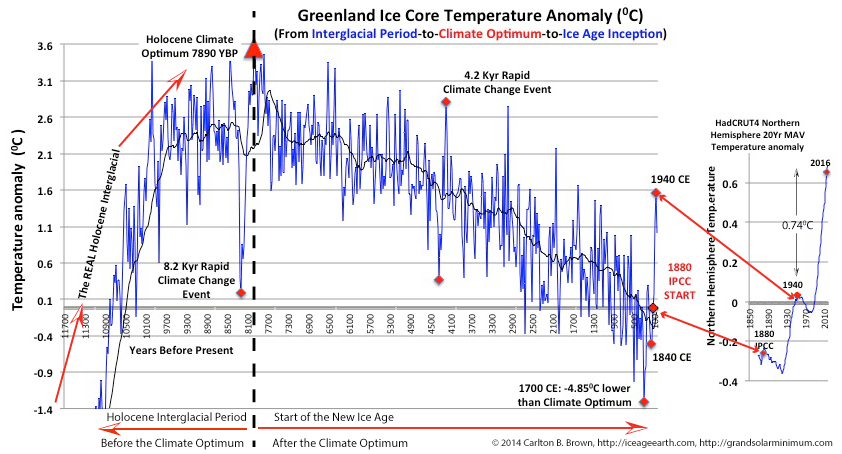
Interglacials last for half a precession cycle around 11,000 years. Last time the peak sunlight started increasing in the NH 20,000 years ago, the glacier calving was so widespread that it prevented the oceans from warming but the ice kept melting. This time most of the land ice in the NH has gone and the oceans are warming rapidly.
New snowfall records are already a feature of weather observation and will continue to be so.:
https://iowaclimate.org/2024/10/19/siberia-mid-october-snow-extent-greater-in-2024-than-in-past-years-could-impact-europes-winter/
The multiple precession cycle glaciation observed for the past million years follows the emergence of the Panama isthmus that cut off the Tropical Atlantic from the Tropical Pacific.
You do not need galactic spirals to explain the paleo climate. Earth’s paleo climate is intimately tied to the life it has spawned and a few catastrophic events that have disrupted the lifeforms of the period. Plate tectonics influences have variable time scale.
Rick, while I agree that the LIA marked the beginning of the end of the Holocene, I don’t think you give the sun enough credit. These plots show signals that I’ve extracted from the motion of the sun around the solar barycenter. The sudden change, which coincided with the LIA, is caused by the planets rapidly shifting into a new resonance mode. It seems our solar system has some chaotic tendencies.
The top plot should look familiar. The peaks of the ~950 year cycle line up with the temperature minimums. The sine wave plot is for reference. It helps show that the phase of the cycle is changing, which is probably why the Eddy cycle period has been incorrectly identified.
The second plot I included to show you where your rapid change events originate.
If you don’t see two plots, refresh your browser cache (shift reload)
The rise in solar constant since the LIA is well established and has contributed more to the global average temperature than the precession cycle that is predominantly causing warming in the NH and some cooling in the SH. So a double whammy of warming that the UN has promoted as being caused by CO2 in their ambition to become the global government.
Your plots have no names or named scales. You state “motion”. What form of motion? Distance from the barycentre? Velocity of the sun around the barycentre? Acceleration of the sun around the barycentre?
Also where did you get the “motion” data and what time interval are you using?
I have done a lot of analysis of the movement of the sun under gravitational influence. It is not difficult to recreate the changes in solar constant that Earth sees if you allow for the fact that what we observe from our platform revolving around the sun is not what is actually occurring on the surface of the sun. It is a good example of ‘observer’s paradox’.
I am gradually forming an understanding of gravitation field imparting torque on planetary bodies. Notable the sun due to its proximity to the barycentre and the large fluctuations in the gravitational field that it experiences. It explains why the sun equator rotates faster than the poles and why the speed of rotation varies.
I’m working on a paper that will explain this in detail. The data comes from JPL and is sampled on a monthly basis. Tidal forces don’t care about position and velocity.
Did you get acceleration data from JPL or are you differentiating velocity?
“Tidal forces don’t care about position and velocity.”
Huh?
… w.r.t the barycenter. Only the gravitational acceleration vector is required. I’m not considering tidal torque.
I’m not sure what you mean about the barycenter. Tidal forces are due to the gradient of a gravitational field.
Jim, you’re of course correct about the gradient, but when it comes to climate, (mostly) only the outer planets have long enough orbital periods and beats. Jupiter is about 75% of the acceleration vector. However in terms of tidal forces it would only be 35% of all planets and 95% of the outer planet contributions. This would suggest that if only tidal forces are a factor, then the only significant influence the other Jovian planets could have on climate would be through interactions with Jupiter. I’m not finding this to be the case,
So, while you’re correct to question my statement — it was perhaps an overly simplified answer Rick’s question — it reflects my finding that however solar activity is being influenced by planetary orbits, empirically the sun’s barycenter acceleration vector appears to represent the forcing function.
In grade school/high school I had access to a book that covered science and scientists from Galileo to Einstein. They even explained time dilation in Special Relativity. They also discussed astrology. If the planets can affect humans on the Earth, then what is that effect due to? If it’s gravity, then the gravitational force of someone a couple of feet away is far greater than the gravity force of a distant planet on an individual–even if it’s Jupiter.
Gravity follows the inverse square law. Tidal effects are smaller-they follow the inverse cube law–roughly, it’s actually an inverse cubic polynomial.
Many years ago on the first day of a class on nonlinear systems the professor began the class by placing a small dot in the middle of an otherwise empty chalk board. He then proclaimed that that was the class of linear systems, everything else is nonlinear. We then went on to study inverted pendulums (think Elon Musk booster landings) and strange attractors.
The point is that climate is all about nonlinear systems no matter how you slice it. Small gravitational forces could be amplified by the highly nonlinear process of fusion, or the mechanisms that generate magnetic fields, or other mechanisms that transport energy from the core to the surface. Geocentric theories allow that small changes in earth’s obliquity and eccentricity result in ice ages. BTW, these orbital changes are caused by the other planets. And then there are the homocentric climate models which allow that anthropogenic emissions of CO2, which have increased concentrations to 0.04% from 0.03%, are the cause of global warming, and that when that model doesn’t work it’s because of human emissions of aerosols, or a volcano if one’s handy.
When Galileo turned his telescope to the sky and observed the phases of Venus, he empirically placed the sun at the center of our solar system. The heliocentric model threatened those in power at the time so he was forced to renounce his model and spend the rest of his life under house arrest for spreading disinformation.
I moved into the heliocentric climate crowd after I figured out why I could predict global temperature with simple moving average of sunspot data.
You lost me with anomalies. They are BS.
“I am gradually forming an understanding of gravitation field imparting torque on planetary bodies.”
And the two-body problem can’t be solved completely. The three-body problem is chaotic–that Poincare discovered but didn’t realize.
Glaciation will begin in about 6,000 years, when aphelion will occur in September, causing a significant drop in temperature in the northern hemisphere, and the tilt will decrease even further. As a result, less solar radiation will reach the northern hemisphere in summer, causing glaciers to grow in the north. This cannot be prevented by any means.
If you look at the temperature at the North Pole in summer, you can see that the temperature remains constant.
https://ocean.dmi.dk/arctic/meant80n.uk.php
Of course it remains fairly constant as long as there is plenty of ice to melt.
No, because the angle of the Earth’s axis is decreasing, the temperature at the North Pole in summer cannot increase.
Note that the amount of ice in summer above the 80th parallel is variable, and the summer temperature does not increase.
Cycles within cycles …each one randomly different in some infinitely small way and with no measurable means of identifying differences except perhaps through trial and error. An infinite universe with boundless potential for change dotted with the occasional species believing it can influence or change climate all on its own.
What a truly wonderful gift we have been given and what an amazing puzzle to have to crack if given the room to do so. Once we have cleared out the manure of the climate change gang we may have a (relatively) short time of better playing our role and, as a result, enjoying a better quality of life at least until the next lot of killjoys who think they know it all, come along.
In my opinion, changes in the Sun’s angular momentum are related to changes in the Sun’s polar magnetic field.
http://wso.stanford.edu/gifs/Polar.gif
To be honest, who cares? It’s utterly irrelevant for the next 100,000 generations of humans, always assuming that humanity still exists in 3 million years time.
It’s a nice piece of academic theorising, but there really are more pressing matters to deal with than this, you know: things like ethnic cleansing; a potential World War III outbreak; a US election fraud; man-controlled geoengineering crimes; Bil Gates trying to take unaccountable control of global health dictatorships etc etc.
Bummer. And here I thought all we had to do to live longer was to stop breathing.
This sounds similar to what Nir Shaviv wrote about several years ago.