By Paul Homewood
Another summer ends, and yet again the Arctic sea ice refuses to melt away!

https://ocean.dmi.dk/arctic/icethickness/thk.uk.php
The ice extent hit the minimum on 7th September, with NSIDC showing 4.213 million sq km:

https://noaadata.apps.nsidc.org/NOAA/G02135/seaice_analysis
Following the steady loss of ice between the 1990s and early 2000s, which culminated with a lot of ice loss through the Fram Strait in 2007, the ice extent has remained remarkably stable since.
I wonder when we’ll get apologies from all of those who predicted it would all be gone years ago?


Climastrology gets EVERYTHING wrong!
It is still over four wadhams at minimum.
That is over 30 times the area of England.
The area of England is not an official climate science unit of measurement, it must be expressed as …
Number of Olympic-sized swimming pools or ( for greater accuracy) London busses.
Football fields…not soccer fields!
Climate science DuJour…future predictions are based on prior trends.
40s to the 70s cooling … Impending Ice Age
80s to the 2010s warming … Impending Thermogeddon
10s to the 40s stagnation …
Adjustments create artificial warming …
…40s to 70s cooling eliminated
…80s to 10s warming exaggerated
…10s to 40s stagnation turned warming causing 1.5°C threshold to be statistically crossed… Nothing Happened
But the elites must stir up FEAR so as to control the peasants. Break out the torches and pitch forks!
and nothing will happen with the next real or manipulated 1.5C.
Lindzen
A well-established equation based on empirical data shows that we get the same warming from an increase from 400 parts per million (ppm) to 800 ppm as we would from 200 ppm to 400 ppm (Pierre Humbert, 2011). That is to say, the impact of each added unit of CO2 is less than the impact of its predecessor. In addition, reasonably straight forward calculations suggest that, all other indirect factors (e.g. clouds) being held constant, a doubling of CO2 should produce about one degree Celsius (1°C) of direct warming—a value that is not generally held to be alarming (Wilson and Gea-Banacloche, 2012),
“Straightforward calculations … show that eliminating U.S. CO2 emissions by the year 2050 would avoid a temperature increase of 0.0084 degrees Celsius,” states a brief paper authored by Drs. Richard Lindzen, Massachusetts Institute of Technology; William Happer, Princeton University; and William A. van Wijngaarden, York University, Toronto. On the Fahrenheit scale, the value of averted warming is 0.015 degrees.
I have often read the CO2 absorption of IR is saturated around 300ppm.
Does this not mean that higher CO2 levels after 300ppm have no effect (or is less consequential than the first 300)?
Saturation means all the surface energy in the near 15 µm IR spectral band is completely absorbed in the atmosphere. However, as CO2 increases it is able to absorb IR just outside the main bands. Hence, CO2 absorption is never completely saturated.
15 µm is proportional to the temperature of -80°C -112°F. Atmospheric windows cold end (where IR escapes) is 14µm, proportional to temperature -66°C -86.8°F.
527 watts of IR at suns zenith, has already escaped to space (towards poles and or higher elevation level) at warmer temperature point.
Land w/ minimal moisture temperature 58°C 136.4°F (8.75µm) 680 watts(half solar constant) reduces to -45°C -49°F (12.7µm) by 527 watts(153 watts).
Whatever you think 15µm means or believe, a significance to global temperature is definately wrong.
Like all the ice-free predictions.
Politics has destroyed climate science and isn’t likely to recover (admit this) for some time soon.
Not until they get what they want, which is the reset we hear about.
“Whatever you think 15µm means or believe, a significance to global temperature is definately wrong.”
Its significance is that ~15 micron is the wavelength of Earth’s outgoing LWIR max, it corresponding to an average Earth temp of 15C. And hence the wavelength at which a max of it is absorbed by the atmosphere before eventual emission to space.
“15 µm is proportional to the temperature of -80°C -112°F. Atmospheric windows cold end (where IR escapes) is 14µm, proportional to temperature -66°C -86.8°F.”
No, the -80C/193K is the temperature at which the max radiation is at 15micron – not that a temperature warmer than that has less.
In fact the earth’s average temp of ~15C has much more radiation at 15 micron leaving to space
As can be seen below at 300K (27C) the radiative energy is an order of magnitude more that that emitted at 200K (-73C)
The Earth’s outgoing LWIR atmospheric window is 11-12 micron – corresponding to an emission temp of ~ -10 to -30C. Which is, along with there being much less WV there, is why most of Earth’s heat escapes from the poles.
Earth isn’t 15C knock 10C off that.
“-80C/193K is the temperature at which the max radiation is at 15micron” 78 watts”.
False: “~15C has much more radiation at 15 micron” (change “at” to “than” then its corrrect).
False: “~15 micron is the wavelength of Earth’s outgoing LWIR max” multiply 80w(15 micron) by 7 to get the correct value of 560w (includes UV).
False:”The Earth’s outgoing LWIR atmospheric window is 11-12 micron – corresponding to an emission temp of ~ -10 to -30C.”
Correct: 8-14 micron atmospheric window.
28C at surface 466w , -72C 93w at tropopause.
At one end of pole -19.33C 233 watts (how much tropical heat is lost. Answer 233 watts
At another pole -19.33C 233 watts. How much has been lost so far? Answer 466 watts. Balance 0.
At tropopause how much heat has been lost?
Answer 373 watts(466-93).
At pole tropopause -53C 130 watts (373-133=240) and other pole -74C 88 (373-88)=285
285+240=525 (Outgoing IR).
Only modeled data is at 15C as they use only mid-latitude data of both hemispheres. And ignore tropics, Antarctic and Arctic data.
Earth absorbs 67% of sunlight (33% is visible light) over 68% of the earth.
25% of earth is lossing heat and 8% is reflecting crysosphere.
50% is daylight and extra 18% is the point earth has lost of the suns heat for that day.
117,912,000,000 watts / 346,800,00 km2 (68%).
Note: a few corrections 7% not 8% is reflecting crysophere.
And -53C 133 watts not 130.
“Earth isn’t 15C knock 10C off that.”
Sorry, but the average temperature of the Earth is near 15C/288K.
Every scientific reference says so.
How about you link one that doesn’t?
My above posted graphs show you are wrong with the rest.
It’s just the Wien’s law and Stephan’s law relation.
How about you try taking a vertical from 15 micron and then a horizontal to the spectral emittance scale?
You will see it gives an order of magnitude larger for the higher temperature that is Earth’s average (where the vertical line meets the top of red segment) vs the lower temp that corresponds to a Wien curve of highest intensity at 15 micron (top of the brown segment).
Then come back and tell us that the Wien law is incorrect eh?
Just restating your misconceptions again and dribbling some home made maths does not make them correct.
It’s called self-referencing and is worthless for provenance.
You will have to show some workings via a link to a valid scientific site – sorry If that basic concept is beyond your ken.
For your reference as you are obviously unaware of ;…
https://en.wikipedia.org/wiki/Wien%27s_displacement_law
average temperature of the Earth is near 15C/288K.
“Every scientific reference says so”
Every scientific reference is wrong.
Global stations
Arctic 1235 say -19C (-24,700)
Mid Latitude 15,933 17C (238,995)
Tropics 792 at 28C (20,592)
Mid Latitude 732 17C (10,980 )
Antarctic 29 -35 (-1015)
Total temps 281,001 / Total stations 18,721 = 15C
Arctic 2433 -19C (-46,240)
Mid Latitude 3369 17C (57,286)
Tropics 2808 at 28C (78,628)
Mid Latitude 3369 17C (57,286 )
Antarctic 2059 -35 (-72076)
Total temps 74,884 / Total stations 14,040 = 5.3C
Global temperature is where and how many stations exist in a region which is far from proportional for the regions of the earth. This creates as artificial global average temperature that would otherwise be colder if the regions had a more equal proportion of stations.
This is a false statement by Anthony.
“How about you try taking a vertical from 15 micron and then a horizontal to the spectral emittance scale?
You will see it gives an order of magnitude larger for the higher temperature that is Earth’s average”.
-80C 193K is blackbody wavelength of peak.
Radiant emittance 78.68w
Radiance: 25wm2 /sr
Peak spectral radiance: 1.10 w/m2 sr/micron.
2898/207=14 (Lower limit)
2898/181=16 (Upper limit)
sr = 1/(0.01*0.1)=1000 x miliwatt per meter squared.
Carbon dioxide has no dipole moment so can’t emit a photon of light.
AI overview after asking does carbon dioxide have a dipole moment. AI answer was no. Explanation.
“The two C–O bond dipoles cancel each other out”.
You really are brainwashed by inept scientists.
Didn’t read most of that ignorant word-salad.
But …
“Every scientific reference is wrong.”
Is telling as to your psychological state.
It’s called the Dunning-Kruger effect.
That you would believe that all learned science is wrong and you are correct is gob-smacking in it’s arrogance/narcissism.
Are you aware of the SB relation?
The T^4 thing?
Which essentially states that a body radiates energy in the relation of the 4th power of it’s temperature.
And that bodies radiate over a spectrum of frequencies?
The Earth at 15C ave radiates much more energy than if it were at a temp of -80C.
That is intuitively obvious (surely ???).
That 15 micron is a wavelength involved (all on display in my posted graph and to be found on any other available including spectracalc/Modtran etc), that engineers use to design much technology including satellite sensing.
Funny how they all work isn’t it?
I don’t know how you sustain your omniscience in the light of reality – but hey if it gets you through your life …..
Good luck!
You are the one that is brainwashed,
“The two C–O bond dipoles cancel each other out”
That is only true for the symmetrical oscillation, it is not true for the asymmetric and two bending modes.
Correct, I have been correcting these misunderstandings about 15 micron radiation on here for years.
Here is the source of stations by the GHCN-D(Global Historical Climatology Network-Daily).
We’ve gone from 280 PPM to 430 PPM and temperature has increased about 1C. if CO2 caused the increase, because the relationship is logarithmic vs temperature, the next 150 PPM increase will increase temperature only half as much = 0.5C additional at 580 PPM for 1.5C of warming since 1860 (preindustrial). At 2.5 PPM per year we’ll be there in 60 years (2085) at 2 PPM per year 75 years (2100). Let’s agree to be half nuclear by 2085 and all nuclear by 2125 so we can quit talking about CO2, I’m soooo bored with it.
2024 so far -0.77C. Start of winter has come early(not full blown winter but past midpoint towards winter). Winter is when total thermal output is less than 1360w (Sept 16th) or less than 340 watts multiplied 68% of the area of earth in km2.
Only modeled data has earth still in July(1C above normal).
“warming causing 1.5°C threshold to be statistically crossed… Nothing Happened”
Not true, Lots Happened.
Science has been neutered by politicians,
Charlatans are lorded as scientists.
Western industry is being crippled.
Colossal amounts of cash have ended up in the pockets of the elites,
Meanwhile, the poor remain poor,
Wars continue to be fought.
Our climates remain the same (with mild fluctuations).
https://youtu.be/LfH5eqNi4XY 1982 & Dan Rather reporting
🤣 🤣 🤣 🤣 🤣 🤣 🤣 🤣 🤣 🤣 🤣
I don’t think that the inevitable ‘revival’ of Arctic sea ice extent / thickness / whatever from its alarmist-convenient decadal ‘lows’ is going to be hailed as a positive development by our posterity.
The drop from the high in 1979 is the recovery.
It has allowed many Arctic sea critters (fish, molluscs, plankton etc.) that were prevalent during the MWP and before, to return to the region.
It’s strange that Paul Homewood apparently made no comment about the DMI Arctic sea ice volume graph displayed above.
It shows the lowest ever (in the DMI model’s records at least) volume for the date, albeit not quite at a minimum on September 7th.
It does NOT show the lowest to date!
It shows the lowest of the five years selected to be drawn on the graph.
2012 arctic ice extent was MUCH lower! (Approximately 60-70 million square kilometers lower, depending upon your comparison date.)
Try this chart
The monthly total volume of sea ice in the Northern Hemisphere for the past 24 years. The ice volume in September corresponds to the minimum extent of the year.
Looks like 2012 was lower. The description of the volume chart includes
The mean sea ice volume and standard deviation for the period 2004-2013 are shown with gray.
It doesn’t depict the range of values, just +/- 1σ from the mean.
However that graph doesn’t include 2024 yet?
PIOMAS updated to now.
The graph in the image at the top of this article is from the DMI, not the PSC.
So what.
The chart of PIOMAS above is up to date..
and shows ZERO TREND in sea ice volume for 13 year.
Get over it…. and stop being an ignorant Arctic sea ice worrying toady. !
Here’s what the most recent full month of DMI volume data looks like:
Meaningless.
Why continue to dig deeper into your slimy AGW fearmongering ??
Good morning BN (UTC),
At the risk of repeating myself, if in your evidently not very humble opinion the data proudly displayed at the top if this article is “meaningless” then take the matter up with the author.
why are we starting at 2000?
Ask DMI. It’s their chart.
Ah, you may be correct.
I always use the “extent” graph as opposed to the “volume” graph, since it is a much more accurate measurement.
Extent may be easier to measure, but in no way is it a more accurate measure of the “quantity” of sea ice in the Arctic. That would be mass/volume..
Yes, PIOMAS
4 Wadhams is a LOT of Arctic sea ice.
Over 30 times the area of England.
The point is, Jimbo, that extent and mass have levelled off to zero trend since at least 2011.
This is totally contrary to the moronic predictions of your Arctic sea ice whinging and whining comrades.
What is the second word in the DMI link, Jimbo..
DMI Modelled ice thickness
Take it up with Paul and/or Anthony.
They chose to put that image at the start of this post!
Poor Jimbo, trying to run away again….
You were the one that said “volume” was “more accurate”.
Haven’t you heard the saying..
“when over your head in a deep hole… stop digging”.
You only make yourself look incredibly stupid.
BN – I said “volume” is “harder to measure”.
That’s why both the PIOMAS and DMI volume numbers are modelled.
Why do you prefer the PSC model to DMI’s?
I notice that nothing that Jim Hunt writes is in any way deragatory about anybody else, unlike some of the people who reply to him. I honestly don’t know whether what Jim says is correct but at least he’s a gentleman. When people resort to making unpleasant comments about other people it completely undermines anything they have to say.
Yes, well said. It’s perfectly reasonable to point out if articles have been angled with data that potentially skews the argument one way or the other. We need much more dispassionate evidence analysis and much less prejudiced opinion.
So, you’re just a retarded troll.
Like this comment, for example!
Prejudiced, unreasonable and passionate opinion……
You all must be new here …
In short there is a cohort of denizens I call the “attack dogs” who find it funny and/or inciteful to reply to opposing views with ad Homs.
They get away with it, but should that come from the other side …
Yep, if this site is truly advocating open-minded rational debate, then please would administrators call to task those who feel free to clutter the discussion with senseless personal attacks……. Anthony, any ideas on this?
Having said that, probably the best approach is to simply ignore all the senseless, irrelevant, prejudiced comments and continue the discussion with well-reasoned debate, good data, evidence etc. I guess it just gets a bit tiring having to wade through the irrelevant stuff.
It’s just as well that the senseless stuff is more than compensated for by the abundance of highly qualified and reasonable opinion.
Arctic PIOMAS since 2011
And of course even you would know that current levels are far HIGHER than they have been for most of the last 10,000 years.
We live in cold times.
PIOMAS sea ice thickness in the CAA in mid September 2024:
Data vs a pretty coloured map.
You will always be a Loser, Jimbo. !
FYI the PIOMAS volume data in your graph is derived from the gridded thickness data visualised in the “pretty coloured map“.
That being the case, presumably you “will always be a Loser” too?
ROFLMAO.
Your comrades Wadhams and Gore were totally wrong.
Yet still you worship their ignorance… That make you a loser. !
Notice the trend in Arctic sea ice volume in the last 13 years, Jimbo !!
Yes.
At the risk of repeating myself, here it is:
https://wattsupwiththat.com/2024/09/24/arctic-ice-still-there/#comment-3973910
The DMI graph above doesn’t “show” any such thing, it is limited to the last 5 years.
Link to the DMI website : https://ocean.dmi.dk/arctic/icethickness/thk.uk.php
Graph at the bottom of that webpage, showing the daily volume calculations from their model from 2000 to “now – delta” (20-somethingth of September 2024, at a guess).
Would you like to revise your comment ?
No!
That graph may only “show” the last 5 years, but if you examine the entire record it does indeed “show the lowest ever (DMI) volume for the date”
I refer you to:
https://wattsupwiththat.com/2024/09/24/arctic-ice-still-there/#comment-3973910
Ah ! … This would appear to be a “two people separated by a common language” problem …
When I were a nipper using “for the date” in that manner implied a reference to a specific day, e.g. “the 25th of September”.
Your graph (and mine ???) appear to only go up to (the 31st of) August.
I’d like to see a version of the ATL graph — which does extend into September, but only for about a week ??? — with 2012 included.
Here’s a longer volume record since you seem interested in that.

I look into things that pique my curiosity, and I noticed that for some reason your graph only goes up to 2011.
I last “messed around with” my PIOMAS spreadsheet at the end of March, along with the NH maximum / SH minimum extent spreadsheets.
PIOMAS data URL : http://psc.apl.uw.edu/research/projects/arctic-sea-ice-volume-anomaly/data/
Attached below is my graph of the annual minima up to (September, when the volume minimum also occurs each year) 2023.
Question : What did the PIOMAS “annual minima” line do from 2011 to 2023 ?
.
PS : I may be overlooking something “obvious”, but does anyone have a link to the DMI volume and thickness datasets, in CSV (or similar) format ?
My old link now only goes to an empty directory, and the parent directory is equally useless …
DMI “dead” URL : https://ocean.dmi.dk/arctic/icethickness/txt/
The record goes back before 1979..Here’s the Northern Hemisphere
sea extent graphs from all six IPCC Assessment Reports:
And proxy data shows current level only a bit down from the extreme high of the LIA.
A slight recovery from the rapid freezing that started at the end of the RWP.
As mentioned before you should stop showing that fake version of the Stein graph!
Arctic summer sea ice is one of the big three climate goods; important because both Gore and Wadhams got it wrong.
The other two are sea level rise acceleration and polar bears. Acceleration is important because Hansen got it wrong for decades. Polar bears are important because experts Sterling and DeRocher got polar bear biology wrong for decades.
Then there a lot of lesser alarm stuff also gotten wrong. GBR is thriving, not dying. Pacific islands are growing in extent, not disappearing. Tourism imported cytridiomycosis caused extinction of Costa Rica’s golden toad, not climate change.
The Global Warming Potential numbers are wrong on their face.
Climate science never says how much warming the lesser
greenhouse gases are projected/predicted to warm up the earth.
All they ever tell us is that :
CH4. N2O CFC and SF6 are
86, 273, 8000 and 17,000
times more powerful than
CO2
The reason we are never told is because their effect will be essentially
nothing. The GWPs are a look here, don’t look there misdirection.
What is the GWP for H2O? 70% of the earth’s surface is covered with water and the average RH is about 70%. Water is the major greenhouse gas and CO2 is a minor trace greenhouse gas.
Presently one cubic meter of air at 21 deg C has only 0.78 grams of CO2 and mass of 1.20 kgs. For this air with 70% RH there is 14.3 grams of H2O. This very small amount of CO2 can only heat such a large mass of air by only a very small amount.
The claim by the IPCC that CO2 is the cause of the recent slight global warming is a lie.
“These figures are fresh . . . Some of the models suggest to Dr. Maslowski that there is a 75% chance that the entire north polar ice cap during some of the summer months could be completely ice-free within the next five to seven years.”
— Al Gore statement on Dec. 14, 2009, during the COP15 climate change conference in Copenhagen
According to https://www.reuters.com/article/fact-check/al-gore-did-not-predict-ice-caps-melting-by-2013-but-misrepresented-data-idUSL1N2RV0K6/ ,
Gore cited findings from climatologist Dr Wieslav Maslowski, a research professor at the Naval Postgraduate School. However, it appears he mis-stated the forecast, according to reporting at the time. In an interview with The Times published on Dec. 15, 2009, Dr. Maslowski said: ‘It’s unclear to me how this figure was arrived at. I would never try to estimate likelihood at anything as exact as this.’ ”
Of course, Al Gore was never any level of scientist (other than rank amateur, perhaps) so its not at all surprising that his confidence in a made-up 75% probability of there being no ice in the Arctic during summer months by no later than 2016 has proven to be pure alarmist fluff.
“Al Gore was never any level of scientist (other than rank amateur, perhaps)”
Al Gore is certainly a rank-are
Martha Stewart Can Carry On Using Small Icebergs for Cocktails
Result.
From the graph, 2024 shows more ice than 2007
Yep, Arctic sea ice extent has been basically zero trend since 2007
note: “average” is the daily average not (max+min)/2, hence can’t be completed for 2024 yet.
And we have seen elsewhere that the volume has been zero trend since 2011
couple years back NSIDC modified their page to show medians and medians and quintiles instead of means and SDs.
maybe we could just switch to modelled ice extents?
But does anyone know what has happened to the Arctic sea ice data
NSIDC and OSI both have a several day gap from about 12th to 17th Sept
After that NSIDC stays about level, but OSI climbs rather quickly.
MASIE doesn’t have the gap in the data, but seems to show a decrease over the last few days.
Something rather odd going on.
ps… here is OSi data screen capture
Here’s a clue for you BN:
And the North-West passage is still iced over.
It’s open. The first commercial vessel transited the passage beginning on August 7th this year.
https://greatwhitecon.info/2024/07/the-northwest-passage-in-2024/
the Arctic CON site.. roflmao. !!
Vessel guided by satellite and probably using drones as well.
“Ponant’s ice hardened cruise ship Le Boreal”
CCGS Des Groseilliers is a Canadian Ice Breaker
And sneaking along the Southern route via Cambridge Bay.
Always expect a CON from Jimbo. !
What is your problem with facts BN?
And what is your problem with “the Southern route” for that matter?
Perhaps you wouldn’t mind reposting some of my comments concerning Route 1 while you’re at it?
Plenty of yachts sailed through the NW Passage this year in both directions.
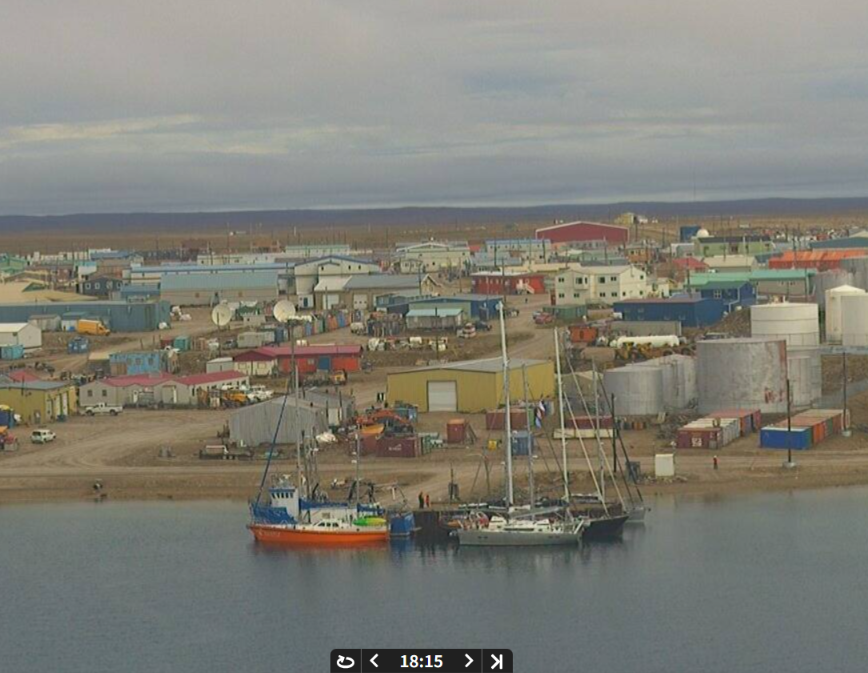
Cambridge bay seems a reasonable place to break ones journey, here are some of the yachts there about a month ago.
BN has gone very quiet. Perhaps he’s suddenly been taken ill?
In order to help him out in his hour of need, I’ll save him the trouble of reading my blow by blow account of his beloved “Northern route” through the Northwest Passage. There’s this from July 27th for example:
“The Alfred Wegener Institute’s AMSR2 data suggests that much of the sea ice on the northern route through the Northwest Passage has already melted“
What’s more the latest CIS charts show that, contrary to Ed’s erroneous assertion above, in actual fact the Parry Channel is still “wide open” to all and sundry:
The CAGW crowd is a joke, have they been right about anything?
The Danish MET Institute have not up dated their Arctic Temperature Graph since the 3rd of September, I have noticed that when Actic temperature are above normal, they updated almost every day. I suspect temperatures for September are well below normal.
The Polar Portal site shown in this heading, changed the way they measure the volume of Arctic sea ice several years ago, I wonder why.
Arctic sea ice volume reached a new record low in the DMI dataset this year beating out 2012.
PIOMAS since 2011
BeeSwax idiot….. There is no 2012 on your chart.
And at this link. 2024 is still above 2012, but not circled as a minimum yet
DMI Modelled ice thickness
PIOMAS give minimum volume in 2012 as 3.673 km³
Current value (day 244) is 4.167 km³
In 2012 value for day 244 was 3.919 km³
Do you have actual values for DMI.. link to data if you have, please
Since the 2012 trajectory is not shown above I thought it might be useful to show what it was through Sep 23rd here
I asked if you had actual data.. apparently you don’t.
PIOMAS, which we have data for, looks like the below.
Why keep digging deeper in quicksand while it is pouring in on you.
Just DUMB.
Last actual data I can find for DMI volume is in 2018.
But here is the DMI volume from 2008 to 2018.
Notice the trend. !!
Pretty amazing that the “hottest two years EVAH (2023, and 2024) 😉
…. have barely moved the Arctic sea ice extent at all, isn’t it little beeswax.
Still WELL ABOVE what it has been for nearly all the last 10,000 years.
Maybe that is because we are still very much in a “coldhouse” period,
(according to the bellboy)
For those new to the topic, old lingo used the phrase “ice free” while the new lingo is “a wadham” or maybe “one Wadhams”. This comes from the man’s name, Peter Wadhams. The IPCC Sixth Assessment Report (2021) stated that Arctic sea ice area will likely drop below 1 million km2 in at least some Septembers before 2050. Whether this number came from Peter W. or someone else is unknown to me. However, on the internet “ice free” now seems to mean under 1 million km2.
Also unknown to me, why is this thought to be a catastrophe? Arctic sea ice was low in the early 1800s, and life went on.
The phrase in academic literature is “nearly ice free”, “practically ice free”, “essentially ice free”, etc. The media and blogosphere tended to shorten it to just “ice free”. Researchers had been discussing “ice free” conditions in the Arctic in the context of it being a majority of the area with varying definitions of what that actually meant objectively for a long time. However, the definition of < 1e6 km^2 of extent was popularized by [Wang & Overland 2009]. The reasoning behind 1e6 km^2 of extent is that this a short term asymptote. It is believe that a smaller area of sea ice will persistent for hundreds of years along the northern shore of Greenland until the ice sheet fully melts out. In addition < 1e6 km^2 is small enough that it would not significantly impair a transit across the Arctic Ocean and through the Bering Straight. Although it could be argued that this may still be possible even with much higher extents if a Siberian route is used.
““nearly ice free”, “practically ice free”, “essentially ice free””
None of which have turned out to be even REMOTELY correct.
Even at the lowest, only getting down to 4 Wadhams.
Another MASSIVE FAIL from the climate scammers.
The rest of your comment is your usual meaningless and irrelevant gibberish.
My understanding — which is probably either wrong or completely out of date — is that for “the world’s leading ice experts” (see second link below …) the term “an ice-free Arctic” is shorthand for :
“Less than 1 million square kilometres with less than 15% sea-ice concentrations”
.
In 2016 “Scientist Peter Wadhams” was plugging his latest book, and gave an interview to the Observer (the Sunday version of the Grauniad, a UK newspaper famous for making speeling mistooks).
URL 1 : https://www.theguardian.com/environment/2016/aug/21/arctic-will-be-ice-free-in-summer-next-year
The first question asked by the journalist, and his “suitable for the general public” answer was :
.
Note that this came 4 years after another “puff piece” in the Graun (direct link 2) which started with
and included this previous “prediction” as well
Professor Peter Wadhams, AKA “the gift that keeps on giving” …
Thanks for that excellent post, Mark. You added a lot to the conversation.
Interesting that the solar AP index made a step function down as did the ice in 2005.
I like this report from 1950. 🙂
Weather history always puts things in perspective.
It was almost as hot in the 1950’s as it was in the 1930’s. Not just in the United States, either.
“Not just in the United States, either.”
Continually saying this does not it a truth make ….
Yes, yes .. infamy infamy they’ve all got it in for me
A hockey stick /yawn/
Am I supposed to be scared of your Fake Data?
Climate pseudo-science has cause and effect backwards when it comes to Arctic sea ice. Global temperatures don’t drive sea ice levels, sea ice influences global temperatures.
Sea ice in the Arctic is driven by a natural warming/cooling of the Arctic Ocean (AO) based on the insulating properties of ice. When more ice exists the AO warms until it starts melting the ice. However, when the ice melts it allows the AO to vent heat to the atmosphere and cool.
The cycle time for this appears to be 60-65 years. The AMO index is likely driven by this cycle. The next AMO phase change could start this decade. We should see the return of more sea ice first.
Data from 2007 is too short a record. \sarc
The problem is that there is no cost to making hyperbolic alarming statements that have no basis in reality.
These people have no skin in the game. In fact, they often have a perverse incentive to exaggerate the supposed problems, even to the extent of entirely fabricating effects that are just not happening. This serves the interests of their benefactors, they will get MORE funding for this kind of reckless, if not dishonest behavior. In a sane world, a “scientist” who made such astoundingly wrong predictions would subsequently have a difficult time getting funding for further research.
That the funding of scientific research is not based on the empirical accuracy of the prior research indicates that there is an external force at work. Something is directing the application of resources to an end other than truth. This is why we find ourselves in a world that is making less and less sense, in which people zealously defend hypotheses that bear no resemblance to reality. The mechanism to achieve this is the widespread and multi-layered application of fear based propaganda, which when applied to the scientific endeavor, creates an amplification of the fear due to the high regard in which information that is labelled “science” is held in our modern society.
Record Arctic Sea Ice Growth
Arctic sea ice area has been increasing at a record rate during the first three weeks of September.
LINK
Tell us without telling us how significant of an influence funding has on an organization’s press release:
“Conditions in context
It is 890,000 square kilometers (344,000 square miles) above the satellite-era record minimum extent of 3.39 million square kilometers (1.31 million square miles), which occurred on September 17, 2012 (Figure 1b). It is also 1.94 million square kilometers (749,000 square miles) below the 1981 to 2010 average minimum extent, which is equivalent to nearly three times the size of Texas. In the 46-year-satellite record, the 18 lowest minimums have all occurred in the last 18 years.
The overall, downward trend in the minimum extent from 1979 to 2024 is 12.4 percent per decade relative to the 1981 to 2010 average. From the linear trend, the loss of sea ice is about 77,000 square kilometers (30,000 square miles) per year, equivalent to losing the state of South Dakota or the country of Austria annually.”
https://nsidc.org/sea-ice-today/analyses/arctic-sea-ice-extent-levels-2024-minimum-set