By Jim Steele
The short answer, based on peer-reviewed science is, small increases in solar insolation increase the tropical trade winds. Stronger trade winds push the Pacific Ocean into a La Nina-like state that reduces cloud cover in the eastern Pacific and eastern Atlantic. Less cloud cover during La Nina-like conditions increase heat flux into the oceans, where the greatest heat flux is now observed. That greater flux warms the oceans and via ocean currents warms the world as it ventilates, as it does now. In contrast El Nino-like conditions increase cloud cover over the eastern Pacific and reduces heat flux into the oceans which cools the world as it did during the Little Ice Age.

In the American southwest, natural La Nina-like conditions induce dry climates and reduce vegetation. Panel “A” from Jimenez-Moreno (2021) using proxy evidence from precipitation-sensitive Pinyon Pines in southwest, illustrates 1200 years of climate change and the oscillating effects of EL Nino and La Nina. When solar irradiance was low during the solar minimums, reduced trade winds created EL Nino-like conditions that enabled greater precipitation across the southwest, and greater growth of Pinyon Pines during the Little Ice Age (LIA) from 1400 to 1850 AD.
Previously from 800 to 1400 AD, solar maximums increased the trade winds and caused the American southwest to suffer megadroughts due to dominance of La Nina-like conditions.

Panel “B” represents the standard contrast between El Nino and La Nino events. During La Nina-like conditions, strong trade winds blow warm water to the west and cause upwelling of cool subsurface water which reduces cloud cover. Reduced cloud cover amplifies solar heating of the oceans. Thus, Southwest megadroughts and warmer temperatures of the Medieval Warm Period strongly correlate with La Nina-like conditions.
During El Nino-like conditions the trade winds are weakened, allowing warmer water to slosh eastward increasing cloud cover over the eastern Pacific. The decrease in solar insolation cools the ocean and the climate and correlates with the Little Ice Age.

Panel “C” from Cronin (2024) illustrates the heat flux into the ocean during the instrumental period. The greatest heat flux into the ocean (red regions) happens in the eastern Pacific, exactly where La Nina-like conditions reduce cloud cover. That solar heat is stored in the subsurface and transported via ocean currents poleward. The blue regions represent areas where more heat ventilates out of the ocean than enters. Thus those regions do not warm the oceans, but cool the oceans. There is no global ocean warming. Ocean warming is local!
You can recognize ignorant climate alarmists who try to dismiss the effects of ENSO falsely stating there is no net warming from ENSO, because it simply causes a back and forth warming and cooling that doesn’t affect long term climate change. They are indisputably ignorant or dishonest.
Further discussion of ENSO and solar effects by Dr Javier Vinos are seen at :
How we know that the sun changes climate (II).
> El Nino La Nina And The Sun Drive Climate Change!
They change the climate. Not the same thing.
Prolonged dominance of one condition over the other does indeed drive climate change on centennial scale, at least.
Millennial, myriadal, hundred thousand- and million-year scales:
https://www.nature.com/articles/s41561-022-00999-y
Mid-Pliocene El Niño/Southern Oscillation suppressed by Pacific intertropical convergence zone shift
El Nino and/or La Nina conditions can last for a century or more?
I didn’t see any mention of a timeframe in the abstract you posted below.
I said “dominance”. That means more Los Ninos or Las Ninas over time.
For instance, there was a pronounced shift about 3000 years ago, which led to fights between fishers and farmers in Pacific coastal South America.
Using drought conditions in the American Southwest as an indicator of a La Nina-like ocean, and wet periods for El Nino-like, those states appear to exist for centuries to varying degrees
Thanks, Jim. That’s very interesting. I was unaware of these long-term events.
Earlier in this century, it was hypothesized that the balmy Pliocene might have enjoyed perpetual El Nino conditions for millions of years. That now appears to be a slight exaggeration, despite the lack of an Isthmus of Panama.
There have been 3 major El Ninos in the satellite era.
Atmospheric warming only occurred with those 3 major El Ninos..
1980-1997.. very little warming (Bod Tisdale does mention a slight step change in 1987 in ocean temperatures, but it isn’t that obvious in UAH)
From 2001 – 2015.. basically no atmospheric warming.
From 2017 – start of 2023.. Atmospheric cooling.
Don’t confuse El Nino events that ventilate heat with El Nino-like conditions where a warm eastern Pacific and cooler western Pacific cause atmospheric circulation anomalies. And dont confuse an La Nina events with La Nina-like or neutral conditions during which the western Pacific is warmer and eastern Pacific is cooler with reduced cloud cover.
So we’re are talking about four different things?
Also 1982-83 and 1987-88, IMO, although they don’t show up strongly in satellite observations.
Please see ENSO index below.
El Ninos “normally” brings drier conditions to Eastern Australia..
The current El Nino…. not so much… in fact, everywhere is soggy, boggy and damp.
El Nino 2023-24 has faded, if not disappeared.
It has been wetter than usual for the whole 2023 El Nino !
ENSO isn’t the only factor in regional weather.
Of course not.. All El Ninos are not the same.
With the modokis, ENSO is more like a continuum than discrete states. In extreme Los Ninos, the trade winds reverse, as happened in 2016. In the weakest Los Ninos, WestPac warm water sloshes across the IDL without reaching Ecuador.
One can clearly see El Niño dominance during the late 20th century warming period and lower El Niño strength with more La Niñas during the subsequent pause.
It would follow that a period of full scale La Niña dominance would lead to cooling but we are not quite there yet.
Maybe I don’t understand this but, why is the horizontal axis on the first graph reversed and going largest to smallest? The entire graph just doesn’t make any sense to me.
The first graph is showing the correlations between droughts an solar irradiance from the year 1200 AD to the far right to our current times on the left. The bottom panel shows decreased solar irradiance (minimums) high on the y axis and solar irradiance increasing as the curve drops lower. The modern solar maximum runs between about 1914 and 1995.
High solar irradiance correlates with La Nina-like conditions and drought in the American southwest and the warm periods. Low irradiance with El Nino-like conditions, wet periods in the southwest and the Little Ice Age.
“High solar irradiance correlates with La Nina-like conditions and drought in the American southwest and the warm periods. Low irradiance with El Nino-like conditions, wet periods in the southwest and the Little Ice Age.”
How long do these “conditions” last? Years?
Jim Steele:
Your post reeks with nonsense!
La Nina’s are TEMPORARY cooling events caused by SO2 injections into the stratosphere from VEI4 and larger volcanic eruptions, with no relation to ANY solar events.
El Ninos are TEMPORARY warming events, primarily volcanic induced, caused by the settling out of volcanic SO2 aerosols, roughly 18-30 months after an eruption, when the descending H2S04 droplets flush out enough of those already in the troposphere to cleanse the air enough to cause temperatures to rise to those of an El Nino. This is observed after most eruptions, unless quenched by another closely following eruption.
They are not caused by the sloshing of the Pacific Ocean waters, in fact, changing ENSO temperatures are CAUSED by changing global atmospheric temperature levels, with ENSO warming being an effect, not a cause.
Then you state “You can recognize ignorant climate alarmists who try to dismiss the effects of ENSO, falsely stating that there is no net warming from ENSO, because it simply causes a back and forth warming and cooling that doesn’t affect long-term climate. They are indisputably ignorant or dishonest”
Which one is you?
LOL BurlHenry,
Clearly you can not even read! We often disagree and now I see it is because you are an idiot. You expose yourself as an ignoramus. I suspect your intent is to create chaos among skeptics.
I wrote La Nina-like conditions, not a La Nina event! La Nina and El Nino events are measured in specific regions. The Niño 3.4 region is defined as an area in the central Pacific Ocean bounded by 5°N-5°S, 120°W-170°W. Events happen when temperatures depart by 0.5°C for five consecutive overlapping three-month periods.
In contrast, when we scientists talk about La Nina-like conditions, we refer to conditions when the eastern Pacific is cooler than normal and the western Pacific is warmer as illustrated. During La Nina-like conditions, solar heated water is stored down to 200 meter depths in the western Pacific. During El Nino events much of that water is transported eastward. You need to learn some science BurlHenry!
Jim Steele:
The attached WoodforTrees.org graph of average anomalous global temperatures,1850- 2023 shows temporary increases and decreases in temperatures.
Each increase correlates to a decrease in global SO2 aerosol emissions, and each decrease correlates with an increase in global SO2 aerosol emissions. The changing levels are due to both volcanic eruptions, and to American Industrial recessions. There are no observable temperature changes due to solar effects, as you postulate, and NO La Nina-like conditions, as you claim, only La Nina events.
Most of the temperature increases result in an El Nino, and ENSO warming, but they are all temporary, with no step increase in average global temperatures, as you insist.
The change in slope of the graph circa 1980 is due to decreases in industrial SO2 aerosol emissions due to “Clean Air” legislation and efforts, as well as to the Net-Zero banning of the burning of fossil fuels. Plus some decrease in Earth’s albedo
All of the evidence points to YOU being the “idiot” and the “ignormaous”.
Jim Steele:
The graph would not attach. Here is another try:
Still did not attach.
Go to Woodfortrees;org. Select interactve in tool bar, then global temperatures 1850-2023
Well I wish you understood that some correlations are just idiotic but uncritically embraced by ignoramuses. I wish you didnt deny the science that during El Ninos warm water from the warm pool slosh eastward. You deny the observed change in sea level. You deny the accompanying changes in the thermocline. You deny that fact the warm pool expands with La Nina events and contracts during El Nino events, or that the dominance of LA Nina-like conditions has caused the warm pool to grow since 1900. You even deny the observations that the ocean can undergo decade changes in El Nino-like vs LA Nina-like conditions similar to seen in the Pacific Decadal Oscillation. You deny the asymmetry in the PAcific ocean’s zonal temperature gradient un explicable due to changes in CO2 or SO2. But denying science and clinging to a correlation that really doesnt explain even half of the observed changes, is the sure mark of an idiot. Consider the fact the only one cheering you on is Richard Greene and he disagrees with your arguments.
Jim Steele:
You say that I deny the fact that “the warm pool expands with La Nina events”
Yes,I do. Water contracts when it is cooled, and expands when it warms.
What I cannot understand is your insistence that El Ninos are cooling events, and that La Ninas are warming events, and that El Nina-like and La Nina-like events exist for extended periods of time. A simple glance at the Oceanic Nino index (ONI) shows just the opposite, ALL increases and decreases are discrete, short-term events. And El Ninos are shown as warm events and La Ninas as cool events.
Surely, you and your supporters cannot be as stupid as you appear to be.
Keep strutting you stupidity Burl. Please learn to read .
First it doesnt take much searching of the scientific literature to find the warm pool increases during La Nina and contracts during El Ninos. I suggest you try it before exposing your buffoonery any further.
Indeed warm water expands but you totally misapply the factoid from 8th grade science
I wish I could repeat this more slowly so even retards can understand. but
During La Nina increased trade winds transport heated waters to the warm pool causing it to expand. Most of the the heat is stored in the western Pacific subsurface and thus cant warm the atmosphere. Simultaneously the increased trade winds cause upwelling of cool subsurface water in the eastern Pacific. That cools the air. Thus La Nina warms the subsurface ocean while paradoxically cooling the air temperature.
Likewise El Nino releases stored subsurface heat which now warms the air, but is cooling the ocean. You really need to understand these paradoxes and dynamics, are get another hobby other than misinforming people about climate change.
Jim Steele:
The “Pal-reviewed” papers that you rely upon completely refute the Oceanic Nino Index. You need to come up with a reason as to why you ignore it, and continually mis-inform people about climate change.
I have attached a WoodForTrees.org plot of average anomalous global temperatures, 1850-2023, which totally refutes your weird claims of extended La Nina- like and El-Nino-like periods.
All of the temporary increases and decreases in temperature are due to increasing or decreasing levels of SO2 aerosols in our atmosphere.
The change in slope circa 1980 is the result of global efforts to reduce the amount of industrial SO2 aerosols in our air because of Acid rain and health concerns.
Go get him Burl !
While I completely disagree with your claim that SO2 emissions are a climate control knob, I do agree that reduced SO2 emissions are one cause of global warming.
I doubt if Steele would admit that because SO2 emissions average 98% manmade, and Steele ignores manmade causes of global warming.
Very nice Jim.
As far as I can tell, La Niña dominates in cooler cloudier periods and El Niño dominates in less cloudy warmer periods.
We saw less clouds in the late 20th century warming period with stronger El Ninos.
Jim is proposing the opposite.
Is that because Jim is focusing on cloudiness in the eastern Pacific whereas I focus on global cloud cover?
My view is that solar variations affect global cloudiness by altering the length of jet stream tracks which changes total global insolation into the oceans which then feeds into the ENSO balance between El Niño and La Niña.
It may well be more cloudy in the eastern Pacific during EL Ninos because of the enhanced convection caused by higher temperatures during the El Niño but the El Niño dominance would be a consequence not a cause.
One of my previous points, from many years ago is that the ITCZ shifts north in warmer times and back towards the equator in cooler times. As another contributor above indicates that shift is related to ENSO and tends to offset the global thermal effect from changes in the balance between El Niño and La Niña.
I contended that the ITCZ shift is the negative system response to keep the overall system in balance despite changes in heat release (El Nino)or absorption (LaNina).
Basically, top down solar effects alter global cloudiness via jet stream meridionality adjustments which leads to a change in the solar input to the global oceans and the balance between El Niño and La Niña and the change in the rate of energy transfer from oceans to air is then countered by a shift in the sizes, positions and intensities of the Hadley, Ferrel and Polar convection cells which adjusts the rate of energy loss from surface to space.
The system is kept stable but certain regions are affected more by those atmospheric circulation shifts than others. It appears to be the northern continents that see the largest changes because those land areas have less thermal inertia than the southern oceans.
That southern thermal inertia is why the default position for the ITCZ is north of the equator rather than directly over it.
Stephen what is your evidence that La Nina-like conditions correlate with cloudier periods? References please. In it is well observed that the eastern Pacific undergoes reduced cloudiness during La Nina-like conditions.
Indeed La Nina events are associated with cooler air temperatures because the trade winds are amplified causing upwelling of cooler subsurface water. Paradoxically ocean subsurface temperatures increase due to greater heat flux into the eastern Pacific.
I mentioned that the difference between us may be that you are looking only at cloudiness in the eastern Pacific whereas I look at it globally.
Warmer ocean surfaces in the eastern Pacific would produce more clouds due to enhanced convection and the opposite when those surfaces are cooler.
However, that does not necessarily tell us what is happening globally.
Longer lines of air mass mixing in the middle latitudes when the jet streams are waving about more meridionally will inevitably produce more clouds on a global scale and I think that is what we should look at.
The LIA was a very stormy period in the middle latitudes with presumably more clouds and we have seen less clouds during the late 20th century warming period.
So, I think you are looking at a regional relationship between ENSO and cloudiness which runs opposite to the global trend.
Thus I think you are misinterpreting a regional consequence as a global cause.
Enso has also been reconstructed for the latter half of the Holocene, about 6000 years back in time: Changes in ENSO Activity During the Last 6,000 Years Modulated by Background Climate State, Soon-Il An and 2 co-authors, https://www.docdroid.net/QmS34GN/101002-at-2017gl076250.pdf
Interesting Key Points from that study:
Thank you for this article. It’s true, weak El Niño conditions must have prevailed during the Little Ice Age, due to the weakening of the jetstream at high latitudes, especially in the southern hemisphere. It is the strong polar vortex in the southern hemisphere, thanks to ocean currents, that stabilizes the temperature of the Earth’s surface. We are currently at the peak of solar activity, and the cold Peruvian Current is already reaching the central equatorial Pacific. However, the easterly wind will weaken as the Sun reaches a minimum and will intensify again at the beginning of the 26th solar cycle.
If La Niña is weak again, it could last a very long time again, as too little heat will accumulate under the western equatorial Pacific.
http://www.bom.gov.au/cgi-bin/oceanography/wrap_ocean_analysis.pl?id=IDYOC007&year=2024&month=05
Yes, La Niña dominates in cooler cloudier periods. In this figure I used the MEI reconstruction going back to 1871, at the very end of LIA. The cumulative index shows some climate shift points also.
De-trended, cumulative total of the MEI ENSO index from 1871–2023. Approximate turning points of the PDO are marked with arrows.
That chart looks kind of like this chart (Hansen 1999):
It is not always the ignorant. When you have such luminaries as Sabine Hossenfelder inveighing on the subject is it a sign of cold feet or is she exemplary in the scientific way of the alternative hypothesis? Although sponsorship may be at the root of her conjecture, don’t you yearn for such limited exposure (YouTube) was not a necessary medium for promulgating one’s ‘opinions’.Regret the authoritarian impositions by the bourgeois media and its subservience to elites.
Someone may ask, what does the southern polar vortex have to do with circulation in the equatorial Pacific? It turns out that there is a strong connection.
https://earth.nullschool.net/#2024/05/25/1700Z/wind/isobaric/70hPa/orthographic=-110.93,2.53,285
“Panel “C” from Cronin (2024) illustrates the heat flux into the ocean during the instrumental period. The greatest heat flux into the ocean (red regions) happens in the eastern Pacific, exactly where La Nina-like conditions reduce cloud cover. That solar heat is stored in the subsurface and transported via ocean currents poleward.”
Isn’t that the net heat flux? Sub-surface currents do also transport sun-warmed water to the east, so not all of the indicated net heat flux in the eastern Pacific will originate from just local solar absorption. Also, as the sub-solar point doesn’t reach 45°S, where there is also high heat flux in red, heat is mainly transported in, not all of it from locally absorbed direct solar radiation @ur momisugly 45°S.
The reduction in cloud cover during La Niña also extends beyond the eastern Pacific, as the central Pacific had positive OLR anomalies for La Niña in 2021-23, from fewer clouds.
http://www.bom.gov.au/climate/enso/wrap-up/archive/20240430.cloudiness.png
There is other evidence from the ESA TEMIS Ozone/UVI data indicating in 2020-21 that La Niña relative cloudlessness extended to most of the ocean, affecting UV Index on all the continents.
The long-term global ocean climate warming effect of predominately positive ENSO activity:
For over 9 solar cycles, the tropical ocean indicates solar activity caused both a La Niña and a following El Niño in-synch with the solar cycle minimum and maximum, respectively. Note that this covers more solar cycles and ENSO circumstances than what Javier showed. This 2022 result indicates the odds of it happening without solar forcing are 1.6(10^19):1.
Yes Bob it is net flux.
Attributing changes of heat flux requires looking at two general possibilities. Heat flux just means more heat is being absorbed then emitted or vice versa, so we cannot simply say the red regions mean more heat was absorbed without further analysis. From an equilibrium standpoint that heat absorption and heat emission should be balanced, a red flux region could either mean more heat is being absorbed while emissions are unchanged, or absorption is unchanged but emissions are reduced.
In the case of the eastern Pacific under La Nina conditions, the resulting decline of cloud cover relative to El Nino conditions suggest increased solar absorption. On the other hand in ice free oceans, reduced emissions are most often due to reduced convection and reduced ventilation of solar heated subsurface heat from barrier layers. Barrier layers form when more fresh water overlays warmer but denser saltier waters. River flow or precipitation are the most common sources of a freshwater lid that would suppress heat emissions. Again under La Nina conditions this seems unlikely because atmospheric convection and rainfall move westward.
Advection of subsurface heat will affect emissions as warmer water carried away from the eastern tropics ventilates as it circulates poleward as in the Kuroshio current. The Equatorial Countercurrent does carry warmer water eastward, but the net flux still suggests absorbed heat is greater than emitted.
So I feel confident arguing the current red flux regions in the eastern tropical Pacific represent increases of heat absorption that doesnt get ventilated until transporte. d poleward.
I suspect a barrier layer of fresh water influx from Antarctic sea ice melt is routinely in play in the eastern Pacific after every El Niño, acting like a short-term negative La Niña feedback.
The equatorial counter-current is likely also responsible for concentrating CO2 from the entire tropical basin into the eastern Pacific where the CO2 ocean flux is the highest:
I will repeat a comment that I made on Feb 20, 2024.
Can I suggest an alternative cause of La Nina and El Nino.
It is a natural oscillation between two unstable conditions.
In both cases, the warming phase and the cooling phase, the water temperatures overshoot thermal equilibrium, because of the thermal momentum of the system. It takes a long time to wind up and wind down the process in a system the size of the central Pacific. The typical periodicity of 3.5 = 4 years reflect the system dynamics, i.e. the size of the system.
Good thinking. That could very well be the physical response when the active solar cycle forcing changes, that looks to regulate the presence of the two conditions at least during that time of a solar cycle. The solar minimum La Niña cloudlessness enhances TSI ocean absorption as sunspots increase during the sunspot cycle rising phase.
I’ve also categorized many other climate indices besides HadSST3 by their individual sun warming thresholds to find an overall climate response continuum to sunspot number during the rising phases of solar cycles of between about 85-105 SN.
The Niño12 SST and trade winds are on the bottom end of this spectrum of climate responses to solar activity, with a threshold near 85 SN, indicating it is the first region to respond to the sunspot cycle ascending phase, heralding an upcoming transition between La Niño & El Niño, a tipping point, for the natural oscillation you described.
One problem with this analysis is it doesnt account for changes in sea level and the thermocline. Nor does it account for the changes in the extent of the warm pool
I am not sure that my analysis contradicts the changes that you mention. Are not the changes in sea level due to changes in the prevailing winds? As for the thermocline and the extent of the warm pool, I am not commenting on heat or mass transfer within the ocean, but rather between the ocean and the atmosphere.
Evaporative cooling is a very important part of the earth’s energy budget, accounting for about 1/3 of the net solar energy received by the earth (80 W/m2 out of the net energy budget of 240 W/m2), with most of it concentrated in the tropical oceans.
What I am pointing out is that this evaporative cooling is highly sensitive to temperature, not only because of the high sensitivity of water vapor pressure to water temperature, but also the secondary effects of water vapor on wind and wave action that provide a positive feed-back loop to further enhance evaporative cooling.
One readily sees how the process works in Hurricane Alley, in the tropical Atlantic. When the seas are calm in late summer, ocean temperatures can easily reach 30C. But this situation is unstable. As soon as there is a weather disturbance coming from the coast of Africa, the winds help to increase the rate of water evaporation, generating a positive re-enforcing feed-back loop that soon results in a tropical storm, and if there is enough warm water, a hurricane. The storm will continue until it runs out of warm water, having transferred a tremendous amount of energy to the atmosphere and cooling the water that it has passed over by several degrees.
In essence El Nino/La Nina is the same process, only on a much larger scale and time frame. This process is also what Willis Eschenbach refers to as ’emergent phenomena’. Whenever the oceans get too warm this evaporative cooling feed-back loop kicks in to cool them back down. limiting the extent to which the tropical oceans, and thus the earth, can warm.
From what I read, you explain El Nino and La Nina in terms of warming and cooling of the surface waters driven by the sun, clouds and winds. You do not mention transport of heat across the ocean as a factor. But changes in sea level and thermocline are observed showing that transport is occurring
What I propose is that the very high sensitivity of evaporative cooling to water temperature is a factor that is overlooked in trying to understand ENSO:
I have not addressed in my comments the variable and cyclical nature of heat transport to the oceans or within the oceans which necessarily affects the magnitude, timing and duration of ENSO events.
Your perception is reality; the oscillation is a form of hysteresis.
There was no increase of top of the atmosphere (TOA) solar energy (TSI) since the late 1970s, that could have been a caused some of the post 1975 global warming
Sunspot counts are an incompetent proxy for TOA TSI — this has been known since the late 1970s
The percentage of cloudiness decline of 7% in recent decades is too small to be statistically significant,
The estimate of average absolute humidity is even worse, with poor low altitude coverage, especially of the Southern Hemisphere. Humidity is the highest at the lowest altitudes. Global average absolute humidity is most poorly measured at low altitudes, below the satellites.
The questionable record shows an increase from 1980 to 2000, as expected from a water vapor positive feedback. But a relatively flat trend from 2000 to 2023, which was not expected. Relative humidity has a 40 year declining trend, which was also not expected. Measurements inaccuracy may be the cause of the unexpected results. There is no accurate global annual average percentage of absolute water vapor statistic.
The ENSO cycle is temperature neutral in the long run (30 to 50 years
If El Ninos are the caused of global warming after 1975, then how did they cause global cooling in the 1940 to 1975 period?
Any claims about an increase of heat released over past decades by underseas volcanoes and vents are data free speculation.
Jim Steele is an El Nino Nutter. Junk armchair scientists like him are the main reason conservative authors are never taken seriously by real climate scientists.
The It’s all Natural Warming Conservative Nutters are just as extreme as the It’s All Manmade Warming Leftist Nutters.
Dumb and Dumber extremists.
Both extremists ignore contrary evidence due to confirmation bias.
It’s All Natural Nutters tend to ignore
La Ninas
Natural Annual Carbon Cycle CO2 absorption that exceeds Natural Annual Carbon Cycle CO2 emissions
More TMIN warming than TMAX warming after 1975, more likely from an increased greenhouse effect warming than from increased solar energy warming
Cooling stratosphere
Lack of Antarctica warming
127 years of lab CO2 spectroscopy
Nearly 100% of over 100,000 climate science papers since 1896
Satellite TOA TSI data versus sunspot counts
The lack of an 11 year sunspot cycle in the Global Average Temperature (GAT)
Consensus predictions of the GAT rise of +0.3 degrees C. per decade, mainly from CO2, starting with the 1979 Charney Report, actually came true after 2006.
I patiently await Steele’s claim that only 4 ppm (3%) of the +140 ppm increase of atmospheric CO2 after 1850 was from manmade CO2 emissions. A professional Climate Nutter must believe that.
LOL The replies to my post would never be complete without another hateful retarded diatribe by Richard Greene intended to slander me once again. It is what I expect from ignorant alarmist trolls…. Hmmmm.
In order to extract any contributions from CO2 effects to the current temperature changes, good scientists simply must account for all the natural contributions first. Alarmists usually ignore natural contributions and dishonestly claim warming is 100% man made. Richard Greene supports such claims by slandering scientists who point out natural contributions as “Natural Warming Conservative Nutters”
The intent of my article was only to elucidate a dynamic that heats the oceans. Heat flux into the ocean is variable and not global. The most intense flux is where La Nina-like conditions reduce clouds which is where solar heating is greatest. For the oceans to warm, absorbed heat must be trapped. CO2 LW only penetrates only a few microns and then is lost compared to solar heated subsurface water that trap heat for days to decades. The tropics naturally produce barrier layers that trap solar heat. I never argued those dynamics account for all atmospheric temperature changes. But I do argue that dynamics accounts for observed increased ocean heat content.
Hateful slandering posters like Richard Greene are simply trying throw every possible irrelevant factoid out simply hoping to see what sticks so to undermine that dynamic without ever refuting the science. For example he says, “If El Ninos are the caused of global warming after 1975, then how did they cause global cooling in the 1940 to 1975 period?” First there are many factors that affect atmospheric temperatures. Paradoxically El Ninos warm the atmosphere but cool the subsurface ocean. While La Nina-like or neutral conditions warm the ocean despite cooling the atmosphere. But again, the article is not about atmospheric temperatures but ocean heat content.
Richard Greene says “Sunspot counts are an incompetent proxy for TOA TSI”. True, converting sunspot numbers to W/m2 of irradiance has uncertainty and there is ongoing debates about sunspots. But most agree a sunspot minimum correlates with reduce solar irradiance. And most data show sunspot minimums correlated with the Little Ice Age and El Nino-like ocean vs sunspot maximums that correlate with the Medieval warm period and La Nina-like conditions. Even alarmist admit this.
From the 2005 paper Volcanic and Solar Forcing of the Tropical Pacific over the Past 1000 Years
By MANN, Cane, Zebiak & Clement
“the tendency for an El Niño–like state in the tropical Pacific during the so-called “Little Ice Age” and a La Niña–like state during the so-called Medieval Warm Period”
So why does Richard Greene ignorantly inject humidity or a cooling stratosphere into an ocean dynamic debate? That’ retarded. Why does Greene fabricate a fake, dishonest argument that I would argue “only 4 ppm (3%) of the +140 ppm increase of atmospheric CO2 after 1850 was from manmade CO2 emissions”. Clearly Greene is just unhinged.
As Greene has demonstrated time and time again, he would better described as an alarmist troll hell bent on trashing any skeptic that he disagrees with instead of engaging in productive debate that promotes good skepticism. Greene simply makes unsupported retarded slurs that we are Nutters. And then when I call him on his hateful ignorance, he cries saying I am mean for punching back. Who’s the real NUTTER here?
Steady rise ins OHC began as thee oceans entered a more La Nina-like state in the 2000s. How long before that heat ventilates? Heat transported into the Arctic has a 25 to 35 year residence time.
Oh dear, yet another evidence-free speculative non-science tantrum rant from RG. !
At least he got his “consensus” phrase in this time. ! 🙂
Jim already pre-empted RG’s post..
From the article: “There is no global ocean warming. Ocean warming is local!”
Somebody had to say it!
Yes, the climate alarmists talk about the oceans as if they are a large bathtub that is the same temperature throughout.
It’s not. Ocean warming is local! And has no discernable connection to CO2.
“Yes, the climate alarmists talk about the oceans as if they are a large bathtub that is the same temperature throughout.”
No they don’t. Well maybe some fool said it somewhere, but all the good science I have read says the earths oceans do not warm uniformly.
So you now admit ocean warming is nothing to do with atmospheric CO2.
Well done. !
https://www.nationalgeographic.com/environment/article/critical-issues-sea-temperature-rise
Why are our oceans getting warmer?
The temperatures of the world’s oceans are hitting record highs, with far-reaching consequences for marine life, storm intensity, and sea levels.”
There’s a headline for you (the second hit on my search), Simon. Don’t you agree that this gives the impression that the oceans all over the world are getting hotter? That would be my impression.
We see exaggerations of ocean warming like this on a regular basis.
Ocean warming is a local phenomenon. Insinuating it is worldwide, is a distortion of reality. Insinuating that CO2 has anything to do with local ocean warming is not based on the facts.
“Don’t you agree that this gives the impression that the oceans all over the world are getting hotter? That would be my impression.”
I don’t think it is pushing anything in regard to uniformity of heating. It talks about how the top part is warming faster, but makes no comment re every part warming at the same rate. So while it is possible that a reader may conclude there is even warming, it is not the purpose of the article, which is to raise awareness that warming seas bring hazards to some marine life, which is irrefutably true. https://www.epa.gov/climateimpacts/climate-change-impacts-ocean-and-marine-resources
This article give an excellent account of how the oceans warm and while it is true some areas are warming faster than others, it is also true that the worlds oceans on average are at present the hottest ever recorded.
https://www.sciencedaily.com/releases/2023/11/231101134840.htm#:~:text=They%20found%20oceanic%20warming%20has,region%20was%20far%20from%20uniform.
On another note Tom you will be very pleased the polls are favouring Trump at the moment. I took a $100 bet with a friend who is a Trump supporter. I’m still hopeful Biden can reverse things otherwise I have to take him (and his partner) out to dinner.
ENSO is more complicated than simple changes in ocean surface temperature. The atmospheric circulation in the upper troposphere acts independently of the ocean. It is said to be the Southern Oscillation for a reason, since it depends on the strength of the southern polar vortex.
The El Niño Southern Oscillation (ENSO) is a naturally occurring large-scale climate phenomenon involving fluctuations in ocean temperatures in the central and eastern equatorial Pacific, combined with changes in the atmosphere.
El Niño and La Niña are the oceanic components, while the Southern Oscillation is the atmospheric counterpart, giving rise to the term El Niño Southern Oscillation (ENSO).
https://tropic.ssec.wisc.edu/real-time/mtpw2/product.php?color_type=tpw_nrl_colors&prod=spac×pan=24hrs&anim=html5
Some stubbornly fail to see that the high temperature of the troposphere above the equator does not affect the increase in temperature near the surface.
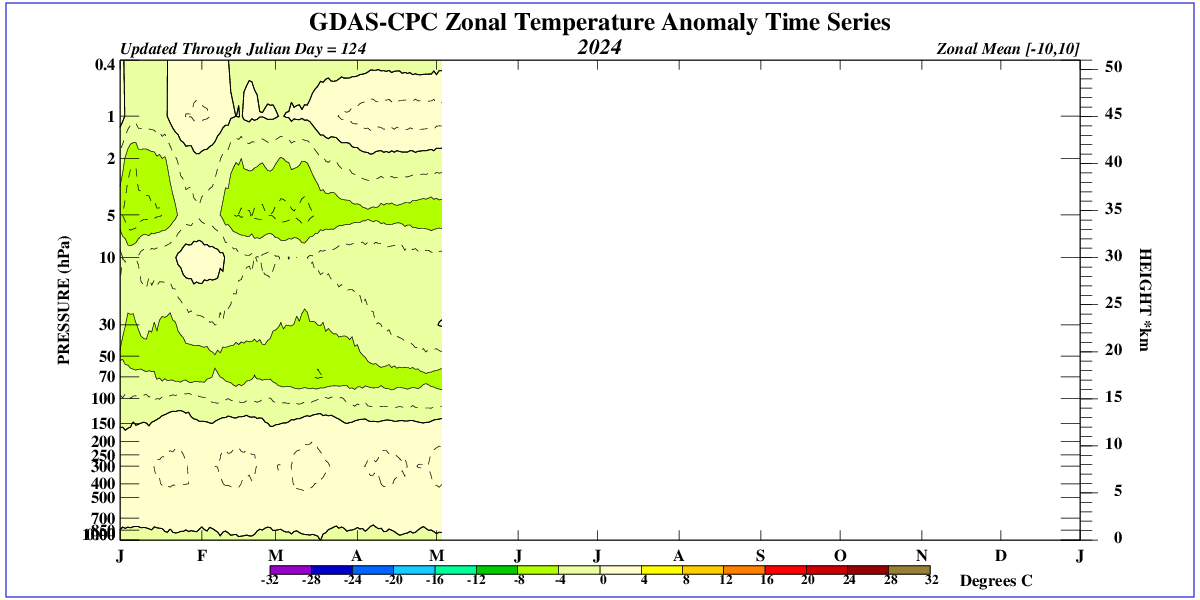
It is likely that the increase in temperature over the equator above 1,000 meters is due to a decrease in stratospheric ozone and an increase in UVB radiation. The temperature drop in the stratosphere is due to a decrease in ozone production.
I believe the expressions “La Nina-like conditions” and “EL Nino-like conditions” need replacing as they obviously are being confused with the actual La Nina and El Nino phenomena.
Having read the piece it is obvious they are not the same.
Sparta, I agree but published literature has used that term for over 20 years. So the best we can hope for is we all learn the difference.
I stopped reading the comments because too many conflated the 2.
Due to Milankovich cycles, the oceans in the northern hemisphere may continue to warm more for hundreds of years to come. Nothing can stop it. This does not mean that winters on the continents will be milder, certainly more snowy. This is because in winter the troposphere at high latitudes decreases a lot and is unable to maintain the temperature.

Snow and frost in the Rocky Mountains.

The Oort Minimum was from around 1010, the wetter period aligns with the very deep but short centennial solar minimum in the early 1100s.
It’s all word games, and very intentional.
By (arbitrarily) naming all these natural variations as “oscillations” : AMO, SO, PDO, AO ….. they are declaring them to be long term neutral by simple definition.
That means they never has to actually prove it scientifically because, well, it’s a oscillation, not a trend!
Climate science is pseudo-science perpetrated by political activists.
Less radiation will not cool anything on its own , it will simply stop heating. What causes the cooling ( and the clouds ) is evaporation and advection.
El Nino is the energy outflow phase of ENSO, when OHC is transfered to the atmosphere on its way back to space.