by Javier Vinós
Part 2 of a 3-part series. Part I is here.
The effect of the Sun on climate has been debated for 200 years. The basic problem is that when we study the past, we observe strong climatic changes associated with prolonged periods of low solar activity, but when we observe the present, we are able to detect only small effects due to the 11-year solar cycle. There are several possible explanations for this discrepancy. But the main question is how the Sun affects climate.
In this article we examine the effects on climate caused by the 11-year solar cycle over the last few cycles and their relation to recent climate change.
- The IPCC Says…
In its 5th Assessment Report, the IPCC used climate models to calculate the Sun’s contribution to warming. These models only take into account changes in the total energy coming from the Sun, which is known to vary by only 0.1%. Therefore, the IPCC’s answer is that the Sun has contributed nothing to the warming.[i] This is absurd given our knowledge of past climate and the fact that we passed through a 70-year solar maximum in the 2nd half of the 20th century, one of the most active periods of solar activity in thousands of years.

Figure after AR5, WGI, Ch. 5, FAQ 5.1, Fig. 1, pg. 393
The IPCC is ignoring a large body of evidence that the Sun affects climate in ways that cannot be explained by these energy changes alone. We have space to review only a few of these unexplained effects. Let’s start with the surface.
- Sun’s Effect on the Surface
Most of the Sun’s energy reaches the surface of the planet. If this energy increases by 0.1%, then every point on the surface receives 0.1% more. One would expect this to cause a small overall warming, estimated by scientists to be two hundredths of a degree Celsius, which is undetectable. But that is not what is being observed. Several studies show that over the solar cycle, the surface is warming 4 times more than expected, 0.1°C, and it is doing so in an extremely irregular way with large spatial variations.[ii]

Figure from Lean 2017. The surface temperature response to solar cycle from observations using multiple regression from the 1996 minimum to the 2002 maximum. On the right are zonally averaged changes.
Going from a solar minimum to a solar maximum, some areas show more than 1°C of warming, while others show more than half a degree of cooling. This is not the effect you would expect. If we analyze the average for each latitude, we observe a very strong warming around 60°N latitude. But if we analyze the change at 20 km altitude, in the stratosphere, we observe something very curious. The response in this layer of the atmosphere is inverse to the response at the surface. Why is this important? The IPCC tells us that one of the fingerprints of warming due to our emissions is that we see warming at the surface and cooling in the stratosphere. But if the Sun also shows an inverse response between the two, then the observation is no longer evidence of guilt from emissions. It could be the Sun. It is also important to note that the part of the globe that has warmed the most during global warming (since 1976) is the land surface of the Northern Hemisphere, precisely the region that shows the greatest warming in response to a more active Sun, while the tropics have barely warmed at all.
- Sun’s Effect on the Ocean
Years ago, some scientists studied the rates of warming and cooling in the upper layer of the tropical oceans. They found that it follows a cycle similar to that of the Sun.[iii] However, there is a problem: the variation in the Sun’s energy is ten times smaller than it would need to be to cause these changes. Instead of thinking that this supported an indirect effect of the Sun on climate, most scientists ignored the study.

Figure from White et al. 2003. Upper, heat storage anomaly above the 22°C isotherm from 30°S to 30°N expressed in W (stored)/m2. Lower, solar irradiation anomaly.
In the Pacific, trade winds push warm surface water westward, bringing up deep, cold water off the coast of South America. This is called the Neutral phase. In some years, the trade winds become stronger and push the cold water toward the center of the Pacific, accumulating more warm water to the west. This is the La Niña phase. In other years, the trade winds blow more slowly or in the opposite direction, the cold water stops rising in the east, and the water in the central and eastern Pacific warms. This is the El Niño phase. This oscillation affects the weather of much of the planet and we must remember that it has three states, not two.
Since 1990, there have been countless studies on the solar cycle and El Niño. You will not find any reference to them in review articles, books or IPCC reports.
I set out to investigate this relationship using solar activity data and the Oceanic El Niño Index, which shows in blue the periods when the equatorial Pacific is cooler than average and in red when it is warmer. Since solar cycles have slightly different lengths, I divided both data series into segments of a solar cycle and then adjusted the length to be the same for all cycles. This statistical technique is called epoch analysis. In this way, the mean and variance of the data are determined for periods that coincide in their phase of the cycle. This revealed a pattern that indicates an El Niño response to solar activity. I looked at a period when the cycle is gaining activity, which is accompanied by La Niña conditions. I used the Monte Carlo method to determine the probability that this result was random, and the answer was only 0.7%. This means that there is a 99.3% chance that the La Niña conditions at this time in the solar cycle are due to the Sun.

Figure shows Epoch analysis of solar activity and Oceanic El Niño Index. X-axis is the variable length of a full solar cycle. Right curves show the mean and standard deviation of left curves. Red rectangle indicates the part of the data analyzed by Monte Carlo method.
Since the answer is clearer for La Niña, I analyzed the relative frequencies of each phase of the El Niño phenomenon. What is observed is that the Neutral condition years follow the solar cycle in their frequency with a delay of one or two years. Surprisingly, the frequency of La Niña is the opposite of Neutral. The solar activity determines whether it is a La Niña year or a Neutral year. The Sun’s effect on El Niño years is less clear. El Niño seems to have another cause, which could be the amount of heat accumulated in the ocean. The solar pattern is confirmed by a study of El Niño frequencies since 1900, because among the repeating peaks there is an 11-year peak, which is the frequency of the solar cycle.[iv]

Figure shows the relative frequency for Neutral years (orange) and La Niña years (blue) from the official (Domeisen et al. 2019) classification shown in the bottom squares. Frequency was calculated for a 5-year sliding window and Gaussian smoothed.
It is striking that with so much evidence and studies, the vast majority of scientists do not know that the Sun controls the very important El Niño phenomenon. But El Niño is a product of the action of the trade winds over the equatorial Pacific. To control El Niño, the Sun must control the atmospheric circulation.
- Atmospheric Effects
We have known since 1988 that the Sun affects atmospheric circulation.[v] But like other effects of the Sun on climate, most scientists ignore this knowledge. This effect on the atmosphere may affect hurricanes in a much more significant way than global warming. The graph of the annual number of major hurricanes in the world (inverted) shows that the number of hurricanes tends to increase at or after the solar maximum.[vi]

Figure after Pielke & Maue 2024. Data for global major hurricanes (≥94 knots) from Ryan Maue, is an inverted and 3-year centered average. It displays a decadal periodicity.
How does the Sun manage to affect the atmosphere? In 1959, a scientist discovered that changes in the polar vortex seemed to respond to solar activity.[vii] This is a question that continues to be studied, and we are beginning to understand that much of the effect of solar activity on atmospheric circulation is due to this effect.
In the next graph, solar activity is represented in red. In purple at the bottom is the strength of the polar vortex.[viii] High values indicate a strong vortex and low values indicate a weak vortex. These values tend to show a large change from year to year. In blue you can see the cumulative wind speed that forms the polar vortex.[ix] When the curve goes up, it indicates that most of the time the speed is above average and the vortex is strong. When it goes down, it indicates the opposite.

This figure shows in red the monthly number of sunspots, in blue the cumulative anomaly of zonal wind speed at 54.4°N, 10 hPa (Lu et al. 2008), and in purple the mean vortex geopotential height anomaly at 20 hPa (NCEP, Christiansen 2010).
During Cycle 20 of low solar activity, the vortex wind was slower than normal and most years had a weak vortex. This corresponds to the late 1960s and early 1970s, when many winters were cold. Then came Cycle 21, which was very active. The wind speed increased, and there was only a weak vortex at the beginning and end of the cycle, when solar activity was low. In the late 1970s and 1980s the winters were warmer. Cycle 22 remained very active and the wind continued to be faster than normal, resulting in no weak vortex years. Winters continued to be warm throughout the 1990s. With Cycle 23, solar activity decreased again, leading to a decrease in wind speed. Weak vortex years returned. And also since the late 1990s, cold winters have returned, something that scientists who ignore the Sun’s effect on climate have trouble explaining.
The data I have does not cover solar cycles 24 and 25, but the correlation between low solar activity and cold winters continues, especially in eastern North America and Eurasia. Since the late 1990s, winters have tended to be colder across much of the Northern Hemisphere, while the Arctic has warmed, as the next figure shows.[x] The winter of 2024 was the coldest in Mongolia in decades. 6 million animals died, 10% of their population.[xi]

This figure shows the observed surface temperature trends for the months of January and February during the 1990–2015 period (Kretschmer et al. 2018).
Without understanding the effect of the Sun on the climate, this cannot be understood. None of this has anything to do with atmospheric CO₂. Acknowledging that the Sun controls the temperature of Northern Hemisphere winters implies that the sun has contributed to the observed warming, since much of the warming is due to increasing Northern Hemisphere minimum temperatures.
The Sun’s effects on the atmosphere also have a striking effect on the Earth’s rotation.
- Earth’s Rotation Effects
Since the middle of the 20th century, we have been able to measure the speed of the Earth’s rotation with great precision. In 1962, a French scientist realized that solar activity modified the rotation speed of the planet.[xii] Since then, this finding has been confirmed by dozens of studies. Climatologists are ignoring this finding.
I have also analyzed the data, and they leave no room for doubt. The Earth’s rotation increases twice a year, when winter arrives in each hemisphere. I chose to analyze the changes that occur between November and January because the change is smaller and more variable, allowing me to see the response better. This graph compares a high solar activity year with a low activity year. When activity is low, the rotation speeds up and each revolution is shortened by half a millisecond.

This figure shows the changes in the length of day in milliseconds for 2014 (red) and 2017 (black). IERS EOP C04 data with smoothing.
My analysis confirms what many researchers have found: the Earth’s rotation changes with solar activity. When solar activity is low, the rotation accelerates more between November and January, and when it is high, it hardly accelerates at all. The effect is disturbed by other phenomena that also affect the rotation of the planet, such as El Niño, but the 11-year cycle is clear. The result obtained in other studies with a different treatment of the data is similar. [xiii]

This figure shows in red solar activity (10.7 cm flux), in black the 3-point smoothed amplitude of the NH winter change in length-of-day, and in purple the result from Barlyaeva et al. 2014.
The effect of the Sun on the rotation has been known for 60 years, and yet no explanation has been given. Its cause must necessarily lie in changes in the angular momentum of the atmosphere. The exchange of angular momentum between the Earth and the atmosphere can be understood in terms of what happens to an ice skater when he turns. As the arms move away from the body, the spin becomes slower, and as they move closer, the spin becomes faster. The problem is that changes in angular momentum large enough to affect the Earth’s rotation cannot be caused by changes as small as 0.1% in the energy deposited on the surface by the Sun.
- Conclusions
None of what you have just read is reflected in the IPCC reports, which ignores the large amount of evidence showing that the Sun’s effect on climate is not limited to a small change in energy. And none of this is in the climate models.
To recapitulate, we have seen that the changes caused by the Sun on the surface have inverse dynamic patterns to those of the stratosphere, which is the same fingerprint at CO2-driven warming. We have seen that the Sun causes temperature changes in the ocean far greater than expected, and that it influences ENSO, a major global climate phenomenon. We have seen that the Sun regulates the strength of the polar vortex, which affects the frequency of very cold winters in much of the Northern Hemisphere, and we have seen that it alters the rotation of the planet. None of this can be explained by a 0.1% change in the energy reaching the planet’s surface from solar minimum to solar maximum. There is something else. Something that has been studied since 1987 that can explain these effects. The IPCC knows about it and mentions it in its 5th report, but is unwilling or unable to understand its global significance.
It can be argued that the effects of solar activity on climate that we have analyzed are periodic. Solar activity varies cyclically every 11 years, El Niño gives way to La Niña, the vortex changes its strength every winter, and the rotation of the planet returns to what it was. However, there are two things indicating that there is a much stronger long-term effect, and therefore that solar activity has a cumulative effect on climate that we do not yet understand well. One is that, as we have seen, the winter temperature trends in the Northern Hemisphere change over decades with solar activity, causing a warming in the Arctic and a cooling in North America and Eurasia during the winter since the late 1990s, which has been going on for 25 years now because of the low solar activity that we have had in the 21st century. The other is that, as we saw in the first part, low activity for more than a century in the past was the cause of some of the major climate changes of the Holocene.
I have spent the last 10 years trying to understand how climate changes naturally, without preconceived ideas, by examining a huge amount of information and data. The evidence has led me to an alternative theory of climate change to that of the IPCC. It is not based on changes in solar activity, but, to my surprise, it explains them. There is much more to climate than the Sun, but the conclusion is that the 20th century solar maximum has been a major contributor to recent warming. And it is not lost on me that this means that controlling our emissions, which has become the main goal of the UN and the Western world, may not have much effect on future climate.
This article can also be watched in a 16-minute video with English and French subtitles.
References
[i] Masson-Delmotte, V., M. et al., 2013. Information from Paleoclimate Archives. In: Climate Change 2013: The Physical Science Basis. Fifth Assessment Report of the IPCC. FAQ 5.1, Fig. 1 pg. 393.
[ii] Lean, J.L., 2017. Sun-climate connections. In Oxford Research Encyclopedia of Climate Science.
[iii] White, W.B., Dettinger, M.D. & Cayan, D.R., 2003. Sources of global warming of the upper ocean on decadal period scales. Journal of Geophysical Research: Oceans, 108(C8).
[iv] Deser, C., et al., 2010. Sea surface temperature variability: Patterns and mechanisms. Annual review of marine science, 2, pp.115-143.
[v] Labitzke, K. & Van Loon, H., 1988. Associations between the 11-year solar cycle, the QBO and the atmosphere. Part I: the troposphere and stratosphere in the northern hemisphere in winter. Journal of Atmospheric and Terrestrial Physics, 50(3), pp.197-206.
[vi] Pielke Jr., R., & Maue, R. 2024. Global Tropical Cyclones.
[vii] Palmer, C.E., 1959. The stratospheric polar vortex in winter. Journal of Geophysical Research, 64(7), pp.749-764.
[viii] Christiansen, B., 2010. Stratospheric bimodality: Can the equatorial QBO explain the regime behavior of the NH winter vortex? Journal of climate, 23(14), pp.3953-3966.
[ix] Lu, H., et al., 2008. Decadal‐scale changes in the effect of the QBO on the northern stratospheric polar vortex. Journal of Geophysical Research: Atmospheres, 113(D10).
[x] Kretschmer, M., et al., 2018. More-persistent weak stratospheric polar vortex states linked to cold extremes. Bulletin of the American Meteorological Society, 99(1), pp.49-60.
[xi] The New York Times, 2024. A Harsh Mongolian Winter Leaves Millions of Livestock Dead.
[xii] Danjon, A, 1962. La rotation de la Terre et le Soleil calme. Comptes Rendus Hebdomadaires des Seances de l’Academie des Sciences, 254(17), p.3058.
[xiii] Barlyaeva, T., Bard, E. & Abarca-del-Rio, R., 2014. Rotation of the Earth, solar activity and cosmic ray intensity. Annales Geophysicae Vol. 32, No. 7, pp. 761-771.
‘Modern Grand Solar Minimum will lead to terrestrial cooling’
by Valentina Zharkova
“In this editorial, I will demonstrate with newly discovered solar activity proxy-magnetic field that the Sun has entered into the modern Grand Solar Minimum (2020–2053) that will lead to a significant reduction of solar magnetic field and activity like during Maunder minimum leading to a noticeable reduction of terrestrial temperature.”
https://www.tandfonline.com/doi/pdf/10.1080/23328940.2020.1796243?needAccess=true
VALENTINA ZHARKOVA’S GSM
“A site to report about my research in solar activity and energetic particles”
https://solargsm.com/
I don’t believe it. The Usoskin etal definition for a GS Min is a 30-year sunspot average of 32 v2 SN; we are double that today. The second half of this solar cycle and the next two cycles will have to crater badly for her prediction to meet Usoskin’s criteria. Not likely. I’m not convinced her modulus charts are accurate enough to make those kind of pronouncements. We’ll see. By 2035-2040 someone will be saying I told you so.
Then, why solar activity in solar cycle 25 is higher than in 24? The Sun is increasing its activity, not decreasing it.
If you look back at the historical sunspot cycles the minimums often consist of three smaller peaks. A low one, a slightly higher one, and a third that is still low but may be slightly lower or slightly higher. The Sun should be in the middle slightly higher peak now.
That means you won’t come out of your mistake for 11 more years. Too bad.
The data does not match that theory. The current solar cycle is warmer than the last. https://www.sidc.be/SILSO/monthlyssnplot
If you look at the SILSO monthly ssnplot the minimum sunspot cycles often have a low peak, then a slightly higher, but still low peak.
The calendar has monthly cycles – the sun does not.
Breaking —- Story Tip —
DeSantis deletes mentions of ‘climate change’ from Florida’s laws,
Florida Gov. Ron DeSantis claimed Wednesday that he was saving his state from ‘radical green zealots’ by removing references of ‘climate change’ from the state’s energy policy and banning offshore windmills.
As I wrote yesterday – the world needs to clone DeSantis. Australia could do with 10 clones please.
Indeed. Sadly, we have the polar opposite in Bowen & co. And even worse during the week with the budget, with the federal government providing billions more tax credits and incentives funded by taxpayer dollars for their green hydrogen and other unicorn green corporatism.
“green hydrogen” – if only it was then it would be far easier to detect 🙂
But how can using more energy to produce hydrogen than that hydrogen then contains be regarded as ‘green’?
Yes, that is how stupid it is..Pure politics nothing else. Its got to the point now where I think more and more of humanity are seeing the realities. Only the true very dedicated believers, the unwavering postmodern progressive zealots will be left battered, bruised but still fighting on for “climate justice”..
Yes, this has to happen soon, before the zealots ruin our economy for at least a decade. We need to just stop this foolish climate mitigation now and get back to reliable fossil fuel energy, until technology for better power generation arrives and is given a general social license- unlike the case for renewables.
From what I have seen so far, NO “green hydrogen” scheme does anything to reduce overall emissions, in fact they ALL increase emissions when you consider the full life cycle of the energy, all it does is change the location of the emissions from an internal combustion engine’s exhaust pipe to a hydrogen production plant… somewhere.
Hope he deletes mentions of ‘gravity’ next. Flying would be a lot easier.
Do you have a zero carbon footprint? If not, why don’t you hate yourself?
All greens hate themselves and the people around them. They believe the world is better off without people, but won’t take the lead by not having children
And only a few self immolate as the ultimate demonstration for others.
“If not me, then who? If not now, then when?”
Gravity always wins
Gravity exists.
There is no evidence that human-caused climate change exists.
at https://www.npr.org/2024/05/17/1252012825/florida-gov-desantis-signs-bill-that-deletes-climate-change-from-state-law
forget that one- NPR
here’s a long list- not sure which one is the best
https://www.google.com/search?client=firefox-b-1-d&q=DeSantis+deletes+mentions+of+%E2%80%98climate+change%E2%80%99+from+Florida%E2%80%99s+laws#ip=1
The reason the IPCC does not dwell on these phenomena is because of one, and only one fact. The IPCC was chartered with identification of ONLY human-caused climate change, thus ALL non-human causes are not of interest to the IPCC. By claiming all warming is due to human-emitted CO2, they live in their own world, which is unlikely to change until we hit a new ice age, which will ‘break’ all their models.
To identify non-human causes of climate change, they could put themselves out of business. That will not happen.
The total focus on human caused climate change is the modern version of why there is any evil in the world according to the bible- because Adam and Eve disobeyed God and he kicked them out of Paradise so they and their descendants would have to suffer evil and die. It’s their own fault!
So now we must be purified of the sin of ff- we must only use “clean” energy. God makes the wind blow and the sun shine. Using only clean energy will be a redemption. God will love us again- we’ll be one big happy, equal family again in a perfect world. Otherwise, God will burn the planet and boil the oceans! All non believers must be canceled! They are shilling for Satan!
And, because of CO2, the only thing they use to determine other factors that go into the equation is radiation. Radiation is not the end all and be all of what occurs on the planet.
From UNFCCC 1992 report, in case you were wondering about their fixation on man-made…
2. “Climate change” means a change of climate which is attributed directly or indirectly to human activity that alters the composition of the global atmosphere and which is in addition to natural climate variability observed over comparable time periods.
https://unfccc.int › text › art01
United Nations Framework Convention on Climate Change – UNFCCC
Thanks for finding that. I knew I read that years ago, but could not find it easily in today’s jumble of ‘information’.
They explicitly ignore natural variation, and focus solely on atmospheric gas concentrations. That permits them to construct models based on gas alone, and to advise politicians on climate policy based on their models. How could we ever get so far from actual science?
Because the UN has an agenda. And that agenda is not necessarily compatible with promoting human rights.
“…which ignores the large amount of evidence showing that the Sun’s effect on climate is not limited to a small change in energy.”
“…that solar activity has a cumulative effect on climate that we do not yet understand well.”
You admit you don’t understand it, yet you write about it expecting to be considered the authority, while you’ve limited your discussion to everything but the most important aspect, the accumulated irradiance warming/cooling effect, the very subject area of my discoveries over the last decade.
Your section on La Niña and solar cycles is very reminiscent of Bob Leamon & Scott McIntosh’s papers, but they weren’t cited this time nor credit given for their original work on solar activity and the La Niña subject, which you appear to be confirming without saying so. This was their idea first, but I will credit you for showing they were right in a different way.
Several years ago I identified the cause of the La Niña at that time of the cycle in your graphic as being a function of the accumulated irradiance deficit below the decadal sun-ocean warming TSI threshold I established a decade ago, when this function is always minimal. I also established the fact that there is a natural tropical temperature step-up in-sync with the solar cycle that produces El Niño after these particular La Niñas, another accumulated irradiance phenomenon, which is what happened over the 2022/23 period into this year currently.
The recent step-up in ocean temperature has resulted from high TSI accumulation, not from the Hunga-Tonga water vapor injection into the upper atmosphere like Javier claimed a month ago.
In 2022, I created a practical prediction system for the timing of the transition between La Niña and El Niño as a function of the sunspot number and the number of spotless days for the previous year, which was successful in 2023. Prediction made May 2022 and Results by Oct 2023.
Incidently, Drs. Leamon and McIntosh saw my work in person in 2022, and I talked to Dr. Leamon for a while in front of my symposium poster about this cycle and what to expect.
As far as hurricanes and sunspot activity, I have both Drs. Vinos and Ryan Maue beat, as I made my graphic years ahead of his graphic. ACE will increase from this solar cycle’s warming effect.
Why don’t YOU send in an article, maybe it will get posted?
Bob
I have started Part 2 of my cycle analysis that I term Weather Maker. It follows from Part 1 that Charles put up this week:
https://wattsupwiththat.com/2024/05/16/cycles-in-earths-climate-part-1-the-trend-setters/
It will be a while off because I am travelling over the next month and mostly doing other stuff.
Looking forward to it Rick, take all the time you need.
Bob Weber.
La Ninas have NOTHING to do with sunspots.
Their cooling effect always occurs after a VEI4 or larger volcanic eruption has injected dimming SO2 aerosols into the stratosphere, with the maximum cooling occurring ~14-16 months after the eruption. .
Burl, please name the VEI4 eruption that triggered the last La Niña 14-16 months ahead.
Bob Weber:
You misunderstood me. I said that the maximum COOLING from an eruption typically occurs 14-16 months after the date of the eruption, as their aerosols circulate around the globe.
I did understand you, so you don’t have to repeat yourself. Would you address my question please? It was your claim, I’m just asking that you demonstrate it by an example.
Which VEI4 volcanic eruption(s) with their maximum cooling effect lagged 14-16 months occurred sometime during the recent 2020-22 triple La Niña?
Bob Weber:
It took a bit of effort, but the 2020 Jan 12 TAAL eruption in the Philippines shows lagged maximum cooling of 12 months (I had said approx.14-16).
I downloaded a WoodForTree graph for 2018-2022 showing the volcanic activity of that period, which I have included. I tried to find out how much SO2 was erupted by TAAL, but could find no data.
Burl I really appreciate that you went through the effort to identify an VEI4 in 2020. That’s great, now, look at the aerosol optical depth movie from NASA and see for yourself there are no discernible aerosols in 2020 coming from the Phillipines.
https://eoimages.gsfc.nasa.gov/images/globalmaps/data/mov/MODAL2_M_AER_OD.mov
As well, 2020 had impressively clear skies allowing for high UV index worldwide.
Sorry Burl, but the TAAL eruption doesn’t appear to call my work into question at all.
And here I was wasting time wondering why they happen.
Now we can all get a life.
Javier, we don’t KNOW that. Some people pretend to know the connection, but they [and you] have no good reasons for that belief. No amount of contrary evidence [see e.g. Willis’ many posts] can rock the fervor of that belief.
I’ve seen many examples that hint at correlation between solar activity and weather, but the correlations usually fail when extended over longer time periods. OTOH, I would think that the sun’s affect on climate is more than just changes in TSI, how much more is an open question.
We do know. We just don’t want to connect the dots. We do know about the changes to Earth’s rotation due to changes in the angular momentum of the atmosphere. We do know about the inverse relationship between solar activity and Arctic temperatures. We do know about the ozone response. We do know about the top-down mechanism.
It is just a nonlinear question that cannot be solved by linear-only minds.
“It is just a nonlinear question that cannot be solved by linear-only minds.”
You shouldn’t be so cocky as you haven’t demonstrated you solved anything important yet.
Leif, my work shown below is the antidote to Willis’ many posts, as his many attempts don’t include the very long-term ocean storage (11 solar cycles) and release of absorbed solar radiation due to solar activity changes. The true sun-earth climate connection is longer term than just the small instantaneous radiative TSI effects that most people consider in their models.
Therefore we do have a very good reason for the belief the sun controls the climate, absolutely. This has nothing to do with what Javier is pitching, as he’s really not even on the playing field.
for both you and Javier: correlation does not imply causation.
Here are some examples:
https://en.wikipedia.org/wiki/Correlation_does_not_imply_causation#Examples_of_illogically_inferring_causation_from_correlation
We know that, thanks. That’s why we have methods to evaluate the probability of correlation be due to chance, as the Monte Carlo method. A probability of p<0.007 is considered good enough to rule out a chance correlation.
Leif, I agree correlation doesn’t always mean causation, but here’s the problem you face today, it is that I followed your years-ago advice to me to make it physical.
The lower part of my graphic was made first, then later the correlation relationship was used in the S-B equation to make it physical, per your advice.
Unless you can falsify my use of the S-B equation, you can’t beat it.
Go ahead and try. No one else has, so you can be the first if it can be done.
There is no surprise there.
Any reasonable person would expect it beyond the reach of governments on Earth to control anything to do with the sun. So governments have now way of fixing the problem in order to fix climate change. Accordingly UN has no interest in anything beyond the control of governments.
You only have to look and see how many gullible people have accepted the CO2 warming fantasy. They do not want see stuff that impacts their income.
First of all, from my many years of data observations, the strength of the solar wind has an impact on pressure changes in high latitudes, which directly affects the strength of the jet stream. The graphics show how quickly the pressure changes in high latitudes when a strong solar wind suddenly reached Earth during the last geomagnetic storm. The solar wind is still quite strong now, which will strengthen the zonal circulation in the northern hemisphere and the polar vortex in the southern hemisphere.
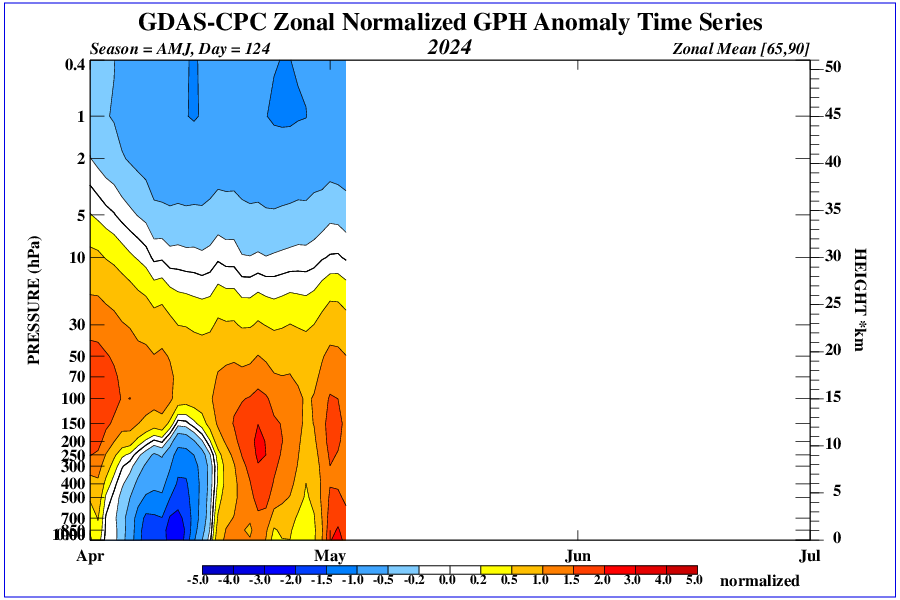
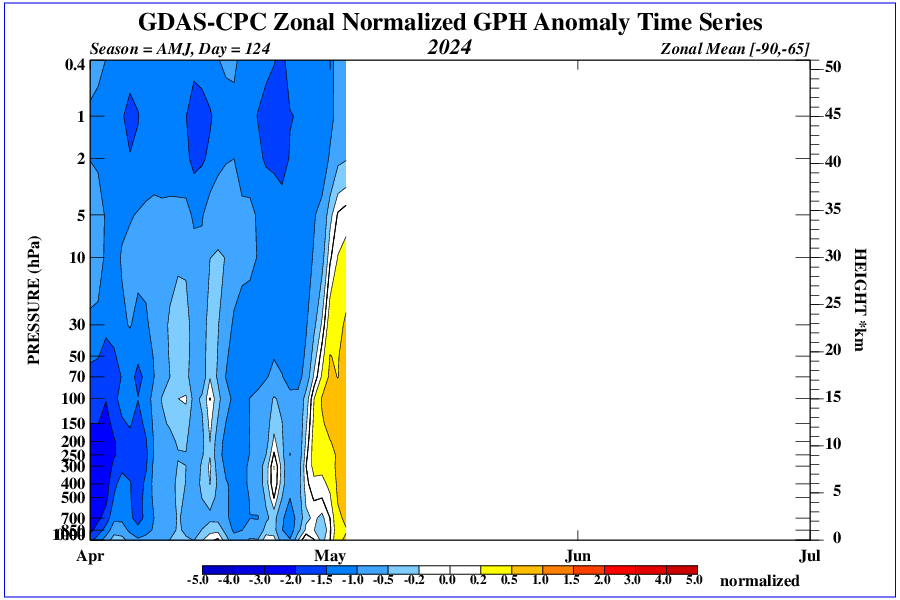

Second, what makes La Niña’s development possible? Strong easterly winds along the equator. This wind is driven by a strong polar vortex in the southern hemisphere.


Temperature changes in the Niño 1.2 region show how the strength of the southern polar vortex affects the development of La Niña. The Humoldt Current is, after all, a surface current.
NASA used to say the Sun was the primary force in Earth’s climate, but that was before they went political.
You can still see their old web page in the internet archive:
https://web.archive.org/web/20100416015231/https://science.nasa.gov/earth-science/big-questions/what-are-the-primary-causes-of-the-earth-system-variability/
The opening paragraph:
“The Sun is the primary forcing of Earth’s climate system. Sunlight warms our world. Sunlight drives atmospheric and oceanic circulation patterns. Sunlight powers the process of photosynthesis that plants need to grow. Sunlight causes convection which carries warmth and water vapor up into the sky where clouds form and bring rain. In short, the Sun drives almost every aspect of our world’s climate system and makes possible life as we know it.”
——
I have copied that web page to here as well:
https://juststopnetzero.com/ Just Stop Net Zero
“Other important forcings of Earth’s climate system include such “variables” as clouds, airborne particulate matter, and surface brightness. Each of these varying features of Earth’s environment has the capacity to exceed the warming influence of greenhouse gases and cause our world to cool. For example, increased cloudiness would give more shade to the surface while reflecting more sunlight back to space. Increased airborne particles (or “aerosols”) would scatter and reflect more sunlight back to space, thereby cooling the surface. Major volcanic eruptions (such as that of Mt. Pinatubo in 1992) can inject so much aerosol into the atmosphere that, as it spreads around the globe, it reduces sunlight and cause Earth to cool. Likewise, increasing the surface area of highly reflective surface types, such as ice sheets, reflects greater amounts of sunlight back to space and causes Earth to cool.
Now look at the temperature of the troposphere above the equator and the temperature near the surface. The surface is cooling.
Here and elsewhere I have been proposing a solar induced sequence of events which appears to continue to meet observations and which could have been mentioned in this article.
Some years ago I pointed out that the solar effect in the stratosphere is warming above the poles when the sun is quiet and cooling when the sun is active.
warming above the poles forces the polar tropopause down which squeezes surface polar air outwards across middle latitudes more often.
The inevitable increase in jet stream meridionality results in more clouds which reduces solar input to the oceans and skews the ENSO balance towards more La Ninas.The opposite when the sun is more active.
Many years ago it was found that the solar effect on ozone on the stratosphere varied between an increase over the poles when the sun is quiet and a decrease when the sun is active. It is ozone amounts in the stratosphere that control the height of the tropopause.
Therefore I proposed that changes in the mix of wavelengths and particles from the sun over the poles has an effect on the stratospheric ozone creation/ destruction balance.
That still seems to be a good explanation for observations.
Why does the circulation in high latitudes respond to changes in the strength of the solar wind? Because the distribution of ozone in the lower stratosphere responds to both the geomagnetic field and the magnetic field of the solar wind. During times of low solar activity, the geomagnetic field has a greater influence on ozone distribution. Ozone is diamagnetic.
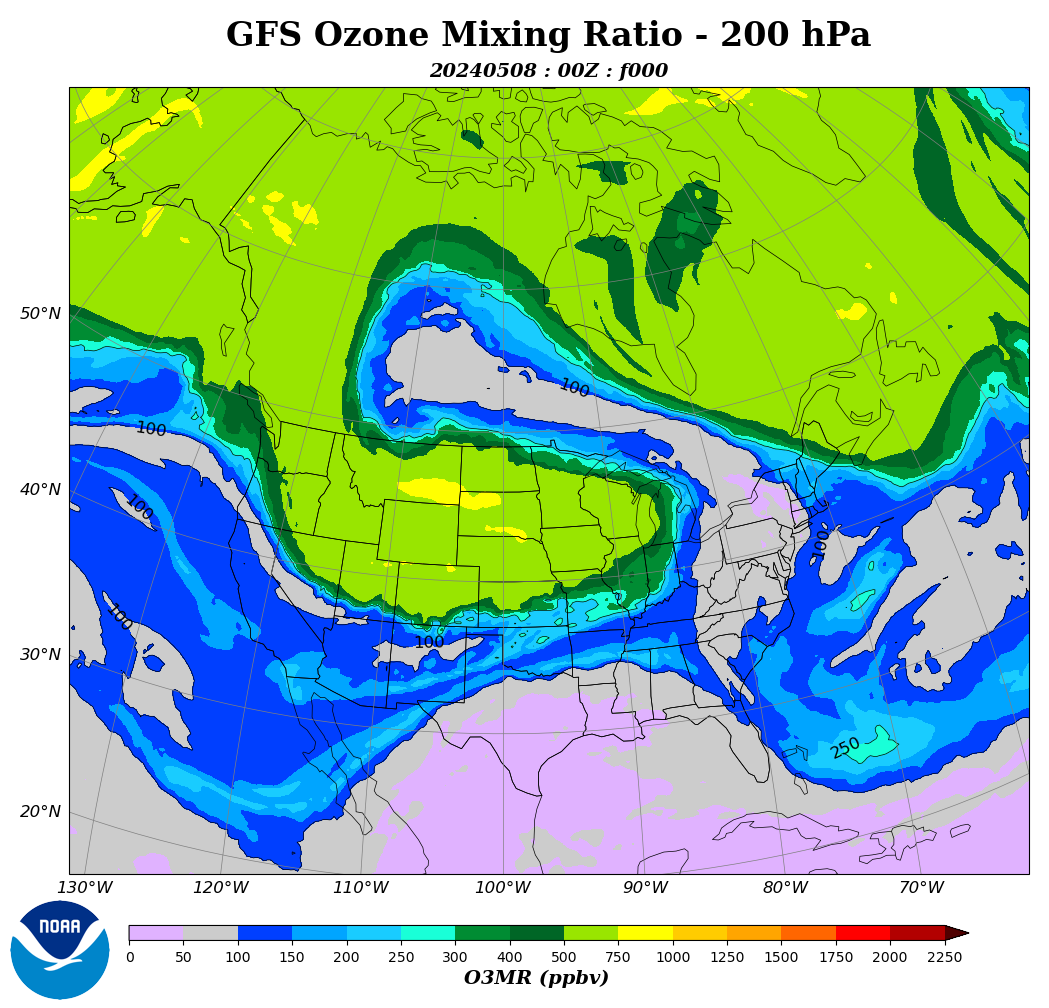
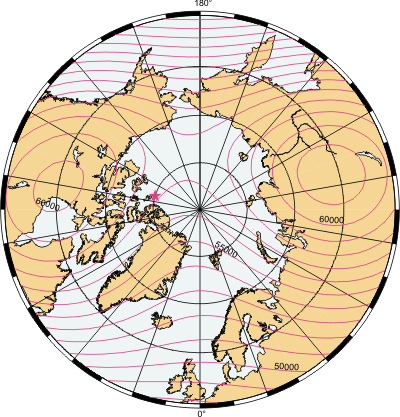
https://www.cpc.ncep.noaa.gov/products/stratosphere/strat_int/
The magnetic field of the solar wind strikes at high latitudes strikes as a wave, which I assume reaches deep into the Earth’s crust.
Everyone is totally ignoring the DROP in SO2 over the last few decades along with the drop in earths cloud cover! Sunlight at the surface has increased a couple of percent. Thats a lot of power, 5 W/m^-2 roughly. This data is well known, why is no one making the connection?
How much of a drop in cloud cover? Much of the planet is getting more rain. More rain should mean more clouds.
A decrease in cloud cover since the 1980’s accounts for all the warming since that time. No room for CO2.
You infer cloud cover is an independent variable, but what causes cloud changes?
No, I don’t. My next question would have been: What controls the number of clouds in the sky. Why would the percentage of clouds vary and how?
Is that “scientifically” documented? I’d presume that there should be excellent data. I’d like to look at it.
https://cds.climate.copernicus.eu/cdsapp#!/dataset/satellite-cloud-properties?tab=overview
It’s CERES data, Joseph.
https://wattsupwiththat.com/2024/05/13/modeling-the-mysteries/
“”The really important fact found in the Conclusions is:
The EEI trend is primarily associated with an increase in absorbed solar radiation (ASR) partially offset by an increase in OLR [Outgoing longwave radiation). … Large ASR trend primarily driven by reductions in low and middle clouds.
Let us emphasize this point. The increase in Earth’s Energy Imbalance (EEI; Trenberth’s “heating”) is due primarily to the increase in absorbed solar radiation—the difference between the sunlight incident upon the earth and the amount of reflected sunlight. Further, the solar irradiance (incident sunlight averaged over the spherical shape of the earth) increased only very slightly—from 340.14 W/m2 for 2000 to 2010 to 340.17 W/m2 for 2013-2023. The Loeb report clarifies that the change is due to the decrease in low and middle clouds.
In other words, the increase in EEI is due to a decrease in albedo (less reflected sunlight), contrary to IPCC’s calculations that always show an increase in albedo.
In yet other words, the heating of our planet that we’re seeing is not due to an increase in atmospheric CO2. This conclusion of the CERES project, which was designed expressly to determine the heat imbalance of the earth and its causes, has been ignored by “climate scientists,” investigative journalists, and politicians, and will continue to be ignored.
Still, this one fact rings the death knell of the “climate crisis.” Unequivocally, it says that the worries about CO2, “carbon pollution,” “carbon emissions,” and so forth are entirely misplaced. The one fact that the warming we are experiencing is due to changing albedo—NOT CO2—means that the UN’s COPs (Conferences of Parties), the IPCC’s Assessment Reports, the restrictions on coal, oil, and natural gas, and the belief that we help “save the climate” by killing our cattle are all based on sham science.”
end excerpt
Wow, complicated stuff. Yet, when I read anything in the MSM here in Wokeachusetts, they make it seem so simple. We drive our ICE cars, heat our homes with NG or oil, eat any meat or dairy products, buy any product where that industry used any FF to produce the product- and voila, we burn the planet and boil the oceans. The science is settled. /sarc
Increased surface insolation, especially over the oceans, would certainly magnify any solar change, which in itself would be enhanced by the “residence time” of energy entering the oceans, which is far far longer then the residence time of any minor driven CO2 back radiation. The sunlight entering the oceans can and does remain there for Decades, and thus a decadal increase in surface insolation can accumulate for Decades. Residence time is likely key.
There are only two ways to changes the energy content of a system in radiative balance, either a change in input, or a change in residence time of energy within the system.
Joseph Zorzin:
No, more rain does not require more clouds. In our current warming climate, just the opposite is true.
Cloud formation requires moisture nucleation sites, which are predominately SO2 aerosols, small droplets of Sulfuric Acid, which has a strong affinity for moisture..
Our climate is warming up because we are reducing the amount of industrial SO2 aerosols in our atmosphere, due to “Clean Air” and “Net Zero” activities.
As a result, there are fewer moisture nucleation sites, and thus fewer clouds..
With fewer clouds, there is more evaporation, and the atmosphere becomes heavily saturated with moisture, which it releases in torrents of rain in “Atmospheric rivers”, apparently randomly around the world. .
These discrete rivers are easily seen in satellite images of moisture in the air.
“This data is well known, why is no one making the connection?”
Good question. According to CERES data, the warming since the 1980’s corresponds with a decrease in cloud cover.
So how can CO2 add any noticeable warmth if cloud cover accounts for the current warming?
zzebowa:
Actually, the drop in SO2 levels is the CAUSE of our warming planet, NOT the increase of CO2 in our atmosphere.
In fact, it can be shown that CO2 has NO climatic effect.
https://doi.org/10.30574/wjarr.2024.21.3.0884
While TSI may change very little, the amount of other energy coming out of the Sun varies tremendously over a solar cycle. For example, how much energy came in on the last CME that sent auroras down into the tropics? The blast compressed the ionosphere and the magnetic input was profound. And on its final days as it left on the lower limb of the Sun, the sunspot group passed through the area that is connected to the Earth magnetically, flared and sent even more energy to us.
The Earth’s weather patterns are influenced by the electric connection to the Sun. Low and High pressure systems intensify which influences jet stream strength and location along with precipitation and cloud cover. There is an increase of Earth to sky lightening. How can this not be impactful to the overall climate?
And as the Earth’s magnetic field weakens, the influences will be even more profound. If you wonder why Bezos and his ilk are building underground shelters, this might be the reason.
“If you wonder why Bezos and his ilk are building underground shelters, this might be the reason.”
Maybe that’s why they are planning on building orbital habitats, too.
Arctic summertime temperatures should show a slight cooling trend if the sun’s output is a primary component for the state of Earth’s climate…
And it does.
Ocean and Ice Services | Danmarks Meteorologiske Institut (dmi.dk)
All that warming in the wintertime the last 25 years still well below freezing anyway while summer temperature is barely cooling.
One point overlooked by the stupid arctic amplification theoreticians is that winter in the Arctic has nothing to do with any radiative properties of the atmosphere.
Vinos’ ability to explain his theory in a way that can be grasped by someone with just undergrad physics is very impressive. Critiques that say “You didn’t consider this or that.” without an explanation I can comprehend do not impress me.
“The late 1960s and early 1970s, when many winters were cold. In the late 1970s and 1980s the winters were warmer.”
Here in the UK, I well, recall the 60s, & 70s, the ground was often frozen hard enough, that you couldn’t break it with a pickaxe. The canal often froze over, and scraping thick ice off windscreens was the norm. Where I live in the Pennines, it wouldn’t just snow on the hilltops, but also settle, quite thickly, in the valleys.
In the early 80s, I started travelling to work by train, and I recall (in 82) one morning in January, as I looked down from the train to the canal below thinking ‘the canal never freezes over now’.
Likewise, snow in the bottom of the valleys became scarce. I’d observed a rapid change in climate/weather conditions. Which fits the above comments.
In the late 90s, I moved into a house on the hilltops, about 300m above sea level. What I’ve observed since, is that we don’t get much snow at our level, and that there are ‘dustings’ at about 200m above us. But winters are wetter.
So I’m confused by the comment that winters since the late 90s have become colder.
Anybody, care to enlighten me please?
The UK is in the North Atlantic region. The main heat transport avenue to move heat to the Arctic. As specified the colder winters are occurring in eastern NorthAmerica and eastern Eurasia.
Check Figure 3h in:
[PDF] awi.de
Great article, Javier.
Can solar magnetic field strength variations explain any of this?
None of the many articles I read on the issue mentioned that possibility. They cited mantle movements, tidal forces, core changes, the Quasi-Biennial-Oscillation, El Niño, and a few more things, but not the interplanetary magnetic field we receive from the Sun. But I am not an expert on the issue. It is too complicated to be worth it becoming one.
My understanding is that extreme UV varies 20-30% through a solar cycle. Given that extreme uv is hte radiation that penetrates furthest into the sea’s depths, I would expect sea temp to vary with levels of extreme uv, probably with a lag.
Possible? Proveable?
Extreme UV doesn’t make it to the surface. The UV that reaches the ozone layer varies on average about 3%.
The Mg II data are derived from GOME (1995-2011), SCIAMACHY (2002-2012), GOME-2A (2007-present), and GOME-2B (2012-present). All three data sets as well as the Bremen Mg II composite data are available (see links below). In late years the GOME solar irradiance has degraded to about 20% of its value near 280 nm in 1995, so that the GOME data have become noisier. The most recent information on our Mg II data can be found in Snow et al. (2014).
https://www.iup.uni-bremen.de/gome/gomemgii.html
The decrease in temperature in the upper stratosphere shows a decrease in ozone and an increase in UVB radiation over the equator, as seen in the temperature of the troposphere over the equator, which contains a lot of water vapor.
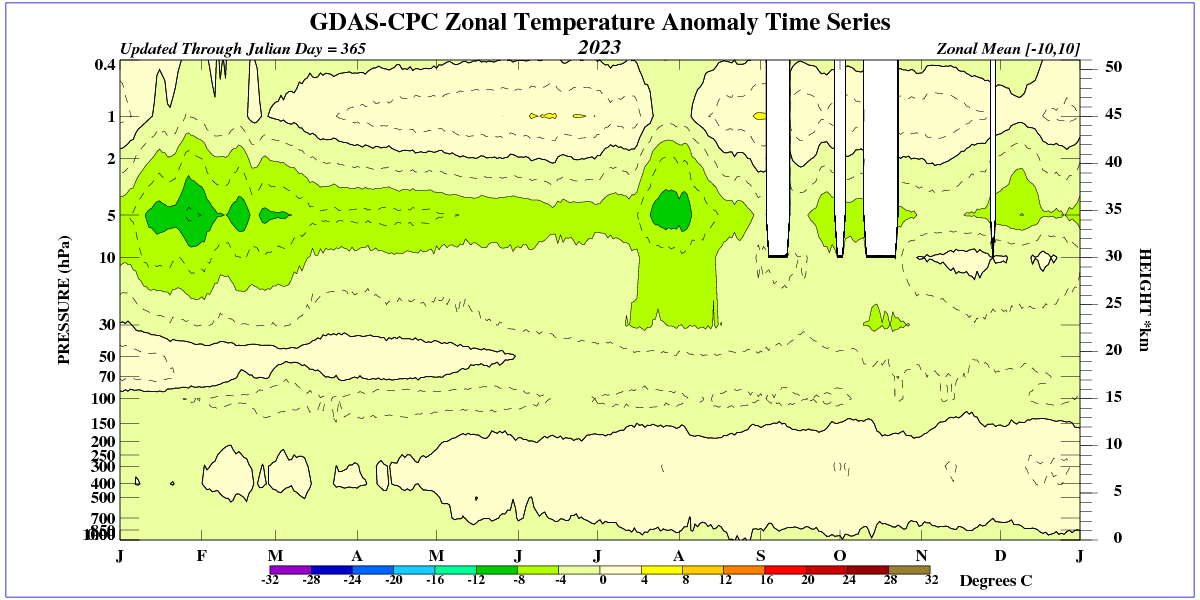
There are studies that show that the increase in UVB over the equator may contribute to the inhibition of easterly winds, due to the increase in the temperature of the troposphere (not near the surface).
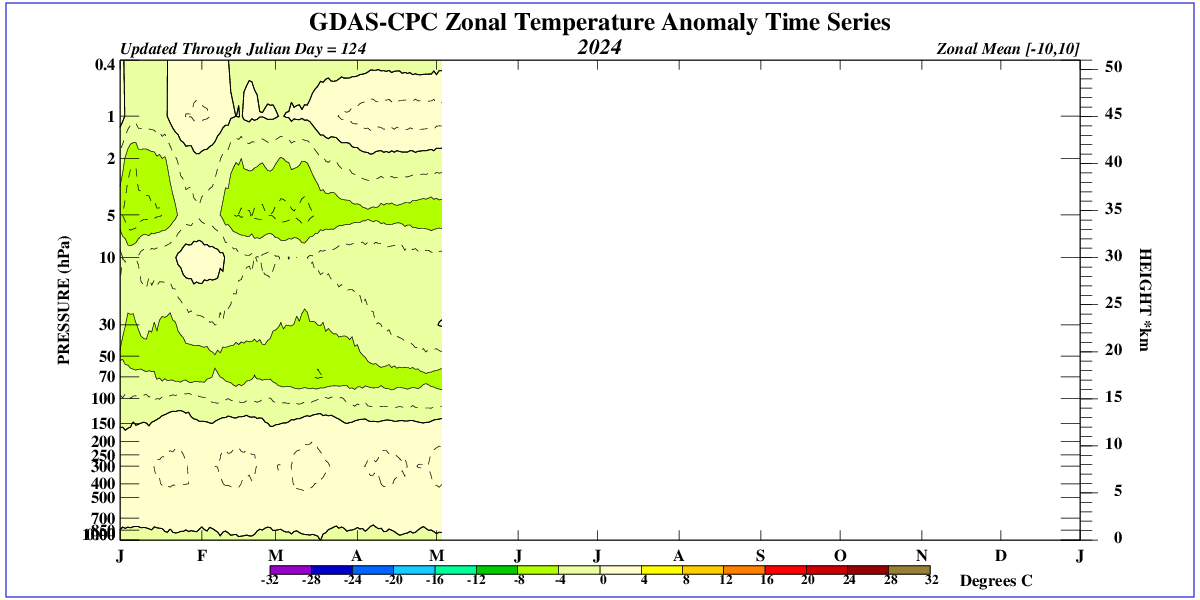
This year the situation is repeated due to the small number of strong solar flares in the 25th cycle.
Have you analyzed the flux in solar w/l (considerably greater then the TSI flux) and estimated the disparate ocean residence time of said solar w/l flux, which can vary and be decal in length. Thus a small change in w/l, could have a long time of accumulated energy within the oceans.
Perhaps too later a comment.
“The effect of the Sun on the rotation has been known for 60 years, and yet no explanation has been given.”
I Woudnt look for the 0.1% added solar warming signal directly per se for the answer. I would look at the change in the average diameter of the planet that would cause the amount of acceleration or deceleration observed. This would, of course, contain all causes, including solar heating.
You mention that cooling is the major factor and warming hardly an effect
at all. You could therefore use only the known rotational speed for notable cold periods and effectively filter out other causes by subtracting the rotational speed from warming periods.
The transfer of angular momentum between the atmosphere and the Earth is due to zonal wind draft with respect to the Earth’s rotation.
Thank You for putting me back on the rails, Javier. I misunderstood the mechanism. I always enjoy your novel perspectives.
.
I hope you just let your brain get ahead of your typing. Changes in solar energy flux are not the same over the entire surface of the earth…you need to figure in latitude, time of day, and season just for starters.