From NOT A LOT OF PEOPLE KNOW THAT
By Paul Homewood
h/t idau
There has been discussion of solar farm projects which include battery storage. (Battery Energy Storage Systems, or BESS).
The claims of the developers and renewable lobby is that storage will help to make intermittent renewables work.
By coincidence Timera have just published this update, which reveals it is nothing more than a money making ploy:

Impact of new balancing platform on GB BESS
Batteries create value from harvesting price volatility. The real time Balancing Mechanism (BM) has the most volatile prices in the GB market, yet battery (BESS) assets have captured limited BM value to date.
BESS BM value capture has historically been impacted by:
- Manual dispatch of flexible assets by the System Operator (ESO), disadvantaging smaller asset dispatch
- The 15 min rule where BESS bid offer acceptances are effectively limited to 15 mins of duration (given issues with the ESO’s visibility as to state of charge)
- Skip rates where the ESO has consistently chosen higher priced assets over BESS in the BM (reflecting issues 1. & 2. above, but also real constraints that the ESO faces in managing the system e.g. locational requirements to use thermal assets).
There has been significant progress in 2024 in addressing these factors with the introduction of the ESO’s new Open Balancing Platform and a relaxation of the 15 min rule.
In today’s article we look at the impact of these changes on BESS asset dispatch in the BM.
The rest is technical, but the key is this opening sentence:
Batteries create value from harvesting price volatility
As Timera note, the Balancing Mechanism (BM) has the most volatile prices in the GB market. This is because of the inherent unreliability of wind and solar power. When supplies are short, the Grid is forced to step in and buy up short term power supplies wherever it can get it.
Prices can obviously go sky high, and it is trading at these times where the battery storage operators can make a handsome return. These costs of course end up being added to consumer bills.
In short, solar/battery farms can make large profits from the very intermittency which they create.
None of these battery storage systems will solve the problem of how to store solar power in summer for use in winter, when generation falls to about 3% of capacity. Instead they are designed to store power during the day, to use at night.
The giant Project Fortress solar/BESS farm in Kent, mentioned by Ray Sanders, is rated at 373 MW, with 700 MWh of battery storage. That’s less than two hours’ worth.
“Batteries create value from harvesting price volatility”
Well, they do, but that hasn’t been their main benefit. In Australia, at least, they don’t make much money there because the volatility is too infrequent. They are, however, profitable and useful, with FCAS. As well as frequency control, they cover transitions from switching generators.
The ambition with solar systems is to overcome the diurnal variation. The two hours worth in Kent does that only partially, but adding two hours to the daily cycle is not nothing. More progress will be made.
“The ambition with solar systems is to overcome the diurnal variation.”
After which comes the battle against darkness.
No, that is the battle against darkness. And a two hour contribution is significant. Actually, it is more than two hours, because the solar plant will not be expected to deliver the 373 max possible MW, because then it would be recharging. A more likely outcome is a reasonably steady say 200 MW, with the battery extending that by 3.5 hurs.
Do you speak English, Nick? Or is tat ChatGPT?
His battery is running down
Thought processes getting confused
Money is no object batteries
Rube Goldberg engineering making a relatively simple grid overly complex.
But is all works on paper
All green dreams work on paper
Just not in reality
A round peg fits a square hole because the surface areas match precisely. That’s the theory of the far-left.
The problem is, they will make it fit no matter what destruction they cause.
That’s ideology.
Yes, when rationality vacates the thinking, ideology kicks in.
You have to work hard at rationality.
Ideology – not at all.
He needs more dedicated solar panels to recharge because recharging time is limited to between 10am and 2pm local. So by midnight, his battery is depleted until after 2pm when the recharging cycle is complete… unless of course the sun is attenuated by a cloudy day then he’s only half charged.
Isn’t Nick a retired climate modeller? His comments show he has very little grasp of engineering concepts. He just lives in an imaginary digital world.
Latitude?
Length of day?
Number of hours sun angle is too low?
Clouds?
Snow?
Dirt and dust?
For the last ten weeks in the UK, solar, has been delivering SFA.
At 20% capacity factor it’s more like 80 MW and 8 hours, all for replacing about 80 MW x 3%= 2.4 MW conventional sources.
Meanwhile one small modular reactor would last a long time, is reliable, doesn’t leave an almighty scar upon the land and doesn’t need massive abuse of green environments to link it to a grid. And when you compare like with like nuclear probably works out as one hell of a lot more value for money on all fronts including energy prices for consumers.
In one fell swoop nuclear deals with all the issues without the need to run up flags nest door to PV farms which are saying look how green and clever we are whilst expecting a huge ransom for doing so while the rest of us get piss poor as prices go ever upwards and value for money ever downward.
There is low appetite for visionary solutions like SMRs because the academic / political / bureaucracy / media classes all want and need to be seen to “DO SOMETHING NOW!” about the climate “crisis” boondoggle they have all vested heavily in creating.
Hopefully, we will live long enough to see a new Enlightenment where rationality prevails, and the (always) obvious solutions for utility-scale electricity generation, storage & distribution will be pursued and delivered.
Given the progression of DEI and Critical Race Theory through academia and much of the business community, it’s going to get much, much worse, before it starts to get better.
Yesterday a so called civil rights lawyer proposed that the solution to the crime problem was to redefine what is and isn’t a crime.
Another Democrat in CA has introduced a bill to raise the minimum wage to $50/hr.
Imagine that, everyone in the country is making over $100,000 a year. We’ll all be rich. /sarc
Another Democrat in CA has introduced a bill to raise the minimum wage to $50/hr.
I kinda hope it passes, let’s see what heppens. Only problem is the people who would leave CA as a result and not change their voting habits. (it’s enough of a problem already)
(That IS a STATE proposal, right?)
At what cost?
For example, how much would the batteries cost to keep, say, the Greater London Area going for a week without power cuts?
For much of the year those batteries sit idle, but still must be paid for. Just like the wind turbines and solar panels when they are idle.
There is only a 15 to 20 year payback opportunity before they need to be replaced as well. Then there’s disposal/recycling which also must be paid for. As we know, that’s not easy or cheap either.
https://www.manhattancontrarian.com/blog/2022-1-31-more-focus-on-the-impossible-costs-of-a-fully-windsolarbattery-energy-system?rq=battery%20cost
“For example, how much would the batteries cost to keep, say, the Greater London Area going for a week without power cuts?”
That is a different problem. The one discussed here, by Timera, is that of extending the daily output time of solar farms. There the batteries are used every day. The Timera report is upbeat about their utility.
You didn’t answer the question of cost.
My post was only an example of large scale battery deployment.
Of course it is. As was that of Arrival van makers so comically skewered by Chris Moncton in an earlier article, until they went tits up.
As was that of Britishvolt. As was that of GM with their partnership with Honda to make EV’s, until they abandoned it. The Ford Lightning pickup is another flop. Hertz and Polestar are yet more evidence of the failures of sticking batteries in everything because dumb politicians can be scammed into thinking that if their vacuum cleaner can be run on batteries, so can everything else.
Then there’s the financial disasters of Orstead and Siemens. Hardly surprising when they won’t bid for contracts because their wind is unaffordable even with the incentives of Biden’s insane Inflation Reduction Act.
Great idea. Print money to stop inflation…….
If the batteries are charged to 100% and discharged to 0% every day, they won’t last long either.
Yep. One of the other problems is they can’t be discharged below 20% or above 80% so, like wind turbine nameplate values, their claims or capacity are nonsense.
Knock 40% off everything they claim.
If the batteries are used every day, they aren’t going to be providing anywhere near 700MWh since the solar is only going to produce up to about 100 MWh per day given a 373MW name plate capacity and an optimistic 25% capacity factor ( a lot less in winter). Where is the energy going to come from to recharge those batteries?
Gaslighter Nick.
But the solar farms output wouldn’t necessarily be extended with batteries, just shifted. The batteries would require a dedicated array of panels in order to recharge daily…sufficient to allow total recharging in just 4 hours when solar is most effective. The solar farm would produce little usable output into the grid because of battery recharging demand.
How much of the solar array would be available for grid use from 10 – 2 if the batteries need it for recharging?
How much additional panels would be needed to recharge what should be (700MWh = 2 hours…16 hours (no solar production)) 5600MWh of storage?
This would be the only way to extend solar and not just shift it to later in the day, when natural production diminishes
“The Timera report is upbeat about their utility.”
Wait, so you are saying that people participating in the greatest grift of all time are enthusiastic about the whole thing? @ur momisugly@._V1_SY1000_CR006621000_AL_.jpg' />
@ur momisugly@._V1_SY1000_CR006621000_AL_.jpg'>
You forgot the tag-line –
“OH, REALLY?”
You’ve not read the Timera article, which is about the benefits of batteries gaining better access to the price volatility in the Balancing Mechanism, which is the only time dispatch is organised by the Grid control room in the GB system. It has nothing to say about solar at all.The word doesn;t even apper in the article.
It is just about making money from a battery purchase by injecting the battery output into the gird system at the times consumers will have to pay the most for it, no?
It’s also about being able to buy up output that would have been curtailed at a cost to consumers in subsidy. The Balancing Mechanism is supposed to operate to adjust grid operation to ensure that supply and demand are kept in balance without overloading grid connections – so geography counts too – with any changes to operation being at lowest cost within the constraints of safe operation. Prices can swing wildly depending on whether there is a surplus or deficit, and which generators are best placed to solve it (here including batteries potentially, although many have been excluded for being too small and fiddly to bother with when there’s a major problem to solve).
Renewables generators look for compensation for loss of subsidy if they are asked to curtail, while a gas generator may offer to reduce output for little more than the lost profit, given fuel savings. A renewables generator is unlikely to have the option to increase output, but a gas generator not already at capacity can do so, perhaps with added costs for warming up if it is not operating. Batteries need to be able to cover their round trip losses in what they do, and be mindful of better opportunities that they may exclude themselves from by charging or discharging for the immediate circumstances: it becomes quite a complex guessing game to try to optimise them, and sometimes they get it wrong because things turn out not as forecast.
No, but it is the bolded first line of Paul’s article. And yes, I agree, Timera was about generic BESS.
The capitol cost of batteries is about $250 per kWh storage, and typical full cycle available about 1,000 cycles, so cost per kWh delivered is about $0.25 per delivered kWh (this is in addition to capitol cost of the solar farm amortized). The cost of 200,000 MWh storage is then $5 billion, not $50 billion.
$250 per kwh for the battery, plus another $250 per kwh for the rest of the packet including enclosure, over current protection, switch gear, fire suppression and more.
The 2023 capital costs and cost/kWh of throughput for this battery system analysis was based on Tesla Megapacks, which are among the lower cost systems, because of mass production.
BATTERY SYSTEM CAPITAL COSTS, OPERATING COSTS, ENERGY LOSSES, AND AGING
https://www.windtaskforce.org/profiles/blogs/battery-system-capital-costs-losses-and-aging
EXCERPT
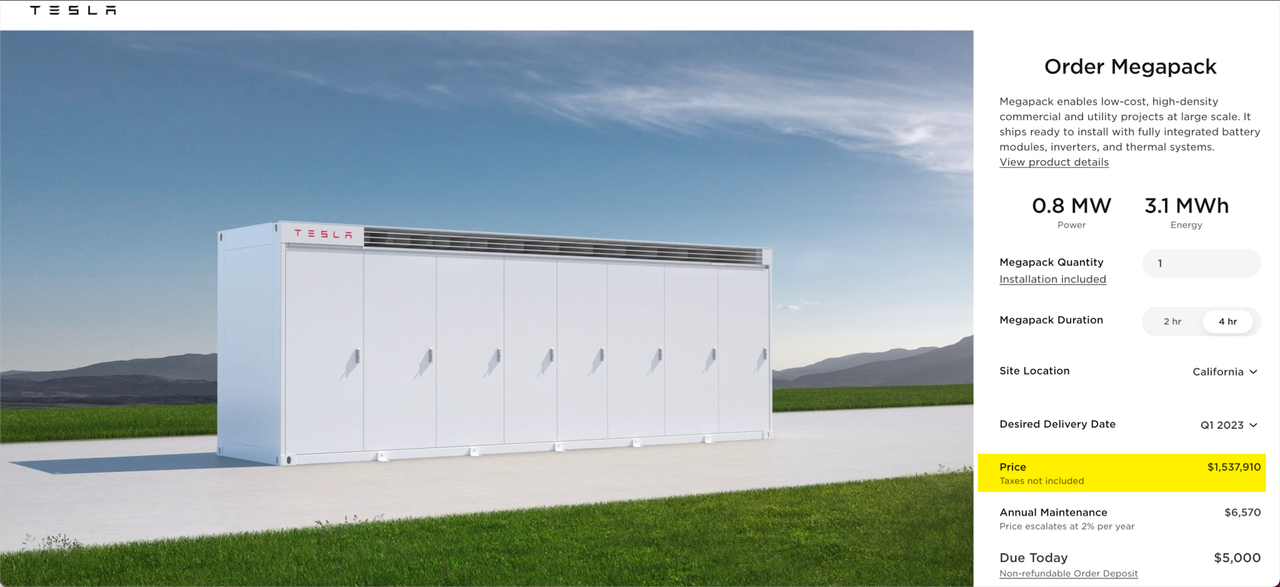
Example of Turnkey Cost of Large-Scale, Megapack Battery System, 2023 pricing
 ?itok=lxTa2SlF
The system consists of 50 Megapack 2, rated 45.3 MW/181.9 MWh, 4-h energy delivery
Power = 50 Megapacks x 0.979 MW x 0.926, Tesla design factor = 45.3 MW
Energy = 50 Megapacks x 3.916 MWh x 0.929, Tesla design factor = 181.9 MWh
Estimate of supply by Tesla, $90 million, or $495/kWh. See URL
Estimate of supply by Others, $14.5 million, or $80/kWh
All-in, turnkey cost about $575/kWh; 2023 pricing
https://www.tesla.com/megapack/design
https://www.zerohedge.com/commodities/tesla-hikes-megapack-prices-commodity-inflation-soars
Annual Cost of Megapack Battery Systems; 2023 pricing
Assume a system rated 45.3 MW/181.9 MWh, and an all-in turnkey cost of $104.5 million, per Example 2
Amortize bank loan for 50% of $104.5 million at 6.5%/y for 15 years, $5.484 million/y
Pay Owner return of 50% of $104.5 million at 10%/y for 15 years, $6.765 million/y (10% due to high inflation)
Lifetime (Bank + Owner) payments 15 x (5.484 + 6.765) = $183.7 million
Assume battery daily usage for 15 years at 10%, and loss factor = 1/(0.9 *0.9)
Battery lifetime output = 15 y x 365 d/y x 181.9 MWh x 0.1, usage x 1000 kWh/MWh = 99,590,250 kWh to HV grid; 122,950,926 kWh from HV grid; 233,606,676 kWh loss
(Bank + Owner) payments, $183.7 million / 99,590,250 kWh = 184.5 c/kWh
Less 50% subsidies (ITC, depreciation in 5 years, deduction of interest on borrowed funds) is 92.3c/kWh
At 10% usage, (Bank + Owner) cost, 92.3 c/kWh
At 40% usage, (Bank + Owner) cost, 23.1 c/kWh
Excluded costs/kWh: 1) O&M; 2) system aging, 1.5%/y, 3) 19% HV grid-to-HV grid loss, 3) grid extension/reinforcement to connect battery systems, 5) downtime of parts of the system, 6) decommissioning in year 15, i.e., disassembly, reprocessing and storing at hazardous waste sites. The excluded costs add at least 10 – 15 c/kWh
NOTE: The 40% throughput is close to Tesla’s recommendation of 60% maximum throughput, i.e., not charging above 80% full and not discharging below 20% full, to achieve a 15-y life, with normal aging
NOTE: Tesla’s recommendation was not heeded by the owners of the Hornsdale Power Reserve in Australia. They added Megapacks to offset rapid aging of the original system, and added more Megapacks to increase the rating of the expanded system.
http://www.windtaskforce.org/profiles/blogs/the-hornsdale-power-reserve-largest-battery-system-in-australia
COMMENTS ON CALCULATION
Regarding any project, the bank and the owner have to be paid, no matter what.
Therefore, I amortized the bank loan and the owner’s investment
If you divide the total of the payments over 15 years by the throughput during 15 years, you get the cost per kWh, as shown.
According to EIA annual reports, almost all battery systems have throughputs less than 10%. I chose 10% for calculations.
A few battery systems have higher throughputs, if they are used to absorb midday solar and discharge it during peak hour periods of late-afternoon/early-evening.
They may reach up to 40% throughput. I chose 40% for calculations
Remember, you have to draw about 50 units from the HV grid to deliver about 40 units to the HV grid, because of a-to-z system losses. That gets worse with aging.
A lot of people do not like these c/kWh numbers, because they have been repeatedly told by self-serving folks, battery Nirvana is just around the corner, which is a load of crap.
NOTE 1: Aerial photos of large-scale battery systems with many Megapacks, show many items of equipment, other than the Tesla supply, such as step-down/step-up transformers, switchgear, connections to the grid, land, access roads, fencing, security, site lighting, i.e., the cost of the Tesla supply is only one part of the battery system cost at a site.
NOTE 2: Battery system turnkey capital costs and electricity storage costs likely will be much higher in 2023 and future years, than in 2021 and earlier years, due to: 1) increased inflation rates, 2) increased interest rates, 3) supply chain disruptions, which delay projects and increase costs, 4) increased energy prices, such as of oil, gas, coal, electricity, etc., 5) increased materials prices, such as of tungsten, cobalt, lithium, copper, manganese, etc., 6) increased labor rates.
NOTE 3: If a 24-h system is desired, each parallel train would have 10 units x 4 h/unit x 0.6, Tesla limit = 24 hours
Ten, 4-h Megapacks, in series, would be required!!
Above example would have 50 x 6 = 300 Megapacks.
Tesla design factors would apply. See article
I don’t understand how you derived your financial calculations. The bank loan is understandable, but doesn’t the owner reap all the rewards, not just 10% on the money he put in? Who gets what is left over? You should use the revenue minus cost of revenue (which includes payment to the bank) discounted at the cost of capital to determine the owner’s profit.
while that doesn’t say either, or even anything at all that is intelligible, there are two inferences one might make if attempting to make up for its deficiencies:
London + Paris = something
London is the equal of Paris in something
Nick,
How does a battery provide frequency stability to the grid? If you look at just VIC, (approximately a quarter of the AEMO coverage area), with a demand in the range of 8,000 MW and the big Victorian battery with a capability of 300 MW.
Frequency control is required due to variations in the demand, when demand goes up, frequency goes down.
Now imagine a typical evening period where the grid demand bounced up 5% during a not unusual 5 minute billing period. In the real world, AEMO use a LARGE generator in frequency control mode. In reality, it means that the large generator has to leave some capacity unused. AEMO pay a premium for this service to cover the holding back.
The extra demand during that 5 minutes is matched as the LARGE generator ramps up to cover it. Also, if the demand dropped, the generator would reduce production and keep the frequency aligned to the target.
So let’s look at Vic, 8000MW demand, 5% is 400MW. Since the demand can vary up AND down, the generator is required to absorb a variation of PLUS AND/OR MINUS the variation. That would be a span of 800 MW.
How is that big battery, (with a capability of 300 MW), going to deliver, (800 MW), more than its design limits? It doesn’t. Never has, never will.
It might be time for you to change foot. Let me know if you need additional help on engineering issues.
Nick is another example of a far-left ideologue. It should work, so it must be made to work, and hang the cost, it’s only taxpayers money after all.
“How does a battery provide frequency stability to the grid?”
Well, the first answer is that they do, which is why they have been so profitable, and sprouting like weeds. In the past, the energy reserve that kept ferequency constant was in the spinning flywheels. Batteries have a lot more stored energy than flywheels. You speak of a fluctuation of 5 mins, but frequency control is in the milliseconds range. The batteries don’t have to take over the whole 8 GW. They have to supply the power needed to get the 49.9Hz (say) back to 50,
Here is the AEMO in 2020 (PFR=Primary Frequency Response):
“Today, utility-scale batteries, wind farms, solar farms, and VPPs can contribute to supporting frequency through PFR. Batteries, wind farms, and VPPs now make up a portion of the FCAS provider pool. AS/NZS 4777.2 (the standard for small-scale inverters) already specifies a frequency response from DER. Expansion of the frequency response requirements on these small-scale devices is currently under review. “
Batteries add stability for base load type use where small variations are smoothed out. However they are progressively less able to compensate for long variations unless they are huge systems, and cost per kWh delivered from them can be very high. The large day/night cycle also requires large depth of cycles which shortens battery total full cycle life. A 20% cycle use can make a battery last 5,000 equivalent full cycles (5,000 kWh per kWh battery size over battery life), while an 80% cycle use lasts only about 1000 equivalent full cycles (1,000 kWh delivered over battery life).
And you know this to be true, how exactly?
That’s what he is paid to believe.
How does the sun shine?
Because it does
I don’t pretend to know but I can imagine a possibility, assuming the electronics can respond quickly enough, without dangerous overshoots:
the battery outputs DC.
a converter circuit (extremely common in today’s world) produces AC from that DC. For this application, tolerances must be tight
the produced AC is what is presented to the grid
possibly that AC is not the grid frequency but is the difference between the desired grid frequency and the actual adverse grid frequency of the moment
This doesn’t say the process is not more expensive than what has been conventional mechanisms but does seem possible. DC to AC Inverters have been around for quite some while.
Electronics can do that at a cost. Look up Uninterruptible power supplies. I have a small one on my computer that cost a few hundred dollars and will keep the computer up for around 20 minutes. The power glitches when the power company switches stuff around. Normally you might see a quick flicker in the lights but it wouldn’t affect a computer. My computer isn’t normal as it’s running at 100% and there isn’t enough reserve in the power supply to ride through a glitch. With the UPS my computer is rock solid and only gets power cycled when it needs a software upgrade. The ability to do this has been available for years, but it’s costly to use on anything that isn’t critical.
Funny things is once every year or two the power company replaces my smart meter as the heat tends to destroy them. I will come home and find the clocks flashing but the computer didn’t notice.
The down side is it uses lead acid batteries and they need to be replaced about every 6 years.
I live out in the desert, at the end of a power distribution grid, nothing connected much beyond here. There are power outages every once in a while. We are told that most are from causes well outside the local power companies jurisdiction, there is nothing they can do. Many last less than a second, sometimes too short a time to effect the electric clocks on the stove, microwave oven, etc.
The computer has a supposedly fairy heavy surge protector but that doesn’t keep the computer on. It dies every time. but so far has always rebooted on demand.
I have a theory that the battery regulator is a major factor in lead-acid battery failure. In every car I had before, it didn’t matter whether I purchased the cheapest battery or the most expensive, they all lasted 3 years. That provided some partial discount on the next battery when I purchase ones with longer warranties.
However, the present car is a Toyota. Its original battery lasted 11 years. The replacement, from Walmart, lasted a bit over 9 years. I suspect it is the automobile system rather than battery technology that has improved.
There are several things that take the battery out early. Higher than normal float voltage boils the battery out. The fact that the charge is always present unlike autos were they charge only when the engine is running. Occasionally the battery deep discharges during a long power outage as oppose to cars where the discharge only last a few seconds. Heat can also age the battery and the UPS may keep the battery warm consistently.
Last but not least is the type of battery. Starting batteries are intended for short dischargers where as deep cycle are designed to withstand near full discharges. Starting batteries could be designed to have some of the features of deep discharge without losing much of what they need to do their job.
I had a 61 and 62 falcon years ago with a big battery tray. When it needs a battery, I would buy the biggest battery that would fit in the tray. The batteries held up pretty well. On the other hand, there is a company on Orange County California that sells a battery called Powertron. They would last over 6 years in applications where I was lucky to get 4. Last, we swapped a battery in a Dodge Ram pickup which was a Mopar battery. The date code indicated it was 7 years old.
Something made the batteries last 3 to 4 times as long as in all previously owned automobiles. I don’t think it was a difference in the basic automobile operation operation, it almost certainly had to be something in the electrical system thereof.
‘has’ rather than ‘had’ as the system is hopefully still operating as well as it seems to be operating.
Most converters are set up to be a frequency follower. That is they match the phase and frequency of the line they are dumping power into.
Nick,
Wrong again. As above, for an energy supplier to provide frequency control it has to have head room, both up and down. To do this you need to have power reserves, batteries are not big enough to do this, they just can’t pull the grid with them.
WRT the short term issues, you have to be kidding. A large, (eg coal), generator also has a large inertia element, let’s call it the conservation of circular momentum. It allows a large spinning mass to provide the short term energy required to source or sink variations in the synchronous current. Batteries do not have this. At best they can have a precise crystal locked frequency control that they drive incessantly toward, and of course, if they were the only provider of the grid power, (think off grid house supply), then it works. BUT if you lock a large battery to a fixed clock and the REAL frequency control generator, (think large coal fired unit), drifts say 180 degrees over 10 cycles, due to a line short. Then that battery is now LOCKED, out sync and is a LOAD on the system not a supplier.
Nick, if you don’t know how things works, just admit it, read up and learn, it’ll make you a better person. It looks to me like you are relying on a press releases from the battery company for your info, you really need to critically review them and accept that you should have asked some questions before accepting their BS. Even basic, year 10 maths or physics is enough to find the holes in their story.
Batteries are not frequency control on a large grid, they just don’t have the grunt to pull the rest along for the ride.
“Batteries are not frequency control on a large grid”
Well, I could continue trying to explain how they do it. But for foolish statements like this, my first answer is sufficient. They do. Here is from the AEMO 2023 Q4 report:
“Batteries continued to be the dominant technology providing FCAS, with a market share of 50% (Figure 68), increasing from their 40% volume share in Q3 2023 and 38% in Q4 2022. This increase was driven by both the new very fast FCAS service and from construction and full commissioning of new batteries, with growth since Q3 2023 led by increased provision from Hazelwood (+163 MW), Riverina (+125 MW) and Torrens Island (+84 MW).”
And you never asked how. They do NOT have the capacity to do it. Never have, never will.
Your quote says nothing about frequency stability. It talks about market share. That would be financial, not electric.
Here’s another quote from that document you might like.
“black coal remained the most frequent price setter in New South Wales with 49% of prices set.”
I was responding to the bald statement
“Batteries are not frequency control on a large grid”
The grid authority is not spending 50% of its frequency control budget on something that cannot work.
NSW currently gets 70% of its electricity from coal. It is not surprising that in 49% of time slots it will be the price setter.
FCAS = Frequency Control Ancillary Services. Nothing to do with finances. But I agree with you that it’s difficult to see how batteries with only a few minutes of power reserve for part of the grid can do much to stabilize the frequency – and the grid was stable for a century without batteries, wind turbines, or solar cells.
The part of the document he quoted mentioned FCAS but they were talking about market share and revenue. Nick didn’t notice that the revenue was down for this year.
He seems to have forgotten the 100+ year history of electric utilities somehow managing to keep the AC frequency constant without giant batteries and converter electronics.
Frequency control is not in the millisecond range for batteries (and is “instantaneous” for natural inertia, because that’s just physics). Part of the reason for the delay is to avoid creating unstable behaviour, and is akin to the droop characteristic applied to generators for the same reason. Part allows for delays in frequency measurement, which are of the order of 0.1-0.2 seconds.
Grids with high levels of fossil fuel generation have inertia of the order of 10 seconds of the level of grid demand. So if demand is running at 30GW, inertia is 300GVAs. Grids with high levels of renewables have low levels of inertia – National Grid is hoping to be able to run at no more than 2-3 seconds of inertia (though whether they still have confidence in that I don’t know – they came very close to a blackout on 22nd December, and they still ain’t saying what happened to let frequency drop to 49.275Hz, but the batteries seem to have failed to act properly, just as they did in VIctoria on 13th February). With high levels of inertia, the rate at which frequency changes (RoCoF) is much slower for a given change in the supply/demand balance, and that gives more time to respond. The level of generation can be adjusted to compensate over a few seconds, mostly by governor control. In more severe incidents, spinning reserve would be called on – e.g. the dispatch of Dinorwig pumped storage in response to the 22nd December incident in the UK.
Batteries can respond rapidly, and provided they are adequately charged, they could maintain maximum output for some minutes while other fast start generation is brought on line. On Feb 13th in Victoria, it seems they did respond to the early loss of the Stockyard Hill wind farm, but then failed to do much when there was the big cascading trip of Loy Yang and wind and solar at 13:10AEST. So there were blackouts instead.
Here’s the the specification for battery response under Dynamic Containment, the main National Grid frequency control contract for batteries. In theory, if called on they are supposed to maintain 100% of charge/discharge for 15 minutes per event rated at +/-0.5Hz or higher.
If, for no good reason whatsoever, I destroy the price system, Nick, and then come up with a solution to the immeasurable downside I created by destroying that truly public-good — even if my solution works — then have I actually done a service to mankind?
does your solution work as well or better, at a lower cost?
Never forget that this is the guy who thinks steel production worldwide can be converted to “green hydrogen” steel, and that this is a good idea.
Nick,
Could you comment on the following:
Although the added 2 hrs may be, as you say, not nothing, doesn’t that come at the additional cost of overbuilding the primary wind and solar source to charge the batteries. Batteries only store energy which must be generated somewhere else.
Although progress will indeed be made, can you point to something in battery development that will do more than quibble over 2 hrs vs 3.5 hrs? And how do you get around the problem of more batteries mean more overbuilding which seems like a cycle of ever increasing cost.
Unless you know of significant and real progress in battery technology, “more progress will be made” seems more like wishful thinking or gambling that engineering or economics.
I think he means “progress will be made” in the direction of making our utility electrical power simultaneously both less reliable and more expensive.
Please don’t encourage Nick or other ‘polymaths’ to depart from their initial qualifications lanes (e.g – fluid dynamics).
We are now seeing “climate scientists” not only self-declaring expert status in chemistry, meteorology, atmospheric physics, instrumental technology, geology, biology, electrical engineering, and many other ‘ologies’.
And of late, they’re also buying into PTSD psychology on account of “climate trauma”.
Annnd – they’re also preparing their next foray into “climate-caused virus pandemics”.
I can’t wait.
There is a movie called “Changing Lanes” that stars my personal favorite actor Samuel L. Jackson.
https://www.imdb.com/title/tt0264472/
It’s basically about two blokes who just have to assert that they are each right in their positions, no matter what others tell them.
Some of the spiel for “Changing Lanes” is instructive for self-declared, lane-changing climate “experts” –
. . . given the volatile nature of these individuals, it seems inevitable that one or both will blame the other for their problems and seek to strike back at the other to get revenge. This may sound immature and childish, but it is also frighteningly believable.
“overbuilding the primary wind and solar source to charge the batteries”
We have always overbuilt generators, of all kinds. Enough are needed to meet the combined annual and diurnal peak demand. So we have about twice as much generating capacity as average demand.
The difference is that with storage, generators can do something useful when demand drops.
Except we no longer have anywhere near as much spare dispatchable supply as we used to.
That is totally down to the anti-CO2 wind and solar idiocy.
And there is absolutely no doubt, that at some stage, it will come back to bite us.. hard !!
They make money solving a problem that didn’t exist until wind and solar came on line.
Mr Stokes,
I’m confused – how does a battery, a DC device, help with frequency control?
Its inverter to AC has to retune to changes in grid frequency (so as not to create instability by adding out of phase power), and its output is modulated in proportion to deviations in frequency from the target. Frequency deviations represent imbalances in supply and demand, so the battery tries to compensate for those by injecting extra power or charging up to withdraw a surplus (e.g. from a local wind gust at the nearby wind farm).
A simple inverter just sees the instantaneous phase of the power and adds to it from the DC source. It does not know if the phase it is measuring is lagging behind the large generators or not. In short, it is a near useless contributor to grid stability, if the grid frequency slows, so does the inverter.
If you want to use a large inverter for phase and frequency control, then you lock it to a crystal stabiised clock and and generate the voltage as prescribed by the clock and NOT the connected grid.
Of course, since the grid is much, much bigger than the inverter, the clock stabilised inverter quickly goes out of sync, it then releases the blue smoke and you then run off and buy a new one.
And that’s why you don’t use a clock locked inverter. At best you could program it to interpret the phase of the grid and to generate 5 degrees in advance of it. This will produce leading power, something the grid could use but it will always be a guess to whether the angle should be degrees, ten or even a slight negative.
And of course, if you are supplying out of phase power, you are not going to get paid for it as only the Watts are payable not the VAR. And if you aren’t going to get paid….. why do it?
A simple inverter can be part of a frequency control scheme as real power (not reactive power) versus demand is what controls the frequency. The problem is trying orchestrate control of all the simple inverters. Shifting the phase of the inverter with respect to the phase of the line will source reactive power if the inverter phase leads and and a lagging phase will sink reactive power.
Grids often pay for MVar to correct power factors, and charge for installing Statcoms that help with that too.
Grid batteries are always going to be 3 phase connected (unless something goes wrong). I already posted the time envelope for response for Dynamic Containment. Here’s the required power response for frequency deviations, designed to try to keep the grid reasonably stable.
Nick, I respectfully suggest that this as a classic case of –
ambition exceeding ability
which we see so often these days in demonstrations of irrationality in public policy-making.
(All with taxpayers’ money of course).
I think the Dunning-Kruger effect is in play due to the lack of competency.
IoW:
One green solution is equal to 10 new problems created.
This is “Never Let A Crisis Go To Waste” turned into a self-licking ice-cream cone. There actually was no problem (crisis) to exploit, so the Lunatic Left has gone about creating one.
So, for yet another bonkers green idea my question – as a taxpayer etc etc – is how much is this idiocy going to cost me and my fellow citizens before they throw in the towel?
Reality check for the loons in SW1A 1AA
Great album…..
Band makes good, singer dumps band.
How many times have we heard that one!
Yep, he turned into a sleazy lounge lizard.
“my question – as a taxpayer etc etc – is how much is this idiocy going to cost me and my fellow citizens before they throw in the towel?”
How many arms and legs do you have?
Just the two….
Not enough…
As does pumped hydro storage, which was historically build to counter the inability of brown coal and nuclear plants to load-follow economically.
Nothing new under the sun.
Would that be the Sun that has no bearing on climate change? Or to quote the, er, consensus
“”The sun is mighty, but modern climate change is caused by human activity | Fact check”
https://eu.usatoday.com/story/news/factcheck/2024/02/15/sun-impact-global-warming-climate-change-fact-check/72600226007/
You have to laugh, they believe such utter nonsense.
OFF TOPIC!
This may be my last post. I am unable to login to the new site.
Fortunately I am still logged in on this computer.
The site may have been hacked,Or else there is a programmer who is rubbish or a criminal being employed
https://wattsupwiththat.com/login/
test
“Price volatility”
Is a product of an insecure and intermittent supply – that has to be backed up, constantly.
A product of the policies that create carbon taxes and makes otherwise cheap energy much less affordable – especially in Europe and the UK.
It was all quite normal before the unreliables craze took hold – at any cost, too..
One must wonder about the logic, even the green logic, justifying building these aggregated battery systems. These are net-negative in life-cycle ‘carbon footprint’, unstable and berluddy expensive. They’d never even get a second read by the investor community if not for the subsidy pond that sustains this sort of life form.
Britain’s Electrical prospects
“”French firm EDF confirmed that the new nuke at Hinkley Point won’t be ready any time this decade (Eye 1615), with Sizewell C an even more distant prospect. “Small modular reactors” are nowhere in sight, so the nuclear fleet will disappoint Labour’s assumptions for 2030, leaving a big gap in reliable electricity generation.
Intermittent wind power cannot fully make up for this, and Labour now pins hope on further extending the lives of already cracked existing nukes, with imports for back-up. Neither can be solidly relied upon for 2030 and beyond.
Old nukes can give up the ghost at short notice. Periods of low wind generation across the whole of northern Europe happen for around 13 percent of the year; and hydro-powered Norway, the biggest electricity exporter, has had enough of being relied on as an unlimited back-up. All this means greater demands on the green budget, plus relying on gas far beyond 2030.
Price pinch
Finally, hope that Miliband’s electricity will be cheaper has been dashed. No new source of green electricity, from wind to tidal power, is on offer at or below today’s wholesale price: many demand more than twice as much, some up to five times.
To the extent his green budget is already spoken for, these costs can’t be levied via general taxation given the self-imposed constraints on that front, and he’ll be left with the old trick of dumping them on electricity bills.””
https://www.private-eye.co.uk/hp-sauce
We know there’s no solar power an average of 12 hours a day. That’s not the most important problem. The big problem is little or no solar power for another six hours a day. And those six hours include the high electricity consumption breakfast and dinner hours
On average, during a year:
7am to 10am incl. breakfast hours
Little or no solar power, depending on the season
10am to 4pm
Maximum solar power minus clouds and assuming panels are not covered with snow
4pm to 7pm incl. dinner hours
Little or no solar power, depending on the season
7pm to 7am
No solar power
Solar panels need 100% natural gas backup (windmills too) to prevent blackouts. No one can afford batteries, and dedicated solar panels or windmills to keep them 100% charged.
If you have 100% natural gas backup, then you don’t need any solar panels or windmills. But that makes too much sense for leftists, who have no common sense.
What I cannot understand is the logic of building ANY solar at latitudes >50 degrees.
“Renewables” were supposed to work as is, without help.
They were claimed to be the full package and full cost.
Now they at least admit there is an optional add-on that you absolutely need to make them work?
Source? Because everyone knew we need storage, and use gas as transition technology. The amount and type of storage needed on the other hand was not so clear.
Well it is certainly not batteries.
” A study modelling solar and wind generation using 37 years of weather data found variations in wind supply on a multi decadal timescale, as well as sporadic periods of days and weeks of very low generation potential. For this reason some tens of TWhs of very long duration storage will be needed. For comparison the TWhs needed are 1000 times more than is currently provided by pumped hydro and far more than could be provided cost effectively by batteries”
They concluded batteries would only provide short term grid balancing services.
UK Royal Society Report ‘Large scale electricity storage policy briefing’ (Sept 2023)
A study was published a few years ago stating that over building wind turbines would produce sufficient power and was doable in America.
I don’t have the ref right now, but as an expert YOU should be able to find it faster than I’m able to.
In Europe, the greens (= Greenpeace) claimed that nat gas was a “transition energy”.
https://www.sciencedirect.com/science/article/abs/pii/S0038092X18312714
Summary:
Also:
https://www.carboncommentary.com/blog/2019/10/14/massive-overbuilding-of-renewables-is-the-way-to-100-decarbonisation
So yes, when nat gas isn’t politically acceptable as a “transition”, the idea is to hugely increase the wind industry. And they say it’s cost effective.
And the more inept of all, of course, the inane Forbes take:
https://www.forbes.com/sites/michaelbarnard/2023/08/17/why-should-we-overbuild-wind-and-solar-to-address-climate-change/
With that gem:
They really believe it?
Forbes is more inept with energy than with vaccines!
And how is energy even a thing? Energy is a useful conceptual quantity, but it doesn’t “enter” the economy in any way shape or form.
“Transition” to what?
Hamsters running in rotary cages?
There has been no transition and there is very unlikely to be.
Fossil fuels still make up essentially the same percentage of an ever-increasing global energy supply as they have for decades.
Source? Every claim by every politician who has been backing this scam.
There are still morons out there who are proclaiming that wind and solar are the cheapest form of power.
So, rent seekers (BESS “investors”) profit, and the consumer pays more.
the Balancing Mechanism (BM)…
I think they spelled Bull Manure wrong…
I couldn’t help thinking they were trolling us with bowel movements.
Is this 700MWh the total capacity or the usable capacity? I have 3.8KWh of battery capacity on my boat but if I use 2KWh regularly before recharging the batteries will be toast in very short order.
It’s the total capacity of a battery farm co-located with a large solar farm under construction near Faversham, Kent. Worth noting is that the grid connection is very close to both Kingsnorth, where the BritNed interconnector has its UK HVDC station, and Richborough, ditto for the NEMO interconnector to Belgium. Adjoining the site is a large 150/400kV electricity substation, which serves the London Array offshore wind farm beyond the mouth of the Thames Estuary to the north.
So the battery has its options covered…
Meanwhile the solar farm took out a CFD for just 112MW, currently valued at £56.99/MWh, with the balance of output to be sold on commercial terms. There have been recent rumblings about improving the terms for co-located storage under the CFD regime, and there is nothing stopping them applying at new, higher prices on the balance of the project if they feel risk averse relying on markets.
Fire up all fossil fuel and nuclear generators, build new fossil fuel and nuclear generators, remove all wind and solar from the grid. Move more to nuclear so we will always have gasoline for our hot rods.
<devils avocado: re Grid frequency>
Adding a battery ‘power station’ to the grid, any grid, would have the same effect as adding any other power generation source.
The thing most folks seem to overlook is the intimate connection in an AC grid between voltage and frequency.
So: Start with a lovely perfectly functioning grid at 50Hz and 240Volts
If there were no frequency, the would be no Volts and vice-versa.
If the volts were 120V, the frequency will be 25Hz etc etc etc
Next you add loads of loads to the grid and they suck power out of the grid.
Fine good, that’s what it’s for.
This puts a load or ‘drag’ on the generator (large rotating alternator machine) and of course this works to slow it down.
Consequence is that both voltage and frequency sag or droop.
To recover from that droop, the easiest way is to use something anything anywhere on that sagging grid to try to prop up the voltage.
And that could be another large alternator OR, a solid state inverter powered by a battery.
Of course what that does is to supply power to the load(s) that caused the droop in the first place and in doing so removes some of the load from the original main generator.
i.e. Adding the battery releases the brakes that the load applied to the main generator so it can then pick up speed again.
That is how batteries do frequency control.
Crazy as it seems, batteries do help with frequency control and they do it by adding power into the grid and how they do that is by trying to lift the voltage.
THAT is the secret that no-one seems to realise, that very intimate connection in an AC grid between voltage and freqency
<end avocado>
That makes absolutely no sense.
There is no fixed relationship between frequency and voltage.
Batteries are great!
When my flashlight’s battery runs down, I just pop in a new one.
When my cordless power tool’s battery runs down, I just put it back on the charger.
(I’ve had to replace a few of those batteries at times because they can only be recharged so often.)
But batteries to power the grid? They won’t last long. The need for them at all because what works 24/7 is being replaced by unreliable wind and solar?
Stupid no matter how much Government tries to manipulate the cost.
The Stokes battery gets run down in cold weather and lacks sustainability. Nick is currently consulting with Rube Goldberg Engineering in the search for a plausible solution. It will work well on paper, but not so much in reality.
“Rube Goldberg Engineering”?
Many squirrels died to bring us this energy.
That’s the trouble with Nut Zero.
The Rube Goldberg Engineering department is right next to the Dyslexic Engineering department.
H/T Eric 🍸
When we see articles like this, from the net-zero zealots. Don’t they realize, that they are tacitly admitting, that ruinables aren’t working?
They are having to build, more complex systems, to make up for the deficiencies in these hair-brained schemes. And of course, the more complex, the system gets, the more inherently unreliable it becomes, requiring, additional ‘solutions’ to overcome, the ever expanding problem.
Whatever happened o KISS?
It’s still KISS, only KISS now means: Keep It Stupid, Simple
😂
The elephant in the room here is that the production, installation, operation, maintenance, disposal, and replacement of these Solar PV/Battery/Backup/Transmission systems are net energy negative. This means they produce more CO2 than if they were never implemented. Isn’t CO2 reduction the whole reason they are being mandated? They are worse than Big Oil in this regard.
Prove me wrong, show me a single system such as this which is producing the materials necessary to make more of them. Solar silicon, copper, silver, glass, aluminum, lithium, plastics (yes, there are tons of them in these systems), steel, concrete. Show me a single production facility anywhere in the world using predominantly Solar PV, Wind, and Batteries to make this stuff.
Anyone, Bueller?….
show me a single system such as this which is producing the materials necessary to make more of them.
I would just like to see a single example of a fully “renewable” power supply to any reasonably sized city. I don’t think there’s even one small town that can demonstrate that.
I seldom comment here.
I’ve been a Professional engineer for over 45 years, degree qualified for about 50 years, Masters degree in electrical engineering for over 40 years. I’m an electronic designer and consultant. I am NOT a “heavy current” engineer but seek to stay generally abreast with technology in most areas of engineering, and more so electrical engineering. I’m an international level expert in some EE areas that have minimal relationship to the current topic :-).
My aim in all things is to attempt to assess the probable state of reality and the degree of uncertainty. I am generally sympathetic with the basics of WUWT’s perspectives on most topics. And consider that many people’s claims are “somewhat over sauced” and that criticisms are often “somewhat excessively one eyed”. That’s life, often.
In the present conversation I’d be appalled at the treatment that people are giving Nick Stokes, and at the amount of technically suspect or downright incorrect comments that many are providing, and that the amount of ad hominem or generally rude statements being made, (draws breath), were it not that this is what I’ve come to expect on most internet sites, almost regardless of subject.
Instead of rationally and politely making the good points that can be made, presenting the available material and drawing reasonable “probability weighted” conclusions, many instead seem to prefer noise, rudeness, spurious claims and general low value input. This, of course, does not apply to all respondents, but it’s not just a small minority.
So.
Nothing to see here.
This is not the polite informed rational discussion you were looking for.
Carry on.
Russell McMahon
This is a “CV” of sorts https://bit.ly/seeermc