Kevin Kilty
Long duration storage is the current rage. As an example of long term energy storage, consider the venerable alkaline AAA primary battery. It has a shelf life of ten years. If discharged at only 25mA it will deliver 1200 mAhr of charge before it is completely spent. Using its nominal 1.5V rating, it will deliver about 1.8Whr of energy. AAA cells cost around a buck ($1 USD); so, in other words, its cost of stored energy is $556 per kWhr. “How can a person afford such expensive energy?” one wonders. The obvious answer is, by using it only in tiny amounts.
Now for the $24,000 question. Will grid scale energy storage remain so expensive that people can afford it only in tiny amounts or will it become as inexpensive as, say, cheap coal or hydro power?
On September 25, 2023 the Department of Energy and Biden-Harris Administration Announced awards amounting to $325 Million For Long-Duration Energy Storage Projects. By long duration DOE means intraday (10 to 36 hours) or multiday (36 to 160+ hours) storage solutions.
According to the press release DOE funding for 15 projects will do the following:
- Increase Grid Resilience and Protect America’s Communities
- Help Advance Energy Storage Technologies,
- Enhance Clean Energy Adoption, and
- Reduce Impacts on the Grid from Climate Change-Fueled Extreme Weather Events
In an unusually candid admission, the press release says that today’s energy storage technologies are not sufficiently scaled or affordable to support the broad use of renewable energy on the grid. Yet, despite this clear rationale for a focussed effort, the press release betrays the defocussing politics.
“Funding applicants were required to submit a community benefits plan to outline how proposed projects will support community and workforce engagement, invest in the American workforce, advance energy and environmental justice, and promote diversity, equity, inclusion, and accessibility, and deliver benefits to disadvantaged communities as part of the Justice40 Initiative. These key requirements, when incorporated comprehensively into project proposals and executed upon, will help de-risk these projects to ensure that the transition to a clean energy economy benefits all Americans.”
The press release is here. Unfortunately it is short on specifics, as are documents it references, and as are the websites of the various participants.[1] Here is a summary of the projects DOE chose:
Projects recycling EV batteries
Communities Accessing Resilient Energy Storage (CARES)
Second life sMARt sysTems (SMART)
New Li-ion batteries are far too expensive to provide inexpensive backup, but decommissioned electric vehicle batteries are widely available. Why not use them for grid storage?
Two projects propose to repurpose batteries as stored energy for two affordable housing complexes. The problem is that decommissioned batteries have varying capacity, which means varying charge/discharge characteristics. Each project approaches a solution to this problem differently. One proposes to use extensive testing to identify batteries that can be paired together; the other proposes to use control electronics (monitoring/buck-boost) to integrate battery packs from different manufacturers at varying states of health.
There is no doubt that either tactic can solve this problem at the small project scale of about 7MWhr. Yet a general rule is that complicated efforts to make widely varying input materials meet very specific objectives would submerge a grid scale effort in O&M costs.
Rechargeable Zn/MO2 Batteries
Project: STOred Rechargeable Energy Demonstration (STORED)
This project location is Oneonta and Westchester County, New York. Anyone who has read the guest blogs of the Manhattan Contrarian or the Pragmatic Environmentalist of New York will understand that energy storage is critical to New York’s idea of a clean energy future. If non-dispatchable power sources like wind and solar are ever to provide a significant portion of New York State’s electricity, storage has to be made available. This project aims to demonstrate the viability of its zinc/manganese dioxide (Zn and MnO2) batteries in large scale and long-duration. The proposed batteries will provide load management and power resilience at a scale of more than 600kW of power for more than 12 hours per discharge.
Zinc is an inexpensive anode material. Zinc anode batteries have been used in a variety of designs since the late 1800s and the alkaline electrolyte version of these batteries has a well-established industrial base and supply chain. Yet, despite these advantages, rechargeable versions of the alkaline batteries suffer from two issues. First, the alkaline electrolyte MnO2 yields a discharge product of ZnO which passivates the zinc anode inhibiting recharge. Second, Zinc anodes in cyclic operation develop dendrites. [5,6,7]
Three projects using Flow Batteries
Rural Energy Viability for Integrated Vital Energy (REVIVE),
Children’s HospitAl Resilient Grid with Energy Storage (CHARGES) and Front-of-the-meter Utilization of Zinc bromide Energy Storage (FUZES)
Flow batteries are a clever solution to the problem of matching fuel quantity against the cross-sectional area of the electrode stack. Design a stack appropriate to the power demand (MW) and then make reservoirs of electrolyte with capacity for the MWhr required. Circulate the electrolyte as needed. Because these batteries may be unfamiliar I have included a schematic in Figure 1.

Figure 1. Reactions in the electrode stack at the electrode surfaces produce a current through the load. A compensating ionic current flows through the membrane to complete the circuit. In contrast to the limited capacity of a typical battery the flow battery has electrolyte tanks of a size designed for energy capacity.
The technology provider for REVIVE proposes to place vanadium redox flow batteries at five rural locations. The batteries have nominal discharge ratings of 700kW to 3.6MW and discharge capabilities of up to 20 hours. So, these are not large batteries by any means and not long duration.
What one finds when researching vanadium flow batteries is, first, they have been around for a surprisingly long time. The idea was first advanced by NASA in the 1970s. Sumitomo Electric advertises that they began developing these batteries in 1985 and commercialized them in 2001;[2] second, there are a stunning number of companies involved.
One would think that such a long history of development and so many competitors would have led to broad deployment already. However, the issue here may be one of cost.[3] I’ll examine this issue more fully in the Discussion section. Meanwhile, Figure 2, using data from the U.S. Geological Survey, shows the cost of vanadium pentoxide per thousand kilograms over the past twenty years or so. The average price is $27 (nominal USD) per kilogram. Vanadium is not cheap and its price is volatile. Much like lithium, the deposits are widespread and of low grade. In fact, a leading source of vanadium is petroleum refining; another is uranium mining.

Figure 2. Price of vanadium (V2O5) over the past 40 years. Data is from the USGS.
Two other teams propose to install zinc/bromide flow batteries for grid backup. The CHARGES project will install a 34.4MWh behind-the-meter, zinc bromide flow battery system as backup for a children’s hospital.This project will allegedly replace diesel generators with cleaner, and allegedly more cost-effective resources. Is the cost claim credible without subsidies?
Similarly the FUZES project proposes to place ahead of the meter zinc/bromide flow batteries at sites in Oregon and Wisconsin. These batteries provide a mere 10 hours of duration. So, they aren’t really long duration or grid-scale storage.
Columbia Energy Storage Project
Columbia County, Wisconsin is the site of a project proposing a closed-loop CO2-based energy storage system. Energy Dome will supply the technology for the project. They have already demonstrated their scheme at a scale of 2.5MW. The idea is to use excess electrical energy to compress CO2 from a large storage dome to a supercritical fluid held in high pressure vessels. When energy is needed the high pressure CO2 is heated and allowed to expand through a turbine back into the dome. Thus, the working fluid remains in a closed circuit.
The project plan calls for using a brownfield site of a coal-fired thermal plant that should be closed in 2026. This site will provide facilities, electrical substation probably, to lower the project cost. There are few details on the technology suppliers site to evaluate the scheme.
Polar heat pumping
Healy, Alaska is a small town along the highway connecting Fairbanks to Anchorage. The area currently gets electrical energy from a coal-fired plant that is soon to retire. Apparently the replacement will be wind energy, but to firm-up this non-dispatchable source, the POLAR project seeks to develop and deploy a Pumped Thermal Energy Storage system. In effect, this system is a very large heat pump that converts excess wind energy into heat stored in inexpensive concrete blocks. This stored energy is then converted back into electricity using a heat engine.
Multiday Iron air Demonstration (MIND)
I find this project to be the most interesting among the lot because it represents true long duration storage – 100 hours at 10MW. The battery chemistry is iron-air which at least promises low-cost materials. The proposed energy storage system is larger in terms of energy than the Hornsdale battery (1000 MWhr vs. 194 MWhr) though it is smaller in terms of power (10MW vs. 150MW). These batteries are proposed to be sited at retiring coal plants in Minnesota and Colorado which will reduce project costs by reusing facilities like transmission lines and substations.
Discussion
Only one project can be called a long-duration project. Most plan for small power output or small stored energy or both. There are few details at this time to analyze the potential for success and what constitutes a success isn’t all that clear. There are some glaring issues. For example, though zinc anode batteries offer many advantages, including low material cost, they are prone to developing dendrites during the recharge cycle and a loss of capacity.[6] Vanadium electrolyte may have an “infinite” life as claimed, but it is surprisingly expensive. At the peak price shown in Figure 2, the cost of a kWhr of electrolyte capacity would exceed $450 (USD); that is, exceeds the cost of lithium batteries in whole by a factor of three.
The two projects making use of thermo-mechanical cycles are vague.[8] One project tries to store energy as heat in a subarctic location. This doesn’t seem like a good choice. The other involves large quantities of stored CO2 which upon a catastrophic release would risk smothering people and animals. It could arguably present a bigger hazard than fire or explosion.
However, a general principle of making and delivering compressed gasses is that one usually reduces the work to accomplish this goal by throwing away the heat it produces. In this CO2 project the objective is not to compressed gas, but to store energy efficiently and that different goal demands something useful has to be done with the heat produced. Let’s just say that schemes to store energy in compressed gasses abound but none appear effective.
One clear goal of all this is to realize a goal of reducing the cost of long duration storage by 90%”, or what is stated elsewhere as $0.05 (USD) per kWhr of delivered energy. Let’s examine basic finance.
Consider this hypothetical situation. Each kWhr of energy storage is fully used each day. Energy is purchased at $0.02 per kWhr at night, and sold each day for $0.05. Efficiency each direction is 80%. Thus, we have gross profit of $0.015 per kWhr or, on an annualized basis, $5.48 per annum. What first cost, capital cost essentially, and interest rate can we withstand to just break even? In other words, what interest rate and first cost make it possible to deliver energy at $0.05 per kWhr.
An interest rate is a measure of a person’s time preference for money. An interest rate discounts the distant future and accentuates the near future. An interest rate of zero is not remotely reasonable as it implies a person can wait forever to be repaid, even beyond their lifetime – a ludicrous suggestion. A reasonable interest rate is 4% per annum. Let’s see what principal amount allows us to break even in 30 years – long past the life of most energy system components.
The factor that converts a present value to an annualized amount is (A/P) or vise versa (P/A) and is a function of interest rate and duration. At 4% per annum and 30 years, the conversion factor is 0.0578 or 17.3 respectively. Thus, $5.48 times 17.3 converts an annualized value to a present value, a first cost in this case, of $94.72. In this incredibly low bar scenario, with no O&M costs and no depreciation or taxes, we cannot allow the capital cost or first cost to exceed $94.72 per kWhr of capability or a delivery cost from storage of $0.05 per kWhr is never possible. A person can explore other interest rates, and time periods by looking up conversion factors on a suitable table like this one.
Using the average cost of vanadium over the past twenty years, and a factor of 7.2 to turn V2O5 price into cost of electrolyte, the cost of electrolyte alone precludes ever delivering stored energy at $0.05 per kWhr – its alleged infinite life matters not at all.
Conclusions
These projects may change form significantly as DOE says “Selection for award negotiations is not a commitment by DOE to issue an award or provide funding. Before funding is issued, DOE and the applicants will undergo a negotiation process, and DOE may cancel negotiations and rescind the selection for any reason during that time.”
Nonetheless, I don’t see how any but one of the projects actually demonstrates long duration storage. Most provide a couple of days storage at most, at small power, and without guarantee that a facility relying on them for backup wouldn’t have to resort to rationing. In several cases the technology supplier has already built projects to the proposed scale, meaning that these are not really “technology demonstrations” in the ordinary use of that term. The lack of truly long term projects in this list may reflect that there were almost no long duration proposals to choose from.
A large number of recent essays or analyses have shown that a goal of 100 hours of replacement energy, though called long duration, is far below adequate capability to avoid rolling blackouts and grid collapse. Some estimates run above 1,000 hours. Projects cited here are too small and too burdened with politics to “accelerate the development of long-duration energy storage (LDES) technologies”.
Alas, we await true demonstrations of capability and cost.
References:
1-One of the most grating aspects of government projects is the perceived need for cute acronyms – in this case even including FUZES. Fuzes are what set off bombs. Long ago our energy projects had fun names, like, say “Project Gasbuggy”, that really did employ a fuze.
2-Sumitomo has made a nice video about how these batteries operate, even so it is full of marketing blather https://www.youtube.com/watch?v=TSsqCazP1V0
3-Flow batteries for grid-scale energy storage: Guiding future research pathways, by
Nancy W. Stauffer, January 25, 2023, https://energy.mit.edu/news/flow-batteries-for-grid-scale-energy-storage/
4-The two MIT researchers highlighted in [3] make a perfectly reasonable point that the low capital cost of a battery system can be negated by a high lifetime cost. However, even if the only cost of a battery system is its fixed first cost, if that cost is very high then time preference of money, reasonable interest rates in other words, make a long pay-back period untenable.
5-Zhicheng Xu, et al, Review of zinc dendrite formation in zinc bromine redox flow battery, Renewable and Sustainable Energy Reviews Volume 127, July 2020, 109838
6-Hyeon Sun Yang, et al, Critical rate of electrolyte circulation for preventing zinc dendrite formation in a zinc–bromine redox flow battery, Journal of Power Sources Volume 325, 1 September 2016, Pages 446-452
7-Yuchuan Shi, et al, An Overview and Future Perspectives of Rechargeable Zinc Batteries, Small 2020, 16, 2000730, DOI: 10.1002/smll.202000730
8-Elements of a thermal storage system were discussed in the WUWT guest blog about why is energy difficult to store.
$1/3 billion proving that none of these are workable is a good idea keeping in mind that using grid scale packets complete with over current protection, switching, fire suppression and more costs $200/kwh, BATTERIES NOT INCLUDED.. If the batteries were free more than 4 hours of storage is forever too expensive. Battery Technology is not the answer, it is forever too expensive!
Indeed, the installation costs are far more than batteries, just as a thermal plant is more than a boiler and pile of coal.
A lot of Stored Heat Integrated Technologies (SHIT) is coming your way.
Based on all-in turnkey systems, connected to the high voltage system, using 50 Tesla Megapacks, the capital cost is about $575/ installed kWh for a 4 h system, 2023 pricing
Tesla recommends not to charge above 80% and not to discharge below 20%, to ensure 15 year life. These systems are used 24/7/365, unlike your EV, which is used a few hours per day.
The loss from HV connection, via step down transformer, frontend power electronics, into battery, out of battery, backend electronics, step up transformer, to HV grid, is about 20% for a new system, greater for an aged system
Aging of the A-to-Z system is at about 1.5%/y; all components age, not just the batteries.
A 1000 kW system would become a 798 kW system in year 15. See part 7 of article
BATTERY SYSTEM CAPITAL COSTS, OPERATING COSTS, ENERGY LOSSES, AND AGING
https://www.windtaskforce.org/profiles/blogs/battery-system-capital-costs-losses-and-aging
Round-Trip Losses of Battery Systems
Because of round-trip losses, batteries are a net consumer of electricity. Of the 150 battery plants (1,022 MW) that reported operating battery storage capacity on Form EIA-860 in 2019, 109 plants (850 MW) also reported electricity discharge and charge data on Form EIA-923 in 2019.
These 109 plants, using a mix of storage technologies, including li-ion, reported a gross discharge of 458,169 MWh, and a gross charge of 553,705 MWh, in 2019; for an average AC-to-AC round-trip loss of 20.85%, as measured from inlet to front-end power electronics, through battery, to outlet of back-end power electronics.
Losses of various storage technologies range from about 35% to less than 20%, for an average of 20.85%; that average has decreased, due to the increased use of li-ion batteries.
The 20.85% excludes electricity consumption of: 1) thermal management of batteries and enclosures, 2) control and monitoring, 3) step-up and step-down transformers, 4) site lighting, O&M, surveillance.
That electricity often is not reported. It may be measured by separate meters.
NOTE: Li-ion battery systems, because of mass production by Tesla and others, have lesser costs per kWh delivered as AC, and lesser percent losses relative to other technologies.
Since about 2017, li-ion systems have become a major part of the US storage system inventory. See Part 4
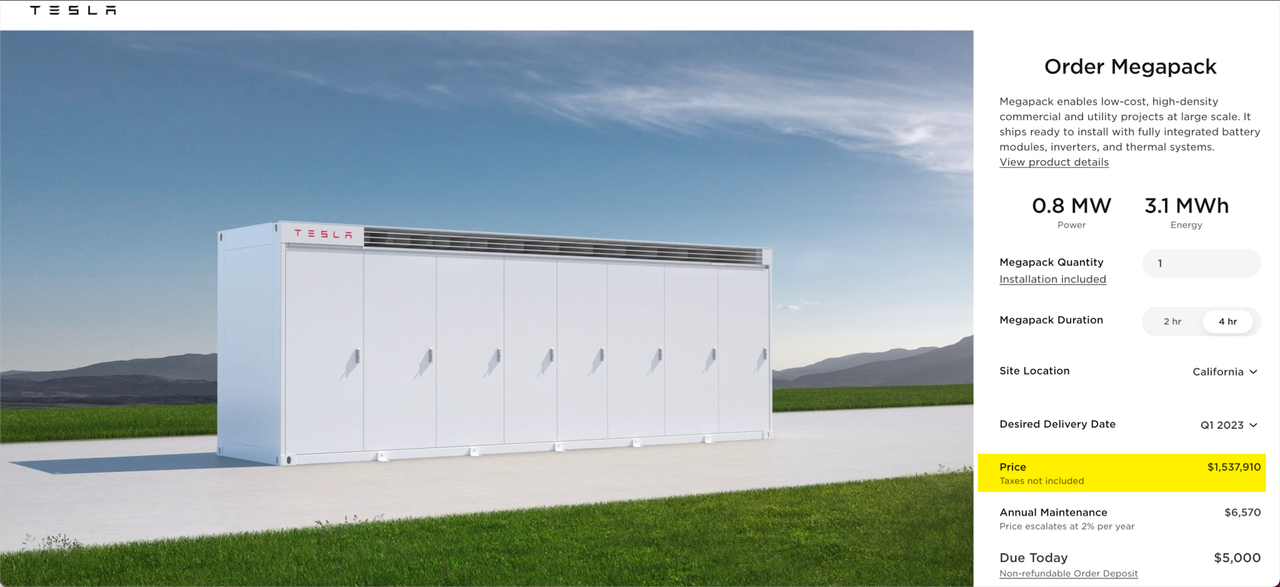
Example of Turnkey Cost of Large-Scale, Megapack Battery System, 2023 pricing
 ?itok=lxTa2SlF
The system consists of 50 Megapack 2, rated 45.3 MW/181.9 MWh, 4-h energy delivery
Power = 50 Megapacks x 0.979 MW x 0.926, Tesla design factor = 45.3 MW
Energy = 50 Megapacks x 3.916 MWh x 0.929, Tesla design factor = 181.9 MWh
Estimate of supply by Tesla, $90 million, or $495/kWh. See URL
Estimate of supply by Others, $14.5 million, or $80/kWh
All-in, turnkey cost about $575/kWh; 2023 pricing
https://www.tesla.com/megapack/design
https://www.zerohedge.com/commodities/tesla-hikes-megapack-prices-commodity-inflation-soars
Fixed Annual Cost of Megapack Battery Systems; 2023 pricing
Assume a system rated 45.3 MW/181.9 MWh, and an all-in turnkey cost of $104.5 million, per Example 2
Amortize bank loan for 50% of $104.5 million at 6.0%/y for 15 years, $5.291 million/y
Pay Owner return of 50% of $104.5 million at 9%/y for 15 years, $6.359 million/y (9% due to high inflation)
Lifetime (Bank + Owner) payments 15 x (5.291 + 6.359) = $174.75 million
Assume battery daily usage for 15 years at 10%, and losses at 19%
Battery output = 15 y x 365 d/y x 181.9 MWh x 0.1, usage x 1000 kWh/MWh = 99,590,250 kWh delivered to HV grid
(Bank + Owner) payments, $174.75 million / 99,590,250 kWh = 175.5 c/kWh
Less 50% subsidies (ITC, depreciation in 5 years, deduction of interest on borrowed funds) is 87.7c/kWh
At 10% usage, publicized cost, 87.7 c/kWh
At 40% usage, publicized cost, 21.9 c/kWh
Excluded costs/kWh: 1) O&M; 2) system aging, 3) system losses from HV grid to HV grid, 3) any grid extension/augmentation to connect the battery systems, 5) downtime of some parts of the system, 6) decommissioning in year 15, i.e., disassembly, reprocessing and storing at hazardous waste sites.
NOTE 1: The 40% usage is close to Tesla’s recommendation of 60% usage, i.e., not charging above 80% and not discharging below 20%. Tesla’s recommendation was not heeded be Hornsdale Power Reserve owners.
They added Megapacks to offset rapid aging of the original system and to increase the rating of the expanded system.
http://www.windtaskforce.org/profiles/blogs/the-hornsdale-power-reserve-largest-battery-system-in-australia
I am going to just summarize your comment here as $0.05 per deliverd kWhr is so far away from reality that it shouldn’t warrant much discussion. As you begin listing all these issues it is obvious there are costs galore and not much upside. In this essay I couldn’t imagine a more favorable scenario for storage as I outlines, and yet it eliminated a number of allegedly game-changing ideas.
So a question for you. A Tesla charging station was just installed near me–a few miles away thankfully–and has those big white boxes. A few days ago, the local utility was busily hooking something up to them. Are they transformers for the charging station or batteries? I have not seen them at other charging installations.
Those are meters and transformers, all utility-owned, to reduce distribution voltage to that of the Tesla charging system.
There are EV charging systems, too remote from distribution systems, powered with out-of-sight, 1000 kW diesel-generator sets, which, at an annual-average output of about 30%, produce power at about 30 c/kWh with diesel fuel at $5/gallon.
Thanks.
My guess is that they are diesel generators. Shhhh..
People can find cost information for these batteries easily and yet persist in the fantasy of under $200 per kWhr storage.
$200/per INSTALLED kWh, which merely is an INDICATION of what could be stored, subject to the limits of Tesla recommendations and aging.
Such a definition is well beyond the ken of most journalism types, who read and write about energy systems, but never analyzed any of them, i.e., they have not a clue.
By the way, thanks for the useful analysis.
I have spent a lot of time on it, over several months, as more info comes in.
It had many views
BTW, since then, interest rates increased from 6% to 6.5% and Owner return on investment from 9% to 10%, which increased costs per delivered kWh
That assumes that the system is well maintained and never abused (Among other things over or under charged). In reality the rate of degradation will be higher than this best case scenario.
See my above Hornsdale Power Reserve comment
Obviously, owners did not observe Tesla limitations, had more rapid aging, added additional Megapacks to offset THAT capacity loss, plus added Megapacks to augment the original system capacity
That’s not how Government of any shade and Leftism works, nothing is ‘not workable’ – it just hasn’t had: enough money spent on it; and/or not had enough time to work; and/or wasn’t done intensively enough to make it work; and/or was hampered by Opposition policies.
None of these Green projects are falsifiable.
Darned hidden change of font…
” …. to boldly go where no font has gone before …. “
I have no tools, apparently, that help me see what my effort will look like once it is filtered through WordPress. I write with Google Docs, then translate to MSWord or HTML to proofread and send here. The MSword and HTML versions have one paragraph that was spaced slightly more, but I didn’t even notice it, and yet look what WordPress did when it encounter god knows what control characters.
Getting to those Steve McIntyre blogs you referenced over at MC about the Endangerment finding and EPA and OMB trying to convince everyone self-servingly that they both are and aren’t significant findings, doesn’t it seem that this should be a focus of one effort to turn the whole cart over?
Kevin Kilty: “Getting to those Steve McIntyre blogs you referenced over at MC about the Endangerment finding and EPA and OMB trying to convince everyone self-servingly that they both are and aren’t significant findings, doesn’t it seem that this should be a focus of one effort to turn the whole cart over?”
Here is the original Manhattan Contrarian article where my comments concerning the EPA’s 2009 Endangerment Finding are being offered:
The Concerned Household Electricity Consumers Council Has Petitioned The Supreme Court For Certiorari
The remarks and comments repeated here follow the progress of the discussion over on MC in regard to how the EPA went about developing its 2009 finding:
At the conclusion of this train of discussion (see it reproduced below) I offer my opinion that the EPA’s latest approach to carbon regulation as published in June, 2023, is highly resistant to litigation and will be very effective in preventing the construction of new coal-fired and gas-fired power plants; and more importantly, in forcing the eventual retirements of most, if not all, of our legacy fossil-fueled power plants.
=======================
Kevin Ralston:
Of interest to your readers may be the EPA Endangerment and Cause or Contribute Findings for Greenhouse Gases under Section 202(a) of the Clean Air Act.
https://www.epa.gov/sites/default/files/2021-05/documents/endangerment_tsd.pdf
I looked it up hoping to find the actual methodology used by scientists in the employ of the EPA. Vain hope. But from what I gather this is the basis of our present technocratic nightmare.
======================
Beta Blocker in Response to Kevin Ralston:
Stephen McIntyre at Climate Audit has gone into great depth examining the Technical Support Document (TSD) written to justify the EPA’s 2009 Endangerment Finding. Here are three Climate Audit blog posts relevant to your question:
EPA Quality Guidelines: the NAS Panel and IPCC (April 19th 2009):
Climate Audit Submission to EPA (June 23rd 2009):
EPA: the Endangerment Finding was not a “highly influential scientific assessment” (October 4th 2011):
Having been previously involved in responding to a variety of regulatory rule making decisions, I find the 2011 article to be the most interesting of the bunch.
To gain a fuller understanding of how the 2009 Endangerment Finding was developed, you need to read all three McIintyre blog posts.
===============
Pablo Honey in Response to Beta Blocker:
I don’t want to say TLDR, but if anyone cares to give a 50-words-or-less summary, I for one would be grateful. I started on the 2011 submission, but gave up after a while.
===============
Beta Blocker in Response to Pablo Honey:
The gist of McIntyre’s analysis is that the EPA’s own internal procedures require that (1) the EPA must sponsor the scientific research which supports an endangerment finding, and (2) that the research itself must be conducted in accordance with the EPA’s own quality assurance standards.
McIntyre argues that in contradiction to its own rules, the EPA’s 2009 endangerment finding relies upon IPCC- sponsored research rather than EPA-sponsored research for its conclusions, and that the IPCC-sponsored research has not been conducted in accordance with the EPA’s own quality assurance standards.
The US Supreme Court rejected this argument, and other kinds of arguments, in 2011. And so the 2009 Endangerment Finding still stands.
The 2009 finding is a Section 202 Endangerment Finding and was originally meant to be a prototype for a Section 108 Endangerment Finding. Publication of a Section 108 finding would allow the EPA to identify carbon emissions as ‘criteria pollutants’ under the Clean Air Air, thus enabling a more powerful regulatory framework to be applied to carbon GHG’s.
Biden’s EPA has chosen not to go down the path of identifying carbon GHG’s as criteria pollutants, an approach which has been advocated for two decades or more inside the environmental law community. Rather, the EPA has chosen to use a rather sophisticated and well thought-out environmental lawfare approach, one based on past interpretations of Section 111 of the CAA.
The EPA’s latest approach is consciously designed to avoid the major questions doctrine and to spawn much litigation whose outcome is far from certain. This has the effect of adding significantly more technical and financial risk to any future coal-fired or gas-fired project, either for building new plants or for upgrading the systems at legacy plants.
IMHO, the EPA’s latest approach to carbon regulation is highly resistant to litigation and will be very effective in preventing the construction of new coal-fired and gas-fired power plants; and more importantly, in forcing the eventual closure of most if not all of our legacy fossil-fueled power plants.
====================
Your only mistake is using google!
It’s such a shame that CO2 can’t actually “trap heat”.
If it could, waste heat from industrial processes could be transported via CO2 pipelines to tanks of CO2 where it would defy the law of entropy forever and could be used to boil water to drive steam turbines at any time in the future it was needed…
As long as we’re defying laws, why not just drive the turbines directly with the CO2?
CO2 has the nice storage property of condensing to liquid above 5 atmospheres pressure, and you could run the turbines directly in a thousand psi system. Welders’ oxygen tanks run 2000 psi, so half that is easily doable. Turbine exhaust runs into something like a rubberized canvas inflatable tennis court, and if you put the pressure tanks inside the dome, you’d save some of the compression heat, and eliminate the danger of a catastrophic release.
I haven’t a clue how efficient low temperature compression/decompression thru a gas turbine would be, but your storing wind energy that would otherwise be wasted due to lack of demand. Either store some percentage of the excess energy, or idle the wind turbines and pay the wind farm not to produce it.
It’d make a good demonstration project if you’re determined to try some of these schemes to see if they work before you completely shut down our reliable energy sources.
CO2 is a pretty friendly and familiar medium to use, and it’s a mostly room temperature operation.
“As long as we’re defying laws, why not just drive the turbines directly with the CO2?”
We already use CO2 to drive turbos.
“”I haven’t a clue how efficient low temperature compression/decompression thru a gas turbine would be,
Carnot is your friend

It has got to be the most elegant, simplest yet most misunderstood/ignored equation in all of science these days.
Of course there is a solid reason for = it utterly trashes the notion of a Green House Gas Effect
and nut zero
Well, I think this is the whole point of the energy dome. The great big dome is the exhaust space for the low pressure CO2 and the high pressure end are tanks that have supercritical CO2 in them. The efficiency problem as I see it is that compressing a gas leads to a lot of work going into heat (not room temperature) and if the goal is to store energy then this heat has value. If what a person is doing is just supplying compressed gas the heat is a nuisance and one tends to waste it in intercoolers to reduce work input.
Depending on the size of the energy dome, though, I would view an enormous volume of CO2, if released somehow, as a grave danger to people and animals down drainage.
I have yet to see any discussion or analysis that addresses what happens when there is excess wind/solar production at a time when energy storage systems are already full. Obviously this would require curtailment and additional costs to pay producers not to produce. Since the generation side has a low average capacity factor around 25 – 35% nameplate capacity would need to be 3-4 times average load just to meet demand. It might be double that to provide enough excess to recharge storage. But that means when weather is optimal – full sun, strong steady wind the over production will be huge. I suspect this is a potentially significant additional unrecognized cost.
Exactly this has been my question to the true believers. We are told that without CO2, this planet would be at a temperature of -18ºC, and that just 100ppm is enough to raise that to a liveable 15ºC, and that our current level of 420ppm is “too much”. If just 10 thousandths of 1% of the atmosphere can “back radiate” sufficient energy the heat not just the remaining 99.958% of the atmosphere but the surface of an entire planet by 33ºC, why can we not harness this awesome power? Shirley it can’t be beyond the wit of man to create a generator that is powered by this principle? Is this not the answer to all our energy problems? So far, I have not had an answer.
Let’s look at a related idea or two which have been put to use. Instead of LWIR radiation, let’s use visible solar.
Thermodynamics all the way down.
Correction: There is no reflection of LWIR onto our boiler with reflectivity=0.
Hmmm … we need a Rube Goldberg solution.
They tell us that it’s important to remove CO2 from the air
Some BB and pellet guns use a CO2 cartridge to propel the projectile…hmmm.
Capture the CO2 from the air.
Compress it. Some as a compressed gas. Some as balls of dry ice.
Fire the dry ice balls at an iron disk backed by a spring to move it back its original position.
The iron disk would be surround by all to the wires and stuff in a hydro turbine to generate electricity but this would be a linear turbine!
Use the power generated to recapture vaporized CO2 from the dry ice cannon balls and return it to the CO2 captured form the air!
Eventually, you wouldn’t need to capture and CO2 from the air!!
(OH! Wait …)
https://en.wikipedia.org/wiki/Rube_Goldberg_machine
CO2 was used to cool the UK’s Advanced Gas Cooled Reactors (AGRs) !
In a nutshell renewables are…
“”far below adequate capability””
And that as they say, is that.
Luton fire update…
“”Police arrest man in his 30s on suspicion of criminal damage
‘We are carrying out a thorough and diligent investigation into all potential lines of enquiry, as should be expected after such a major event.
‘The man has been released on bail while our enquiries continue.’””
https://www.dailymail.co.uk/news/article-12661185/Police-arrest-man-30s-suspicion-criminal-damage-Luton-Airport-car-park-fire-saw-1-500-vehicles-flames.html
The media is not allow to say hybrid or battery and fire in the same sentence.
‘criminal damage’….
1,500 vehicles and a £20m car park. Not to mention the airport closure etc
Almost pandemic like.
‘As a precaution.’ Just in case it wasn’t an accident and he deliberately set fire to his own car on the third floor of a crowded car park. It’s all a bit off I think; something’s not quite right about the whole thing and I’m not exactly sure what.
Call me a Luddite if you wish, but I think all EV drivers should be charged with criminal damage. Worst “solution” to an invented problem ever.
EV’s aren’t the problem – it’s just those horrible, dangerous Li-ion battery packs. If anyone can make a battery that is lighter, longer ranged and doesn’t explode when someone sneezes nearby then It’ll be a winner. Trouble is the EV market is going to be forever tainted by these batteries and I can’t see it surviving that.
There are safe alternatives, like LTO – lithium titan oxide batteries, which are ultimate safe, but their energy density is 4-5 times lower than of li-ion batteries. And they are around 3 times more expensive per kWh than li-ion. So you can have safe car, instead of 400km range it will have 100km range.
But there is one little benefit of that, LTO is able to recharge in 6 minutes. And you have up to 30 years and 30,000 cycles in them.
It doesn’t matter whether the battery is perfect in all respects, there will not be the electricity and means to deliver and distribute it, so BEV use will be restricted to the very rich like motor cars were in the early part of the 20th Century, when petrol/gas was not widely available often only at chemist shops/pharmacies.
Then the coachmen was sent with a cart to fetch it. The rest of us will have horses if we can even afford those.
And receiving stolen goods – the plunder taken from taxpayers to fund manufacture, sale and purchase of their feel-good toys.
From “Day 1” I thought the fire was deliberately set.
Here is my current story line: a man had a car he didn’t want and the resale value had plummeted. He parks it in a garage where EVs are relatively numerous. He then sets fire to his auto or the one next to it – and leaves down the nearest staircase. He expects to get an insurance settlement based on the original selling price.
– – –
Reading about the pending clean-up of the site, this seems like the Chernobyl of parking garages. I wonder how the auto owners are coping with the demise of their vehicles.
Most insurance companies won’t pay up until you provide proof that your car has indeed been flambe’d. If your vehicle is one of those in this crime scene, how long will it take before the police allow individual people in, in order to collect this proof. Beyond that, what proof would work and would survive that fire? Those little VIN plates and license plates are made out of aluminum and I’m pretty sure the fire was hot enough to have melted those.
I offer a challenge to the COP28 elite, nut zero guardians – pick a western nation, remove all fossil fuels derivatives from it, remove all gas, coal & nuclear power generation from it, remove all meat & dairy from it, remove all ICE vehicles from it, remove all gas boilers from it – then, let us watch how it performs over a period of 24 months, then based on the data, let’s make a decision on the silly nut zero garbage
That is a great idea just as long as it isn’t my country they decide to use. 😉😊
Anyway hasn’t this already been tried on the island of Graciosa in the Azores and it has been a total failure?
nimby!!
Assuredly. Why should I go through the collapse this experiment would create when we already know it doesn’t work. Like a teaching opportunity,this idea will be more effective when we use it on the people that actually think unreliable energy is a viable solution to a non existent problem.
I recall reading about two other similar approaches, going back decades.
Iron bromide using the Fe2+/Fe3+ system is simple, aqueous, reliable, and scalable. The energy density is low compared to Vanadium but that is less of a problem for bulk storage and extremely cheap materials.
The sodium/sulphur flow cell is equally simple with very low cost materials. The energy density is higher, the main reported disadvantage being that it had to operate at about 200°C, not an insurmountable problem on a large scale. It was being looked at seriously by a UK generator (possibly the CEGB) a long time ago. Well before the global boiling twaddle metastasized.
I wonder what happened to them?
I don’t know. Perhaps an essay about batteries could prove useful here. It could investigate what became of so many these ideas as a guide to where we are headed and will end up in this effort.
The Fe2+/Fe3+ exchange is what powers the Iron-air batteries as nearly as I can tell. The exchange occurs in a coating of Fe(OH)2 and Fe(OH)3 which resides comfortably on an iron substrate and solves the problem of dimensional change of the iron structure during charge/discharge cycles. The biggest drawback of Iron-air I read as its low roundtrip efficiency.
It could be heated by the waste heat of thermal power plant (nuke or otherwise) and all the electrical interconnects would be there.
The electrolyte in that flow cell will give the firefighters quite a surprise when they try to put out the inevitable fires. 😱
Good review, Kevin Kilty!
Piles of coal and caverns full of natural gas will be necessary long into the future. And eventually the inherent long-duration characteristics of nuclear fuel will work nicely.
Thanks. I wish it had formatted more cleanly.
I am absolutely convinced like you that this fantasy won’t continue to levitate much longer, but I do worry in the meanwhile that people can make disastrous decisions or rather make expensive mistakes.
Right now there is an epidemic of general rate hearings at PSCs across the country that are asking for enormous increases in tariffs. I swear that all the utilities got together and plotted to blame the increases on fossil fuel prices even though their own case documents point to other causes. When people notice gasoline prices rising it may be easier to misdirect them to general fuel prices as the villain.
We’re getting progressive power so we’re not the winner anymore-
South Australian’s suffer nation’s highest energy bills | Watch (msn.com)
From the article, the DOE’s goals are:
Note that there are no quantified measurements of success.
All the better for a successful demo.
And The Search for the Magic Battery continues…
What are the self-discharge rates of these chemical batteries? They can’t be zero.
As you may know, the lithium batteries are advertised as around 1% per month, Alkaline primary cells on the shelf decline around 0.01 volts per year taking them from 1.6V to 1.5V at which point they are barely a nominal 1.5V cell — so only about 1% per year. Batteries that recharge with metal anode are prone to dendrite formation and thereafter have issues with self discharge. You have probably experienced a lead-acid cell or NiCd that would droop overnight. People don’t really wish to discuss the issue, but I conclude it is very difficult to get a handle on as it is related to chemistry, age, abuse, etc…
Thanks, Kevin. It is all just more hidden costs.
Some of them are not batteries. They are fuel cells, so the discharge rate really is zero.
The battery in your EV may have a discharge rate but the fuel tank in your ICE does not.
It is only consumed when you mix it with air and ignite it.
I get the feeling Rube Goldberg is somewhere laughing his a$$ off!
It appears that the goal of these projects is less to find good battery storage systems and more about checking all the social justice boxes.
Yeah, doesn’t matter whether it works or not, just that it sells to a certain group or groups of voters. Biden is using voters money to buy votes for the Democrats.
Another way of saying it is that social justice narrative engineering is just as important to DOE, if not more important, as is battery technology systems engineering.
This is a simplistic analysis that does not consider power system dynamic.
In Australia, it is lunchtime power that needs to be soaked up. Wholesale price for lunchtime power in Australia is often negative. The reason is that the coal generators bid at the floor price, currently MINUS $1200/MWh, to stay hot; producing at minimum stable output. A grid with some nuclear generation would have similar issues. Batteries in Australia often charge when price is negative. They get paid to soak up power to keep the coal plants running.
NetZero is fantasy but there are possibilities for marginal economic use of wind and solar. Such grids will have dispatchable plant that could operate at steady output feeding to batteries when demand is low. This produces the required battery duration and the overbuild of the weather dependent generators.
If this was actually the crisis these morons claim it to be, then there would be no tolerance for these extra set asides and mandates on building green energy sources.
The fact that they are willing to tack so much extra garbage onto these projects is just more proof that even they don’t believe it is a problem, much less a crisis.
This is so stupid, build more fossil fuel and nuclear generators and wind, solar and batteries become redundant piles of crap.
“In fact, a leading source of vanadium is petroleum refining; another is uranium mining.”
Thank you. That’s the first laugh I’ve had all day.
Except. They may be able to provide (some) power but they cannot provide frequency stability, fluctuations of which must be within +/- 1Hz, which more critical than power fluctuations.
Batteries and wind and solar reduce grid resilience, and render the grid liable to frequent shut downs. Coal-fired, gas fired power station have tons of built in inertia to smooth potential frequency fluctuation due to variations demand, variations of power feeding into the grid.
Physics is all joined up. The nitwits in charge have no science, and do not understand the complexity of electricity generation, supply and distribution.
’Solutions’ appear easy if looked at one at a time, but as the Man says, there are no solutions, only trade-offs.