Image above: Global Water Vapor – Source: NASA: https://earthobservatory.nasa.gov/global-maps/MYDAL2_M_SKY_WV
Readers may recall that we have reported on the massive amount of water vapor that has been injected into the stratosphere by the 2022 eruption of the Hunga-Tonga volcano. A recent study said a 13% increase in stratospheric water mass and a 5-fold increase of stratospheric aerosol load.
Water vapor is by far the strongest greenhouse gas according to NASA, and it stands to reason that the dramatic increase in stratospheric water vapor is having an effect on global temperature.
Water vapor is Earth’s most abundant greenhouse gas. It’s responsible for about half of Earth’s greenhouse effect — the process that occurs when gases in Earth’s atmosphere trap the Sun’s heat.
https://climate.nasa.gov/explore/ask-nasa-climate/3143/steamy-relationships-how-atmospheric-water-vapor-amplifies-earths-greenhouse-effect/
Dr. Ryan Maue writes on Twitter:
Everything was going fine until mid-March 2023, and then a dramatic 1°C warming spike in a matter of 2-weeks raised global temperatures to the record levels we are at today.
La Nina –> El Nino is certainly important for the Equatorial Pacific temperature increase. But, how is Hunga-Tonga affecting the Southern Hemisphere polar vortex? Not so good with the Antarctic sea ice down there.
And, the Northern Hemisphere is much warmer than normal especially in the Atlantic. How are all those trillions of gallons of water vapor in the stratosphere doing? How much is left, and how many more years of impacts?
https://twitter.com/RyanMaue/status/1685753261620363267

Another metric, the UAH satellite data also shows a spike in recent months, though still not as strong as the 2015/2016 El Nino, it is at least as strong as the 1997/1998 event.

From a recent publication, “Global perturbation of stratospheric water and aerosol burden by Hunga eruption” bold mine:
The eruption of the submarine Hunga volcano in January 2022 was associated with a powerful blast that injected volcanic material to altitudes up to 58 km. From a combination of various types of satellite and ground-based observations supported by transport modeling, we show evidence for an unprecedented increase in the global stratospheric water mass by 13% as compared to climatological levels, and a 5-fold increase of stratospheric aerosol load, the highest in the last three decades.
https://assets.researchsquare.com/files/rs-1864748/v1_covered.pdf?c=1659031907

Figure 6. Global perturbation of stratospheric water vapour and aerosol burden. (A) 372 Evolution of the global MLS stratospheric water vapour mass (3-day averages) between 100 hPa 373 – 1 hPa pressure levels (solid black curve) and climatological (2004-2021 period) annual cycle 374 (dashed curve), the positive and negative anomalies are shown respectively as red and blue 375 shading. (B) Deseasonalized stratospheric water vapour mass anomaly (per cent 3-day averages) 376 for both hemispheres and the whole globe from MLS. The embedded panel shows the evolution 377 of global anomaly in 2022. (C) Stratospheric aerosol optical depth (SAOD) anomalies for the 60⁰ 378 S – 60⁰ N latitude band (monthly averages) from GloSSAC merged satellite record extended using 379 OMPS-LP measurements at 675 nm scaled to 525 nm wavelength using GloSSAC data and SAGE 380 III/ISS measurements at 521 nm converted to 525 nm using SAGEIII-derived Angstrom exponent. 381 The SAOD anomalies are computed with respect to the background level estimated as GloSSAC 382 SAOD average over volcanically-quiescent 1995-2003 period. The embedded panel shows the full 383 time span of SAOD series. The cyan and pink letters indicate the most significant volcanic 384 eruptions and wildfire events respectively (EC – El Chichon, Pi – Pinatubo, Sa – Sarychev, Na – 385 Nabro, Ke – Kelud, Ca – Calbuco, PNE – Pacific Northwest wildfire event, Ra – Raikoke, ANY 386 – Australian New Year wildfire event, HT – Hunga Tonga).
Here is a video worth watching on the issue.
Any time I’m feeling low, can’t make temperatures go … up, I just watch a YouTube video show: https://www.youtube.com/watch?v=S94Bh3Qez9o
Thanks, finally some science here, but it’s just ENSO, http://climexp.knmi.nl/data/inino34_daily_2022:2024.png
Starting at about 1’20”, listen and marvel at the words of Stuart Jenkins, currently defiling the academic standing of my alma mater. The most brilliantly circular argument ever.
GH gasses in the stratosphere cause cooling, and that much aerosol material is going to cause clouds, and that causes cooling. Perhaps there is some weird short term warming mechanism, but the long term forecast has to be cooling.
This whole warming/Hunga Tonga thing is pretty interesting because the Rim of Fire (the ring of volcanoes around the Pacific) – the volcanoes seem to erupt in batches as opposed to randomly.
If one, admittedly large, volcano really caused this effect – what would 3 or 5 or 10 do? Because that’s the kind of activity that occurs during an active Rim of Fire decade.
‘<i>Water vapor is by far the strongest greenhouse gas according to NASA, and it stands to reason that the dramatic increase in stratospheric water vapor is having an effect on global temperature.</i>’
I thought that when alarmists claim that a rise in CO2 levels would cause a rise in temps, it was safe to ignore as the absorption bands are pretty much saturated and little more warming is possible. Is this not true of water vapour too, and if so, how can this be responsible for the warming?
The bands for water vapor are nowhere near saturated. The saturation also varies wildly from place to place, because water vapor is a CONDENSING GHG. CO2 is not (at Earthly temperatures and pressure).
There is missing context for the supposed jra-55 warming via the Hunga-Tonga volcano, and Dr. Maue should have caught this himself. The recent 2023 jra-55 2m warming is a similar response to El Niño conditions that occurred in 2016:
Both happened after high solar activity drove up tropical and global ocean temperatures.
I see very little reason to beat this dead horse any more, the volcano didn’t cause any warming.
It was seawater that was injected into the stratosphere. Loaded with sodium chloride. What effects this will spawn is a crap-shoot, given the un-appreciation of this fact.
Since the IPCC models depend on the water vapor recirculation model, isn’t anyone denying the current effect on global temperatures of the Hunga eruption also denying the validity of the IPCC models?
The Tongan eruption has caused a small temporary blip in global temperature but it caused a great deal of rainfall in New Zealand which caused a massive flood in Hawkes Bay and destruction in many other locations .
It took a year from the eruption but our rainfall has now exceeded our yearly total in most districts in New Zealand.
New Zealand is in the path of many tropical cyclones that transport water vapour and heat to Antarctica and for the record Hawkes Bay had more rainfall in 1938 than 2023.
A private weather forecaster (Phill Duncan ) who is a very good weatherman ,stated recently that there was not enough water from the eruption , to make a difference .
I think he got this wrong this time.
187 billion tonnes of extra water must ,and did make a a big difference to New Zealands weather .
.
Who supports this statement?
“Water vapor is Earth’s most abundant greenhouse gas. It’s responsible for about half of Earth’s greenhouse effect — the process that occurs when gases in Earth’s atmosphere trap the Sun’s heat.”
And “traps heat”, that’s cute.
So Hunga Tonga erupted in Jan 2022, and all that water vapor did very little until magically in March 2023 it decides to become active and warm up the earth? Doesn’t seem like a good argument. What happened in March 2023 to cause water vapor from the eruption to decide to become active?
It takes awhile for the plume to disperse globally. It would be nice if we had the data analyzed to track local and regional temperature changes that would show the dispersion.
It doesn’t just stick around in one spot, then disperse globally 14 months later. The effect of the eruption is estimated to be 0.03 C for 5 years or so. So it’s worth discussing, but it’s not rational to imagine that this eruption caused an abrupt change 14 months later.
It started in the Southern Hemisphere last year, Antarctic sea ice set a record low. It is in the process of setting a record low again this year.
Antarctic sea ice set record lows in 2022 and again in 2023; that didn’t cause a sudden increase in temperatures in March 2023.
scottjsimmons
I have done an analysis of all El Ninos between 1950 and 2020, and found that EVERY one was due to a decrease in global atmospheric SO2 aerosol levels, primarily in the aftermath of a volcanic eruption, and on average, 16 months after the date of the eruption, when the volcanic SO2 aerosols begin settling out of the atmosphere, usually causing an El Nino because of the less polluted air.
I would therefore expect that our 2023 El Nino would also be due to a decrease in atmospheric SO2 aerosol levels, this time because the moisture from the Hunga-Tonga began to settle out, in Feb-March of this year (14-15 months after the eruption), flushing out SO2 aerosol pollution in the atmosphere, and causing temperatures to rise.
Fortunately, they will eventually be replenished by Chinese industrial SO2 aerosol emissions, so we can expect the El Nino to end, probably later this year.
Forgive me for not believing you. Do your analysis and publish it in a respectable journal, and I promise I’ll take it seriously. The fact remains that we’ve had large El Ninos before, but none of them followed 14-16 months after an eruption like Hunga Tonga. That eruption was unique in that it was just the right depth to put large quantities of water vapor into the stratosphere. And people think this water vapor did nothing and then magically decided to rapidly warm the planet.
Most volcanic eruptions cause cooling for a couple years. The uniqueness of this eruption bucks that trend by causing a little warming – kind of a nail in the coffin of your observations, if you ask me. Still it’s about 0.03 C and certainly not responsible for a huge chunk of the record breaking heat the globe has seen this year.
scottjsimmons
“We’ve had large El Ninos before”
Both the large 1997-8 and 2014-16 El Ninos were caused by large decreases in atmospheric SO2 aerosol levels, due to “Clean Air” efforts (i.e., man-made).
Not something that you can compare Hunga-Tonga to.
How do explain the sudden large increase in temperatures about 15 months after the eruption? If the Hunga-Tonga moisture did not cause temperatures to decrease for that period of time, why would it have any effect when the moisture rained out?
The only possible explanation is that, in raining out, it flushed out SO2 aerosol pollution from the troposphere, cleansing the air, and causing temperatures to rise.
(The July warming spike was about 0.36 deg. C.,not 0.03 deg C, as you say)
What I said is that Hunga-Tonga is likely responsible for 0.03 C, which means it doesn’t explain much of the July 2023 spike. New studies may come up with different estimates of the impact of Hunga-Tonga, but right now that’s what has been estimated.
And as you point out Hunga-Tonga is not comparable to previous eruptions, which was also my point. Please see what I wrote.
I have been pleasantly surprised at how little sunburn I experienced this summer, though I was out in bright sun for longer than I ought to have been on a couple of occasions. Perhaps the extra atmospheric water vapor provided added protection?
Now temperatures will not rise. Heat is escaping quickly from the Pacific Ocean.
http://www.bom.gov.au/archive/oceanography/ocean_anals/IDYOC006/IDYOC006.202308.gif
http://www.bom.gov.au/archive/oceanography/ocean_anals/IDYOC007/IDYOC007.202308.gif
Stronger solar wind accelerate the jet stream in the north, which becomes latitudinal.


The analogy happens in the southern Pacific.
Radiative transfer modelling shows that if we can get more water vapour into the atmoshere, the temperature will rise. CO2 is at its limit. https://www.youtube.com/watch?v=8-zaQWAaPAg
Most of the water in the atmosphere is now concentrated in the western Pacific. The typhoon sends water vapor into the stratosphere and lowers ocean temperatures.
https://earth.nullschool.net/#2023/08/08/0700Z/wind/surface/level/overlay=total_precipitable_water/orthographic=-186.61,14.83,372/loc=130.987,29.535
https://earth.nullschool.net/#2023/08/05/0000Z/ocean/primary/waves/overlay=sea_surface_temp_anomaly/orthographic=-240.33,21.46,1128
This shows that the water that reaches the tropopause cools the surface. The same thing happens in winter in high latitudes.
Water vapor that reaches the tropopause in the tropics cools to the average temperature in the tropics (about -80 C). The temperature in the stratosphere depends only on radiation below -242 nm, which triggers the photochemical Chapman reaction. Therefore, the temperature in the stratosphere rises from above and not from below. Invariably, the lowest temperature is detected in the tropopause. Changes may be local and do not affect the average.
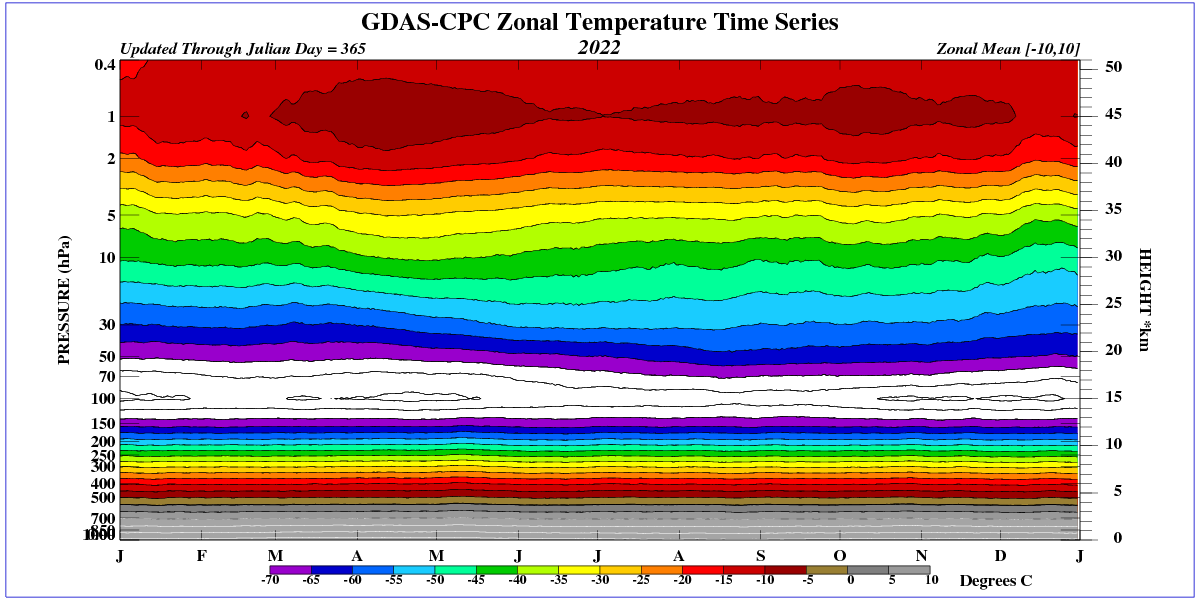
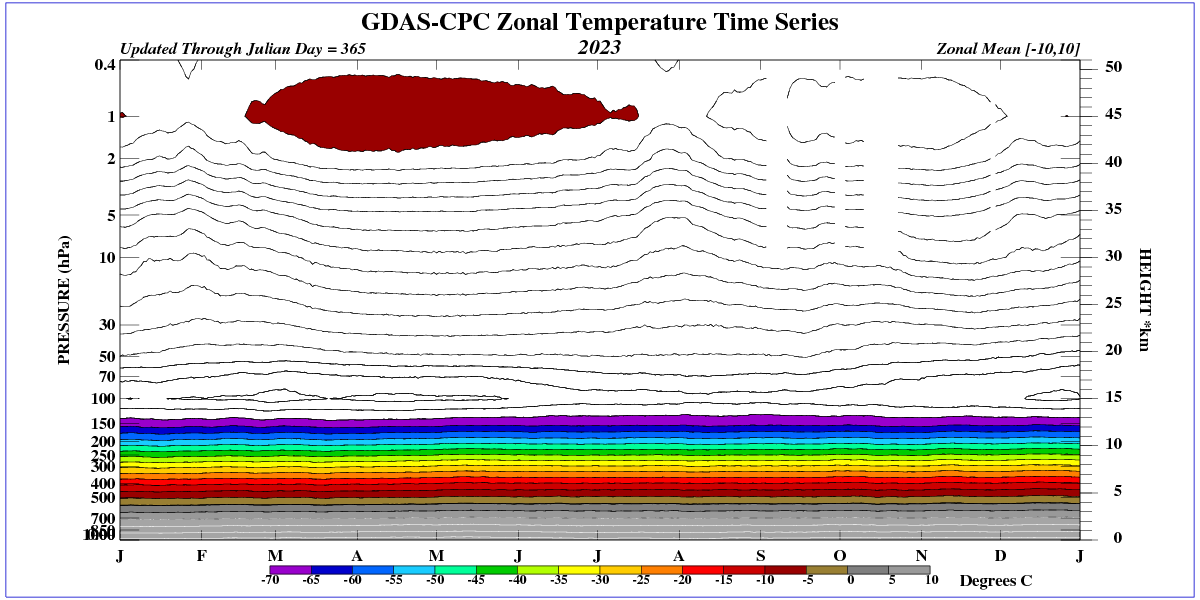
http://www.cchem.berkeley.edu/molsim/teaching/fall2008/ozone/Ozone%20website_files/Page603.htm
Let’s look at typhoon temperatures in the Philippine Sea. You can see that the cloud tops are radiating at -80 C.

The problem is that the temperatures of the surface, troposphere and lower stratosphere are mixed in the satellite era. These temperatures vary according to the amount of water vapor and ozone which is evident during La Niña and El Niño, as well as in winter temperatures over the Arctic Circle.
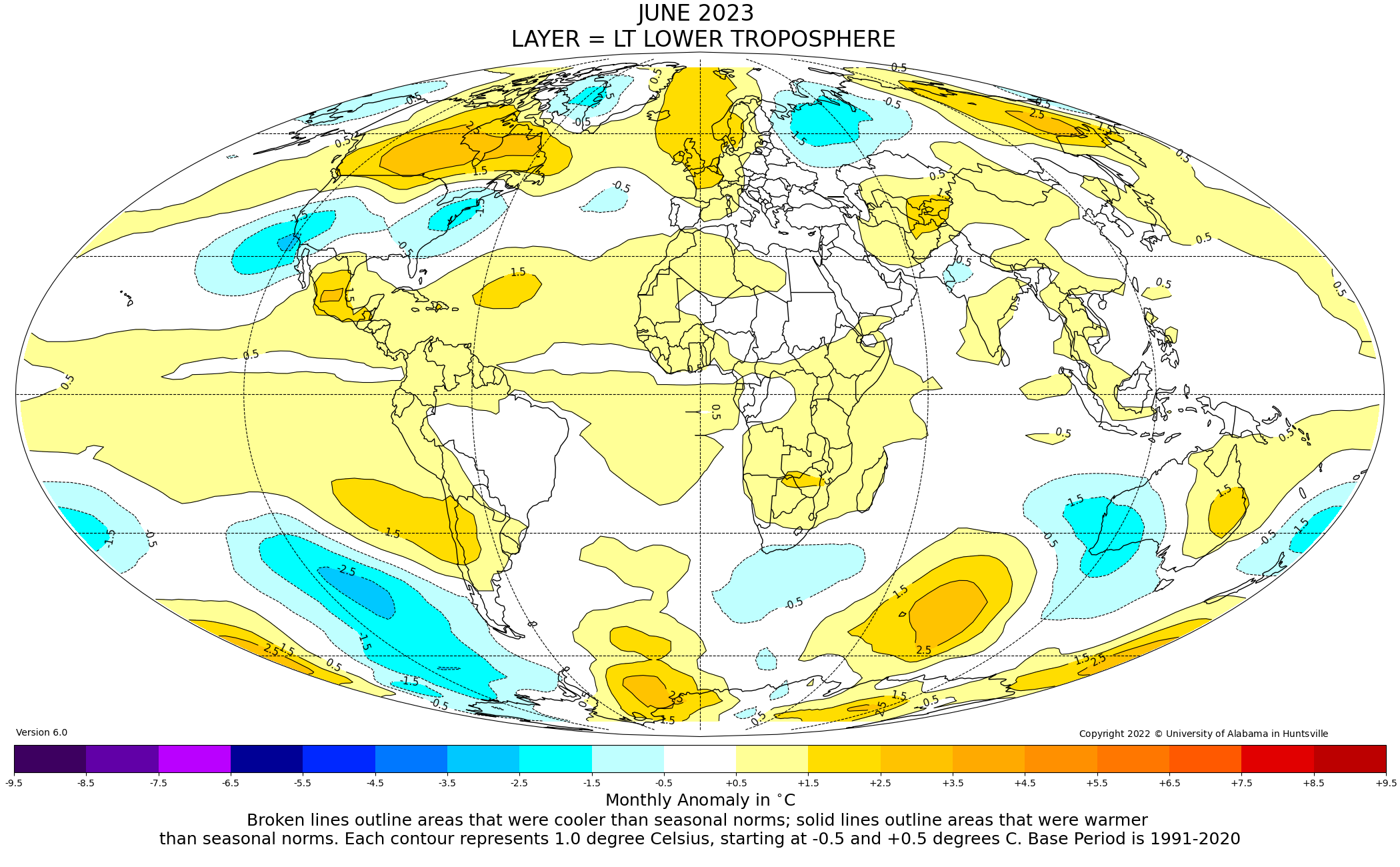
If a satellite detects high infrared radiation in an area where there is a stationary high, is it troposphere or surface radiation?
“If a satellite detects high infrared radiation in an area where there is a stationary high, is it troposphere or surface radiation?”
Exactly.
The satellite measures O2. There is probably little O2 in the surface.
Can the average surface temperature increase without surface air pressure increasing (holding insolation constant) ? The idea that without CO2 the Earth would be significantly cooler makes no sense to me as CO2 is just . 06% of atmospheric mass. If insolation is held constant. A decrease of . 06% of atmospheric mass would have little impact on surface pressure. How do you get a big decrease in temperature?
pv = nrT. The volume of the atmosphere can go up, i.e. expansion, as well as pressure.
Of course, but holding insolation constant (v???) how does such a small change in mass lead to a change in P or V.
Insolation has to do with radiation from the sun, not volume. Typically, gravity is the only force restricting how far the atmosphere can expand.