Guest Post by Willis Eschenbach
Short post. Here are the satellite-determined temperature trends of the various area of the lower troposphere, the lowest layer of the atmosphere.

Figure 1. Temperature trends, UAH MSU lower troposphere. NoPol—North Polar Region; NoExt—Northern ExtraTropics; NHem—Northern Hemisphere; Trpcs—Tropics; SHem—Southern Hemisphere; SoExt—Southern Extratropics; SoPol—South Polar Region.
And here’s how it maps out around the globe:


Figures 2. Pacific and Greenwich centered views of the trends of the lower tropospheric temperatures.
Short conclusion, to match the short post. The warming may be many things, but it’s not global …
w.
Once Again: When you comment, please quote the exact words you are discussing. I can defend my words. I can’t defend your interpretation of my words. Thanks.
It’s net warming global, it’s just not uniform in time or space.
A question for Willis E:
If we put to the side temperature changes in the Arctic, what are the temperature trends for the rest of the Earth over the same interval (ie, since 1979).
Thanks.
A slightly longer view of instrumental temperature anomalies.
During the current La Niña, little heat has accumulated in the western Pacific. This is a far cry from El Niño.

The SOI does not drop below zero.
http://www.bom.gov.au/clim_data/IDCKGSM000/soi30.png?1677568495
Galactic radiation is extremely sensitive to the Sun’s magnetic activity. Take a fresh look at the increase in GCR since the previous solar cycle.

https://cosmicrays.oulu.fi/
You can see it better in the chart below.

Let’s look at the surface temperature anomalies of the South Pacific. Is it possible that La Niña will rebound during the winter in the southern hemisphere?
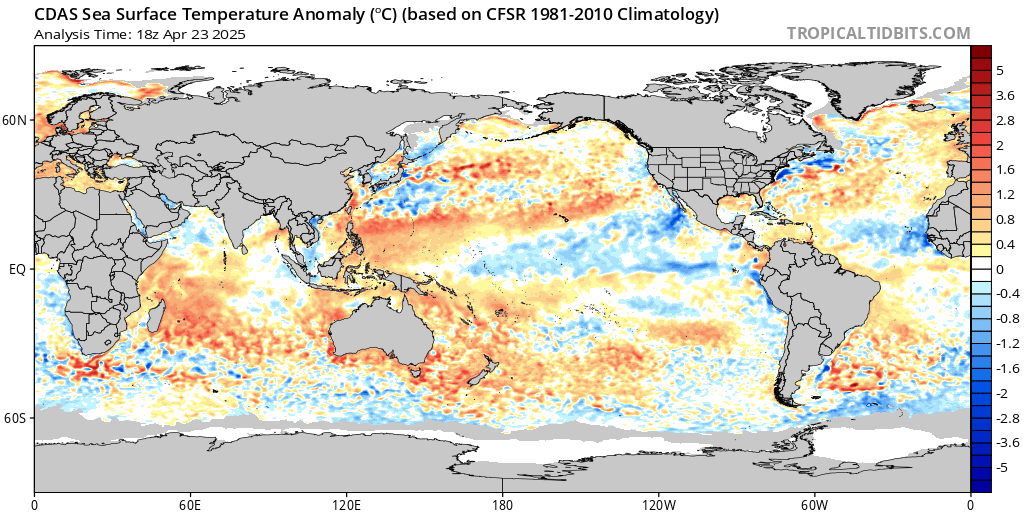
The Humboldt Current is a surface current.
During the summer months the only time that has gotten warmer at my central Indiana home is at night! It generally does not cool off at night,. A result of more moisture in the air. Otherwise it has been generally cooler for years now! Have not hit the century mark on the thermometer for several years now and we have fewer 90 degree days too!
Winters have been milder than they were back in the 70’s. Absolutely no doubt about it, though this winter we had our first white Christmas in some time, even though the 60 mph winds and sub zero temps ruined the ambiance.
My own personal experience and observations agree with what Tony Heller has been saying:
https://youtu.be/WdXifnnFS-U
Over fish the Krill and the whole food chain collapses.
Dr. Roy Spencer is looking at the UHI adjustment contribution to UAH warming. Definitely interested to see what he finds…
The Artic warming is likely just the warm phase of the AMO. If so, we should observe cooling in the attic over the next 30 years or so.
Hi Willis,
Since you like using CEEMDAN, I wonder why you didn’t use it here?
Below is the derivative of the CEEMDAN residuals to get the current warming rate for all the locations you’ve mentioned.
I don’t really know what to make of it all, but there was a massive bump in warming rate in the Tropics in the late 80’s, which seems to have impacted on other zones, and rippled in time in Northern Hemisphere locations.
The North Pole seems to hold on to all warming.
Regards,
Stephen.
Most interesting, Stephen, thanks. The bump in tropical warming is most interesting, and I have no clue what it might be from.
Best to you and yours,
w.
Another stratospheric intrusion on the West Coast of North America.

Still heavy frost in the Midwest.

Western circulation completely blocked in the Atlantic. Europe remains in northern air mass.
In a few days d Europe will receive air from as far away as the North Pole.
https://i.ibb.co/4K4Rpcq/hgt300.webp