Turnkey Capital Costs of Site-specific, Custom-designed, Utility-grade, Grid-scale Battery Systems Tesla Megapacks
Tesla is at the forefront of providing the world with lithium-ion battery systems, that include front-end power electronics, the batteries, and back-end power electronics, and systems for battery heating and cooling, as needed, in standardized enclosures.
The Megapack ratings shown in the table, in bold, fit into a standard container W, 286” x D, 85” x H, 99”
If multiple Megapacks are purchased, the $/kWh becomes less. See URL https://www.tesla.com/megapack/design
The 2022 Megapack pricing is shown in the table
The 2022 Megapack pricing is 24.5% greater than the 2021 pricing. See URL
The 2025 Megapack price likely will be much higher, due to: 1) Increased inflation rates, 2) Increased interest rates3) Supply chain disruptions, which delay projects, increase costs, 4) Increased energy prices, such as oil, gas, coal, etc., 5) Increased materials prices, such as of Tungsten, Cobalt, Lithium, and Copper, 6) Increased labor rates. ?itok=lxTa2SlF https://www.zerohedge.com/commodities/tesla-hikes-megapack-prices-commodity-inflation-soars
Open Article URL to view Tesla 2022 pricing table
Example of Large-Scale Battery System
PG&E, a California utility, put in operation, at Moss Landing, a li-ion battery system with 256 Megapacks, rated capacity is 182.5 MW/730 MWh, 4-h energy delivery duration.
Power = 256 Megapacks x 0.770 MW x 0.926, factor = 182.5 MW
Energy = 256 Megapacks x 3.070 MWh x 0.929, factor = 730 MWh
1 Megapack costs $1.566 million, per above table
Supply by Tesla was about 256 Megapacks x $1.25 million each = $320 million, or $320 million/730,000 kWh = $438/kWh, 2022 pricing.
Supply by Others was about $46 million/730,000 kWh = $63/kWh, 2022 pricing. All-in, turnkey cost was about $438 + $63 = $500/kWh. See Notes
NOTE 1: After looking at several aerial photos of large-scale battery systems with many Megapacks, it is clear many other items of equipment are shown, other than the Tesla supply, such as step-down/step-up transformers, switchgear, connections to the grid, land, access roads, fencing, security, site lighting, i.e., the cost of the Tesla supply is only one part of the total battery system cost on a site. NOTE 2: World Cobalt production was 142,000 and 170,000 metric ton, in 2020 and 2021, respectively, of which the Democratic Republic of the Congo was 120,000 metric ton in 2021.
Grid-Scale Battery Systems Round-Trip Losses, A-to-Z basis
Often one sees various round-trip losses for battery systems
Here is an estimate, based on greatly increased wind and solar systems tied to the New England high voltage grid, with a one-day, wind/solar shortfall made up with a battery system
Grid-scale battery systems typically are connected to the NE high-voltage grid by step-down and step-up transformers. The below calculations show the electricity drawn from the high voltage grid to charge the battery system, and then discharge the battery system to counteract a one-day wind/solar lull.
We make the following assumptions:
1) Greatly increased wind and solar connected to the NE grid at a future date, such as: wind onshore at 12.5%, wind offshore at 12.5%, and solar at 25% of annual grid load, a total of 50%, or 125/2 = 62.5 TWh/y, or 0.171 TWh/d
The required installed wind/solar nameplate capacities would be:
Wind offshore = 0.125 x 125 TWh/y / (8766 h/y x 0.45, CF) = 3,961 MW; existing about 30 MW, at end 2021
Solar = 0.25 x 125 TWh/y / (8766 h/y x 0.15, CF) = 23,766 MW, existing about 5,500 MW, at end 2021
2) Wind/solar output at 15% of their annual average grid load, during a wind/solar lull lasting 24 hours
Wind/solar loaded onto the NE grid would be 0.15 x 0.171 = 0.02568 TWh/d
Wind/solar shortfall would be 0.171 – 0.02568 = 0.14555 TWh/d
3) Grid-scale battery systems, connected to the HV gird, provide the entire shortfall, in TWh/d
Step-by-Step Battery System Losses
The below calculation shows the step-by-step losses of battery systems, A-to-Z basis
1) Fed to HV grid via step-up transformer 0.14555, as AC, to make up the above shortfall
Step-up transformer loss at 1%.
From back-end power electronics, as AC, to step-up transformer 0.14700
2) Back-end power electronics loss at 3.5%
From battery to back-end power electronics 0.15215, as DC
3) Battery discharge loss at 4%
Deduction from battery charge 0.15823, as DC
4) Battery charge loss at 4%
From front-end power electronics to battery 0.16456, as DC
5) Front-end power electronics loss at 3.5%
From step-down transformer to front-end power electronics 0.17032, as AC
6) Step-down transformer loss at 1%
Drawn from HV grid via step-down transformer 0.17203, as AC
Battery System Loss, A-to-Z basis
About 0.17203/0.14555 x 100% = 18.2% more needs to be drawn from the HV grid to charge the battery systems up to about 80% full (preferably many days before any wind/solar lull starts), than is fed to the HV grid by discharge from the battery system to about 20% full; the loss percentage increases with aging.
Battery systems are rated at a level of power, MW, provided for a number of hours, MWh, such as providing 2 MW for 4 hours, 2 MW/8 MWh, as AC at battery voltage, which needs to be stepped up to HV voltage.
where the lifetime record of battery charging is a total of 397GWh of which 310GWh have been discharged back to the grid for an overall round trip efficiency of 78.1%. Some of the difference with your figures will be for cooling and some for battery ageing. As the total capacity is <<1GWh the current state of charge is not a factor in the calculation over the long timescale.
The battery systems will be in hot and cold climates
They have HVAC systems to heat/cool the Megapack enclosures and batteries
My calculated losses do not include the HVAC loss
Energy Losses of Site-specific, Custom-designed, Utility-grade, Grid-scale Battery Systems
Articles often assume a battery loss of 10%, which likely would be only the battery.
That loss should have been assumed at about 20%, on a-to-z basis.
See Note.
Here are two sources:
Source 1 is based on measured data, on a-to-z basis
This article identifies 18 losses of a stationary battery system, totaling about 20% for a round-trip, excluding transformer losses.
See Note.
– The system model has four coupled, component models: 1) Battery, 2) Power Electronics, 3) Thermal Management, such as heating/cooling of batteries and enclosures, and 4) Control and Monitoring.
– Electricity for site lighting, O&M, surveillance, etc.
Source 2 is based on EIA survey data from OPERATING grid-scale battery systems
Per EIA survey, grid-scale battery efficiency is about 80%, AC-to-AC basis, excluding step-down and step-up transformer losses.
Aging had only a minor effect, because the battery systems were only a few years old.
See Note. https://www.eia.gov/todayinenergy/detail.php?id=46756
Sequence of Losses:
1)AC electricity from a distribution, or high-voltage grid, via a step-down transformer, about a 1% loss, to reduce the voltage to that of the battery
2) Through the power electronics to DC
3) In battery
4) Out battery
5) Through power electronics; DC is digitized, made into a sine wave with same phase and 60-cycle frequency as the grid
6) Via a step-up transformer, about a 1% loss, to the distribution, or high-voltage grid
“I think the consensus view, even when you talk about to people in the global warming community, is that a forcing for clear sky of CO2, which is about 3W/m2. When you take clouds into account that’s going to reduce it by about 30% to about 2W/m2. But that’s where there is a lot of uncertainty at the present time..”
Great stuff, but very difficult to explain to the ignoratissimos, which means, with a big foghorn, all lies will continue, until something blows up in their faces.
Great talk by van Wijngaarden, covering the ground of the WH paper on 5 GHGs in clear skies, and moving on to introducing their later modelling including clouds. Ending up with considering the effects on the biosphere, crops etc. pointing up that climate policies are more dangerous than climate changes.
Robert Kernodle
December 24, 2022 5:17 pm
The block-quote feature here is a mess — the big quotes and the block lines merge with the text to give a sloppy, broken appearance. Can this be fixed?
In blockquote::before I change font-size to 10px and it actually looks pretty good IMO. Maybe also change left to -3 to -5px
rckkrgrd
December 24, 2022 8:00 pm
It seems a greenhouse gas is one because it is not completely transparent to infrared radiation which is a quality of greenhouse glass. It is also a quality of water vapor, water itself, dust or any solids suspended in the atmosphere, or the very air itself. Most insulations in use today depend on trapped air pockets. Then there is the very surface of the earth itself which is much more effective at trapping heat and is a major factor in the UHI effect.
Still they are trying to convince me that the extremely tiny percentage of CO2 content in the air is significant.
Its been clear for some time now that very similar thinking and reasoning patterns are found in all three of the great ‘woke’ ideologies of recent decades. I have been reading about the other two – gender and race. Here are some of what I’ve found thought provoking and helped clarify thought and approach. Whether you agree with them or not (and I have not always ended up agreeing) reading them carefully will help anyone work out what they think and why.
Gender
Kathleen Stock, ‘Material Girls’.
Stock is a professional philosopher who was forced out of Sussex University in the UK for the heretical view she took in this book of gender issues . Its not in the least trans-phobic however, its a calm and reasoned approach to sex and gender in humans and the associated policy issues currently under debate. As you would expect from a philosopher there is quite a bit of emphasis on the logic or illogic of trans ideology.
Abigail Shrier, ‘Irreversible Damage’. Mainly directed at the phenomenon of the wave of trans among teenage girls, and is a critical look at the way in which its being handled.
Helen Joyce, ‘Trans – When Ideology Meets reality’.
Joyce is a writer for the Economist. A level headed and wide ranging account.
Race
Thomas Sowell, ‘Intellectuals and Race’.
An examination of the logic, evidence for and history of the collection of ideas that has become known as Critical Race Theory. Calm in tone and factually based, with some eye opening accounts of the antecedents of modern day thinking in the Eugenicist and Progressive movements of the early 20c. He is very good on movements of thought, what persists and what has changed, and how.
John McWhorter, ‘Woke Racism’.
This is different from the others, written informally as if you were listening to a speaking voice, funny, acerbic, indignant, pointed. But still very logical and has some very penetrating insights. The basic argument is that the critical race theory movement has many of the characteristic marks of a religion, and this insight is then used to explain many of the puzzling and internally inconsistent features of it.
Climate
What does any of this have to do with climate? Well, the thing that strikes you as you move through the other two waves of opinion of our time is the similarity of the methods of reasoning, the approaches, and the way in which policies are being justified in all three cases. Read McWhorter attentively and you will no longer be puzzled by (for instance) the fact that New Zealand is talking about lowering or eliminating CO2 emissions from sheep, to tackle climate change, when its obvious to the most casual observer that whatever they do about their sheep can have no effect whatever on climate.
The pattern of thought running through the climate, the trans or gender, the critical race theory movements is the same. Read about all three, with the help of these writings, and you will see it clearly. And also, probably, at the same time you will come to see that on some non-trivial issues you don’t agree with the authors. But you will know where you stand and why.
Today is Christmas Day as I type this.
(Merry Christmas!)
“A Christmas Carol” is one of the most filmed stories of all time.
I’d like to see a compilation of them all, “Mr. Magoo’s Christmas Carol” (The first animated TV Christmas special), the ones with Alister Sims, Patrick Steward, the guy who played “Patton”, all of them rolled up and spliced into one story. (The best scenes. Some scenes may need to be doubled up.)
The copyright stuff would be a nightmare, but I think it could be very entertaining.
I was logged in earlier today, then when I got back on just a few hours later, I’m logged out. I always check “remember me”. In fact, I had been logged in for at least a week up until this happened just now.
It’s happened several times over the past few weeks.
Gunga, no. Like I said it maintains the cookies for quite some time of normal use. The particular incident yesterday was a case of me finishing my reading this site and closing those tabs, then returning to check my email for new articles, without having closed firefox in between. Something I do multiple times per day just about every day without similar incident.
Without CO2, earth would be a dead planet. Because life on earth is entirely composed of little carbon sacks of water we call cells. More CO2, up to at least 2,000ppm of the atmosphere, makes life greener, stronger, more drought tolerant, and abundant. Greenhouse growers routinely pay to add up to 1,600ppm CO2 to their operations to make their products greener, healthier, and more productive. Just like using coal, oil, and gas does for our atmosphere for free today. And today recycling more CO2 makes it easier to feed eight billion people than it took to feed 3.5 billion a century ago. How? With arguably, the most important and powerful aspect of life’s metabolism – photosynthesis. Whose formula is sunlight plus CO2 plus H2O, with the green enzyme chlorophyll, converting sunlight into the high-energy bonds of life’s carbon compound sugar. And as a bonus, also produces 100% of our atmospheric oxygen! While, as Dr. John Christy has clearly proven, CO2 is insignificant in climate. EVERY one of the over 100 CO2 driven climate model projections massively overestimates temperatures compared to actual weather balloon and satellite data. Our normal, natural ever changing climate has moved twice during human existence through 12°C cycles. 100 thousand year cycles driven by Milankovitch Eccentricity. And in the warmest 4°C portion of that massive normal, natural range of earth’s temperature, earth’s orbit is in its warmest, near circular shape. We call these warm periods interglacials. In our current interglacial, the Holocene, we invented agriculture and civilization. In our CO2 driven life on earth, warmer with more CO2 is always better.
vinceram
December 27, 2022 8:10 am
I find it interesting that many on this site buy-in to the concept that CO2 can cause warming, when in fact, CO2 in the atmosphere acts as a coolant. In my opinion, there are basic thermodynamic principles that dictate this fact. Any theory — GHG, pressure induced warming, etc., that do not recognize this fact are not portraying physical reality.
Excerpt from article
Often one sees various turnkey capital costs for battery systems
Here is an estimate, based on the latest 2022 pricing
BATTERY SYSTEM CAPITAL COSTS, OPERATING COSTS, ENERGY LOSSES, AND AGING
https://www.windtaskforce.org/profiles/blogs/battery-system-capital-costs-losses-and-aging
PART 1
Turnkey Capital Costs of Site-specific, Custom-designed, Utility-grade, Grid-scale Battery Systems
 ?itok=lxTa2SlF
Tesla Megapacks
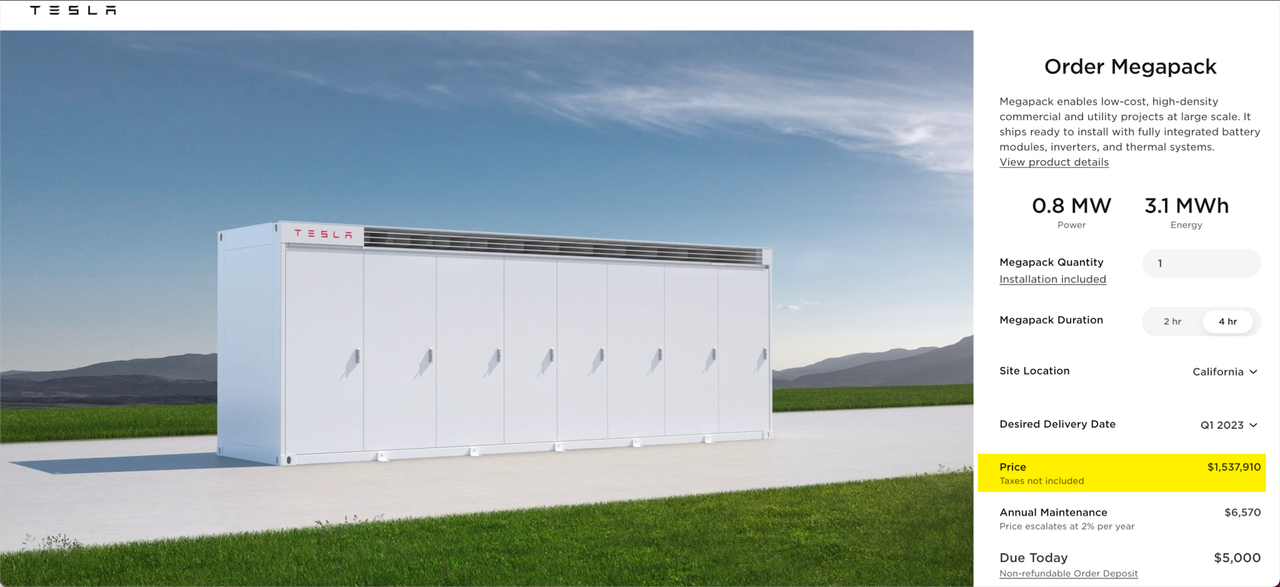
Tesla is at the forefront of providing the world with lithium-ion battery systems, that include front-end power electronics, the batteries, and back-end power electronics, and systems for battery heating and cooling, as needed, in standardized enclosures.
The Megapack ratings shown in the table, in bold, fit into a standard container W, 286” x D, 85” x H, 99”
If multiple Megapacks are purchased, the $/kWh becomes less. See URL
https://www.tesla.com/megapack/design
The 2022 Megapack pricing is shown in the table
The 2022 Megapack pricing is 24.5% greater than the 2021 pricing. See URL
The 2025 Megapack price likely will be much higher, due to: 1) Increased inflation rates, 2) Increased interest rates3) Supply chain disruptions, which delay projects, increase costs, 4) Increased energy prices, such as oil, gas, coal, etc., 5) Increased materials prices, such as of Tungsten, Cobalt, Lithium, and Copper, 6) Increased labor rates.
https://www.zerohedge.com/commodities/tesla-hikes-megapack-prices-commodity-inflation-soars
Open Article URL to view Tesla 2022 pricing table
Example of Large-Scale Battery System
PG&E, a California utility, put in operation, at Moss Landing, a li-ion battery system with 256 Megapacks, rated capacity is 182.5 MW/730 MWh, 4-h energy delivery duration.
Power = 256 Megapacks x 0.770 MW x 0.926, factor = 182.5 MW
Energy = 256 Megapacks x 3.070 MWh x 0.929, factor = 730 MWh
1 Megapack costs $1.566 million, per above table
Supply by Tesla was about 256 Megapacks x $1.25 million each = $320 million, or $320 million/730,000 kWh = $438/kWh, 2022 pricing.
Supply by Others was about $46 million/730,000 kWh = $63/kWh, 2022 pricing.
All-in, turnkey cost was about $438 + $63 = $500/kWh. See Notes
The primary purpose of the battery system is to absorb midday solar output bulges.
None of the costs associated with such systems will be charged to Owners of solar systems
https://www.10news.com/news/national/pg-es-tesla-megapack-battery-in-san-francisco-now-operational
NOTE 1: After looking at several aerial photos of large-scale battery systems with many Megapacks, it is clear many other items of equipment are shown, other than the Tesla supply, such as step-down/step-up transformers, switchgear, connections to the grid, land, access roads, fencing, security, site lighting, i.e., the cost of the Tesla supply is only one part of the total battery system cost on a site.
NOTE 2: World Cobalt production was 142,000 and 170,000 metric ton, in 2020 and 2021, respectively, of which the Democratic Republic of the Congo was 120,000 metric ton in 2021.
https://www.kitco.com/news/2022-02-02/Global-cobalt-production-hits-record-in-2021-as-mined-cobalt-output-in-DR-Congo-jumps-22-4.html
https://www.wilsoncenter.org/blog-post/drc-mining-industry-child-labor-and-formalization-small-scale-mining
Excerpt from article
BATTERY SYSTEM CAPITAL COSTS, OPERATING COSTS, ENERGY LOSSES, AND AGING
https://www.windtaskforce.org/profiles/blogs/battery-system-capital-costs-losses-and-aging
Part 9
Grid-Scale Battery Systems Round-Trip Losses, A-to-Z basis
Often one sees various round-trip losses for battery systems
Here is an estimate, based on greatly increased wind and solar systems tied to the New England high voltage grid, with a one-day, wind/solar shortfall made up with a battery system
Grid-scale battery systems typically are connected to the NE high-voltage grid by step-down and step-up transformers. The below calculations show the electricity drawn from the high voltage grid to charge the battery system, and then discharge the battery system to counteract a one-day wind/solar lull.
We make the following assumptions:
1) Greatly increased wind and solar connected to the NE grid at a future date, such as: wind onshore at 12.5%, wind offshore at 12.5%, and solar at 25% of annual grid load, a total of 50%, or 125/2 = 62.5 TWh/y, or 0.171 TWh/d
The required installed wind/solar nameplate capacities would be:
Wind onshore = 0.125 x 125 TWh/y / (8766 h/y x 0.29, capacity factor) = 6,146 MW; existing about 1450 MW, at end 2021
NE has high project costs/MW, about $2,600 in 2019, and low CFs, which means high costs/kWh. See page 42 of URL
https://www.energy.gov/sites/default/files/2022-08/land_based_wind_market_report_2202.pdf
Wind offshore = 0.125 x 125 TWh/y / (8766 h/y x 0.45, CF) = 3,961 MW; existing about 30 MW, at end 2021
Solar = 0.25 x 125 TWh/y / (8766 h/y x 0.15, CF) = 23,766 MW, existing about 5,500 MW, at end 2021
2) Wind/solar output at 15% of their annual average grid load, during a wind/solar lull lasting 24 hours
Wind/solar loaded onto the NE grid would be 0.15 x 0.171 = 0.02568 TWh/d
Wind/solar shortfall would be 0.171 – 0.02568 = 0.14555 TWh/d
3) Grid-scale battery systems, connected to the HV gird, provide the entire shortfall, in TWh/d
Step-by-Step Battery System Losses
The below calculation shows the step-by-step losses of battery systems, A-to-Z basis
1) Fed to HV grid via step-up transformer 0.14555, as AC, to make up the above shortfall
Step-up transformer loss at 1%.
From back-end power electronics, as AC, to step-up transformer 0.14700
2) Back-end power electronics loss at 3.5%
From battery to back-end power electronics 0.15215, as DC
3) Battery discharge loss at 4%
Deduction from battery charge 0.15823, as DC
4) Battery charge loss at 4%
From front-end power electronics to battery 0.16456, as DC
5) Front-end power electronics loss at 3.5%
From step-down transformer to front-end power electronics 0.17032, as AC
6) Step-down transformer loss at 1%
Drawn from HV grid via step-down transformer 0.17203, as AC
Battery System Loss, A-to-Z basis
About 0.17203/0.14555 x 100% = 18.2% more needs to be drawn from the HV grid to charge the battery systems up to about 80% full (preferably many days before any wind/solar lull starts), than is fed to the HV grid by discharge from the battery system to about 20% full; the loss percentage increases with aging.
Battery systems are rated at a level of power, MW, provided for a number of hours, MWh, such as providing 2 MW for 4 hours, 2 MW/8 MWh, as AC at battery voltage, which needs to be stepped up to HV voltage.
Alternatively you can look at the cumulative charge and discharge flows of grid batteries e.g. here
OpenNEM: South Australia
where the lifetime record of battery charging is a total of 397GWh of which 310GWh have been discharged back to the grid for an overall round trip efficiency of 78.1%. Some of the difference with your figures will be for cooling and some for battery ageing. As the total capacity is <<1GWh the current state of charge is not a factor in the calculation over the long timescale.
Thank you for reminding me.
The battery systems will be in hot and cold climates
They have HVAC systems to heat/cool the Megapack enclosures and batteries
My calculated losses do not include the HVAC loss
Energy Losses of Site-specific, Custom-designed, Utility-grade, Grid-scale Battery Systems
Articles often assume a battery loss of 10%, which likely would be only the battery.
That loss should have been assumed at about 20%, on a-to-z basis.
See Note.
Here are two sources:
Source 1 is based on measured data, on a-to-z basis
This article identifies 18 losses of a stationary battery system, totaling about 20% for a round-trip, excluding transformer losses.
See Note.
– The system model has four coupled, component models: 1) Battery, 2) Power Electronics, 3) Thermal Management, such as heating/cooling of batteries and enclosures, and 4) Control and Monitoring.
– Electricity for site lighting, O&M, surveillance, etc.
Open URL and click on “View Open Manuscript”
See figures 3, 4 and 17 of article.
https://www.sciencedirect.com/science/article/pii/S0306261917315696
Source 2 is based on EIA survey data from OPERATING grid-scale battery systems
Per EIA survey, grid-scale battery efficiency is about 80%, AC-to-AC basis, excluding step-down and step-up transformer losses.
Aging had only a minor effect, because the battery systems were only a few years old.
See Note.
https://www.eia.gov/todayinenergy/detail.php?id=46756
Sequence of Losses:
1) AC electricity from a distribution, or high-voltage grid, via a step-down transformer, about a 1% loss, to reduce the voltage to that of the battery
2) Through the power electronics to DC
3) In battery
4) Out battery
5) Through power electronics; DC is digitized, made into a sine wave with same phase and 60-cycle frequency as the grid
6) Via a step-up transformer, about a 1% loss, to the distribution, or high-voltage grid
Overall efficiency of about 78%, less with aging at about 1.5%/y. See URL
https://www.explainthatstuff.com/how-inverters-work.html
Did I just turn into consensus?!
Interesting statement here by Wijngaarden..
“I think the consensus view, even when you talk about to people in the global warming community, is that a forcing for clear sky of CO2, which is about 3W/m2. When you take clouds into account that’s going to reduce it by about 30% to about 2W/m2. But that’s where there is a lot of uncertainty at the present time..”
https://www.youtube.com/watch?v=WfwnKWIWPzk&t=3770s
Yes, that community is me.. 😉
https://greenhousedefect.com/the-holy-grail-of-ecs/the-2xco2-forcing-disaster
Great stuff, but very difficult to explain to the ignoratissimos, which means, with a big foghorn, all lies will continue, until something blows up in their faces.
Great talk by van Wijngaarden, covering the ground of the WH paper on 5 GHGs in clear skies, and moving on to introducing their later modelling including clouds. Ending up with considering the effects on the biosphere, crops etc. pointing up that climate policies are more dangerous than climate changes.
The block-quote feature here is a mess — the big quotes and the block lines merge with the text to give a sloppy, broken appearance. Can this be fixed?
In blockquote::before I change font-size to 10px and it actually looks pretty good IMO. Maybe also change left to -3 to -5px
It seems a greenhouse gas is one because it is not completely transparent to infrared radiation which is a quality of greenhouse glass. It is also a quality of water vapor, water itself, dust or any solids suspended in the atmosphere, or the very air itself. Most insulations in use today depend on trapped air pockets. Then there is the very surface of the earth itself which is much more effective at trapping heat and is a major factor in the UHI effect.
Still they are trying to convince me that the extremely tiny percentage of CO2 content in the air is significant.
Reading recommendations for 2023
Its been clear for some time now that very similar thinking and reasoning patterns are found in all three of the great ‘woke’ ideologies of recent decades. I have been reading about the other two – gender and race. Here are some of what I’ve found thought provoking and helped clarify thought and approach. Whether you agree with them or not (and I have not always ended up agreeing) reading them carefully will help anyone work out what they think and why.
Gender
Kathleen Stock, ‘Material Girls’.
Stock is a professional philosopher who was forced out of Sussex University in the UK for the heretical view she took in this book of gender issues . Its not in the least trans-phobic however, its a calm and reasoned approach to sex and gender in humans and the associated policy issues currently under debate. As you would expect from a philosopher there is quite a bit of emphasis on the logic or illogic of trans ideology.
Abigail Shrier, ‘Irreversible Damage’. Mainly directed at the phenomenon of the wave of trans among teenage girls, and is a critical look at the way in which its being handled.
Helen Joyce, ‘Trans – When Ideology Meets reality’.
Joyce is a writer for the Economist. A level headed and wide ranging account.
Race
Thomas Sowell, ‘Intellectuals and Race’.
An examination of the logic, evidence for and history of the collection of ideas that has become known as Critical Race Theory. Calm in tone and factually based, with some eye opening accounts of the antecedents of modern day thinking in the Eugenicist and Progressive movements of the early 20c. He is very good on movements of thought, what persists and what has changed, and how.
John McWhorter, ‘Woke Racism’.
This is different from the others, written informally as if you were listening to a speaking voice, funny, acerbic, indignant, pointed. But still very logical and has some very penetrating insights. The basic argument is that the critical race theory movement has many of the characteristic marks of a religion, and this insight is then used to explain many of the puzzling and internally inconsistent features of it.
Climate
What does any of this have to do with climate? Well, the thing that strikes you as you move through the other two waves of opinion of our time is the similarity of the methods of reasoning, the approaches, and the way in which policies are being justified in all three cases. Read McWhorter attentively and you will no longer be puzzled by (for instance) the fact that New Zealand is talking about lowering or eliminating CO2 emissions from sheep, to tackle climate change, when its obvious to the most casual observer that whatever they do about their sheep can have no effect whatever on climate.
The pattern of thought running through the climate, the trans or gender, the critical race theory movements is the same. Read about all three, with the help of these writings, and you will see it clearly. And also, probably, at the same time you will come to see that on some non-trivial issues you don’t agree with the authors. But you will know where you stand and why.
Today is Christmas Day as I type this.
(Merry Christmas!)
“A Christmas Carol” is one of the most filmed stories of all time.
I’d like to see a compilation of them all, “Mr. Magoo’s Christmas Carol” (The first animated TV Christmas special), the ones with Alister Sims, Patrick Steward, the guy who played “Patton”, all of them rolled up and spliced into one story. (The best scenes. Some scenes may need to be doubled up.)
The copyright stuff would be a nightmare, but I think it could be very entertaining.
Is anyone else being randomly logged out?
I was logged in earlier today, then when I got back on just a few hours later, I’m logged out. I always check “remember me”. In fact, I had been logged in for at least a week up until this happened just now.
It’s happened several times over the past few weeks.
Is your browser set to remove cookies when you shut it down or run another program that does something like that?
Gunga, no. Like I said it maintains the cookies for quite some time of normal use. The particular incident yesterday was a case of me finishing my reading this site and closing those tabs, then returning to check my email for new articles, without having closed firefox in between. Something I do multiple times per day just about every day without similar incident.
Then I don’t know.
Sorry I couldn’t help.
Without CO2, earth would be a dead planet. Because life on earth is entirely composed of little carbon sacks of water we call cells. More CO2, up to at least 2,000ppm of the atmosphere, makes life greener, stronger, more drought tolerant, and abundant. Greenhouse growers routinely pay to add up to 1,600ppm CO2 to their operations to make their products greener, healthier, and more productive. Just like using coal, oil, and gas does for our atmosphere for free today. And today recycling more CO2 makes it easier to feed eight billion people than it took to feed 3.5 billion a century ago. How? With arguably, the most important and powerful aspect of life’s metabolism – photosynthesis. Whose formula is sunlight plus CO2 plus H2O, with the green enzyme chlorophyll, converting sunlight into the high-energy bonds of life’s carbon compound sugar. And as a bonus, also produces 100% of our atmospheric oxygen! While, as Dr. John Christy has clearly proven, CO2 is insignificant in climate. EVERY one of the over 100 CO2 driven climate model projections massively overestimates temperatures compared to actual weather balloon and satellite data. Our normal, natural ever changing climate has moved twice during human existence through 12°C cycles. 100 thousand year cycles driven by Milankovitch Eccentricity. And in the warmest 4°C portion of that massive normal, natural range of earth’s temperature, earth’s orbit is in its warmest, near circular shape. We call these warm periods interglacials. In our current interglacial, the Holocene, we invented agriculture and civilization. In our CO2 driven life on earth, warmer with more CO2 is always better.
I find it interesting that many on this site buy-in to the concept that CO2 can cause warming, when in fact, CO2 in the atmosphere acts as a coolant. In my opinion, there are basic thermodynamic principles that dictate this fact. Any theory — GHG, pressure induced warming, etc., that do not recognize this fact are not portraying physical reality.