From the Cliff Mass Weather Blog
Cliff Mass,
European weather prediction models provided to be substantially superior to U.S weather prediction systems predicting the track of Hurricane Ian.


Weather radar image near the time of Ian’s landfall on the
west coast of western Florida today.
This is an issue I have blogged about and written papers about in the past, with the most well-known past case being Hurricane Sandy in 2012.
And it reflects the decline of U.S. national weather prediction skill versus leading international centers–a situation that is a national embarrassment and must be fixed.
Let me show you the unfortunate details for Hurricane Ian.
I will start with a graphic of forecast track error by Professor Brian Tang of the University of Albany (website here). This figure presents the track error (in km) for various forecast lead times.
The main US global model (the GFS) is shown by the dark red color (AVNO), while the leading weather prediction center in the world (the European Center) is shown by blue (ECMF). The high-resolution US hurricane models (HWRF and HMON) by purple and cyan, and the official forecast (with human input!) by the black line.

For the short-term forecasts (24 or 48 hr) everyone was on the same page.

But look at the extended forecasts (96 and 120 hr)! OMG. The European Center was the clear winner, with roughly HALF the track error of the US global model.
Furthermore, it is very concerning that the U.S. high-resolution hurricane models (HWRF and HMON) had even larger track errors.
High resolution doesn’t do you much good if you get the storm in the wrong place!
Let me show you the problem spatially by presenting the tracks of the U.S. and European ensembles of many forecasts, with each forecast providing a track of the storm.
Below are the forecasts starting at 0000 UTC 25 September (Saturday at 5 PM PDT), with the black lines showing you the mean track of all the forecasts). (imagery courtesy of weathernerds.org)
The European Center forecasts were very good, suggesting landfall on the central and southern western coast of Florida. South of Tampa. Quite close to the actual landfalling position (as shown by the radar image above)


In contrast, the US GFS ensemble was displaced much more to the west (which was wrong). Much more spread (uncertainty). The U.S. forecasts were MUCH more threatening to Tampa, since a storm making landfall north of Tampa could push water into the bay.


As a result of the problematic U.S. forecasts, the media went nuts talking about a catastrophic storm surge in Tampa, with calls to evacuate hundreds of thousands of people. And people down the coast were not warned of a serious threat.

I wish this was an isolated case, but it is not.
U.S. global weather prediction is not as good as some major international centers, and the cost to the American people is enormous (can you imagine the costs of all the evacuations in Tampa, for example).
The U.S. has the largest and best weather research community in the world. We spend more on weather prediction than anyone else. Yet, our forecasts are not as good as others. And a shadow of what we are capable of.
I have written a new paper describing the origins of the problem. It is a problem of organization, of duplication of efforts, of no one group or individual being responsible, and a lack of a coherent system for improving our weather models.
And it will take the active intervention of Congress to fix it.
good article
You need to be deleted permanently.
Mods, by deleting the the bot comment “christopher” it erroneously appears that the follow-up comments are aimed at Prof.Girish Rai
If I was a mod. here, I would delete this comment and ban this jackass.
I follow Ventusky
Interesting and worrisome report by Cliff Mass. I clearly remember other examples of the European model beating the US model. Here’s the question, then: when something doesn’t work, but its use continues, it is serving some interest, what is that interest? There are enough honest and professional weather forecasters in the US to adjust the models and even refine them, why continue down this this failed path? Bad management by typical Peter Principle government good-old-boy promotions?
This is actually standard operating procedure in many U.S. agencies. They receive 2-10x more funding than their foreign counterpart agencies and almost never make adjustments even in the face of consistent error issues. It’s made worse when new administrations have no clue and attempt no reforms–the rot becomes endemic.
Amen!
Rot hosts critters that require copious decay.
Look at the positive side. US institutions are the most diverse in the world.
And there you have it. It is always a question of priorities. When your success as an administrator is measured by how many employees fit a certain demographic and have completed diversity training, performance of mission statement always suffer. There are only so many hours in the day.
Beyond that, if your primary concern when hiring is whether the candidate ticks the right gender and racial boxes, then quality is going to suffer.
What do you think would happen to any sports team, if there was a requirement that each team must match the demographics of the country, and that the playing time of all players must be equal.
Go Woke and go Broke? Go Woke and take another Toke? Go Woke is no Joke.
Spelled “Bwoke”?
It’s almost as if these forecasters are spending time on something else !
Also, Cliff, we don’t need anymore government involvement, no calls for Congress please. We have too many problems because government already finds too much of the scientific research
I would go for Congress eliminating the US GFS and using the money to purchase the most accurate forecasts from wherever they originate.
Might be Russia?
The Russian climate model is the closest to observations.
I was thinking along the line of purchasing the European modeling for weather predictions since the U.S. one is subpar.
Yep, let ALL of the US modelers go, terminate them, and contract with the best. New contract issued annually to the best performing modelers.
Free enterprise at its finest.
Well it’s not as if the US gets a lot of weather.
Yeah, Bloke. The US stopped getting weather a few years back. Now all we get is Climate.
In Winter, people to the North have to shovel various amounts of Climate from their driveways. In the Spring, some of the reservoirs have to let out a couple of feet of Climate.
In the Fall, the Gulf coasts and Atlantic coasts are subject to Climate coming in off the ocean. And in Summer, Climate is likely to brown lawns and slow streams to a trickle just about anywhere in the US., and the Southwest usually gets a particularly large dose of Climate.
I miss having weather.
+100 🙂
When it’s really, really cold (eg hummingbirds freezing on their bird-feeders), THAT’s “just weather”, (nothing to do with climate).
Only when it’s a predictably hot spell (eg hummingbirds are manically active), is it “climate change”.
I can’t believe that some people just don’t get this basic science.
The ECMWF has bigger faster computers, has better horz & vert resolution, uses better science (non-hydrostatic), uses 4D-Var data initialization, ingests aircraft hurricane data better, has consolidated operations, and has a better business model (Euro charges $$ for their products) — and probably forces less CO2 its thermodynamic logic.
Typo:
University of Albany is actually State University of New York at Albany.
Looking at the US GFS ensemble / models track seems about 20 – 25% showed a landing somewhere on the west coast of Florida. That was about half as accurate as a coin toss. So make predictions with a coin toss and you will double the accuracy! Quite an improvement in government work and much cheaper!
According to anecdotal “evidence”, quite a few of the people who evacuated from Tampa went south and ended up right in the path of the storm. By the time the forecast shifted, it was too late to evacuate again.
My friends and I were planning on going to my sister’s house in Englewood from the Tampa area but due to a car not being able to start and needing a new battery, got delayed. Then we heard the hurricane forecast had shifted the landfall to Englewood and decided to stay in the Tampa area. Englewood ended up being in the north eyewall of the storm. No word yet on the condition of my sister’s house (my sister is in Michigan at this time). The house is newer and built to stronger building codes. It probably is ok.
My Brother lives in the Fort Myers area. He and I exchanged several emails where I shared Joe Bastardi’s hurricane forecasts with him.
My Brother was complacent believing TV weather predictions using “US GFS ensemble” for Hurricane Ian’s path.
After reconsidering Bastardi’s and Euro hurricane forecasts, my Brother and his significant other decided it was best to visit a family member in the northwest Florida panhandle. They left days before Ian threatened Florida’s west coast, easy since Joe Bastardi was sharing his forecasts well in advance.
Their house may have suffered storm surge flooding, but they are safe, unharmed and cozy.
Assault by Spaghetti forecasts seems to be a consistent bureaucratic pattern of U.S. agencies. “This is the way we’ve always done it” is in full force with them.
Sure, but are they as diverse, equitable and inclusive?
“European Models Provide Far Better Forecasts than U.S. Models for Hurricane Ian”
Then there must be a discrepancy between European and US Models for Climate…
“ And people down the coast were not warned of a serious threat.” They understood a lot, but with a short attention span susceptible to the latest thing on TV. That cannot be fixed by improved forecasts and newsreaders vowing to pick the victims better in their race to ratings victory. I am reminded of the NYTimes (Sulzberger) explaining their failures to address the Holocaust adequately as being too selective about what they reported and proposing to fix that by being more selective about what they report.
Okay, done then.
Hate to tell you, but Congress sets up administrative agencies so that they don’t have to take action, leaving them free to place blame and partake of sweet insider trading and the bountiful harvest from lobbyists.
No skin off my back, but I was wondering why European taxpayers are being taxed to fund hurricane models.
Or even why they’d be interested.
…who said they were? The ‘European Models’ are their global, everyday models they run, just like our GFS…nothing special for hurricanes.
Nonsense. No one plots the course of the lowest pressure of a non hurricane.
No, never.
No one ever cares about the path that snowstorms are gonna take, or nor’easters.
Otherwise known as mid-latitude cyclones, or just “storms”.
Barometers were invented just for hurricanes. Any other usage makes no sense at all.
*rolls the eyes*
FWI…plots of the barometric pressure at every point on a map has for many a decade been the main feature of all weather maps.
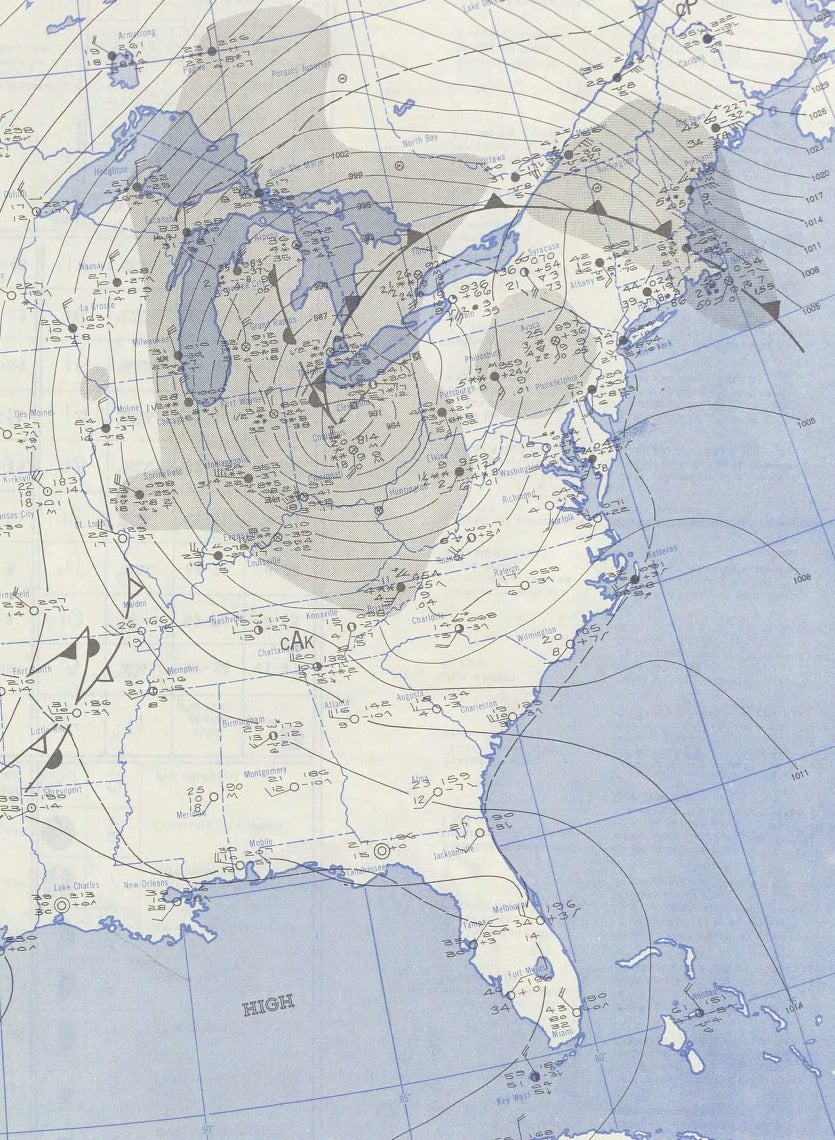
The isobars tell the whole story to those who know what they mean. Obviously that does not include you.
Here is a weather map from the 1950s.
Back when they were hand drawn.
See any sign of a center of low pressure on there?
Below is the map that the weather forecasters of the allies used to find the window in the weather that would let them pull of the Normandy landings on D-day in WWII.
When the Germans were sure we would never invade, so they all went home (Rommel for his wife’s Birthday), or to some war games (the rest of the general staff of the German Army). They have made movies about it. See The Longest Day.
Maybe they want to show that the US agencies are either incompetent or else lying bastards.
If that is their intent, they have succeeded.
Somehow, the Nation Weather Service knew it should trust the European forecasts more than NHC forecasts. 48 hours before landfall, NWS predictions for peak wind were higher for Venice than St.Petersburg, higher for Orlando than Ocala, higher for Daytona than Jacksonville. Meanwhile, the center of the track endorsed by the NHC passed west of Jacksonville, straight north into Georgia.
I was in st martin watching Irma in 17 . The European model showed a direct hit days in advance while the American model showed it curving North . I left 3 days before it wrecked st martin and sailed south with the US model still showing it curving north and missing the island .
What are some good websites where we can see the European forecasts as they are published?
Try ventusky.com.
Got to: https://www.windy.com/ click on the hurricaine Icon. In the lower right hand of the screen you can oicik the model you want it to use.
Great web site. There is also a phone app.
I just checked the phone app. It has huricaine tracker too. As I type the eye of the storm has moved off the east coast of Floria and is about 16 mi. NNE of Cape Canaveral. Fortunately. The winds have dropped to about 70 mph. And because of the geometrey of this storm and its path over Florida, the winds over the cape are from the west and carry a lower storm surge. Wouldn’t want to damage all of that expensive hardware.
Windy has almost too many features.
https://www.windy.com/station/pws-f073f8b4?42.976,-72.777,8,i:pressure
Credit where it’s due – NHC got the landfall location of hurricane Fiona almost dead on about 48 hours in advance (IIRC)
Blind squirrel in the woods?
At 48 hours , most of the models were in agreement according to the graph. Its the 72 and 96 hr graphs which had such divergent paths. Those are also the ones needed so that the right population center can have time to evacuate if needed. If at 4 or 5 days out you are seeing that it is going to hit the panhandle and then it hits south of Tampa, the wrong people are leaving their houses.
Quite often our local TV weather guy will talk about incoming storms and projections for things like temperature, wind speed, rainfall, etc. and mention that some of the model numbers look unrealistic (in his opinion) and will then show the same data from European models. Guess which ones he seems to prefer, and which are more often correct.
The answer is simple. When observations do not match the computer models, change the observation. Therefore, Ian did not make landfall in southern Florida. It made landfall where the computer models said it would, and all that “evidence” is just denier talk. Problem solved.
If there are serious accuracy problems with the US’ 72-hour predictions, how can we believe projections out to 2100?
Where’s Mosher? He could Mosh-splain it to you in a short, cryptically worded drive-by.
(free of punctuation and capital letters, but with so many spelling errors that it appears to be encrypted).
Different models.
Both Word and Acrobat are word processors, but they also have different strengths and weaknesses.
Note that this projection was based on US models run on Sept 27, 2022.
Note that the projection was incorrect less than one day later when landfall occurred 142 miles to the south and Tampa was not subject to major hurricane wind speeds.
This had to affect people severely who either fled south to avoid the warning or remained in place assuming a different landfall.
The US models are made by affirmative action lottery winners whose job it is to make sure that the models have all of the colors to represent of the proper gender perversities. And wish forecast the hurricane onto the most conservative areas. US is doomed.