Guest “Let’s go Mets!” by David Middleton
There are three things that I am somewhat embarrassed of:
- I am not a native Texan… I was born in Connecticut, but I got here as fast as I could.
- I am a life-long New York Jets fan… I watch a recording of Super Bowl III every Super Bowl Sunday.
- I am a life-long New York Mets fan.
One of my favorite books of all time is The Year the Mets Lost Last Place…

Date: 1969
After the Mets secured their World Series win in Game 5 on October 16, 1969, people wanted the story of that miraculous season as soon as possible. Paul Zimmerman and Dick Schaap would be the first among many to publish a comprehensive account, issuing their book on “the most amazing year in the history of baseball” only two days after the Mets won the World Series. How did they manage that? They documented the thrills of the season as they happened. By the time the Mets surprised the world with their upset of the Baltimore Orioles, Zimmerman and Schaap’s play-by-play prose was already in hand, ready for fans who wanted to learn about and relive one of baseball’s most inspiring triumphs.
TAGS:1960S • 1969 SEASON • DICK SCHAAP • PAUL ZIMMERM
Mets Virtual Vault
I was ten years old throughout most of 1969. The Jets won Super Bowl III in January, Neil Armstrong took that “giant leap for mankind” in July and the Amazing Mets went from perennial last, or next-to-last, place finishers to upsetting the Baltimore Orioles four games to one in the World Series. 1969 will always be one of my favorite years… So I guess I shouldn’t rag on renewables for crawling out of last place… But, I will anyway.
APRIL 26, 2022
Renewable generation surpassed nuclear in the U.S. electric power sector in 2021Electric power sector generation from renewable sources totaled 795 million megawatthours (MWh) in the United States during 2021, surpassing nuclear generation, which totaled 778 million MWh. The U.S. electric power sector does not include electricity generators in the industrial, commercial, or residential sectors, such as small-scale solar or wind or some combined-heat-and-power systems. Renewable generation includes electricity generated from wind, hydropower, solar, biomass, and geothermal sources.
Natural gas remained the most prevalent source of energy used in electricity generation in the United States, accounting for 1,474 million MWh in 2021. Although several U.S. coal-fired power plants retired in 2021, coal-fired electricity generation increased for the first time since 2014 and was the source of more U.S. electricity than either renewables or nuclear power. Total generation in the electric power sector increased slightly in 2021, but it remained less than its record-high year of 2018.
The increase in U.S. electric power sector renewable generation during 2021 came mainly from more wind and solar generation as a result of more wind turbines and utility-scale solar power plants coming online. Wind generation increased by 12% in 2021, and utility-scale solar generation increased by 28%. Hydroelectric generation decreased to its lowest level since 2015, mainly because of dry conditions in the western United States. Biomass and geothermal electricity generation remained relatively unchanged in 2021.
Nuclear-powered generation has remained relatively steady in the United States during the past decade because uprates at existing facilities have offset the retirement of several reactors. Only one reactor was retired in 2021: New York’s Indian Point Unit 3. Despite a slight increase in the capacity factor of the U.S. nuclear fleet in 2021, U.S. nuclear electricity generation fell to its lowest level since 2012.
Principal contributor: Syne Salem
Tags: generation, coal, electricity, natural gas, nuclear, renewables, wind, biomass, hydroelectric, solar
EIA
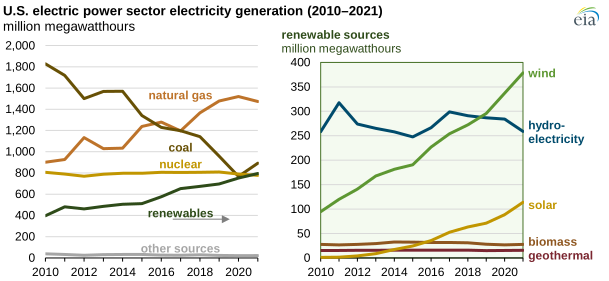
Renewables (wind + hydroelectricity + solar + biomass + geothermal) barely edged out nuclear power (795 to 778 million MWh) in 2021. This seems about as newsworthy as the New York Mets’ starting lineup hitting more homeruns in 1969 than Hank Aaron…
- Hank Aaron: 44 homeruns
- New York Mets starting lineup: 68 homeruns
Hank Aaron hit his 44 homeruns in just 547 at bats. The Mets starting lineup required 3,250 at bats to rack up their 68 homeruns… giving us another analogy: MWh of generation per MW of installed capacity. The most recent EIA numbers are for 2020.
- Nuclear Power: 96,501 MW
- Renewables (wind + hydroelectricity + solar + biomass + geothermal): 284,895 MW
Nuclear power plants generated 778 million MWh from about 96,500 MW of installed capacity. Renewables required about 286,000 MW to rack up 795 million MWh. Nuclear power plants delivered a 92% capacity factor, renewables took 2/3 of the year off, only delivering a 32% capacity factor. The numbers aren’t exact because I’m using 2021 generation and 2020 installed capacity… But they are “in the ballpark.”
Carrying on with odd segues…
If nuclear had the support that the green fanatics in government have given to wind and solar, we would have a Star Trek level of civilization, instead of the dark ages – hope and pray it’s windy and sunny tomorrow or else I won’t eat again – level that we’re reverting to.
I still don’t understand why biomass gets lumped in with Zero CO2 sources in the renewable category. Biomass is about as carbon-less as coal. In fact, Coal and petroleum really are biomass.
The claim is that biomass that gets burned comes back as new biomass from new growth of trees etc. so it gets a pass.
Sadly, even 3rd grade teachers will see in that graph that it is possible for renewables to take over all electricity production. And that is all they will be allowed or willing to see.
I’m looking at the slope for renewables over the last ten years of extensive wind/solar efforts and trying to imagine how long it will take to rise to the total of all sources on that graph. (Zero carbon / zero nuke) Wind/solar needs to increase by about of factor of 5? 50 years? While attacking all the current sources right now? And about that transportation issue where we’re also being forced to go carbonless and will require about an additional 3 times current wind production? Also, grid battteries?
And we won’t even end up with a world thermostat controlling the temp.
Having hydro power in the “renewables” basket I think distorts the reality. I wonder what the capacity factor is for hydro and whether it is significantly boosting the low 32% number of renewables!
Dave,
Good post. These are all U.S. numbers. It made me wonder about the global numbers. From Exxon Outlook (2021), from 2010 through 2020, fossil fuel use went up by 13 quadrillion BTUs (QBTU) globally, an increase of 3.2%.
Over the same period, all renewables (geothermal, wind, solar, biofuels) went up 11 QBTU, an increase of 157%. They more than doubled, but still did not keep up with the global growth of energy use.
Exxon shows that they might exceed the yearly growth in energy consumption by 2050, but I’m not holding my breath. They project increasing use of oil and natural gas through 2050, but a decline in coal use. If you believe that, I have a bridge in Connecticut I’ll sell you!
Of course, we remember the brilliant John Kerry recently said that oil and gas would be gone in ten years. What a mess.
The nut-jobs are out in full force…
https://reclaimfinance.org/site/wp-content/uploads/2022/04/Asset_Manager_Climate_Scorecard_2022.pdf
Yuck! What bozos.
Since you mentioned the Mets, I was 13 and living in the Bronx and a diehard Met fan since 1962 (long story), BUT my favorite year has to be 1986 when my Mets and my Giants both won , sorry Jets. The climate was mostly the same as it has been since my birth in 1956, so there’s that..