Update (EW): Free link to the full paper, kindly provided by Dr. Willie Soon.
I received this email from Willie Soon today,
Dear Friends and Colleagues,
I am proudly attaching this new paper:
“Group Sunspot Numbers: A New Reconstruction of Sunspot Activity
Variations from Historical Sunspot Records Using Algorithms from Machine Learning”
that just appeared online at Solar Physics,
https://link.springer.com/article/10.1007/s11207-021-01926-x
Indeed we think that this paper is very important on various fronts, including
even the rather clear and revisionist attempts by several activists during the last
10 years or more to try to modify the Group Sunspot Number (GSNs) record with
rather flawed reasonings and evidence as documented in this detailed paper.
If we are wrong, let the debate begin openly and objectively in the public and science
spheres. The rather ugly approach by the revisionists may not be clear but throughout the
last 10 years, they have been systematically ignored and censored any constructive criticisms
and suggestions by Douglas Hoyt, our co-author, who is a serious scholar on
the reconstruction of sunspot activity records.
For some of us that called America home, the fun aspect of this paper is
to point to the possible recovery of the long-lost first sunspot drawings
from Colonial America by Humphry Marshall (1722-1801).
Cordially,
Willie together with colleagues Victor Velasco Herrera, Doug Hoyt and Judit Murakozy
ps: for some of you whom may be interested in more details and discussion
concerning the origin of this article, please consider these two talks
(1) Studying the role of the Sun on Climate
(2) Studying Sunspot Activity Cycles: Hindcasting and Forecasting
Here is the paper’s abstract.
Abstract
Historical sunspot records and the construction of a comprehensive database are among the most sought after research activities in solar physics. Here, we revisit the issues and remaining questions on the reconstruction of the so-called group sunspot numbers (GSN) that was pioneered by D. Hoyt and colleagues. We use the modern tools of artificial intelligence (AI) by applying various algorithms based on machine learning (ML) to GSN records. The goal is to offer a new vision in the reconstruction of sunspot activity variations, i.e. a Bayesian reconstruction, in order to obtain a complete probabilistic GSN record from 1610 to 2020. This new GSN reconstruction is consistent with the historical GSN records. In addition, we perform a comparison between our new probabilistic GSN record and the most recent GSN reconstructions produced by several solar researchers under various assumptions and constraints. Our AI algorithms are able to reveal various new underlying patterns and channels of variations that can fully account for the complete GSN time variability, including intervals with extremely low or weak sunspot activity like the Maunder Minimum from 1645 – 1715. Our results show that the GSN records are not strictly represented by the 11-year cycles alone, but that other important timescales for a fuller reconstruction of GSN activity history are the 5.5-year, 22-year, 30-year, 60-year, and 120-year oscillations. The comprehensive GSN reconstruction by AI/ML is able to shed new insights on the nature and characteristics of not only the underlying 11-year-like sunspot cycles but also on the 22-year Hale’s polarity cycles during the Maunder Minimum, among other results previously hidden so far. In the early 1850s, Wolf multiplied his original sunspot number reconstruction by a factor of 1.25 to arrive at the canonical Wolf sunspot numbers (WSN). Removing this multiplicative factor, we find that the GSN and WSN differ by only a few percent for the period 1700 to 1879. In a comparison to the international sunspot number (ISN) recently recommended by Clette et al. (Space Sci. Rev. 186, 35, 2014), several differences are found and discussed. More sunspot observations are still required. Our article points to observers that are not yet included in the GSN database.
Update (EW): Free link to the full paper, kindly provided by Dr. Willie Soon.
Discover more from Watts Up With That?
Subscribe to get the latest posts sent to your email.

The winter circulation in the lower stratosphere will be typical of the Maunder Minimum. This is because the geomagnetic field to the north is split into two centers.
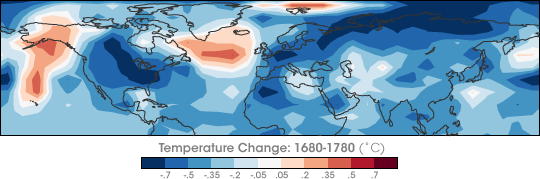
It will be a tough winter for Europe’s energy industry.
https://i.ibb.co/3vQ3kQH/hgt300.webp
Very heavy rain and snowfall in the southeastern US.