POHANG UNIVERSITY OF SCIENCE & TECHNOLOGY (POSTECH)
While the entire world focuses on achieving carbon neutrality – zero carbon dioxide (CO2) emissions – a new research shows climate change in some regions is inevitable even if the already increased CO2 level is reduced. As CO2 decreases, the intertropical convergence zone (ITCZ) shifts southwards, which can trigger persistent El Niño conditions. El Niño refers to a phenomenon in which the sea surface temperature near the equator rises by 1 to 3°C above its surroundings, causing droughts, storms, and floods around the world.
A POSTECH research team led by Professor Jong-Seong Kug and Ji-Hoon Oh (Division of Environmental Science and Engineering) conducted a simulation on the Earth system model that can ramp-up and ramp-down the concentration of atmospheric CO2. The researchers observed that the ITCZ, which hardly moved when the CO2 concentration increased, sharply shifted southwards when the CO2 level decreased. Even when the CO2 concentration was returned to its original level, its center still remained in the Southern Hemisphere.
The shift of the ITCZ, where 32% of the global precipitation occurs, is an extremely important factor in determining the amount of precipitation in the tropics and subtropics. The shift can change the Hadley circulation – the starting point of the global atmospheric circulation – to cause abnormalities in the global climate. Through this study, Professor Kug’s team has confirmed that as CO2 begins to decrease, the ITCZ moves to the Southern Hemisphere which remains warm, unlike the Northern Hemisphere that cools down with CO2 reduction.
Atmospheric CO2 reduction could slowly return the average global temperature and precipitation to normal. However, the researchers claim that the climate may appear completely different in some regions. The change in precipitation due to the southwards shift of the ITCZ is very similar to the pattern during an extreme El Niño. In other words, it is expected that some regions will experience an abnormal climate condition where an extreme El Niño persists.
The model simulations confirmed that even if the increased CO2 concentration is reduced and returned to its original value, the Sahel zone including the Sahara Desert and southern Europe around the Mediterranean Sea experienced a 20% decrease in average annual precipitation compared to the current levels, leading to further desertification. In contrast, North and South America had an increase in precipitation by about 15%. In fact, a risk of more frequent flooding was found in the western regions of North and South America where the increase in precipitation was noticeable. In East Asia, including the Korean Peninsula, a possibility of more rain during the monsoon season was found due to the increased precipitation in summer.
“It is impossible to properly reflect the complex climate system if only the average global temperature and precipitation levels are considered when creating mitigation policies to prevent climate change, such as carbon neutrality or carbon reduction,” explained Professor Jong-Seong Kug. Emphasizing that regional changes such as the southwards shift of the ITCZ should be fully taken into account, Professor Kug added, “The already emitted greenhouse gases have lasting effects on the planet so we need to recognize their long-term impacts as well as their immediate effect on climate change.”
Recently published in Nature Climate Change, this study was conducted with the support from the Irreversible Climate Change Research Center funded by the National Research Foundation of Korea.
JOURNAL
Nature Climate Change
ARTICLE TITLE
Hysteresis of the intertropical convergence zone to CO2 forcing
ARTICLE PUBLICATION DATE
9-Dec-2021
“Climate science” is starting to become a parody of itself.
If by “starting” you mean has been for 30 years, then yes.
The latest scientific data from CERES tells a different story. The data appears to show that the warming seen over the past 25 years was driven by a reduction in clouds and not CO2.
“The drop of cloudiness around the millennium by about 1.5% has certainly fostered the positive net radiative flux.”
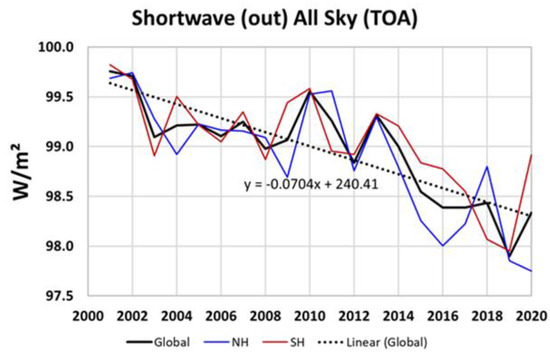
“… the root cause for the positive TOA net flux and, hence, for a further accumulation of energy during the last two decades was a declining outgoing shortwave flux and not a retained LW flux. ” – Hans-Rolf Dübal and Fritz Vahrenholt, October 2021, journal Atmosphere, Radiative Energy Flux Variation from 2001-2020.
https://www.mdpi.com/2073-4433/12/10/1297/htm
“The shift from a negative to a positive PDO (Pacific Decadal Oscillation) index as an additional factor for the net TOA flux”
OK, the PDO shift occurred in 2014 so how does this align with the warming?
https://woodfortrees.org/plot/uah6/from:1997/to/plot/uah6/from:1997/to:2014/trend/plot/uah6/from:2015/to/trend
So two drops in clouds. One right around the turn of the century and another around 2014. Warming followed. Sure looks like a solid theory. This means we’ve likely gone 25 years without any greenhouse warming. I wonder how that fits into their model.
https://woodfortrees.org/plot/uah6/from:1997/to/plot/jisao-pdo/from:1997/to/normalise
The cloud reaction ( for the “albedo warming” after 2014 ) could be indeed a result of the PDO+ swing.
“Recently published in Nature Climate Change, this study was conducted with the support from the Irreversible Climate Change Research Center funded by the National Research Foundation of Korea.”
What a surprise, the research center established to study irreversible climate change, found irreversible climate change. That’s as surprising as the IPCC finding that CO2 is the climate control knob. Are we ever going to move on from this nonsense?
“Models confirmed…”. What bullshit. Models confirm nothing. I worked my whole career in the semiconductor business where everything is designed using Models. An axiom from people who actually know Modeling is that models never work. They can be tweaked into usability only after much testing against REALITY.
Nature Magazine = BBC = Climate Change Propaganda
https://www.americanthinker.com/articles/2021/04/the_coming_modern_grand_solar_minimum.html
Quote – “Even when the CO2 concentration was returned to its original level…”
—————
At that point I realized there was no point reading any further. “Original” level???
Well actually I realized that from reading the title because we are already in the climate of the past and no matter how much it changes in any direction, we will still be in a climate of the past. Earth has been through it all before.
Since the climate can logically only get hotter, get colder, or stay the same, and it’s been all of those in the past, saying we can’t return to a climate of the past is nonsensical.
A conclusion that begs the question. Notably an assumption, assertion of cause and effect. And a colored perception of systems and processes, past, present, and future.
If we build our assumptions into a model, then the model confirms our assumptions. The end.
I’m confused by the information provided under the initial graph and the text directly below. Which is it…does the ITCZ shift to the south in CO2 levels “increase” (text with graph) or does the shift occur when the CO2 levels “decrease” (1st paragraph), thus causing lingering El Nino conditions?
Yes.
The Magic Molecule can do anything at all that the models want it to do.
More self satisfaction models return what the modeler desires.
“The model simulations confirmed” I stopped reading at this point.
return the average global temperature and precipitation to normal
Did someone finally define “normal”? I’ve been asking what the right temperature (and the rest) should be for years, still haven’t gotten an answer.