A new study published in Geoscience Frontiers gives a surprising result.
By NEW YORK UNIVERSITY JUNE 20, 2021
Analysis of 260 million years of major geological events finds recurring clusters 27.5 million years apart.
Geologic activity on Earth appears to follow a 27.5-million-year cycle, giving the planet a “pulse,” according to a new study published in the journal Geoscience Frontiers.
“Many geologists believe that geological events are random over time. But our study provides statistical evidence for a common cycle, suggesting that these geologic events are correlated and not random,” said Michael Rampino, a geologist and professor in New York University’s Department of Biology, as well as the study’s lead author.
Over the past five decades, researchers have proposed cycles of major geological events — including volcanic activity and mass extinctions on land and sea — ranging from roughly 26 to 36 million years. But early work on these correlations in the geological record was hampered by limitations in the age-dating of geologic events, which prevented scientists from conducting quantitative investigations.
However, there have been significant improvements in radio-isotopic dating techniques and changes in the geologic timescale, leading to new data on the timing of past events. Using the latest age-dating data available, Rampino and his colleagues compiled updated records of major geological events over the last 260 million years and conducted new analyses.
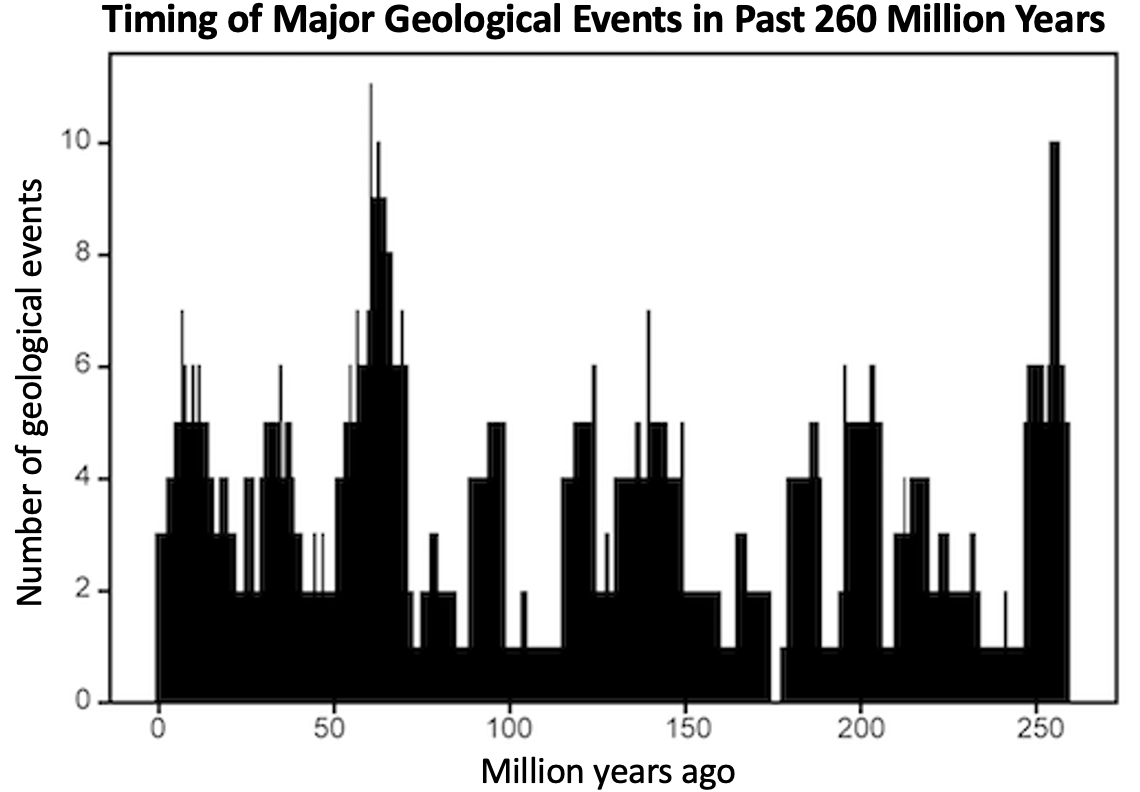
NYU researchers found that global geologic events are generally clustered at 10 different timepoints over the 260 million years, grouped in peaks or pulses of roughly 27.5 million years apart. Credit: Rampino et al., Geoscience Frontiers
The team analyzed the ages of 89 well-dated major geological events of the last 260 million years. These events include marine and land extinctions, major volcanic outpourings of lava called flood-basalt eruptions, events when oceans were depleted of oxygen, sea-level fluctuations, and changes or reorganization in the Earth’s tectonic plates.
They found that these global geologic events are generally clustered at 10 different timepoints over the 260 million years, grouped in peaks or pulses of roughly 27.5 million years apart. The most recent cluster of geological events was approximately 7 million years ago, suggesting that the next pulse of major geological activity is more than 20 million years in the future.
Here is is a link to the original study
And the abstract.
Abstract
We performed spectral analyses on the ages of 89 well-dated major geological events of the last 260 Myr from the recent geologic literature. These events include times of marine and non-marine extinctions, major ocean-anoxic events, continental flood-basalt eruptions, sea-level fluctuations, global pulses of intraplate magmatism, and times of changes in seafloor-spreading rates and plate reorganizations. The aggregate of all 89 events shows ten clusters in the last 260 Myr, spaced at an average interval of ~ 26.9 Myr, and Fourier analysis of the data yields a spectral peak at 27.5 Myr at the ≥ 96% confidence level. A shorter period of ~ 8.9 Myr may also be significant in modulating the timing of geologic events. Our results suggest that global geologic events are generally correlated, and seem to come in pulses with an underlying ~ 27.5-Myr cycle. These cyclic pulses of tectonics and climate change may be the result of geophysical processes related to the dynamics of plate tectonics and mantle plumes, or might alternatively be paced by astronomical cycles associated with the Earth’s motions in the Solar System and the Galaxy.
Graphical abstract

” … geologist and professor in New York University’s Department of Biology … ”
A specialist professor of biology … who’s really a geologist? … wtf?
That does not scan.
He has all the qualifications to be a climatologist!
I read this book back in the 80’s. Nemesis, by Donald Goldsmith.
It means we’re doomed.
“The aggregate of all 89 events shows ten clusters in the last 260 Myr, spaced at an average interval of ~ 26.9 Myr, and Fourier analysis of the data yields a spectral peak at 27.5 Myr at the ≥ 96% confidence level. A shorter period of ~ 8.9 Myr may also be significant in modulating the timing of geologic events. Our results suggest that global geologic events are generally correlated, and seem to come in pulses with an underlying ~ 27.5-Myr cycle.”
To believe this, one must believe that scientists have the ability to pinpoint the time frame of numerous events in the very distant past with some precision.
Note that the cycle periodicity they give is 27.5 million years. Not 27 million or 28 million but 27.5 which suggests precision that doesn’t exist.
Take the random occurrence of events in any realm which is based on variables that are independent from each other and just like flipping a coin, you will get streaks of non correlated but coincidental events. It’s actually more likely than not to happen.
Unless you can find causation or an explanation for the cycles, they are as likely to be part of the expected coincidental streaks as they are to be from a legit repeating cycle that resulted from an underlying related cause.
Hit any data with a heavy Gaussian filter and it starts to look “a bit cyclic” but that looks like a very irregular “cycle”, which has no predictive ability. ie there is no significant cyclic component.
well 20 mil to go
wont be an issue for me;-)
So this says we just passed a peak of geo events ~1 million years ago and its 26 million years to the next peak. Got it, I’ll let my homeowners insurance lapse for ~15 million years.
Subjective choice as to what is counted as an event?
The Nemesis Star is thought to have a 26 million year cycle?
“major geological events — including volcanic activity and mass extinctions on land and sea”
It struck me their research is about a pretty loose selection of large scale geological phenomena. OK, I am not a geologist, but does that matter? When your research object is that broadly defined, what is it you are studying?
It leaves me wondering whether geologists are agreed on, and are working with, a clearly defined set of “major geological events”, still specific enough to interpret the data in terms of interactions between detectable geological mechanisms.