Guest “debunking the debunkers” by David Middleton
Setting the Stage
Why was Texas, ERCOT (Electric Reliability Council of Texas) in particular, so unprepared for the onslaught of frigid weather? This was NOAA’s February temperature outlook map, released on January 31, 2021:

20 days later, this was NOAA’s map of the number of hours below freezing for the week of Feb. 12-19, 2021:

In less than a week, we went from an outlook for about normal February temperatures to the forecast of an ice storm and then “the worst winter weather conditions seen locally in decades (if not on record)”… Radical would be an understatement.
The first hint I had of the approach of Winter Storm Younger Dryas was on Monday, February 8. Not being hurricane season, I wasn’t paying too close attention to the weather. The forecast on Monday was for possible freezing rain overnight on Wednesday… But the scary bit was a forecast of single digit low temperatures early in the week. It simply doesn’t get that cold in the DFW area. And as the days went by, the forecast kept getting worse.
The ice storm hit Wednesday night and caused this on Thurday…
And it just kept getting colder. By Sunday, February 14, it was snowing and temperatures were 41 °F below normal…

This Arctic blast was essentially unprecedented…
Oklahoma City set a record for its longest straight period of temperatures at or below 20 degrees: 210 hours between Feb. 9 and 17 beat its previous record in 1983. The temperature dipped to minus-14 degrees on Feb. 16, the city’s lowest since 1899.
Dallas experienced its second-longest streak of temperatures at or below freezing and at or below 20 degrees, and reached its third-coldest temperature on record: minus-2 degrees.
Houston, which was placed under its first wind chill warning, observed a wind chill of 1 degree, its lowest since at least 1990, according to meteorologist Alex Lamers. Its high temperature of 25 degrees was its fourth coldest on record.
Kansas City set a record for the longest stretch with temperatures at or below 15 degrees, at 10 days.
Washington Post
February 16 was actually tied for the second lowest DFW temperature on record.
Coldest temp in over 70 years and the 2nd coldest temp ever recorded in the D-FW area
On Feb. 16 the temperature dropped to -2°.This ties the 2nd coldest temp ever recorded.
On Jan. 31, 1949 the temperature also dropped to -2°.
The only time it has been colder was -8° back on February 12, 1899.
3 days in a row of record lows
Feb. 14, 15, and 16 all observed record low temps.Feb. 14 the low was 9°, which shattered the old record of 15° set in 1936.
Feb. 15 the low was 4°, which shattered the old record of 15° set in 1909.
Feb. 16 the low was -2°, which shattered the old record of 12° set in 1903.
3 days of record cold high temperatures
From Feb. 14 to 16, all three days observed record cold high temperatures.This means the afternoon was the coldest on that date that is ever been observed.
Feb. 14 the high was 22°. This breaks the old record of 27° set in 1951.
Feb. 15 the high was 14°, which shattered the old record of 31° set in 1909.
Feb. 16 the high was 18°, which breaks the old record of 21° set in 1903.
WFAA
It also pretty well knocked out most of Texas wind power production… because Texas doesn’t winterize their wind turbines… Right?
Debunking the debunkers
Fact Check: Do Wind Turbines Really Fail in Cold Weather?
It’s time to debunk the rumors.By Brad Bergan
Feb 17, 2021
Crisis breeds confusion and the recent string of record-low temperatures amid this week’s cold and frosty weather conditions in Texas are no exception. But when the state’s power grid fell short of energy demands, misinformation spread like wildfire — arguing that frozen wind turbines are to blame for the blackout.
However, wind turbine installations don’t go up without substantial investment — which means planning for the kind of volatile weather much of the world is already seeing for the first time. The question is raised, then: Can wind turbines really fail in cold weather?
Wind turbines in cold environments typically ‘winterized’
Misinformation sparked when an image showing an Alpine helicopter de-icing wind turbines covered in frost or ice surfaced on social media. The implication was that frozen wind turbines were the cause of Texas’ series of power outages.[…]
Interesting Engineering

The interesting engineer went on to state that helicopter-assisted wind turbines are better for the climate than coal-fired power plants.
In fact, carbon emissions generated from de-icing a turbine — like in the Alpine Helicopter video and image — saves two days’ worth of emissions, relative to coal power.
Interesting Engineering
This may be true… But it’s not likely to be of much comfort to the 4.5 million Texans who lost power during the record-shattering cold stretch.
While I have no doubt that wind turbines are winterized in very cold places where fossil fuels and nuclear power have been effectively outlawed, Texas isn’t one of those sort of places. So… If Texas (ERCOT) wind turbines failed because they weren’t properly winterized, then the other grids hammered by Winter Storm Younger Dryas must have fared better… Right?
The Southwest Power Pool (SWPP) and Midcontinent Independent System Operator (MISO) extend from Texas to the Canadian border.

Their wind power output did what ERCOT’s did… It failed.

Here’s a funny, maybe coincidental, correlation:

Note that the correlation is just as good when temperatures are above freezing. Why use DFW temperatures?
- I live in Dallas and I remember 1983 and 2011.
- The Dallas-Fort Worth (DFW) area was the first major metropolitan area in the ERCOT grid to be hammered.
- The North Central Texas region had the highest electricity demand in the ERCOT grid.
Why were ERCOT and Texas hit so hard?
Why weren’t power outages nearly as bad in the SWPP and MISO grids? It might just have something to do with coal.


On the other hand, the fuel source receiving most of the blame from the lamestream media, outperformed the neighboring grids by a wide margin.

The “failure” was the drop-off from 900,000 MWh/d on February 14 to 700,000 MWh/d on February 16. At this time, the explanations for this are anecdotal. Hopefully, the multitude of investigations will produce at least one dispassionate explanation for what went wrong and how to prevent it from happening again.
Let’s Make Orwell Fiction Again!
[W]hile frozen wind turbines have contributed to the state’s energy crisis, that type of energy has only slightly underperformed against published expectations for winter output.
NBC News
Wind typically accounts for 20-25% of ERCOT’s winter generation. Winter, particularly February, is actually a good wind season. According to the EIA, in February 2019 wind achieved a 41% capacity factor in Texas. ERCOT data indicate a 31% capacity factor in February 2019. Up until February 8, wind was exceeding expectations… Then the bottom dropped out for 10 days.


Wind’s failure occurred a full week before the power outages… When 25% of your team doesn’t show up for the game, the phrase “only slightly underperformed” is, at the very least, Orwellian.
Natural gas, the state’s dominant energy source, has provided drastically less energy than expected, according to experts and industry data.
NBC News
This is akin to saying that the Avengers performed drastically less well than expectations against Thanos in Infinity War.

About 60% of Texas natural gas generation consists of combined cycle (CC) power plants, which can exceed 80% capacity factors. Gas turbines and other combustion generators can ramp up and down quickly, but have low capacity factors. From Feb. 7-12, natural gas ramped up 10-20% to >60% and was operating like it normally does in August.
| Technology | Time adjusted capacity (MW) | % | Ann | Jan | Feb | Mar | Apr | May | Jun | Jul | Aug | Sep | Oct | Nov | Dec |
| Capacity Factors | |||||||||||||||
| Natural Gas – CC | 41,095.7 | 60% | 56.4 | 52.7 | 46.8 | 44.6 | 41.4 | 54.2 | 65.4 | 71.6 | 75.9 | 69.3 | 51.1 | 49.2 | 53.4 |
| Natural Gas – GT | 9,689.5 | 14% | 33.8 | 31.9 | 29.2 | 28.6 | 28.0 | 32.7 | 35.9 | 40.5 | 42.9 | 38.7 | 32.8 | 31.3 | 33.0 |
| Natural Gas – IC | 908.5 | 1% | 19.7 | 15.5 | 16.1 | 17.2 | 16.3 | 19.6 | 20.3 | 25.1 | 29.0 | 26.5 | 18.7 | 18.5 | 13.9 |
| Natural Gas – ST | 17,096.7 | 25% | 14.8 | 6.8 | 6.0 | 8.8 | 8.4 | 13.2 | 18.3 | 24.6 | 34.8 | 24.4 | 15.4 | 8.5 | 7.8 |
While natural gas generation should have been able to hold at a 60% capacity factor from Feb. 14-18, it clearly outperformed what is normally expected for this time of year.
Every part of the ERCOT system failed to some degree from Feb. 15-17.

The narrative has been that conservatives have unfairly blamed the power failure on wind power in order to prop up fossil fuels. The narrative is a straw man.
No, Wind Farms Aren’t the Main Cause of the Texas Blackouts
The state’s widespread electricity failure was largely caused by freezing natural gas pipelines. That didn’t stop advocates for fossil fuels from trying to shift blame.By Dionne Searcey
Feb. 17, 2021
As his state was racked by an electricity crisis that left millions of people without heat in frigid temperatures, the governor of Texas took to television to start placing blame.His main target was renewable energy, suggesting that the systemwide collapse was caused by the failure of wind and solar power.
“It just shows that fossil fuel is necessary for the state of Texas as well as other states to make sure we will be able to heat our homes in the winter times and cool our homes in the summer times,” said Gov. Greg Abbott, speaking on Sean Hannity’s show on Fox News. Other conservative talk-show hosts had already picked up the theme.
[…]
New York Times
Nothing in Gov. Abbott’s statement is false or misleading. While there were failures across the system, wind and solar failed almost totally a week before natural gas, coal and nuclear experienced their problems. On the coldest day since 1899, fossil fuels accounted for 83% of ERCOT’s electricity generation. Fossil fuels + nuclear accounted for 92%.
Orwellian efforts to exonerate wind & solar and place the blame on natural gas, coal and nuclear power are simply… Orwellian. Claiming that this is a “wake up call” for the United States to further degrade our energy infrastructure, because climate change is Orwellian on LSD and steroids…
White House climate czar to AP: Texas storm ‘a wake-up call’
The Associated PressWASHINGTON (AP) — The deadly winter storm that caused widespread power outages in Texas and other states is a “wake-up call” for the United States to build energy systems and other infrastructure that are more reliable and resilient in the face of extreme-weather events linked to climate change, President Joe Biden’s national climate adviser says.
[…]
“We’re going to push the clean energy, we’re going to push for better cars, but it’s also going to be about capturing the will of the public to actually face the challenges we’re facing today and meet them in a way that’s going to be beneficial to them,″ she said.
For example, Biden’s plans to provide 500,000 charging stations for electric cars and invest in battery technology are intended to make it easier for the public to participate in a clean-energy economy. “If we can lower that cost, and everybody knows they can get where they need to go when they need to get there” in an electric car, “we’ll get the kind of demand on the auto-sector side that we need,″ she said.
Similarly, if utilities are given the right incentives, they can meet Biden’s goal to have net-zero carbon emissions by 2035, McCarthy said. The head of a lobbying group for electric utilities said earlier this month that the 2035 date would be “an incredibly difficult situation to handle” for most U.S. providers.
[…]
Associated Press
Clearly, if the grid was devoid of natural gas & coal generation, more wind & solar generation, ERCOT was connected to SWPP & MISO (it already is connected to SWPP and Mexico) and we had 500,000 more EV charging stations… What? Winter Storm Younger Dryas wouldn’t have happened? The power failures wouldn’t have been so bad?

It’s time to make Orwell fiction again… MOFA!
Who, what, when, where and why?
Whatever happened to the 5 W’s? At this point we only know what, when and where. Yet, virtually all of the lamestream media are distorting the what and reporting conclusions about who and why based on anecdotal information and “expert” opinions.
We won’t know the “why” until we know exactly what failed:
- Wind
- Ice on blades?
- Frozen turbines?
- Poor wind conditions?
- Poor cold weather performance in general?
- Natural gas
- Frozen wellheads and damaged separators?
- Shut in production to avoid frozen wellheads and damaged separators?
- Frozen pipeline control valves and/or hydrate plugging?
- Low line pressure due to excess demand for heating and electricity?
- Compressors knocked offline by power outages?
- Frozen pipes in power plant cooling systems?
- Power plants offline for maintenance in low demand season?
- Coal
- Frozen pipes in power plant cooling systems?
- Frozen boilers?
- Ice covered coal stacks?
- Emissions restrictions?
- Power plants offline for maintenance in low demand season?
We won’t know the “who” until we know the “why”.
Even worse, the politicians have already claimed to know what the solutions are. And in almost every case, the media and politicians are focusing on what they think should have been done differently over the past 20-50 years, rather than on what could have been done differently over the past 20-30 days, particularly what could have been done differently from February 5-14, 2021.
A couple of points about gas supply: a very large chunk of gas supply actually came from storage drawdown. In the US South Central region, withdrawals were 55bcf in the week to 5th February, 89bcf in the week to 12th February, and 156bcf in the week to 19th February. 156bcf has an energy content of about 45TWh.
When used for electricity generation, efficiency of conversion will vary between 60% for a modern CCGT operating in stable fashion at design capacity and about 40% for an open cycle peaker unit. Perhaps 5-6% of energy sent out will be used in pumping it to users with furnaces and stoves – maybe less to well located power stations. What is quite clear is that natgas storage puts any talk of batteries, pumped storage and other green boondoggles completely in the shade.
It should be noted that the gas in storage is dry gas, only subject to liquefaction at -160C, and not subject to hydrate formation. This map show gas in storage by county in Texas as at Nov 30th (the latest data from Texas Railroad Commission), which gives a fairly good idea of storage capacities:
https://datawrapper.dwcdn.net/66IkX/1/
We should note that gas supply was adequate to fire some 44GW of generation at peake demand at 8 p.m. on 14th February. It was only subsequently that supply became a problem. So although production was down due to freeze-offs and voluntary precautionary shut-ins at wellheads, supply was being made good from storage and from re-routing about 4bcf/day from LNG liquefaction to the market. It was ony when power was cut to pipelines that supply really became a problem.
…Orwell on LSD and steroids!
Is that how the DemoKKKrats came up with the Equality Act, or is that bigoilbob’s go to choice for breakfast?
Thanks for trying spread some light on a self-induced tragedy, and lightening the tragedy with some humor! That the lame stream urinalists and libtard pols are so loudly blaming fossil fuels for the near disaster of Winter Storm Younger Dryas indicates that even they have no faith in their Green Weenie solutions! They just parrot the party line so they can continue with the slush funds and bribery schemes that predominate in DC now! To be honest, some of them seem to be too stupid to know any better, but let’s not talk about AOC, let’s look at solutions!
Do you think ERCOT can be fixed or even be improved enough to avoid further mishaps like what just occurred? How many more “events” will have to take place before the public wakes up to the horrendously expensive scam that is Unreliable Energy!
re: “Do you think ERCOT can be fixed”
WRONG question; this was a PUCT and QSE (generator) failure. Read the 2011 report again.
SEARCH for this title: Report on Outages and Curtailments During the Southwest Cold Weather Event of February 1-5, 2011
_Jim,
Don’t you think that ERCOT exacerbated the problem? Whether or not the problems with Unreliable generators can be solved will depend on government and public policies that are still in flux and seem to be fighting the last war still!
What if there isn’t another extreme cold event for 15 years or more? Just about anything could seem to be solving the problem until the problem surfaces again. Nobody now in charge is likely to have to worry about it again.
“What if there isn’t another extreme cold event for 15 years or more?”
I would bet money that a large high-pressure system will settle over Texas within the next 15 years. It might happen this summer.
When the high-pressure system settles in, the winds don’t blow, and the windmills dont work.
Persistent high-pressure systems occur all the time and are involved in the most severe weather extremes such as cold waves and heat waves.
Persistent high-pressure systems make windmills incapable of successfully supplying base load electricity 100 percent of the time for any grid they are on.
Windmills have to have reliable backup power generation like natural gas for 100 percent of their output, otherwise windmills put the whole electrical grid in danger of failing.
Using helicopters to spray de-icing fluid on windmills is extremely inefficient. The helicopter burns more energy simply staying airborne than the windmill could produce in a day once it starts rotating in the wind. The better solution is to ramp up power production by natural gas during the cold snap, then let solar power melt the ice during the next warm front in Texas, and the windmills will start up naturally.
Another false meme from the ignorant media is that the gas-fired power plants couldn’t start their electric compressors. Huh? Natural-gas turbines have an inlet air compressor, which is connected to the same drive shaft as the power generation turbine, so that some of the output power is used to drive the inlet air compressor. As long as the flow of natural gas to a turbine continues, colder inlet air will not prevent the compressor from operating, and why would anyone shut the turbine down during a period of peak demand?
By the way, since cold air is denser than warm air at the same pressure, the volume flow rate through the compressor would be lower for the same mass flow rate in cold conditions than in warm, making the compressor more efficient!
re: “Another false meme from the ignorant media is that the gas-fired power plants couldn’t start their electric compressors.”
You seem to be conflating some things too, like the compressor stations situated at various points in the nat gas system that are now electric powered vs used to be nat gas-engine powered compressors.
One has only to understand that Wind is intermittent, meaning is CANNOT be counted on, to know that it is not any part of a solution to make a more stable grid. Solar is worse, it cannot be counted on in the day and can be counted on not to be available at night.
Peak power demand requires power that is there when you need it…not when the weather is cooperating. It must come from fossil fuels or nuclear – end of story. For fossil fuels, there needs to be enough fuel stockpiled to survive on for several days.
Texas should get behind an effort to start dismantling Wind Turbines as they have already proven to be a costly failure. No more should be built. The same with any centralized solar generation, get rid of it. The easiest way to start down this path is to remove the subsidies that intermittent power generation counts on to make fat profits.
re: “Texas should get behind an effort to start dismantling Wind Turbines as they have already proven to be”
You have NO grasp of the reality of the situation and ‘market’ (EVERYBODY has their hand out for ‘graft’) in Texas that enables this nonsense, IOW, that horse left the barn a LONG time ago.
Exactly, unreliable forms of energy like wind and solar get the subsidies
re: “Why was Texas, ERCOT (Electric Reliability Council of Texas) in particular, so unprepared for the onslaught of frigid weather?”
I read the above and have to think, what was Dave Muddle-minded’s thinking? It is up to each generator (QSE) on the Texas grid to prepare their equipment for cold weather …
Reading the report after the LAST event in 2011 we know the answer … but does Dave know?
It’s not a matter of ERCOT preparing equipment for cold weather. It was a matter of ERCOT not taking the storm seriously enough and not shedding load early or quickly enough…
https://www.kxan.com/news/texas/or-abbott-gives-2-reasons-why-ercot-is-responsible-not-a-scapegoat-for-storm-outages/
On February 14, it was too late to winterize anything. But there was still time to initiate rotating outages.
ERCOT doesn’t have regulatory power. That resides with the PUC and state legislature. All of them basically ignored recommendations made after similar, but smaller scale, problems in 1989 and 2011.
https://www.wfaa.com/article/news/local/investigates/30-years-of-warnings-to-winterize-texas-power-plants-yet-they-still-froze-will-austin-finally-require-it/287-20540908-dbce-4e17-90a3-19aa4f4f4690
Bingo
Texas needs to STOP RELYING on UNRELIABLES.
GREATLY INCREASE the percentage of RELIABLE COAL-FIRE ELECTRICITY. (they have plenty of coal)
Weather harden the gas supplies so that cold doesn’t cause supply issues.
And certainly don’t rely on wind and solar for pumping that gas.
The blame for the WHOLE DEBACLE can be place totally at the feet of the scientifically unsupportable ANTI-CARBON agenda.
“…Wind was operating as well as expected” Really? Ask the people on the ground who played Texas blackout Baseball: The facts: # players on payroll: Wind-28755, Nuclear-5153. # players in uniform: Wind-7070, Nuclear-5153. World Series batting average: Wind-0.110, Nuclear-0.800. Who do you want on your team?
If you were to hire workers for a job would you hire unreliable workers like solar and wind?
From the article: “Why weren’t power outages nearly as bad in the SWPP and MISO grids? It might just have something to do with coal.”
I live in Oklahoma and my electricity never did go out, although other large metropolitan areas in Oklahoma, like Tulsa and Oklahoma City, had temporary blackouts. I attribute my good fortune to the fact that there is a coal-fired powerplant located about 20 miles from my house. It was chugging right along.
I heard today on the local news that the Oklahoma Gas and Electric Company, which supplies a good portion of Oklahoma with electricity, paid about $600 million last year for electricity, and during the two week period of the arctic blast, they ended up paying over $1 billion for electricy during that period! Of course, the OG&E customers will have to pay this extra cost, but the Oklahoma legislature is proposing that these costs be spread out over a decade or more. We’ll see what happens.
We need to add some dependable power supplies to our grids. We clearly run short in extreme weather. And extreme weather doesn’t have to be just cold weather.
The real problem with windmills is sometimes the wind doesn’t blow, and many times when the wind doesn’t blow, it is because there is a serious weather situation going on such as an extreme cold front like we just experienced, or an extreme warm front, both of which can incorportate a period of days when the wind is becalmed because a huge area of the country is sitting underneath a high-pressure system where the winds fall off to zero.
When the winds fall off to zero, the windmills don’t produce power. For days! That is unacceptable, and inevitable if we increase windmill encroachment into the electrical grid.
We have reached the limits of windmill intrusion in Texas and it looks like in the SPP, too.
You can’t do anything about the wind not blowing. Windmills are useless then. We have better alternatives, even for the alarmists. Let’s wise up and start heading in the right direction.
Both the Right and the Left can probably agree on building more nuclear reactors. Let’s start from there. All we really need is nuclear reactors, but being one who doesn’t believe in evil CO2, I can’t see wasting all those fossil fuels for a science fiction scare story. But I’ll compromise on nuclear. 🙂
But the Left doesn’t agree with building nuclear reactors. They agree with destroying western civilization at that’s about it all they agree with.
I was appealing to the alarmists who don’t seek the destruction of western civilization. I assume there are some. If not, then never mind.
Today there is very little wind in the whole of the UK. Wind is performing almost as well as expect 5.45% of demand. Outperforming coal which is at 5.38% fortunately gas is also performing as well as expected 53.39%
As expected:)
At this very moment if the wind is steady at 5 and the next second drops to zero…where does the power come from ?
Weather doesn’t cause pileups. People not driving for conditions does.
A question for MSM apologists for wind turbines and solar energy:
Inasmuch as approximately half the country was experiencing similar or colder temperatures at the same time that Texas suffered massive supply failures, why didn’t the rest of the country experience the same fate? What is different about the Texas energy grid that sets it apart from the rest of the country, other than an unusually high reliance on so-called ‘free energy’?
There were blackouts elsewhere not just Texas
None as widespread or as long as Texas. Nearly everyone north of Texas did better in colder weather. Why?
I haven’t taken a hard look at overall net interchanges or excess capacity in SWPP and MISO. So, I can’t say whether or not a connection to MISO would have made much difference. This might be the subject of a future post.
As stated numerous times in the post, the primary subject was “what” happened, not “why” it happened.
A small correction. Neighbouring grids were supplying about 1.2GW at the time of the big trip. Later that fell as low as 123MW. At $9,000/MWh there was a huge incentive to maximise exports to ERCOT. That was all they could manage. There is some data at the EIA dashboard I will try to find again later.
This doesn’t show up on the Hourly Grid Monitor, assuming I’m reading it correctly.

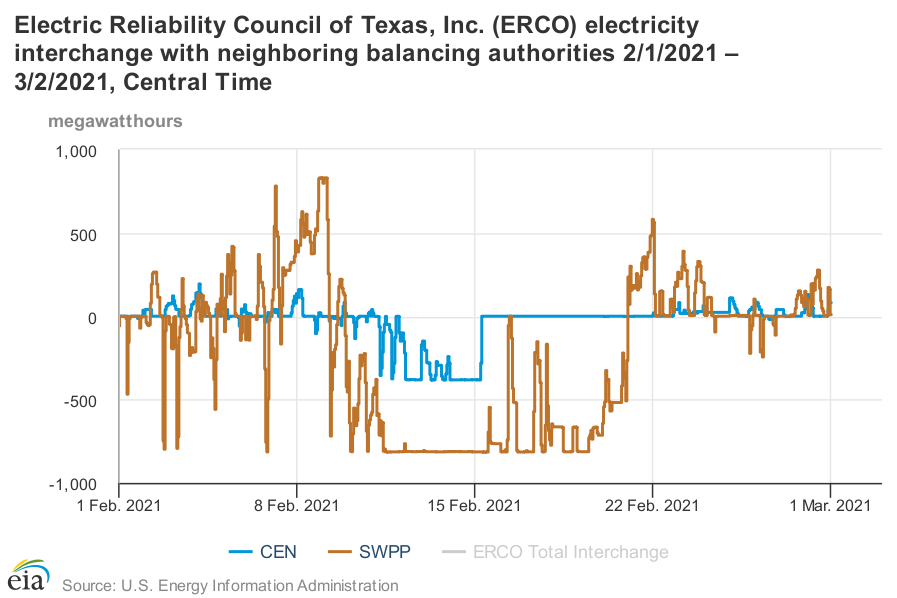
You found the numbers. Negative numbers are imports by ERCOT. Note that in the first plot “ERCO Demand” is higher than “ERCO net generation” by exactly the negative of “ERCO total interchange”, reflecting the imports helping overall supply. From the (i) Notes for the chart:
NotesHourly (or daily) electricity demand, day-ahead demand forecast, net generation, and total net interchange for the selected balancing authority. Negative interchange values indicate net inflows from neighboring balancing authorities, and positive values indicate net outflows to neighboring balancing authorities.
There are details tie by tie on the ERCOT dashboard prints available from Wayback. e.g. this from the big trip:
http://web.archive.org/web/20210215075245/http://www.ercot.com/content/cdr/html/real_time_system_conditions.html
“blackouts elsewhere” does not equal “massive supply failures.”
Just my view, but it would do some people living in Texas, who are “in charge” of important stuff, a world of good if they spent a winter up here in the Great Frozen Northern Midwest. Lake Michi Gamu will test your mettle (and your metal, too), and if you can’t deal with the reality that Queen Winter has her own agenda, then you’re on the wrong planet.
We’re used to this stuff, no matter how much “anxiety attack” nonsense the local newsies try to put into it. We deal with it, shovel it, and move on. If the forecast is for snow, we’uns up here in the Great Frozen North just assume it means enough white stuff to build a full-sized fort and prepare accordingly.
Now, how hard is that to understand? That, and the ridiculous arguments about climate vs. weather are getting old.
This winter storm in Texas and the Great Plains (why aren’t we hearing about THEM?) isn’t something new, any more than another dry spell/drought.
It’s weather, for Pete’s sake. Deal with it!!!
irony is been pretty warm here in mid maine. by that I mean I have not seen any -20+F nights this year, bunch of -6-10F nights.
David,
Any chance of digging into why the Nuke went down? Loss of cooling pumps due to “weather related issues” sounds like a cover up. Were the cooling pumps load shed?
No. A pressure gauge feed pipe froze, so the pressure gauge gave a false reading (reported that the pipe feeding the gauge was narrow gauge: suspect that lack of flow helped the freezing). That triggered an alarm that shut down the water pumps, and in turn the reactor, because you must use the energy it generates which you can’t do it there is no water for steam. Had the gauge not given a false reading there would have been no problem at all. Info based on an account given by an STP executive.
Thank you. I tried to point this out in comments on a couple of previous posts. You said it better than I did.
Well, I’m going to address the problem in a logical fashion. I’ll be shopping for a whole house generator. And as more grids become unreliable because of reliance on green energies, I suspect this will be a growing market – until the environmentalists decide you need a special license to install one.
I think the proper way to look at the situation is to compare how energy systems perform if you have coal and gas only providing the energy compared to a system with a mix including renewables. The real problem is that renewables weaken the whole system so it enhances the likelihood of failure. Trying to pinpoint whether that failure is due to coal, gas or renewables is irrelevant. Would the system have failed to the extent that it did if there was no renewables? The answer is most certainly no. Would the system have failed if there was only renewables? The answer is most certainly yes.
So the clear answer is not what is the best mix but rather why do we need renewables at all?
And that is where governments have to argue that dangerous man made global warming does not exist and even if it did exist that renewables are not the way to fix it. This would be the most logical solution. Let’s check the data and the predictions to see if we have a problem and if there is a problem let’s think of solutions that will help. Ie If you are concerned about 2 degrees of warming buy an air conditioner for everyone. If you are concerned about rising sea levels build walls ( like in Holland).
At the moment all the world is doing is creating non solutions to a non problem. It’s time to start the re-education process.
The video of that big I-35 pileup was quite something. My wife and I were spent the first third of our respective lives in the Midwest, so were no strangers to driving conditions such as those. She remarked that there’s not much you can do about such accidents. There is so rarely ice in most of Texas that people don’t have a chance to learn.
I disagree, and see a business opportunity for some enterprising driving school. There are a number of skating rinks in the Dallas area, and they are certainly not 100% utilized. Hire some instructors from Minnesota, rent out some rinks, and teach people how to drive on that stuff.
I would propose a similar thing here in the Washington DC area, where a little snow on the beltway results in carnage, except for two things: 1) Because no one around here can drive on a little snow, the Federal Government shuts down if there’s even snow in the forecast. That’s such a good thing, I wouldn’t want to chance it going away. However, 2) there’s really only a small chance of shutdowns going away, because drivers in this area (especially Maryland) don’t know how to drive on dry pavement, and thus are probably unteachable.
As I was young, around 19, we used to exercise with our VW beetles do drive and slide on snowy streets around corners and bends, late in the evening when there was no other circulation around – hat was very helpfull, off course with mounted snow tyres.
Nowerdays, the German Carclub ADAC offers winter- and snowtraining on special places as they do for driving caravan and other trailer.
PS
As I never drove an automatic car, I have no idea how to start driving with on ice or snow. But it’s always amazing to see people or also truckdriver with stick shift, change in first gear and try to start driving, same in sand or mud and, off course mostly full throttle 😀
Third or even forth gear and nearly no throttle, just not stalling the engine, they never heard off 😀
ERCOT is a bunch of lawyers. Lawyers are smart people; they’re just no good at electrical engineering. Consider: Would you put lawyers running NASA? Would you want lawyers in charge of building your next aircraft, bridge, or life-saving medical device? Who thought it was a good idea to put lawyers in charge of the grid? What did they freaken’ expect?
MSM is conflating kWh over time with kW. At the critical time when load shedding started winds contribution fell to 500 kW of capacity. Which is nothing.
The kWh over time is completely irrelevant to holding the system together by meeting kW capacity vs load. If wind generated a lot of kWh before or later so what, it wasn’t there when it was needed.
Can you provide evidence for that claim? I think it’s bunkum. According to the ERCOT dashboard, wind was producing 5,148MW right in the middle of the trip down to 59.3Hz.
http://web.archive.org/web/20210215075245/http://www.ercot.com/content/cdr/html/real_time_system_conditions.html
Even at the low point which was 8 p.m. on the 15th, wind managed 649MW.
By all means let’s look at how wind failed, but exaggerated claims that aren’t true do not help the case – they undermine it.
David-
As a fellow Texan, I want to thank you for the time and effort you have put into your recent posts on the failure of our electrical system during the recent cold spell.
I hope you will contact your State Representative and State Senator to testify at the legislative hearings that are sure to come. Every State Legislator needs to see and hear this information.
My state representative is a Democrat… Texas 100 is a weridly shaped district.
My state senator, Bob Hall, has been calling for grid resilience for years.
https://blueribbonnews.com/2021/02/state-senator-bob-hall-doubles-down-on-power-grid-resilience-and-security-legislation/
Less plant food is the better outcome, you see …
Biden’s Net Zero by 2035 would require an impossibly large Nuclear Power build up… Or… Live with killing hundreds of thousands during wind and solar total bkackouts that are 100% certain to occur.
The Liars are sitting on the Throne.
I live in Austin and was without power for 4.5 days. Good thing I had gas stove and hot water heater that were still functioning, as well as battery-powered carbon monoxide and CO2 detectors. Natural gas fossil fuel made it possible for me to survive. It’s that simple.
Global Warming causes everything!
by
Meteorologist Mike
https://www.marketforum.com/forum/topic/65704/#65905
In your section on natural gas, one of the bullet points is:
“Compressors knocked offline by power outages?”
I suggest a corollary:
“Compressors knocked offline by “Green” requirement that they be powered by the same grid which they used to be a backup supply for”
In other words, if you make a simple flowchart showing CC natural gas generation stations as a backup electricity suppy, you’ll see the folly of using that same electricity to pump gas down the pipelines to provide that backup power.
The compressor stations used to be powered by natural gas fired pumps in many cases, or as gas fired pumping backup to electric compressors.
But the “Greens” know best, forcing the move to electric gas pipeline compressors to supposedly reduce CO2.
I wish they could read a flowchart, there’s a big problem with their analysis, as millions of freezing Texans could attest.
As has been suggested, did the windmills stop producing because of ‘Lack of Wind’, rather than ‘Surplus of Ice’
Me being me, took off to check some Personal Weather Stations(PWS) at Wunderground
What I found was/is quite amazing.
Here’s my screenshot and a gorgeous example of what a large number of Texas PWSs show..
From this PWS.
See how the wind speed (2nd from top squiggly line) drops to zero at about 11:00 on that day, Thurs 11 Feb while the rest of the PWS carries on as normal?
Loads of other PWS show the exact same.
Immediately followed by some ‘precipitation’. This had to have been melting ice/snow because, as you see, the sun came out as the ‘precipitation’ occurred
Could we take those little anemometers as (all the rage these days) proxies for the bigger wind turbines?
Rub a warmist nose in that if you wish……
whats been entirely Omitted?
how the livestock and wild critters fared in this?
my guess is very very poorly;-((