In case there was any doubt that ‘Climate Change” was not communism, here is an article in Foreign Policy that will remove it.
The Case for Climate Reparations
The world’s poorest will bear the worst consequences of the climate crisis. Redirecting international resources to address entrenched inequalities provides a way out.
NICOLÁS ORTEGA ILLUSTRATION FOR FOREIGN POLICY
BY OLÚFẸ́MI O. TÁÍWÒ, BEBA CIBRALICOCTOBER 10, 2020, 6:00 AM
Current estimates put the world on track for as much as a 5°C temperature increase by the end of the century, reshaping the places that humans have lived for thousands of years. Island states such as Haiti, Cape Verde, and Fiji face “existential risks” from sea level rise and extreme weather events. By as soon as 2050, large parts of Mumbai, Ho Chi Minh City, and New Orleans may be underwater.
Over the next 30 years, the climate crisis will displace more than 140 million people within their own countries—and many more beyond them. Global warming doesn’t respect lines on a map: It will drive massive waves of displacement across national borders, as it has in Guatemala and Africa’s Sahel region in recent years.
The great climate migration that will transform the world is just beginning. To adapt, the international community will need a different approach to politics. There are two ways forward: climate reparations or climate colonialism. Reparations would use international resources to address inequalities caused or exacerbated by the climate crisis; it would allow for a way out of the climate catastrophe by tackling both mitigation and migration. The climate colonialism alternative, on the other hand, would mean the survival of the wealthiest and devastation for the world’s most vulnerable people.
It’s filled with goodies such as:
Climate colonialism is like climate apartheid on an international scale. Economic power, location, and access to resources determine how communities can respond to climate impacts. But these factors are shaped by existing global injustices: the history of slavery, colonialism, and imperialism that enriched some countries at the expense of others. Global warming has exacerbated these inequalities, and the climate crisis will lead to new divisions between those who can mitigate its impact and those who cannot.
It’s for the greater good Comrade
Unless these powerful entities abandon financial and political self-interest in favor of the greater good, the pursuit of elite interest in a world where power is distributed so unevenly guarantees climate colonialism—that is, if society survives at all.
It’s all about redistribution;
But to mitigate climate change effectively and fairly, the international community needs to broadly redistribute funds across states to respond to inequalities in resilience capacity and the unjust system underpinning them. As Mohammed Adow, the director of the Nairobi-based think tank Power Shift Africa, explains, the international community has already designed a mechanism that could perform this task: the Green Climate Fund (GCF), which is the largest international fund aimed at helping developing countries mitigate and adapt to climate impacts.
HT/Steve Milloy
Discover more from Watts Up With That?
Subscribe to get the latest posts sent to your email.

Famous movie lines:
Benjy Benjamin: Look! We’ve figured it seventeen different ways, and every time we figured it, it was no good, because no matter how we figured it, somebody don’t like the way we figured it! So now, there’s only one way to figure it. And that is, every man, including the old bag, for himself!
Ding Bell: So good luck, and may the best man win!
Benjy Benjamin: [to Mrs. Marcus] Right! Except you,lady. May you just drop dead!
Lennie Pike: All right, all right, we all agree on that. Now look, let’s be sensible about this thing. There’s money in this for all of us. Right? There’s enough for you, there’s enough for you, and for me, and for you, and there’s enough for…
[they all race to their cars]
Just remember, as we sit here, the ice is melting in the north.
“We will never have peace as long as we make war on Mother Earth.”
https://centerforneweconomics.org/publications/the-ice-is-melting/
http://blogs.nwic.edu/pavlik/files/2011/05/Oren-Lyons-article.pdf
https://www.youtube.com/watch?v=SRz2mih5-JU
24:45. “The economies of nations will be broken by natural disasters. Not wars. ”
27:50 “Value change for survival.”
Donna Meness October 14, 2020 at 11:53 am
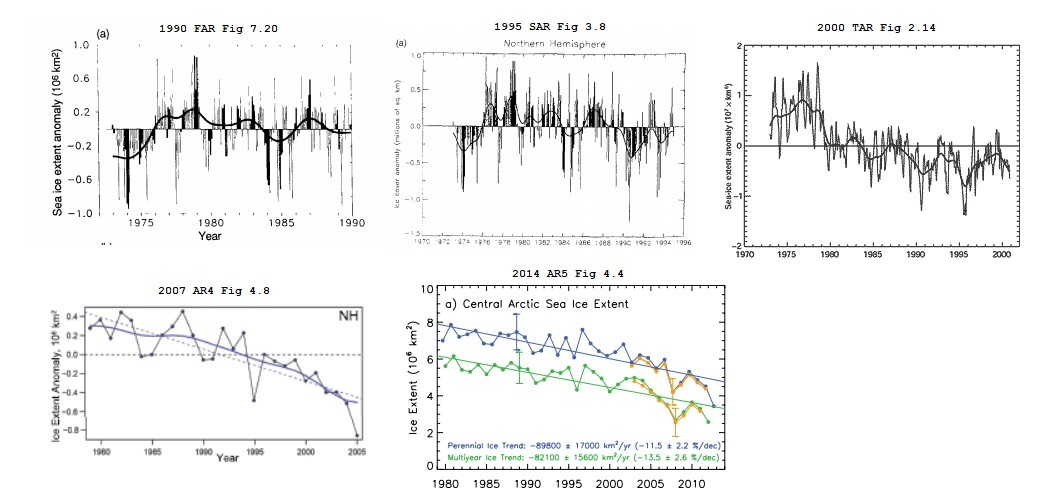
Three links, no numbers.
Here are the graphs depicting northern sea ice extent from the first five IPCC reports:
Any body can see that the original data was chopped off and the remaining data was changed. It’s difficult for the average person to really know what’s going on.
Greenland is most probably losing ice, sea level is rising and the water has to come from somewhere, but it’s not melting, it’s way below freezing in Greenland nearly everywhere nearly all of the time. Ice loss is due to more icebergs calving into the sea than fell as snow years, decades or longer ago, it has nothing to do with temperature or human activities.
“ the ice is melting in the north ”
Reminds me of this:
“It will without doubt have come to your Lordship’s knowledge that a considerable change of climate, inexplicable at present to us, must have taken place in the Circumpolar Regions, by which the severity of the cold that has for centuries past enclosed the seas in the high northern latitudes in an impenetrable barrier of ice has been during the last two years, greatly abated.
(This) affords ample proof that new sources of warmth have been opened and give us leave to hope that the Arctic Seas may at this time be more accessible than they have been for centuries past, and that discoveries may now be made in them not only interesting to the advancement of science but also to the future intercourse of mankind and the commerce of distant nations.”
President of the Royal Society, London, to the Admiralty, 20th November, 1817 [13]
*13 President of the Royal Society, Minutes of Council,
Volume 8. pp.149-153, Royal Society, London.
20th November, 1817.
So – does ‘the poor’ have any appreciation for the benefits fossil fuels and the west have given them?
I’ll tell you this, I don’t owe anybody anything. Certainly, not for a carbon blood debt.
I want to contribute to the Green Climate Fund (GCF). Just send me the BSB, account code and password and I’ll do the rest.
A) in the first line of the article:
“was not communism”?
Or did you mean to state “was/is communism”?
Existential:
Sounds like Olúfẹ́mi O. Táíwò and Beba Cibralic are suffering from delusions or at least severe hyperbole.