Guest Post by Ed Zuiderwijk,
About a year ago I read in a Dutch national newspaper an article which elaborately and somewhat aggressively argued that if you had the choice between, say, a 1000MW gas-fired power plant and a few thousands windmill generators the latter was the way to go. It was full of the phoney arguments and broken reasoning well-known to readers of this blog, and was, of course, palpable nonsense. I had a good laugh about it; you can’t argue with purveyors of foolishness and, furthermore, when you know something is utterly wrong it is usually completely uninteresting to precisely analyse why. I had almost forgotten about it when some conversation with friends brought it back to my attention and made me question (myself) why it was that I knew with such total clarity that the argument put forward in that article was piffle given that I know not much more in depth about the subject than your average informed layman. After some reflection I realised that it was because of something I was taught many years ago at school. That’s what this posting is about.

I attended primary school in the city of Haarlem in the Netherlands, a medium size town going back over 750 years and having quite a bit more pedigree than its namesake in the US. Located some 20 km west of Amsterdam, Haarlem had (and has) its fair share of museums (footnote 1), several of which were on the list of school outings. One of these is the Museum Cruquius, located a few miles to the south of the town centre. The place had a lasting effect on the young lad. The exhibition is about the draining (and conversion into a polder) of the Haarlemmermeer, ‘Lake Haarlem’, at the time (about 1850) a substantial inland body of water inside the triangle formed by the cities of Amsterdam, Haarlem and Leiden. The museum building itself is one of the original three pumping stations that emptied the lake and has the original massive steam-driven pump, still in working order. Nowadays the exhibition does a slick multi-media presentation, but then, the late 1950s, you had the thing as it was, basic but very imposing.
What was this lake and why was it drained? That there were lots of shallow lakes in a place called Holland (‘low land’, footnote 2) is no surprise but Lake Haarlem had over the centuries shown a habit of growing, to encroach on the land and gobble up adjacent waters. In particular after a south-westerly gale the damage to its surroundings could be considerable (and irreversible). By the early 1800s it had become a threat to the city of Amsterdam itself and on occasion to Leiden as well. The idea to ‘reclaim’ Lake Haarlem had been proposed several times since the 17th century but it had never been attempted in earnest. One consideration had been that it was at least 5 times the size of anything tried earlier, which would have required an extraordinary number of wind-mill powered pumping stations.
In the 1830s controlling the lake had become a matter of urgency. The government, on instigation by king William I, convened a royal commission to investigate and make recommendations. Mind you, that same king was also a driving force behind the rapid early development of the country’s railway system and with it the Industrial Revolution in the Netherlands; royalty nowadays just don’t do that sort of thing anymore. Not surprisingly the recommendation was to drain the lake, but with steam-driven pumps instead of windmills.
So, how do you do that, drain such a lake? It had been done in Holland since the late 1500s and in particular the early 1600s when several smallish lakes and peat bogs to the north of Amsterdam had been turned into farmland. With the expertise acquired in those and subsequent projects it was well established knowledge how to go about it. The first part of such a project is the easiest and mostly straightforward. You can’t just put a pump on the water and start pumping. Not only is there no outlet for the large quantities of pumped water, even if you succeed in lowering the water levels the lake will refill in no time from the groundwaters of its surroundings, thus drying out the adjacent lands. Bad idea. So what you do is to construct a dyke going around the lake a bit inside its boundary. The waters outside of this ‘ring dyke’ then become, after some further dredging, a relatively narrow canal where the water will be kept at the original lake level. This way you solve three problems at once: the canal still has the original outlets that the lake had so you can dump the pumped water in it, the groundwater level in the surrounding lands is unaffected and you have a controlled waterway for bulk transport. With that dyke in place (3) you can start pumping. And that was where the real problem was with Lake Haarlem.
The pumps used until then were primarily of the paddle wheel type or Archimedes screws driven by windmills if there was enough wind. The engineers had figured out that they would need a really large number of such units, somewhere between 150 and 200, spread out along the odd 60km of dyke and that it would take at least 5 years but more likely a decade to complete the job. The costs of such an operation would be colossal, not mentioning the logistics of it. It would make the project technically unfeasible and economically unaffordable. However, in the 1820s an aristocrat (again!) and member of the senate, Frans Godert baron van Lynden, had written a treatise proposing the radical idea of using steam-driven beam pumps. He knew how the water was kept out of Cornish tin mines in faraway England by using an advanced design of such pumps. A delegation went to Cornwall to have a look and, being competent engineers, they realised in no time that three of such pumps were indeed a much, much better proposition than the odd 200 windmills.
The specially designed pumps were acquired from a company in Plymouth. The engine’s (steam) cylinders were more than 3.6 meter diameter, that’s bigger than my kitchen. They were placed in purpose-built pumping houses, named after pioneering hydro engineers of the past, van der Kruik (aka. Krukius) and Leeghwater and (of course) Lynden. It took three and a quarter years to drain the lake. Afterwards only one was kept in its original state. And this is why the worlds largest vertical steam engine still in existence is found hidden in a small museum in an unremarkable corner of Holland.
When I read that newspaper article about a power plant versus thousands of windmills I knew at once it was nonsense because what its author essentially claimed was that those engineers of the 1840s had had it all wrong, that they should have used windmills instead of steam. The notion is just preposterous. Methinks the 150000 people dwelling on what once was the bottom of Lake Haarlem ought to be told and asked for an opinion, whether they would rather keep their feet dry with windmills or with pumps powered by gas and oil(4).
Are there any take-away messages in this story? Perhaps. One could be about the ‘nonsense detector’ in each of us. How does it work? I consider myself to be a skeptic, but how do I know when to be skeptical and when to acknowledge expertise? If the mechanic tells me that my car doesn’t go because the fuel pump has died I accept that without hesitation. When I discuss the increasing failings of my physique with my doctor I will carefully consider his or her diagnosis. But if some pundit tells me that I need to get my electricity from renewable un-reliables because of whatever, then the alarm of my nonsense detector sounds big time. Why? It appears to me that we as individuals know more than we know we know. That mostly forgotten knowledge and experiences we picked up in life somehow linger and at times emerge to inform and trigger that alarm. In this case I recognised the nonsense not because of some in-depth analysis but because of a completely different look at the matter based on a specific experience.
Nevertheless, an essential aspect of being a skeptic is to not only scrutinise the subject but, most importantly, yourself as well, why you reason the way you do. In this case, why am I certain that those 19th century engineers had it spot on?
It is a matter of geometry, really. The surface area of a lake, and therefore the quantity of water to be shifted, increases with the square of its cross-section, but the space available for the pumps (at the dyke) grows only linearly. This means that the bigger the lake, the more windmills you need. Not just more but more per kilometer of dyke at an increased density. Since you can’t put windmills arbitrarily close together because they catch each other’s wind there is, consequently, a limit to the number of them that can be accommodated. That means that there is a limit to the size of the lake that you can manage using windmills. Lake Haarlem, requiring the odd 200 pumping stations was close to that limit, if not over it: it was too big for the technology of the past. That was the fundamental reason for it not having been tried before. A straightforward way of putting it: by the 1800s the windmill based technique had become obsolete and the engineers knew it. That was some 2 centuries ago. That technological concept, therefore, most certainly is obsolete today.
The idea of going back to wind power for our base-load energy provision is a massive retrograde step, a devolution, an indirection. Don’t be mislead by the shiny modern look of the turning beasts, courtesy of being made of metal and composites. That’s what Americans call: lipstick on a pig. Underneath it is essentially a medieval technology and we are in danger of learning the hard way that it can’t replace power generation from a primary source – coal, gas, nuclear and hydro – with a much higher energy density than wind can ever deliver.
Notes:
1) If you ever find yourself near the place pay a visit to Teylers museum. It’s a small natural history cum science museum old style with only natural light for illumination and a marvellous collection of science related paraphernalia.
2) The Netherlands has 12 provinces. The name Holland specifically denotes the two provinces adjacent to the North Sea and to the north of the delta formed by the rivers Rhine, Meuse and Schelt.
3) My paternal ancestor Emmanuel Zuiderwijk (six generations between us) of Lisse, a village on the west side of Lake Haarlem, was one of those labouring on the construction of the ring dyke, using only a shovel and a wheelbarrow.
4) The Dutch national airport Schiphol. It is located in the north-east corner of the Haarlemmermeer polder. The name was in use for that part of the lake since well before. It translates as ‘ship’s hell’ because it was the corner where vessels were stranded and often wrecked in serious stormy weather. I always found it somewhat ghoulish having an airport named after a graveyard and sometimes wonder how passengers would feel about it if they knew.
Some urls with more info:
https://www.haarlemmermeermuseum.nl/en/cruquius-museum–world-largest-steam-engine
https://www.asme.org/about-asme/engineering-history/landmarks/153-cruquius-pumping-station
https://en.wikipedia.org/wiki/Haarlemmermeer
https://en.wikipedia.org/wiki/Nicolaas_Kruik
https://en.wikipedia.org/wiki/Jan_Leeghwater
https://www.teylersmuseum.nl/en
Brilliant
Thank you
Great article, especially the insightful points about the “nonsense detector.” My internal detector says, “That can’t be right!” when I hear claims that heat will be “trapped” at the surface to harmful effect on the planet. How was my detector calibrated? By watching the weather, especially thunderstorms, and coming to appreciate the energy transformation and mass transfer performance of the atmospheric heat engine.
My observation is that the air cools much faster at night when it is dry, compared to when it is humid.
Excellent point. I often look at this plot of precipitable water for the U.S. When it gets really dry, it can get really cold in winter.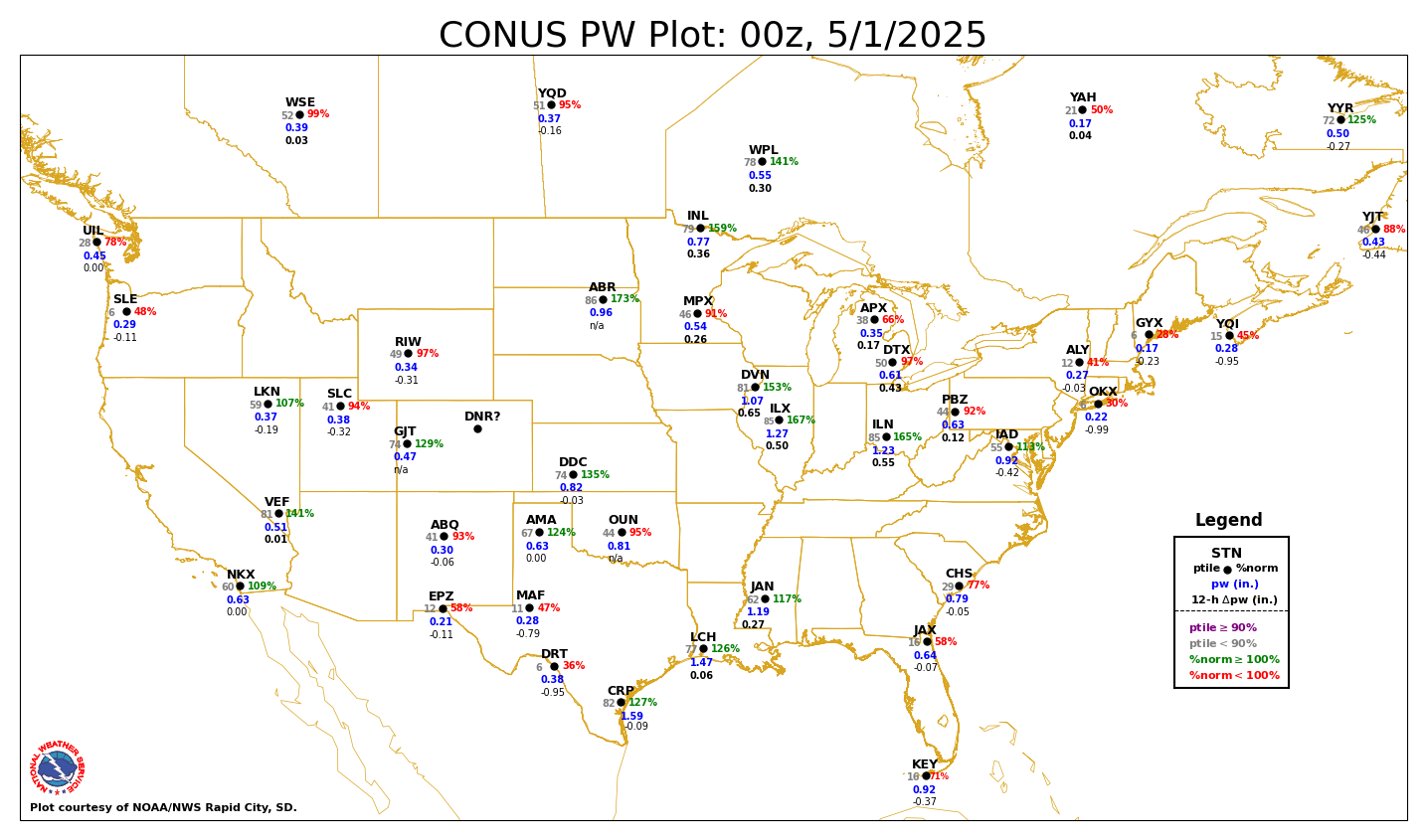
>>If the mechanic tells me that my car doesn’t go because the fuel pump has died I accept that without hesitation.<<
Most likely you are not accepting without hesitation but rather you have unconsciously reached the same diagnosis after reviewing the symptoms. Unfortunately for the world the liberal masses don’t have the skill to do this and therefore immediately appeal to and accept the word of anyone who appears to be in a position of authority. If your mechanic told you that you needed new sway bar drop links in a car that handled fine would you still accept it? Happened to me… so i crawled under the car… nope!
Skepticism comes from knowing things. Blind faith in authority comes from not knowing, and not wanting to know, how the world works.
Nice reading, thanks Mr Zuiderwijk.
I’ve visited the Netherlands many times and have always found that the Calvinistic streak in the people I worked with a real strength, also I’ve never met more honest people than the Dutch.
Ed Zuiderwijk—Thank you for the interesting, common sense, experiential story. An inspiring story of hope….a hope that common sense, and some knowledge with calculations, will prevail.
Sadly, in the USA, our formerly trusted sources of science and engineering have been overwhelmed, corrupted even, by a continuous barrage of mis/mal-information, and great amounts of factual omissions.
The belief that wind / solar can physically replace reliable, proven, economy-building, weather/disaster resistant gas, oil, coal, and nuclear generation is fraud.
And that the belief that wind/solar is cheaper is a cruel and unusual punishment to taxpayers and utility customers, and a massive political diversion that restricts productive economic growth.
The widespread beliefs in “green energy” sources and CO2 single causality have been institutionalised in all of USA (EU) society over the last 40 years…and escalated in the last 15 with massive political payouts.
So, the “common sense” that we count on to overwhelm fantasy and corruption is no longer available.
We are, should be , smarter than this.
Thanks again. For the hope at least.
“… need to get my electricity from renewable un-reliables because of whatever.”
Good article, and I do appreciate the history of how the swampy marshlands of Holland were drained, but I grew up in the prairies far to the south of me, and the windmills down there were used to pump water into watering troughs for beef cattle and sheep to use. None of them were the monstrosities being constructed and planted everywhere now, nor did they pollute the landscape with detritus when they failed. They were steel frames with wooden vanes and a steel rudder to keep the windmill in line with which way the wind blew. They were nothing but pumps. A single one could pump quite a bit of water for farming use. Some were built close to houses to provide water to the household. They’re mostly gone now, but it isn’t difficult to set them up again. They made sense. And not all of them have been demolished. What was a farm without a windmill, for Pete’s sake?
These land grabs to plant indestructible trash that corporate greed generates, are not the same thing. They are, in addition to being indestructible, industrial junk once they’ve reached their life span. That thought never occurred to the producers of that junk, nor do they care how much pollution they cause.
Lease contracts for wind farms include restoring the original grade and removal of the stanchions and turbines.
Assuming the operator doesn’t file for insolvency the minute the first crack appears!
Which is what performance bonds are for.
How it s made’ did a bit on water pumps, still being made today
Ed,
I always knew about the nether (low) land, but the “land of the hollows” is new.
Thank you.
Ed Zuiderwijk, thanks for a delightful story.
Growing up in the fifties, in a semi-desert area at the other side of the world , I remember stories we were told of Holland and the dykes. Perhaps the proximity to the 1953 flood was the influence. Throwing money to try and engineer climate is utter folly but human ingenuity like that displayed in Holland shows how we can adapt at a small fraction of the cost of reducing carbon dioxide emissions. Engineers understand ingenuity but unfortunately the politicians and activists are clueless and therefore not to be trusted. That is why I have great respect for the sober and sensible insights of people like Professor Guus Berkhout.
My favorite quote from the article is this one: “when you know something is utterly wrong, it is usually completely uninteresting to precisely analyse why.” Americans would just say, “Nope, it didn’t pass the smell test.” Meaning: if it’s so bad that you can smell it without even drawing near, there’s no reason to investigate into the details. You know it’s bad.
“The notion is just preposterous”
It’s worse than that – at least when you’re pumping something like water which can easily be stored, the intermittent nature of wind is rarely a problem.
Exactly the same transformations happened on the English Fens for exactly the same reasons.
coal could be cheaply barged around the coast and up the canals to large pumping stations.
Steam was replaced by diesel in the early 20th century, and by electric pumps post war.
https://www.youtube.com/watch?v=rtFPlvnS-Gk
is a lovely video of one of the old steam pumps in operation
In the name of Greta, tear down this museum.
You can see beam engines in working condition in Leicester, UK.
https://en.wikipedia.org/wiki/Abbey_Pumping_Station
They had the vital but unglamorous duty of pumping the city’s sewage.
Also Crossness, on the Thames.
A sewage pumping station.4
Auto
The green Marxists have their solution to the problem Ed Zuiderwijk describes.
Solution: dumb down the Primary school education system so the following generations don’t innately recognize they are being taken to the slaughterhouse like sheep. They will do what they are told and march right in to the gassing chambers.
Like babies who are scalped (“Planned Parenthood”) today, and cross-contaminated (“Planned Parent”), with a xenophilic, high tuition flourish, tomorrow.
My question to Ed is:
Why has Germany and Denmark, a German satellite, invested in windpower, whereas the Netherlands, another German satellite, hasn’t?
The answer is that you have Natural Gas deposits.
But the Netherlands has invested in wind and if you look for my post elsewhere you’ll see its ambitious offshore wind plans…
I believe the engines were made by Harvey and Co of Hayle in Cornwall and the pumps by Fox and Co in Falmouth. Don’t like to belittle the Plymouthians…..yes I do….I’m Cornish
Moving on to the modern day, here is Dutch govt information on its plans for offshore wind farms
https://www.government.nl/topics/renewable-energy/offshore-wind-energy
Griff, Thank you for giving me the opportunity or excuse to refer to the current unsatisfactory situation re: wind farms as seen by an observer in Australia and posted at Jonova
http://joannenova.com.au/2020/08/wind-power-failure-100-times-a-year-we-get-a-500mw-outage/
(people are going to suspect we are a tag team) .
(BTW the link , by not allowing capitals, has minified the outages from MW to mW)
I had a mW reduction in power generation the other day.
Then I replaced the hamster with a well rested one.
Interesting…
Looks like you have incompetents running the power grid in Oz (I think we all knew that anyway) as this doesn’t have to happen and hasn’t happened in (foe example) Germany, as far as I know, since the early 2000s.
It is perfectly simple to manage the wind farms so they don’t trip out.
griff — incompetents? Pot-kettle much? Clue for the clueless — Australia does not have the large amounts of backup power (FF & nuclear power) on their grid available to make up shortages due to unreliables (wind-solar) like European countries.
You’re talking out your posterior again. You don’t know jack-schist about grids.
Governments, because they spend other people’s money, never care how costly or inefficient something is. Case in point, all this investment in so called renewable energy, that only makes countries poorer. But since it makes those who invest in government richer, it will always be preferred.
I follow the UK power grid on a daily basis. They have many off shore windturbines. Their output varies tremendously from day to day and month to month. Only gas turbines allows such erratic producers of power to be used. Otherwise, the grid would collapse.
And, BTW, despite these windturbines, atmospheric CO2 is rising steadily. What am I missing?
I repeat for the terminally dim, wind, as a technology to do “work” is 4th – 6th century technology. It has a place on small scales such as water pumps on farms and low-lying lands (Pay bas), but for reliable, grid scale, power generation it certainly isn’t
A bit irrelevant but perhaps of interest to engineers, when a replica of the transatlantic Vickers Vimy was built in the 1960s, two original WW1 vintage Rolls-Royce Eagles were found pumping water from a Dutch dyke which they had happily been doing for several decades. When put on the test-bed they were within 2 hp of the original specification. Sadly the replica was lost in a ground fire.
Ed, a great article to start my day reading. Thanks. I learned a bit!
Loved it – especially the part about making a ring-dike just inside the lake tocarry the water away. What great technology.
Ed Zuiderwijk – I add my kudos to this huge list of positive comments that you’ve inspired within the WUWT community. Good Job !!
My father, Arend, emigrated to America in the early 20cent. and I joined the Paalman party 87 years ago. My uncle Johann lived in Haarlem. We visited several times and he saw to my education about polder making matters. You’ve inspired happy memories of those times. Thanks. Oranje Boven!
Thanks Ed a great piece and always encouraging to read about real history where logic triumphs over impossible but the universal preferred conventions of the time.
It is also great to read about cross pollination of engineering ideas. Who back in the 17 century ever thought hacking tin from a deep mine in Cornwall England, would provide the answer to a flooded region of Holland a few decades later?
Great story, Ed.
Was anything interesting found on the lake bed after it was drained?
Great story Ed. Grew up within one km of this Cruquius pumping station, in Heemstede. Have visited the museum various times, as well as the ones in Haarlem and environments. I did know, or knew, the story of the Haarlemermeer, ( Haarlem lake) , but never knew about the decision to use the steam driven pumps instead of the windmills. That is, from an engineering point of view. I always thought that windmills were not used because of the amount of wood required. Which could be better used in the merchant sailing ships. Even though Haarlem expanded outside its city protective walls towards the Haarlem lake, it also annexed areas to the west and south of the city.
Anyway, great tale and I enjoyed it.
To Mr. Pappas: natural gas recovery in the Netherlands will cease starting in 2022.
Good story. As an engineer, I can sum it two words — energy density. Wind & solar are pathetically energy-diffuse. That means alot of land and infrastructure are required to achieve a given amount of output compared to fossil-fuels or nuclear (not even considering that wind & solar are also weather/time-dependent).