
A container ship leaves a trail of white clouds in its wake that can linger in the air for hours. This puffy line is not just exhaust from the engine, but a change in the clouds that’s caused by small airborne particles of pollution.
New research led by the University of Washington is the first to measure this phenomenon’s effect over years and at a regional scale. Satellite data over a shipping lane in the south Atlantic show that the ships modify clouds to block an additional 2 Watts of solar energy, on average, from reaching each square meter of ocean surface near the shipping lane.
The result implies that globally, cloud changes caused by particles from all forms of industrial pollution block 1 Watt of solar energy per square meter of Earth’s surface, masking almost a third of the present-day warming from greenhouse gases. The open-access study was published March 24 in AGU Advances, a journal of the American Geophysical Union.
“In climate models, if you simulate the world with sulfur emissions from shipping, and you simulate the world without these emissions, there is a pretty sizable cooling effect from changes in the model clouds due to shipping,” said first author Michael Diamond, a UW doctoral student in atmospheric sciences. “But because there’s so much natural variability it’s been hard to see this effect in observations of the real world.”
The new study uses observations from 2003 to 2015 in spring, the cloudiest season, over the shipping route between Europe and South Africa. This path is also part of a popular open-ocean shipping route between Europe and Asia.
Small particles in exhaust from burning fossil fuels creates “seeds” on which water vapor in the air can condense into cloud droplets. More particles of airborne sulfate or other material leads to clouds with more small droplets, compared to the same amount of water condensed into fewer, bigger droplets. This makes the clouds brighter, or more reflective.
Past attempts to measure this effect from ships had focused on places where the wind blows across the shipping lane, in order to compare the “clean” area upwind with the “polluted” area downstream. But in this study researchers focused on an area that had previously been excluded: a place where the wind blows along the shipping lane, keeping pollution concentrated in that small area.
The study analyzed cloud properties detected over 12 years by the MODIS instrument on NASA satellites and the amount of reflected sunlight at the top of the atmosphere from the CERES group of satellite instruments. The authors compared cloud properties inside the shipping route with an estimate of what those cloud properties would have been in the absence of shipping based on statistics from nearby, unpolluted areas.
“The difference inside the shipping lane is small enough that we need about six years of data to confirm that it is real,” said co-author Hannah Director, a UW doctoral student in statistics. “However, if this small change occurred worldwide, it would be enough to affect global temperatures.”
Once they could measure the ship emissions’ effect on solar radiation, the researchers used that number to estimate how much cloud brightening from all industrial pollution has affected the climate overall.
Averaged globally, they found changes in low clouds due to pollution from all sources block 1 Watt per square meter of solar energy — compared to the roughly 3 Watts per square meter trapped today by the greenhouse gases also emitted by industrial activities. In other words, without the cooling effect of pollution-seeded clouds, Earth might have already warmed by 1.5 degrees Celsius (2.7 F), a change that the Intergovernmental Panel on Climate Change projects would have significant societal impacts. (For comparison, today the Earth is estimated to have warmed by approximately 1 C (1.8 F) since the late 1800s.)
“I think the biggest contribution of this study is our ability to generalize, to calculate a global assessment of the overall impact of sulfate pollution on low clouds,” said co-author Rob Wood, a UW professor of atmospheric sciences.
The results also have implications for one possible mechanism of deliberate climate intervention. They suggest that strategies to temporarily slow global warming by spraying salt particles to make low-level marine clouds more reflective, known as marine cloud brightening, might be effective. But they also imply these changes could take years to be easily observed.
“What this study doesn’t tell us at all is: Is marine cloud brightening a good idea? Should we do it? There’s a lot more research that needs to go into that, including from the social sciences and humanities,” Diamond said. “It does tell us that these effects are possible — and on a more cautionary note, that these effects might be difficult to confidently detect.”
###
Other co-authors are Ryan Eastman, a UW research scientist in atmospheric sciences, and Anna Possner at Goethe University in Frankfurt. The research was funded by NASA and the National Science Foundation.
What about the fact that a ship’s passage churns up the water, bringing cold water to the surface? Would there be condensation of warm humid air?
They have just destroyed the main argument against Henrik Svensmark’s GCR theory. Svensmark shows that increased GCRs result in increased numbers of cloud-forming particles. The main argument against has been that there are so many particles (aerosols) already that a few more won’t make any difference. This study shows that a few more do make a difference. Score one more to Henrik Svensmark.
Is LNG a good option for all ships then very clean and economical.
Cruise liners were converting I think there will be conversion capacity to burn so as to say.
Ha! Ships leaving … chem trails.
Where is jmorpuss when you need him.
Maybe it’s not just the ship’s engine exhaust?
Look behind any large ship and you see a churning wake that throws up a lot of water vapor and water droplets … throwing a lot of water vapor into the air behind the vessel that then condenses into a cloud trail. In the process, it is moving a lot of heat from the ocean into the air … speeding the cooling of the water.
I’m reminded of some old articles (cannot find links) hypothesizing the global temperature drops during WW1 and WW2 might be linked to the surge in naval activity.
+ [many] !
Taught of it as well, good to know I’m not alone to rise this hypothesis.
What about the swath of oily soot that every bunker-fueled ship lays on surface of the ocean? But that would be a non-CO2 warming effect that no planetary savior wants to find.
So presumably all the factories burning the cheapest coal available would have lowered the temperature. Say from mid nineteenth centuary-1950s when they began to clean up their act. If that’s right, then some of the recent warming would have been due to cleaner power rather than GHGs.
Well it is not only ships who makes smoke. I Guess it is clear that the air has gotten cleaner since 1990.
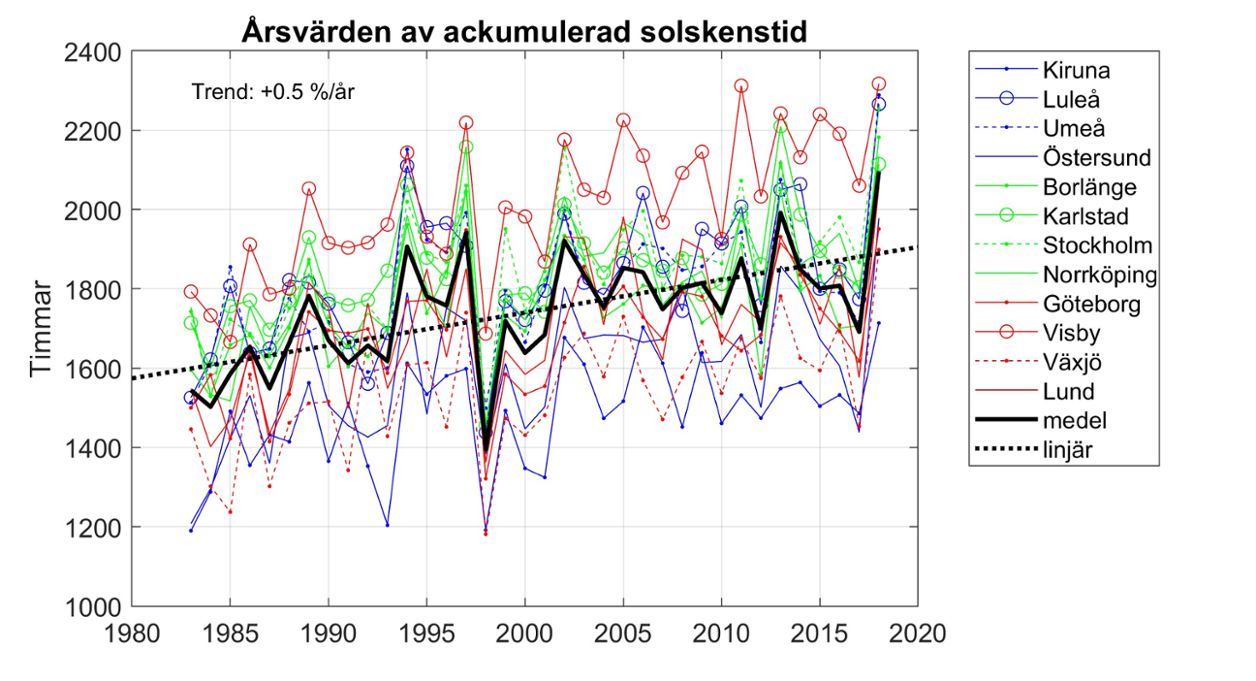
Thus opening up fore warming!
70-90% of all sulfur is gone!
More sun hours due to less clouds.
It has gotten better and warmer! In Sweden at least!
I thought most modern container and tanker vessels are diesel powered (or LNG), with the number of HFO/bunker oil fuelled ships gradually diminishing. Any merchant seamen around able to confirm this?
Not yet.
BFD….
Shipping rules have recently changed to require Ultra Low Sulfer Diesel Fuels. My bet is that that will reduce the clouds allowing more sunlight to reach the oceans. That will result in MORE warming and it will have absolutely nothiing to do with CO2. Alarmists will use this positive news on pollution to be spun as a negative that CO2 is causing warming. If you want warming, simply allow more sunlight to reach the oceans, it is that easy and has nothing to do with CO2.
BTW, fewer jets flying has also cleared the skies, so more sunlight is already reaching the oceans. Expect more warming, and it has nothing to do with CO2.
“But because there’s so much natural variability it’s been hard to see this effect in observations of the real world
That says it all, about climate science in general. Emphasis on the “real world”
More contrails sciencism. No comparison to coal or oil-fired, low temp steam shipping. No cost-benefit comparison to wind powered logistics. Don’t eat yellow journalism.
It is difficult to take an article as a serious scientific report when the author telegraphs their bias so clearly by using the word “pollution”. Forests also cause cloud formation by similar such “pollutants” normally emitted by vegetation.
To be fair, I realise the article later puts the words “pollution” and “clean” in quotation marks, and it is not immediately obvious what words were actually used by the UW researchers themselves. But the abandonment of journalistic integrity has already happened before most readers get that far into the article, and the people writing such pieces know it well. Most of the damage to science reporting is done in the headline and first sentence.
I live overlooking Subic Bay, PI. Container ships in and out of here all the time. I’ve never seen a line of clouds following them. Must be a northern latitude deal. BTW, the virus has had the effect of emptying the port. Not a ship in sight.
I note credit for the “photo” is as follows: ” Credit NASA Earth Observatory ”
This does not seem to be one of the NOAA operational GOES satellites. We need more detail on the provenance of this so-called image, was it even “visible” light (as opposed IR or WV wavelengths) that is being depicted? Is it a time-lapse in nature? IOW, trails behind the ships dissipated some minutes later BUT the image illustrates a 3 or 6 or 12 hour period?
I thiunk I found the full article/study, didn’t see a link above so here it is:
“Substantial Cloud Brightening From Shipping in Subtropical Low Clouds”
Michael S. Diamond, Hannah M. Director, Ryan Eastman, Anna Possner, Robert Wood
First published: 24 March 2020
https://doi.org/10.1029/2019AV000111
On-line readable form: https://agupubs.onlinelibrary.wiley.com/doi/full/10.1029/2019AV000111