UPDATE: A Covid-19 case correlation between malarial and non-malarial countries has been plotted by Dr. Roy Spencer, and the results are stunning – see below.
Encouraging news: three new medical studies show a commonly available anti-malaria drug known as chloroquine aka chloroquine phosphate is showing strong results against COVID-19 infections in both China and South Korea. Excerpts from three studies, including one published in Nature are below.

An Effective Treatment for Coronavirus (COVID-19)
Presented by: James M. Todaro, MD and Gregory J. Rigano, Esq.
In consultation with Stanford University School of Medicine, UAB School of Medicine and National Academy of Sciences researchers.
Translation by: Celia Martínez-Aceves (Yale B.S. Candidate 2021), Martín Martínez (MIT B.S. 2017)
Summary
Recent guidelines from South Korea and China report that chloroquine is an effective antiviral therapeutic treatment against Coronavirus Disease 2019. Use of chloroquine (tablets) is showing favorable outcomes in humans infected with Coronavirus including faster time to recovery and shorter hospital stay. US CDC research shows that chloroquine also has strong potential as a prophylactic (preventative) measure against coronavirus in the lab, while we wait for a vaccine to be developed. Chloroquine is an inexpensive, globally available drug that has been in widespread human use since 1945 against malaria, autoimmune and various other conditions.

Chloroquine: C18H26ClN3
Background
The U.S. CDC and World Health Organization have not published treatment measures against Coronavirus disease 2019 (“COVID-19”). Medical centers are starting to have issues with traditional protocols. Treatments, and ideally a preventative measure, are needed. South Korea and China have had significantly more exposure and time to analyze diagnostic, treatment and preventative options. The U.S., Europe and the rest of the world can learn from their experience. According to former FDA commissioner, board member of Pfizer and Illumina, Scott Gotlieb MD, the world can learn the most about COVID-19 by paying closest attention to the response of countries that have had significant exposure to COVID-19 before the U.S. and Europe.[1]
As per the U.S. CDC, “Chloroquine (also known as chloroquine phosphate) is an antimalarial medicine… Chloroquine is available in the United States by prescription only… Chloroquine can be prescribed for either prevention or treatment of malaria. Chloroquine can be prescribed to adults and children of all ages. It can also be safely taken by pregnant women and nursing mothers.”[2]
CDC research also shows that “chloroquine can affect virus infection in many ways, and the antiviral effect depends in part on the extent to which the virus utilizes endosomes for entry. Chloroquine has been widely used to treat human diseases, such as malaria, amoebiosis, HIV, and autoimmune diseases, without significant detrimental side effects.”[3]
The treatment guidelines of both South Korea and China against COVID-19 are generally consistent, outlining chloroquine as an effective treatment.
Specifically, according to the Korea Biomedical Review, in February 2020 in South Korea, the COVID-19 Central Clinical Task Force, composed of physicians and experts treating patients agreed upon treatment principles for patients with COVID-19.[4] In China, the General Office of the National Health Commission, General Office of the State Administration of Traditional Chinese Medicine as well as a Multi-Center Collaborative Group of Guangdong Provincial Department of Science and Technology and Guangdong Provincial Health Comp and the China National Center for Biotechnology Development have established effective treatment measures based on human studies.[5]
According to their research (reported in Clinical Trials Arena),
“Data from the drug’s [chloroquine] studies showed ‘certain curative effect’ with ‘fairly good efficacy’ … patients treated with chloroquine demonstrated a better drop in fever, improvement of lung CT images, and required a shorter time to recover compared to parallel groups. The percentage of patients with negative viral nucleic acid tests was also higher with the anti-malarial drug… Chloroquine has so far shown no obvious serious adverse reactions in more than 100 participants in the trials… Chloroquine was selected after several screening rounds of thousands of existing drugs. Chloroquine is undergoing further trials in more than ten hospitals in Beijing, Guangdong province and Hunnan province.”[6]
…
Chloroquine as a prophylactic (preventative) measure against COVID-19[11]
According to research by the US CDC, chloroquine has strong antiviral effects on SARS coronavirus, both prophylactically and therapeutically. SARS coronavirus has significant similarities to COVID-19. Specifically, the CDC research was completed in primate cells using chloroquine’s well known function of elevating endosomal pH. The results show that “We have identified chloroquine as an effective antiviral agent for SARS-CoV in cell culture conditions, as evidenced by its inhibitory effect when the drug was added prior to infection or after the initiation and establishment of infection. The fact that chloroquine exerts an antiviral effect during pre- and post-infection conditions suggest that it is likely to have both prophylactic and therapeutic advantages.”
The study shows that chloroquine is effective in preventing SARS-CoV infection in cell culture if the drug is added to the cells 24 h prior to infection.
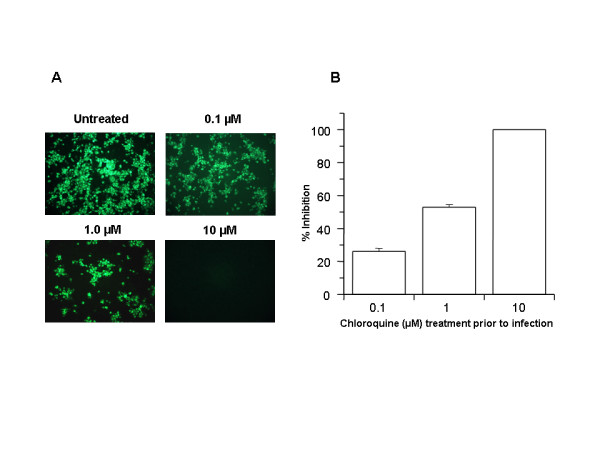
FIGURE 1
Prophylactic effect of chloroquine. Vero E6 cells pre-treated with chloroquine for 20 hrs. Chloroquine-containing media were removed and the cells were washed with phosphate buffered saline before they were infected with SARS-CoV (0.5 multiplicity of infection) for 1 h in the absence of chloroquine. Virus was then removed and the cells were maintained in Opti-MEM (Invitrogen) for 16–18 h in the absence of chloroquine. SARS-CoV antigens were stained with virus-specific HMAF, followed by FITC-conjugated secondary antibodies. (A) The concentration of chloroquine used is indicated on the top of each panel. (B) SARS-CoV antigen-positive cells at three random locations were captured by using a digital camera, the number of antigen-positive cells was determined, and the average inhibition was calculated. Percent inhibition was obtained by considering the untreated control as 0% inhibition. The vertical bars represent the range of SEM.
…
In addition, the study also shows that chloroquine was very effective even when the drug was added 3–5 h after infection, suggesting an antiviral effect even after the establishment of infection.
…
The UK has banned the export of Chloroquine[13]
As of February 26, 2020, the UK government has added chloroquine to the list of medicines that cannot be parallel exported from the UK. Chloroquine was never on this list before. This likely happened because of the growing body of evidence of chloroquine’s effectiveness against coronavirus.
China prioritizes internal use of Active Pharmaceutical Ingredients (APIs) including Chloroquine[14]
In early February, Chongqing Kangle Pharmaceutical was requested by the Ministry of Industry and Information Technology, Consumption Division to promptly increase the manufacturing and production of the active pharmaceutical ingredients chloroquine phosphate despite slowed production during the Chinese New Year.
…
Conclusion
Chloroquine can both both prevent and treat malaria. Chloroquine can prevent and treat coronavirus in primate cells (Figure 1 and Figure 2). According to South Korean and China human treatment guidelines, chloroquine is effective in treating COVID-19. Given chloroquine’s human safety profile and existence, it can be implemented today in the U.S., Europe and the rest of the world. Medical doctors may be reluctant to prescribe chloroquine to treat COVID-19 since it is not FDA approved for this use. The United States of America and other countries should immediately authorize and indemnify medical doctors for prescribing chloroquine to treat COVID-19. We must explore whether chloroquine can safely serve as a preventative measure prior to infection of COVID-19 to stop further spread of this highly contagious virus.
Full study available here
Then there’s this second study:
Breakthrough: Chloroquine phosphate has shown apparent efficacy in treatment of COVID-19 associated pneumonia in clinical studiesJianjun Gao, Zhenxue Tian, Xu Yang
Abstract
The coronavirus disease 2019 (COVID-19) virus is spreading rapidly, and scientists are endeavoring to discover drugs for its efficacious treatment in China. Chloroquine phosphate, an old drug for treatment of malaria, is shown to have apparent efficacy and acceptable safety against COVID-19 associated pneumonia in multicenter clinical trials conducted in China. The drug is recommended to be included in the next version of the Guidelines for the Prevention, Diagnosis, and Treatment of Pneumonia Caused by COVID-19 issued by the National Health Commission of the People’s Republic of China for treatment of COVID-19 infection in larger populations in the future.
https://www.jstage.jst.go.jp/article/bst/14/1/14_2020.01047/_article
Finally, there’s a new study in the prestigious journal Nature:
Remdesivir and chloroquine effectively inhibit the recently emerged novel coronavirus (2019-nCoV) in vitro
Excerpt:
Chloroquine, a widely-used anti-malarial and autoimmune disease drug, has recently been reported as a potential broad-spectrum antiviral drug.8,9 Chloroquine is known to block virus infection by increasing endosomal pH required for virus/cell fusion, as well as interfering with the glycosylation of cellular receptors of SARS-CoV.10 Our time-of-addition assay demonstrated that chloroquine functioned at both entry, and at post-entry stages of the 2019-nCoV infection in Vero E6 cells (Fig. 1c, d). Besides its antiviral activity, chloroquine has an immune-modulating activity, which may synergistically enhance its antiviral effect in vivo. Chloroquine is widely distributed in the whole body, including lung, after oral administration. The EC90 value of chloroquine against the 2019-nCoV in Vero E6 cells was 6.90 μM, which can be clinically achievable as demonstrated in the plasma of rheumatoid arthritis patients who received 500 mg administration.11 Chloroquine is a cheap and a safe drug that has been used for more than 70 years and, therefore, it is potentially clinically applicable against the 2019-nCoV.
Our findings reveal that remdesivir and chloroquine are highly effective in the control of 2019-nCoV infection in vitro. Since these compounds have been used in human patients with a safety track record and shown to be effective against various ailments, we suggest that they should be assessed in human patients suffering from the novel coronavirus disease.
A commonly available over-the-counter quinine source exists in Margosa Tree Bark and Cinchona succirubra, Peruvian Bark


Tablets of bark extract are widely available in tablet form, from many sources, including Amazon.com here.
There’s also quinine in Tonic Water, which is available just about anywhere at any grocery or liquor store and also at Amazon:
Tonic water is a soft drink containing quinine, which gives it a bitter taste. Quinine is a common treatment for malaria. Quinine comes from the bark of the cinchona tree.
UPDATE:
From Facebook, Dr. Roy Spencer adds this new information.- Anthony
On the subject of using antimalarial drugs for COVID-19 treatment, I’ve compared COVID-19 cases versus malaria incidence by country….
This is amazing. I downloaded all of the data for 234 countries, incidence of total COVID-19 cases (as of 3/17/2020) versus the incidence of malaria in those countries (various sources, kinda messy matching everything up in Excel).
RESULTS, Multi-country average malaria cases per thousand, COVID-19 cases per million, in three classes of countries based on malaria incidence:
- Top 40 Malaria countries: 212 malaria = 0.2 COVID-19;
- Next 40 Malaria countries: 7.3 malaria = 10.1 COVID-19
- Remaining (81-234) countries: 0.00 malaria = 68.7 COVID-19
Again, the units are Malaria cases per thousand “population at risk”, and COVID-19 cases per million total population.
In all my years of data analysis I have never seen such a stark and strong relationship: Countries with malaria basically have no COVID-19 cases (at least not yet).
Additional support for antimalarial drugs for COVID-19 treatment comes from this investigation linked below.
The map says it all: COVID-19 is where Malaria is not.

While in Burma, 1946 to 48 and later in Papua New Guinea 1956 to 73, we again took anti malerian tablets. No Malaria and TB which is rife up there.
Now we hear that it, the Queenine group of drugs have potential, with no side effects . So lets dose all persons with this cheap drug and hop for the best.
VK5ELL MJE
As others point out CHLOROQUINE IS NOT QUININE.
In any of the articles discussing the effect of chloroquine on coronavirus I have seen no mention of quinine being tested to see if it posesses the same antiviral effects. Just because it is also an anti malarial does not necessarily mean that it also posesses antiviral effects.
As a medicinal chemist, comparing the structures of the two molecules I would actually predict that quinine would be less likely to be a potent zinc ionophore (if at all). It is this property that is actually given as chloroquine’s likely mode of antiviral action, not the antimalarial properties (which are to be due to the different property of preventing hemozoin aggregation in malaria-infected cells).
It seems that bromo-quinine was once a popular treatment for colds:
https://www.ebay.co.uk/sch/i.html?_from=R40&_trksid=m570.l1313&_nkw=bromo+quinine&_sacat=0
There is a reason they call it tonic water.
The reason being that it contains quinine which is a real antimalarial, and not a proven zinc ionophore.
And (Chas) it is going to take more than showing that bromoquinine is available for sale on ebay to convince me that bromoquinine is an effective zinc ionophre either.
I was referring to the historic reason for the naming of it.
The Graun has an article this morning about reports from the Chinese of a Japanese drug being effective, albeit not very effective,
https://www.theguardian.com/world/2020/mar/18/japanese-flu-drug-clearly-effective-in-treating-coronavirus-says-china
The fly in the ointment is that the Japanese Health Ministry say they have tried it and it doesn’t seem to wotk well when the virus has already multiplied.
That an anti-malaria drug would help got me wondering if Northern Italy might be prone to malaria in case this past exposure to malaria could explain the number of deaths there. It apparently isn’t prone to malaria but is struck by another mosquito-borne illness – West Nile Virus.
The description of West Nile Virus is generally similar to Covid-19. 80% who get it will show no symptoms. The rest appear to have the flu. A small percentage will get encephalitis and meningitis which can become fatal. It is also present in bat populations. Could past exposure to WNV lead to a greater risk from Covid-19?
When the Chinese authorities first began dealing with Covid-19 it was reportedly viewed as not contagious. Were they spraying disinfectant or insecticides in Wuhan?
https://www.nationalgeographic.co.uk/science-and-technology/2020/02/i-cant-wait-hold-my-kids-again-life-inside-wuhans-quarantine
That anti-malaria drugs can affect this disease in no way means that malaria has anything to do with the disease. Besides use of the drug would have a positive not a negative effect.
Further, malaria was eradicated in Italy a long time ago. It is not mosquito season. The Chinese sprayed disinfectant, that contained hydrogen peroxide as the active ingredient. It is not mosquito season in Wuhan either.
Horses can get West Nile virus, should we stop riding them?
My thinking was a previous bout of malaria or WNV might make you more likely to suffer the worst effects of Covid-19, as an explanation for the deaths in Southern Europe. An over-reaction from the immune system or something like that.
The elderly patients would be old enough to have been at risk from malaria in Italy, Spain, etc as children.
Yeah, maybe.
Or maybe not.
It seems to take a long time to get pneumonia and die.
An over reaction from the immune system would seem to be what happens when people get severe symptoms soon after infection and a rapid course of disease progression.
Best to stick with evidence.
There are people studying this in labs all over the world who know everything anyone here knows and a lot more.
I’m in the South Shore area of Ma. About 22 miles south of Boston. We now have 2 cases in our small community and Boston will most become another Italy.
Hospitalizations for coronavirus escalate in Greater Boston
https://www.google.com/amp/s/www.bostonglobe.com/2020/03/18/metro/hospitalizations-covid-19-escalate-greater-boston/%3foutputType=amp
Massachusetts hospitals began to see a mounting number of suspected coronavirus patients Tuesday, an ominous indication that the pandemic may be spreading in the region at a clip that is more rapid than the official state numbers imply.
Massachusetts General Hospital officials said the number of patients suspected to have COVID-19 in their emergency room or in beds had quadrupled to 53 between Monday and Tuesday, in addition to three other confirmed cases in intensive care and three in regular beds.
Hi John: I have family and own property in Boston, and used to work at the steel foundry Wollaston Alloys in Braintree… right around where you’re describing.
Is this effect of anti-malarials a possible expanation for the surprising result of Willis E’s analysis of the data from the Diamond Princess in an earlier post? Provided the data are reasonably accurate, his analysis showed that 83% did not contract the disease, despite being stranded under incubator conditions for weeks. The 17% that did test positive included those who were asymptomatic.
It seems to contradict the received wisdom about infectivity, etc.
Is it possible that these drugs could have influenced the Diamond Princess outcome?
Given the general area the ship was due to cruise in, it seems likely that many of those onboard would have been taking anti-malarials (or had taken them on other trips).
It would be interesting to see if there is a common factor in the medical backgrounds of the passengers and crew which could have influenced their susceptibility, such as taking anti-malarials.
I would guess that the use of anti-malarials on the ship by passengers and crew was virtually zero, unless gin and tonics were counted.
Mikehig, an interesting idea.
I took a cruise in January-February this year, to South America, departing Tilbury, 8th January 2020; accordingly, I took chloroquine from before arriving on the Amazon, to a week or so after leaving the last malarial area. Many others did, according to conversations I had with passengers and crew.
There was a considerable outbreak of a cold-like infection, involving much coughing, on the ship [crew, and passengers like me].
The Company has subsequently confirmed that “air-conditioning systems on board have to be regularly maintained and serviced in-keeping with current maritime regulations” – not a confirmation that they were actually so maintained, and a less than ringing endorsement of on-board maintenance, I feel . . .
To the best of my knowledge [limited, certainly], there was no Wuhan-ite on board. Nor was I aware of any passenger who had recently been in the Far East [again, limited knowledge].
Auto
Chloroquine is used to cut heroin. I’m sure other agents are too but)…
It would be a fascinating study to see if users are nit getting sick or are asymptomatic.
https://www.unodc.org/unodc/en/frontpage/2009/June/afghanistan-identifies-cutting-agents-for-heroin.html
Here’s another approach which is said to be promising:
https://www.physiciansweekly.com/cocktail-of-flu-hiv/
Lot’s of good potential.
Thank you Anthony for making this information available. It still seems to be ignored in all media outlets. If indeed this is a cure for the virus this information needs to be broadly disseminated. It certainly could result in the saving of lives and bring down the panic that has recently been seen in the world.
It has been widely discussed for well over a month.
I am just making sure my serum vitamin D is correct. And I am taking 45-60mg of zinc. Manuka honey lozenges and Cell Power. Emergen-C is always on hand.
I only get sick when I stop that regimen. But the sickness lasts only a day or two once I ramp up again.
How do you get your serum tested on a regular basis? Also is that your standard zinc intake, or as a prophylactic for the current situation? 45 is considered the upper daily limit.
It’s not cheap to test your serum level of D. I do take a lot of D3, 50mcg 3x /day, which is about 6000 iu. This is far less than the amount one would get from being in direct (mostly full body) sunlight for 15 minutes with the insolation level of CA Bay area in summer time.
So I assume I am at ample level and not taking too much, but I do not really know since I do not pay to get it tested.
Do you take vitamin K with that 6000 IU? I’ve read that’s important.
I do not… but it’s in some other stuff I take. I also eat Ju’ce from Costco and several other green powders every day. tons of stuff in there plus probiotics from several sources. I am a nutrient rich haven… probably wasteful but… That’s probably fine right?
“That’s probably fine right?”
Most excellent, I’d say.
“Most excellent, I’d say.”
Great! Thank you… icisil
–and I forgot about the vitamin K or K12, and do not want to have to add even more supplements to my regimen… so the various Juice and vegetable powders I consume in my morning drink hopefully cover me. I also eat dry cheeses, kale, nut butters, and lots of greens in all forms along with my all the colors of meat, especially red when my wife lets me.
Interestingly, I have had a few areas of actinic keratosis, and was told there is no cure, and in which I had no luck in removing by freezing. As of several years ago, I’d had it on my face for at least 15 years. Since then, it slowly diminished and disappeared. I’ve also had basal cell carcinoma… it too has disappeared. I still go out and drink in the sun, but try not to get burned. The vitamin D and other benefits of solar radiation are too numerous for me to end up pale and unhealthy.
And none of that is likely to make any difference but if it makes you feel less anxious go ahead and do it.
Covid19 has a very specific attack on your respiratory system it doesn’t really give a rats about the rest of your body.
Dr Spencer’s maps showing general inverse geographic correlation to high malaria and high Covid-19 areas is very interesting . There are some notable exception countries that malaria and Covid-19 are both high including Iran, Algeria, Indonesia and Malaysia. Is there anything in common with these countries (such as national religion prohibiting gin & tonic)?
Malaria has developed a resistance in the Indonesian archipelago of southeast Asia, therefore it’s unlikely that it would still be given as a prophylactic for malaria.
https://www.ncbi.nlm.nih.gov/pubmed/12114045
Now the equivalent medicine for the banking system, undergoing convulsions, is quarantine with a very large dose of Glass-Steagall, the ultimate financial tonic.
FDR used this medicine generously in 1934, after a quarantine Bank Holiday – the patient, the Economy, improved dramatically.
It is critical that President Trump administer this medicine fast to the FED and Wall Street, as he promised campaigning, before Contagion spreads globally. The City of London is notoriously Glass-Steagall resistant, very much like the resistant malaria plasmodium – a stronger variant may be needed, Prime Minister Johnson!
Check CDC chloroquine tab on this site for dosage usage etc. Note it can be used during pregnancy. My family used it when working in Nigeria 1964/5.The government should arrange for it to be given out free to everyone
via drug stores starting with the hot spots and the elderly-( I declare my interest in the latter category)
https://www.cdc.gov/malaria/travelers/drugs.html
The UK’s last 24 hours Wednesday update is very grim, follows the Italian case with two weeks delay (3000 dead current Italian total)
Infected up 35% from 1950 to 2626
Dead up nearly 50% from 71 to 104
Note graph is exponential
http://www.vukcevic.co.uk/UK-COVID-19.htm
I had a little fright when I saw the deaths cross above the infected, then I saw it’s own scale on the right hand axis.
Italy’s exponential growth phase may be over.
“Italy’s exponential growth phase may be over.”
I hope you’re correct, however, based on this, I do not see that… Note the slope of the linear ramp in cases does not ‘appear’ to be flattening. Would be nice to see a first derivative of the data!
https://www.worldometers.info/coronavirus/country/italy/
Page down and switch to logarithmic scales by clicking on the word. It seems that growth rates have been slowing marginally. Remember that a constant growth rate produces a straight line on a log plot.
Yes, I get that about the log and straight line. Maybe the slope (rate) of the increase in deaths is slightly bending but it could also be the timing of tests being reported. Today’s daily deaths is 38% greater than yesterday’s. I hope it flattens and declines sooner than later!
My reply didn’t show up here, but basically, looking at the Italy data on a log scale it can be seen that the exponent is shrinking.
That is not the case with the U.S. data which show that cases and deaths are increasing at a constant exponential rate that is perfectly linear on a log scale.
A plot of U.S. cases vs deaths, even without compensating for any time lag, is linear with R=0.997.
Yes, thank you for pointing that out. We’re at a much lower point but accelerating faster. I’d say the deaths adding up are not due to recent testing, which means that is more concerning than assuming it’s because we are now testing more.
Its started. The economics of war. I rent in a smallish sea-side town. Its usually choked up with backpackers, campervans, and day-trippers. They are thinning, out thank God.
Right next door there is a BnB. The longest stay there is 3 days. Yesterday a grey old lady struggled her way up my stairs. I had left a car in the driveway. I thought it strange. They are usually youngish. This one did not have a surfboard. This morning the penny dropped, She, and her equally-old passenger, are self-isolating.
All over the Western world townies are fleeing to the countryside. There are lots of vacant dwellings in my town. Many are just investments and stay vacant. Others are BnB. They are going to fill up, not with foreigners, but Kiwis. The poor sods think that they can avoid the virus. They won’t.
Nevertheless, I am planning to move my family back to our old farmhouse. Its old, its tatty but its ours. On the other hand, I could probably rent it for a goodly amount. Some people are going to make a lot of money out of this virus. Townies will not make friends with their county cousins. We were the deplorable bumpkins up to a moment ago.
Also reported at the Illumina Inc website that seqauence comparisons of SARS virus and the new Covid19 virus suggest that drugs developed to target SARS should also work against CoVid19.
Another strand to follow, perhaps?
wow most I have ever seen for comments.
So here is a good video that puts Climate change and a Pandemic on the same page..
these people are sick.
I see that Greta still has those 2 BIG meat eating dogs stealing her youth and her future.
During the Vietnam War, in 1967, when I was helping a medic I found a bottle of quinine in his kit. I asked him why- he said that if he found somebody with a virus infection he would give the quinine to the patient so he/she would survive until proper medical treatment could be given in a hospital. After that I spread that bit of information to many rural areas in asia and elsewhere- and I passed the info to many in the Peace Corps, which I was in charge of for 32 years, as asked by 7 US Presidents.
Is corona virus going to shut down (for time being) all but the must profitable of oil producers, and who is the most exposed to the crude price collapse ?
David Middleton’s opinion would be appreciated, perhaps in a new update thread.
https://oilprice.com/commodity-price-charts?1&page=chart&sym=CLJ20&name=Crude%20Oil%20WTI
I remember hearing about another malaria treatment called “primaquine” but I know zero about whether it’s more of a preventative than a treatment, etc. Maybe it’s an alternative to chloroquine?
I’m just adding the name here for discussion.
On Coronavirus: if you’re old you might die. The end.
On Arctic sea ice. Maximum just passed, highest in 5 years. Almost vanished from the internet including from WUWT reference pages. That’s news.
http://ocean.dmi.dk/arctic/icecover.uk.php
” Almost vanished from the internet .. ”
Not for me:
https://drive.google.com/file/d/19I6WWxw-xavC0H7K7tS_Ocef8BE2gzcs/view
Daily anomalies wrt the mean of 1981-2010 show the situation more accurate.
I would await October before telling us anything.
J.-P. D.
On march 4, temporary max was 15.155 mio qkm
What is your point – apart from your typical coolista attitude?
That in October you can’t see any maximum, that was in question.
I understand, having looked through quite a lot of papers, that chloroquine has been considered as an antiviral treatment for a number of years, and has been trialled against a number of viruses, with no marked successful result.
Could this be yet another attempt to propose it for use against yet another virus?
You saw that too, huh?
There were a whole bunch that tested it in various situations for HIV and a bunch of others.
If it has broad antiviral activity, there would be places that had like zero people dying of any of those viruses.
No evidence of that either.
There were a lot of drugs that had some effect on HCV viral loads…some very dramatic.
All but a handful ultimately failed in clinical trials.
Ebola kills people quickly.
Remdesivir worked very well on it, and people with Ebola have enormous viral loads.
It would have been a miracle drug against Ebola if it had not been tested with something that was even more miraculous.
So it works well and works fast, and it is generally safe, although that can mean something other than “everyone can eat it like skittles”.
I have lupus and am taking hydroxychlorquine; however, I have been sick for the last 3 weeks with no fever. However, I’ve had a sore throat, then I improved for 2 days, and then lost my voice and have had a dry cough and chest pain ever since (week 3 1/2 now). Again, I have never had a temperature above 99.3; however the respiratory symptoms have been ridiculous. Is there/will there be a test to see if I’ve had Covid-19? It would be interesting to see if I did and, at least anecdotally, be able to see if the Plaquenil helped with avoiding a more severe issue.
Google News [Yes, I know . . .] now has several main-streamish results when I search Chloroquine.
Perhaps progress.
Perhaps.
As someone up-thread said, surely governments should now issue seven [ten?] days’ Chloroquine tablets to everyone – starting with the elderly, and health care workers. Cost for the UK – perhaps £100 million [arm-waving number]. A very small fraction of the £330,000 million stimulus the Chancellor announced yesterday.
Auto
Quinine Sulfate is used to treat falciparum malaria which resistant to the drug chloroquine
‘Falciparum malaria is the most dangerous type of malaria, it is associated with high levels of parasites in the blood and has the highest death rate and rate of complications of all types of malaria.’
I ordered QS tablets, due to be delivered in a couple of days time. If get Covid I will certainly try it, my wife isn’t too enthusiastic, will see, in such unhappy circumstance will report here if able to, hopefully QS is less deadly than the virus.
I think in terms of lowering ones metabolic age… or maybe it should be biologic age. If we feed our immune systems, we should be able to fight off viruses faster than they can consume us. Taking the ingredients to give us an “unfair” advantage is a great idea too. Attack it from all means possible!
At 55 years of age, I get fewer viral flus and colds than I used to get, and they only last a day or two. I am usually the last one in my proximity to get it if I do at all. The recent Covid 19 was long for me, 5 days of severe symptoms. My wife was sick with something in her lungs in December for 8 to 10 weeks.
So, maybe the pounding of Zn did something for me, maybe it is a well fed immune system, but I did not know about or try the various quinine formulations. Had I done so, based on reading all the thoughtful posts here, I’d probably be thinking that’s what did the trick.
In summary, I do not know for certain that I actually had Covid 19, and will take the test if there is a pop up self-test station appears near me. Maybe it’s still in me in a weakened state… I just don’t know, but would certainly like to find out AFTER symptomatic people have their chance to get tested first.
If you take anything else, you may be ineligible to get in a trial for remdesivir.
In fact I think you surely will be.
You would not speak to your doctor first?
I thought you all had that medical system we would have (in the US) if we were smarter?
But it sounds like you do not trust them as much as you trust your own judgement and preliminary reports.
I am genuinely curious about this.
Hi Nicholas
UK’s NHS has loads of problems, at the moment for country pop. 65 millions has only 5000 intensive care units (ICU) equipped with respirators/ventilators. On the other hand Germany with 82 million has about 25 thousand similar but better equipped units.
In the UK currently there is no spare capacity in ICU, with more than thousand Covid hospitalised and the rest of the units taken by other critical cases. In very near future (matter of days) it’s going to be a lottery who gets allocated ICU, where for the covid patients average stay is 16 days. The early patients were lucky, it is expected that up to 250,000 or more may get on critical list and “If we can get this (the dead) down to 20,000 and below, that is a good outcome” said the UK’s chief scientific adviser. Choose who get’s a ICU, a careless badly injured in his early 20s boy car racer or a 60+ year old retired corona virus patient? Choice is clear.
VUK – “Choose who get’s a ICU, a careless badly injured in his early 20s boy car racer or a 60+ year old retired corona virus patient? Choice is clear.”
Yep, the 60+ should get it. The boy car racer is a future Darwin Award recipient, shouldn’t waste a bed on him.
A person really should be free to take a drug if they want to, aside from addictive drugs or pain killers. Having to go through a doctor is complete BS and a fundamental assault on freedom and liberty.
In the USA many drugs are prescription only. You can get these some of these same drugs in Canada OTC at less than half the cost.
‘Kay, bye!
Best hurry before they close the border!
your OTC availability is a huge amount more than in Aus as an example you can get antibiotic creams w out script
here we have to see a doc or a vet for something like that
so instead of a few dollars it adds around 70$ to the cost
tricin powder to puff into animal wounds is 100 a bottle in aus
a 5ml tube of it as cream is 30
“The map says it all: COVID-19 is where Malaria is not.”
I suspect that’s because they aren’t testing much in those countries yet, especially in Africa.
And we just ignore Indonesia and Malaysia a mere 200M people sample and high Malaria rate 🙂
I can give you other explanations for the map which are probably better fits than that but I really don’t want to encourage speculation.
Malaria has developed a resistance in the Indonesian archipelago of southeast Asia, therefore it’s unlikely that it would still be given as a prophylactic for malaria.
https://www.ncbi.nlm.nih.gov/pubmed/12114045