Guest Grauniad & UN-bashing by David Middleton
UN hosts drive to suck back carbon and reverse climate change
New York forum aims to ‘restore’ the climate by reducing atmospheric levels of carbon to those of a century agoOliver Milman in New York
Tue 17 Sep 2019 09.00 EDTA new effort to rally governments and corporations behind technologies that suck greenhouse gases from the atmosphere to help stave off disastrous global heating will be launched at the United Nations on Tuesday.
The first annual Global Climate Restoration Forum, held in New York, aims to spur international support for emerging and sometimes controversial methods to claw back planet-warming gases after they have been emitted from power plants, cars, trucks and aircraft.
[…]
The Grauniad
Carbon capture, storage and utilization (CCSU) makes economic sense if the CO2 is used for enhanced oil recovery (EOR) or other industrial and agricultural purposes. Direct air capture (DAC) might eventually serve an economic purpose. There could even be an economic benefit if CCSU and DAC simply enabled the continued use of fossil fuels, while restricting the growth in atmospheric CO2. However, doing this in an effort to “restore the climate” to some previous state is an Ian Malcolm-scale bad idea.
Taking dinosaurs off this island is the worst idea in the long, sad history of bad ideas.
Jeff Goldblum as Dr. Ian Malcolm, Lost World: Jurassic Park 1997
To what point in time would they restore the climate? 1975?

All of the warming allegedly caused by CO2 has barely elevated the bulk temperature of the atmosphere above “The Ice Age Cometh”…

Oh wait a second… They want to go back before 1975…
The Foundation for Climate Restoration, the group behind the forum, has released a manifesto for its goal to “restore” the climate by reducing atmospheric carbon dioxide levels to those of a century ago.
The Grauniad
I didn’t read the manifesto yet; my daily tolerance for stupidity is not unlimited. After I read it, I’ll probably post a sequel.
A century ago, sea level was about half-a-foot lower than it currently is.

These people are constantly wailing about coral reefs… What would happen to coral reefs if sea level was to drop by 6 inches (150mm)?

University of Colorado. (Great Barrier Reef: 2016 Coral Cover Loss and Local Sea Level Fall)
Coral reefs can adapt to rising sea levels more easily than falling sea levels.
A century ago, Earth was barely recovering from the Little Ice Age, the coldest climatic period of the entire Holocene Epoch.

The Little Ice Age was bad news…
UPDATED: AUG 29, 2018 ORIGINAL: JAN 31, 2012
Little Ice Age, Big Consequences
Explore some of the numerous events scholars have linked to the Little Ice Age, which new research suggests was caused by volcanic eruptions.
JENNIE COHENGreat Famine
Beginning in the spring of 1315, cold weather and torrential rains decimated crops and livestock across Europe. Class warfare and political strife destabilized formerly prosperous countries as millions of people starved, setting the stage for the crises of the Late Middle Ages. According to reports, some desperate Europeans resorted to cannibalism during the so-called Great Famine, which persisted until the early 1320s.Black Death
Typically considered an outbreak of the bubonic plague, which is transmitted by rats and fleas, the Black Death wreaked havoc on Europe, North Africa and Central Asia in the mid-14th century. It killed an estimated 75 million people, including 30 to 60 percent of Europe’s population. Some experts have tied the outbreak to the food shortages of the Little Ice Age, which purportedly weakened human immune systems while allowing rats to flourish.[…]
French Revolution
As the 18th century drew to a close, two decades of poor cereal harvests, drought, cattle disease and skyrocketing bread prices had kindled unrest among peasants and the urban poor in France. Many expressed their desperation and resentment toward a regime that imposed heavy taxes yet failed to provide relief by rioting, looting and striking. Tensions erupted into the French Revolution of 1789, which some historians have connected to the Little Ice Age.[…]
History Dot Com
Sounds like “yellow vests” with guillotines!
Little Ice Age
JUNE 5, 2015 / K. JAN OOSTHOEK[…]
During the height of the Little Ice Age , it was in general about one degree Celsius colder than at present. The Baltic Sea froze over, as did most of the rivers in Europe. Winters were bitterly cold and prolonged, reducing the growing season by several weeks. These conditions led to widespread crop failure, famine, and in some regions population decline.
The prices of grain increased and wine became difficult to produce in many areas and commercial vineyards vanished in England. Fishing in northern Europe was also badly affected as cod migrated south to find warmer water. Storminess and flooding increased and in mountainous regions the treeline and snowline dropped. In addition glaciers advanced in the Alps and Northern Europe, overrunning towns and farms in the process.
Iceland was one of the hardest hit areas. Sea ice, which today is far to the north, came down around Iceland. In some years, it was difficult to bring a ship ashore anywhere along the coast. Grain became impossible to grow and even hay crops failed. Volcanic eruptions made life even harder. Iceland lost half of its population during the Little Ice Age.
Tax records in Scandinavia show many farms were destroyed by advancing ice of glaciers and by melt water streams. Travellers in Scotland reported permanent snow cover over the Cairngorm Mountains in Scotland at an altitude of about 1200 metres. In the Alps, the glaciers advanced and threatened to bulldozed towns. Ice-dammed lakes burst periodically, destroying hundreds of buildings and killing many people. As late as 1930 the French Government commissioned a report to investigate the threat of the glaciers. They could not have foreseen that human induced global warming was to deal more effective with this problem than any committee ever could. \
[…]
Environmental History Resources
“Many farms were destroyed by advancing ice of glaciers and by melt water streams”… “Ice-dammed lakes burst periodically, destroying hundreds of buildings and killing many people”… Sounds like…
Taking the climate back to Neoglaciation has to be “the worst idea in the long, sad history of bad ideas.”
History of Glaciers in Glacier National Park
The history of glaciation within current Glacier National Park boundaries spans centuries of glacial growth and recession, carving the features we see today. Glaciers were present within current Glacier National Park boundaries as early as 7,000 years ago but may have survived an early Holocene warm period (Carrara, 1989), making them much older. These modest glaciers varied in size, tracking climatic changes, but did not grow to their Holocene maximum size until the end of the Little Ice Age (LIA) around A.D. 1850. While they may not have formed in their entirety during the LIA, their maximum perimeters can be documented through mapping of lateral and terminal moraines. (Key, 2002) The extent and mass of these glaciers, as well as glaciers around the globe, has clearly decreased during the 20th century in response to warmer temperatures.Climate reconstructions representative of the Glacier National Park region extend back multiple centuries and show numerous long-duration drought and wet periods that influenced the mass balance of glaciers (Pederson et al. 2004). Of particular note was an 80-year period (~1770-1840) of cool, wet summers and above-average winter snowfall that led to a rapid growth of glaciers just prior to the end of the LIA. Thus, in the context of the entire Holocene, the size of glaciers at the end of the LIA was an anomaly of sorts. In fact, the large extent of ice coverage removed most of the evidence of earlier glacier positions by overriding terminal and lateral moraines.
Tree-ring based climate records and historic photographs indicate the initiation of frontal recession and ice mass thinning between A.D. 1860 and 1880. The alignment of decadal-scale climate anomalies over the early 20th century produced a period of glacial recession somewhat analogous to conditions experienced over the past few decades. The coupling of hot, dry summers with substantial decreases in winter snowpack (~30% of normal) produced dramatic recession rates as high as 100 m/yr from A.D. 1917-1941 (Pederson et al. 2004). These multidecadal episodes have substantially impacted the mass balance of glaciers since A.D. 1900.
USGS
The glaciers of Glacier National Park reached their maximum Holocene extent about 150 years ago.

Glaciers are always advancing or retreating. Advancing is bad, always bad.
Most alpine and valley glaciers formed after the Holocene Climatic Optimum and generally advanced until the early to mid 1800’s. This period is known as Neoglaciation. Since the end of Neoglaciation most alpine and valley glaciers have been retreating. Neoglaciation ended long-before CO2 levels had risen much above 280 ppm.
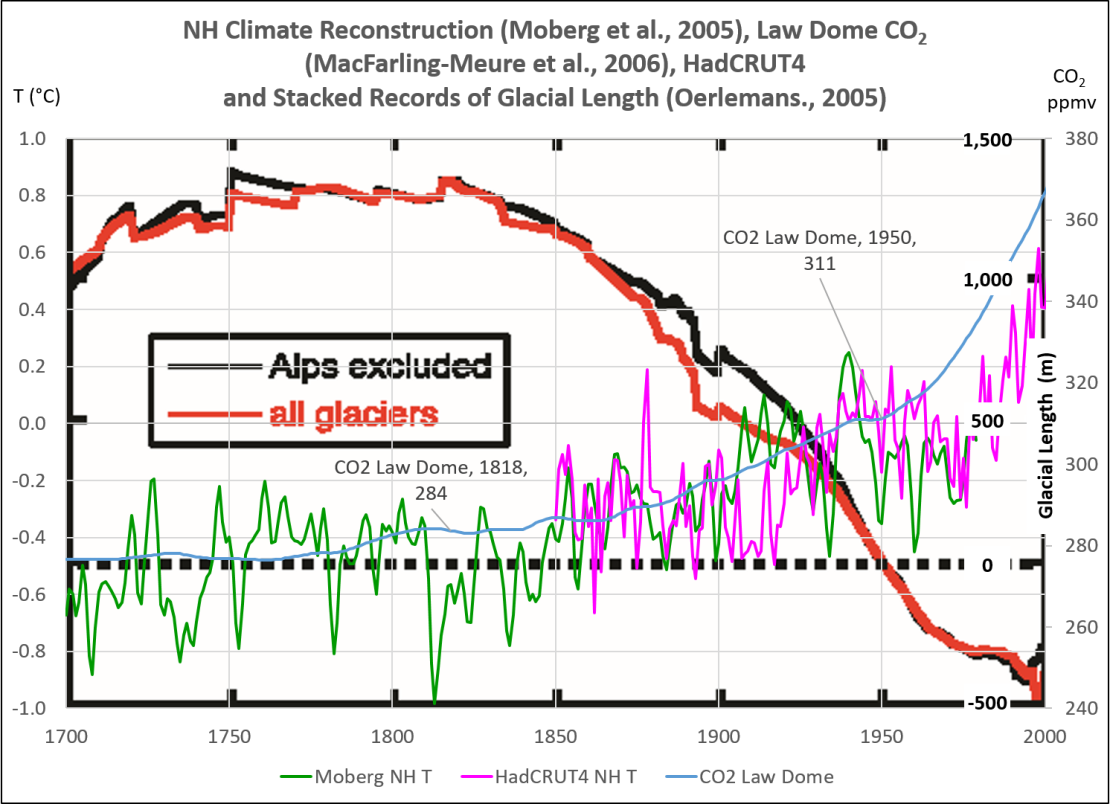
The good news: The recent rise in atmospheric CO2 didn’t end Neoglaciation. Natural Holocene climate cycles ended it.
The bad news: Sucking CO2 in a mad scientist’s effort to restore the climate to some previous ideal state, won’t work the way they expect it to, yet they are Hell-bent on trying.
References
When I get…

I was confused when I read above (Little Ice Age K Jan Oosthoek) that “cod migrated South to find warmer water” as it has been all over the press recently (https://www.business-live.co.uk/retail-consumer/north-sea-cod-menu-stocks-16976598) that North Sea cod stocks are endangered again because of warmer water caused by climate change.
I guess this means that the cod are smarter than the researchers, they moved out and the researchers are looking in the wrong place.