4:54 PM 01/28/2019 | Energy
Michael Bastasch | Energy Editor
Nearly 90 percent of the continental U.S. will experience below-freezing temperatures over the next five days as Arctic air moves south, according to forecasts.
The “polar vortex” event will have 89 percent of the continental U.S. with below freezing weather, meteorologist Ryan Maue said. In fact, all of the lower-48 are forecast to experience freezing weather, including Florida.
The National Weather Service (NWS) is warning of “extreme and dangerous” cold weather across the Great Plains and Great Lakes where wind chill could dip as low as -60 degrees Fahrenheit. NWS expects temperature “lows in the -30s and -40s” Wednesday through Thursday.

CNN reports that 75 percent of the U.S. population, more than 220 million people, could see below-freezing temperatures in the coming days. Frigid weather is expected to shatter dozens of temperature records throughout the eastern half of the country.
Temperatures across the region are expected to be as low as -40 degrees, and Chicago could break an all-time record low of -27 degrees Celsius set back in 1985, according to Maue. (RELATED: Kamala Harris Makes Misleading Climate Change Claim In Her First Campaign Speech. Why Isn’t The Media Correcting Her?)
https://twitter.com/RyanMaue/status/1089994196591800325
Farther north, Ennadai Lake in the Canadian Arctic could see wind chill as low -81 degrees Fahrenheit, NWS reported.
Discover more from Watts Up With That?
Subscribe to get the latest posts sent to your email.

Regarding the reference to Australia having hot weather. It is a almost flat country , and its big, as big as USA itself Weather is mostly determined from where the wind comes from.
If its from the West , the Indian Ocean, its moderate, if from the South its from Antarctica and can be very cold. If from the East which is seldom, its from the vast Pacific and moderate, unless your in the North East when you will get the odd cyclone.
But if its from the North and its Summer, then you will get hot and moist air from South East Asia plus if its the Moonsoon season, then its lots of rain.n.
Its the hot winds from the North which then pass over the vast and hot desert, and that makes the air very hot.
Nothing to do with “Climate Change” and certainly nothing to do with the 1 % of the worlds CO2 which we produce.
MJE
The current temperature in the Midwest.

Rahmstorf did it again:
What the 2018 climate assessments say about the Gulf Stream System slowdown
He wont learn it 😀
The current temperature in the Midwest.

This is not the end of low temperatures in the Midwest.
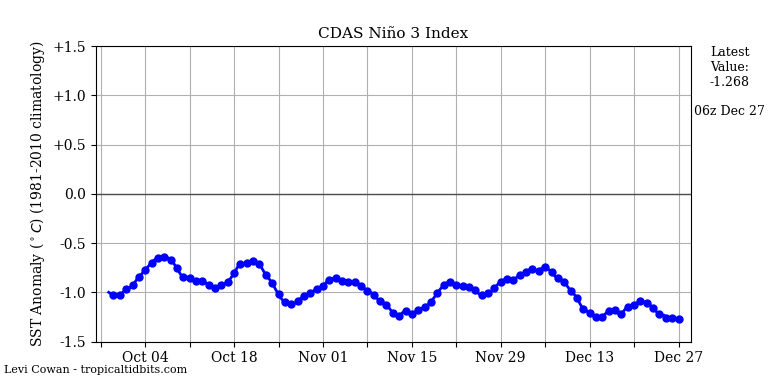
During solar cycle minimum you can not count on El Nino.
This is the forecast of stratospheric intrusion on 31/01/2019.

And that the temperatures in the hot Arctiv:
http://ocean.dmi.dk/arctic/plots/meanTarchive/meanT_2019.png
And at Penn State, home institution of the great Michael Mann, classes are canceled for remainder of day on Jan 30 2019 and all day Jan 31.
I don’t recall Penn State closing for cold weather in the past but if so it has been in recent years. It is not uncommon for Penn State to shut down for snow or ice. And more so in recent years
How will the “Mann” spin this? Maybe a warmer earth means more cold?
From Penn State website:
“1/30/19 3:08 PMDue to extreme cold: Jan. 30, students dismissed at 4:30 p.m., faculty and staff and 5 p.m.; Jan. 31, classes and activities are cancelled. On Jan. 31, faculty and staff should not report unless previously identified as performing essential services.”
I agree that weather is not a indicator of climate but the “cause” uses weather as such during heat waves.