Even worse, its growing problems with wind and solar spell trouble all over the globe
Oddvar Lundseng, Hans Johnsen and Stein Bergsmark
More people are finally beginning to realize that supplying the world with sufficient, stable energy solely from sun and wind power will be impossible.
Germany took on that challenge, to show the world how to build a society based entirely on “green, renewable” energy. It has now hit a brick wall. Despite huge investments in wind, solar and biofuel energy production capacity, Germany has not reduced CO2 emissions over the last ten years. However, during the same period, its electricity prices have risen dramatically, significantly impacting factories, employment and poor families.
Germany has installed solar and wind power to such an extent that it should theoretically be able to satisfy the power requirement on any day that provides sufficient sunshine and wind. However, since sun and wind are often lacking – in Germany even more so than in other countries like Italy or Greece – the country only manages to produce around 27% of its annual electric power needs from these sources.
Equally problematical, when solar and wind production are at their maximum, the wind turbines and solar panels often overproduce – that is, they generate more electricity than Germany needs at that time – creating major problems in equalizing production and consumption. If the electric power system’s frequency is to be kept close to 50Hz (50 cycles per second), it is no longer possible to increase the amount of solar and wind production in Germany without additional, costly measures.
Production is often too high to keep the network frequency stable without disconnecting some solar and wind facilities. This leads to major energy losses and forced power exports to neighboring countries (“load shedding”) at negative electricity prices, below the cost of generating the power.
In 2017 about half of Germany’s wind-based electricity production was exported. Neighboring countries typically do not want this often unexpected power, and the German power companies must therefore pay them to get rid of the excess. German customers have to pick up the bill.
If solar and wind power plants are disconnected from actual need in this manner, wind and solar facility owners are paid as if they had produced 90% of rated output. The bill is also sent to customers.
When wind and solar generation declines, and there is insufficient electricity for everyone who needs it, Germany’s utility companies also have to disconnect large power consumers – who then want to be compensated for having to shut down operations. That bill also goes to customers all over the nation.
Power production from the sun and wind is often quite low and sometimes totally absent. This might take place over periods from one day to ten days, especially during the winter months. Conventional power plants (coal, natural gas and nuclear) must then step in and deliver according to customer needs. Hydroelectric and biofuel power can also help, but they are only able to deliver about 10% of the often very high demand, especially if it is really cold.
Alternatively, Germany may import nuclear power from France, oil-fired power from Austria or coal power from Poland.
In practice, this means Germany can never shut down the conventional power plants, as planned. These power plants must be ready and able to meet the total power requirements at any time; without them, a stable network frequency is unobtainable. The same is true for French, Austrian and Polish power plants.
Furthermore, if the AC frequency is allowed to drift too high or too low, the risk of extensive blackouts becomes significant. That was clearly demonstrated by South Australia, which also relies heavily on solar and wind power, and suffered extensive blackouts that shut down factories and cost the state billions of dollars.
The dream of supplying Germany with mainly green energy from sunshine and wind turns out to be nothing but a fading illusion. Solar and wind power today covers only 27% of electricity consumption and only 5% of Germany’s total energy needs, while impairing reliability and raising electricity prices to among the highest in the world.
However, the Germans are not yet planning to end this quest for utopian energy. They want to change the entire energy system and include electricity, heat and transportation sectors in their plans. This will require a dramatic increase in electrical energy and much more renewable energy, primarily wind.
To fulfill the German target of getting 60% of their total energy consumption from renewables by 2050, they must multiply the current power production from solar and wind by a factor of 15. They must also expand their output from conventional power plants by an equal amount, to balance and backup the intermittent renewable energy. Germany might import some of this balancing power, but even then the scale of this endeavor is enormous.
Perhaps more important, the amount of land, concrete, steel, copper, rare earth metals, lithium, cadmium, hydrocarbon-based composites and other raw materials required to do this is astronomical. None of those materials is renewable, and none can be extracted, processed and manufactured into wind, solar or fossil power plants without fossil fuels. This is simply not sustainable or ecological.
Construction of solar and wind “farms” has already caused massive devastation to Germany’s wildlife habitats, farmlands, ancient forests and historic villages. Even today, the northern part of Germany looks like a single enormous wind farm. Multiplying today’s wind power capacity by a factor 10 or 15 means a 200 meter high (650 foot tall) turbine must be installed every 1.5 km (every mile) across the entire country, within cities, on land, on mountains and in water.
In reality, it is virtually impossible to increase production by a factor of 15, as promised by the plans.
The cost of Germany’s “Energiewende” (energy transition) is enormous: some 200 billion euros by 2015 – and yet with minimal reduction in CO2 emission. In fact, coal consumption and CO2 emissions have been stable or risen slightly the last seven to ten years. In the absence of a miracle, Germany will not be able to fulfill its self-imposed climate commitments, not by 2020, nor by 2030.
What applies to Germany also applies to other countries that now produce their electricity primarily with fossil or nuclear power plants. To reach development comparable to Germany’s, such countries will be able to replace only about one quarter of their fossil and nuclear power, because these power plants must remain in operation to ensure frequency regulation, balance and back-up power.
Back-up power plants will have to run idle (on “spinning reserve”) during periods of high output of renewable energy, while still consuming fuel almost like during normal operation. They always have to be able to step up to full power, because over the next few hours or days solar or wind power might fail. So they power up and down many times per day and week.
The prospects for reductions in CO2 emissions are thus nearly non-existent! Indeed, the backup coal or gas plants must operate so inefficiently in this up-and-down mode that they often consume more fuel and emit more (plant-fertilizing) carbon dioxide than if they were simply operating at full power all the time, and there were no wind or solar installations.
There is no indication that world consumption of coal will decline in the next decades. Large countries in Asia and Africa continue to build coal-fired power plants, and more than 1,500 coal-fired power plants are in planning or under construction.
This will provide affordable electricity 24/7/365 to 1.3 billion people who still do not have access to electricity today. Electricity is essential for the improved health, living standards and life spans that these people expect and are entitled to. To tell them fears of climate change are a more pressing matter is a violation of their most basic human rights.
____________
Oddvar Lundseng is a senior engineer with 43 years of experience in the energy business. Hans Konrad Johnsen, PhD is a former R&D manager with Det Norske Oljeselskap ASA. Stein Storlie Bergsmark has a degree in physics and is a former senior energy researcher and former manager of renewable energy education at the University of Agder.
Discover more from Watts Up With That?
Subscribe to get the latest posts sent to your email.

All that excess German wind and solar energy at peak times, just needs a bit of liebensraum.
“liebensraum” = love room
“Lebensraum” = living-room, or, with a different, not pc connotation “Lebensraum” (im Osten…)
Not to be confused with Liebestraum (by Liszt), which I used to play fairly well.
Those who were obsessed with Lebensraum loved his”Préludes” a bit too much.
https://www.youtube.com/watch?v=p8dvw1kzgsg
(14:20)
jorge
If you played Liszt you must be good.
Once I could just about make it to the end of Beethoven’s moonlight sonata.
But I was never any good at sight-reading.
Thanks for the language correction.
Electrons have feelings too though.
What is life without love?
AlGore
OUCH! That had to hurt.
‘Germany took on that challenge, to show the world how to build a society based entirely on “green, renewable” energy.’
Costa Rica tried to go 100% renewable, but if you speak to anyone that’s ever visited or lived there for more than a day in recent years one of the first things they’ll tell you is the that blackouts are an everyday clockwork-like occurrence.
If Germany gets excess power, they can just install two humongous electrodes in the Baltic Sea and boil sea-water/cook fish.
The negative prices would be a great opportunity to make glaciers. Wouldn’t it be fun to have a piece of mountain property that was rigged to make snow when the prices go negative. Create your own private glaciers.
“… the country only manages to produce around 27% of its annual electric power needs from these sources.”
I doubt that. “Renewable”, ok, but this includes hydro and biomass. Solar and wind are about 15%.
(renewables from 20111, wind and solar are larger today)
If green energy actually worked capitalism would have proved it long ago. Especially wind which isn’t exactly new technology.
Indeed, there are reasons why mankind moved away from wind-power in previous centuries. Mainly to do with better, more reliable sources of energy (such as from fossil fuels) being available.
Germany became a nation of green morons. Hard coal under German soil is said to last for 200 years minimum.
But the time of “home grown” hard coal is finally over. Germany just shut down their remaining two hard coal mines once and for
goodbad. Instead, they chose to chop down the Hambach Forest for a brand-new open-cast lignite coal mine. This time, the green blob went berserk rightfully but couldn’t change a thing.The green blob fosters Frankensteins beyond their control.
As for those closed for good coal mines…I doubt it.
Freezing to death and starving has a way of concentrating the mind.
It is only a matter of time.
History shows that it is wise to have a reserve or backup. Even when not needed, these reserves or backups provide and preserve the knowledge of mining, in this case. If something goes terribly wrong, there will be no hard- coal miner left who has learned the art of digging for coal. These politruks are giving away technology and knowledge collected in hundreds of years w/o anything in return. It’s a shame.
Don’t worry, the Chinese will buy the mines and bring in their own people to run them.
/sarc
Chinese? Apparently happening right now in South Africa. AND they are going to build their own, private, coal-fired power station to feed their own, private, industrial estate, which, in a country with a 28% (and counting) unemployment rate, will be most likely be staffed with their own, private, countrymen!
Digging is not difficult.
People hundreds of years ago figured out how to do it on a large scale, and figured it out very quickly.
And even with no such thing as electric lamps or power tools, within a short time country after country learned how to mine coal on a huge scale.
I am not disagreeing that it is good to have back-ups, or anything like that.
I am saying that when people start dying or even suffering greatly, well, it may not be a great idear to be the person trying to prevent getting at what is needed.
People do not like being forced to suffer because someone else said so.
And history is replete with examples of what happens when the masses have had enough.
The shutdown of hard coal mining in Germany is not motivated by green ideology but by economics, even though I’m sure the greens love it.
The hard coal layers in Germany’s largest mining region, the Ruhr conurbation, are rather deep and at an angle. The most accessible ones in the south of the Ruhr area were mined in the 19th century and have long been exploited. Through the 20th century mining moved slowly north where the layers get deeper. It’s now at the northern edge of the Ruhr conurbation where it’s already very deep and expensive to mine. They could go further north, there’s enough coal there. But for cost reasons it was decided to shut it all down. Cheaper hard coal is imported instead.
Most mines have been running at a loss from the 1960s/70s on, and therefore probably they’d all have shut decades ago if it wasn’t for government subsidies. To cushion the blow for the mining regions, and for strategic reasons, huge subsidies went into hard coal mining from the 1970s onwards, but the idea was to shut it down eventually, just later than capitalism would have done otherwhise.
On the other hand, lignite mining in Germany is running at a profit. The greenies want to shut that down too, and this time it’s for purely ideological reasons. So far it hasn’t started, but the green media are campaigning for a shutdown.
Oh? I didn’t get that take on it all – this past week, one of the Main TV Channels devoted time to a church service celebrating the closure of the LAST deep mine somewhere in the Ruhr.
AS far as the Lignite / Opencast mining – there’s a big anti-mining effort on the go where MORE Villages are to be destroyed – don’t know where the folk are being decanted to… not the first time some of them have had to move on.
Between Open Cast in populated areas and deep mining leading to Land settling ( as we are becoming increasingly aware of in the UK ) this is a more serious topic for settling than fracking and oil extraction from same IMHO
In the past, villages that had to be abandoned for mining were resettled to a new place somewhere in the same region. The inhabitants get compensated for their lost real estate. Usually the new settlements would be given the same name as the destroyed one. I wonder if this will go on in the future, given the current political climate.
German Utility companies have lost $billions because of renewable grid priority. Without grid priority there wouldn’t be any renewables. Everything about renewables is bad somethings worse than others. Not worthless, worth less than nothing. Amazing what corrupt politicians and willfully uninformed voters can accomplish when they “team up”.
Utility companies shouldn’t be penalized when they are forced by political mandates to contend with “off spec” poor quality power from dozens of wind farms with dozens of turbines all operating at different times and producing different quantities and qualities of electricity.
Wind power causes problems with:
Voltage regulation (magnitude and frequency)
Voltage sags and swells
Harmonics and inter harmonics*
Real and reactive power
Sub synchronous resonance issues due to interaction of the electric network
and the complex shaft/gear system of the wind turbine.
*Harmonic currents can produce a number of problems:
1. Equipment heating
2. Equipment malfunction
3. Equipment failure
4. Communications interference
5. Fuse and breaker mis-operation
6. Process problems
7. Conductor heating.
Take off the solar and wind subsidies and both industries crash tomorrow.
With world energy demand increasing 1.5% per year, solar and wind cant keep up with just this increase. Right now they total 1.1% of energy supply. And this after 30 years of massive subsidies
There is at least one country doing very well out of all this wind/solar installation: Norway. Because they get almost 100% of their electricity from hydro, they can take other countries’ excess power and just adjust their hydro output to balance. This is why Holland has an HVDC link to Norway and I guess Germany either has one or is building it now.
I’d love to know how much money Norway makes on the split: get paid to take power nobody else can use and then charge spot market rates to sell it back when it’s dark and windless. Norway is functioning as Europe’s battery for excess renewable output.
This allows other European politicians to hide the true cost of their plunge into wind and solar. I don’t think Norway has any pumped hydro (why would they need it?), so they can only take excess power equal to actual domestic usage at any given moment. When highly renewable countries have more excess power than Norway needs, I don’t know what they do; perhaps build a couple of aluminum smelters. If other people pay you to take their excess power, it drives the cost of aluminum production way, way down.
Reality check:
Population of Norway = 5.3M;
Population of Europe = 741.4M
Understood, but remember two things: (1) not every country in Europe has installed large amounts of intermittent sources, and (2) even those that have will only need to dump excess intermittent power at a loss when they have exhausted other balancing measures. Still, the countries which have built or are building HVDC links to Norway are doing so because they have to, not because Norway is asking for it.
When you desperately need something for which there is only one seller, guess who gets the best deal?
What you are pointing out is there is a limit on how much excess power Norway can absorb. If installed intermittent capacity in Europe continues to increase that limit will be reached at some point. Which is why I speculated that new aluminum smelters might be in Norway’s future.
I see that one German aluminum facility is already looking at how they can keep operating with unreliable power. The article title appears to be about a new “green battery”, but it’s really about how to adapt to variable power.
I don’t understand your logic, it is not desirable for any country to act as a “buffer” for another country’s wether dependent generation, regardless if the buffer is hydro, coal, or nuclear. The temporal shutting down of their own power plants is a cost factor, but they don’t profit from having to do that.
The idea of some of the German greens (maybe elsewhere too) about Norway is something else. They know they need huge storage capacity to run the grid off wind or solar alone, and they’re looking at Norway as a location for pumped storage. So far Norway’s hydro plants are not pumped, just plain reservoirs. The German greens want Norway to transform some of them into pumped storage, build a huge line across the North Sea, and then store German wind/solar energy over in times when there’s a surplus, and retrieve it back in times of low wind and sun.
Of course these installations would first have to be built in Norway, at enormous costs that someone has to pay, and Norway would only let Germany use them at a price. Both of which would ultimately be paid for by the German households, on top of all the green surcharges they already pay on their electricity bills. At this time that plan is cloud cuckoo land, and so far nobody has asked the Norwegian people how they feel about it.
Sorry, but this is a myth:
“Norway is functioning as Europe’s battery for excess renewable output.”
Norways elecricity output (all hydro) is roughly 1 % of the EU output. In a normal year Norway is able to export 10 % of its Hydro output, which is insignificant when it comes to functioning as Europe’s battery.
The Norwegian HVDC links to Holland, Germany, Scotland (being built) are hideously expensive, the bill is sent to Norwegian consumers. Ohms Law is still relevant, so there is a substantial loss in these links.
Norway has plenty of politicians who want to save the world from the CO2 demons changing our climate, so a huge number of windmills are being constructed, with green certificates ensuring the mill owners get paid twice the market value of the energy produced – the bill is again sent to the consumers. Shortly our electricity will be more expensive than in neighboring Denmark.
There is no sane reason for this windmill construction, since 110 % of our electricity consumption is being covered by hydro.
I”m so far off-topic you can slap me but;
NASA says we’ve experienced 13% “greening” of the Earth over the last thirty years (due to fossil fuel CO2 emissions).
More CO2 in the atmosphere causes more plant growth which then causes more O2 creation. ?
Are we adding both CO2 and O2 and increasing the volume of our atmosphere?
Just wondering.
It’s the plants 🌱 that are taking CO2 from the atmosphere and adding O2. O2 allows humans and multicellular life in general to exist. The only reason that there is O2 in the atmosphere is because of plants. And the only reason that there are plants is because of CO2.
But CO2 is bad, because … it’s bad.
So plants that like CO2 must be bad too.
And humans that like plants are also bad, especially vegans.
None of this adds up, so there is this huge excess of righteousness in the biosphere, that allows governments to sell carbon credits and build wind turbines and solar arrays for no reason.
slap
It’s a net zero or zero sums game. H2O and CO2 combine to make hydrocarbon solids, and O2 is expelled as a waste product. So liquid H2O and gaseous CO2 are converted into solids and gas.
Riddle me this: The energy from the sun is converted into solids, changing radiation into stored energy in the form of hydrocarbons… Is this a net endothermic cooling reaction? Does growing plant life cool its surroundings?
Sure, that is the only way the energy budget can add up
/Jan
I think so too. Would make for an interesting science experiment to devise a mini environment one with plants growing, and the other with all the same ingredients, except similarly colored plastic plants while monitoring temperature.
There’s no need. The chemistry of photosynthesis demonstrates that net energy is absorbed by plant growth. Conservation of energy must be adhered to, it’s not optional.
Id have to admit that in not certain about the energy budget when decomposition is factored in, however. Working that out should not be difficult, but it’s beyond me.
Huh: I understand and agree with you. Still would be a nice science experiment for high school or jr high. growing trees cool the planet… until which time the crackin is released by campfire, wood pellet stoves, or some other evil human conjours up.
Slight correction: The sunlight is converted in covalent bonds.
Not a solid.
In fact, electrons barely exist.
Just ask Schrodinger’s cat.
There is no past, and there is no future.
Just one, long, ever-present now. No…now. Wait…now…now…now…now…nownownow…
^dang*
Someone’s had some eggnog spiked of course 🙂
Zig Zag: A pile of mulch will generate heat while decomposing. I don’t know if this is caused by bacteria or if they are incidental. Hey stacks have been known to burst into flame while stacked in a barn if they contain too much moisture when stacked.
Mulch with organisms feeding on it is exothermic. Whenever hydrocarbons separate into CO2 heat is released in the “burn”.
It’s not true eggnog if it hasn’t been spiked.
of course…
Intuitively, I’d say no. Heat/energy that enters our atmosphere is still here whether as part of a plant or not. Eventually it may leave our planet but not because of plants.
I’m taking the word “surroundings” to mean our entire planet.
Temperature and energy are not the same thing. I said if energy gets converted from radiant to hydrocarbon, it should be endothermic and cool it’s surroundings.
Thanks, I’m no physicist. Interesting topic.
Albert,
Oxygen is never created. What plants do is splitting CO2 into Carbon and oxygen. The carbon is combined with hydrogen from water (H2O) to form solid plant material and the oxygen is released into the atmosphere.
Fossil fuel consist mostly of hydrogen and carbon which combines with oxygen in the combustion process to form CO2 and H2O. Since more oxygen is consumed in this combustion than gained in worldwide net plant growth, the atmospheric level of O2 is falling, but that is not much of a problem since we have so much of it.
/Jan
Change in Volume (or density) is not measurable at the amount theorized.
In theory there is more stuff. But a volume change cannot be estimated within realm of unknowns. Just like temp.
When fossil fuels are burned it uses O2 in the atmosphere to create the CO2. This cancels out gains from increased plants. Keep in mind were talking about variations of O2 in the .01% range of the 20.95% in the atmosphere.
Green energy is about power – political power. Thepower to control a poulation. For millenia, food has been tried and usually fails, especially in rural areas.
Now they (the Marxist/Socialists) are attempting to bring rural areas to heel with control of their energy, and the fuels they need to produce food (animals and grains).
And the even more sinister effort to control the population, at least in Europe, is with Islamization and the Sharia law to comes with it to erase popular democracy.
As a legal system, the Sharia law is exceptionally broad. While other legal codes regulate public behavior, Sharia regulates public behavior, private behavior, and even private beliefs. Compared to other legal codes, the Sharia law also prioritizes punishment over rehabilitation and favors corporal and capital punishments over incarceration. Of all legal systems in the world today, the Sharia law is the most intrusive and restrictive, especially against women.
Which makes Sharia law the ultimate eco-fascist political system. What I find amazing, is the ignorance of European women to the fact that its as the Left embraces Islamic immigration, it holds two diametrically opposed beliefs when its comes to women’s rights on one hand and the restrictive controls on women that comes with Islamization on the other. George Orwell predicted this kind of behavior in the drift towards a totalitarian political system and he called this Double Think.
Fellini Film I tells ya!
Living it.
Nor by 3030.
The best that can be said is that they are teaching the rest of the world to avoid such expensive mistakes made by worshiping the false god of modern environmentalism.
So,,,,,,,,,, Germany is a world leader in providing 5% of their energy needs via wind and solar? 5%, with all the money spent and pain inflicted on their population? 5%? I guess it is a big step up over the global numbers of, what 1%? The only time wind and solar look even remotely good is when the get lumped in the renewable category of which the predominate source of energy in that category comes from the CO2 producing process of burning wood and Dung. Perhaps some Germans should start cooking their dinners with Dung to help with their rediculous targets.
Unfortunately the BS produced by politicians is not combustible. If it were we’d have an endless supply of bio fuel.
Actually wind and solar are made to look good by lumping them together with hydro, which is the ONLY “renewable” electricity worth a damn. Which of course means Eco-Nazis are against it.
Everything is renewable.
Some are just slower to do so.
That depend on how you define renewable, and I think this is a misleading one. When we use fossil fuel, it is gone forever. Fossil fuel is non-renewable. Oil was formed from dinosaur fat several million years ago. When we burn a gallon of gasoline it will not form new fossil energy again on a human time scale. That is unquestionably a non-renewable resource.
Land-use is not in the same category. After all we do not consume land, we just occupy it for some time period. If our grandchildren want to use the land for some other purposes, they can do that. The land does not vanish because we have built windmills or solar plants there. You may argue that we have occupied it for a long time by bad investments, but the land is still there.
Therefore, I think it is misleading to label land-use as non-renewable resource.
Similar with chemical elements like iron, sink, copper, rare earth elements et cetera, they never disappear. We can use the same chemical elements repeatedly forever. In my opinion that does not qualify as a non-renewable.
/Jan
Oil from dinosaur fat?
O yes I forgot – we’re not allowed to mention photosynthesis or plants any more, wouldn’t want to risk implying anything good about CO2 would we?
Among their growing litany of lies the Climagisterium have found it necessary, contrary to straightforward evidence such as bomb test nuclide fallout, to assert the fantasy that CO2 in the atmosphere is more or less immortal and never leaves it.
Thus “carbon” in the atmosphere is as stable and durable as carbon in fossil fuels.
So in the atmosphere carbon is still a fossil fuel, just like before.
Thus all carbon is renewable.
Everything on earth comes from a supernova (except hydrogen) and is renewable.
Thank you Tasfay,
I see that you are right about dinosaurs, I remembered the dinosaur theory from an old school lesson and wrote it without checking. I see now that newer science tells that it was formed by bacteria, not big animals.
However, that does not make any difference for my point. Fossil fuel was formed several million years ago, and when we burn it, it will not return to that form in any human time scale.
That the carbon is stable is beside the point. The value of fossil fuel is in its internal energy, which is released when we burn it. That energy is only released only once, and therefore the energy is non-renewable.
/Jan
At the end of the day, what’s the issue? You’re kind of arguing that, having found yourself marooned on an island, you should stop burning the sticks and branches you forage up to keep yourself warm during the cold nights just because the trees don’t grow fast enough (and drop branches and twigs that dry quick enough) to replenish them at the rate of what you burn, all while slowly becoming ill and dying of exposure to the cold. Better to keep burning the sticks and branches while you figure out other ways to warm yourself, rather than die fretting over the notion that someday you’ll run out of sticks and branches to burn.
Fossil fuels are sustainable until they run out. Since we’re nowhere near that point, we should continue to use them until we come up with something better. Newsflash – windmills and solar panels ain’t it.
The geological formations from which we are able to economically extract oil is not the source of th4e supply, and does not represent the amount of oil in the ground.
Under those oil bearing formations are the layers of rock that contain the real reservoir, and they are many times larger then the amounts that we can get out immediately. Some oil bearing formations fill from below as fast as oil is pumped out of them. Some wells that went dry decades ago can be reopened and more oil pumped, already. Give it a hundred years and better technology.
Besides, there is surely many times what experts tell us is left…as has been the case for over 100 years.
And beyond that, making gasoline or another liquid fuel is just a question of energy.
Right now we can dig it and drill it and pump it for very cheap prices.
Does it seem strange that the places like the US where we spend a lot of time and money looking for oil, we find giant amounts of it? Ever more.
Ten years ago experts, some of them anyway, said there was not enough oil under the US to bother looking for, and now we are again the leading producer in the world.
And all the increase is on private lands, and public lands are enormous by comparison, and entire regions known to be some of the richest plays are off limits.
There is a lot of sedimentary rocks under the ground and under the seafloor…and likely more oil than even the most optimistic have speculated. We pump more than ever in more places than ever and yet we have more known reserves and estimates of oil in place than ever and the price is getting cheaper.
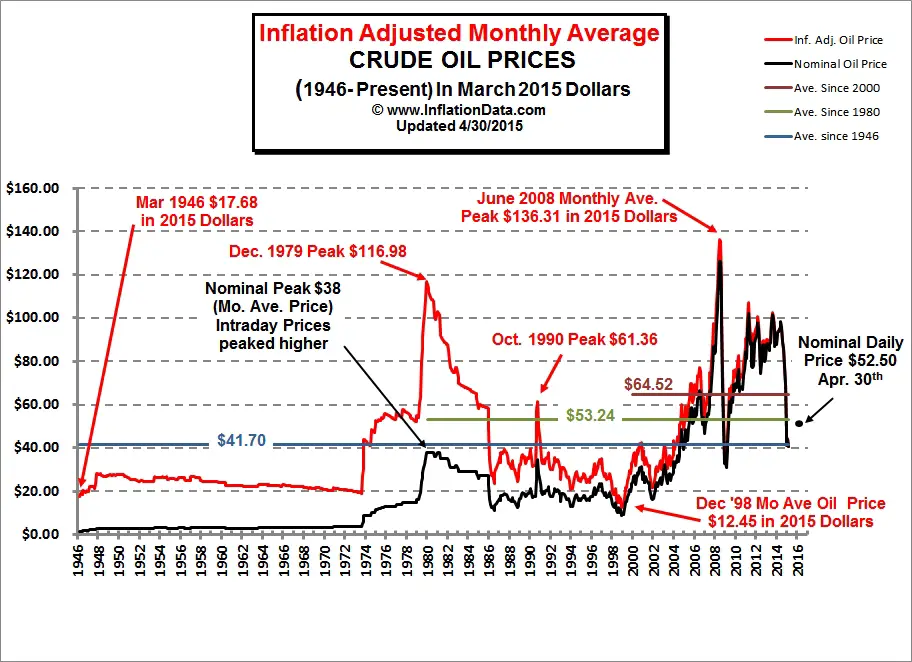
Accounting for inflation, it is getting towards the low end of the historical range since WWII, and falling fast, which large producers slashing production to prop up prices, and yet it falls anyway.
We will never pump the last barrel of oil…ever.
Chemistry aint voodoo and it aint rocket surgery neither.
We can make it if we needed to, and we do not need to.
So relax.
For generations we drilled right through the rock – shale! – that held unimagined tanker loads of hydrocarbon, oil that we are now able to harvest cheaply, safely and abundantly with today’s tools. I wonder what else we are drilling right through?
So Germany is now “the dog that caught the car”. And instead of reevaluating the decisions that led to this situation, they are doubling down on stupid.
They think if they just work harder at doing more “stupid” they can drag this car home, and impress the neighbors with their “skills”.
Sad to see a public psychosis take hold of those in power. And watch as economic chaos starts a downward spiral. Take a good look at Venezuela. They are further along this process, but that is where “doubling down on stupid” will take you.
Has anyone thought to check (audit) the power output from old solar rooftop panels in Germany. They weren’t very efficient to begin with and started declines in year two. By 2020 they will amount to rooftop virtue signaling tiles.
To give a sense of scale on grid storage; according to Wikipedia, Germany’s installed electrical generating capacity is about 198 gigawatt. 10 days of power output at this level is 198 x 24 x 10 = 47,520 Gw-hr. By contrast WORLD output of lithium ion batteries is of the order of a couple of hundred Gw-hr a year
We are nowhere close to the point where lithium batteries can make any significant dent in time-shifting grid-scale energy. They may have a role in supplying the grid for a matter of seconds whilst other facilities come on line.
As regular readers may know I am a fan of EVs but I detest grid scale windmills. A lot of structure, a lot of maintenance, a lot of visual blight for negligible return
And the potential for bidding up the price for Lithium. Storage of electricity is a critical factor for many electrical systems, and electronic products. The more they depend on Lithium, the greater the risk of price spikes crushing those use massive quantities of Lithium, and compete against products that don’t require those batteries. EVs are vulnerable to a bidding war Lithium.
What if Russia and other countries dependent on oil sales, decide to buy up worldwide supplies of Lithium? Who is going to stop them?
You make a very good point. And until the time that renewable energy can be made to act as “dispatchable” it will fail as a reliable power source. Reliable renewable power will not happen until a cheap (very cheap), small, quick charging, extended life battery with the potential to hold significantly more power than the present batteries can hold is invented. We are talking about several quantum leaps in battery technology. When this happens we will most likely have another form of energy generation that makes the present wind and solar efforts look primitive. In the mean time, all solar and wind farm generation facilities are just monuments to stupidity.
It will never happen that batteries become more efficient by orders of magnitude.
Try looking up how much batteries have improved since back when doctors scoffed at the notion of germs causing diseases, and the telegraph was wondrous technology.
We have made more progress on flying cars, ray guns, and communicators just since the first episode of Star Trek aired than we have made in battery tech in three times that long.
Like fusion, just because someone can think of it, does not mean it is only a matter of time before it is a reality.
And capacity is only the first problem with batteries. They cost out the wazoo, waste a lot of power, and then become useless after a few years or a few hundred to at best a few thousand duty cycles. Grid scale battery storage is a pipe dream. Aint happening, unless someone can figure out how to make ones that are dirt cheap and use iron or sand or something.
IOW…likely never.
*cue the person assuring us they have it almost licked*
A lot of visual blight and health problems for those who live close to them, and for NEGATIVE returns, when ALL COSTS are considered (they seldom are, as their champions endlessly “promote” them to the next round of suckers).
Everyone knows that solar power doesnt work. That’s why the ISS is powered by coal, but they don’t tell anyone.
Are you under the impression that the ISS is equivalent to cities in Europe? I did not see anyone saying that solar power doesn’t work. I did see many who think it is not an appropriate source of electricity for the modern world. It is fine for remote locations, that don’t have access to base load electricity. Especially those locations that have to “bring your own atmosphere”.
A space station is very different from an industrialised country.
The ISS:
– Has sunlight not obstructed by the atmosphere or weather nearly 100% of the time.
– Rechargeable batteries for the short periods of sunout need not have a huge capacity.
– Its surface/electricity consumtion ratio is very favourable
– There are few workable options: It’s either solar, nuclear or not have a space station at all. There are spacecraft and probes that use nuclear.
– Cost is not really an issue, so they go for whatever works at whatever it costs.
This isn’t entirely wrong, but it is misleading.
Part of the reason why they haven’t achieved emissions reductions is because they are replacing nuclear energy with wind and solar. After Fukushima, Germany decided to shut down their nuclear fleet – completely unrelated to the goals of expanding wind and solar.
The same basic thing is happening in California.
Every organization with serious decarbonization goals realizes that nuclear is needed. Wind and solar are optional add-ons. Unless magic season-scale storage is invented, the foundation of any electric sector decarbonization plan has to be nuclear.
Yeah but nuclear WORKS and provides useful energy. Similar to hydro, the Eco-Nazis just won’t have it.
Exactly.
The people pushing climate change fearmongering are against any real solutions.
And besides for that, CO2 is the essential basis of the entire biosphere and it is a tiny trace gas.
Rounded to the nearest 1/10th of 1%, the amount in the air is zero.
That sounds very low for something that, if it every ran out, would mean the end of every plant and animal on Earth, forever.
It’s a religion. No sacrifice too great. To be pure, you must submit and pay moar.
Well WHO with a science education (16 years) would have guessed otherwise? Why do I see Nuremberg Rallies in my mind every time i see a climate conference?
“Germany has installed solar and wind power to such an extent that it should theoretically be able to satisfy the power requirement on any day that provides sufficient sunshine and wind. However, since sun and wind are often lacking ” Anyone with half a brain would know this was going to happen. How intelligent people can wildly rush down a road with so many pitfalls is beyond me. And as far as establishing the 50Hz frequency, that is usually anchored by your largest base loaded generator, most like a coal or nuclear steam plant. If none of those units are on line, none of the wind or solar units are big enough to keep the system in line. Where are the electrical engineers who know what the problems will be when you push it this far? Reading the article it was one major problem after another that was not adequately thought through.
Yeah, the energy price doubled in the last 18 years from 0,14 € kWh to 0,30 € kWh in Germany. Last year 344.000 households couldn’t pay their energy bill and their energy was turned off. The mass media still propagates this climate alarmism and brainwashes the people to pay co2 taxes and subsides.
“Last year 344.000 households couldn’t pay their energy bill and their energy was turned off.”
Maybe the government should tell them to keep warm in yellow vests.
And some still wonder at the collapse of traditional political party coalitions. It is really amazing!
I would love to know how anybody gets by with their power turned off. I would do it myself, but food is the main difficulty that I can’t solve. Buying food every day would easily get more expensive than being connected and having a fridge.