
Guest essay by Eric Worrall
“Denier” NASA Administrator Jim Bridenstine has confused critics by suggesting that humans contribute to climate change “in a major way”.
New NASA Chief Bridenstine Says Humans Contribute to Climate Change ‘in a Major Way’
By Sarah Lewin, Space.com Associate Editor | May 19, 2018 07:24am ET
In a NASA town hall yesterday (May 17), NASA’s new administrator, Jim Bridenstine, said that he knows Earth’s climate is changing, and that humans contribute to it “in a major way,” also supporting NASA’s research into that important area. The statement is significant because Bridenstine has expressed doubt about human-caused climate change in the past, causing some to question his suitability to lead a fact-focused NASA.
In 2013, as an Oklahoma congressman, Bridenstine claimed there was no current trend toward global warming. More recently, such as in his NASA administrator confirmation hearings last November, he has acknowledged that human activity contributes to climate change. But he had stopped short of saying that humans are the phenomenon’s primary cause.
At the NASA employee town hall, Bridenstine described how his thinking had “evolved” on the topic and laid out his current beliefs.
“I don’t deny the consensus that the climate is changing; in fact, I fully believe and know that the climate is changing,” he said. “I also know that we, human beings, are contributing to it in a major way. Carbon dioxide is a greenhouse gas. We’re putting it into the atmosphere in volumes that we haven’t seen, and that greenhouse gas is warming the planet.
“That is absolutely happening, and we are responsible for it,” he added. “NASA is the one agency on the face of the planet that has the most credibility to do the science necessary so that we can understand it better than ever before.”
…
“We need to make sure that NASA is continuing to do the science, and we need to make sure that the science is void and free from partisan or political kind of rhetoric,” he said. “We have guidance from an apolitical, nonpartisan National Academy of Science telling us what is important for humanity, and we’re going to follow it.”
…
Read more: https://www.space.com/40640-nasa-chief-bridenstine-climate-change.html
I think, a lot of people at WUWT think it is plausible that humans contribute to climate change in a “major way” – that low end IPCC climate sensitivity estimates are possible.
But there is a big difference between thinking we contribute to global warming, and thinking we face a global climate emergency.
The reason Bridenstine has surprised critics is that normally, any time someone criticises extreme climate claims, the critic is immediately caricatured as a “denier”. Alarmists stop listening to what they are saying.
In the case of Bridenstine they had no choice but to listen, because he is the new boss. But what Bridenstine said didn’t conform to their prejudice of what they thought he would say.
Who knows, just maybe the shock of discovering a “denier” doesn’t necessarily disagree with everything they say might prompt some alarmist climate scientists to re-evaluate their prejudices, to be more receptive to criticism and other points of view.
Update (EW): Video of Jim Bridenstine’s speech to NASA (h/t ATheoK). Jim’s climate comments start around +23 minutes.
Discover more from Watts Up With That?
Subscribe to get the latest posts sent to your email.

There is no need to distinguish between the right and the left in this matter because the processes affect everyone. Scientific consensus on this issue is quite obvious and can not be completely ignored.
you mean, the consensus according to which scientists give results incompatible with each other, as evidenced in the IPCC graph provided by Nick Stokes above?
I’m a scientist working at the periphery of this. At my facility, if we took an anonymous vote, the concensus would be different.
That of course is not how science works and you should know that. Besides that, politics are driving this debate and have been at least since the late 1980’s.
Mihaly Malzenicky,
With respect, I think you are mistaken. You fail to recognize that there are many competent scientists who disagree with what is, in reality, a political consensus. I think that you are in Slovakia? I have no first-hand knowledge of how it is in your country, but expect it is not unlike the rest of Europe. When the scientists are given both positive and negative incentives to stick to the party line, we cannot ignore the question of politics and how this suppresses the search for the truth. Any time that it is considered dangerous to question orthodoxy, the search for knowledge is in peril. And these days, scientists know that there are political limits to what they may think or say. Look to the situation in Australia with Peter Ridd for an example.
In any case, consensus is irrelevant. The question is what is real, what is true. Many times in history there has been a consensus that something is true when it was totally false. The only thing we owe to consensus is to answer its claims. If you spend some time reading here, you will find many examples of this being done well, and some unnecessary political chatter that you can safely ignore.
Bridenstein should stick to Space Development.
He is the first elected official to serve as NASA Administrator. His nomination drew controversy given his lack of formal qualifications in science or engineering, and his rejection of the scientific consensus on climate change.
Trump rejected Paris not based on science, but business. Pruitt wanted a Red-BlueTeam to debate climate but was sidelined. Has science become so damaged politics rejects it? The only way to change this is NASA-like crash programs, like Apollo, not PPP nutty deals.
As Stafford said NASA will have to pay Russia to take over the US part of ISS since no PPP is capable of doing it in time. “N” in NASA means National, a part of international relations.
Sounds like he was either lying in Congress or converted to the secular religion.
I find it fascinating as to how weak minded most politicians are in the face of “progressive” claptrap.
…and how effective the swamp/consensus is in marketing their failed narrative.
Bridenstine is not a scientist. Here’s 49 former NASA scientists and astronauts view on climate change:
“The unbridled advocacy of CO2 being the major cause of climate change is unbecoming of NASA’s history of making an objective assessment of all available scientific data prior to making decisions or public statements.”
“We believe the claims by NASA and GISS, that man-made carbon dioxide is having a catastrophic impact on global climate change are not substantiated.”
“We request that NASA refrain from including unproven and unsupported remarks in its future releases and websites on this subject.”
http://www.businessinsider.com/nasa-scientists-dispute-climate-change-2012-4
I’ll never shake the feeling that in the end Trump will screw us over and switch sides.
It’s good to have that feeling, it shows that you don’t reject all we know about power, politicians and their earned trust. Furthermore, disappointments are always around the corner.
“I’ll never shake the feeling that in the end Trump will screw us over and switch sides. ”
Is that the same thing as the dems will stop insanely hating Trump?
I think Trump will side with what most Americans want, is that switching sides?
“I think, a lot of people at WUWT think it is plausible that humans contribute to climate change in a “major way” – that low end IPCC climate sensitivity estimates are possible.
But there is a big difference between thinking we contribute to global warming, and thinking we face a global climate emergency.”
———————————————————————————————————-
Thank you so much for saying that. It needs to be said over and over. We will never convince the greater public that climate science is some a left wing conspiracy to control the world, or any other strident claim. Perhaps though, with a measured tone, we can convince them that the evidence and data for an emergency are lacking.
“Perhaps though, with a measured tone, we can convince them that the evidence and data for an emergency are lacking.”
A warming world has always been a good thing.
Problem is people don’t know what warming world looks like and people tend not to like change, even though they tend to be eager to vote for it.
I think it is overly optimistic to assume humans are having major effect upon global temperature.
We currently live in a cold world. Our global climate is called an icebox climate.
A icebox climate is when the world has a cold ocean, and our oceans are cold.
The ocean surface is fairly warm, but all of the ocean has average temperature of about
3.5 C, which is cold, but within a period of say 1 million years, the ocean has been colder than 3.5 C.
It thought to have cooled as cold as an average temperature of 1 C.
But if and when the entire has average temperature of 1 C, the temperature of the surface of the ocean is not a lot different than our current average surface temperature of about 17 C.
Or average ocean surface temperature instead of being 17 C, could have average of around 15 C, but land average temperature would much colder, it ocean surface was 2 C cooler.
So currently our average land surface air temperature is about 10 C, and over last century or so, land temperature have increased by about 1 C.
The averaging of ocean 17 C and Land 10 C gives a average global temperature of about 15 C.
The land average temperature of Canada and Russia is about minus 4 C, and being largest countries it is part of reason why average land is about 10.
China average is about 10 C, and all of US is about 10 C, but excluding Alaska, or just the continental US it is about 12 C. Africa is warmest continent and India is a warm country, as is countries in southeast Asia. And these warm regions have “always” been warm and have “always” had relatively high human population. And humans are a tropical creature.
Therefore humans not in tropics tend to like warmer conditions, or tend to consider a tropical island as a paradise. And they will set home thermostat to about 20 C.
Anyhow to increase global average temperature, the entire ocean average temperature must increase, and in last hundred years it has not increased by much or been around 3.5 C. And it has been around 3.5 C for thousands of years. The ocean average surface temperature in last century may risen by about 1/2 C, and average ocean surface temperature has been fluctuating over thousands of years.
It is thought that in last interglacial period that the ocean was much warmer than 3.5 C and may have been as high as 5 C. And if our oceans had average temperature of 5 C, this have very significant effect. Or Germany had tropical creatures when ocean was this warm. Huge effect.
But humans are going to cause the oceans to warm anytime soon.
“>>> I also know that we, human beings, are contributing to it in a major way. <<<"
This is neither proven, nor obvious. If it was proven, why, there'd be no discussion at all. The reason why there is a discussion is because there is neither a theoretical nor an empirical proof of it.
The earth is equipped in a natural thermostat. When it gets too warm, there's more evaporation, more clouds, more incident radiation gets reflected back into space, and it gets cooler in response. When it gets too cold, there's less evaporation, fewer clouds, more incident radiation makes it to the ground or, more importantly, to the ocean surface, so it gets warmer in response. This is the #1 climate regulation mechanism, and we owe it to the world's ocean, which covers 71% of the planet's surface, and 90% of the planet's biosphere.
The earth's climate is amazingly stable, the average global temperature variability is kept naturally to within a degree Celsius per century–and we have not exceeded it at all over the past 130 years, according to NASA. This is the fundamental reason why.
CO2 is not a "greenhouse" gas, because greenhouses don't work this way. They work, because they block warm air convection, so warm air accumulates within the greenhouse. You could replace glass with an IR transparent cover, as Wood did in his famous 1909 experiment, and the result would be the same. In fact, Wood found, that the IR transparent cover produced even more warming within the test greenhouse.
CO2 is an IR active gas. It means it absorbs, but also emits, IR photons, but its ability to do so depends on various factors such as concentration, temperature, and saturation. When it becomes fully saturated, it stops interacting with the outgoing IR photons altogether. And it is fully saturated. CO2 becomes saturated at concentrations far lower than the ones observed in the atmosphere today. This is why CO2, even at much higher concentrations in the past, never had any geologically observable effect on past climates, and neither does it have any real effect on the climate today.
Then, there is the issue of convection. When you add convection to the picture, it turns out that an IR active gas can end up cooling the planet, not warming it. This is called "negative greenhouse." Detailed analysis of this phenomenon shows its presence in the atmosphere of both Venus and Earth, theoretical curves fitting observed temperature profiles of both planets to extraordinary accuracy [1].
In summary, if humans, who impact mere 9% of the Earth's surface, indeed contribute to the Earth's climate at all, it is through agriculture first and foremost, because agriculture alters the greatest area of the planet, about 1/3rd of the continents, affecting the planet's albedo and cloud formation characteristics–forests, for example, exude chemicals that assist in cloud nucleation.
Our CO2 emissions are not only harmless. They are of benefit to life on Earth, because they feed it. Earth's food chain is anchored in the atmospheric CO2. We see this in greening of the Earth's deserts and in higher crop yields. We see it in more plentiful ocean life.
The problem with people like Jim Bridenstine, who majored in Economy, Psychology and Business, is that they are not qualified to opine on matters such as "climate change," instead becoming hapless tools in the hands of charlatans who run this racket at NASA and at other branches of our corrupt administration.
[1] http://dx.doi.org/10.4236/acs.2014.45072 (Atmospheric and Climate Sciences, 2017)
While I’m on your team so to speak, I don’t see that some of what you’re saying makes sense. I’m guessing what you really meant here was that when water vapor is saturated in the air at the ocean interface, most of the upwelling long wavelength IR is absorbed by water vapor, so that CO2 doesn’t have the opportunity to contribute outside of very limited bandwidths where water doesn’t absorb?
It doesn’t make physical sense to talk about CO2 being saturated in air. Any proportion of CO2 can mix in air. CO2 is saturated in the ocean but that also doesn’t fit what you wrote.
No, what I mean is that the ability of CO2 molecules, in air, to absorb outgoing IR photons becomes saturated, because they already have absorbed photons, they hold on to them (for about 10 minutes) and so they have no space, so to speak, for more. (It’s more complicated than this, when it comes to details, but this is really the gist of it). This net saturation effect is described by a logarithmic function, that is, the CO2 IR absorption in the atmosphere rises logarithmically (it means, increasingly slowly) with the concentration of the gas. The higher the concentration, the less impact CO2 doubling has on the outgoing IR absorption. There are coefficients involved that tell us at what partial CO2 pressure, within the atmosphere, the ability of CO2 to absorb more outgoing radiation becomes negligible. Ferenc Miskolczi wrote a number of theoretical papers looking into this and found, based on empirical data, that CO2 is not involved in the observed, minor, temperature rise during the solar activity grand maximum of the second half of the 20th century–hence, it must be saturated already. Neither is the hypothetical water vapor feedback in response to the rising CO2 concentration observable [1].
[1] See, e.g., “The stable stationary value of the earth’s global average atmospheric Planck-weighted greenhouse-gas optical thickness,” by Ferenc M. Miskolczi, Energy & Environment, vol. 21, no. 4, pp. 243-262, 2010
Actually, I should have just referred you to this article, which explains the matter of greenhouse saturation better, and in some depths, then refers the reader to Miskolczi’s papers:
https://friendsofscience.org/assets/documents/The_Saturated_Greenhouse_Effect.htm
You’re quite right. My description of the saturation above and in the comment following is quite wrong. It is indeed the greenhouse saturation, not the CO2 (or, more precisely, its ability to absorb IR) saturation. Of course, the latter is true too, that is, a >>certain fixed<< amount of CO2 in the atmosphere can absorb only a certain amount of outgoing radiation and, eventually, it will have to drop the ball and let out the remainder of the outgoing IR photons, if there are too many. But in the greenhouse saturation it is the balance between CO2 and water vapor that matters, which is where Miskolczi's work comes in.
That reference is very interesting, Gus, to say the least. I’m not confident in my ability to evaluate it properly. I hope that others who have the proper expertise would weigh in. It’s easy enough for me to see that it is controversial. I’m old enough to know that if something seems too good to be true, it probably isn’t true. So I’m guessing that this is ground that has been covered in the past that I have missed.
Miskolczi’s work seems to argue for a climate sensitivity to a doubling of CO2 that is zero, that is that although CO2 is indeed a GHG, increasing it will have NO net effect on global surface temperature at all. Given that claim, all observed warming and cooling periods over the past 150 years have been due to solar variation, anthropogenic albedo effects (land use and interestingly including warming from reduced aerosol pollution in the latter part of the 20th century), and ocean oscillations.
The theory is based on an equilibrium mechanism that maintains a constant greenhouse effect by compensating for any added non-condensing GHGs by reducing water vapor or adding water vapor if NCGHGs are absorbed by the oceans or otherwise sequestered. It seems to be a falsifiable theory that predicts that we should see steadily decreasing water vapor in the atmosphere as CO2 has increased. Data is presented and claims are made that this is exactly what has been observed and that the theory matches the empirical data for troposphere temperatures, explaining why the GCM models’ predicted hot spot does not exist.
Rich, here’s another excellent reference on how CO2 and water vapor interact…
https://www.friendsofscience.org/index.php?id=710
The ‘science’ that was used to create CAGW is 100% incorrect.
Observations (in peer reviewed papers) support the assertion that the resident time for anthropogenic CO2 in the atmosphere is around 4 years, not 1000s of years in accordance with the phoney Bern model.
Based on the fact that the resident time of anthropogenic CO2 emissions is 4 years, anthropogenic CO2 emissions only contributed 17% of the recent rise in atmospheric CO2.
83% of the increase in atmospheric CO2 was caused by the increase in temperature.
Obviously if the rise in CO2 was natural, then the rise in temperature was also natural, not caused by the rise in atmospheric CO2.
https://www.sciencedirect.com/science/article/pii/S0921818116304787
This is an excellent summary of the sciency monkey business that was used to create the Bern model.
Carbon cycle modelling and the residence time of natural and anthropogenic atmospheric CO2: on the construction of the “Greenhouse Effect Global Warming” dogma.
http://www.geocraft.com/WVFossils/Reference_Docs/Carbon_cycle_update_Segalstad.pdf
Again, it’s amazing that in the last few decades, after all the billions spent in research and the economic and political impacts many times greater than that, this fundamental question is still not definitively answered. (See http://edberry.com/blog/climate-physics/agw-hypothesis/human-co2-not-change-climate/ from above.)
It’s almost like “hide the decline” when reality is being intentionally obfuscated.
I didn’t appreciate it, but the CAGW crowd needs the CO2 atmospheric lifetime to be long, >50 years to 1000 years for human induced GW to significantly occur. This is fundamental. It is also uncertain and IPCC and followers are probably wrong about their conjecture but they largely avoid it.
Is their failure to answer this question one of ignorance or intentional deceit?
Are they mutually exclusive?
Thanks Eric!
That article in Space dot com is a terrific example of gross assumptions, spin, sophistry and nonsense tales.
Bridenstine stated a number of points at a “NASA town hall” assembly. Points that CIO₂ then took and spun fanciful tales to overexpand Bridenstine’s statements into entire CO₂ religious tales.
“Climate is changing” is accepted by all real scientists and virtually all skeptics. Alarmist attempts to claim false beliefs of skeptics is specious.
“I also know that we, human beings, are contributing to it in a major way. Carbon dioxide is a greenhouse gas. We’re putting it into the atmosphere in volumes that we haven’t seen, and that greenhouse gas is warming the planet.
“That is absolutely happening, and we are responsible for it,” he added. “NASA is the one agency on the face of the planet that has the most credibility to do the science necessary so that we can understand it better than ever before.”
Nowhere in Bridenstine’s speech does he adhere to a catastrophic anthropogenic global warming definition.
“Climate is changing”, a perfectly normal view of climate.
“human beings are contributing”, an accurate description.
“greenhouse gas is warming the planet”, an accurate description.
Nowhere does Bridenstine lapse into CO₂ dooms nor accept CO₂ disaster predictions. Instead, Bridenstine pushes for accurate science.
Bridenstine statements focus on improved research, better science and NASA following the science.
Facts that normally alarm CO₂ religious advocates.
Especially, as thirty years of failed predictions prove alarmist reliance upon CO₂’s faulty assumptions.
Facts that cause CO₂ alarmists to decry demean degrade every climate researcher that adheres to scientific principle and observational accuracy.
Meaning that space dot com and a host of leftist media outlets are spinning specious stories from a few of Bridenstine’s well stated simple and blunt answers.
Adherence and support for honest science and research is a good thing. All of us skeptics support that!
It will not be long before alarmists are once again vilifying Bridenstine, when Bridenstine relies upon definitive observational climate science.
Bridenstine’s climate references start at about 23 minutes:
https://youtu.be/YFqz7VBoZCE?t=1344
If you parse it out, the only part I can’t swallow whole is the word “major”. But I can chew it a few times and gag it down. If major means a significant fraction, and the theoretical warming due to CO2 is accepted as real (here I refer to effects that Richard Lindzen would acknowledge), even if we can’t isolate the effect from other natural effects within measurement error, then the plausible effect of the additional CO2 in the atmosphere is probably a significant fraction of the observed warming over the past 150 years.
Objectively this could have been spun unappetizingly to the CAGW-true-believing crowd at NASA as human activity may have slightly improved the climate beyond the natural improvement long underway, or we may deserve credit for mitigating a mild cooling trend. Not terribly surprisingly, that was not the spin chosen.
I could see myself saying similar words to a hostile crowd of CAGW true believers if I were a politician who previously said distinctly different things more palatable to constituents in the most-conservative state in the US. My mind-reader is on the fritz, so I don’t have hard data to back this up, but my guess is that he nuanced his statements in both cases to be as palatable as possible to the respective audiences. That may be maddening to those of us who prefer straightforward and transparent communications, but hey, that’s what politicians do.
He “knows” that we are contributing. Notice that he did not say that he “knows” that the change is causing any harm or that it is likely to be catastrophic. “Contributing to it” is not “driving it” either. He ambiguously refers to the “consensus that climate is changing”, likely knowing that CAGW-believers hear “catastrophically” at the end. But he didn’t say the consensus for CAGW, he said the consensus that the climate is changing, which I imagine is a 99.9999% consensus, which I also “know” is true. That carbon dioxide is a GHG is not controversial to me, nor that we are emitting it in high volumes. He could have pointed out that the current concentration of CO2 is 10% of what it was when the Ordovician ice age started, but that would not have pleased his audience, so it’s fair enough that he let them hear an acknowledgment that the concentrations are higher than “we have seen”. He could have said that temperatures are not as warm now as they have been during other climate optimum periods when civilizations flourished, but that also would have riled the natives. So it is fine that he let them hear that greenhouse gas is warming the planet.
Instead of all those opportunities missed to poke them in the eye with a sharp stick, what he did was to argue that the good scientists at NASA would be well-positioned to gather evidence. If under this rubric, he allows some qualified skeptical scientists to pursue heresies previously unthinkable, that will be good, no?
I doubt
he’s allowed back in Oklahoma after saying that.
This particular Oklahoman is not very happy with Bridenstein. He has weighed in on a subject where he obviously has no expertise, and has made things worse by coming down on the side of the Alarmists by relying on a “consensus”.
Fortunately, his boss, President Trump is not so easily fooled by the corrupt consensus.
“…In 2013, as an Oklahoma congressman, Bridenstine claimed there was no current trend toward global warming…”
He was probably referring to “the pause” that even some major warmistas eventually had to admit was real.
I don’t care what his opinion on climate change is; so long as he accepts that it is not NASA’s job to study it.
Particularly, when studying climate costs more than going to the Moon.
So, ok, if only about 1/10th the cost of a lunar exploration program.
NASA was supposed to be focusing on Muslim outreach.
Humans do affect their local climate in a big way. Urban infrastructure, superhighways, deforestation, damming waterways, etc. all contribute to weather development on a micro scale that is repeated in heavily populated areas to the point where the region seems affected. This has nothing to do with CO2, however.
It surely is the reason so many urbanites swallow the global climate change when presented with the current polar lack of sea ice due to warm oceanic oscillation.
This is just another bureaucrat needing to get a better understanding of the difference between science and scientific sounding propaganda.
You hit the nail on the head. He is right, but for the wrong reason. London Heathrow is warmer than it was 100 years ago, but has more to do with the concrete runways than CO2 from aviation fuel. Same with the city of Atlanta Georgia. It has grown rapidly to such an extent that it is claimed that it makes its own weather.
He demeans NASA. Free speech, ok, but for their sake, provide the balance!
We often had bosses, political appointees, who staff were convinced were evil because of their previous views and from the day they arrived in house staff refused to listen and didn’t everything possible to thwart the new boss. Sometimes something happened and the boss’s views changed, sometimes dramatically to go along lock step with staff’s often bizarre view of the world. A few of us often speculated that someone put a “seed pod” next to their desk. Part of the problem was that often the new boss was far removed from the world of science but still enthralled with scientists. What some of them didn’t understand was the technocrats working for them were anything but good scientists.
Good lord almighty. We are NOT supposed to be cooler right now. Every bit of science says we are supposed to be naturally warm right now. And we are. No humans needed. Maybe people think there were extraterrestrial humans in the past that played a major role in past warming before earthlings built their first campfire????
http://cdiac.ess-dive.lbl.gov/images/air_bubbles_historical.jpg
1950 CE (as you call it) was a long time ago, do you have anything more up to date?
He does seem to be right in one sense: The greater the contribution of money, the faster they report that climate is changing. The solution appears equally obvious.
Denier is a unit of measurement that is used to determine the fiber thickness of individual threads or filaments used in the creation of textiles and fabrics.
[However, deweiner is the basic unit of hotdogs. .mod]
There are a number of fundamentals, all boiling down to the quality of data and the extent to which it is fit for scientific scrutiny.
Fact 1. Despite hundreds of millions invested in Climate Science, Climate Sensitivity to CO2 has not been narrowed these past 35 or so years. The range is wide said to be in the order of 1 to 4.5degC per doubling.
Fact 2. We have a temperature data set covering the period where CO2 has risen from about 260/270ppm to about 410ppm
Fact 3, The forcing from CO2 is logarithmic.
Fact 4, No one has yet been able to eek out the signal to CO2 sensitivity from the noise of natural variation.
The upshot of this is that if one considers the data sets to be reasonably accurate, eg., to have an error margin of around 0.2 to 0.3 degC and natural variation to be slight, Climate Sensitivity cannot be more than about 0.5/0.6deg C per doubling. If on the other hand once considers that there are wide error bounds in the temperature record, say around 1.2 to 2 deg C, and if one considers that natural variation can be quite large then Climate Sensitivity could be as high as 3 degC, or even 4.5 degC.
The wide margin for Climate Sensitivity, held by the IPCC, is simply a recognition that the temperature data set (as we all know it is not really data since it has undergone adjustments) contains a wide margin of error and natural variation can be in the order of more than 1 deg C.
Correction:
“about 0.5/0.6deg C per doubling” should have read “about 0.5/0.8deg C per doubling”
The issue being how much has temperature risen since 1940? I envisage that if we were to properly measure temperature, we would find that there has been no significant increase in temperature as from 1940 during which approximately some 96% of all manmade CO2 emissions have taken place.
richard verney
HadCRUT4 includes in its monthly updates the lower and upper bounds of the 95% confidence intervals of the combined effects of measurement, sampling, bias and coverage uncertainties. The differences between their ‘best estimate’ and the coolest of the uncertainty ranges amounts to 0.05C since 1940 (0.73C versus 0.68C): https://www.metoffice.gov.uk/hadobs/hadcrut4/data/current/download.html
The best estimate warming since 1940 is statistically significant in all the surface temperature data sets, as it is from 1979 in the satellite data: http://www.ysbl.york.ac.uk/~cowtan/applets/trend/trend.html
@DWR54
The land based thermometer data records are rubbish and have no scientific value.
What is required is to audit the stations find say the best sited stations (completely free of environmental change since the 1930s), which have the best procedures, practice and record keeping. Then retrofit those stations with the same enclosures, painted with the same type of paint, fitted with the same LIG thermometers as was used at the station in question, calibrated in the same manner as the LIG thermometer that was fitted to the station in question, and then take observational readings in the same manner and same practice and procedures as used by the station in question, eg., using the same TOB.
We can then compile a list comparing each station’s historical RAW data (i., the station’s own individual record for the period 1930 to mid 1940s with no adjustments being made to that historic RAW data) with that station’s modern day RAW data (with no adjustments).
No adjustments will be necessary since the equipment used and the practices and procedures will be replicated as best possible to reflect that being used at the individual station in the 1930s/1940s on an individual station by station basis, and there will be no station changes or any impact of environmental change (because the stations being used are selected on that no change criteria). There will be no attempt to create a global or hemispherical or continent or country wide data set. No need to play around with spatial coverage, homogenisation etc. Just one pin point measurement being compared with exactly the same pin point measurement, so that we can tell whether the temperature at that pin point location has changed over time.
We would then just create a spreadsheet listing the number of stations that show X degC cooling, Y deg C cooling, Z deg C cooling, no change, X deg C warming, Y deg C warming, Z deg C warming etc.
Comparing like with like in this manner will tell us something of substance, ie, whether there has actually been a temperature change at any given site.
@DRW54
You may recall that Phil Jones, head of CRU was interviewed by the BBC following the Climategate scandal, and this is what he had to say:
QUESTION
ANSWER
Thus Phil Jones was of the view that there was statistically significant warming from 1860 to 1880, and again from 1910 to 1940 which was no different to the statistically significant warming for the modern day period 1975 to 1998.
In fact most records suggest that there was little warming between 1910 and 1920 and if one looks at the 20 year period between 1920 to 1940 the warming is statistically significant, and is at a rate considerably greater than the rate observed for the period between 1975 and 1998.
Phil Jones readily accepts that there is no worthwhile historical data for the Southern Hemisphere (see his 1980 paper) and in Climategate emails he is more forthright observing that the Southern Hemisphere temperatures below the tropics is largely made up. (I myself have spent approximately 30 years studying ship log data detailing sea temperature records and I well know from this personal experience how sparse and unsatisfactory the data is prior top the ARGO era). This means that the only temperature data that comes close to being scientifically useful is that pertaining to the Northern Hemisphere.
Jame Hansen in his 1981 paper accepts the caveats that Phil Jones placed on Southern Hemisphere temperature records. Both Phil Jones (in his 1980 paper) and James Hansen in his 1981 paper considered the Northern Hemisphere as at 1980, was some 0.3 degC cooler than it was in 1940. If since 1980 there has been about 0.3 deg C of warming, as satellite records would suggest and appearing to be being largely ENSO driven, then the temperature today (in the Northern Hemisphere) is about the same as it was in around 1940 notwithstanding that during this time man has emitted about 96% of all manmade emissions of CO2
This would suggest that if there is any Climate Sensitivity to CO2, it is modest at most.
richard verney
Let’s assume that’s right, for the sake of argument, up to 1979 at least. We’re still left with the global TLT satellite data, which shows statistically significant warming since 1979. Warming in RSS in particular is as fast as that in the warmest of the surface data sets (here both are set to the 1981-2010 base, running centred 12 month mean for clarity):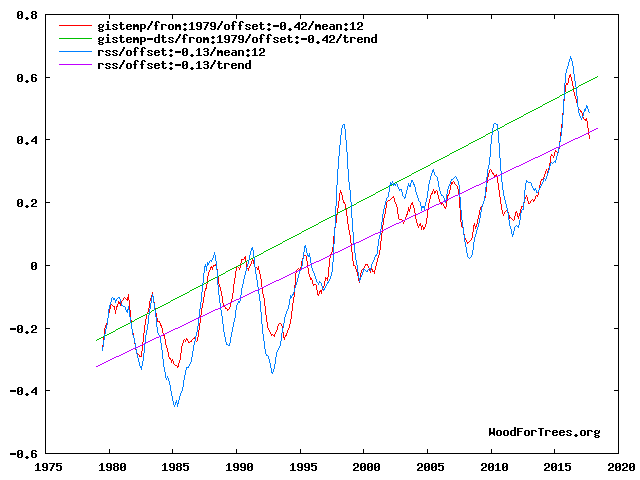
The rate of warming in the surface data sets and in RSS TLT since 1979 all round up to 0.2C/dec. That’s a total warming of ~0.7C in less than 40 years.
You might argue that UAH TLT shows less warming, and it does (about 0.5C in total), but it is still statistically significant; the lower bound of the 95% confidence margin still shows a positive trend (0.128 ±0.059 °C/decade (2σ)). Also, The upper bound of the UAH TLT confidence margin brings it into the best estimate ranges of all the other data sets mentioned.
At the very least, it is likely that there has been global warming of between 0.5 and 0.7C over the past 40 years, with most data producers settling on ~0.7C. Perhaps you also dismiss the satellite producers?
we do with land changes, anything that affects clouds, CO2? take a hike lol
Much of the debate indeed seems to be on a religious level; sacred Mother Earth versus the ‘Invisible Hand’ of commerce. The reality is that we are not threatening a fragile earth, we are surviving on a very hostile Earth and fossil fuels undeniably allow us to survive better.
Gee it would be just dandy if renewables replaced fossil fuels without doing more harm than good but so far only a few countries have been able to partially manage that; eg. Norway with it’s abundant high water and France with 85% nuclear power. For the rest of us we can only try to increase efficiencies by switching to gas. As it happens the Earth absorbs 60% of our CO2 anyway so our target can be as small as 40% reduction from current levels even if the science was saying something other than ‘nothing much is happening beyond a benign, probably beneficial, warming of a mere 0.6K/century’.
Then all that middle-class angst could be diverted back into globalization or population-control or whatever other sanctimoniousness keeps the ‘climate-concerned’ comfy with their own hypocrisy whilst those they affect are heartlessly condemned to a cold, hungry, energy-scarce future.
UHI is real but beyond that we have multiple cycle denial on a mass scale.