Guest Post by Willis Eschenbach
The CERES satellite dataset is a never-ending source of amazement and interest. I got to thinking about how much energy is actually stoking the immense climate engine. Of course, virtually all the energy comes from the sun. (There is a bit of geothermal, but it’s much less than a watt per square metre on average so we can ignore it for this type of analysis).
So let’s start from the start, at the top of the atmosphere. Here’s the downwelling top of atmosphere (TOA) solar energy for the northern and the southern hemisphere:

Figure 1. Top of atmosphere (TOA) downwelling solar energy. This is averaged on a 24/7 basis over the entire surface of the earth.
However, we don’t get all of that energy. Much of it is reflected back into space. So I took the CERES solar data and I subtracted the reflected solar. The reflected solar is the total upwelling sunshine at the top of the atmosphere (TOA) that has been reflected from the clouds, the aerosols, the soil, the plants, the ice, and the ocean. The TOA solar minus the TOA upwelling solar reflections is the amount of energy available to heat the planet. Here’s the amount of available solar energy around the world.

Figure 2. Map of the global distribution of average available solar energy. This is the solar energy remaining after albedo reflection of part of the incoming sunshine back into space.
Once I had the available energy, I subtracted out the seasonal variations. These are the changes that repeat year after year. Removing these repeating signals leaves only the small variations due to irregular changes in the amount of the reflections. (There is also a very small sunspot-related variation in the incoming solar of about a quarter of a W/m2 on a global 24/7 basis. It is included in these calculations, but makes no practical difference).
So here is the first look at how much energy is available to drive the great planet-wide heat engine that we call the climate, divided by hemispheres:

Figure 3. TOA solar and available solar after albedo reflections. Solar is about 340 W/m2, and about a hundred W/m2 of that are reflected back out to space.
Bear in mind that the amount of energy that enters the climate system after albedo reflections is a function of highly variable ice, snow, and clouds … and despite that, there is only very little variation over either time or space. Year after year, somehow the clouds and the ice and the snow all basically balance out, northern and southern hemispheres … why?
As you can see above, the available solar energy in two hemispheres are so near to each other that I’ve had to make the line representing the southern hemisphere narrower than that for the northern hemisphere so that you can see both. To see the two separately we need to zoom in close, as shown in Figure 4 below.

Figure 4. Available TOA solar energy after albedo reflections, northern and southern hemispheres.
Now, I noticed a few curiosities about this graph. One is that despite the great difference between the northern hemisphere (more land, lots of mid-and-high-latitude ice and snow) and the southern hemisphere (more ocean, little midlatitude land or ice or snow), the amount of average incoming energy is within a half a watt (NH = 240.6 W/m2, SH = 241.1 W/m2, black and red dashed horizontal lines)
Second, the two hemispheres generally move in parallel. They increased to 2003 – 2004, stayed about level to 2013 – 2014, and then increased again.
Third, there’s about an apparent lag between the northern and southern hemispheres. Now, I thought well, that makes sense … but then I realized that there is no annual signal left in the data. And I checked, there’s no six-month signal left in the data either. Not only that, but up until about 2011 the south moves before the north, but after that, the north is moving first. Again … why?
Gotta love the joys of settled science …
In any case, I then wanted to compare the variations in available energy with the variations in surface temperature. Now the CERES dataset doesn’t contain surface temperature. However, it contains a dataset of surface upwelling radiation, sometimes called “radiation temperature” because it varies as the fourth power of temperature. Figure 5 shows the monthly changes in TOA downwelling available solar radiation, compared to surface upwelling radiation.

Figure 5. Scatterplot, surface radiation temperatures (upwelling longwave radiation) versus TOA average available solar energy. Each dot represents the situation in a 1° latitude x 1° longitude gridcell, covering the entire planet. So there are 64,800 dots in the graph above.
So … what is happening in this scatterplot? Obviously, what’s happening depends on the temperature … and maybe more. To understand it, let me give you the same data, divided by hemisphere and by land versus ocean. To start with, here’s what might be the most revealing graph, that of the land in the southern hemisphere.

Figure 6. Scatterplot, southern hemisphere land-only surface radiation temperatures (upwelling longwave radiation) versus TOA average available solar energy.
On the right we have we have the southern parts of Africa and South America … and on the left, we have Antarctica. You can clearly see the different responses between what happens below and above freezing.
Next, here’s the land in the northern hemisphere.

Figure 7. Scatterplot, northern hemisphere land-only surface radiation temperatures (upwelling longwave radiation) versus TOA average available solar energy.
There isn’t anywhere in the northern hemisphere that the land gets as cold as Antarctica. In part, this is because the South Pole is land and the North Pole is water, and in part because much of Antarctica is a high elevation perpetually frozen plateau.
What all of this shows is that the response of the planetary surface to increasing solar radiation is in part a function of temperature. The colder the average temperature, the more the system responds to increasing solar radiation.
With that in mind, I took Figure 5 and calculated the slope of just the part of the world that on average is not frozen. Figure 8 shows that result.

Figure 8. As in Figure 5, and including the trend of the unfrozen parts of the globe.
Now, I found this to be a most curious graph. Here’s the curiosity. The greenhouse effect is the reason that the surface of the planet is warmer than we’d expect from simple calculations of the amount of sunlight hitting the Earth. This is because the greenhouse gases absorb the upwelling surface radiation, and when they radiate, about half of the radiation goes up, and half goes back towards the earth. As a result, the earth ends up warmer than it would be otherwise.
If the poorly-named “greenhouse effect” were 100% perfect, for every additional watt per square metre (W/m2) of sunlight entering the system, the surface would radiate two W/m2—one W/m2 from the sunlight, and one W/m2 from the downwelling radiation from the atmosphere. Based on the ratio of the incoming radiation and the radiation from the surface, we can say that the overall greenhouse multiplier factor of the perfect greenhouse is 2.0. (See my post The Steel Greenhouse for a discussion of this.)
Of course, in a real world, the multiplier factor will be less. We know what the long-term overall average multiplier factor for the planet is. We can calculate it by dividing the overall average upwelling longwave radiation from the surface by the overall average available solar energy. The average upwelling surface longwave radiation is 398 W/m2, and the average available solar energy is 240 W/m2. This gives a greenhouse multiplier factor of 398 / 240 = 1.66.
And that’s the curiosity because in Figure 8 the average multiplier factor is 0.72, well below 1.0. Because this multiplier is less than one, it would imply that the world should be much colder than it is …
How can we resolve this apparent contradiction? To me, it is evidence of something that I have said for many years. This is that the sensitivity of the surface temperature to the amount of downwelling radiation is not a constant as is assumed by mainstream climate scientists. Instead, it is a function of temperature. At temperatures above freezing, the surface upwelling radiation increases by about three-quarters of a W/m2 for each additional W/m2 of incoming solar radiation.
But when the earth is quite cold, such as is the case in Antarctica, the surface temperature is much more responsive to changes in incoming radiation. Here’s the situation in Antarctica:

Figure 9. As in Figure 8, but showing the situation in Antarctica
Note that this sensitivity is not a result of the land ice on Antarctica melting and changing the albedo. Almost all of Antarctica is frozen year-round.
Now, there is one other way we can look at this situation. We’ve looked above in Figures 5 to 9 at the long-term, basically steady-state situation shown by the average state of the 68,400 one-degree by one-degree gridcells that make up the surface of the planet. However, instead of the steady-state long-term average shown above, we can also look at how things change over time. Figure 10 shows the change in time of the anomaly in temperature over the period of the CERES satellite observations, as compared to the anomaly in average TOA solar energy.

Figure 10. Monthly surface longwave and TOA solar radiation.
You can see that other than the jumps in surface radiation due to the warm El Nino events of 2009/10 and 2016/17, there is a close relationship between available sunshine. A cross-correlation analysis (not shown) verifies that there is no lag between the changes in the solar input and the surface response.
We can also determine the nature of the short-term relationship between these two variables by using a scatterplot, as shown in Figure 11 below:

Figure 11. Scatterplot, monthly averages of available top-of-atmosphere available solar energy and surface upwelling longwave radiation.
As we would expect, the trend is smaller in the short-term data monthly changes shown in Figure 11 than the trend in the longer-term gridcell average data shown in Figure 8 (0.58 versus 0.72 W/m2 surface change per W/m2 solar input change).
CONCLUSIONS:
• Overall, the response of the non-frozen surface to increasing solar radiation is an average increase of about 0.7 W/m2 of upwelling surface radiation for each 1 W/m2 increase in available solar energy.
• Below freezing, this response increases with decreasing temperature, until at typical Antarctic temperatures of -20°C to -60°C the response is about 5 W/m2 for each 1 W/m2 increase in available solar energy.
• Per the Stefan-Boltzmann equation, the change in surface temperature corresponding to a 1 W/m2 change in surface longwave radiation ranges from 0.2°C per W/m2 at 0°C, to 0.16°C per W/m2 at about 30°C.
• Given a change of 0.7 W/m2 for a 1 W/m2 change in incoming solar energy, this would indicate a temperature change in the unfrozen part of the planet of from 0.11°C per additional W/m2 at 30°C, to 0.16°C per additional W/m2 at 0°C.
• The increased downwelling radiation estimated for a doubling of CO2 is 3.7 W/m2. Ceteris paribus, this would indicate that if solar radiation increased by 3.7 W/m2, we would see a temperature increase of 0.4°C to 0.6°C depending on the surface temperature.
• Finally, as a side note, the average change in TOA downwelling total solar irradiance (TSI) due to the change in sunspot activity is on the order of 0.26 W/m2 peak to peak (global 24/7 average). However, only 240/340 = 70% of this is available, the rest is reflected back to space. Given the relationship of 0.72 W/m2 surface change per each additional W/m2 of TOA available solar energy, and a maximum temperature change per watt of 0.16 °C per W/m2, this would indicate a maximum effect of 0.26 * 240/340 * 0.72 * 0.16 = 0.02 °C from that change in TOA solar radiation …
It’s a lovely evening here on our hill above the sea, a few clouds, cool air … I wish all of you the joy of this marvelous life.
w.
AS USUAL, I politely ask that when you comment on someone’s words, you QUOTE THEIR WORDS EXACTLY. This is a long and complex post, and misunderstandings are the bane of the intarwebs. The only way for the rest of us to be sure what or who you are talking about is for you to quote their words exactly.
DATA: This is all done with the CERES satellite TOA and Surface datasets, which are available here under the heading:
Energy Balanced and Filled (EBAF)
Climate Data Record (CDR) of monthly TOA fluxes and consistent computed surface fluxes and clouds suitable for analysis of variability at the intra-seasonal, inter-annual, and longer time scales.
Willis or someone else competent and with the time willing to take on this question.
I’ve followed the “greenhouse” series by Willis, beginning with “The Steel Greenhouse”, “Glass Planet”, and finally the current “Symmetry and Balance”. While reading through the excellent debates following the “Symmetry…” discussion and the relationships to ENSO, PDO, AMO, etc., I made the links with present topics I am teaching in my Physical Science and Environmental Science classes ( I am a HS teacher) about heat transfer.
I began thinking about the annual pulses of cold saline waters into the deep oceans during each hemisphere’s alternating winters. What I lack is a firm grasp or even a broad estimate of the volume of water that will be cooled enough during the northern and southern hemispheres winters that sinks to the abyss, flows generally toward the equator and displaces the warmer surface waters poleward.
Is there enough variability involved in this process on an annual timescale to significantly effect the strength of the ENSO cycles by the equatorial upwelling strength?
I eyeballed the 3 to 5 years leading up to the 2015/16 big El Nino, as the thought of the massive expansion of Southern Ocean sea ice occured during those years prior to the rapid reduction in sea ice in more recent years, and noted that there was correlation to the increase in sea ice and the ramp up to the strong El Nino.
There also appears to be some correlative trends around the ’98 El Nino.
What do you see when the actual data is tortured into its confessions?
PRDJ May 7, 2018 at 9:17 am
Interesting question. We have data on the AMOC, the Atlantic Meridional Overturning Current. It has a normal flow on the order of 17 sverdrups (1 Sv = 10^6 m^3 per second), with annual variations of a couple of sverdrups. This is about half a million km3 per year.
By comparison, the volume of the Atlantic Ocean is about 310 million km3 … so the annual flow involves only on the order of a tenth of a percent of the Atlantic volume. There’s a good discussion of this here.
There is some comparable data for the Pacific. Meinen & McFadden say zonal warm water transports during El Nino events are on the order of 15-25 Sv. Meridional Ekman transports are on the order of 30 Sv.
Finally, the total ice melted in the Arctic each year is about 10 million square km. Figuring an average ice thickness on the order of 1.7 m, that gives us about 17,000 km3 of fresh water from melted ice each year. Assume it gets mixed at say three to one with salt water as it sinks, that’s about 50000 km3 per year. That’s an annual flow of a couple of Sv.
In addition, however, as the ice freezes it squeezes out the salt. The resulting salty water also sinks and moves toward the equator. No idea how big this movement is.
Regarding the size of the Pacific deepwater currents, I find this:
SOURCE (paywalled), and see also here.
Hope this helps,
w.
W., an erratum. I believe the unit of measure is a Sverdrup (Sv)= 1 million cubic meters per second. Sievert is a measure of radiation( which I think you know.) Cheers.
Thanks, Richard, moving too fast. Fixed.
w.
PRDJ May 7, 2018 at 9:17 am
Suggest to watch this documentary: https://www.youtube.com/watch?v=kpFryXQbVEA
The whole documentary is fascinating. From ~35 mins on Antarctica is discussed, including the formation of AntArtic Bottom Water.
Since a number of people have agreed with Ben’s incorrect analysis above, I thought I’d respond in a new thread. Ben says:
Rotation has no effect? I’m sorry, but unless you are going to average the sun over the entire surface, rotation absolutely has an effect.
Not. Things are nowhere near that simple. See the link at the end of this comment.
Here are the day/night swings of the moon, along with the blackbody temperatures if we average over the entire surface. There’s a full discussion of the graphic here.
Per Ben’s calculation the daytime temperature should be 59°C, but it is over 90°C. And the night-time temperature per Ben should be -113°C, but in fact it is about -190°C.
This is total nonsense. The geothermal heat flux of the moon was measured during the Apollo mission, viz:
Anyone who believes that a heat flow of 14 – 21 milliwatts per square metre (0.041 to 0.025 W/m2) will heat the surface by forty degrees as Ben claims shouldn’t quit their day job …
IF the temperature of the oceans were ~ 275K maintained by geothermal heat, it would also have to be losing the same amount of heat. Per the S-B equation and assuming an emissivity of 0.96, that means it would be losing through radiation/sensible heat/latent heat a total of 310 W/m2.
And that, of course, means that it would have to be continually supplied with 310 W/m2 from geothermal heat.
So how much geothermal heat comes out of the earth? From the geology department at the University of California, Santa Barbara, we have:
This is about four times the corresponding figure for the Moon, as the Earth’s interior is more active. Here’s the same calculation from George Mason University
A similar figure, sixty milliwatts instead of eighty. I find values for global average geothermal heat flux ranging from fifty to one hundred milliWatts/m2 in the literature [0.050 – 0.100 W/m2].
And for Ben’s theory about how the ocean is heated to be valid, the heat flow would have to be no less than 310 watts per square metre … so taking the highest geothermal estimate in the literature, 100 mW/m2, we’d need about 310 / 0.1 = more than three thousand times the known amount of geothermal energy to get the ocean up to 275°C.
Conclusions? Ben is wrong on all counts. The ocean is NOT heated to 275K [2°C] by geothermal energy. The moon’s surface is NOT warmed an additional 40°C by geothermal energy. His claimed blackbody day/night moon temperatures are way off.
Finally, as to Ben’s claims about the blackbody temperature of the Earth, I encourage everyone to read Dr. Robert Brown’s outstanding post, Earth’s baseline black-body model – “a damn hard problem”. It points out that you can’t calculate the blackbody temperature it with a couple of simplistic assumptions as Ben has done.
In closing, let me say that I encourage people to do their own calculations as Ben has done. Me, I don’t believe something until I run the numbers myself, so I congratulate Ben on his industry and dedication.
But as I’ve found out the hard way more than once, running the numbers myself is no guarantee of success—I have to run the right numbers in the right way … as my Grandmother used to observe:
Best to all,
w.
Willis, Your chart reminded me of my now likely infamous 🙂 chart, I was going to repost it in case anyone forgot, but out of kindness and fear of being lynched(mostly the latter) I’ll just include the link upthread.
Earth’s temp profile, and the associated net radiation flow are quite interesting, and insightful.
https://wattsupwiththat.com/2018/05/05/symmetry-and-balance/#comment-2809726
His geothermal heat and moon calculations were wrong, but the conclusion was correct for the wrong reasons. Water vapor and CO2 doesn’t explain any of the planets large surface temperature differences but, the oceans and solar insolence explain all. Nailed on the head as it’s the oceans, not so much water vapor and CO2.
If all the heat could be released from the oceans suddenly went into the atmosphere at once there would be nothing alive left on planet Earth.
WV couples the ocean SSTS changes to the land masses.
+1000, almost perfect reply. I may have added a few things extra but this is more than enough. So many bad assumptions by Ben!
Nylo
If you can just fill us in on how you measured the amount of energy being added to the oceans due to volcanic avtivity? What we now see happening in Iceland and Hawaii is only a small area….
The atlantic- and pacific rims are enormous areas where there is continous volcanic activity at the bottom.
Ben is right and I agree with him. But I dont think we can prove much because there simply is no credible data.
Willis Eschenbach May 7, 2018 at 2:15 pm
An ideal blackbody has NO heat storage / conductivity. So rotation indeed has no effect in this case.
Acording dr. Brown:
Willis,
This post has provided some great data. Lot’s of food for thought.
My interpretation of the warmer temperatures increasing only 0.7 W/m2 of upwelling surface radiation for every 1 W/m2 of available solar energy is that the IR-active gases are cooling the surface and moving the heat upward and poleward. In contrast, the upper latitudes are warmer than they would otherwise be and able to radiate away more W/m2 than received by direct sunlight.
Other than that, I don’t think the data can be used to explain anything about the role of CO2 or water vapor. Without them the atmosphere wouldn’t be as warm as it is now, but also not as cold as a black body. The reason is that solar insolation would still warm an inert atmosphere and without the IR-active gases, there would be no way for the atmosphere to cool, other than “back” conduction at night. The temperature fluctuations would be large and, because of Holder’s inequality, the average temperature would be lower than our current atmosphere, although not as low as predicted by S-B calculations.
I also think you haven’t interpreted Ben Wouter’s calculations correctly regarding black bodies and geothermal heat. As an example, I think he was saying that some heat is carried to the night side from the day side, because the ground has absorbed energy during the day and it is gradually released during the night. You seem to attribute all of Ben’s “40K warmer” to geothermal as opposed to geothermal plus carryover from the day side.
Chic Bowdrie May 7, 2018 at 4:31 pm
Chic, if you believe anything Ben said about blackbodies or the moon after reading Dr. Brown’s post, you are beyond my poor power to add or detract.
And if you didn’t read Dr. Brown’s post, then … well … then you should.
w.
Willis Eschenbach May 7, 2018 at 6:35 pm
Let me remind you of your request in the main post:
What I actually wrote:
40 W/m^2 refers to an energy FLUX. 40K refers to a temperature. Very different things.
see eg
https://en.wikipedia.org/wiki/Energy_flux
https://en.wikipedia.org/wiki/Temperature
The average lunar temperature as measured by the Diviner project is ~197K.
Night time average temperature seems around 80K.
This means the actual average temperature for the day side must be 314K (= 41C)
According your own calculation my numbers result in 46C, a whopping 5C difference, which can be easily explained by the fact that the dayside is not evenly heated (Holders inequality).
Where does your 90K average dayside temperature come from??
Again I suggest to actually read and understand dr. Browns post. It should clear up at least some of your misunderstandings.
Chic, regarding the part of your post already cited by Willis, Ben especifically mentioned the opposite of what you attribute to him: “Rotation has no effect since no heat storage is specified for a blackbody”.
I can’t speak for him, but I think he was initially referring to a black body which has no heat storage. Then he explains why actual moon temperatures are different because it does have heat storage:
That is what prompted my original comment. I was attempting to smooth some common ground that seemed disturbed by misunderstandings.
Chic Bowdrie May 8, 2018 at 5:34 am
You’re missing the point. His theoretical temperature for the moon is 160K (-113°C). He says the day side is “close to radiative balance”. According to him, “radiative balance” with no heat storage for the day side is 680 W/m2 less albedo (13% for the moon). This is 590 W/m2, which corresponds to 46°C. In fact the moon has a daytime temperature of about 90°C. So his daytime claim is not true.
On the other hand, his night-time claim is as follows:
Get that? Darkside radiative balance is 3K, or -270°C … and in fact it is about -190°C, a difference of 80°C.
He hand-waves this away with a fatuous claim of a non-existent 40 W/m2 from geothermal and “some heat carried from the nightside from the hot day side.
But remember, his calcs for the dayside only show 45°C, while the real temperature is 90°C. So there is no spare heat in his calculation to carry to the night side …
In short, every one of his calculations is not just wrong, but way, way wrong.
Best regards,
w.
Willis, “This is 590 W/m2, which corresponds to 46°C. In fact the moon has a daytime temperature of about 90°C. So his daytime claim is not true”.
Are you sure about that? I know it does reach 90ºC, and even more, but that is not its average day side temperature, AFAIK. Not all of the day side of the moon is at or near 90ºC. I bet it is far less near the poles where incident light comes at a very low angle, and also less “early in the morning” for the same reason.
Willis,
You’re doing a great job with these creative and instructive posts and answering so many comments. However, I did read Dr. Brown’s post again and I find no serious discrepancies between the points he makes there and Ben Wouters’ comments. They both flip back an forth between black body and real planets. He has since responded to some of your criticisms and I’ll be interested to see how that plays out.
Chic Bowdrie May 8, 2018 at 3:20 pm
No serious discrepancies? Dr. Brown says that figuring out the blackbody temperature of the earth without GHGs is a “damn hard problem”. Ben thinks he can do it with a couple of simple calculations.
I’d call that a serious discrepancy …
As to Ben’s recent comment, I’m gonna pass … he has far too many misunderstandings to take on one by one, and seems wedded to them. As Shakespeare said about Lady MacBeth’s sleepwalking, “This disease is beyond my practice” …
w.
That’s why they call it a practice. 😉
Willis, I was thinking about the surface radiation rate referenced multiple times here, as well as the various down welling sources, When I do all of my energy calculations, I do a 2 body equation, and use my measured temp from my IR thermometer, which is the BB temp over 8u-14u. My thermometer’s pyrometer integrates this energy, and then looks up that value in a table to report a temp.
Even in the optical window it’s over 200k, so even there, the surface never see the 3K of space, and the main contributor in the window is TPW, and with a calibration that temp can directly map to TPW.
Obviously the moon is nothing like this.
I also recall someone mentioning that the correct approach to the calculations is to use the schwarzschild equation, indeed it is not an easy problem to solve.
One of the reasons I like to take measurements of stuff. Including the temp straight overhead.
Yes. Always remember that you cannot calculate that which has never been measured.
Nobody has actually measured even if there is a + GH effect. My actual results show that it has been cooling
http://breadonthewater.co.za/2018/05/04/which-way-will-the-wind-be-blowing-genesis-41-vs-27/
So. There is no man made warming. We cannot have a calculation or election that says anything else.
In quantum mechanics all possibilities exist that have a probability, even if that probability is very slight, it’s only when a measurement is taken that it is actualized.
I haven’t gotten to no effect, but I am at the point that it’s so small that even if we burned the entire known reserves of fossil fuels, we couldn’t damage the planet.
Micro.
That is exactly what my result is saying…. any AGW is too small to measure compared to the natural forces at work
Bless you.
H.
Willis writes:
“But remember, his calcs for the dayside only show 45°C, while the real temperature is 90°C. So there is no spare heat in his calculation to carry to the night side …”
You got that backwards, with a warmer day side, the night side would have to be colder for an average of 197K. You are confusing peak daytime temperature with average daytime temperature.
Yogi Bear May 10, 2018 at 12:17 pm
Seems Eschenbach is confused on just about anything on this topic.
Only reason for his outrageous reaction against me I can come with is that he began to realize that his beloved Greenhouse Effect does not exist.
He doesn’t seem to have the decency to react on my comments or to apologize for his villain remarks.
Willis,
This downward radiation thing.
Suppose that some upward radiation is intercepted by mechanisms like CO2 ones, that cause isotropic re-radiation. Half goes off to space, half goes back to earth.
Earth then emits the next phase of radiation. Some is intercepted by mechanisms like the CO2 ones, that cause isotropic re-radiation. Half goes off to space, half goes back to earth.
Rinse and repeat.
Here we have a series where the return to earth each phase is 1/2, then 1/4, then 1/8 … of the original. This series sums to 1, meaning that although the mechanisms might exist, they result in all of the radiation, the sum to 1, getting back to space. If this is correct, why is there a need to invoke the mechanism in the first place?
P.S. This topic sends my mind into a block every time I try to analyse it. Hope you do not think I am ignorant, I just can’t seem to find explanations that satisfy. Geoff.
Geoff, of course in the end the energy that leaces the Earth is equal to the Energy entering from the sun. What changes is that the surface needs to radiate a lot more because not all that it radiates manages to escape. And to radiate more it needs to be at a higher temperature. In the end you will have the same ~240W/m2 escaping the Earth that enter the surface from the sun. But to get that energy out, the surface must radiate away 398W/m2, meaning it must be considebly hotter than without GHGs. The surface remains in equilibrium despite radiating that much, because the surface does not receive energy only from the sun, it also receives it from the atmosphere due to GHGs. There are ~160W/m2 being received by the surface that do not come directly from the sun. Of the ~400W/m2 radiated by the surface, 160 are coming back and the remaining ~240 escape to effectively counter the incoming solar energy.
Geoff Sherrington May 7, 2018 at 9:49 pm
First, let me clear up one thing. The only ignorant people on my planet are those who stop asking questions and learning, and you are clearly not among them.
Next, why “invoke the mechanism”? First, because it exists … and also because, as you point out, you end up with it summing to 1. You are correct. However, you need to remember that 1 is indeed going out to space as you point out … but 1 is going back to the earth. That leaves the earth emitting 2 … meaning that the surface is warmer by twice the amount of the incoming radiation.
That’s why I said that a perfect greenhouse has a multiplication factor of 2.
If this is not clear, ask again. In the meantime, the following three posts discuss this question in some detail.
w.
The Steel Greenhouse 2009-11-17
There is a lot of misinformation floating around the web about the greenhouse effect works. It is variously described as a “blanket” that keeps the Earth warm, or a “mirror” that reflects part of the heat back to Earth, or “a pane of glass” that somehow keeps energy from escaping. It is none of these things.
People Living in Glass Planets 2010-11-27
Dr. Judith Curry notes in a posting at her excellent blog Climate Etc. that there are folks out there that claim the poorly named planetary “greenhouse effect” doesn’t exist. And she is right, some folks do think that. I took a shot at explaining that the “greenhouse effect” is a…
The R. W. Wood Experiment 2013-02-06
Pushed by a commenter on another thread, I thought I’d discuss the R. W. Wood experiment, done in 1909. Many people hold that this experiment shows that CO2 absorption and/or back-radiation doesn’t exist, or at least that the poorly named “greenhouse effect” is trivially small. I say it doesn’t show…
Micro, your graphic “Proof of Active temperature regulation at night …” is interesting and informative. I have viewed it previously in other posts.
Willis, another interesting post and lots of discussion as always. Thanks for linking to Dr. Browns earlier posting. He made a lot of informative posts and comments here @ur momisugly WUWT. That one was one of his best (IMHO) if such a rating could even be made and would be relative to the discussion at hand or just his insight of an issue.
philsalmon, thanks for the link to Vangelis, very soothing music.
I have one question that I believe may have been covered in a comment above related to the downwelling IR from clouds. Is the DWIR being observed actually ‘reflected’ from the upwelling IR from the ground, or is it actually generated from the cloud itself? I’ve wanted to ask this previously but never found the forum while staying OT or derailing the flow of a good comment thread. Micro may have looked into or discussed this at some point. I just need a better understanding
eyesonu, although you see the term a lot, there is very little reflection of IR. Clouds in particular are almost perfect blackbodies with respect to IR. As a result, in general, the overwhelming bulk of downwelling IR is radiated from the cloud itself.
w.
Willis
I have some problem with your reasoning here
note fig 6
http://w.astro.berkeley.edu/~kalas/disksite/library/turnbull06a.pdf
the blue line
and see how much radiation 0.5-2 um is bounced off from earth by the water vapor & clouds
-we can easily see all this radiation from the water coming back to us via the moon.
OTOH
true enough we have some radiation 10-15um trapped [mainly by clouds – at night time!]
But now the big question:
which one is more? The deflected sun light [that we can clearly see via the moon] or the trapped earthshine?
Remember that radiation 0.5-2 um is many times more energetic than the radiation 10-15 um..
Truth be told, I doubt very much that a + GH effect even exists. I don’t think it is proven from any kind of test or measurement. You are all ‘calculating’ things that have not been measured yet.
There is no mass of GHG in the atmosphere. It is just 0.5% of the atmosphere.
Ben’s theory makes a lot more sense than the GHG theory.
henryp May 8, 2018 at 11:19 am
Willis
I have some problem with your reasoning here
note fig 6
http://w.astro.berkeley.edu/~kalas/disksite/library/turnbull06a.pdf
the blue line
and see how much radiation 0.5-2 um is bounced off from earth by the water vapor & clouds
-we can easily see all this radiation from the water coming back to us via the moon.
As pointed out many times you fail to understand what is presented in that paper.
The blue line is the clear air absorption spectrum of water vapor.
The most relevant data for Willis’s statement is the green dotted line which is determined from the backscatter from 8micron water droplets (upwelling not downwelling). For particles of that size most of the elastically scattered light is forward scattered rather than back scattered. That figure gives us no way to assess what fraction of the incident light is scattered vs absorbed, as Willis said most of the downwelling IR from a cloud would be from thermal radiation by the cloud (and would be at longer wavelengths than the scattered solar radiation).
Phil.
You are trying to confuse issues again. Read the abstract of the paper. Anyway. As I said: there is no man made warming. Are you trying to teach or say differently?
http://breadonthewater.co.za/2018/05/04/which-way-will-the-wind-be-blowing-genesis-41-vs-27/
Henryp May 9, 2018 at 8:53 am
Phil.
You are trying to confuse issues again. Read the abstract of the paper.
No need I’ve read the whole paper! You are the one who is confused.
Phil.
If you will.
Please answer my question.
Do you believe there is any AGW?
Willis,
You refered to your post ‘the steel greenhouse’. I read the physics part.
If the steel shell has infinitesimal thickness, there is no backward radiation from the steel shell. The shell has the same temperature as the surface of the earth. For a photon it does not matter if there is a distance between that surface and the steel shell, for a photon there is no distance. In general, the temperature of the cavity (the space between surface and shell) with respect to the temperature of the outside of the shell is linear related to its thickness (for a not to thick shell). There exists a thickness that results in a backward radiation of the mentioned 235 W/m2.
Willis
If you don’t know, don’t call Phil.
he is clueless.
Phil. only believes in his books.
He does not think independently or measured anything, like you and me.
Really, that’s amusing. On this particular issue i was the co-inventor of an instrument utilizing light scattering by droplets which has been sold world-wide for 40+ years. Doesn’t think independently or measure anything, right.
Phil.
Just answer the question we all long to hear. And if you do believe in AGW, how exactly did you measure it?
Phil.
So. We are all waiting for your reply on how you measured AGW. How much is it by your own measurement?
There is none?
That would be the same result as I got…..
Mmmm….
Henryp May 9, 2018 at 10:25 am
Phil.
Just answer the question we all long to hear. And if you do believe in AGW, how exactly did you measure it?
Science isn’t about belief henry. The earth’s energy balance depends on the atmospheric composition and we are changing the composition, QED.
“You can see that other than the jumps in surface radiation due to the warm El Nino events of 2009/10 and 2016/17, there is a close relationship between available sunshine. A cross-correlation analysis (not shown) verifies that there is no lag between the changes in the solar input and the surface response.”
So why has the available sunshine increased?
Phil.says
Science isn’t about belief henry. The earth’s energy balance depends on the atmospheric composition and we are changing the composition, QED.
Henry says
No, this is where the argument starts. Your theory that you believe in is not correct. I checked all weather stations here in South Africa which had a good record and I could not find any warming over the past 40 years here. In fact, as I showed you in my summary,
http://breadonthewater.co.za/2018/05/04/which-way-will-the-wind-be-blowing-genesis-41-vs-27/
all of them showed that it has been cooling here over the past 40. Even the cooling is showing an interesting [natural] pattern. No chaos?
So, how does this fit in with your theory of AGW? There must be something wrong with it?
[in fact, in the abstract I have given a reasonable explanation for the fact that it is getting cooler here and why it is getting warmer in the arctic. There is no need for any AGW /green house theory]
So, please enlighten us about AGW, on why it does not seem to work here. In fact, did you check the temperature over the past 40 years in your own backyard? What did you get? [just give me the station no. that you used and I will double check at an independent source.]
Phil.
We are all aware of your deafening silence.
Well some of us have other things to do henry.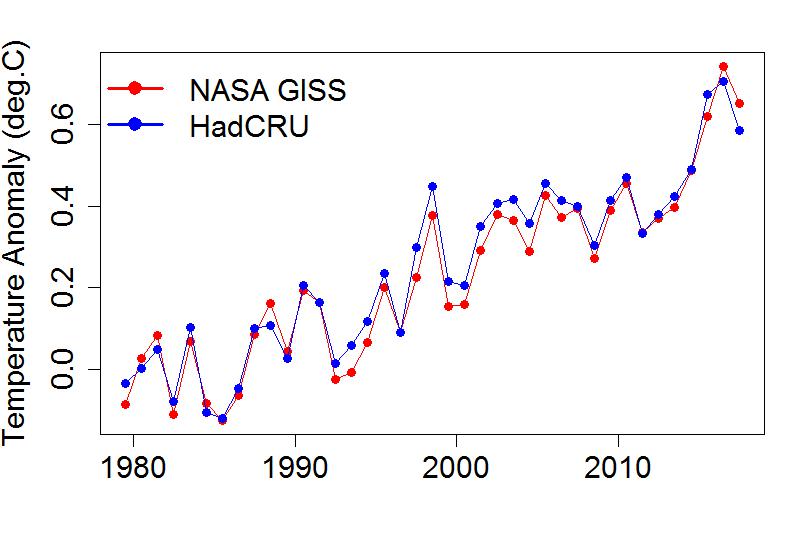

It may have escaped your notice but the G in AGW stands for Global.
Here’s some data for surface temperatures:
And some for troposphere temperatures:
Phil.
Those of us who checked those graphs know that they are fake news.
http://breadonthewater.co.za/2018/05/04/which-way-will-the-wind-be-blowing-genesis-41-vs-27/
Henryp May 11, 2018 at 10:19 pm
Phil.
Those of us who checked those graphs know that they are fake news.
No henry, fake news is fitting a quadratic to four data points!
eishh
Phil.
Are you honestly a chemist? You don’t know that you only need 4 definitive points to define a function?
So how did you measure pH, or do AAS, UV /visible or FTIR or XRF spectrometry? With more than 4 standards?
How many standards then did YOU use?
I am ‘not fitting’ a quadratic. When I do a random sample of 54 weather stations and I summarize all the results of the daily data over the past 40 years to give me the 4 speeds of warming/cooling over the 4 periods randomly chosen they seem to fit exactly into a quadratic = which I know happens to be exactly half of the relevant sine function.
For the drop in maxima it worked out better to use a natural logarithmic function which gave me a correlation of 0.9964 over those 4 points over the past 40 years. Obviously, the reason being that maxima came to their lowest point at around 2014.
Phil. May 12, 2018 at 6:20 am
Phil, I tried to point this out to Henry as well, and got the same unpleasant torrent of abuse in return. He truly believes that given three datapoints, all he has to do is to pick any one of a hundred different parametric equations, fit the parameters, and then proudly claim a WOW! R^2 OF 0.993!!! AMAZING! …
I’ve tried over and over to point out to him that
a) three or four points is not enough to even begin to establish a trend or a cycle,
b) given a free choice of equations you can fit almost any collection of three or four data points,
c) when you have more tunable parameters than datapoints, you are in a widely recognized situation known as “overfitted” where no reputable scientist wants to tread, and
d) an R^2 of 0.992 in such situations is not a mark of a valid relationship, it is a mark of overfitting.
All that my efforts have gotten in return are insults such as the ones you got for your efforts, viz:
Say what???
I did have to laugh at this particular line of Henry’s however …
So Phil, let me suggest that trying to show something to a man who thinks a quadratic is “exactly” half of a sine wave and who responds to well-meaning suggestions by insulting the those trying to help him is an exercise in futility.
There is good news, however—knowing all of this, I freely able without compunction or regret to totally ignore any posts by henryp …
w.
Willis
I am sorry for the abuse although I am not sure exactly which abuse you refer to.
Phil. was accusing me of using only 4 points. I was just referring Phil. to the fact that you only need 4 points to define a function and, depending on Rsquare, you would then make your decision whether to use it or not in a practicable measuring application. Such investigations with a low number of standards are important, for example, when determining, the best possible wavelength to measure at. I am sure he knows that so I am not sure why he came up with this argument against me.
In the case of me doing only 4 regressions to get the speed of warming/cooling in K/year on each of the 54 weather stations [that were randomly selected to fulfill certain descriptions of the sampling procedure] and me getting a perfect curve on the averages of all those stations:
it is true of course that I could have done the regressions for each year like1973-2015, 1974-2015, ….etc
which would have given me 42 points to fit in the curve. However, at the end of the day, that would have given me exactly the same curve as the one that I ended up with. If you don’t understand that you should really spend some time and money doing first year stats. It is not really difficult and it teaches you everything about probability, regressions, distribution, etc.
It is a pity you are saying goodbye to me. I am saying that my experiment is repeatable and anyone can do it again, getting the same results as I got. Perhaps someone else will pick it up.
that were randomly selected to fulfill certain descriptions of the sampling procedure
sorry, that could be misunderstood,
lt should have been:
that were randomly selected subject to fulfilling certain specifications of the sampling procedure
Yes I know Willis you’re preaching to the choir! The only reason I question henry’s posts are in case someone else reads them and think he knows what he’s talking about, I know there’s no chance of getting through to him.
HenryP May 13, 2018 at 5:38 am
Henry, the fact that you don’t understand why this is a ridiculous claim is why I pay little attention to your posts. Given a free choice of any equation and enough tunable parameters, you can fit a curve to any four given points and get an R^2 very near 1.0 … but that means NOTHING.
You think that the high R^2 means you are on to something real.
It means nothing of the sort. All it means is that you can fit any four points with some random tunable curve … SO WHAT?
w.
Willis Eschenbach May 12, 2018 at 10:03 am
Phil. May 12, 2018 at 6:20 am
Henryp May 11, 2018 at 10:19 pm
Phil.
Those of us who checked those graphs know that they are fake news.
No henry, fake news is fitting a quadratic to four data points!
Phil, I tried to point this out to Henry as well, and got the same unpleasant torrent of abuse in return. He truly believes that given three datapoints, all he has to do is to pick any one of a hundred different parametric equations, fit the parameters, and then proudly claim a WOW! R^2 OF 0.993!!! AMAZING! …
HenryP May 13, 2018 at 5:38 am
It is a pity you are saying goodbye to me. I am saying that my experiment is repeatable and anyone can do it again, getting the same results as I got. Perhaps someone else will pick it up.
Actually I took henry’s 4 data points and fitted them with a quadratic using XL.
Interestingly the fit wasn’t a good as he claimed, R^2 of 0.78, of course a cubic fitted perfectly. 🙂
Sorry, I rechecked and there was an error so henry’s R^2 was right, the cubic was still a perfect fit of course.
Phil.
I did not yet publish the 54 x 4 derivatives of the 54 weather stations?
I gather you are looking at the table of my first graph.
Must say again that I can clearly see from your graphs that the sats are calibrated on the terra data. If the terra data are wrong with to begin with you really have nothing.
My sampling procedure is probably the only one that gives the correct result. If you want to know you must ask.
Not that I think the global cooling is much but it is significant. And it is the opposite as what you guys are saying. My main point is that the global cooling proves there is no AGW.
Henryp May 14, 2018 at 6:04 am
There isn’t even a Greenhouse Effect. All the atmosphere is doing is reducing the energy loss from the surface to space. NO warming of the surface (and thus the oceans) by the thin layer of cold air around Earth.
You’re arguing with true Greenhouse believers who have convinced themselves that a little bit of air around our planet can increase the temperature of the surface (including all ocean water) some 80 – 90K above the average Lunar surface temperature, who believe that the sun also shines on the night side of a planet.
I’m afraid we’ll have to wait until these Greenhouse dinosaurs move away or go extinct before a serious discussion about the temperatures on Earth is possible.
Ben Wouters May 15, 2018 at 5:51 am
Henryp May 14, 2018 at 6:04 am
“Not that I think the global cooling is much but it is significant. And it is the opposite as what you guys are saying. My main point is that the global cooling proves there is no AGW.”
There isn’t even a Greenhouse Effect. All the atmosphere is doing is reducing the energy loss from the surface to space. NO warming of the surface (and thus the oceans) by the thin layer of cold air around Earth.
Not sure what planet you live on where “reducing the energy loss from the surface to space” while at the same time maintaining the same energy input to the surface, wouldn’t warm the surface!
Phil.
It seems to me we had this conversation before. I need the balance sheet to show me how much incoming solar energy is deflected back to space by each GHG and how much energy is trapped by same GHG on earth [by trapping some earth shine]/.
You have never supplied me with such a balance sheet.
I am not denying that some warming effect exists. For example, I notice minimum T rising here in winter nights when clouds move in. But the next day, the same clouds can reduce the maximum T here during the day by up to 5-10 degrees C. So, which effect is more? The deflection of incoming solar by the clouds 12 h /day or the entrapment of earth shine 24h/ day?
You tell me!
Until you do give me the right answer on that, I am with Ben.
Phil. May 17, 2018 at 4:46 am
The planet I live on receives ON AVERAGE~240 W/m^2 from the sun (after reflection) and radiates on average at the TOA ~240 W/m^2 to space. Not sure how this would warm the earth.
If you believe that the atmosphere can somehow cause the average surface temperature on earth to be ~90K higher than the average surface temperature on the moon, I would love to see your calculations showing how this miracle is achieved. Don’t forget to show the mechanism that lets warm surface water sink to the bottom of our oceans.
Ben Wouters May 18, 2018 at 5:38 am
Phil. May 17, 2018 at 4:46 am
“Not sure what planet you live on where “reducing the energy loss from the surface to space” while at the same time maintaining the same energy input to the surface, wouldn’t warm the surface!”
The planet I live on receives ON AVERAGE~240 W/m^2 from the sun (after reflection) and radiates on average at the TOA ~240 W/m^2 to space. Not sure how this would warm the earth.
Nice ‘bait and switch’ changing from your original comment about the surface to the planet as a whole.
HenryP May 17, 2018 at 5:52 am
Phil.
It seems to me we had this conversation before. I need the balance sheet to show me how much incoming solar energy is deflected back to space by each GHG and how much energy is trapped by same GHG on earth [by trapping some earth shine]/.
As I’ve told you before GHGs don’t ‘deflect’ solar energy to space. In the case of CO2 it absorbs in a region covering about 20% of surface emitted IR.
Phil.
You are simply denying my observation that Tmax declines by 5-10K when the clouds move in here.
Radiation can only move in straight lines and if it hits on the water in the range where water has deflection (absorption) 0-5 um it radiates back to space. In the atmosphere there is no mass for all the heat from the sun to be absorbed – since there is only 0.5% GHG in the atmosphere – and if it cannot reach the ocean – where there is mass for heat to get absorbed – iti has to go back to space. You honestly do not understand this?
I have shown you the paper that shows that I am correct, namely we can pick up the deflected light by the GHG via the moon coming back to us.
Anyway, it was good to find out why Willis gets stuck into his belief that a GH effect exists.
Phil.says
https://wattsupwiththat.com/2018/05/05/symmetry-and-balance/#comment-2821799
&
As I’ve told you before GHGs don’t ‘deflect?
Henry says
I really don’t see any balance sheet here in your graph of how much energy is trapped by GHG’s and how much energy is sent back to space by GHG’s, forming part of earth’s albedo.
I remember Trenberth did an initial report and from that one I calculated that ozone (a GHG) on its own is responsible for sending back at least 25% of all energy that is sent back to space. Never mind he forgot about the peroxides (in the ozone hole) and the nitrous oxides….
Anyway, my point is: don’t you realize that if the atmosphere did not act the way it does to deflect the most harmful rays back to space you would be dead?
henryp May 19, 2018 at 8:29 am
Phil.
You are simply denying my observation that Tmax declines by 5-10K when the clouds move in here.
Radiation can only move in straight lines and if it hits on the water in the range where water has deflection (absorption) 0-5 um it radiates back to space.
This is your problem, you appear to think that absorption is the same as ‘deflection’, it is not (are you sure you have a chemistry degree?)
In the atmosphere there is no mass for all the heat from the sun to be absorbed – since there is only 0.5% GHG in the atmosphere – and if it cannot reach the ocean – where there is mass for heat to get absorbed – iti has to go back to space. You honestly do not understand this?
It isn’t true, also you appear to be unaware that a primary property of a GHG is that it doesn’t significantly absorb solar radiation.
I have shown you the paper that shows that I am correct, namely we can pick up the deflected light by the GHG via the moon coming back to us.
That paper doesn’t show that, it shows that light scattered to the moon by clouds and the surface of the earth is missing those wavelengths corresponding to CO2, O2, water thereby revealing their presence in the atmosphere. You have never understood what that experiment was about and continually misrepresent it.
Willis, you will like this one.
virakkraft.com/Net_SW-vs-Total_Up_surface-Tropics.pdf
Ben
yes, they are arguing from ignorance because they believe in the results that they are given.
Many thanks for your support.
true enough, there is some increase in T min. here in ZA in winter when the clouds move in at night time.
OTOH
it is not clear how much incoming energy is deflected by the clouds and I have not received any clear answer from Phil., or anyone whom I asked the question, to show me the exact balance sheet.
So I did my own experiment and found, indeed, there is no GH effect, man made or otherwise.
http://breadonthewater.co.za/2018/05/04/which-way-will-the-wind-be-blowing-genesis-41-vs-27/
There is no one here in Africa to help me so I am needing some confirmation that the method I used is correct/
let me know if you know someone interested in stats who can help me.
henryp May 15, 2018 at 9:07 am
I’m afraid I can’t help you here. My background is in aviation.
That’s the reason I knew the whole Greenhouse Effect is nonsense, when reading about the average emission height becoming higher, and the Dry Adiabatic Lapse Rate shifting upwards increasing the surface temperature. Never seen such total nonsense before.
Ben
it is simple really
To get their global warming figure they are looking at many stations but their sample is not properly balanced. The Sats had so many problems and every time they had to correct they looked at the GISS data to recalibrate…..
So everyone of them ended up getting a wrong figure for ‘global warming’
I say:
take a simple sample of at least 50 weather stations, as per the following procedure:
No. of stations SH must be equal to the number of stations NH
All stations must balance out to zero latitude to give you the warming/cooling as for an observer standing on the equator.
To eliminate the need to worry about longitude as well, you just look at the derivatives of the least square equations, i.e. the speed of warming / cooling in K/annum and see how this changes over time. It is just like looking at the curve of a ball being thrown….
To make the sample of weather stations even more representative I also applied the rule that my total sample must be 70/30,
i.e. 70% at sea and 30% inland.
There is also a special procedure for any station that has a one or more months with missing data.
henryp May 18, 2018 at 7:51 am
Sorry henry, at the moment I’m only trying to get rid of the bizarre idea that the thin, cold layer of air around Earth can somehow increase the temperature of the surface and thus of the deep oceans.
I can simply explain why the average surface temperature on Earth is over 90K higher than on the moon.
The role of the atmosphere is just reducing the energy loss from the surface to space, no surface warming required.
It’s now over 4 years ago that i posted the initial idea, and I really didn’t think I had to argue that cold air does not warm the oceans, or that warm water does not sink to the bottom of those oceans.
see
https://tallbloke.wordpress.com/2014/03/03/ben-wouters-influence-of-geothermal-heat-on-past-and-present-climate/
and
https://tallbloke.wordpress.com/2014/10/14/ben-wouters-geothermal-flux-and-the-deep-oceans/
Assuming you still can read Dutch, have a look here:
https://klimaatverandering.wordpress.com/2018/02/27/marcel-crok-afwijzende-houding-tegenover-klimaatwetenschap-klimaatgevoeligheid/#comment-24584
Just search for my name. My last two posts with data showing they are wrong on all counts is now in moderation for over a month.
I agree with your thinking! Is exactly how I also figured it coming from different angles. I would much appreciate if you could leave similar comment as the one above on my own blog
http://breadonthewater.co.za/2018/05/04/which-way-will-the-wind-be-blowing-genesis-41-vs-27/
This would also illuminate many of my friends and family.
Thx.