From MIT and the “always 15 years away” department.
MIT and newly formed company launch novel approach to fusion power – Goal is for research to produce a working pilot plant within 15 years.

Progress toward the long-sought dream of fusion power — potentially an inexhaustible and zero-carbon source of energy — could be about to take a dramatic leap forward.
Development of this carbon-free, combustion-free source of energy is now on a faster track toward realization, thanks to a collaboration between MIT and a new private company, Commonwealth Fusion Systems. CFS will join with MIT to carry out rapid, staged research leading to a new generation of fusion experiments and power plants based on advances in high-temperature superconductors — work made possible by decades of federal government funding for basic research.
CFS is announcing today that it has attracted an investment of $50 million in support of this effort from the Italian energy company Eni. In addition, CFS continues to seek the support of additional investors. CFS will fund fusion research at MIT as part of this collaboration, with an ultimate goal of rapidly commercializing fusion energy and establishing a new industry.
“This is an important historical moment: Advances in superconducting magnets have put fusion energy potentially within reach, offering the prospect of a safe, carbon-free energy future,” says MIT President L. Rafael Reif. “As humanity confronts the rising risks of climate disruption, I am thrilled that MIT is joining with industrial allies, both longstanding and new, to run full-speed toward this transformative vision for our shared future on Earth.”
“Everyone agrees on the eventual impact and the commercial potential of fusion power, but then the question is: How do you get there?” adds Commonwealth Fusion Systems CEO Robert Mumgaard SM ’15, PhD ’15. “We get there by leveraging the science that’s already developed, collaborating with the right partners, and tackling the problems step by step.”
MIT Vice President for Research Maria Zuber, who has written an op-ed on the importance of this news that appears in today’s Boston Globe, notes that MIT’s collaboration with CFS required concerted effort among people and offices at MIT that support innovation: “We are grateful for the MIT team that worked tirelessly to form this collaboration. Associate Provost Karen Gleason’s leadership was instrumental — as was the creativity, diligence, and care of the Office of the General Counsel, the Office of Sponsored Programs, the Technology Licensing Office, and the MIT Energy Initiative. A great job by all.”
Superconducting magnets are key
Fusion, the process that powers the sun and stars, involves light elements, such as hydrogen, smashing together to form heavier elements, such as helium — releasing prodigious amounts of energy in the process. This process produces net energy only at extreme temperatures of hundreds of millions of degrees Celsius, too hot for any solid material to withstand. To get around that, fusion researchers use magnetic fields to hold in place the hot plasma — a kind of gaseous soup of subatomic particles — keeping it from coming into contact with any part of the donut-shaped chamber.
The new effort aims to build a compact device capable of generating 100 million watts, or 100 megawatts (MW), of fusion power. This device will, if all goes according to plan, demonstrate key technical milestones needed to ultimately achieve a full-scale prototype of a fusion power plant that could set the world on a path to low-carbon energy. If widely disseminated, such fusion power plants could meet a substantial fraction of the world’s growing energy needs while drastically curbing the greenhouse gas emissions that are causing global climate change.
“Today is a very important day for us,” says Eni CEO Claudio Descalzi. “Thanks to this agreement, Eni takes a significant step forward toward the development of alternative energy sources with an ever-lower environmental impact. Fusion is the true energy source of the future, as it is completely sustainable, does not release emissions or long-term waste, and is potentially inexhaustible. It is a goal that we are increasingly determined to reach quickly.”
CFS will support more than $30 million of MIT research over the next three years through investments by Eni and others. This work will aim to develop the world’s most powerful large-bore superconducting electromagnets — the key component that will enable construction of a much more compact version of a fusion device called a tokamak. The magnets, based on a superconducting material that has only recently become available commercially, will produce a magnetic field four times as strong as that employed in any existing fusion experiment, enabling a more than tenfold increase in the power produced by a tokamak of a given size.
Conceived at PSFC
The project was conceived by researchers from MIT’s Plasma Science and Fusion Center, led by PSFC Director Dennis Whyte, Deputy Director Martin Greenwald, and a team that grew to include representatives from across MIT, involving disciplines from engineering to physics to architecture to economics. The core PSFC team included Mumgaard, Dan Brunner PhD ’13, and Brandon Sorbom PhD ’17 — all now leading CFS — as well as Zach Hartwig PhD ’14, now an assistant professor of nuclear science and engineering at MIT.
Once the superconducting electromagnets are developed by researchers at MIT and CFS — expected to occur within three years — MIT and CFS will design and build a compact and powerful fusion experiment, called SPARC, using those magnets. The experiment will be used for what is expected to be a final round of research enabling design of the world’s first commercial power-producing fusion plants.
SPARC is designed to produce about 100 MW of heat. While it will not turn that heat into electricity, it will produce, in pulses of about 10 seconds, as much power as is used by a small city. That output would be more than twice the power used to heat the plasma, achieving the ultimate technical milestone: positive net energy from fusion.
This demonstration would establish that a new power plant of about twice SPARC’s diameter, capable of producing commercially viable net power output, could go ahead toward final design and construction. Such a plant would become the world’s first true fusion power plant, with a capacity of 200 MW of electricity, comparable to that of most modern commercial electric power plants. At that point, its implementation could proceed rapidly and with little risk, and such power plants could be demonstrated within 15 years, say Whyte, Greenwald, and Hartwig.
Complementary to ITER
The project is expected to complement the research planned for a large international collaboration called ITER, currently under construction as the world’s largest fusion experiment at a site in southern France. If successful, ITER is expected to begin producing fusion energy around 2035.
“Fusion is way too important for only one track,” says Greenwald, who is a senior research scientist at PSFC.
By using magnets made from the newly available superconducting material — a steel tape coated with a compound called yttrium-barium-copper oxide (YBCO) — SPARC is designed to produce a fusion power output about a fifth that of ITER, but in a device that is only about 1/65 the volume, Hartwig says. The ultimate benefit of the YBCO tape, he adds, is that it drastically reduces the cost, timeline, and organizational complexity required to build net fusion energy devices, enabling new players and new approaches to fusion energy at university and private company scale.
The way these high-field magnets slash the size of plants needed to achieve a given level of power has repercussions that reverberate through every aspect of the design. Components that would otherwise be so large that they would have to be manufactured on-site could instead be factory-built and trucked in; ancillary systems for cooling and other functions would all be scaled back proportionately; and the total cost and time for design and construction would be drastically reduced.
“What you’re looking for is power production technologies that are going to play nicely within the mix that’s going to be integrated on the grid in 10 to 20 years,” Hartwig says. “The grid right now is moving away from these two- or three-gigawatt monolithic coal or fission power plants. The range of a large fraction of power production facilities in the U.S. is now is in the 100 to 500 megawatt range. Your technology has to be amenable with what sells to compete robustly in a brutal marketplace.”
Because the magnets are the key technology for the new fusion reactor, and because their development carries the greatest uncertainties, Whyte explains, work on the magnets will be the initial three-year phase of the project — building upon the strong foundation of federally funded research conducted at MIT and elsewhere. Once the magnet technology is proven, the next step of designing the SPARC tokamak is based on a relatively straightforward evolution from existing tokamak experiments, he says.
“By putting the magnet development up front,” says Whyte, the Hitachi America Professor of Engineering and head of MIT’s Department of Nuclear Science and Engineering, “we think that this gives you a really solid answer in three years, and gives you a great amount of confidence moving forward that you’re giving yourself the best possible chance of answering the key question, which is: Can you make net energy from a magnetically confined plasma?”
The research project aims to leverage the scientific knowledge and expertise built up over decades of government-funded research — including MIT’s work, from 1971 to 2016, with its Alcator C-Mod experiment, as well as its predecessors — in combination with the intensity of a well-funded startup company. Whyte, Greenwald, and Hartwig say that this approach could greatly shorten the time to bring fusion technology to the marketplace — while there’s still time for fusion to make a real difference in climate change.
MITEI participation
Commonwealth Fusion Systems is a private company and will join the MIT Energy Initiative(MITEI) as part of a new university-industry partnership built to carry out this plan. The collaboration between MITEI and CFS is expected to bolster MIT research and teaching on the science of fusion, while at the same time building a strong industrial partner that ultimately could be positioned to bring fusion power to real-world use.
“MITEI has created a new membership specifically for energy startups, and CFS is the first company to become a member through this new program,” says MITEI Director Robert Armstrong, the Chevron Professor of Chemical Engineering at MIT. “In addition to providing access to the significant resources and capabilities of the Institute, the membership is designed to expose startups to incumbent energy companies and their vast knowledge of the energy system. It was through their engagement with MITEI that Eni, one of MITEI’s founding members, became aware of SPARC’s tremendous potential for revolutionizing the energy system.”
Energy startups often require significant research funding to further their technology to the point where new clean energy solutions can be brought to market. Traditional forms of early-stage funding are often incompatible with the long lead times and capital intensity that are well-known to energy investors.
“Because of the nature of the conditions required to produce fusion reactions, you have to start at scale,” Greenwald says. “That’s why this kind of academic-industry collaboration was essential to enable the technology to move forward quickly. This is not like three engineers building a new app in a garage.”
Most of the initial round of funding from CFS will support collaborative research and development at MIT to demonstrate the new superconducting magnets. The team is confident that the magnets can be successfully developed to meet the needs of the task. Still, Greenwald adds, “that doesn’t mean it’s a trivial task,” and it will require substantial work by a large team of researchers. But, he points out, others have built magnets using this material, for other purposes, which had twice the magnetic field strength that will be required for this reactor. Though these high-field magnets were small, they do validate the basic feasibility of the concept.
In addition to its support of CFS, Eni has also announced an agreement with MITEI to fund fusion research projects run out of PSFC’s Laboratory for Innovation in Fusion Technologies. The expected investment in these research projects amounts to about $2 million in the coming years.
“Conservative physics”
SPARC is an evolution of a tokamak design that has been studied and refined for decades. This included work at MIT that began in the 1970s, led by professors Bruno Coppi and Ron Parker, who developed the kind of high-magnetic-field fusion experiments that have been operated at MIT ever since, setting numerous fusion records.
“Our strategy is to use conservative physics, based on decades of work at MIT and elsewhere,” Greenwald says. “If SPARC does achieve its expected performance, my sense is that’s sort of a Kitty Hawk moment for fusion, by robustly demonstrating net power, in a device that scales to a real power plant.”
While only talking and planning is going on elsewhere, Iter’s tomakak complex, the heart of the complex, is slowly taking shape. From these pictures it becomes clear that the system is not a dollhouse and that it is a huge scale. A nuclear fission power plant is not bigger either.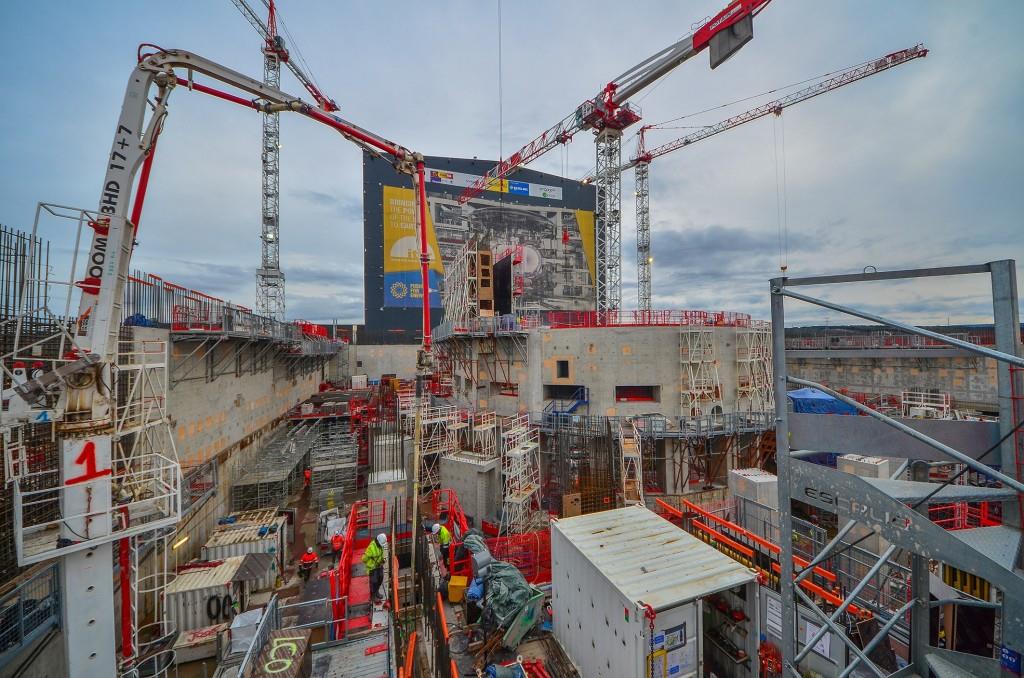
https://www.iter.org/construction/tkmcomplex
Incidentally, the magnetic coils for the tomakak are being developed at KIT in Karlsruhe, near where I live.
right tokamak, not tomahawk or tomakak. It ist confusion stuff.
Iter is a research facility, not a power plant. They don’t even have generators.
Did someone inadvertently hit “send” a few weeks early for the April 1 posting?
….to keep the lights on and the retirement benefits coming no less
I’m surprised the Tesla Tokamak (TT) is not being touted with stock offerings and early signups.
https://finance.yahoo.com/news/proxy-firm-iss-joins-glass-200323347.html
Headline: Tesla’s $2.6 billion stock award for Musk is too high: ISS
Elon’s bet is on solar with battery backup. And in the long run, he might have a winner.there. His problem is that he’s likely to run out of (other people’s) money long before battery technology makes renewables a viable.alternative to fossil fuel in enough places for his visions to be actualized.
For a constantly updated list of links to finance-related links to articles about TSLA, mostly negative, on the Seeking Alpha site, see https://seekingalpha.com/symbol/TSLA/analysis-and-news?analysis_tab=focus&news_tab=latest-news
Hard to imagine this ever working, and hardly something Europe should be wasting money on.
Tokomaks are a dead end… gigantic ones (ITER)… small ones (MIT) … doesn’t matter.
The real action in fusion are alternative configurations such as Dense Plasma Focus at LPPFusion in Middlesex, NJ. This micro company has already hit two of three criteria for achieving fusion. Unlike the tokomaks, its design is aneutronic, operating at 3 B degrees C.
With a development budget of only $6 M, the LPPFusion reactor (FF-1) is now in the final experimental phase of development, leading the way to loading in the pB11 fuel later this year.
Details
Fusion Leader Board:
The LPP Fusion reactor (FF-1) is currently #5on the fusion output leader board.
http://lppfusion.com/wp-content/uploads/2016/05/ntauT-chart.png
How it works
Reaching ignition
Complete Album of Videos
Device video:
BTW: Here’s what Prof. Bruno Coppi said about LPPFusion
https://lppfusion.com/?s=coppi
Is the MIT project a Tokomak or a Theta pinch style design?
The MIT initiative is a smaller tokomak using superconducting magnets.
But note: “In contrast, the private fusion companies are smaller, nimbler, and learn by iterating quickly. This approach, coupled with private funding, provides driving pressure to move as quickly and efficiently as possible to commercialize fusion. Their universal challenge, however, is that their fusion concepts are based on unproven physics that, at best, may require a long time and extensive resources to prove the science and, at worst, may be unable to scale to the performance required for a fusion power plant.”
The underlying concepts of Dense Plasma Focus (DPF) are not highly mysterious and exotic. The demo videos above show the behavior of stable and predictable. The reactor design is quite simple and amenable to rapid commercialization.
thank you sarasastro
I was astonished how many comments filled this post’s thread before someone stepped up and pointed out the obvious – DPF.
And beyond being aneutronic, also requires no boilers, pressure vessels, etc. Direct conversion into electrical current.
And doesn’t attempt to “capture” or “contain” plasma, but rather respects plasma’s natural “expressions”. (not, of course, a scientific term)
Why not better financed? Follow the Money: – Pretty hard to ‘control’ an energy source that will ultimately fit on the back of a big pickup truck and power entire neighbourhoods/towns.
d.Tiburon: LPPFusion welcomes investors as long as the company’s independence is assure Given the possibility of virtually limitless energy production at least 10 times cheaper than current rates, every rent seeking monopolist will want to get his hands on LPPFusion technology and pocket 95% of the savings for themselves.
Thus the crowd funding… but again, large investors are welcome if they simply want to reap the rewards of a mega-disruptive technology that can be implemented and leave it at that.
In any case, the final experimental phase can proceed apace without massive cash infusions and decades of development… this is doable a near-term, project. I’m bullish.
Tiburon: LPPFusion welcomes investors as long as the company’s independence is assured. Given the possibility of virtually limitless energy production at least 10 times cheaper than current rates, every rent seeking monopolist will want to get his hands on LPPFusion technology and pocket 99% of the savings for themselves.
Thus the crowd funding… but again, large investors are welcome if they simply want to reap the rewards of a mega-disruptive technology that can be implemented and leave it at that.
In any case, the final experimental phase can proceed apace without massive cash infusions and decades of development… this is doable a near-term, project. I’m bullish.
Been watching LPPF for several years. Seem like sincere people but there always seems to be fly in the ointment that “poisons” the plasma. I lost confidence in the players when they obtained their holy grail tungsten electrode from Wang’s Chinese Discount Electrode Shoppe and it turned out to be a POS.
If the process is that fragile, it’s doubtful that it will ever be a serious contender.
The proton-boron fusion occurs at 6 billion degrees Kelvin. Without magnetic confinement, the large-scale version of this process will vaporize the electrodes and the container.
I hope they are right.
I expect they are not.
Trying is better than studying, my grandma said and continues:
No master has fallen from the sky yet.
They seem to be dumping idiots from the sky.
If you don’t study before you try, odds are you are going to fail.
“I hope they are right. I expect they are not.”
Here’s a more concise way to put that:
Hoping but not hopeful.
“Could be about to take…..” is all I needed to see to know it ain’t going to happen in the time frame stated.
You’d think they would first get a single fusion reaction before telling us about how close it is till we can harness the power. Metals, burning oil, rubber, were all known years before it was combined in what we now call a car. Perhaps fusion is possible, perhaps it is not. Let’s tackle that first step first.
Potentially an inexhaustible … source of energy? You have not looked at the physics of it.
All these guys (ITER, MIT, Max Planck, …) are trying to produce controlled fusion of deuterium and tritium. Which they get from splitting lithium – which is hardly an inexhaustible source. That is not what drives the Sun – see here https://www.space.com/26956-proton-fusion-sun-power-source-infographic.html and nobody as a clue how to achieve THAT.
No,we have a good idea how to achieve that; collect 0.075 to 250 solar masses of hydrogen…
Natural gas is a bridge fuel to fusion power not renewables. It’s time people recognize that if there is a CO2 climate problem fusion power will resolve it before any significant impacts.
We already have fission. There is no need to worry. And we have enough fossil fuels for a very long time yet.
The THOR reactor in Norway is the bridge and we should go that route to burn our current nuclear waste
rambling…..
Haven’t they set an impossible task with this magnetic bottle idea – that plasma stuff is just far too slippery
And they’re walking into the problem all nukes have is that of a huge store of potential energy that *could* release uncontrollably and suddenly. Scares the living bejeezuz out of plant eaters and other chronic depressives. Arguably, quite rightly.
Why not go along the lines of creating a series of tiny hydrogen bombs with some sort of thermal buffer/store to average out the ‘blasts’
Aren’t some folks doing that with lasers?
If hydrogen has a propensity to ‘stick together’ into helium etc etc then basically it is burning innit?
It likes to burn, it is ‘flammable’
So, and the clue is ‘100’s of millions’ of temperature, all we need is a hot enough ‘match’ or ‘spark’ and the stuff will burn, even at moderate sorts of pressures.
We have the principle of that already – under the hood/bonnet of almost every motor car ever made.
Tiny blasts averaged out by a mechanical contrivance and the average temperature is not high enough to melt the machine
How hot are gamma rays maybe
if we got a laser with a wavelength of 0.1 Angstroms wavelength, I get that to be nearly 300 Million deg C
How big are X-rays, they’re measured in Angstroms usually.
There it is, a modified internal combustion engine with a laser spark plug producing X-ray sparks.
What we waiting for?
Late thort before hitting Post= Maybe those folks with their ‘hydrogen technology’ are actually on to something!!!!!
I think the approach you’re talking about is being worked at Laurence Livermore Labs – set of high powered lasers surrounding a spherical chamber into which a heavy hydrogen “pill” is introduced. Lasers fire simultaneously from all sides to compress the hydrogen pill, and thereby raise its temperature to the fusion point – result is burst of energy, and introduction of a fresh pill. Sort of like a rich man’s pellet stove. Last time I looked, they had got it sort of working – were producing energy, just not enough or sustainable enough, but promising.
It’s a long shot but it might just work.
That thought has been funding this idea for decades.
But if it ever is going to work then new materials will be the key to the breakthrough.
Polywell Fusion
Fusion Rockets
We already have fission. There is no need to worry. And we have enough fossil fuels for a very long time yet.
Yes how is this doing? I like the ides, a different approach.
Going nowhere fast. Too bad. Electrostatic confinement fixes so many of the problems (it’s not thermal!!!), just not enough.
The problems haven’t changed in over 35 years of effort.
1) How do you get the energy out in useful way?
2) How do you get the waste product (Helium) out?
3) How do you get new fuel (heavy Hydrogen) in?
4) How do you do all that and maintain the fusion reaction?
More like 55 years – see my note below. Also, note that their short term answer to the “in and out” dilemma is 10 second “pulses”. Presumably they do cleanup in between.
However, I note they project that it produces twice as much energy as was put in, maybe 4x in the production versions. That implies that they need 100MW input to get 200MW out – exactly where do they get 100MW of energy? Do they need that kind of input every 10 seconds to restart the reaction? If so, they better build this pretty close to a real power plant – not going to get that out of a plug in the wall…
I’m going to go out on a limb and say; 10 second “pulses” will never make a practical commercial power source, it needs to be continuous like the Sun. Don’t get me wrong, I just want to hear a proposal to overcome the problems I’ve listed before we spend another few billion dollars on fusion.
I agree with you about the 10 second problem. The real secret is a sustained plasma that doesn’t have to be restarted/reheated. Then the net power in vs. power out can scale. if you have to keep giving it 100 MW bursts to restart the reaction, and you get 200 MW out (net of 100 MW, then why not just build the 100MW “feeder” power source and tap into that, and not bother with the complex machine that nets no additional power. Now of course, if they can get 4X, then it starts to make sense. Otherwise, they could always put multiple units together, enough out of the 10 second phase to deliver continuous power to keep all of them going and still produce some power to send to the grid.
Frankly, wouldn’t it be a better use of resources to work on perfecting molten salt thorium reactors, a technology we know can be made to work in a lot less time than this, and which eats it’s own waste?
So you don’t think cars work then…?
We don’t need Thorium for a long time. Uranium is a better fuel for the foreseeable future.
I don’t understand what the grumbling is all about. There is no such thing as instant success when you’re trying to develop something like this. Thomas Edison’s efforts to develop a storage battery involved over 10,000 different kinds of materials.
From the article, it seems to me that commercial/private funding has been made available. So that gurmping about funding sources doesn’t wash. Do you have any idea how many failures there were in trying to develop the first controlled nuclear chain reaction?
There is no instant success in such things, never will be. They may be overly optimistic about the length of time, or it could happen sooner, too. At least they’re trying to get there.
So, what was the beef about fusion reactors, again?
Salute!
Not so fast Sara!
The bomb project started late 1941 and more seriously during 1942, About the time I was born Fermi had his reactor working in Chicago and another year saw other reactors and we started making plutonium in Washington and other places. The “weapons grade uranium” was not required much after 1944, as it was tooeasy to make the plutonium.
Such terrible times, but at least many of us did not have to learn a new language.
I cannot see the fusion effort advancing at even one-fiftieth the pace we saw with fission. It could well be that getting something very small to work is the key, then makre lot to work in paralell.
I can still dream, huh?
Gums opines…
Was wondering just who “Commonwealth Fusions Systems” was. Turns out, as I suspected, it was 6 academics from MIT’s Plasma Science and Fusion Center.
from: https://www.cfs.energy/team/
“The six co-founders hail from the MIT Plasma Science and Fusion Center (PSFC), the world leader in high-field fusion:
Martin Greenwald
Dan Brunner
Zach Hartwig
Brandon Sorbom
Robert Mumgaard
Dennis Whyte
CFS will collaborate with researchers at the MIT Plasma Science and Fusion Center to design and build a fundamentally new class of superconducting magnets that will drastically reduce the size and cost of fusion power plants.”
I have to chuckle a bit over this. I decided to go to the University of Texas as a physics major in 1964, because of their commitment to a Tokamak project (one of the first). They were “twenty years away” at that point, and had recruited some serious scientists to drive the project. I figured that by the time I had gotten my degrees, they would have made some good progress, and I could continue to work on what promised to be the power source of the future (Ah, the idealism of youth!).
Texas has since built several Tokamaks, but is still at least 20 years away, after what is now nearly 55 years. As for me, I switched to math in my junior year – I could see the writing on the wall even then. It was a great disappointment, at the time, but at least I got a degree in something that turned out to be useful to my career in computers.
I’ve often wondered how one could harness fusion power by using magnets that required LESS energy than was being generated.
Never had a plausible explanation.
Any suggestions?
I think that’s why this project is so dependent on new superconducting magnet technology. Have to have incredible flux density/efficiency to get past the power problem, and the superconductivity means that the currents required for that flux do not produce excessive heat (because of essentially zero resistance). At least that’s the theory.
Containing the plasma, which is essentially chaotic and desperately wants to escape, required (I think) some modulation of the magnetic “bottle” in which the plasma is trapped – really hard problem which is inching toward getting solved. Initial plasmas lasted a fraction of a second – they are talking in this case about 10 seconds, which is a lifetime given how tricky this whole process is.
All of your ionized species are precessing around the field lines. The stronger the field (and gradient) the better your confinement. There’s no leakage from the ends in a tokomak because there are no ends. All of the losses are to the physical walls of the containment vessel. The drift of the neutrons are also a significant problem even though they do have a moment and are influenced by the magnetic fields.
“how one could harness fusion power by using magnets that required LESS energy than was being generated.”
The magnets confine the electromagnetic force between protons. The energy output is partly kinetic energy of neutrons, which is not confined by the magnetic field because they are electrically neutral. Deuterium-tritium fusion reaction is promising because 80% of energy output is thru neutrons.
Dr Strangelove
But one also needs to contain the kinetic energy from the neutrons in order to draw it off in a useable form so how does one achieve that without rendering the whole process uncommercial?
Stephen Wilde
You don’t need to confine the neutrons. They can hit a fluid and heat it when they collide with the molecules.
Then you have to contain the heated fluid until conversion to electrical power can be arranged. If 20% of the energy output of the fusion reaction is transferred to a fluid then quite some containing will be required.
“Then you have to contain the heated fluid until conversion to electrical power can be arranged.”
Yes the boiler contains the heated fluid. That’s how James Watt did it since 1765 and still done in nuclear plants and coal plants.
Better be more than Hot water being produced! The Core of the fusion reactor must develope that Magnetic field and began to rotate to begin a Magnetic Flux and Field before it can produce Real Electrical Energy. Think of a Dynamo !
John, a fusion reactor is not an electric generator. It’s a neutron generator. You have to convert the energetic neutrons to heat using a boiler then to electricity using an electric generator.
It seems to me that one of the biggest problems in nuclear research, both fission and fusion, is that the projects are so large and slow-moving that they cannot make effective use of new ideas. Wasted time is the best way of wasting large amounts of money when there are only huge mega-projects.
Rather than government trying to pick a winner and hope that they are correct, I would like to see more emphasis on organizational structures that can quickly implement, and reward, incremental improvements that make a real difference to what is already known to work. At the moment I get the impression that they are still trying to hit a home run with every swing, and swinging only infrequently.
“The magnets, based on a superconducting material that has only recently become available commercially, will produce a magnetic field four times as strong as that employed in any existing fusion experiment,”
I’m skeptical because the problem in magnetic confinement is not magnetic strength but the chaotic force of the plasma. If you put very strong magnetic field in all possible directions, the energy input would be greater than energy output and the fusion reactor is useless commercially. The trick is to predict a few direction where the force is strongest and put a stronger magnetic confinement in those directions. This is not merely an engineering problem. It is a mathematical problem of predicting chaos. Good luck!
They should investigate graphene pseudo-magnetism… apparently if you take a graphene sheet and stretch it a bit, it exhibits an astoundingly strong magnetic field (up to 200 Tesla). The magnetic field strength can be controlled by the amount of stretch applied to the graphene, and the magnetic field vector can be controlled by the shape of the graphene sheet. This would allow them to dynamically control magnetic field strength to maintain containment.
https://phys.org/news/2015-12-powerful-pseudomagnetic-fields-graphene.html
http://journals.aps.org/prl/abstract/10.1103/PhysRevLett.115.245501
The real challenge is generating net power output. Attaining nuclear fusion is child’s play. 13-year old boy playing with his fusion reactor (a Farnsworth fusor)
http://geekologie.com/2014/03/07/13-year-old-nuclear-fusion.jpg
This MIT initiative is based on the work of Dr. Dennis Whyte. See: https://royalsociety.org/science-events-and-lectures/2018/03/tokamak-development/