Guest post by David Middleton
Deep Bore Into Antarctica Finds Freezing Ice, Not Melting as Expected
Scientists will leave sensors in the hole to better understand the long-term changes in the ice, which may have big implications for global sea level.
By Douglas Fox
PUBLISHED FEBRUARY 16, 2018
Scientists have peered into one of the least-explored swaths of ocean on Earth, a vast region located off the coast of West Antarctica.
[…]
SURPRISING FINDS
The surprises began almost as soon as a camera was lowered into the first borehole, around December 1. The undersides of ice shelves are usually smooth due to gradual melting. But as the camera passed through the bottom of the hole, it showed the underside of the ice adorned with a glittering layer of flat ice crystals—like a jumble of snowflakes—evidence that in this particular place, sea water is actually freezing onto the base of the ice instead of melting it.
“It blew our minds,” says Christina Hulbe, a glaciologist from the University of Otago in New Zealand, who co-led the expedition. The Ross Ice Shelf is considered more stable, at present, than many of West Antarctica’s other floating shelves—and this observation could help explain that: if a few inches of sea water periodically freezes onto the bottom of its ice, this could buffer it from thinning more rapidly.
[…]
“It blew our minds”… Of course it blew their minds. It always blows their minds when it’s not worse than previously expected. The climate science community probably has more blown minds per capita than UC Berkeley did in 1969.
Not sure why anyone’s mind would be blown by this discovery. It is ONE hole, to ONE spot under the ice. If they find more of this then it becomes more interesting.
In any case, it seems that the only minds that this discovery would blow are thinking that everything works exactly the same everywhere – which does make it simpler for their models. .
Battisti actually said in one of his studies. He was the 2nd author named in the report
2015 Tetreault-Pinard, E., D.S.Battisti, and M.B.Baker: Impacts of Surface Moisture on Surface Temperature Variability. Submitted, J. Climate, Dec.
I quote
“A striking finding is that globally, all land areas belong to one of two
regimes, defined by the role of surface moisture on temperature variability. In
’dry’ regions variations in moisture enhance the impacts of forcing anomalies
on temperature, whereas in ’wet’ regions, surface moisture variations, acting
by a somewhat different mechanism, damp the temperature fluctuations.”
I HAVE NEVER IN ALL MY LIFE EVER READ A STUPIDER STATEMENT THAN THAT.
And dont forget he was not talking about the oceans being one land area and the land being another land area. p;ease let that statement sink in for a minute. I really think we need a minute of silence on this one. The 3 names on the report are all PhDs in Atmospheric science. You dont get on a report with any less education. of course he needs the above to be true so that he can easily incorporate this into his models. These people are so lost into there models that they are living in a virtual world of AGW doom. Of course cash grants and worldwide acclaim feed their ego.
“I really think we need a minute of silence on this one”
No. We need your explanation of what is wrong with it. And how you know that.
Nick I am astounded. You cannot classify the earth’s land into just 2 regions that operate on different principles. Only in computer models can you do this. In fact that is the only way computer models work. They need to have definite divisions or else the equations cant work. Ex: the computer models divide up the atmosphere into cones. That approach can never work unless the cones are the size of molecules which will be impossible even by computers a million years by now. No one would be able to come up wiith a definition of dry land vs wet land (that wouldn’t have a billion exceptions). Take a piece of land that is basically a desert but has a river like the Nile running through it. Is that dry land or wet land? So it is very convenient to have only 2 types of land. Nick you have drank the koolaid of non reason.
Well give Mr Stokes his just dues here and you can’t deny it’s a striking finding globally speaking. It’s consistent with the leftist computer modelling of their dichotomous world. Humans can be divided into victims and oppressors, science into true believers and deniers and so on and so forth.
“You cannot classify the earth’s land into just 2 regions…”
Of course you can. There is a region that gets more than 600 mm rain annually, and one that gets less. There is a region N of the Equator, and a region S. etc….
What you need to do is to read what he actually wrote, and see what his evidence is.
There is hope for climate science after all. The authors were ‘surprised’. They shouldn’t be but they still published the results as they found them.
The quacks would have been surprised, then annoyed and then ignored the data because they ‘were discordant’.
“It blew our minds”… Of course it blew their minds. It always blows their minds when it’s not worse than previously expected. The climate science community probably has more blown minds per capita than UC Berkeley did in 1969.
😀 +1000
The NatGeo article that David quotes also says this: “The Ross Ice Shelf “has come and gone probably many times in the last million years,” says Scherer. It likely collapsed during a warm period 400,000 years ago. But he believes it could also have collapsed as recently as 120,000 years ago, the last time that temperatures were about as warm as they are today.”
Which tells you two things: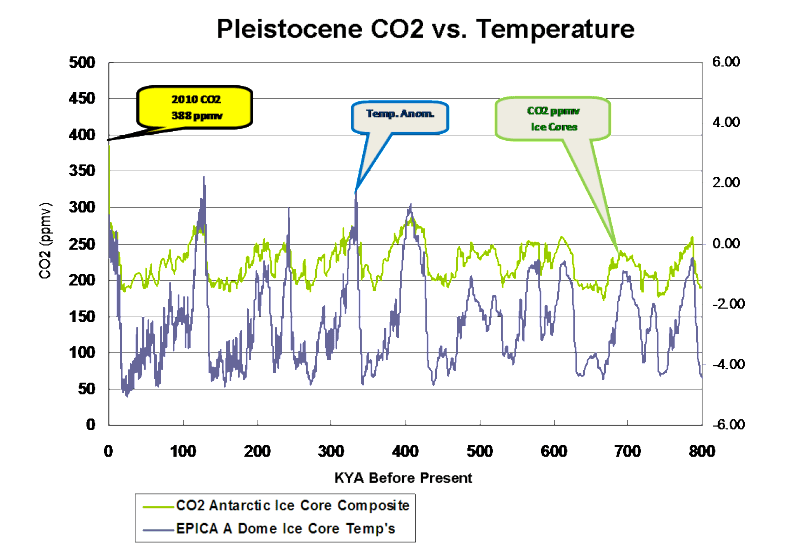

1) The climate isn’t doing anything today that it hasn’t done naturally during the Quaternary.
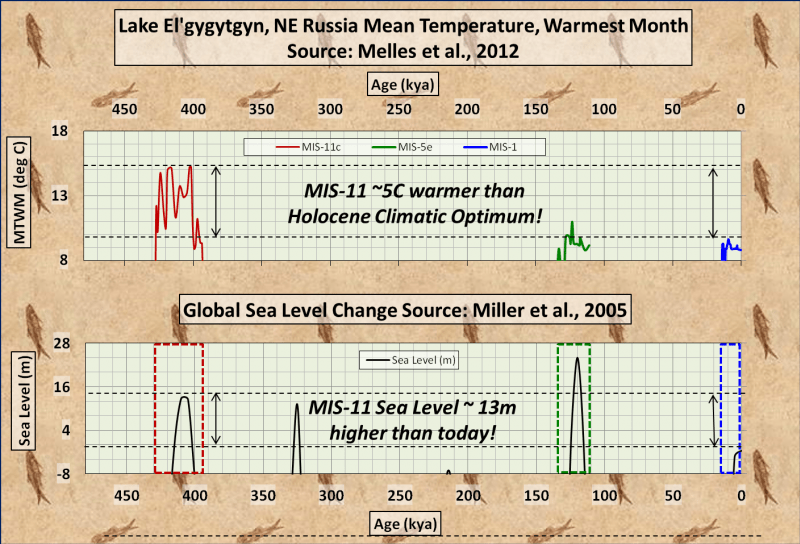
2) That whoever wrote “the last time that temperatures were about as warm as they are today,” is either ignorant or a liar. The MIS 5 and MIS 11 interglacial stages were considerably warmer than today, particularly in the polar regions. MIS 11 (400 kya) was one of the warmest Pleistocene interglacial stages.
Antarctica was significantly warmer…
Siberia was significantly warmer…
Greenland was about 5 °C warmer during MIS 5…
“1) The climate isn’t doing anything today that it hasn’t done naturally during the Quaternary.”
So what? That’s like saying that we should not be concerned about man made forest fires because lightning caused forest fires occurred before homo sapiens time on earth.
@chris
no, that’s like saying there is no reason to suspect an arson, since the fire just fellow the usual natural pattern.
While you imply that we should not be concerned about lightning caused forest fires, only those man made.
No, I am saying the fact that 100% naturally caused warming in the past is irrelevant to a discussion of warming today and whether action should be taken. The proper question sequence is 1) is the earth going to warm substantially? If the answer is yes, then 2) will that lead to more beneficial or more adverse consequences? If that answer is adverse, then 3) what actions should be taken?
Bringing up warm periods in the past is done for 2 purposes. 1) “see, it’s no big deal, it happened before; and 2) “since it happened in the past, it must be natural warming now, not man made.”
You’re one who cited their reference to MIS 5 and MIS 11. Either the natural variability of the Quaternary clinate is relevant or it isn’t.
1) Until the climate behaves in an anomalous manner relative to the rest of the Holocene and Late Pleistocene, there is no basis to assert that human activities are significantly affecting the climate. Science generally starts with an observed anomaly and then looks for an explanation, rather than starting with an explanation and then seeking out supporting observations.
2) It’s simply a lie to state that “120,000 years ago, the last time that temperatures were about as warm as they are today.” MIS 5 (Eemian, Sangamonian) was clearly significantly warmer that it is today; and this was just a possible melting of the Ross Ice Shelf. MIS 11 was significantly warmer than MIS 5.
“2) It’s simply a lie to state that “120,000 years ago, the last time that temperatures were about as warm as they are today.” MIS 5 (Eemian, Sangamonian) was clearly significantly warmer that it is today; and this was just a possible melting of the Ross Ice Shelf. MIS 11 was significantly warmer than MIS 5.”
Why is it a lie when the peak of MIS 5 in the Eemian was 130-125,000 ya, and MIS 11 was 400,000 ya ?
http://www.dandebat.dk/images/1517p.jpg
Because the reference clearly implied that melting of the Ross Ice Shelf may have occurred when temperatures were about what they are today.
Both MIS 5e and MIS 11 were warmer than the present interglacial. And in neither did the Ross shelf melt as shown by the AND-1B core:
https://pubs.usgs.gov/of/2007/1047/kp/kp07/of2007-1047kp07.pdf
MIS 5e was actually more than 8 degrees warmer than the present in the Ross embayment:
https://www.academia.edu/19263676/Wisconsinan_and_Holocene_Climate_History_from_an_Ice_Core_at_Taylor_Dome_Western_Ross_Embayment_Antarctica
“1) The climate isn’t doing anything today that it hasn’t done naturally during the Quaternary.”
True – but (crucially), it’s doing it for different reasons…..
Temperatures are right about where the Holocene TSI evolution indicates they should be.

Vieira LEA, Solanki SK, Krivova NA, Usoskin IG (2011) Evolution of the solar irradiance during the Holocene. Astron Astrophys 531:A6. doi: 10.1051/0004-6361/201015843
@chris
No wonder you issue such nonsense.
How can you assess the importance of present warming without past perspective? If it didn’t happen in the past, THEN there would have something to wonder about.
-> 50% chance, as far as we know. And 50% it cools.
Actually, as pattern of change can and will be more mixed.
Actually, no. This question has no answer. Consequences are not per se beneficial or adverse. YOU turn them beneficial if you adapt and use them for the best, and adverse if you don’t.
This one is easy. We have limited resources, most of them used in trivialities. The few we actually use for action of importance are scarce, and not to wasted. Natural disasters will keep happening even if by some techno miracle we stabilized the climate (which isn’t the Paris claim anyway) to “good old days”. On the other hand, if you are ready for a Katrina, you are ready for two. But if you tried to prevent a man-made Katrina instead of withstand it, you will still succumb to Nature’s Katrina and you wasted your effort.
Besides, it is much cheaper to move or rise my house in case of a sea level rise, than to try to prevent this rise anyway.
Adaptation always win.
Nope, you miss the point. 1) see, it happened before, so, small or big deal, you cannot prevent it to happen again, for better or worst 2) those who passed the dire test in the past don’t have to fear it in the future
You better adapt.
Whether some part of current GW is man-made or not is not only not answerable (you cannot prove it and cannot disprove it), it is utterly irrelevant. We need to be ready to a warmer/colder/wetter/drier/whatever world anyway. We need countries and people of the world rich enough to build earthquake-proof, flood-proof, cyclone-proof, and this require cheap energy NOW. Not some fool, expensive, premature Energiewende.
When everyone is rich, don’t worry. They will put some of their wealth into organic food, electric cars, passivhaus, and solar panels on their (huge) roof, and Energiewende will happen all by itself. If people want it, of course. If they don’t, your fight is lost anyway.
[Formatted for clarity, since it’s a good comment. -mod]
@chris
damn, my previous post lack this @chris tag
[Fixed. -mod]
@toneb
You can believe it does that for different reason, but cannot prove it.
And the reason is not important at all, unless you expect the reason to disappear soon. Do you?
Chris, the alarmists have been claiming that the current warming MUST be caused by CO2, because there is no other explanation.
Once you prove that temperatures have been as warm and warmer in the past, you have provided another explanation.
You alarmists have not been able to demonstrate that whatever caused previous warmings is not causing the current one.
Toneb, you assume that the reason is different, but your only evidence for that are the broken climate models.
What’s the difference between a broken climate model and a broken clock (analog)?
The broken clock is right twice a day!
https://youtu.be/9CdVTCDdEwI
https://youtu.be/__6P2VK-Qao
paqyfelc said: “No wonder you issue such nonsense.
How can you assess the importance of present warming without past perspective? If it didn’t happen in the past, THEN there would have something to wonder about.”
First, the main reason skeptics point to past occurrences of warming is to say “see, no big deal, it’s happened before.” It is not to say “let’s take a careful look at the climate, land mass and sea levels at the time of similar warming in the past, in order to see if a warmer earth will pose problems for humanity.” The way you assess the importance of present warming is by building models that predict what will happen. You can certainly cross check it against prior occurrences of warming, but they are not essential.
Take a counter example. Say the earth had never been covered with ice sheets. And say that power plant emissions led to a reduction in albedo in the earth’s atmosphere. You’re saying that scientists could not analyse and predict cooling that would lead to rapid glaciation just because the earth had not experienced glaciation in the past?
@chris
nope, already answered above. It MAY be big deal, Sea level rose so much as to turn “Doggerland” into … sea. Dogger Bank is full of humans remains. It sure was a big deal, and would just as much if it happened again, in, say, Bengal or Netherlands. And it may happen again, whether you “fix climate” or not. Obviously Netherland is rich enough to cope. Pretty sure Bangladesh isn’t, still, and the sooner it is, the better, but this need no climate effort, quite the opposite: just cheap energy and proper government.
Are you listening? Do you read? Math says this is just impossible to tell. Just read, learn, and write yourself, once and for all
“chaotic system are unpredictable. climate is a chaotic system. climate in unpredictable. period.”
No adding “but,still, we can know something, so lets pretend a model can …” NO. stop it. forever. Or gain your Field medal and hard science Nobel, for proving math wrong.
I understand your need of fortune tellers, but science says they belong to social science studies, as to why people need them and still trust them despite failure. There even exist competent fortune tellers who DO improve the life of those asking them, because they can deliver useful advises no less than any other. But that’s not science.
Quit superstition.
A warmer Earth will, for sure, pose problems. And present opportunities. Just as a colder Earth, and a wetter, and a drier, and even a just-the-same-as-before Earth (for whatever a “just-the-same-as-before” means, as it may very well means anywhere between 0°C and 30°C average, which is just a +/-5% around current ~288 K).
Just solve CURRENT issue, and half of future problem are solved. Just fix Haiti and bring it on par with Dominican Republic, and you don’t have to worry so much about Earthquakes and tropical storms, whether they turn more frequent or not.
You do that when and only you have a strong theory, already proven to work. You do that for mechanics, and you can fly to the moon and even an asteroid.
You don’t do that when math tell you you cannot, because the system is chaotic, which the climate IS, as per IPCC own assessment. No model will ever tell you where a double pendulum or a magnetic pendulum will move later, and just likewise no model will ever predict anything about future climate. period.
And no “climate scientist” even denies it. Just ask them.
Well, it has, and logic says that out of a false premise, you can draw any conclusion you want. You are once again founding your reasoning on swampy ground. sigh…
{Well, a reduction in albedo most surely would lead to a warming, not a cooling… so let’s suppose you just meant increase in albedo. }
Nope, I tell the very opposite. I say that you NEED the event to be extraordinary (like, appearance and expansion of ice sheets on a planet that never experienced them) for the prediction to have some value to come to support a theory which in turn could support some political action. Something that already happened all by itself without the new factor obviously doesn’t qualify as proof that the new factor has new influence.
@chris
nope, already answered above. It MAY be big deal, Sea level rose so much as to turn “Doggerland” into … sea. Dogger Bank is full of humans remains. It sure was a big deal, and would just as much if it happened again. And it may happen again, whether you “fix climate” or not.
Are you listening? Do you read? Math says this is just impossible to tell. Just read, learn, and write yourself, once and for all
“chaotic system are unpredictable. climate is a chaotic system. climate in unpredictable. period.”
No adding “but,still, we can know something, so …” NO. stop it. forever. Or gain your Field medal and hard science Nobel, for proving math wrong.
I understand your need of fortune tellers, but science says they belong to social science studies, as to why people need them and still trust them despite failure. Everybody has. There even exist competent fortune tellers who DO improve the life of those asking them, because they can deliver useful advises no less than any other. But that’s not science.
Quit superstition.
A warmer Earth will, for sure, pose problems. And present opportunities. Just as a colder Earth, and a wetter, and a drier, and even a just-the-same-as-before Earth (for whatever a “just-the-same-as-before” means, as it may very well means anywhere between 0°C and 30°C average, which is just a +/-5% around current ~288 K).
Just solve CURRENT issue, and half of future problem are solved. Just fix Haiti and bring it on par with Dominican Republic, and you don’t have to worry so much about Earthquakes and tropical storms, whether they turn more frequent or not.
You do that when and only you have a strong theory, already proven to work. You do that for mechanics, and you can fly to the moon and even an asteroid.
You don’t do that when math tell you you cannot, because the system is chaotic, which the climate IS, as per IPCC own assessment. No model will ever tell you where a double pendulum or a magnetic pendulum will move later, and just likewise no model will ever predict anything about future climate. period.
Well, it has, and logic says that out of a false premise, you can draw and conclusion you want. You are once again founding your reasoning on swampy ground. sigh…
{Well, a reduction in albedo most surely would lead to a warming, not a cooling… so let’s suppose you just meant increase in albedo. }
Nope, I tell the very opposite. I say that you NEED the event to be extraordinary (like, appearance and expansion of ice sheets on a planet that never experienced them) for the prediction to have some value to come to support a theory. Something that already happened all by itself without the new factor obviously doesn’t qualify as proof that the new factor has new influence.
payqelc, You lost all credibility with your entirely unsupported “proving math wrong” nonsense.” “chaotic system are unpredictable. climate is a chaotic system. climate in unpredictable. period.” If I add a DC bias voltage to an AC waveform, I am increasing the average voltage of that waveform. It doesn’t matter how chaotic and unpredictable that waveform is.
More heat is being added to the earth’s atmosphere. Over time, that leads to warming temperatures and rising seas. Warming temperatures are not bad for all locations – Russia will certainly benefit, as will Canada. But for the billions that live in Africa and Asia, not such a good thing.
So….. They went and did some actual science….and it blew their minds.
It’s amazing what you’ll find when you actually go and do some looking and some science.
Yes indeed …. and it’s what Glaciologists do routinely…
https://glaciologistsemily.weebly.com/
“The climate isn’t doing anything today”
This is the heart of the matter. There is no system separate from the real time weather system that does things behind the scenes. If you aren’t changing the weather today, right now, you aren’t changing anything.
Andrew
The climate can’t do anything today. Today is weather.
Andrew
https://youtu.be/9CdVTCDdEwI
It must be due to the “anti-greenhouse effect” (yes they have called it anti-greenhouse).
I’m trying to encourage a long and cooled debate about “Back cooling” – any takers?
I’d sure like to see a temperature profile of that bore hole–after it’s cooled back down. –AGF
Lots of comments that I did not read, and maybe somebody else made this joke, so sorry if a repeat:
Duh!, … if we freeze water, then we might get more ice. THAT … blows … my … mind !!