Guest rant by David Middleton
“If you’ve ever wondered why science journalism is so incredibly bad…”
NPR Is Seeking A Science Editor. Science Education Not Required.
By Alex Berezow — February 5, 2018
The job ad is appalling.
NPR, which to its credit at least attempts to cover science and health, is looking for a new Science Editor. Unfortunately, actually being trained in science is not required for the job.
Under the qualifications section, the ad says, “Education: Bachelor’s degree or equivalent work experience.” Amazingly, not only is a background in science unnecessary, college itself is optional.
[…]
If you’ve ever wondered why science journalism is so incredibly bad, this is why. (It’s also one reason why we ranked NPR’s science coverage rather poorly.) But it’s not just NPR. It’s almost all of journalism.
KCTS, the PBS affiliate in Seattle, has a job ad for Science/Environment Producer. Once again, neither a background in science or even a college degree is required. Instead, the jaw-dropping ad reads:
“The ideal candidate will be an experienced field producer with a deep understanding of Northwest environmental issues, including urban sustainability and environmental justice.”
In other words, the ideal candidate works for Greenpeace or Sierra Club in policy issues rather than accepting science.
[…]
Alex Berezow has always been a straight shooter. Real Clear Science was far better when he and Hank Campbell were involved.
Senior Fellow of Biomedical Science
Dr. Alex Berezow joined the American Council on Science and Health as Senior Fellow of Biomedical Science in May 2016. Dr. Berezow is a prolific science writer whose work has appeared in multiple outlets, including The Wall Street Journal, CNN, BBC News, The Economist, and USA Today, where he serves as a member of the Board of Contributors. In 2017, he published Little Black Book of Junk Science, and with Hank Campbell in 2012, he co-authored Science Left Behind, which was an environmental policy bestseller. Dr. Berezow has spoken to a wide variety of audiences about science, from graduate school seminars and church congregations to national TV and radio programs. Formerly, he was the founding editor of RealClearScience. He holds a Ph.D. in microbiology.
While a science Ph.D. may not be necessary to be a science journalist, some educational or work experience in STEM (science, technology, engineering and mathematics) should be a prerequisite. Science journalism is generally abysmal. However, there is one notable exception: local news broadcasts. Whenever there is an earthquake, volcanic eruption or some other geological/geophysical catastrophe, who does the local news anchor turn to?
In my experience, they almost always turn to the weather person… Even if the weather person doesn’t have a degree in meteorology, they generally have a strong science background.
Although, even in the area of broadcast meteorology, the focus is blurred by the “E” word…
The Certified Broadcast Meteorologist (CBM) program was established to raise the professional standard in broadcast meteorology and encourage a broader range of scientific understanding, especially with respect to environmental issues. Among radio and television meteorologists, the CBM designation is sought as a mark of professional distinction and recognition.
That said, it’s a fairly safe bet that no Certified Broadcast Meteorologist would try to link asteroids to climate change or government shutdowns.
[Insert Creative Segue]
Here’s a typical example of abysmal science journalism …
Not a Drill: Oil and Gas Exploration Dead in the Water for Governors
GABRIELLE GURLEY FEBRUARY 2, 2018
With most coastal chief executives ready to battle to protect their seashores and fisheries, the Trump administration storms into the country’s first energy-environmental showdown.
[…]
The debate over offshore oil and gas drilling is the first major clash of the Trump-inspired energy-environmental wars. This battle doesn’t just pit the states against the federal government; it also pits the fossil fuel actors that quickly seized the regulatory levers of government against the renewable energy forces that were empowered during the Obama years. Unlike the new federal centurions, governors in Massachusetts, New Jersey, New York, Oregon, Rhode Island, and elsewhere have firmly embraced renewable energy in the oceans in the form of wind farms.
Turbines are not benign; they come with their own environmental negatives as any ornithologist can attest. But they are unlikely to produce the kind of environmental devastation that a Deepwater Horizon-style oil spill can unleash, or produce the greenhouse gases that imperil life on Earth.
[…]
Ms. Gurley’s degrees in political science enable her to cover “several beats, including mass transit, municipal government, child welfare, and energy and the environment“; and to write something this fracking stupid:
Turbines are not benign; they come with their own environmental negatives as any ornithologist can attest. But they are unlikely to produce the kind of environmental devastation that a Deepwater Horizon-style oil spill can unleash, or produce the greenhouse gases that imperil life on Earth.
Really?
In U.S. offshore drilling and production, there is no such thing as “a Deepwater Horizon-style oil spill.” There’s just the Deepwater Horizon oil spill, more commonly referred to as “Macondo” in the oil industry.
“Or produce the greenhouse gases that imperil life on Earth”… I’ll let Tim Allen handle this one.
Scientific American fared a little better with this story…
Trump Wants Offshore Drilling, but States Are Choosing Wind Energy
States bordering the outer continental shelf are looking for carbon-free electricity as the Trump administration rolls back rules requiring it
By Brittany Patterson, ClimateWire on February 5, 2018
Atlantic coast states might be protesting President Trump’s plan to expand offshore oil drilling, but they’re increasingly embracing a different kind of seaborne energy: wind.
States bordering the outer continental shelf are looking for carbon-free electricity, even as the Trump administration rolls back rules requiring it. Last week, New Jersey Gov. Phil Murphy (D) announced that his state will aim for 3,500 megawatts of installed offshore wind by 2030, enough to power 1 million homes. Massachusetts has a goal to build 1,600 MW of offshore wind power by 2027, and New York has committed to 2,400 MW by 2030.
[…]
It’s possible that the wind and oil industries may compete for the same blocks of ocean seabed. That could create strife. Generally, when BOEM grants renewable energy rights on the outer continental shelf, they are exclusive rights to the seafloor.
[…]
While the article does go on to discuss the synergies that would occur with offshore wind farm installations and offshore drilling and production facilities, the article includes two mind bogglingly stupid concepts…
- Offshore wind and offshore oil are an either-or proposition; as if they were interchangeable.
- Offshore wind and offshore oil might “compete for the same blocks of ocean seabed.”
While the Scientific American article is a distinct improvement over The American Prospect article, how could someone be so scientifically illiterate that they would think that offshore wind and offshore oil might not be compatible or that they would “compete for the same blocks of ocean seabed”? Maybe it’s the result of magna cum laude degrees from the Berkeley Graduate School of Journalism and San Jose State University.
Nether article even touched on the atrocious economics of offshore wind power, although the Scientific American did at least mention the death of “Cape Wind’s 130-turbine project off the coast of Martha’s Vineyard.”

Offshore wind costs more than “beautiful clean coal” with CCS, almost twice as much as nuclear power and it’s half as reliable. No, offshore wind is not down to £57.5/MWh (~$80/MWh) in Europe.
In it’s first year of operation the Block Island Wind Farm managed a 39% capacity factor.
| MWh | 100% Output | Capacity Factor | |
| Dec-16 | 6,313 | 21,799 | 29% |
| Jan-17 | 8,898 | 21,799 | 41% |
| Feb-17 | 7,801 | 19,690 | 40% |
| Mar-17 | 10,514 | 21,799 | 48% |
| Apr-17 | 6,904 | 21,096 | 33% |
| May-17 | 9,162 | 21,799 | 42% |
| Jun-17 | 9,932 | 21,096 | 47% |
| Jul-17 | 6,724 | 21,799 | 31% |
| Aug-17 | 5,712 | 21,799 | 26% |
| Sep-17 | 5,698 | 21,096 | 27% |
| Oct-17 | 10,195 | 21,799 | 47% |
| Nov-17 | 10,985 | 21,096 | 52% |
| 1-yr Total | 98,838 | 256,668 | 39% |
That’s an average daily rate of 271 MWh/d… That’s 924 million British Thermal Units per day (mmbtu/d).
In light of the journalistic practice of assuming that wind and fossil fuels are interchangeable and mutually incompatible:
- A typical Marcellus natural gas well produces 5,000 mmbtu/d.
- A typical deepwater oil well in the Gulf of Mexico produces 5,000 bbl/d, nearly 30,000 mmbtu/d.
- The Block Island Wind Farm produces 924 mmbtu/d.
Oh… But it gets better. Offshore oil production platforms generally host multiple oil wells. If offshore wind and offshore oil actually did “compete for the same blocks of ocean seabed,” it wouldn’t be much of a competition. Offshore oil easily beats offshore wind in the false dichotomy category.
Whats that? It’s unfair to directly compare wellhead natural gas production to electricity output from a power plant… OK…
| Natural Gas | btu/kWh | 7,870 |
| Well Production | btu/d | 5,000,000,000 |
| Electricity Ouput | kWh/d | 635,324 |
| Electricity Ouput | mWh/d | 635 |
| Electricity Ouput | Block Islands | 2.3 |
A single typical Marcellus gas well yields 2.3 Block Islands worth of electricity-equivalent per day.
Recommended further reading:
Capital cost of offshore wind farms is rising
OFFSHORE WIND STRIKE PRICES Behind the headlines
Is any of you reading newspaper? I don’t.
Seems to me that newspaper have an audience of ignorant socialists and brainwashed enviromons, and they need to satisfy them. Proper science and real news won’t satisfy them, only fake news and astrology-like “science”
I always force myself to look, and keep my eyes open.
‘Was I unwise to keep them open for so long.”
Someone pays every science reporter.
The only variable is who…
The success of anything to do with renewable energy is the success of a bandwagon meme that diverts taxpayer money into causes that are subsidised to allow them to buy journalists to promote their cause.
This IS the politics of the ‘New Left’.
– Find a Cause, any Cause
– Get government grants to Do Something About It
– Use those grants to buy publicity for the Cause
– Get taxpayer dollars to subsidise those Doing Something About The Cause.
– Get Those Doing Something About The Cause to advertise with your media.
– Pay Journalists to turn their Press Releases into ‘stories’.
In the end its a wonderful rolling money machine for anyone who ‘Supports the Cause’ and the only losers are the taxpaying plebs.
Who can safely be won over with a bit of Liberal Virtue Signalling.
And anyone who opposes the Cause gets the sack.
Simples!
I propose Trump build a Wall — of virtuous, planet-saving windmills along Martha’s Vineyard. Civic-minded, planet-saving residents will probably chip in to pay for it.
Then he could erect a city of “dreamers” to work on it.
I think this article has way too many personal attacks and too much juvenile name calling in it, and isn’t worthy of inclusion in this blog. You can make your point without using phrases like “mind bogglingly stupid”.
These are actually mind bogglingly stupid concepts:
Mind boggling…
http://www.dictionary.com/browse/mind-boggling
Stupid…
It is simply mind bogglingly stupid to think that offshore wind and offshore oil platforms would be competing for seafloor real estate and that they are an either-or proposition.
Offshore wind power could even serve a purpose in enhanced oil recovery….
https://www.eniday.com/en/technology_en/renewable-wind-power-offshore-platforms/
They can even sit 1/10 mile away from each other without affecting one another
Sharing the same sea floor tract allows for BOTH sources of energy to be exploited simultaneously in the same space. The Sea Floor usage around the platform is similar to the platform footprint anyway.
Absolutely no reason why you couldn’t have 4 wind turbines making a square 1/4 mile on a side and have an Oil Drilling Platform right in the center of the 4 turbines
Bryan A
Er, NO. No you cannot site them like that.
The oil drilling and production platforms require continuous assist ship availability – so the assist ship (fire or evacuation most importantly, replenishment and re-stocking of drill chemicals and general supplies and part that are too heavy for helicopter servicing) have to be able to get to and around the drill platforms unimpeded by storms, sea, and direction of the wind. The wind turbines around a drill platform prevent that access, particularly under night and stormy conditions when access and maneuvering are most limited BY the adjacent minefield (er, windmill platforms.)
Second, the wind turbines require smooth, even wind flow to the blades, out to what used to be 6-7 blade diamters, but for the newer bigger blades needs to be 12-15 diameters. Siting them that close – and the oil platforms create as much turbulence downstream as the big windmills do! – is prohibited by the physics.
Not sure about exact distances, offshore wind farm facilities aren’t terribly different than oil production platforms and are serviced by the same sorts of ships.

A Case-Study on Offshore Wind Power Supply to Oil and Gas Rigs
https://www.sciencedirect.com/science/article/pii/S1876610212011228
David Middleton
Your photo’s and links confirm my point:
The oil platform IS as strong an influence on downwind disturbance levels as the wind-turbine,
the oil platform MUST Be isolated from the wind turbine platforms (the one in the example is on the outside of the wind turbine array, approachable from >3 sides freely and with no turbines around it! ),
and that the wind turbines at sea MUST BE maintainable and approachable themselves.
If one assumes they ever actually will be repaired. Today, on land, wind turbines are one of them most dangerous, most expensive repair and maintenance projects ever! Much more deadly than most jobs!
You seem to confuse reporting both sides of an issue with a journalist stating an assertion of personal belief. As I wrote in my post below, the opposite view is also presented – there will be no competition. You may be right in suggesting some idea is mind-bogglingly stupid, but it’s false, misleading and irresponsible to suggest that it’s an example of poor journalism, or “scientific illiteracy” on the part of the journalist to report on that idea as one position of the issue.. It’s so easy, though, isn’t it? Many people will simply believe you, and not read the article you rant about.
As the Sci Am article points out, competition may simply come down to getting the rights to a given bit of sea-bed. That doesn’t mean that two industries couldn’t work it out, but there is nevertheless the POSSIBILITY of competition. That doesn’t make it inevitable. Did you even read the Sci Am article, David?
There aren’t two sides to this particular issue. LEARN HOW TO READ…
“Did you even read the Sci Am article, David?”
Several times… And I even read the BOEM agreement for offshore wind leases.. I even posted a link in a comment…. And most importantly, I know how offshore wells are drilled and produced…. And that there is no chance that a wind farm and an oil field would require the same piece of seafloor real estate.
Why would Alex Berezow report this when The American Council on Science and Health (NCSH) has a chart on its web site that claims that the magazines NATION, NATIONAL GEOGRAPHIC, SCIENCE etc. are “evidenced based reporting”? I am confused, if NCSH believes that NATGEO is ‘science based’, why would they have a problem with these employee standards?
jw
I, too, was very surprised to see National Geographic categorized as an “evidenced based reporting” publication.
In addition to their decade-long repetition of wholly unsubstantiated climate propaganda, I will never forget the Arab Oil Embargo era (c1975) cover article proclaiming, “The End of Oil.”
It is difficult for me to imagine a more biased, partisan operation.
I don’t see that on their website…
https://www.acsh.org/
David Middleton
I’m not good with this HTML stuff
the link is the one in the third paragraph from the top.
If you’ve ever wondered why science journalism is so incredibly bad, this is why. (It’s also one reason why we…..ranked NPR’s science coverage rather poorly…..) But it’s not just NPR. It’s almost all of journalism.
jw
Try here
https://www.acsh.org/news/2017/03/05/infographic-best-and-worst-science-news-sites-10948
Thanks. I remember seeing this now.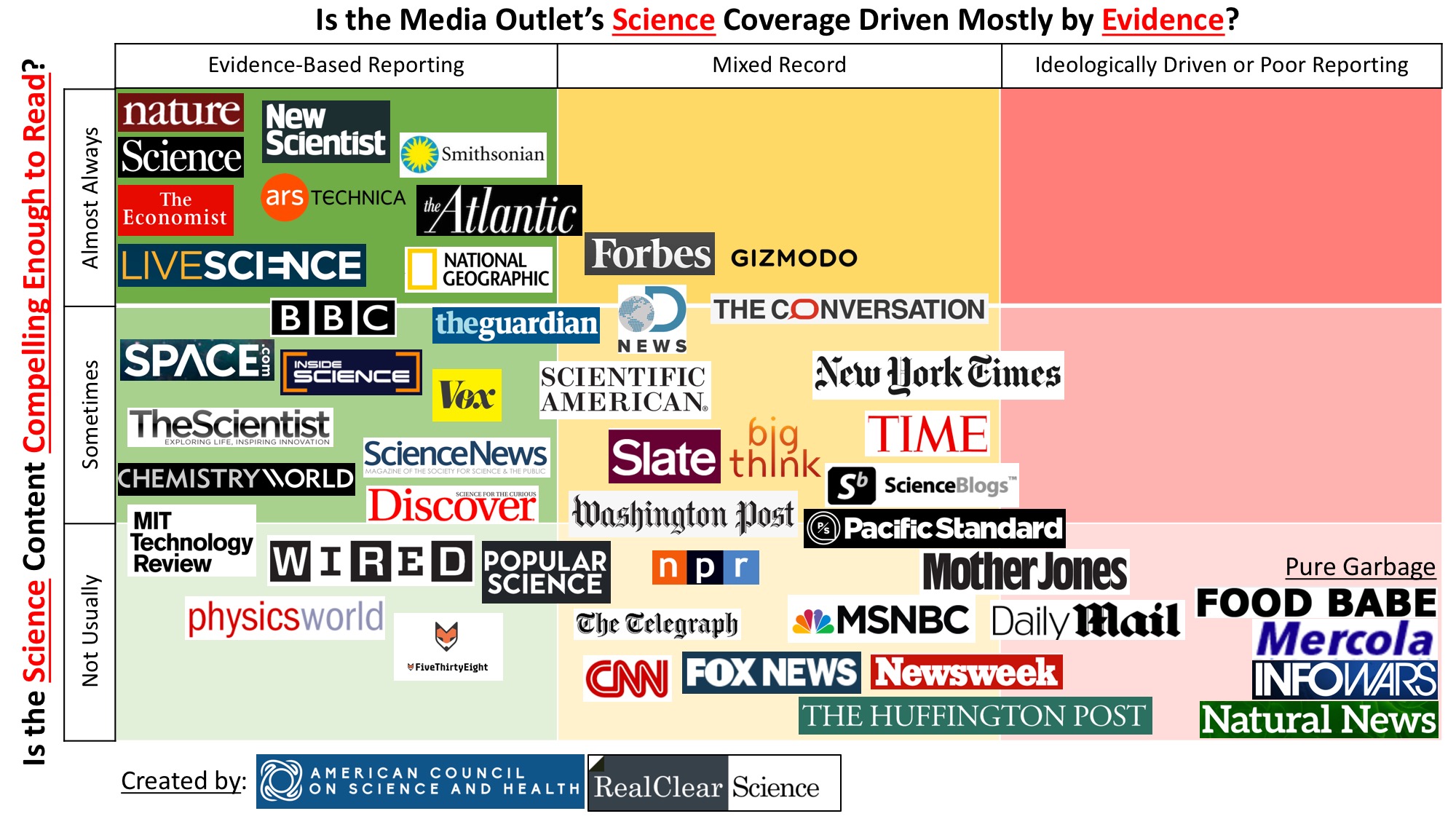
While I would put NatGeo in the “mixed record” category and The Grauniad next to InfoWars, this isn’t too out of whack…
wow.
MIT tech review, guardian, BBC, the economist, labeled “evidence-based” when reporting science ? seriously?
While most of us here would disagree with those sources’ interpretations of the evidence, they are generally evidence-based reporting.

NatGeo looks at the evidence for global sea level rise and comes up with this interpretation:
I look at the same evidence from a geological perspective and I come up with this interpretation:
Since science is not at all involved in NPR’s propaganda style coverage of science and health, there is no need for the candidates applying for a new Science Editor position to have any sort of science qualification. In fact, such a qualification could be a real disadvantage as they could start asking too many awkward questions.
Maybe we should hang wind turbines on the oil platforms just to keep the greens happy, yes it a waste of money but at least we could get something of value from the deal. Think about it might not be a bad idea when the winds blowing they won’t need to run as many diesel generators to keep the platform powered even though the diesel would be less expensive.
I agree that we would all be better off if the media were better at interpreting science to the public, and ideally journalists would be trained in science. (Are there science journalism degrees, I wonder?) But they aren’t. I doubt many people would go through the drudgery of getting a PhD and doing research, then want to write about it instead. This position is specifically for Health Editor, and it’s such a broad topic that experience in one field might not help anyway..
Regardless, there is no need to single out this ad and turn it from average into “appalling” though one criticism: it says, “or equivalent work experience,” just like so many other job ads do. That’s getting really desperate when you want to disparage a media outlet so badly that you use that for an excuse.
There is no mention of the other requirements. Here’s one:.
“Strong grasp of journalistic ethics. Experience maintaining high journalistic standards including standards of objectivity, balance and fairness. ”
Right there in the job ad, before you even apply: ethics, objectivity, balance, fairness. Of course, you will think NPR and scoff – and it’s true, it’s liberal, but it tries to present the whole story far more than this site does.
It’s ironic to present an essay about the dearth of good science journalism here.
“The ideal candidate will be an experienced field producer with a deep understanding of Northwest environmental issues, including urban sustainability and environmental justice.”
In other words, the ideal candidate works for Greenpeace or Sierra Club in policy issues rather than accepting science.
There is absolutely no logic here. It’s propaganda, that’s all. Someone could have a deep understanding of those things and be a lobbyist for the forestry industry. “Works for Greepeace…rather than accepting science.” The whole sentence is just loaded with meaning, the message that public TV prefers advocacy over truth., It’s an accusation with the illusion of evidence.
The ranter complains that the article says oil and wind could compete for the same seabed. The article also says, “Experts said it’s unlikely there would be direct competition for the same slice of ocean between the two industries.” It’s called presenting two sides to a story. Middleton prefers that the author assert there’s no possibility of competition, I guess, regardless whether it’s true.
The whole essay is filled with bits of unrelated, poor examples as if they were evidence justifying a general conclusion. I agree fully with the general premise that science journalism is poor, but the way it’s supported here is nothing but an excuse to send messages that have nothing to do with the supposed point of the essay. I believe the real motive is to send messages denigrating public news and discrediting (a type of) reporting on the energy industry.
I guess the essayist at least admits that it’s a rant and not journalism, but there are plenty of better instances of lack of professionalism out there..
Learn how to read. From the post:
There aren’t “two sides” to this story. The only competition between offshore oil and offshore wind would be for boats and shore facilities… Because the people and methods used to build and support offshore oil facilities are the same people and nearly the same methods used to build and support offshore wind facilities.
David, you said the article had mind bogglingly stupid concepts, one of which was the idea that offshore wind and offshore oil might “compete for the same blocks of ocean seabed,” but you failed to also say that the article told readers that some experts said the reverse. These are the two sides to the story – or two views of it, or whatever you want to call it. As you know, journalists often try to represent conflicting opinions in the desire for “balance” in reporting. You call it stupid, fine. You have your opinion, but that doesn’t mean I can’t read.
Either-or propositions do not imply two things are interchangeable.
Try actually reading the post..
There aren’t two sides to this story and “either-or” mathematically implies interchangeable.
The first article presented one side that doesn’t exist: Offshore wind and offshore oil is an “either-or” proposition.
The second article presents both sides of a one-sided issue by noting the synergies that would occur with both.
It requires a mind-numbing level of stupidity to think that offshore wind and offshore oil are an either-or proposition or that they might require the same patches of seafloor.
Quit telling me I need to read the post just because I disagree. If you think I’m misunderstanding a particular point, tell me.
Either-or propositions are neither mathematically nor logically about interchangeability. Take a quadratic equation that has two solutions: either 4 or -9 will solve it. Does that mean 4 and 9 are interchangeable quantities? Or, say I want either an apple or an orange. Does that mean they are interchangeable in general?
You may well be right about wind turbines and oil rigs sharing the same spot, though it seems more complex than you make it. What about helicopter transport, especially during storms? What about emergency procedures? What if states don’t want an oil rig off their shore, and would prefer wind? And, as you point out, there is boat access. I frankly don’t know enough to judge, but none of that is really my point anyway.
My point is that I don’t think you are justified in saying the journalist is scientifically illiterate just because you don’t agree with something in the story. The journalist may not agree any more than you do, but that doesn’t mean it’s illiterate to include their position; it’s a common practice in journalism, one that is much discussed these days. Some journalists are wondering whether it is actually doing readers a disservice if two sides of an argument are given equal space when one side is deemed much more likely to be accurate and true than the other. However, then there are problems of bias and the definition of “truth” and different ideas about what is good for society. I believe that generally the best, most ethical journalism presents a range of plausible ideas and evidence and allowsj the reader to decide. I don’t expect you to do so now because your essay is an op ed. You are free to state your opinion, I’m free to state mine.
I’m sorry if I offended you. I get rather carried away sometimes in my writing. I’m not here to make enemies, though I suppose that’s bound to happen these days simply through passionate disagreement and the effects on discussion conferred by the internet.
Offended? I’m having a blast ridiculing your comments
It’s simply idiotic to view offshore oil and offshore wind as an either-or proposition. This is a side of the issue that doesn’t exist.
Both articles present the issue as if offshore wind and offshore oil are a mutually exclusive choice between two alternatives. This is simply a moronic, scientifically illiterate notion.
If you actually read and comprehended the post, I would stop suggesting that you learn how to read or actually read the post. I clearly stated that the second article pointed out the synergies that would occur.
An either-or proposition gives you a mutually exclusive choice between two alternatives. This requires the two alternatives to be interchangeable and incompatible. Either one or the other is the answer.
Journalistic ethics? Don’t make me laugh.
I’m sure the creative-accountancy departments can make the maintenance budgets look reasonable for off-shore wind installations before they hit the wall, but I never hear much said about decommissioning costs.
(I could also be persuaded that abandoned turbines help form artificial ‘reefs’ which are beneficial for marine life. But owners of oil rigs are not afforded the same luxury, if the Brent Spar story is anything to go by.)
And… On the US OCS, the wind farms will have to be as fully decommissioned and removed as offshore oil infrastructure is when it reaches the end of its economic life. P&A liabilities are a bitch.
Need a new term. Too much of the propaganda feed cannot be honestly described as “journalism.” There is a suggestion of objectivity and investigation inherent in that term.
I call this new stuff “churnalism.”
We also need a new term for the politicized so called post modern “science” too. If it does not use the scientific method it is not science.
No need of a new term. If it gets an adjective, is in not science. For instance: Geology is science; Earth science is not. Climatology is science; “climate science ” is not.
Twenty years ago I learned that a degree in Education that ‘qualifies’ someone to become a science teacher in public schools does NOT require even a single science class with a laboratory component.