From RICE UNIVERSITY
World Weather Attribution study: Climate change made Harvey 3 times more likely

A team of scientists from World Weather Attribution, including researchers from Rice University and other institutions in the United States and Europe, have found that human-caused climate change made the record rainfall that fell over Houston during Hurricane Harvey roughly three times more likely and 15 percent more intense.
The study is available online in Environmental Research Letters.
“The takeaway from this paper is that Harvey was more intense because of today’s climate, and storms like Harvey are more likely in today’s climate,” said study co-author Antonia Sebastian, a postdoctoral research associate with Rice’s Severe Storm Prediction, Education and Evacuation from Disasters (SSPEED) Center. “It highlights the need to consider that our hazards are changing over time, and that we should be considering those changes in the design of our infrastructure.”
Sebastian’s co-authors included Dutch researchers from both the Royal Netherlands Meteorological Institute (KNMI) and the Red Cross Red Crescent Climate Centre in The Hague,
Netherlands, and English and U.S. researchers from the University of Oxford, Princeton University and Princeton-based Climate Central. The team is part of World Weather Attribution, an international effort to analyze and communicate the possible influence of climate change on extreme weather events, such as extreme rainfall, heat waves and droughts. SSPEED is not affiliated with World Weather Attribution.
Sebastian has spent a decade studying urban flooding and flood risks in Houston, first as a doctoral student at Rice and later as a research associate at SSPEED. She was completing a one-year visiting appointment at Delft University of Technology in the Netherlands when Harvey struck Houston, and she was asked to participate in the World Weather Attribution study by lead author Geert Jan van Oldenborgh, senior researcher at KNMI, and Maarten van Aalst, director of the Red Cross Red Crescent Climate Centre.
Van Oldenborgh said, “This multimethod analysis, drawing upon both observed rainfall data and high-resolution climate models, confirms that heavy rainfall events are increasing substantially across the Gulf Coast region because of human interference with our climate system.”
Harvey made landfall Aug. 25 near Corpus Christi, Texas, as a Category 4 hurricane and stalled. As a tropical storm, it dropped more than 30 inches of rain on Southeast Texas and caused record catastrophic flooding in Houston and the surrounding region. In east Harris County, a record 51.89 inches of rain — the highest storm total in U.S. history — was recorded over the six-day period from Aug. 25 to 30. During the first three days of the storm, 41.07 inches fell over Baytown.
For a specific location like Houston, the study found that the maximum observed rainfall is still extremely rare in today’s climate – less than a one-in-9,000-year event. However, the chances of seeing this much rain over a three-day period anywhere over the entire Gulf Coast region are much higher, but still small — less than once every 100 years.
“These results make a clear case for why climate change information should be incorporated into any plans for future improvements to Houston’s flood infrastructure,” Sebastian said. “The past is no longer an accurate predictor of present or future flood-related risks.”
Due to global warming, global temperatures in today’s climate are about 1.8 degrees Fahrenheit higher than pre-industrial temperatures, the researchers said. They estimated that even if Earth met the global targets set by the Paris Agreement of limiting warming to 3.6 degrees Fahrenheit, an event like Harvey will see a further increase of about a factor of three in probability.
“But if we miss those targets, the increase in frequency and intensity could be much higher,” said study co-author Karin van der Wiel, a postdoctoral researcher at KNMI.
“Although the rainfall levels from Harvey are extremely rare, additional factors, such as rapid population growth, urban growth policies and aging water-management infrastructure, further exacerbated the ultimate impacts of this storm,” van Aalst said. “Damage from storms like Harvey, Ike in 2008 and the Tax Day Flood of 2016 illustrate the importance of managing exposure and vulnerability when reducing the level of flood impacts in Houston.”
###
The paper: http://iopscience.iop.org/article/10.1088/1748-9326/aa9ef2/meta
Attribution of extreme rainfall from Hurricane Harvey, August 2017
Abstract
During August 25–30, 2017, Hurricane Harvey stalled over Texas and caused extreme precipitation, particularly over Houston and the surrounding area on August 26–28. This resulted in extensive flooding with over 80 fatalities and large economic costs. It was an extremely rare event: the return period of the highest observed three-day precipitation amount, 1043.4 mm 3dy−1 at Baytown, is more than 9000 years (97.5% one-sided confidence interval) and return periods exceeded 1000 yr (750 mm 3dy−1) over a large area in the current climate. Observations since 1880 over the region show a clear positive trend in the intensity of extreme precipitation of between 12% and 22%, roughly two times the increase of the moisture holding capacity of the atmosphere expected for 1 °C warming according to the Clausius–Clapeyron (CC) relation. This would indicate that the moisture flux was increased by both the moisture content and stronger winds or updrafts driven by the heat of condensation of the moisture. We also analysed extreme rainfall in the Houston area in three ensembles of 25 km resolution models. The first also shows 2 × CC scaling, the second 1 × CC scaling and the third did not have a realistic representation of extreme rainfall on the Gulf Coast. Extrapolating these results to the 2017 event, we conclude that global warming made the precipitation about 15% (8%–19%) more intense, or equivalently made such an event three (1.5–5) times more likely. This analysis makes clear that extreme rainfall events along the Gulf Coast are on the rise. And while fortifying Houston to fully withstand the impact of an event as extreme as Hurricane Harvey may not be economically feasible, it is critical that information regarding the increasing risk of extreme rainfall events in general should be part of the discussion about future improvements to Houston’s flood protection system.
300% more likely yet still a rare 9,000 year event?
How do they explain https://en.wikipedia.org/wiki/Tropical_Storm_Claudette_(1979)?
Did CO2 somehow cause Harvey to stall in the same spot for 3 days? Maybe the models confirm that Claudette wasn’t actually as bad as your lying eyes and memories.
The CO2 molecules all joined hands and sang Kumbaya, thus holding the storm in place.
Not to mention Tropical Storm Amelia in 1978!
https://notalotofpeopleknowthat.wordpress.com/2017/08/28/storm-harvey-update/
If I bought 2 extra tickets, I’d be three times more likely to win the lottery.
Climate change also made a 10-year interval between hurricane landfalls on the U.S. mainland 300% more likely.
3x and 15 % of anything are too small.
They need to Paul Ehrlich to get some “old school” ways to kill people for the cause.
IED on Jihad Janes and Johns on city buses, sabotage of city water and sewage facilities and power lines.
The Alarmists will not win the hearts and minds of their fellow polluters with piece meal reports that most will never read in the first place.
Body bags! Pain! Blood on the city streets! Those are ACTION ITEMS that get attention.
Ha ha
Water vapor over the Gulf at the time of year Harvey hit increased less than 6% due to the Gulf’s warming since the Industrial Revolution. Make that 3% in the past few decades according to Dr. Michael Mann, although he got something else about Harvey wrong. He claimed Harvey stalled because global warming moved the jet stream northward. Although global warming is moving the northern hemisphere polar front jet northward on average, Harvey stalled due to it being farther south than usual in the central and eastern US, and northwesterly upper level winds countered the northwestward movement of most hurricanes that hit Texas in August.
First, if a warming atmosphere did make Harvey 15% more wet, that doesn’t prove anthropogenic causation. And that’s the debate, causation.
Second, these people are nuts.
Third, it was simply a confluence of weather events (remember who when it snows Warmists tell us that weather isn’t climate? Right before they tell us cold and snow are caused by AGW) that blocked the movement of Harvey, allowing it to move so slowly after landfall.
….”Extrapolating these results to the 2017 event, we conclude that global warming made the precipitation about 15% (8%–19%) more intense”…..
===========
15%, give me a break, or at least a baseline.
If they said something like 0.5-1.5 percent I might take them seriously, but 15% is just so far out the bounds of the reality of heat transfer on this planet, that it just sounds silly.
As a west Houston resident still “recovering” from a flooded house, I would venture to suggest that the flooding that occurred due to Harvey was increased due to human activity. Just NOT due to supposed effects of some climate change. Texas allows, and will continue to allow despite such events, unchecked development of the land. Development and artificial drainage hurry the rainfall quickly into the bayous, far more rapidly than if left in its natural state. The storage capacity of open land is lost, the bayous quickly fill and overflow into the same developed areas causing ever more costly damage. It is a vicious cycle that will not stop until we stop covering the land in concrete.
Blaming the extent for flooding on AGW exonerates poor planning, it has become as politically useful to the right as to the left, there are no innocents here…
No planning needed. Just build on high enough piloti were you have reason to fear flood (anywhere flood already happened, to begin with) as men learned to do a few millennia ago.
Three times more likely to have been 15% more intense?
How much additional energy input is required for such a change to be broadly applicable to (some of, most of) the Whole Earth?
And then they woke up, with complete solutions regarding Heisenbergs uncentainties.
How marvellous it must feel to be both a climate scientist and a master of the Universe.
According to known and accepted measurements, the anthropogenic percentage of atmospheric CO2 represents only 4%. Since Co2’s share of the atmosphere is only 0.04% becomes the anthropogenic proportion of our atmosphere only 0.0016%. This is logically not problematic …
Why are our 4% a hazard while the natural 96% is not ..?
“According to known and accepted measurements, the anthropogenic percentage of atmospheric CO2 represents only 4%. Since Co2’s share of the atmosphere is only 0.04% becomes the anthropogenic proportion of our atmosphere only 0.0016%. This is logically not problematic …
Why are our 4% a hazard while the natural 96% is not ..?”
Erik:
You have your sums wrong….
Mankind has upped the amount of atmos CO2 by ~ 50%
From around 270 ppm to 400.
The “natural” is 66% and Man’s 33% (roughly).
“Mankind has upped the amount of atmos CO2 by ~ 50% From around 270 ppm to 400.”
Rubbish, the natural warming out of the LIA has contributed a large proportion of the enhance atmospheric CO2.
Scientific estimates, (as against agenda based non-science) are about 15% of the increase is down to man.
It is good that man has made at least some contribution, because it means the extra 1600 coal fired power stations being built around the world with an approximate CO2 emission increase of 43%, will continue to enhance the supply of the fundamental building block of all life on Earth.
http://cdiac.ess-dive.lbl.gov/trends/co2/iso-sio/graphics/isospgr.jpg
http://cdiac.ess-dive.lbl.gov/trends/co2/iso-sio/iso-sio.html
“The 13C isotope is stable and heavier than the normal form of carbon (12C), and plants tend to selectively assimilate the lighter isotopes during the photosynthetic process. This results in the following features of the 13C/12C ratio in the atmosphere: (1) a seasonal cycle occurs with the heavier isotope at relatively high concentrations during the summer, as plants selectively remove the lighter isotope from the atmosphere, and (2) a general decrease with time, as more fossil carbon (which originally was plant material, and consequently biased toward the lighter isotope) is injected into the atmosphere from the combustion of fossil fuels. Additionally, about 95% of fossil-fuel carbon emissions are from the Northern Hemisphere, and there is a 6-12 month time lag before this material is transported by the atmosphere to the various stations in the Southern Hemisphere. The seasonal cycle reverses and its amplitude decreases in the Southern Hemisphere, where the seasons are opposite those in the Northern Hemisphere and there is much less land area to support a terrestrial biosphere.”
Not to mention decreasing oceanic ph.
But on the other hand – if you say so.
Ta ta
If you think its more than 15% , that is absolutely great news.
That means the atmospheric CO2 will climb even quicker from the advent of the 1600 new coal fired power stations.
Wonderful news, thanks 🙂
typo …. should be 1600 not 16000
AndyG55 December 14, 2017 at 3:04 pm
Fixed … I hate typos.
w.
“plants tend to selectively assimilate the lighter isotope”….
I wish people that claim to have an education…wouldn’t say stupid things that says they don’t.
Plants do not have a brain..they don’t select.
The lighter isotope is just transports easier.. so it sometimes beats out the heavier one at the receptors
plants don’t care…and the higher concentration of both has the effect of making it even easier
“Fixed … I hate typos.”
You do NOT want to hear me try to play piano !! 😉
My calculations show 14% more intense.
Anyone who claims 15% more intense is a fool.
They just made up their number.
My number is based on weeks and weeks of calculatin’.
Thats cypherin Richard, no one does calculatin’ anymore. You gotta do yer guzintas. 2 guzinta 100 50 times, 3 guzinta 100 33+ times. 33-50 inches of rain.
hahaha! That’s funny!
I think Dr. Neil Franks article that he posted on this website summed it up best. It was a storm that just didnt move. Take 100 and divide it by the forward speed of the storm whcih was 2-3 mph and you get your rainfall total. So we had 33-50 inches of rain. It was predicted and it happened. Hardly unusual but I can tell you it sucked for those of us who lived it.
Man, I loved this statement about the three “ensembles” of climate models used:
So one ensemble showed rain going up twice as fast as the CC relationship suggests.
The second ensemble showed going up exactly as fast as the CC relationship suggests.
And the third ensemble? I suspect that it showed rain going up less than the CC relationship suggests … so they threw it out. However, like all the failed model runs that end up on the cutting room floor because their modelers deem that they are not “realistic”, we’ll never know what crime it committed that lead to its execution.
And they believe this nonsense? That’s right up there with chicken entrails …
Pathetic …
w.
Erik, on point. I have demonstrated this at gatherings by using 1 pound of rice (10,000 grains) and separating out 4 which demonstrates CO2 in atmosphere. I then cut one (attempt) into16 pieces anthro contribution. To top it off I explain how they inhale 400ppm and then exhale 40,000 to 60,000. Room gets real quiet.
Atmospheric CO2 enhancement has been the equivalent of going from 3 cents in $100 to 4 cents in $100
Not a great interest rate, is it 🙂
Now 10 cents ….. you can actually buy something with that. !
Where do you get your rice?
I only got 9981 in mine,- I just checked.
Sorry, make that 9982, I found one on the floor.
Do you also work at Rice University?
The 3 x or 15% is straight out of RCP 8.5. Apparently they decided they no longer needed the 3°C from CO2 doubling to make it happen.
The BBC are all over this like a rash.
Absolutely lapping it up.
The ridicule is, of course, warranted. But lest we get carried away with mocking the idiocy, bear in mind that any day now, these science vandals will show up in a courthouse somewhere as expert witnesses to whom a judge will defer and innocent people and their lawful enterprises will be plundered. It’s going to get worse before it gets better.
Jonthetechnologist December 14, 2017 at 12:28 pm
Thanks, Jon. This is perhaps the weakest argument against CO2. The implied argument is “there’s not enough CO2 to harm us”.
However, consider ozone. At an atmospheric concentration of something like 340 parts per billion with a b, it is only about a thousandth as common as CO2. And yet it prevents us from totally being fried by the sun.
Not only that, but at 1/8th the concentration of atmospheric CO2, 50 ppmv, ozone is lethal to humans.
So the idea that we can dismiss CO2 because it’s only four grains of rice out of a pound is simply not true. There are valid reasons to dismiss CO2 … but that’s not one of them.
Regards,
w.
Doesn’t work like that Willis. Once that idea gets in and starts confirming the bias, only something truly catastrophic is going to shift it. Nothing you say will dissaude Jon from bringing a jar of rice with him.
Thanks, Tony. If I were just writing to Jon that would be an issue. But mostly I write for the lurkers … and many of them are willing to change their minds if the facts change.
Regards,
w.
That really doesn’t seem like an apples to apples comparison. Ozone concentration In the stratosphere it is much higher than 340 ppb – avg 8 ppm – and the vertical distance of the stratosphere is much greater than the troposphere, so the likelihood of UV hitting an ozone molecule is great. And the photon energy is lost in the photochemical reaction. That’s a different issue it seems than heat retention in the atmosphere via CO2.
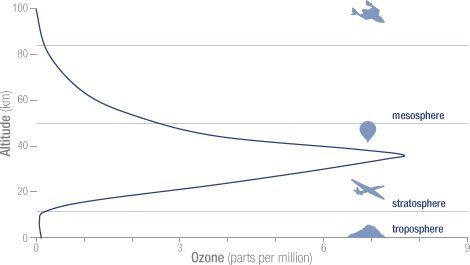
Thanks, icisil. Even in the stratosphere at the max concentration, the ozone concentration is still only 5% of the CO2 concentration. Also, although the stratosphere is much thicker, it is also much less dense, so the likelihood of hitting an O3 molecule is not as great as it seems.
However, this was just one of many possible examples of how a very small concentration of a substance can have large effects. If you don’t like that example, consider ricin … lethal concentration in the human body is 22 parts per billion with a b … so the argument that because CO2 can be ignored because there is so little of it doesn’t hold water.
w.
You keep using examples involving some form of chemical reaction to compare with a thermodynamic phenomena. It doesn’t hold water IMO.
Also, btw, the ozone in the stratosphere blocks all UV-C and most UV-B. So that more than seems to be great; it is great. Ozone has little to no effect on UV-A, so it passes right through.
Oh heck, I was wrong. Ozone absorbs virtually 100% of UV-C, 90% of UV-B, and 50%of UV-A.
Willis Eschenbach December 14, 2017 at 2:20 pm
Jon, there is also a problem with your attribution of the increase in CO2. You’ve attempted to describe it by pointing out that the anthro annual emissions are only a sixteenth of the natural emissions. While this is true, it doesn’t describe what’s happening.
To demonstrate this problem, consider a spring flowing into a tub with a hole in the bottom. Initially, there’s more water coming out of the spring than will flow down the hole, so the tub starts to fill up. As it fills, the water level rises, the pressure at the bottom of the tub increases, and the flow out of the tub increases. At some water level, the tub is full enough that the pressure forces the same amount out of water of the hole as is coming in from the spring.
At this point, the tub is at what is termed a “steady-state condition”. The level in the tub is not going up or down. Since it’s a natural spring, we’ll call this the natural level of the water in the tub.
Next, suppose that I take a hose, and I start adding water to the tub, say a sixteenth as much water as is coming from the spring.
What will happen to the level of the water in the tub?
Obviously, the level of water in the tub will rise until a new steady-state condition is achieved. Now here comes the important question:
Who is responsible for the rise in the water level in the tub to its new steady-state condition? Me, or nature?
And if I am responsible, am I only responsible for one-sixteenth of the rise? I mean, before I got out my hose, there was no rise in the level at all …
As I said above, there are good reasons to think that CO2 is not the climate control knob … but that’s not one of them.
w.
Eloquent and persuasive arguments refuting the: ‘how can such tiny amounts.?’ myth and the; “natural sources dwarf human sources?” myth.
Perhap after your snorkeling you’d like to tackle the: “how can we even know where the extra CO2 comes from…? myth.
Spent a week at Matikuri Lodge on Marovo lagoon a few years ago. Fond memories.
“The station Cedar Bayou at FM1942 (www.harriscountyfws.org/GageDetail/Index/1730), about 40 km west of Houston,…..” Oh well, east is west, port is starboard, dyslexia rampant.
“…..That is, at this stage, there is no clear scientific evidence to support the notion that the existence of Harvey was made more likely by global warming……….
……However, the impacts of Harvey may have been influenced by global warming; ….
I was just on a beach this morning over 15 miles from the Gulf of Mexico where a small group of sprouting from seed mangroves had apparently been planted by Harvey a few feet above msl. Yesterday I was looking at the pattern of how live oaks got blown over and talked to somebody who got 20 inches of rain actually quite a lot of km west of Houston. Do any of them actually get out of their office and study impacts? I know, not easy. Oh well, I guess if they did not know about this before as found near the end of their conclusions–—”…and whether compound flooding during tropical cyclones should be considered in the design of coastal flood defences.”
We have enough problems with those who plan and spend our money not knowing much.
Harvey has been labelled the wettest hurricane in history; however, the 50 inches recorded in the hurricane is not related to global warming. The reason for the heavy rain is the hurricane stalled for 3 days and unfortunately southeast Texas is where that happened. The amount of rain in a tropical system is not related to the strength of the wind, it depends on the forward speed of motion. If a tropical system is moving 10 mph, expect 10 inches of rain, 20 inches for a system moving 5 mph and if the forward speed is only 2 mph be prepared for 50 inches. That is exactly what happened in Harvey. The hurricane was moving around 2 mph for 3 days and a broad band of 40 to 50 inches of rain covered a large portion of southeast Texas and southwest Louisiana. However, the reality is that Alvin, Texas, was deluged by 43 inches of rain in 24 hours on July 24-25, 1979. That would be more impressive than 52 inches over four days. Commonly with the wind the cloud moves away and cause reduction in rain.
There are numerous examples of stalled tropical systems producing excessive rains. For example, in 1979 tropical storm Claudette stalled for 2 days and generated over 40 inches in a broad area south of downtown Houston. A year earlier, stalled tropical Storm Amelia produced 48 inches in central Texas. In 1967 slow moving Hurricane Beulah moved into in south Texas and generated between 30 and 40 inches inland from Brownsville. If there had been a rain gauge in the area east of the Bahamas where Hurricane Jose stalled for four days, I am sure it would have recorded over 60 inches. They had to come up with a record, and the only record broken by Harvey was the single storm and the four day record. For a real deluge, look at the 1926-27 Mississippi flooding that lasted one year.
Indian system shows that temperature is not the driving force.
Dr. S. Jeevananda Reddy
Eloquent and persuasive arguments refuting the: ‘how can such tiny amounts.?’ myth and the; “natural sources dwarf human sources?” myth.
Perhap after your snorkeling you’d like to tackle the: “how can we even know where the extra CO2 comes from…? myth.
Spent a week at Matikuri Lodge on Marovo lagoon a few years ago. Fond memories.
tony mcleod December 14, 2017 at 5:24 pm
Thanks. I hear those a lot and I thought it was time I refuted them.
There are two lines of evidence on that one. One is that the carbon isotope percentages are different in environmental CO2 and in fossil fuel CO2. The other is that a simple exponential decay curve, of the type we’d see in the tub of water I discussed above, matches very closely to the actual amount of airborne CO2.
It’s a world heritage area for a good reason … my buddy Mike and I were given an island there by the Holy Mama once upon a time, I discussed that man in my post In Which I Talk To The Thunderstorms. He’s dead now and the religion his father founded has dissolved into squabbling sects … another day in Paradise.
Regards,
w.
Event attribution science is a failed science
https://ssrn.com/abstract=2929159
it’s not a science at all.
It seems fairly straightforward.
Is the climate warming?
If yes, it will hold more moisture, and that moisture has to fall at some point.
Of course, if you believe the climate is not warming, you have to consider other reasons as to why these deluges appear to be becoming more frequent and intense, if indeed they are.
these deluges indeed are NOT more frequent and intense. However, that’s usual media stuff to have them appear to be.
So, either the “straightforward” thinking is faulty, or it’s not warming.
Alternative: warming occurs where it make no difference (your pick : deep ocean, polar or mountainous regions, deserts, far sea, … )