Guest Post by Willis Eschenbach
Short answer? Of course not, that would violate the Second Law of Thermodynamics … BUT it can leave the hot object warmer than it would be if the cold object weren’t there. Let me explain why this is so.
Let me start by introducing the ideas of individual flows and net flows. Suppose I owe you twenty-five dollars. I run into you, but all I have is a hundred dollar bill. You say no problem, you have seventy-five in cash. I give you the hundred, you give me the seventy-five, and the debt is paid.
Now, there are two equally valid ways to describe that transaction. One way looks at both of the individual flows, and the other way just looks at the net flow. Here they are:

Figure 1. Net flows and individual flows. The individual flows are from me to you, $100, and from you to me, $75. The net flow is from me to you, $25.
What does this have to do with cold and warm objects? It points out a very important distinction, that of the difference between individual flows of energy and the net flow of energy, and it relates to the definition of heat.
Looking at Figure 1, instead of exchanging dollars, think of it as two bodies exchanging energy by means of radiation. This is what happens in the world around us all the time. Every solid object gives off its own individual flow of thermal radiation, just as in the upper half of Figure 1. We constantly radiate energy that is then being absorbed by everything around us, and in turn, we constantly absorb energy that is being radiated by the individual objects around us.
“Heat”, on the other hand, is not those individual flows of energy. Heat is the net flow of energy, as represented in the bottom half of Figure 1. Specifically, a heat flux is the net flow of energy that occurs spontaneously as a result of temperature differences.
Now, the Second Law of Thermodynamics is only about net flows. It states that the net flow of thermal energy which we call “heat” goes from hot to cold each and every time without exception. However, the Second Law says nothing about the individual flows of energy, only the net flow. Heat can’t flow from cold to hot, but radiated energy absolutely can.
When an object emits radiation, that radiation goes on until it hits something that absorbs it, whereupon it is converted to thermal energy. The individual temperatures of the emitting and absorbing objects are not significant because these are individual energy flows, and not the net energy flow called “heat”. So there is no violation of the Second Law.
Here’s the thing that keeps it all in balance. If I can see you, you can see me, so there are no one-way energy flows.
Which means that if I am absorbing radiation from you, then you are absorbing radiation from me. If you are warmer than me, then the net flow of energy will always be from you to me. But that says nothing about the individual flows of energy. Those individual flows only have to do with the temperature of the object that is radiating.
So how do we calculate this net energy flow that we call “heat”? Simple. Gains minus losses. Energy is conserved, which means we can add and subtract flows of energy in exactly the same way that we can add and subtract flows of dollars. So to figure out the net flow of energy, it’s the same as in Figure 1. It’s the larger flow minus the smaller flow.
With all of that as prologue, let me return to the question that involves thermal radiation. Can a cold object leave a warm object warmer than it would be without the cold object?
While the answer is generally no, it can do so in the special case when the cold object is hiding an even colder object from view.
For example, if a person walks between you and a small campfire, they hide the fire from you. As soon as the fire is hidden, you can feel the immediate loss of the radiated energy. At that moment, you are no longer absorbing the radiated energy of the fire. Instead, you are absorbing the radiated energy of the person between you and the fire.
And the same thing can happen with a cold object. If there is a block of wood between you and a block of ice, if you remove the wood, you’ll get colder because you will be absorbing less radiation from the ice than you were from the wood. You no longer have the wood to shield you from the ice.
Why is all of this important? Let me offer up another graphic, which shows a simple global energy budget.

Figure 2. Greatly simplified global energy budget, patterned after the Kiehl/Trenberth budget. Unlike the Kiehl/Trenberth budget, this one is balanced, with the same amount of energy entering and leaving the surface and each of the atmospheric layers. Note that the arrows show ENERGY flows and not HEAT flows.
These ideas of individual flows, net flows, and being shielded from radiation are important because people keep repeating over and over that a cold atmosphere cannot warm the earth … and they are right. The temperature and the radiation are related to each other by the Stefan-Boltzmann equation. When we apply the S-B equation to the 321 W/m2 of downwelling “back radiation” shown in the graphic above, it tells us that the effective radiating level is somewhere around freezing, much colder than the surface.
BUT a cold atmosphere can leave the earth warmer than it would be without the atmosphere because it is hiding something even colder from view, the cosmic microwave background radiation that is only a paltry 3 W/m2 …
And as a result, with the cold atmosphere shielding us from the nearly infinite heat sink of outer space, the earth ends up much warmer than it would be without the cold atmosphere.
To summarize …
• Heat cannot flow from cold to hot, but radiated energy sure can.
• A cold atmosphere radiates about 300-plus W/m2 of downwelling radiation measured at the surface. This 300-plus W/m2 of radiated energy leaves the surface warmer than it would be if we were exposed to the 3 W/m2 of outer space.
My best regards to all,
w.
My Usual Request: When you comment, please QUOTE THE EXACT WORDS THAT YOU ARE DISCUSSING, so that we can all understand the nature of your objections.
My Second Request: Please keep it civil. Speculation about the other person’s motives and cranial horsepower are greatly discouraged.
Further Reading: My post entitled “The Steel Greenhouse” looks at how the poorly-named “greenhouse effect” work, based on the principles discussed above.
Math Notes: There’s an excellent online calculator for net energy flow between two radiating bodies here. It also has the general equation used by the calculator, viz:

with the following variables:

and Q-dot (left-hand side of the equation) being the net flow.
Now, when the first object is totally enclosed by the second object, then area A2 is set to a very large number (I used a million) and the view factor F12 is set to 1. This is the condition of the earth completely surrounded by the atmosphere. For the general case, I’ve set area A1 to 1 square metre. Finally, I’ve made the usual simplifying assumption that thermal IR emissivity is 1.0 for the surface and the atmosphere. The emissivity values are greater than 0.9 in both cases, so the error is small. With those usual assumptions, the equation above simplifies as follows, courtesy of Mathematica:

But sigma T ^ 4 is simply the Stefan-Boltzmann radiation for the given temperature. That is why, in the energy budget above, we can simply add and subtract the energy flows to produce the budget and check to see if it is balanced.
Willis has succeeded in provoking an exceptionally illuminating thread. A number of posts are deeply informative and though-provoking. I’m thinking of posts by rogertaguchi, daveburon, Stephen Wilde and Berenyi Peter – but I haven’t read all the thread.
What seems to be emerging is the sense that the atmosphere’s thermal behaviour is adaptive, or self-regulatory.
For instance, why and how do both hemispheres have identical in-out solar heat budgets when SH albedo is much less than that of the NH (more sea). Answer – clouds compensate albedo by exactly the right amount (Berenyi Peter). No-one knows how.
Or take the surprisingly long time of one whole second between CO2 bending excitation by a photon and subsequent re-emission (following millions of thermal collisions)? This means that CO2 radiation is about temperature only, photon fluxes fall out of the picture. (daveburton).
And why are we haggling over small percentages of CO2 re-radiation anyway when IR absorption in clouds is 100% (rogertaguchi)?
In the big picture radiation may have it’s role in atmospheric heat dynamics greatly diminished by convective turbulent mixing (nonlinear dissipative structures) that may operate to effectively neutralise radiation imbalances (Stephen Wilde).
Also, if the effective radiation level – or the stratosphere as a whole – cool, but it’s emmisivity is increased by higher CO2 concentration, then in terms of emission to space, are we not back where we started and nothing has changed?
Here’s my own penny-worth of negative feedback:
CO2 makes plants 🌱.
Plants make clouds.
Clouds cool 😎 the earth 🌏 .
The atmosphere is a great washing machine.
Just how many things come out in the wash?
CO2 “back radiation warming” might very well be one of them.
Are nonlinear adaptive processes cancelling the effect of CO2, accounting for th very weak to nonexistent correlation over geological history between atmospheric CO2 and global temperature?
https://drive.google.com/file/d/0B_RXGJAF_XL5V0Y0eU1ya3E2UTA/view
Ward has good explanations covering energy vs temperature and GHG failings….http://ozonedepletiontheory.info/primary-problem-with-GG.html
Thankyou for that.
The explanation Ward gives is very clear.
The top chart explains why there is so much more Energy in Sunlight than CO2 based Radiation. So all those people on here saying the Frequency of the Radiation does not matter are talking absolute nonsense.
The missing link for me is how to get from there to the 300+ Watts/m2 attributed to CO2.
Actually, the chart explains why there is similar energy from the sun as from CO2. The vertical axis is “per steradian”. The sun covers about 6.9×10^−5 steradians, while the sky covers about 6.3 steradians — roughly 100,000x more. To calculate the TOTAL energy, the curve from the sky should first be multiplied by 6.3, while the curve from the sun should be multiplied by 6.9×10^−5. That ends up putting the two on a pretty even footing.
Ward is correct that less ozone in the stratosphere results in more energy into the oceans but that ozone change is solar induced as explained here:
http://joannenova.com.au/2015/01/is-the-sun-driving-ozone-and-changing-the-climate/
and it is correct that as a result the proportion of solar energy entering the oceans increases but the reason is changes in global cloudiness caused by changes in jet stream behaviour caused by those solar induced ozone variations.
CO2 has no effect because more GHGs change the lapse rate slope so that convection weakens and the GHGs radiate more effectively to space from a lower, warmer location which neutralises any effect on surface temperature.
“CO2 has no effect because more GHGs change the lapse rate slope so that convection weaken”
Enhanced CO2 actually decreases the specific heat of the atmosphere…
…. thus, it increases the lapse rate
Its basically immeasurable, like any other effect of CO2…… except plant growth.
Andy,
GHGs absorb radiation from the ground so as to become warmer than they ‘should’ be for their position along the lapse rate slope.
That causes temperature to decline less rapidly with height which reduces upward convection.
Temperature and heat are are two different things. A block of ice if big enough can have more heat than a thimble full of molten steel the heat flow will go from the higher temperature molten steel to the lower temperature the block of ice.
If there are two blocks of ice and you place a bag of CO2 between them, which one overheats and melts first?
Sparks,
The one without a bag will melt first, as the plastic containing the CO2 isolates better…
If it makes a difference if you use two bags, one filled with air, the other with pure CO2? Yes, if you make them 100 m thick, the difference caused by the CO2 feedback may be measurable…
Sorry, a little to fast: a bag between them, not on top, will not give much difference, as CO2 in such small radiation path has little effect…
Actually, the double glazing guys did experiments on different gases between the glazing.
CO2 allowed MORE heat through than normal atmosphere.
ie… it is a WORST insulator than normal air.
AndyG55,
You may be right, I haven’t checked conduction of CO2 vs. air at all, as the overall discussion is about radiation… Thus it may be that even a 100 m thick CO2 layer is a better conductor than backradiator, not to mention convection to make the mess complete…
Argon has a lower thermal conductivity than air (0.018W/m.K vs. 0.026W/m.K), CO2 is slightly lower (0.017W/m.K) all values at 300K.
The object isn’t always hotter. Daily land Tmin at 5cm is usually lower than Tmin at 2m.
Willis,
585 responses and counting… Heading for a new record?
Anyway, a clear overview of what is known of this point and as usual, all the objections are coming up again and again…
Having had a few discussions in the past with the Slayers, I have made an interactive Excel sheet where all initial parameters are changeable for experimenting and are recalculated momentarily.
The setup is simple: a (solar energy…) heated 1m2 plate in vacuum between two cooled walls at fixed temperature which is allowed to equilibrate (or not) in 19 seconds with each other so that incoming and outgoing energy are equal (or not). After 19 seconds a second plate is inserted at a given temperature between the first plate and one of the walls.
All radiation transfers, temperatures and energy balances are immediately calculated for the next up to 80 seconds and plotted.
Gives a good idea what the reduction in cooling is if you insert any kind of radiation hindrance, cooler or not, including GHGs:
http://www.ferdinand-engelbeen.be/klimaat/klim_img/slayers.xlsx
Some graphs to show the possibilities:
http://www.ferdinand-engelbeen.be/klimaat/klim_img/slayers_1.jpg
http://www.ferdinand-engelbeen.be/klimaat/klim_img/slayers_2.jpg
[Well, several threads have crossed 1000+ replies, but this one is in the top hundred …. .mod]
The key phrase here is “reduction in cooling.” If everyone clearly understood the keen physical difference between that and the usual climate-science phrasing of “heating Earth’s surface,” the entire dispute would disappear, along with any need for elementary explanations of actual heat transfer versus mere radiative exchange. There would be no endless blog discussions.
Thanks, 1sky1. If an object is at equilibrium, gaining energy at a certain rate and losing it at the same rate, and we reduce the rate of cooling, will the object at the new equilibrium be:
1. Warmer,
2. Cooler, or
3. The same as it was before
I say it will leave the object warmer than it was without the reduced cooling, which is WHAT I SAID IN THE FIRST PARAGRAPH.
I don’t know why this is so hard to understand …
w.
Indeed, the principle of the reduction of the rate of cooling is not difficult to grasp at all. The physical stumbling block lies not in the principle, however, but in the fact that Earth’s surface is cooled not by radiation alone. In fact, as careful experiments around the globe show, the Bowen ratio of sensible-to-latent heat transfer is usually well below unity, i.e., evaporation is the principal means of transfer from surface to atmosphere.
Thus the radiative GHE is by no means the dominant factor in setting the surface temperature that “climate science” makes it out to be. And the steady-state planetary temperature as seen from space is scarcely affected at all. There is LWIR absorption and isotropic emission, along with collisional transfer of thermal energy to radiationally inert constituents, but no real “trapping” of heat by the atmosphere.
Ferd,
The above does not confirm anything. It is just based on your interpretation of the science without any experimental proof.
skepticgonewild,
My “interpretation” of science is the simple application of established physical laws, even if it is in ideal circumstances. As several practical tests show that the results are similar (like the lamp at MIT), this theoretical experiment shows what happens if you change any of the intial parameters…
Ferd,
I figured as much, You have proposed a hypothesis and presented some calculations. You are only half way through the steps of the scientific method.
skepticgonewild,
I have neither the means nor the time to build that experiment, but as said before, the high yield lamp built by MIT is a clear example that reflecting IR back to the wolfram spiral heats that further up, so that you need less energy to reach the same temperature where maximum light is emitted below where the wolfram melts.
As reflecting or emitting IR from an outside source has exactly the same effect, there is no need for me to do anything further: theory and real life experiments do match…
Ferd,
You continue to make unsupported statements without providing experimental evidence. That is not how science operates. Show me the experimental data and analysis for this lamp.
skepticgonewild November 27, 2017 at 4:46 pm
Ferd,
You continue to make unsupported statements without providing experimental evidence. That is not how science operates. Show me the experimental data and analysis for this lamp.
Like Ferdinand I have posted about these lamps here in the past. You can find the patent for one of them here: http://www.google.la/patents/US3931536
Phil,
That’s just a patent. It does not provide any scientific data whatsoever. It does not confirm anything.
skepticgonewild,
Have a look at the real world experiment:
https://gizmodo.com/this-new-incandescent-bulb-uses-nano-mirrors-to-match-l-1752426237
And here directly to the Nature Nanotechnology article.
Tested and proven.
Remember the test with the reflector around the lamp from Anthony? When the mirrors were set, there was a slight decrease in amperage at a constant voltage. That is only possible if the temperature of the filament increased, then its resistance increases and the current drops…
“the high yield lamp built by MIT is a clear example that reflecting IR back to the wolfram spiral heats that further up
Ferdinand, please show me in your link where reflected IR “heats the spiral up further”.
skepticgonewild,
A few excerpts will help:
Figure 1b (theory):
The difference in energy to heat the tungsten (wolfram in Dutch and German…) to the same temperature of 3,000 K is provided by the reflected IR radiation.
Page 322 near the end (observations):
As good as Fig. 4 shows the gain in the visible spectrum and the suppression in the IR range for the same input power compared to a bare transmitter.
Ferd,
There is nothing there that indicates any temperature rise. Stop trying to force your preconceived ideas to create an outcome that is not stated in the paper You are grasping at straws.
SkepticGoneWild,
If you can reduce the electrical energy supply to 1/3 to emit the same amount of light as without the mirrors, then the reflected IR is doing 2/3 of the work to heat up the filament to the desired temperature…
SkepticGoneWild November 28, 2017 at 4:44 am
“the high yield lamp built by MIT is a clear example that reflecting IR back to the wolfram spiral heats that further up
Ferdinand, please show me in your link where reflected IR “heats the spiral up further”.
It’s in the methods section, shows a temperature increase of ~200K.
Very nice,except it doesn’t apply to ghg gases because they are not black surfaces.
The ghg effect stems from the spectral properties of “ghg” gases.
Paul Aubrin,
Agreed, but the nice thing of the above theoretical experiment is that any change in the pathway between a heated source (the earth by the sun) and a cooler recipient (outer space) that sends some energy back to the first (GHGs) will leave the first warmer than without that change…
Ferdinand Engelbeen,
Generally, it will be true. The temperature of an object will warmer in presence of another object, even if it is cold, than it would be if that the same object would be colder, unless the first object spectrally absorbs none of the emission of the second, for example if there is a shield at the common frequencies.
I’m posting here for the first time, being motivated by the desire to understand what makes planets hot, etc., and having read a lot of ideas on the internet (also I have formal training in engineering, if it comes to that).
Willis Eschenbach mentions a “further reading” post of his that I haven’t looked into, so it’s possible I am missing something. I have to say that I am encouraged by this article, first by the emphasis on thermodynamics as involving “net flows” of heat energy. When I try to understand the GHC theorists, even the more skeptical “lukewarmers”, it seems they are always saying that CO2 is the “rich guy” on the block when it comes to interrupting or reprocessing net heat flows — but there is really no good reason for this. At the same time, when it comes to discussing the effect that two parts per million of methane might have, some of them really double down and say that each part of methane has *86* times the effect (or whatever other factor), as compared to the heat trapping effect that mere CO2 has!
The last I checked, 86 times zero was still essentially zero! Maybe that’s over stating my sense of skepticism a bit — but not much.
Digging in just a bit deeper, if I am understanding Willis Eschenbach correctly, he also seems to be saying that one layer of atmosphere can effectively “hide” the heat difference involved in looking at another layer farther away. In other words, heat conductivity is primarily a locally transmitted effect, with *all* gases *in principle* regulating or resisting heat flow? For gases, the basic resistivity to heat flow is much better than you get with a pane of glass or a block of granite, say. So all the talk about IR escaping directly to space is putting emphasis on what must be just a minor effect at best. On the most basic physics level, resistivity (or it’s inverse, conductivity) has to be much more important. This is my takeaway from the writer’s talk of one layer “hiding” the layer behind it.
In essence, while it may be that not *all* heat conductivity is due to local contact, one layer to another, I’m sure that wherever the atmosphere is reasonably dense, *most* heat flow, *at least as a first principle* is going to tend to go Eschenbach’s way, by direct contact, not by radiation.
Now the real “zinger” here is that, notwithstanding all that I’ve said above, there is *another* universal or omnipresent heat moving mechanism that does get a lot of play here on WUWT, and that is *convection*. Most people seem to think that planets like the earth and Venus are generally trying to conduct heat generated by the ground ambient temperature, i.e., trying to conduct that heat flow up toward the sky. However this heat flow direction could easily be sporadic and variable, so why does this flow of heat so readily result in a steady temperature gradient or adiabatic lapse rate , with the temperature dropping from ground level going upward?
It just seems to me that the temperature lapse rate is a kind of persistent quasi-stable effect, with no prospect whatever of planets reaching anything like thermodynamic equilibrium for billions of years, if ever. My reasoning here is that any column of air that more or less matches an ideal temperature gradient is therefore going to be right on the edge of initiating convection, where any possible move toward actual convection will either try to move overly warm air upward, and/or will try to move extra cold air downward.
If convection really does tend to “teeter” on the edge of moving heat in this way, then *there’s* your basis for a persistent dry adiabatic lapse rate!
So, in other words, looking at any preconceived idea we may have about planets moving toward “thermal equilibrium” or “maximum entropy” or maybe saying that “atmospheres should move to being isothermal”, why, these things are in reality, nothing but a textbook writer’s dream.
So I’m saying that planets as such have other ideas about what to do, regardless of what *we* think is the ultimate maximum entropy endpoint.
Welcome to the discussion. A few pointers to help you get started.
H2O and CO2 do indeed absorb longwave infrared radiation, whereas N2, O2, and Ar do not. This is easily demonstrable in the lab with repeatable experiments and has been well understood for over a century. Look up some references on basic spectroscopy.
The reasons for this are that H2O, CO2, and similar molecules have polar covalent bonds that can interact with IR radiation. They also have more than two atoms, so have vibrational modes at the frequencies of some IR radiation.
Remember that radiation is the ONLY method the earth and its atmosphere have for energy transfer to and from the rest of the universe. So it is NOT a “minor effect at best”. Thermal conductivity in the atmosphere is so low that it can be ignored compared to radiation and convection, at all levels of the atmosphere.
The earth’s atmosphere is hotter at low altitudes than high because it receives energy primarily at the bottom from the surface, and loses energy primarily at the top, from radiation to space. (This would not be the case with a “transparent” atmosphere, because all radiation to space would need to come from the surface.)
The “resistance” of our atmosphere to the passage of IR radiation from surface to space is large enough that the vertical temperature gradient (lapse rate) it creates in the atmosphere would be greater than the adiabatic lapse rate. This condition is known in meteorology as an “unstable lapse rate”; when this is present, convection starts, which tends to reduce the lapse rate toward adiabatic. This is why the adiabatic lapse rate is prevalent. But remember, this is only true because of “greenhouse gases” in the atmosphere.
Many times in these discussions, people use the terms “thermal equilibrium” or “thermodynamic equilibrium” when they strictly should be talking about “steady state” conditions. This is the cause of a lot of confusion. As long as the sun is shining, the earth will never be in, or close to “thermal equilibrium” as it is technically defined.
+1
ED,
You don’t need GHGs to create a lapse rate.
Rising air would still convert KE to PE as it rises and thus would still show a cooling gradient which is fully reversible on the subsequent descent.
KE registers on sensors as heat but PE does not and that is why one sees cooling with height when PE gradually replaces KE as the rising column does work against the downward force of gravity.
Ed Bo November 26, 2017 at 4:28 pm Edit
I’m sorry, Ed, but that is simply not true. Both N2 and o2 can absorb and emit longwave IR, although only in a narrow band. Argon, like neon, helium, and zenon, are monatomic gases and neither absorb nor emit IR. Regarding O2, here’s a bog-standard diagram …
See the O2 in there, busily absorbing LWIR? I could find you a bunch more such graphs if you wish … as for N2, it absorbs more weakly, but it does absorb …
See also here, Figure 6.3, for a graphic that separately shows the absorption bands of O2 and O3 molecules
w.
Willis, first of all, that peak near 10 um is actually O3, not O2. So O2 itself is responsible for very little absorption of thermal IR.
Furthermore, this seems a lot like arguing against a statement like “aluminum conducts electricity, but glass doesn’t”. Glass has a large but finite resistivity, and hence does conduct electric current. But for any normal conversation, glass is not a conductor. Similarly, since N2 and O2 are orders of magnitude worse at absorbing/emitting IR, to a first (or second or third) approximation, we can say pretty safely ignore them.
There ARE cases where the conductivity of glass matters, just like there ARE cases where the absorption of IR by N2 is important. But global energy balances are not one of those cases.
Tim Folkerts November 27, 2017 at 9:35 am
Not only do I know that, I gave a link that specifically shows the difference between the two. So I’m not sure what your point is. Did you read the link?
Look. I was responding to a statement that O2 and N2 are unable to either emit or absorb IR. I produced a graphic and other evidence showing that they do. And no, O2 and N2 are not “orders of magnitude worse” than other absorbers.
Sez you … but the people who designed the MODTRAN calculator used for just such balances disagree. They calculate the effect of both N2 and O2 on the infrared radiation. Your claim that it is so small that it is simply ignored is not true in the slightest.
w.
Willis:
I appreciate your clarification. I was trying to keep things short and sweet.
While I agree that N2 and O2 can absorb some IR — primarily from dipoles created at the moment of collision — everything I have seen when I have looked at the magnitude of this effect has indicated that it is far, far less than that of the molecules that absorb IR even when not in the moment of collision.
Steven:
In a transparent atmosphere, what will create the lapse rate sufficient to start convection? No absorbed IR energy in the lower atmosphere, no IR energy emitted to space from the upper atmosphere.
In a day/night cycle, you are as likely to get a temperature inversion as the lower atmosphere conducts energy to the cooling surface that is radiating directly to the 3K effective ambient of space.
David
I agree with your point about convection, as di others on this thread such as Steven Wilde.
It’s all well-established theory of Benard convection:
The Benard or convection instability is manifest in a situation in which a fluid layer is heated from below and kept at a fixed temperature above so as to create a temperature gradient in opposition to the effects of gravitational force. At small values of this gradient heat is transported from lower to upper regions by conduction [and radiation] and macroscopic motion is absent. Random motions of the molecules and a damping of convection currents characterise the state of the fluid. However, when the gradient exceeds a critical value a convective, macroscopic motion occurs generally in the form of rolls or hexagons (for variations see Koschmeider 1977). In short, out of an initial state that is completely homogeneous there arises a well ordered spatial pattern. Moreover, with further increases in the gradient the spatial pattern becomes oscillatory.
Kugler PN, Kelso JS, Turvey MT. 1 On the Concept of Coordinative Structures as Dissipative Structures: I. Theoretical Lines of Convergence. Advances in Psychology. 1980 Dec 31;1:3-47.
Actually there is such a thing as a critical radius of insulation around a hot pipe where the thickness of insulation increases the exposed area of the outside diameter of the insulation whereby the heat flow thru the insulation increases as more insulation is added thus decreasing the temperature of the insulated pipe.
I have sitting on my desk at home a lava lamp that my son once gave me as a gift. It is not the greatest lava lamp – it is under-powered and I suspect it was very cheap – and it often has trouble getting up to operating temperature. On a cold day in winter it struggles to get warm enough to work at all. On a warm day however it works no problem.
Perhaps some of the “cold things cannot warm hot things” people would like to consider how it is that my cold (by comparison) office can warm the hot lava lamp. In winter, to help it get going, I sometimes put an aluminium foil cover over it for a while. Works a treat. Can they explain why is that helpful?
Ian:
No fair to use a simple real-world example. You are going to make heads explode around here!
Great example Ian
It is fascinating to what length some people go to deny this simple fact, and even deny that everyday examples from our daily life is happening.
I met one who denied that wearing insulating clothes on a cold day will make your body warmer, absolutely astonishing.
/Jan
I don’t understand why you (and others) use a completely ridiculous term like “warm”, when that is clearly not happening. Even a primary school kid could understand that the warmer air on a hot day is not warming the lamp. The heater in the lamp is warming the lava, but on a cold day that heat escapes into the atmosphere around the lamp faster than the heater can heat the lamp. That’s so simple, really. So your aluminium foil prevents the heat from warming the atmosphere, but the aluminium doesn’t warm the lamp, for goodness sake!
To me it seems that a lot of people here and in general should have paid more attention in grammar class to have been able to express themselves in way that others can understand. And possibly understand the own nonsense they spout as well, which happens far too often.
Quibble with the word “warm” all you like – I really don’t care about the word “warm”. Just notice that the lamp with foil ends up hotter than the lamp without foil. And you even correctly stated why. Just one tiny step more and you’ll be there.
The heater (sun) is warming the lamp (earth). The aluminium foil (greenhouse gases in the atmosphere) prevents the heat from warming the room (escaping into space). Consequently the lamp (planet) ends up at a higher temperature with the foil (with greenhouses gases present) than when there is no foil (without greenhouses gases present).
While the above argument is good enough to get you to the greenhouse effect (hopefully), it isn’t fully correct. Because actually (wait for it) the room REALLY DOES warm the lamp. The flow of heat is bidirectional. It is just that a lot more heat flows from the lamp to the room than is flowing from the room to the lamp. Heat isn’t water – it can flow both ways simultaneously. If we stand in a dark room and shine torches at each other then the light from my torch and the light from your torch is going through the same space in opposite directions. Replace the torches with heat lamps, it works just the same. Heat can go both directions at the same time.
There’s only one problem with the idea (which we basically agree on): The frenzied demonisation of CO2 as the big culprit can be shown to be patently false. CO2 acts as an excellent conductor, better that air in general, so it should be the last worry in the mixture that’s acting as a sort-of insulator that prevents the from earth cooling off as quickly as the moon (essentially without an atmosphere) is doing at night. But all this has absolutely nothing to do with the quest of misguided misfits that are trying to get us to part with advances in technology, money (and lots of it) and lots of other things in the name of “saving the planet”. We’re not going to fry, CO2 is good for the earth and climate change politics is founded on blatant lies and deception.
Ian
Problem with your example-
Lava lamp-“on a cold day in ,it struggles to get warm enough to work at all. On a warm day however, it works no problem.”
Cold office-struggles-a cold office on a cold winter day
Wamer office-lava lamp doesn’t struggle as much
On a cold office day, that cold air does NOT “warm” your lamp does it? The air around your lamp is the atmosphere-with greenhouse gases and everything already in it. In fact, being indoors where you breath etc, it’s probably got a higher than outside concentration of Co2 than outside air does.
When you turn up the thermostat, or the “summer temps” outside cause your office’s atmosphere to be warmer than it is on cold winter days, your lava lamp warms up faster.
Now, put the foil around your lamp without turning it on. Does the foil cause the lamp to get warmer than it would be without the foil? Nope.
Turning on the heated base of the lamp is what WARMS the lamp. Not the foil. And that base is hotter than the lamp. Now put foil on the lamp. the Foil is a CONDUCTOR. (air is an insulator) it heats up quickly and conducts the heat from the lamp (which is heated by the base) directly by conduction back into the lamp. But if you touch the foil, you will feel heat radiating out of it into the room as well. More of it is just being reflected and conducted back towards the lamp.
CO2 in our atmosphere does not work like the foil. The foil is “colder” at one point, but once it absorbs the heat from the lamp base, it becomes a “warmer/hotter” object than the glass and liquid at the surface of the lamp. It’s no longer a “cold” object warming a hot object. And the source of the warming, the entire time, is the lamp’s base.
“The heater (sun) is warming the lamp (earth). The aluminium foil (greenhouse gases in the atmosphere) prevents the heat from warming the room (escaping into space). Consequently the lamp (planet) ends up at a higher temperature with the foil (with greenhouses gases present) than when there is no foil (without greenhouses gases present).”
No it does not, because unlike the lamp the Sun is exterior to your Foil not interior to it.
Without Water and GHG the Earth would get Much Hotter during the Day and Much Colder during the night.
The Water and the GHGs reduce the variability of the Earths temperature as does the Atmosphere in general, but may allow it to end slightly warmer overall.
If you don’t believe me take a look at the Temperature of the Moon’s Surface
253F to – 243F.
Of course the moon is not rotating, but that doesn’t make that much difference.
Why do people keep referring to Occam’s Razor
instead of the simplest explanation:
the simplest explanation?
+1 I’m going to plagiarize that.
Hocus Locus November 26, 2017 at 4:54 pm
Hocus, we do it because Occam’s Razon does NOT imply that we should choose “the simplest explanation”. Instead, directly translated from the Latin that William of Occam wrote it in, Occam’s Razor says:
“Plurality should not be posited without necessity.”
Note the clause about “necessity”. It is often stated as:
“Do not multiply causes without necessity.”
Again, the “without necessity” is very important.
FOR EXAMPLE:
The simplest explanation of lightning is that it is the thunderbolts of the Gods.
The actual explanation involves the mechanics of thunderstorms, the nature of static electricity, the involvement of cosmic rays, the list is long but finite.
Should we follow your lead and take the simplest explanation for lightning?
w.
A very large rock, the size of earth with no atmosphere will equilibrate with S incoming shortwave energy and L outgoing longwave energy. S=L. If you add an atmosphere that is transparent to shortwave and translucent to longwave with factors h that tells you how much longwave does not get out and 1-h that goes back to the surface you can model a set of iterative equations to describe it.
The equations are moderately difficult power series that can be treated as Taylor series expansions of simple equations. What you get (reduced as n approaches infinity) is the surface is impinged with:
S from the sun and L/(1-h) – L from the atmosphere.
Add them up and you get S + L/(1-h) – L and since S=L the surface input energy is just:
L/(1-h)
At equilibration of the surface all of this is returned to the atmosphere and what gets out to space is:
(1-h) x L/(1-h) = L
Put some numbers on it….. Let S = L = 300 joules and let h = 0.1
You have 333.33 joules hitting (300 SW, 33.33 LW) and leaving (333.33 LW) the surface . You have 300 LW joules leaving and 300 SW entering the system. The surface is equilibrated and balanced, the system is equilibrated and balanced.
This is where intuition (and failure to do the math) fails. Yikes! You’ve created energy they say! Where did that extra 33.33 joules come from. Well it came from S, over time. See the atmosphere is not a blanket. It’s not an insulator. And it’s not adding heat.
It IS changing the equilibration point of the surface. Adding atmosphere doesn’t instantaneously get you a new equilibration. It might take thousands of years, but when you impede the outflow of energy the planet MUST heat up to create enough outbound energy radiation to equilibrate the planet-atmosphere system again. The entire system is operating at a higher energy level when you add an atmosphere. Any atmosphere. Doesn’t have to be GHG (hate the term because it has nothing to do with what is going on). Just molecules that absorb and reradiate LW energy. They get you the translucent mirror effect. Don’t ding me here. I know it’s not a mirror, just a mirror effect.
The atmosphere didn’t add energy. The sun did that over time. It doesn’t require blocks of wood or sheets of ice somewhere else in the universe. It doesn’t require a lapse rate or convection or conduction. Sure all these things exist and are important ‘add ons’ but never forget that all it takes is molecules to get some effective change to the equilibration point. As a matter of fact, it doesn’t require talking about heat or temperature at all. It’s all about energy.
Willis is not wrong. He has reduced the concept to its simplest form and the math bears it out. My feeble explanation is simply an attempt to shine a different light on it so that more might see.
Note:
Another favorite rebuttal to this model is that the energy coming from the atmosphere can’t heat the planet. It’s an admission to downwelling energy with the caveat that it doesn’t do anything because the surface is warmer than the downweilling stuff.
Well then you have defined a perfect reflection. Not only that, it is a temperature dependent reflection you propose. Think about it this way. If the surface is T and the downwelling is T-1, you are saying that it doesn’t (can’t) do anything. What does it do at T? What does it do at T+1. Finally, what does it do if the planet moves to T – 2. Does it suddenly start to absorb the previously reflected downwelling? You are hypothesizing a feature that has NEVER been observed in nature……
albedo = f(T)
Really?
Paul Bahlin
Long, nice elaborate … flat earth theory of a flat rock being illuminated on only one side at a mythical circular orbit.
Rotate away! Doesn’t change the boundary conditions one bit
One thing I’ve yet to understand is for the GHE hypothesis to be correct, with rising atmospheric CO2 levels, the tropical troposphere should be rising at a much higher rate than the surface. Yet we are observing an “upside down” GHE.
Both Dr. Roy Spencer and Dr. John Christy agree with WUWT’s official position on the subject, yet both acknowledge if that’s the case, the ubiquitous “hot spot” should be there. I’ve seen John Christy say what the theory states and that the data doesn’t support it.
This a good clear and, above all, a physically correct article. However, while the atmosphere as a receptacle of heat from the sun and to a much larger extent, the surface of the warmed earth, a far greater receptacle ifs the surface of the earth itself. Forget about carbon dioxide, forget about water vapour. The heat from the daily dose of sunshine is retained by the earth and keeps us and the atmosphere warm, either by contact between the air and the earth’s surface – with conduction which warms the air in the tropics and cools it in the higher latitudes – i.e. the air does then warm the earth by the exchanges described in this article by Wills.
For every degree centigrade (or Kelvin) that the air changes temperature in its 250 km column above us, the energy changes by 1.380,000 Joules. For every degree thet 1 metre of earth beneath us changes by 1 degree, the energy changes by 8,400,000 Joules, nearly six times as much as the whole of the atmosphere. Thus the earth is a much more significant player in stabilising our temperature. The sea, for instance, absorbs sunlight to a depth of 200 m, most of the energy being absorbed, probably in the top 10 m. But its temperature remains stable to about +- 0.5 degrees in calm conditions. In this case, the oceans, which cover 70% of the earth’s surface, absorb of emit 42,000,000 Joules for every degree change in the surface temperature. That is 30 times more efficient than the atmosphere. John Nicol
Thanks to Ed Bo in particular for his reply to my post. I agree with some of his comments about the central role of convection in maintaining a temperature vs. altitude lapse rate. In my internet searches I’ve found it difficult get a really clear or complete explanation of this. So, it’s interesting that this apparently key idea finds currency with Ed Bo.
There are a couple of things about Ed’s reply, however, that I might want to clarify or question further. First, in his reply, he says “radiation is the ONLY method the earth and its atmosphere have for energy transfer to and from the rest of the universe. So it is NOT a “minor effect at best”. In my original post, I qualified my comment about radiation being a minor effect (in my next paragraph after mentioning it) by saying that my “minor effect” idea is really only true “wherever the atmosphere is reasonably dense”. This is an important point, as I expect that our planet does have to radiate all of the heat it receives, by radiating from some quite high layer of the atmosphere. The higher, less dense layers (say, at tropopause height or even higher), are a lot more likely to be radiating the earth’s overall heat output, as compared to anything likely to be occurring much lower down (such as say, radiating right from the surface). I think I am echoing Willis Eschenbach’s ideas in thinking that there should not be too much mass of atmosphere above whatever level we might regard as a major “into deep space” radiating layer. Specifically, if the temperature of the cosmic background is roughly minus 270 Celsius for these purposes, we wouldn’t want much of an insulating layer in the way to take advantage of that, in radiating outward.
Having made that clarification, the comment that I see in Ed’s response that I *still* very much question is essentially the usual GHC or greenhouse effect perspective on things. The response here is the comment that:
“H2O and CO2 do indeed absorb longwave infrared radiation, whereas N2, O2, and Ar do not. ”
Now, truly, I can easily web search questions like “is argon a greenhouse gas?” , and get wiki entries, web pages, etc., that explain over and over again, how argon is not a greenhouse gas, how argon in particular is “transparent” to IR trying to escape earth’s surface, and how it is therefore up to greenhouse gases like CO2 or methane to trap, absorb, re-emit, or ‘downward emit’ lots of infrared. It is made to seem that, without these key minor gases, the atmosphere just could not restrict or regulate the flow of heat, since N2, O2, and Ar ” are “transparent to IR, and therefore transparent to heat flow, or so it is made to seem?
At this point, why not switch gears and think about how gases are used in home window installations these days? Double paned windows typically have a two centimeter air gap between them, as this is apparently close enough to prevent much convective heat transport. At the same time, the heat resisting effect of air, or even pure nitrogen, say, is something like *forty* times better than putting an equivalent two centimeters of glass in between! Further, I understand that the best windows use, not nitrogen, but “argon”. Argon has a sufficiently larger molecular weight compared to nitrogen that it is, again, much “better” than nitrogen in slowing the flow of heat, and no special “greenhouse” property is needed for this to work!
If I carry on a bit further on this and ask if it might be a good idea to replace argon with CO2 for this purpose (and checking a table of gas conductivities), I then find that CO2 is almost identical to argon in this regard. Conductivity (or it’s exact inverse, resistivity) has nothing to do with whether the gas in question has “greenhouse” absorption lines in its spectrum.
Going on further still, suppose I try to replace a window’s argon with methane, that greenhouse “super” gas? What I find *then* is that methane in a window would conduct heat much “faster” than nitrogen or argon ever would!
The thing to note well here, is that I am describing a practical engineering reality. The people who sell windows and the people who buy them, are *sure* that argon is a much better resistor to heat flow than nitrogen or whatever. Comparing argon to CO2, there may also be, I think, a financial reality in the sense that argon may possibly be somewhat cheaper to obtain than CO2? My thought here is that since argon is roughly twenty times more abundant in the atmosphere, it might be cheaper to get, especially if I assume the approach is to liquify and distill air as such.
So, there you have some further comments. Thinking about transparency and actual absorption of specific frequencies, I should only care about *that* if I am pointing an infrared camera through my window, trying to get the best possible image! At the same time, overall resistance to heat flow is quite a different thing! How did absorption lines ever become conflated with resistivity, anyway?
David,
I have been investigating and explaining the mass induced surface temperature enhancement since 2007.
Various relevant articles can be found here:
http://www.newclimatemodel.com/latest-articles/
David:
I have recently been playing with the thermodynamics of multi-paned windows. If you start looking at the physics in detail, you see significant differences.
In a double-paned window, the gap between panes is only about 10mm, and the temperature difference between the inside surfaces of the panes (which are virtually completely opaque to LWIR) seldom exceeds 10K.
So in this case, conductivity is the dominant mode of heat transfer between the panes. Any absorption by CO2, and there won’t be much, has very little effect in this case.
Contrast this to the atmosphere, where there are kilometers of gas between the surface and “space”, and a huge difference between surface temperatures of ~250-300K and an effective temperature of space (for radiative purposes at least) of just 3K. Here the thermal conductivity of air is not the dominant factor.
So why argon instead of CO2? Because it’s cheaper! Even 99.9999% pure argon (far purer than needed for this purpose) is only about 40% of the cost of CO2.
Jan Kjetil Andersen November 26, 2017 at 8:40 pm
Great example Ian
It is fascinating to what length some people go to deny this simple fact, and even deny that everyday examples from our daily life is happening.
I met one who denied that wearing insulating clothes on a cold day will make your body warmer, absolutely astonishing.
……………………………………………………
They do not make you warmer, they stop the cold atmosphere drawing the heat out of your skin, they insulate, thats why you take coats off indoors.
Try putting putting the clothes and coat on a rock outside on a cold day, tell us how much warmer the rock gets.
Gary, The rock does not have an internal heat source so it cannot warm up.
A living organism such as a human burn calories and therefore generate heat. This heat will make you warmer unless you can get rid of it. If the clothes are thick enough you will indeed get warmer.
Willis,
Thank you for confirming that radiation from a cool object cannot increase the temperature of an already warmer object. That is the first time I have seen you explicitly say that.
If you agree with that, then I think you then have to agree that sometimes electromagnetic emissions raise temperature and sometimes they do not.
Consider the example of a cold bar of steel. If a white hot piece of steel at 1500 c was placed next to the cold bar of steel, no doubt that the hotter bar will cause the cold bar to warm up.
Now consider starting with a white hot steel bar, at 1500 c. Then a second steel bar at 1500 c is placed next to it. Even though the second white hot bar is emitting a lot of radiation, the temperature of the first white hot bar will not increase at all. They will both stay at 1500 c. This would be the case even if 100 white hot bars were added, the temperature of the first bar would not go up. In this example, temperature would appear to have nothing to do with the massive emissions being added!
So, now you agree that sometimes electromagnetic radiation increases temperature and sometimes it does not. So I think you now must agree that although energy might always be additive (like in your money exchange example) temperatures are not. Your money flow example is perhaps too simplistic.
In your steel greenhouse essay, you assume both the surface and the shell are black bodies, emitting back and forth to each other. This means that they absorb 100% of all radiation at all wavelengths and that the energy is all converted into heat. They also emit at all frequencies causing temperatures to fall. The final temperature is determined by the net flows. The math is beyond me but I’m guessing that model does not allow for energy to be added without an increase in temperature? If so, it does not match the real world. I really don’t know if that guess is correct. If it is, your steel greenhouse example is a truism in that you prove a greenhouse effect because you build the necessary conditions for it into your model. I offer that as a genuine question to the mathematicians here to confirm or refute. Apologies in advance if my guess is incorrect.
You do say that the green house effect does not need to actually increase the temperature of the atmosphere. It would still work by reducing its cooling. I can think of a mechanism for this as follows:
Say the bottom layer of air has a temperature of 15.0 c. The next layer up has a temperature of 14.9 c and the layer above that 14.8 c etc etc. If a GHG is added that slows cooling, the 15.0 c layer could cool to 14.9 c and then be warmed by the 14.9 c layer to stop it cooling further. The 14.9 c layer could cool until it reached 14.8 c at which it would be warmed by the 14.8 c layer etc etc. In this example, the atmosphere does cool but each layer would be 0.1 c higher in temperature than if the GHG was not there, yet at no time is a cooler layer required to increase the temperature of a warmer layer.
That mechanism would work provided that the GHG did in fact slow the cooling. I am not saying if that is true or not. In fact, intuitively, it looks like the opposite might happen. If I replace a molecule of O2 with a molecule of CO2 then the CO2 will start emitting radiation that the O2 was not doing. Half of those emissions would go up and be lost to space. The CO2 would then bump into another warm air molecule, become energized again and then emit some more emissions, half of which would be lost again to space. It would seem to me that the CO2 would strip the heat out of the rest of the air and emit it to space. The fact that some of the emissions go down doesn’t change the fact that lots of new emissions go up, presumably cooling the air … even close to the surface?
In summary, I agree emissions go back and forth between warm and cold bodies; sometimes they raise temperatures and sometimes they don’t; a cool body cannot raise the temperature of a warmer body; slowing cooling would raise temperatures above what they would otherwise be; since CO2 radiates more than O2, it seems that GHG effect for CO2 would in fact be negative.
Best regards
“since CO2 radiates more than O2, it seems that GHG effect for CO2 would in fact be negative.”
Right so we have an atmosphere of O2 (say).
LWIR from the planets surface is unhindered in it’s exit to space. Yes?
How can that NOT be otherwise than maximum cooling
We have an atmosphere of CO2 (Venus).
LWIR is greatly hindered from exiting to space. Yes?
How can a substance that hinders exit to space allow more cooling as apposed to less cooling?
Thats like saying your duvet will make you colder overnight than if you didn’t have one!
This idea that emission after absorption is more efficient than none at all is bizarre.
The point is the emission takes place at a higher altitude in the atmosphere which is necessarily colder and therefor less efficient.
Net result a slowing of cooling.
It just does.
“They will both stay at 1500 c.”
Oh dear – when did anyone ever claim something would get hotter due to a colder object?
What your example does is simply confirm Willis’s article. If the bar stays at 1500c in one case, but drops to 1000c in the other case, then the 1500c case is hotter than the other case. That’s all anyone ever expected, not that it’s temperature would rise.
Bernard Lodge November 26, 2017 at 10:05 pm
I’ve said that many times. However, you appear to have missed the second part of my opening paragraph, where I said that a cold object can leave an object warmer than if the cold object were not present. Let me ask you what I asked 1sky1, viz:
Suppose a hot object is at thermal equilibrium, say with a block of ice near it. The object is heated by a heat lamp, cooled by the ice block, and reaches thermal equilibrium. We then put a block of cold foam between the ice and the hot object, shielding the hot object from the radiation coming from the ice … and guess what?
The object gets hotter! Is it warmed by the cold foam? NO! That would violate the second law.
But the rate of cooling is slowed by the cold foam, while the rate of heating stays the same, and the object ends up hotter than it would be without the cold foam.
Why does this work? Because the foam is warmer than the ice it replaces … just as the atmosphere is warmer than the infinite heat sink of outer space that it replaces.
w.
Willis, nobody with any life knowledge can argue with your example.
What you are doing is describing “Insulation” and everybody knows Insulation works.
Take away the energy source, does the object still get “hotter”? (Which by the way happens every night to the earth)
No, but you will slow the cooling and I have no arguments with that as that is also obvious every day with any weather forecast where there are clouds and also the difference in cooling between Deserts with Dry Air and ordinary earth with moist air.
My concern comes back to the previous post about the “quality” or for me the Characteristics of the CO2 induced Radiation and what Energy it can actually impart to the Surface of the Earth as the majority of it is thermalised by conduction in the Atmosphere.
It all comes back to the question of why it can’t do any kind of work other than making objects colder when concentrated?
A C Osborn November 27, 2017 at 6:11 am Edit
We’ve been through this. The reasons are:
1. Nobody knows any way to “concentrate” environmental thermal IR since it is diffuse and coming in from every angle. You cannot focus it with a mirror or a lens … how are you planning to “concentrate it?
2. Every heat engine needs a cold heat sink into which it returns the rejected heat. That heat sink must be cooler than the temperature of incoming energy. Where is the heat sink at the surface for downwelling IR from a region colder than the surface?
3. There is not enough energy in thermal IR to power the photoelectric effect.
Look, let’s take the atmosphere out of it. We get thermal IR from the objects around us. Recast your question about why we cant use that IR for useful work …
Regards,
w.
You say:
“Suppose a hot object is at thermal equilibrium, say with a block of ice near it. The object is heated by a heat lamp, cooled by the ice block, and reaches thermal equilibrium. We then put a block of cold foam between the ice and the hot object, shielding the hot object from the radiation coming from the ice … and guess what? The object gets hotter”
The thermal equilibrium is found between the cooling effects of the block of ice and the warming effects of the heat lamp. The rise in temperature is nothing to do with “shielding the hot object from the radiation coming from the ice”, it’s the opposite: you’re shielding the ice from the radiation coming from the hot object. The hot object would lose some internal energy in the form of heat, through radiation, to the ice (which would warm). However, less of that internal energy will be lost with the shield in place, so the object remains warmer. In other words, the heat lamp is then able to warm the object back up to nearer its maximum possible temperature, without the object losing so much of its internal energy to the ice, with the shield in place.
But this is not reducing the rate of cooling through addition of an object of a lower temperature inbetween. This is reducing the rate of cooling through addition of a heat (radiation) shield between objects (blocking the radiation due to the extremely low thermal conductivity through the foam). All it really shows is that if you had just the object and the heat lamp, the object would be warmer than when you add the ice near to it as well, the lower temperature object.
With the GHE, the Earth’s surface is already like the hot object warmed by the heat lamp, without the ice (or with the block in place). It would already be at or near its maximum possible temperature due to the heat from the lamp (the sun). Adding the ice (atmosphere) is just going to cool it down, if anything. NOT warm it. To warm the surface or the “ice” (atmosphere) near to that surface is going to require an additional source of energy, or work being done on it. Now, we have no (significant) additional energy source*, but we do have something that can do work…gravity!
You can point out the atmosphere is warmer than space, and it’s true that space may be thought of as having an average temperature of 3K. In a sense though (it being mostly vacuum) it doesn’t really have any temperature at all. It’s just the radiation passing through it that gives it that, and immediately outside of Earth’s atmosphere it can actually be quite “warm”, “hot” even.
Generally I’d say sun (hot lamp), Earth (warmed object) atmosphere (ice) makes more sense as the analogy.
* There is geothermal energy, but this is not generally considered to be a significant additional source of energy.
Tony November 27, 2017 at 12:26 pm
That is why we’re discussing whether the atmosphere can explain why the average surface temperature on Earth is over 90K higher than that of the moon.
see
Below the seasonal penetration depth ( ~ 10 m or so) the TEMPERATURE is completely caused by geothermal energy. The flux to the surface is very small (~65 mW/m^2 on average) and even nonexistent during the warm season, but the sun only has to increase the temperature of ~10 m of soil a little to arrive at our observed surface temperatures.
Wiilis replied this:
https://wattsupwiththat.com/2017/07/13/temperature-and-forcing/#comment-2564261
to my comments, after which the comments were closed. He seems to believe that the temperature ~10m below our feet is ~40K or so and that the sun is responsible for the increase to our ~288K average.
The atmosphere merely reduces the energy loss to space. With the average surface temperature of 288K (explained by geothermal temperature plus solar heating) and no atmosphere earth would radiate ~400 W/m^2 directly to space (and cool down quickly)
Due to the atmosphere we merely lose ~240 W/m^2 which the sun resupplies => balanced energy budget
and no heating of the surface by the atmosphere required.
Well that’s an interesting hypothesis, haven’t heard that one before. Would the depth that the solar energy can penetrate into the ground (via conduction) be determined by the rate the Earth rotates? In the lunar craters where solar energy never reaches, what is the reason you think the temperature is not at the background temperature for space?
Ben Wouters November 27, 2017 at 3:48 pm
I said NO SUCH THING. I agreed with you that if there were no sun the SURFACE of the earth would be at 40K or so. Please do not misquote me, it merely makes you look inattentive. Here’s what I said:
How you’ve twisted that to a statement about the ten metre depth is beyond me.
w.
Willis Eschenbach November 27, 2017 at 3:04 am
“Suppose a hot object is at thermal equilibrium, say with a block of ice near it. The object is heated by a heat lamp, cooled by the ice block, and reaches thermal equilibrium. We then put a block of cold foam between the ice and the hot object, shielding the hot object from the radiation coming from the ice … and guess what?
The object gets hotter! Is it warmed by the cold foam? NO! That would violate the second law.
But the rate of cooling is slowed by the cold foam, while the rate of heating stays the same, and the object ends up hotter than it would be without the cold foam.
Why does this work? Because the foam is warmer than the ice it replaces … just as the atmosphere is warmer than the infinite heat sink of outer space that it replaces.”
Willis,
Thank for your response.
You often begin your comments with ‘Suppose an object is at thermal equilibrium’. In the real world, there is no such thing as thermal equilibrium as it would require a constantly varying heat source that exactly counterbalanced the movement and heat content of every other bit of matter in the universe. At first glance, it might seem I am being pedantic but I think that ‘technicality’ is important.
In your example above, when you describe a ‘hot’ object in thermal equilibrium next to a block of ice. This implies a third, hotter object that is heating the ‘hot’ object. There is also a fourth ‘object’ – outer space. So, conceptually, you have a ‘hotter’ object, a ‘hot’ object, some ice and then outer space. You then introduce a fifth object – some foam in between the ‘hot’ object and the piece of ice.
To make this scenario more visually understandable, imagine you place all five objects in declining temperature from left to right:
‘hotter’ object, ‘hot’ object, foam block, ice block, outer space
You agree that a colder object cannot INCREASE the temperature of a an already warmer object. Which to me implies that any of the five objects above can only increase the temperature of the objects to their right. They cannot increase the temperature of any object to their left. I would argue that changing the order of any of the objects on the right will still not allow them to raise the temperature of any object to the left of them. So the foam could be placed either side of the ice and it still would not make the ‘hot’ object hotter.
My ‘proof’ of this conclusion is what I said in my earlier comment. Although energy joules are additive when considering energy flows, temperature is not. My best example of this is starting with a 1 kg white hot piece of steel at 1500 c. If you then place another white hot bar next to it, the temperature of the first bar will not increase at all, even if the second white hot bar weighed 1000 kg! This seems to defy all ‘energy budget’ logic. How could you introduce so much new energy and not get an increase in temperature? The answer is because it’s against the law … the second law of thermodynamics that is! 🙂
I did not have to introduce the infamous ‘start with a body at thermal equilibrium’ to reach my conclusion. Which I think is where you are going wrong.
Tony November 27, 2017 at 5:04 pm
Yes, plus the effect of Earth’s tilt (seasons). Also the structure of the soil plays a role (dry, wet, sand, rock etc.etc.)
More interesting are the oceans. Comparable idea, different mechanism.
If not solar heating the rim from the outside, it must be the geothermal flux. The moon is supposed to have a hot core as well. And a flux comparable to the one on earth can explain these temperatures. (25K or so) very well.
Willis Eschenbach November 27, 2017 at 5:56 pm
Your own ‘simple algebra’:
The temperature at ~10 meters is ~288K on average, and COMPLETELY caused by geothermal energy.
The 40K number will only be reached if the sun shuts down AND the Earth is allowed to cool down until the flux through the crust is equal to the radiation from the surface directly to space (no atmosphere).
Ben Wouters December 1, 2017 at 4:51 am Edit
Your own diagram shows a layer of permafrost … so I doubt greatly that the earth there is at 288K (15°C). Here’s a look at a number of years of data in Deadhorse, Yukon territory …
There are two things of note. First, temperature variations extend beyond the depth shown in the graph, which is 55 metres. Second, it is cold all the way down to 55 metres and well beyond.
This is in total contradiction to your claim that the soil at 10 metres is 15°C …
It is also in contradiction to your claim in the previous thread, viz:
Clearly, that’s not true. The lack of solar energy in Deadhorse has left the ground far below zero to a depth of 55 metres.
If we remove the sun, you say the surface temperature will be -40K. So are you agreeing with me, that everything above 40K has to be from the sun? Because before, you said that somehow the base temperature was 288K, or 15°C, and the sun only needs to warm us up from there … but Deadhorse says different.
Finally, you claim that the ocean temperature at 300 m is the “base temperature” for the oceans. Typically that’s on the order of 4°C or so. But if we remove the sun, the oceans won’t stay at that temperature. They would freeze solid … which means that what is keeping them from freezing is the sun.
Truly, I don’t get your logic. Your claim is that the “base temperature” without the sun is 15°C … but that’s the average temperature of the planet already. If I follow your logic, the sun doesn’t need to heat us at all, we’re already there …
Perhaps if you gave me the elevator speech, the short few paragraphs that distill the important ideas down to a clear statement of what your claim is, it would all be clearer.
Because I still don’t get it.
Thanks for persevering,
w.
Willis Eschenbach December 1, 2017 at 5:54 am
Couldn’t find a similar clear diagram without the permafrost. The principles remain the same regardless the temperature at the surface.
Notice I wrote 288K ON AVERAGE. The temperature at the maximum penetration depth (MPD) is normally ~equal to the average surface temperature.
With Deadhorse you’ve probably found one of the cold spots created during the last glaciation:
https://en.wikipedia.org/wiki/Geothermal_gradient#Variations
Obviously not. The sun slowly warms the soil in spring and summer up to the MPD. In autumn and winter that same soil cools down again.
Incoming solar has to be thermalized and increase the temperature of soil or water.
Total solar energy during a whole day is just able to increase the temperature of 10m of water about 0,5K.
Thinking in radiative balance doesn’t make sense for a water world. The day side of our moon however is close to radiative balance with incoming solar. The night side is way above radiative balance temperatures.
The temperature INCREASE in the soil up to MPD or in the oceans in the mixed layer is caused by the sun.
Resulting surface temperature is the base temperature plus the temperature increase caused by the sun.
On a planet with a cold (0K) interior, the sun would only warm the surface beginning from this base temperature.
You have to think in amount of energy supplied by the sun warming how much material having how much heat capacity.
Ben, the logic of GHGs warming the world does not stack up when comparing the Earth to the Moon.
What GHGs and the Water (in our water world) appear to do is decrease the Amplitudes involved in solar heating and Non Solar cooling, ie it provides Stability, not extra heat.
This is also borne out by comparing Dry Desert Areas with moist tropical areas, deserts get both hotter and colder, just like the Moon.
A C Osborn December 2, 2017 at 10:00 am
This stability is due to solar penetrating (and warming) at least the upper 10-20 meters of water directly. Combined with the very high heat capacity of this water gives the temperature stability.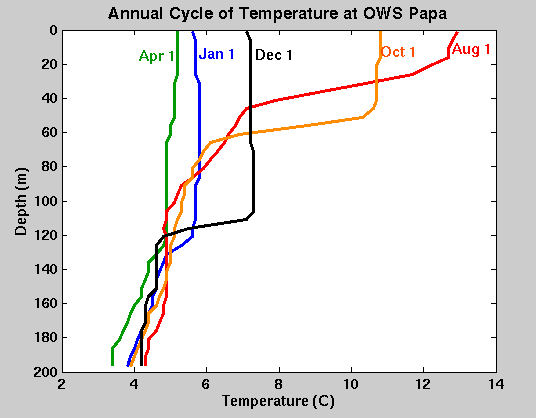
see eg.
Sun only influences the temperature of the upper 150-200m. The temperature of the DEEP oceans is created and maintained by geothermal warming minus cooling by sinking cold water at high latitudes.
eg. Antarctic Bottom Water.
For continents the the sun only warms the upper 10-15 m. The temperatures below that are geothermally caused;
http://www.mpoweruk.com/images/geo_temperature.jpg
To me it is obvious that the sun is very well capable of increasing the upper layers of land and ocean to the observed temperatures. The surface in turn warms the atmosphere (plus some direct heating by the sun), which merely reduces the energy loss to space. (Insulation effect, no greenhouse effect)
Thank you.
Ed Bo
November 26, 2017 at 3:31 pm: Well no, Ed.. You are just showing your willigness to deceive. Insulation cannot warm above the available input, and CO2 is the opposite of an insulator among gases (read Hottel for instance). NASA has, and we have for safekeeping from criminals, the solar system data which proves atmospheres above 0.1bar can be figured accurately for temperature by Solar distance and gravity alone. As Maxwell, who some imagine they are smarter than, figured out well before Arrhennius’ musings (refuted by Wood).
But it does not matter about the pride of bit players. Nature is in the process of showing us what it is talking about. CO2’s role may be to help plants survive extremes of drought and cold, under the Quiet sun regime.
Thanks Brett! Phew! 🙂
I’m having a hard time believing that warmists just have blind faith in the hypotheses of others without also having a hidden agenda. Surely no-one can be that stupid?
Brett Keane November 27, 2017 at 12:15 am
First off, accusing people of deception without adducing proof is a nasty habit that you should work to rid yourself of. Your accusations in this thread have totally destroyed your reputation with me. When you started, I didn’t recognize your name. Now I shudder when I see it … and I doubt that that is the effect you are striving for.
Second, your actions are particularly unpleasant because I asked you to keep it civil, viz:
Third, I’ll ask you what I asked 1sky1 and Bernard, viz:
w.
Willis Eschenbach: what is the mechanism how CO2 reduce the rate of cooling of the atmosphere? In real life insulating materials are used. But can CO2 be an insulator because it absorbs and emits the same amount of heat?
“But can CO2 be an insulator because it absorbs and emits the same amount of heat?”
Yes.
Because the emission is less efficient than the absorption. ….. the photons finally escaping to space being emitted by CO2 molecules higher in the atmosphere and therefore colder.
How does an insulator work? An ideal insulator “returns back” the same amount of heat that it receives. CO2 is not an ideal insulator; it returns back only 50% of heat received. The other 50% it radiates forward. (That all applies only to photons in the CO2 absorption window. Water has more absorption windows, therefore it is a much better insulator).
“Water has more absorption windows, therefore it is a much better insulator).”
Not really as at 15 micron which is the planets most intense radiating wavelength is significantly overlaps WV.

Yes, but the rest it emits weakly to space as it comes from a part of the atmosphere that is around -18C.
Esa-Matti Lilius November 27, 2017 at 4:49 am
Willis Eschenbach: what is the mechanism how CO2 reduce the rate of cooling of the atmosphere? In real life insulating materials are used. But can CO2 be an insulator because it absorbs and emits the same amount of heat?
It does not “absorb and emit the same amount of heat”, as can be seen from space the emissions from the center of the CO2 band are emitted from high in the atmosphere at a temperature around 220K (~50mW.m-2.sr.(cm-1)-1). If there had been no CO2 in the atmosphere then the emissions in that band would have been from the surface at 280K (~120mW.m-2.sr.(cm-1)-1, more than 50% of the emissions have been retained.
Just like a pipe carrying hot water at say 50ºC which is surrounded by insulation the surface of which is at 20ºC.
http://lasp.colorado.edu/~bagenal/3720/CLASS5/EarthBB.jpg
Brett, you say: “Insulation cannot warm above the available input”.
For this statement to make any sense at all, you must be talking purely about temperatures. The temperature of the input source to the earth (the sun) has a surface temperature of about 5770K. I agree that that “insulation cannot warm” the earth above this temperature. But that is the ONLY fundamental thermodynamic limit (there are plenty of practical limits before that).
Then you say: “CO2 is the opposite of an insulator among gases (read Hottel for instance)”.
I do read Hottel, and I was just consulting his charts on CO2 absorption of IR as a function of concentration and distance. The greater absorption (and so less direct transmission), the more effective the insulation.
Next you say: “we have for safekeeping from criminals, the solar system data which proves atmospheres above 0.1bar can be figured accurately for temperature by Solar distance and gravity alone.”
You really need to read and understand Willis’ numerous takedowns that absolutely demolish Nikolov’s and Zeller’s claims. They don’t understand either high school physics or high school statistics.
And no, Maxwell did not endorse the “gravito-thermal” effect. He was in fact the first to authoritatively prove that it could not exist.
There is also the small problem that all warmism is indeed flat Earth calculation ignoring Holders Inequality and the rotating rotundity of our home planet. Just one of the reasons to give up the magic mushrooms.
Believing in the evidence does not make one a warmest. Spewing drivel though, does make one a spinner and fabulist
Brett:
You get Holder’s Inequality backwards. What Slayers like to call the “flat earth” calculation is the limiting case of very high thermal capacitance limiting the diurnal temperature swings and very high horizontal heat transfer lessening the tropical/polar differences to get a uniform surface temperature.
Applying Holder’s Inequality to temperature variations (given the same energy input) means that any variations from this uniformity will result in lower average temperature and therefore lower total energy levels. The bigger the variation, the lower the average. This is why the average moon temperature is so much lower than the earth’s, even though it absorbs more solar radiation.
So a more precise calculation than the simplified “flat earth” calculation actually shows a bigger greenhouse effect to explain our actual surface temperatures.
“You get Holder’s Inequality backwards“
I doubt it, because
“So a more precise calculation than the simplified “flat earth” calculation actually shows a bigger greenhouse effect to explain our actual surface temperatures.“
that’s the whole point. Too big a GHE to be explained by back-radiation.
Tony:
People like Nikolov and Zeller, who take the moon as a direct analog to what the earth would be without an atmosphere and note the very low ambient temperature, fail to note (at least) three other very significant differences that lead to its very high temperature variation and therefore low average temperature:
1. Its day is ~30 times longer than earth’s resulting in plenty of time to heat up and cool down during the diurnal cycle.
2. Its surface is almost all dust (regolith) with extremely low thermal conductivity, so the thermal capacitance of its surface layer subject to the day/night cycle is tiny compared to that of the earth, accentuating temperature swings.
3. The moon has no significant horizontal heat transfer mechanisms, unlike the earth’s oceanic and atmospheric transport mechanisms that lessen the equatorial/polar differences.
So the people like N&Z who look at the moon’s temperature profile and claim that a greenhouse effect could not explain why the earth is hotter are making a fallacious argument.
That’s very interesting, Ed, but we’re not talking about the moon. You stated:
“So a more precise calculation than the simplified “flat earth” calculation actually shows a bigger greenhouse effect to explain our actual surface temperatures.”
A calculation that shows a bigger greenhouse effect than 33 K. And this is calculated for Earth, not the moon.
Tony:
The implication of Brett’s post (if it had any sense) was that because of the rotation of the earth and so time-varying insolation at any point, the greenhouse effect is not needed to explain current temperature levels. That is what I originally responded to.
You are arguing the opposite, that the greenhouse effect is not sufficient to explain current temperature levels. You don’t say what the temperature would be, or what other effect could increase the temperature levels to what we observe.
The simple fact is that the MEASURED levels of downwelling longwave infrared radiation (aka “back radiation”) provide sufficient power to make the surface energy balance work out at current temperature levels. Without this, it can’t. And there is NO other plausible power input to the surface that can explain these temperature levels.
No no, Ed, I’m not arguing anything right now. YOU said:
“So a more precise calculation than the simplified “flat earth” calculation actually shows a bigger greenhouse effect to explain our actual surface temperatures”
So YOU are stating that the ACTUAL GHE is greater than 33 K. Nothing to do with any diversions you might want to make wrt the moon, or anything like that. Because of what you have explained re Holders Inequality, the ACTUAL GHE on Earth MUST be greater than 33 K. The 33 K is a theoretical MINIMUM. Correct?
Once you have made a definitive statement in response to that, THEN I’ll be making my argument.
Tony:
You already made the argument that the variation in temperatures of the earth implies “too big a GHE to be explained by back-radiation.”
The 255K figure commonly cited is the maximum surface temperature a body that receives the insolation that the earth does (~240 W/m2 averaged over time and surface) can have if it radiates directly to deep space (effective temperature of 3K) with an emissivity of 1.0. It would reach this maximum if it could transfer thermal energy around its surface so that it is uniform at all times.
Personally, I would use a lower emissivity value — a value of 0.95 gives a temperature of 258K, but that’s a quibble.
Yes, Holder’s inequality says that any variation in temperature makes the average lower (for the same power input), with the bigger the variation the lower the average.
So the question is, what imaginary alternative Earth are you using to claim that there is “too big a GHE to be explained by back-radiation”? And once you decide the average temperature of this imaginary alternative Earth, how do you determine what is too big to be explained by back-radiation? 34K? 35K? 40K? 50K?
I’m not sure why you’re unable to respond directly. You’re very much the politician, Ed. But I guess:
“The 255K figure commonly cited is the maximum surface temperature a body…“
is the closest you are going to get to admitting that here on this real, non-imaginary, non-alternative Earth, the 33 K is the theoretical minimum amount that the GHE could be, and in reality it MUST be higher than this. Unless you DO have it in you to talk straight and put in plain and simple terms what follows logically from what you’ve been saying? Let’s see if we can get a “yes” or “no” from you on if you agree with that statement.
Tony:
I was very clear in answering your question. It looks like you are unable to comprehend anything more than a simple sentence of more than eight words. You seem to be looking for an answer that you can pounce on and twist.
I answered your question — why won’t you answer mine??? I don’t think you can!
It’s funny how you’re allowed to be as offensive as you like. Yes, I comprehend perfectly well what your earlier answers imply, I just want to make sure there’s no way you can wriggle out of it later. So I’m looking for a “yes” or “no” here, do you agree to this statement?
Here on this real, non-imaginary, non-alternative Earth, the 33 K is the theoretical minimum amount that the GHE could be, and in reality it MUST be higher than this.
Then we can get to the bit that you already know is coming (that’s what’s so ridiculous about these farcical conversations…as if this hasn’t all been discussed a hundred times before!)
“It’s the water vapor, stupid.”
You see, one reason I’m worried about you wriggling your way out of things later on IS your first question:
“So the question is, what imaginary alternative Earth are you using to claim that there is “too big a GHE to be explained by back-radiation””
The answer is, obviously, no imaginary alternative Earth. THIS Earth. The real one we’re living on at the moment. This is why I’m phrasing the statement in the way I am, which I’m asking you to state whether or not you agree with.
Tony:
You really are too much! A statement such as “there is an X-degree GHE” is comparing our real earth to some imaginary alternate earth. There is no way around that.
But with that caveat, I’ll bite. Your statement: “Here on this real, non-imaginary, non-alternative Earth, the 33 K is the theoretical minimum amount that the GHE could be, and in reality it MUST be higher than this.”
Yes, I will agree with this statement.
Now, you need to show me what the maximum the GHE could be. Please show your work.
OK, now you can re-read the intro to the Nikolov and Zeller paper.
“A recent study has revealed that the Earth’s natural atmospheric greenhouse effect is around 90 K or about 2.7 times stronger than assumed for the past 40 years. A thermal enhancement of such a magnitude cannot be explained with the observed amount of outgoing infrared long-wave radiation absorbed by the atmosphere (i.e. ≈ 158 W m-2), thus requiring a re-examination of the underlying Greenhouse theory“
And the intro to the Volokin and ReLlez paper:
“According to satellite observations, Earth’s atmosphere retains on average 155–158 W m−2 of the upwelling long-wave radiation emitted by the surface (Kiehl and Trenberth 1997; Trenberth et al. 2009; Stephens et al. 2012; Wild et al. 2013). This infrared heat absorption by greenhouse gases a.k.a. long-wave radiative forcing (Kiehl and Trenberth 1997) is presently believed to drive 100% of the near-surface ATE (Peixoto and Oort 1992; Lacis et al. 2010; Pierrehumbert 2010; Schmidt et al. 2010).”
And you have no grounds on which to dismiss this part of their papers; since even if you disagree with an estimate as high as 90 K, you have agreed that the estimate of 33 K is a minimum, and that the true difference must be greater. Therefore, something other than long-wave radiative forcing must be responsible for at least part of the true difference, as you agree it’s greater than 33 K. Please don’t bother to pretend that you’re not sure where the 155-158 Wm-2 number comes from, as I’ve seen you argue this before. I have actually seen this entire discussion before. Lol.
”…Earth’s natural atmospheric greenhouse effect is around 90 K”
Tony, N&Z calculate 90K (their ATE) above the airless moon’s median brightness temperature from orbit of ~197K (287-197=90K).
With current semi-opaque air atm., Earth’s natural atmospheric greenhouse effect (measured in the satellite era) for the past 40 years is still ~33K over ~transparent air atm. (288-255=33K). As always in climate, one has to watch the pea.
Two people to one conversation. Me and one other.
Don’t get me wrong, anyone can comment wherever they like. In this particular conversation though, unless your name is Ed Bo, your comment will not get a response, nor even be read. So it would be pointless trying.
Tony:
I don’t think you’re interested in an honest debate. You are at least five cycles of this discussion behind. And you said to me above: “That’s very interesting, Ed, but we’re not talking about the moon.”
But you are talking about the moon (as I anticipated)!
Yesterday, I pointed out three glaring mistakes in N&Z’s analysis as to why they cannot use the moon as their alternative imaginary earth. I’ve pressed Ned directly on these points, and he never responds.
And no, I don’t agree that any difference greater than 33K cannot be explained by a radiative greenhouse effect. Why do you think this would be?
I’m not talking about the moon. Try to keep up. That’s why I made you agree to the statement I made. You can’t just agree to something and then immediately go back on it. Silly Ed.
This might help “refresh your memory”:
https://wattsupwiththat.com/2017/11/24/can-a-cold-object-warm-a-hot-object/comment-page-1/#comment-2679299
Unless you for some reason believe that without an atmosphere, there would be no temperature variations on Earth!? Lol, I wouldn’t put anything past you at the moment, Eddie-baby…
Tony:
You are too much! You can’t even keep out of your own way!
Way back, I predicted you were using the moon as your imaginary alternative earth. You denied it.
Then you cited the N&Z paper as your evidence, which uses the moon as its imaginary alternative earth. I called you on it, and you still deny it!!! Have you no shame???
Then you present the argument that: “Therefore, something other than long-wave radiative forcing must be responsible for at least part of the true difference, as you agree it’s greater than 33 K.”
You provide absolutely no backing for this argument (because there is none).
Nobody (but you) is making the argument that 33K is the MAXIMUM increase that the GHE can provide.
You don’t even understand the issues in play here.
I’m not using the moon as an imaginary Earth. OK let’s try to go through it slowly for you. As I said:
“And you have no grounds on which to dismiss this part of their papers; since even if you disagree with an estimate as high as 90 K…”
1) THEIR 90 K estimate comes from their moon-based calculations. Agreed. Always was agreed, known, and understood.
2) However, as you’ve agreed, due to what you’ve explained Holder’s Inequality and if we accept that without an atmosphere, the Earth is still going to have some degree of temperature variation, then the true GHE on Earth is going to be higher than 33 K.
3) So even if you dispute their 90 K estimate and think it’s too high, their point still remains. It is not a necessary condition for their point to be valid that the difference actually be as high as 90 K.
It’s as simple as 1, 2, 3.
And if you want to talk about predictions, I predicted from the beginning that you would try to wriggle out of it. And here we are…
You must be aware that this logic isn’t hard for anyone reading to follow, surely!?
* due to what you’ve explained RE Holder’s Inequality *
Tony:
Finally, you admit that you are talking about the moon, although your statement that this “always was agreed, known, and understood” is plainly laughable.
There is still a huge gaping hole in your (and N&Z’s) logic.
You and they have provided absolutely no evidence, or even a real argument, for the proposition that the earth’s greenhouse effect could provide a temperature increase greater than 33K. I’ve challenged you on this “maximum” idea multiple times, and you always ignore the issue. Why?
This’ll help clear the rest up. From the Nikolov and Zeller paper:
“In a recent study Volokin et al. [1] demonstrated that the strength of Earth’s atmospheric Greenhouse Effect (GE) is about 90 K instead of 33 K as presently assumed by most researchers e.g. [2-7]. The new estimate corrected a long-standing mathematical error in the application of the Stefan–Boltzmann (SB) radiation law to a sphere pertaining to Hölder’s inequality between integrals. Since the current greenhouse theory strives to explain GE solely through a retention (trapping) of outgoing long-wavelength (LW) radiation by atmospheric gases [2,5,7- 10], a thermal enhancement of 90 K creates a logical conundrum, since satellite observations constrain the global atmospheric LW absorption to 155–158 W m-2 [11-13]. Such a flux might only explain a surface warming up to 35 K. Hence, more than 60% of Earth’s 90 K atmospheric effect appears to remain inexplicable in the context of the current theory”
So, you see, even if you disagree with their 90 K estimate, anything over 35 K presents a li’l bit of a problem for the poor ol’ GHE. So there’s no reason for your moon obsessions. Has absolutely nothing to do with it. Keep on wrigglin’
Ed, I’ve never been talking about the moon. Why are you pretending this is so difficult to follow? Your faux-indignation/confusion was amusing at first (bear in mind I’ve seen you argue this subject before so I KNOW you’re not actually confused), but it’s just getting a bit silly now.
Tony November 29, 2017 at 5:37 pm
This is hilarious. Tony, you’ve been duped. “Volokin et al.” is Volokin and Rellez … which are the aliases that Nikolov and Zeller used when they published the paper under false names. So N&Z are QUOTING THEMSELVES AND PRETENDING THEY ARE QUOTING AN INDEPENDENT AUTHORITY. Shameful, underhanded, and disgraceful. They are a blot on science.
Now, if you were actually as knowledgeable about the climate as you claim, you would have known that … but instead, N&Z suckered you in..
Fail.
The gory details are here. Short version? N&Z are a scientific joke. Anyone who quotes them approvingly immediately identifies themself as a climate noob …
w.
Tony:
Assertion is not evidence. N&Z simply say: “satellite observations constrain the global atmospheric LW absorption to 155–158 W m-2 [11-13]. Such a flux might only explain a surface warming up to 35 K.”
Nowhere do they back this up.
And your heroes don’t even understand high school physics when they assert that static pressure can provide an ongoing power transfer to the surface of the earth, which they propose as the alternative to DWLWIR radiation. Any semi-competent high school student knows that for a mechanical force (such as the weight of the atmosphere on the surface due to its pressure) to transfer energy, it must act over a distance.
For a mechanical force to provide ongoing continuous power, it must create an ongoing velocity — that is, the pressure would have to be continuous shrinking the earth to transfer this power to the surface. It’s patently ridiculous, but you buy it!
Calm down, Willis. Authors often refer to their previous papers in their work. You don’t actually have an argument. We all know about the name reversal thing, you may have mentioned it a few times before…lol.
“Nowhere do they back this up“
How could it account for more than 35 K?
Tony November 29, 2017 at 11:52 pm
Oh, please. Point me to one other scientific author who referred to a previous paper that they published under a fake name and didn’t mention that they wrote the previous paper themselves. Just one.
I’ll wait … and while I’m waiting, I’ll note that their paper was retracted because of their deception. So no, you don’t get to pretend that this is standard in science. It is not standard science, it is a cause for getting a paper yanked before final publication.
w.
PS—And no, we don’t “all know” about their skullduggery. There are a lot of folks lurking and reading this that had no idea from reading your quotation that Nikolov was referring to himself. Heck, lots of them never heard of Nikolov, he’s not exactly well-known … and for good reason, although at this point he is a bit infamous.
Not only that, but despite knowing that Nikolov was doing it, you said nothing about Nikolov citing himself as if someone else agreed with him, so you are enabling their ongoing deception … and you would have gotten away with it if I hadn’t pointed it out. So I can understand why you’re angry with me, I spoiled your attempt to deceive … but you might more profitably direct your anger elsewhere. I’m just the messenger.
It would be unusual for an author to make a special point about that author when referencing said author. Especially if said author is themselves. Perhaps they were just not so self-involved that they felt the need to buck the tradition.
I understand that you are unhappy about the name reversal. But Willis, why are you playing these grade-school games about their name change?
Tony, I asked:
In what you obviously think is a response, you say:
Tony November 30, 2017 at 3:00 am
Huh? What does that have to do with publishing under an alias? That’s not responsive to my request in the slightest. But you persevere, viz:
I’m not “unhappy” about their scientific malfeasance, which you try to pass off and minimize as a “name reversal”. I think it is despicable, but that doesn’t affect my happiness.
In any case, what you call “grade-school games about their name change” that they, not I, played got their paper unceremoniously yanked from publication and mentioned in Retraction Watch, which for any scientific author is a Very Bad Thing™ … so clearly, the scientific world thought it was far more serious than the innocent fun you are trying to convince us it represents.
More to the point, all of this wriggling on your part can’t hide the fact that you are unwilling to just come out and admit that you cannot find one other case of any scientist practicing this kind of underhanded deception, just as I suspected. It’s not standard practice as you keep claiming, nor is it trivial. It is a one-off piece of underhanded deception. The fact that you defend it so vigorously speaks volumes …
w.
You seem to be keen to argue about what you think is malfeasance. Whilst you’re welcome to your opinion, I’m only interested in discussing the point they’re making. The validity of which isn’t changed by the activity of the name change, malfeasance or otherwise. You did catch me out though, I said I wasn’t going to respond to anyone but Ed Bo in this conversation. My mistake. Won’t happen again.
Tony:
You ask: “How could it account for more than 35 K?”
Look, N&Z make a specific claim that is the keystone of their whole theory without a shred of analysis to back it up. You obviously agree with this claim. The onus is on you to support the claim.
The real earth’s surface power balance cannot come close to being in balance without the contribution of DWLWIR (the “greenhouse effect”). And here I am not comparing it to any imaginary alternative earth.
With the contribution of DWLWIR, the balance is very close (within measurement errors). No other possible physically plausible mechanism closes the gap.
Ball’s in your court.
Nah, balls in yours. They provide a list of citations, look it up. You were talking more about those citations last time, strange…seems like you just can’t be bothered this time around. Play the game properly at least. I’ve read you trying a lot harder to deceive than this.
“They provide a list of citations.”
No, they don’t. I’ve looked several times. They cite some sources on W/m2 values, but nowhere do they say how they get from that to 35K maximum.
Ball’s back in your court.
Course they cite some W/m2 values…and they come from the energy balance diagrams, and it’s the surface minus the outgoing at TOA, as in, what’s absorbed by the atmosphere, and those values correspond to temperatures of 288 K and 255 K or thereabouts ya da ya da ya da, not estimated, measured (by satellite) W/m2 values, we know the surface is 288 K on average, we know the outgoing flux at TOA would relate to a black body temp of 255 K, blah blah blah, yeah yeah yeah, you know this already…etc
Tony:
Here’s the thing. Let’s assume you are correct that they are citing the difference between blackbody radiative flux density at ~288K and that at ~255K, the average surface and emission layer temperatures.
First, it’s appalling that they don’t either reference or derive/explain the key claim in their paper. That alone is grounds for rejection from any respectable, responsible journal.
But the bigger issue is this. The bulk of the paper expresses the argument that analysis using (average) surface temperatures that are constant over the whole planet is fundamentally incorrect. But their whole argument is based on calculations that use these very same averages as constant over the planet.
So their paper arguing that using these average values is wrong is based on the very same use of these averages! It’s hilarious and pathetic at the same time. (And yes, the “problem” they cite would go away if they used consistent analysis.)
And that’s just one of the many egregious fundamental errors they make, none of which you appear to have spotted.
“The bulk of the paper expresses the argument that analysis using (average) surface temperatures that are constant over the whole planet is fundamentally incorrect.“
Not incorrect, lower than currently thought. But that applies to the calculated (effective) temperature. Obviously what is measured, is measured. And you didn’t appear to spot that this is NOT the main claim of their paper (the second one). Etc etc etc, blah blah blah, all argued before of course.
And in fact it’s not even the “bulk” of the first paper.
Tony, putting aside for the moment whether or not a CO2 molecule’s photon from an area of the Atmosphere that is around -80C can warm the surface, the one thing that has not really been discussed on here or the previous Post by Rod Gill is not just the physics, but also the Mechanics of the process.
The Trenberth Diagram talks about averages which are not real as far as the way the Radiation in and Radiation out act.
This is the part that concerns me the most, because all the focus of Climate Scientists is on CO2 and trying to control it, but the logic of it does not add up.
Tony, did you see the reference Willis made here to a previous post that supposedly “gave the gory details”.
Willis Eschenbach November 29, 2017 at 6:36 pm
The gory details are here. Short version? N&Z are a scientific joke. Anyone who quotes them approvingly immediately identifies themself as a climate noob …
So here we have 2 Scientists trying to get their work published that contradicts the whole Climate Change industry. We all know how well that goes, especially if you are known as “Deniers”.
So they try to get it published under pseudonyms and the wonderful Willis himself complains and gets the paper withdrawn.
I suggest that Mr Eschenbach takes a look at this article with links to the various Scientists & Mathematicians who have published under pseudonyms
http://bigthink.com/neurobonkers/in-defence-of-pseudonyms-in-science-defending-the-right-to-write
So not only does he insult you, the theory of the paper was not “destroyed”, just the presence of the paper.
So here we have Willis doing the Climate Change Industries job for it.
As to the Gory Details, for me the gory details are that I always new that our host and Mr Eschenbach had it in for certain individuals and thoeries but I had no idea that he would go that far and not only that but would brag about it afterwards.
Not only didn’t the post pointed to “do anything to destroy the theory”, as lot of the comments backed it up, it just attacked the individuals. Where have we heard that before.
N & Z are not the only ones pushing an alternative to current Climate Concensus, No Tricks Zone has hundreds of papers questioning the whole concept.
You’re right, AC. It’s pretty disgraceful really.
Tony:
You are still not coming to grips with the fact that the whole justification for these papers is based on an analysis that they spend a lot of time in the papers claiming is completely invalid.
AC:
I’m all for overturning conventional wisdom. But these papers are simply ridiculous. I would reject them as undergraduate student reports.
N&Z don’t even understand high school physics. Static pressure cannot provide an ongoing power source. (If you want to claim this very basic point of physics, understood for hundreds of years, you need to provide a very convincing argument as to why it is not so. N&Z don’t even try.
These kinds of shabby efforts just serve to discredit all skeptics.
“You are still not coming to grips with the fact that the whole justification for these papers is based on an analysis that they spend a lot of time in the papers claiming is completely invalid“
That isn’t a “fact”.
1) it’s not the “whole justification for the papers”. In the second, it’s a minor footnote really.
2) the claim is that the 255 K calculation for the surface temperature of an Earth without an atmosphere is too high. This is from a WUWT post that they wrote back in 2012 that you’ve no doubt read, despite pretending not to be aware of:
“Furthermore, the application of Eq. (3) to calculate the mean temperature of a sphere runs into a fundamental mathematical problem caused by Hölder’s inequality between non-linear integrals (e.g. Kuptsov 2001). What does this mean? Hölder’s inequality applies to certain non-linear functions and states that, in such functions, the use of an arithmetic average for the independent (input) variable will not produce a correct mean value of the dependent (output) variable. Hence, due to a non-linear relationship between temperature and radiative flux in the SB law (Eq. 3) and the variation of absorbed radiation with latitude on a spherical surface, one cannot correctly calculate the mean temperature of a unidirectionally illuminated planet from the amount of spatially averaged absorbed radiation defined by Eq. (2). According to Hölder’s inequality, the temperature calculated from Eq. (3) will always be significantly higher than the actual mean temperature of an airless planet”
It’s to do with the relationship between temperature and radiative flux. Calculating a mean temperature based on fluxes. So will not be a problem when simply computing an average of recorded temperatures for the actual Earth’s surface, or at the TOA. The only reason they give it as a flux difference and not a temperature difference is:
“in the scientific literature, the actual effect is measured via the amount of outgoing infrared radiation absorbed by the atmosphere (e.g. Stephens et al. 1993; Inamdar & Ramanathan 1997; Ramanathan & Inamdar 2006; Houghton 2009). It is usually calculated as a difference (occasionally a ratio) between the total average infrared flux emanating at the surface and that at the top of the atmosphere. Defined in this way, the average atmospheric GE, according to satellite observations, is between 157 and 161 W m-2 (Ramanathan & Inamdar 2006; Lin et al. 2008; Trenberth et al. 2009). In other words, the current theory uses radiative flux units instead of temperature units to quantify ATE.”
Yep, they had already explained everything you pretended to be mystified by in a post here at WUWT that you were most likely commenting under, albeit under another name. I’m guessing, perhaps a name with initials JS?
Tony:
Nothing in your lengthy comment even tries to argue against my point that they are using a calculation that assumes a linear relationship between radiative flux density and temperature to argue that using a linear relationship between radiative flux density and temperature is not valid.
And you don’t even realize it…
They’re not. And you do realise it. You’re just intellectually dishonest.
Ed Bo December 2, 2017 at 1:04 pm
Tony December 2, 2017 at 3:04 pm
Tony, you know how above I said I didn’t think you were vicious and vindictive? I said:
You just changed my mind. Ed is doing his best to point out flaws in your logic. In response, you pretend that you can read his mind, and that you know what he thinks. Based on that untenable fantasy that you can see inside his head, you call him a liar, and you are doing your best to slime him.
You are lucky that this is not my website. I’d ban you in a minute for repeated violation of the site policies.
Go away. Don’t go away mad. Just go away.
w.
Proof of Ed’s intellectual dishonesty, for those that need it:
http://notrickszone.com/2017/09/25/another-new-paper-dismantles-the-co2-greenhouse-effect-thought-experiment/#comment-1231159
Notice how in this comment from only a few months ago, he looks through the references for the LW absorption figure of 155 – 158 W/m2, and comes to the same conclusion as I do about where they must be getting that number from (and that is confirmed by their own words from the WUWT article from five years ago, anyway). Here, in this article, he pretends to have no idea about any of it.
Tony:
Projection much?
For a long time, you wouldn’t say what source you were citing. First you denied you were talking about the moon as the no-GHE comparsion body.
Then when I called you on it, you said “THEIR 90 K estimate comes from their moon-based calculations. Agreed. Always was agreed, known, and understood.”
Then you start denying it again.
And since neither N&Z or you will ever state explicitly where their 35K maximum GHE value comes from, I can only surmise its source. I challenged you to back up the claim explicitly (I wanted to see if you made the same surmise that I did) and you have never done it. Still waiting…
Ed, the arguments have already been made. Anyone following the link above can see that before you began this discussion, you’d already been through the whole thing. Your dishonesty exposed, it’s no wonder you want to redirect back further into this discussion. But I’m not here to play your games, I’m here to expose you for what you are. Mission accomplished. Have a nice day!
“And since neither N&Z or you will ever state explicitly where their 35K maximum GHE value comes from, I can only surmise its source. I challenged you to back up the claim explicitly (I wanted to see if you made the same surmise that I did) and you have never done it. Still waiting…“
The problem for you is that the comments I’ve made in the conversation above, exist. They haven’t suddenly disappeared. People can still read them. So for you to sit there and pretend you are waiting for an answer you’ve already been given, isn’t going to work. It’s just a further demonstration that you are what you are.
Tony:
Now you’re completely desperate and delusional. In that comment at NTZ, I stated clearly than Nikolov and Zeller provided no supporting analysis for their claim that the GHE was limited to 35K, and that I had to guess at how they derived that figure.
I still don’t know for sure, and I’ve been very clear on that — that this is a surmise. And you call that “intellectual dishonesty”.
You on the other hand — “I’m not comparing it to the moon” … “I’ve always been comparing it to the moon” (We have always been at war with Oceania) … “I’m not comparing it to the moon”
Keep it up, Ed. You’re doing a great job!
https://wattsupwiththat.com/2017/11/24/can-a-cold-object-warm-a-hot-object/comment-page-1/#comment-2688993
“Further, there is no logical reason that a new relationship may suddenly appear, that has not appeared in the past. For example, the 1979 report by the Climate Research Board, “Charney Report,” published by the National Academy of Sciences, contained the speculation that the modest warming from CO2 would be greatly amplified by an increased warming from water vapor, the dominant greenhouse gas. The report offered no data supporting the speculation, nor are any reported. The net effect, if it exists, is likely weak as well”.
The simplest argument I have seen is the fact that a cold body can “see” a warm one. The eye absorbs radiation at certain wavelengths, this creates an electro-chemical reaction which transmits a signal to the brain.
So if a warm body cannot absorb radiation from a colder body, how can I, at 37c, possibly see the bio-luminescence from those plankton at 20c disturbed in the wake of my fishing boat? Of course a warm body can absorb radiation from a colder one – it is plain common sense!
There is a great book called “Mistakes were made (but not by me)” by social psychologists Carol Tavris and Elliot Aronson published in 2007. It deals with cognitive dissonance, confirmation bias and other cognitive biases. The classic and most extreme case is the policeman who refused to believe a “murderer” he had helped put in jail was innocent, even when the supposed victim turned up alive and well!
These biases are absolutely rampant on both sides of the AGW argument. We all need to stop trying to prove we are right and do our best to understand that we could well be wrong on some of this stuff. In an ideal world we should all read this book before trying to discuss anything on the internet. It would make us all a lot more humble and willing to listen to others.
Willis’s explanation is a good one for the scientifically naive to understand without too much detail to cloud the issue. Space is effectively 3 kelvin, the lower troposphere somewhere around 280 kelvin. I am really glad that atmosphere at 280 kelvin is between me at 310 kelvin and space at 3 kelvin!!!
Your example is a great one. I argue that the whole class of supposition that warm objects Can’t absorb energy from cold ones is the ridiculous hypothesis that albedo is a function of temperature.
That’s a Nobel for anyone who can prove that.
TLM: how much hotter your eyes became seeing the light from plankton at 20C?
Esa-Matti Lilius:
Not very much, maybe not at all. It depends what I would be looking at instead. However, they would be warmer than they would be if my eyes were looking at the darker ocean – imperceptibly of course. Both the plankton and the ocean are colder than me, yet my eyes can absorb energy from them (both). The energy delivered by a few photons sensed by my retina is next to nothing – but not nothing – otherwise I would not be able to see the plankton.
Anyway that is not really my point. The whole gist of Willis’s piece is the refusal of some to accept the patent truth that radiation from a colder body can be absorbed by a warmer body. Newton’s Second Law is not violated provided the net transfer is from warm to cold.
I think what some people get confused over is the difference between these two statements:
1. The earth goes up in temperature in the presence of a colder atmosphere (wrong)
2. In the presence of a colder atmosphere the earth cools more slowly and is not as cold as it would be if the atmosphere were not there, and it were instead exposed to the even colder depths of space (correct)
The earth is warmer than the atmosphere, so more energy is being absorbed by the atmosphere from the earth than by the earth from the atmosphere so absent any source of energy the earth would gradually cool until it, the atmosphere, and the depths of space were all at around 3K. Luckily for us we have a constant source of energy coming from the sun making sure we do not all cool to 3K.
Remember the atmosphere cannot absorb very much of the sun’s short wave radiation, so nearly all of the sun’s energy at the top of the atmosphere reaches the surface of the earth. It is the infrared energy emitted by our earth and seas that warms the atmosphere, not the sun.
Terrestrial emission of LWIR is but a minor factor in warming the atmosphere. Moist convection is the principal one
1sky1
“Moist convection” cannot “warm the atmosphere”!?! It is not a source of heat, it is a system of heat transport. It moves the warm air from the lower levels of the atmosphere to the higher levels. So how does the air at the lower levels in the atmosphere get warmer in order to convect upwards?
Your statement that LWIR is a “minor factor” suggests that the energy to warm the atmosphere seems to come (magically?) from some other source. If not upwelling LWIR what exactly? Volcanoes? Wood burning stoves?
If the air cannot absorb the sun’s energy directly it must absorb the suns energy indirectly, via the IR re-radiation from the surface of the earth. There is no other significant source of energy above the surface of the earth other than the sun.
So the water vapour, and (to a lesser extent) the CO2 and other gases capable of absorbing radiation in the infrared, that are close to the earth’s surface, absorb the IR radiation and their temperature increases. As warm gas is less dense than cold gas, they rise up through the atmosphere cooling as they go and exchanging their energy with other gas molecules. As the warm air rises it is replaced by cool air falling, which in turn is warmed by the earth’s surface. Hence your moist convection.
By that misguided line of thought, LWIR cannot warm anything, since it too is “a system of heat transport.”
Those with a modicum of scientific grasp will recognize that the sun and, to a negligible extent, the Earth’s molten core are the only natural SOURCES of heat. All natural heating of other matter is the result of heat TRANSPORT by conduction, convection or radiation. Observations of the Bowen ratio (q.v.) throughout the globe clearly indicate that, outside of the dry environments of deserts and Antarctica, the principal means of cooling the surface and heating the troposphere is by buoyant transport and condensation of water vapor, which recovers the latent heat of evaporation. That’s what’s involved in the physical concept of moist convection.
TLM, why do you say that “If the air cannot absorb the sun’s energy directly it must absorb the suns energy indirectly”
Of course it absorbs some of the Sun’s Energy, as well as the Radiation from the Surface.
https://www.ucar.edu/communications/gcip/m7sssystem/m7pdfc3.pdf
Water in the Atmosphere also Reflects some as well, clouds do not overall slow cooling in the day, they prevent heating, they only overall slow it at night.
No, not “nearly all of the Sun’s radiation at the TOA reaches the surface of the Earth.” Less than HALF of it does.
According to NASA, “29% of the solar energy that arrives at the TOA is reflected back out to space by clouds, particles and Earths albedo. 23% is absorbed by the atmosphere (water vapor, dust, ozone etc) and 48% passes through the atmosphere and is absorbed by the surface.”
+100. It’s still amazing why people don’t get this.
Willis:Your conclusion is correct but your radiation modeling is confused.You choose to assume that the atmosphere can be represented by a radiating surface A2.The extinction depth for I.R. above the earth is of the order of hundreds of meters,so A2/A1 is not much greater than unity, not nearly infinite as you have used.However, once you assume black surfaces(epsilon=1) and F12=1,the area ratio cancels out your equation to get the trivial result that you obtained.
The net heat flow Qdot is the difference between two independent photon streams, Qdot12 and Qdot21.The net heat flow is Qdot=Qdot12-Qdot21. If Qdot21 is increased due to an increase in T2 ,or emissivit for a gray surface,Qdot is decreased.This is the nature of radiation heat transport, which is quite different to that of heat conduction and convection.It is as simple as that.
Block A 270 kelvin block B 280 kelvin in a vacuum chamber, perfectly reflective with no radiation loss.
Both blocks are emitting fluxing frequencies from 1 kelvin to 270 kelvin and even if all photons are absorbed it is as if they were never emitted, as the fluxes are exchanged in a nano-second, B to A A to B.
Block B is also emitting the frequencies between 271 kelvin and 280 kelvin, block A cannot emit at those frequencies and the thermal radiation flow is one way between the diminishing temperature differential until equilibrium is achieved
Then all frequencies representing from 1 kelvin to 275 kelvin are being emitted and absorbed by both blocks in the absence of any heat being created.
And again it is as if the energy never leaves it is just swapped between the blocks at exactly the same rate nano-second by nano-second, and the blocks stay an equal steady state. 275 kelvin.
Really Doesn’t work like that. Block A emits a broad spectrum with peak centered at 270 and big tail both ways. It has IR spectra way above 280
Gary Ashe,
As Paul Bahlin already said, both blocks send IR spectra which are largely overlapping at both sides of their peaks, only the peak value shifted a little bit, see:
https://en.wikipedia.org/wiki/Wien's_displacement_law
Thus slightly less than half of the waves sent out by block A are “hotter” than the peak wavelength of block B and in your reasoning must be absorbed. The same for B to A, but then slighly more than half is “hotter” than the peak of A.
In reality in both cases, all the radiation received is absorbed both ways, so all what counts is the net difference in transferred energy, which is slightly higher for block B than for A, until equilibrium is reached.
Gary Ashe November 27, 2017 at 10:17 am
Block A 270 kelvin block B 280 kelvin in a vacuum chamber, perfectly reflective with no radiation loss.
Both blocks are emitting fluxing frequencies from 1 kelvin to 270 kelvin and even if all photons are absorbed it is as if they were never emitted, as the fluxes are exchanged in a nano-second, B to A A to B.
Block B is also emitting the frequencies between 271 kelvin and 280 kelvin, block A cannot emit at those frequencies and the thermal radiation flow is one way between the diminishing temperature differential until equilibrium is achieved
This is not correct, both blocks emit over the same range of frequencies, the block at 270K has a peak radiance of 5.9 W/m2/sr/µm at 10.7µm whereas the block at 280K peaks at 7.05 W/m2/sr/µm at 10.35µm
How do the photons know not to thermalise when being exchanged at equilibrium, thats to the Tonyb fella, and his how do cold photons know their cold sophistry.
“How do the photons know not to thermalise when being exchanged at equilibrium, thats to the Tonyb fella, and his how do cold photons know their cold sophistry.”
It doesn’t really matter how, because reality shows they do. The backward flux auto-magically cancels the correct fraction of the forward flux