And why it won’t matter when they do…
Guest mockery by David Middleton
CEO of world’s largest oil company says it will be ‘decades’ before electric cars become real threat
- It will be decades before electric vehicles make up a significant percentage of the global car fleet, Saudi Aramco CEO Amin Nasser said.
- Electric cars accounted for about 0.2 percent of all the light-duty vehicles on the road in 2016.
- Crude oil demand will remain robust in the shipping, aviation and petrochemicals business even as electric cars erode demand, Nasser said.
CNBC.com
CEO of world’s biggest oil firm is not too worried about electric carsSaudi Aramco CEO Amin Nasser, who runs the world’s largest oil company, is taking the rise of electric vehicles in stride.
Growing adoption of electric vehicles stands to put a big dent in oil demand in the coming years. Barclays recently forecast that cleaner-burning cars could wipe out crude consumption nearly equal to annual output from Iran, OPEC’s third-biggest oil producer, by 2025.
But while electric vehicle manufacturers are making “good progress,” battery and hybrid cars still account for just a fraction of the overall market, Nasser told CNBC in an exclusive interview. They won’t account for a significant part of the global fleet for years to come, he said.
“Electric vehicles will continue to grow. They will take good market share, but it will be decades before they shoulder a significant percentage of the energy mix.”The number of electric vehicles grew to just more than 2 million in 2016, up nearly 60 percent from the previous year, according to the International Energy Agency. They now make up about 0.2 percent of all cars on the road — a “very small percentage,” in Nasser’s view.
Nasser also points out that hybrid-electric vehicles with gas engines make up a big chunk of the total. There were about 805,000 plug-in hybrid electric cars in the world in 2016, according to IEA. That’s 40 percent of all electric vehicles.By 2030, IEA projects the electric fleet could grow to 160 million, he noted. By that time, there will be 2 billion vehicles overall, Nasser estimates.
[…]

60% growth 2015-2016 –> 0.2% “of all cars on the road.”
160,000,000 / 2,000,000,000 = 8.0% “of all cars on the road.”

Will that save us from Gorebal Warming? Apparently not…
The Number of Electric Cars on the World’s Roads Doubled Last Year
To 2 million.
The number of electric vehicles on roads worldwide rose to a record high of 2 million last year, but has a long way to go to reach levels needed to help limit an increase in global temperatures, the International Energy Agency (IEA) said on Wednesday.
In 2015, the number of electric cars, including battery-electric, plug-in hybrid electric and fuel cell electric passenger light-duty vehicles, was 1 million, the IEA said in a report.
Even though that doubled last year, the global electric car stock is only 0.2% of the total number of passenger light-duty vehicles in circulation.
“They have a long way to go before reaching numbers capable of making a significant contribution to greenhouse gas emission reduction targets,” the IEA said.
“In order to limit temperature increases to below 2 degrees Celsius by the end of the century, the number of electric cars will need to reach 600 million by 2040,” it added.
[…]
- EV = Electric Vehicles
- PEV = Plugin Electric Vehicles
- HEV = Hybid Electric Vehicles
- ICE = Internal Combustion Engine
Will 600 million EV’s save us from Gorebal Warming? Not if the total number of vehicles continues to grow at the current rate. By 2040, there will be 2.7 billion vehicles. If 600 million of them will be EV’s, the better part of 2.1 billion will be ICE (1.1 billion more than the current climate-killing total…

“But… but… the world gubmint will save us from Gorebal Warming by banning ICE-powered vehicles! France, the UK, China, Volvo and the Peoples Republic of California have already banned them!”
Sorry, my well-intentioned green friend, but “that dog don’t hunt”…
Why Petrol Powered Cars Aren’t Going Anywhere
By Peter Tertzakian – Oct 19, 2017
Internal combustion engines keep accumulating at a rate of tens of millions per year. When is the earliest date that we could expect to see “peak piston”?
Your intuition may be taxed when I say this, but more electric vehicle sales does not quickly equate to declining piston-fired cars on the world’s roadways.
Banning All Engines
In my last column, I pitched an aggressive de-carbonization scenario for transportation—a simultaneous, global ban on the sale of all new internal combustion engine (ICE) vehicles by 2040. In other words, I imagined that every country in the world, from Brazil, to Nigeria, to Russia, to China, rapidly accelerates their electric vehicle (EV) sales starting in the early 2020s. And within 25 years each and every country would commit to stop selling spark plug machines.
Even under such heavy-handed government restriction, the global fleet of purely petroleum-powered cars wouldn’t start to decline until 2030 at the earliest. By 2050, it’s quite likely that there would still be the same number of ICE vehicles on the road as today.
[…]
In mature economies like the U.S., the scrappage rate was just over 4.0 percent of the fleet, but it’s been declining over time (see Figure 1). Today, it’s half of what it was in the 1970s and falling. Globally, the trend line is the same, but the rate is lower, at 3.0 percent. Car-owners in less wealthy countries can’t afford to swap their cars out, so they tend to keep their wheels for longer.
Yes, EVs are coming in, but new ICE cars are still accumulating by tens of millions per year, and are being driven for longer.
[…]
Even under an aggressive EV adoption scenario, our second figure shows that peak piston isn’t likely to occur before 2030. That’s because of the residual sales momentum and retention of petroleum power vehicles. By 2050, 60 percent of the global fleet of personal vehicles could be composed of EVs, but the number of ICE vehicles remaining on the roads would not likely to be much less than today.


But… but… but… Tony Stark Elon Musk will save us from Hydra Gorebal Warming by building 500,000 Iron Legionnaires Tesla Model 3 vehicles per year!!! He promised us!!!
Sorry, my Tesla cultist green friend, but there’s a cobalt cliff waiting for the Tesla Model 3… assuming Tesla can ever figure out how to weld steel. (How did he ever make that Iron Man suit, if he can’t weld steel?)…
The Cobalt Cliff Will Cap Tesla’s Model 3 Production Capacity At 250,000 Units Per Year
Oct.23.17 | About: Tesla Motors (TSLA)
John Petersen
Long-term horizon, nano-cap, micro-cap, alternative energy
Summary
- From a geopolitical perspective, there are two classes of cobalt supplies; metal refined in China that’s unavailable to non-Chinese customers and metal refined outside China that’s available to anyone.
- From an economic perspective, there are two classes of cobalt users – industrial users that represent half of global demand and battery manufacturers that scarf the leftovers.
- From a battery manufacturing perspective, there are two end-use segments – high-value consumer products and low-value transportation and stationary storage products.
- When one separates cobalt refined in China from cobalt refined elsewhere and further separates non-Chinese cobalt based on end use, it becomes clear there’s almost no cobalt for non-Chinese automakers.
- Tesla has no cobalt supply chain of its own and Panasonic’s supply chain can’t support the production of more than 250,000 Model 3s per year.
Introduction
Tesla (TSLA) has a problem that may be a company killer. Elon Musk has promised stakeholders a Model 3 run rate of 500,000 cars per year by the end of 2018, but Panasonic’s (OTCPK:PCRFF) cathode powder supply chain can’t support more than half of that volume. More importantly, expansion of Panasonic’s supply chain would be a Herculean task because its cathode powder supplier, Sumitomo Metal Mining (OTCPK:SMMYY), already is using 100% of its cobalt production to satisfy Panasonic’s cathode powder requirements.
While I would consider a sustained run rate of 250,000 Model 3s per year a major accomplishment, I don’t think a market that expects multiples of that production volume next year would share my admiration. Some of my readers will delight in observing that Tesla has a long history of ambitious promises backed by small and late deliveries, but that kind of criticism mutes the ugly reality that a 250,000 car per year run rate on the Model 3 won’t be enough to stem the tide of red ink or put Tesla in a position to service its debts.
We all know what happens when companies are chronically incapable of making a buck without the kind financial gimmickry that pervades Tesla’s financial reporting.
[…]
As usual, any and all sarcasm was purely intentional.
Addendum: “How commodity demand would change in a 100% EV World

Quantitative statements made with such certainty this one are ridiculous. But the ignorant public are likely to believe it since they’ve been taught in school that mankind can control the climate with CO2.
Especially since the electricity for those electric cars will more than likely be coming from coal fired power plants.
A friend recently presented the following:
{[excerpt]
An issue that everyone forgets is lack of infrastructure. Our residential electrical grid system is not designed to handle electric cars. Currently you can only have 3 cars in every block on slow charge. Where I live there are quite a few Tesla’s. People buy Tesla’s not to save or being green, but for the incredible acceleration. A $180,000 Tesla will out accelerate the fastest gas powered super car that cost $400,000 to $1 million. There several lawsuits going on in Mount Royal where the neighbours are suing the car owners for causing brownouts. One lady lives in an apartment block, and was told not to plug in her car because it was causing serious electrical issues. So she is suing the condo association to restore access and they are counter suing her for damages.
An engineering study done by CERA indicates it will 2048 before residential areas can have electric cars on the same density as gas powered cars, and it will cost between 200 and 400 billion dollars. BASICALLY IT MEANS RIPPING UP THE STREETS AND REWIRING THE ENTIRE SYSTEM.
The notion of Tesla acceleration is partly urban myth, as it is with a Fisker. The “insane” mode in the Model S will get you to 60 in about 3.2 seconds, but drains the battery pretty quickly. There are some software bypasses that will get you to 60 in under 3 seconds, but then you can walk home when the battery is totally drained.
There’s a guy about 10 miles from me with a Fisker, who thought he was cool when he punched it from a stop sign, He pulled away pretty quickly up to about 50 mph, then I blew his doors off to 90 mph with my 2.65L Cosworth Turbo Baja, which also does much better on the beach, off-road, and in the winter.
The neighborhood I live in is about 45 years old, with abundant mature trees; the subdivision is called Sherwood Forest. All the electrical lines are underground! To even get to the lines, many trees would have to be damaged or removed. Not the ‘greenest’ of actions!
Since when does any Tesla model cost $180,000? AFIK the top of the line Telsa is about $90,000. Other than that, your friend is correct about the electric grid not being ready for a big influx of EVs.
2017 Tesla Model S – Build and Price

https://www.edmunds.com/tesla/model-s/2017/st-401702534/options/?legacy=true&style=401702528&zip=75218#step1
Add in title, tax & registration and it’s >$170k. But, then you do get to write off $7,500 on your Federal income tax return.
Paul – We are in Canada and our Cdn dollar is now below 80 cent US. The price is accurate.
Mark: The acceleration is excellent, and the battery does not run down THAT fast.
The key flaws with electric cars are:
1. Recharging – slow recharge with huge power demand, as outlined above.
2. Battery cost and limited life.
3. Cold weather problems.
4. Limited range.
The pros are:
1 The excellent torque-speed characteristic of the electric motor – no need for a transmission.
2. Very few moving parts in the drive train.
OK, so if you start out with the most expensive model and max out the invoice with every possible add-on package, you can get to CN $180K. But that’s hardly the median price. Nor do you need to spend that much to out accelerate just about every production car made. For under $100K you can pretty much do the same thing. But I suppose it’s more shocking to claim the higher figure.
Go ahead and hate on Elon, but he’s not doing anything illegal or even particularly unethical (when compared to other businesses). Your complaints about subsidies lies entirely with the government; and I promise I won’t defend them!
The cost of replacing batteries exceeds the cost of replacing the power train, and happens much more frequently.
By 2030, the cost of a useful battery pack will still be higher than a brand new 350 cubic inch V8 engine… yet the EV cult chants that EV’s will dominate the market by 2030. You literally couldn’t make this up if you were trying to write bad science fiction.
https://wattsupwiththat.com/2017/09/12/china-to-ban-gasoline-powered-passenger-cars-say-goodbye-to-gasoline-in-fantasy-land/
I don’t hate Musk for making a product that people want to buy.
I hate him for stealing my money in the process.
I don’t hate Musk at all… I just enjoy ridiculing his business model and his cultists, who still take every promise he makes as gospel.
Paul – for the record:
I do not hate Elon – I think he’s having a lot of fun (with other people’s money) and I wish him success.
I like electric cars because of their simplicity and their potential, but I have stated above their limitations at this time – especially true for “pure” electrics. The Chevy Volt configuration appears to make the most sense, given today’s technology. Pure battery cars are just too expensive.
I do not understand why this Volt configuration is so expensive compared to other much more complicated hybrids – basically it is a lawn mower engine and small battery driving two electric motors. Is the extra cost all in the battery?
Correct – it is the LV distribution infrastructure that is the real bottle neck and solving it is going to be VERY VERY expensive. I have posted before that for the 23 dwellings off the 1 transformer where I live (rural settlement 3m from town) the LV upgrade would cost c £400 – 450K for 23 houses with an average of 2 cars. One car charged 5 nights a week (commuting), second car charged twice a week. Where the flip is that kind of money coming from?
Is that the total cost, including running new service lines to each residence and installing the requisite number of chargers? Or just the cost for the utility to upgrade the service to the neighborhood?
Not true, all you need is a 200 HP or so gas powered generator in your garage to charge your EV. No need for new power lines.
RethinkX comes to a different conclusion.
“We are on the cusp of one of the fastest, deepest, most consequential
disruptions of transportation in history. By 2030, within 10 years of
regulatory approval of autonomous vehicles (AVs), 95% of U.S. passenger
miles traveled will be served by on-demand autonomous electric vehicles
owned by fleets, not individuals, in a new business model we call “transport-
as-a-service” (TaaS). The TaaS disruption will have enormous implications
across the transportation and oil industries, decimating entire portions
of their value chains, causing oil demand and prices to plummet, and
destroying trillions of dollars in investor value — but also creating trillions of
dollars in new business opportunities, consumer surplus and GDP growth.
The disruption will be driven by economics. Using TaaS, the average
American family will save more than $5,600 per year in transportation costs,
equivalent to a wage raise of 10%. This will keep an additional $1 trillion
per year in Americans’ pockets by 2030, potentially generating the largest
infusion of consumer spending in history.”
https://static1.squarespace.com/static/585c3439be65942f022bbf9b/t/591a2e4be6f2e1c13df930c5/1494888038959/RethinkX+Report_051517.pdf
To which I would add I think LENR powered cars will appear soon after 2030.
“the average American family will save more than $5,600 per year in transportation costs”
And suffer many times that in loss of convenience and utility. Most people are willing to pay $5600 for the convenience of owning their own car.
We’ve heard similar promises:
The average family will save $2400 per year with Obamacare.
This would mean that regulatory approval of on-the-road autonomous vehicles would have to happen by 2020.

https://www.cnbc.com/2017/10/25/steve-wozniak-theres-way-too-much-hype-around-elon-musks-tesla.html
In addition to handling unusual situations like weather, stop signs and traffic lights, an autonomous vehicle would be totally incapable of handling situations with aggressive drivers in non-autonomous vehicles. The first time it came to a four-way stop sign, it wouldn’t move again until there were no cars at the other three stop signs.
78% of people surveyed…
https://iq.intel.com/trust-and-autonomous-driving-what-will-it-take/
And all of this will totally change in less than 13 years because some futurist bozo uses the buzzword “disruption” several times in a paragraph of psychobabble? AI couldn’t think its way out of a paper bag, much less deal with actual human-driven vehicular traffic.
https://cloudtweaks.com/2017/10/iq-artificial-intelligence-ai-outsmart-humans/
Maine was the first State to set an IQ minimum for obtaining a drivers licence…
The “smartest” AI doesn’t make it onto the bottom of the adult IQ chart…

How about a minimum IQ for voting?
https://wattsupwiththat.com/2017/07/28/the-stupidest-thing-the-federal-government-does/comment-page-1/#comment-2564755
[excerpt]
As George Carlin said:
“You know how stupid the average person is, right? Well, half of them are stupider than that!”
About 30% (or more) of humanity are imbeciles who vote for raving “progressives” like Gerry Brown, who continues to Californicate the Golden State. The left is full of them.
That is the problem with democracy. I dislike programs to “Get Out the Vote”. I want more programs like this:
Skill testing question: “If your car says Dodge on the front, do you really need a horn?” If you fail the question, “Stay home – you are ‘way too stupid to vote.”
Regards, Allan 🙂
You can get the same thing with taxis, yet for some reason people still prefer to own their own cars.
The idea that people are going to stop owning cars and start using self driving taxis for everything is ludicrous.
When I want to go somewhere, the car is right there at my doorstep waiting for me. I don’t have to wait 20 minutes for one to arrive. Hopefully.
When I want to come home, same thing.
Secondly, since the vast majority of trips are, just like today, going to happen at the same time, there is no decrease in the total number of vehicles needed. And the vast majority of those vehicles are going to sit all day waiting for people to come home from work.
There are not magical savings to be made here.
Did you ever wonder if the RethinkX Bozos or the EV aficionados who believe these fairy tales have, or have ever had, real jobs?
One of the absolute dumbest ways to foresee the future is to simply extrapolate some graph.
This is especially true in an area where the technology and economics are changing significantly.
If anyone had done this when PCs first appeared (at $4,000, with practically no functionality, no graphics, etc), then by this time there should be fewer than 100,000 PCs in existence. The exact same thing is happening in the electric car business, which, unfortunately, has become a football
in the global warming debate. But people like zero emission vehicles for more than just a reduction in CO2 emissions Let’s take the reasons for the slow growth of EVs over the past
decade : slow recharging, no or few publc charging stations, high cost of batteries, very few models to choose from, living in a place where the owner can’t recharge at their residence, no general repair shops outside of dealerships, few automakers with a large loyal clientele even building electric vehicles, mainly due to battery costs. So if you take a graph of those sales and simply extrapolate it into the future, you are displaying incredible ignorance of what’s been going on – battery prices not 5 years ago were roughly $500 to $600 per kWhr. Now they are down to between $150 and $190 per kWhr. Fast public chargers reduced the time from Level 2 (hours and hours) to those of DC fast chargers – 30 minutes for an 80% charge at Tesla, now 15 minutes for 300 miles of range from CCS Combo, which is certain to become the universal charging protocol (Royal Dutch Shell Oil just bought a company that installs DC fast chargers to begin replacing gas pumps in its gas stations). Almost every single automaker has announced an enormous number of electric models over the next few years. Some simply won’t manufacture any ICE vehicles after 2019. I have no clue as to where all those ICE vehicles mentione above are going to be built 5 years from now. And also assuming that iCE vehicles will be scrapped at the current rate is also a very foolish assumption. An electric vehicle is intrinsically superior to an ICE vehicle in every conceivable way – lower operating costs, a far more reliable vehicle, easier to repair (I exclude Tesla’s overly complicated vehicles) , etc. A Tesla Model S just completed 350,000 miles – no repairs needed. Now how often do you repair or do maintenance on your electric refridgerator? They can run for over 20 years without any attention.
In the past, especially, electric cars got a bad rap because of the govt subsidies, which has practically nothing to do with the recent surge in demand for EVs – it has all been about the batteries. The batteries, the batteries – their costs and recharge times, both of which have been reduced enormously. And will continue to do so. Skeptics point to things like cobalt supplies, just as people used to point to peak oil. They also had been pointing to the high cost of lithium, until someone pointed out just how small the amount of lithium contained in a battery really is – the price had virtually no effect on the battery prices. The cobalt assumption is another case of assuming nothing changes – but solid state batteries are within 5 years of commericalization. That would allow even faster recharges , although not really neeed – less than 15 minutes is fast enough,
and we can do that now with an electric Porsche and some other EVs. And I seriously doubt that
IF there is a continued high demand that cobalt cannot be mined in greater amounts before long.
When two things happen – automakers ceasing production of ICE vehicles, and EVs
becoming far more available and cheaper and better, keeping ICE vehicles away from the scrp heap for decades simply ain’t gonna happen.
It is possible, using the Elio architecture, to produce a two passenger three wheeled electric vehicle for well under $14,000 , with a driving range of 200 miles or more, and an 80% recharge in less than 10 minutes. It would be a VERY cheap vehicle to operate, with fuel costs (assuming 12 cents per kWhr) of close to 1 1/2 cents per mile. No tune ups, no oil, no antifreeze, no exhausts, etc. The drivetrain would last practically forever. THAT is the car the younger low economic classes need, not an old ICE vehicle that can’t pass either a safety or emissions inspection.
So the global warmists can save their strength to fight some other battle – the coming dominance of electric vehicles won’t be based on anything other than its superior technoogy. It is simply a better, more reliable, (will be) cheaper to build, chaper to fuel and maintain, easier to repair vehicle,
tht has thousands of fewer parts than an ICE vehicle. Just the loss of all those engine management sensors and fuel injectors is a good reason to want to own an electric. Compared to an electric drivetrain, an iCE drivetrain is a disaster (or a hundred potential disasters) waiting to happen. I am waiting for a DIY conversion kit so that I can convert my vintage 1957 Ford Thunderbird to electric.
I have worked on ICE drivetrains all my life and won’t miss them one little bit. They are simply horrendously complicated , and costly.
“One of the absolute dumbest ways to foresee the future is to simply extrapolate some graph.”
You;re right. See my comment above yours. Many less vehicles will be required in cities.
I would also guess the rich will have LENR personal drones as that energy source will make them practical.
You are delusional if you actually believe that this solution will result in a decrease in a total number of cars on the road.
Just take a look out your window during the next rush hour. Tell me how you are going to get rid of most of those vehicles.
The people will just stagger their schedules so everyone isn’t requesting a shared EV at 7:30 AM and 5:00 PM Mon-Fri… /SARC^3
Many +
I said much of the above a while ago and was flamed for it.
“Some simply won’t manufacture any ICE vehicles after 2019.”
That’s not true. Most of the cars manufactured by those companies will be hybrids, which are ICE cars. They will simply have an additional battery that allows them to qualify as electric cars.
“Almost every single automaker has announced an enormous number of electric models over the next few years.”
That’s because California will require them to offer EVs if they also sell ICEs. They will lose money on their EV sales.
That would be an EV Isetta:
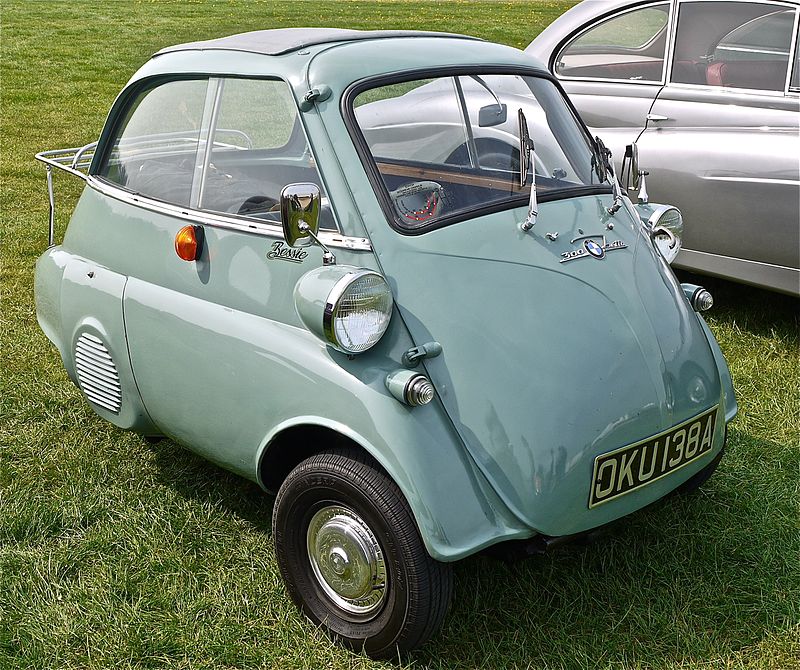
(picture is backwards)
AKA Roadkill…
“now 15 minutes for 300 miles of range”
I want to see the 10 MWe battery charger just before it put the batteries in orbit.
People generally do not understand how much power things use.
My ‘big’ 2000 w inverter/battery charger in the motor home draws more power than the frig, A/C, hot water heater, micro wave, and coffee maker. This is why many RV appliances are electric or propane. Unless a campground has 30 or 50 amp service, I can not run anything else until the batteries are more than 75% charged.
I got a quote for putting a 50 amp service for the motor home where are son lives. $600! I tied into an existing 20 amp kitchen service for $10. Then we had to move the coffee pot to keep from trip the circuit.
The point here is that there is a huge difference low power electronics and things that draw lots of power when it comes to storing energy in batteries.
Solid state batteries will spark an EV revolution within ten years. Peakers won’t be necessary. Nuclear renaissance within 20 years.
I’ve been watching battery technology creep along for over 20 years now. Predicting a revolution in any time period cannot be based on any actual evidence, so it must be based purely on faith. Religion, in other words.
Yep… There’s no Moore’s Law for batteries.
Hardly religious. Definitely optimistic. Toyota is in production engineering for a 2022 EV using ultra fast charging and high energy density batteries. Glass electrolytes also look promising, holding at least 3x the charge. I expect we’ll see solid state batteries in phones in the next three to five years. Imagine fully charging a phone in less than five minutes, with the batteries simply not wearing out. These batteries also promise to operate in extreme hot and cold environments.
Looking into my crystal ball, I see EV’s dominating light vehicle sales in ten years. The resulting storage capacity should be able to buffer the daily and weekly demand cycles for electricity. We’ll need to double our base load generation capacity. Better nuke technology should also be coming online around that time, perfectly suited for the task.
https://www.forbes.com/sites/bertelschmitt/2017/07/25/ultrafast-charging-solid-state-ev-batteries-around-the-corner-toyota-confirms
https://www.texasmonthly.com/energy/all-charged-up-john-goodenough/
https://hardware.slashdot.org/story/17/04/19/016213/the-slashdot-interview-with-lithium-ion-battery-inventor-john-b-goodenough
What is a solid state battery? Are you talking capacitors? Have you checked out the leakage rate for capacitors?
Not capacitors. It’s a battery where the electrolyte is a solid instead of a liquid. They eliminate dendrites so the batteries essentially don’t wear out. The problem in the past was low voltage, but that appears to being overcome.
I ran some numbers assuming 100% EV uptake for light vehicle duty (far distant future). In the US that’s about 3 trillion miles per year at about 3 miles per kwh. If I’ve done my math correctly, that would require an extra 100Gw of constant generating capacity. That’s less than 10% of current capacity. I thought it would be more. Maybe I’ve slipped a digit somewhere.
EVs may be simpler, but they will never be cheaper.
You may be able to charge to 80% in 10 minutes, assuming you have paid hundreds of dollars to provide electric service that can support that.
However you will only be able to do that a few hundred times (at most) before you have to replace those burned out batteries.
There are no lack of predictions that we will soon run out of this and that, but that seldom happens. Cobalt is not a particularly rare element; it comprises 0.0029% of the Earth’s crust.
Furthermore, the amount of cobalt used in batteries have decreased eightfold since 2008.
The 53 kilowatt-hour pack on a 2008 Tesla Inc. Roadster contains an estimated 38 kilograms of cobalt. The same-sized battery on a 2017 Tesla would have about one-eighth of that, or 4.8 kilograms.
https://www.bloomberg.com/gadfly/articles/2017-09-28/cobalt-s-chemistry-experiment
/Jan
Nobody is predicting that we will soon run out of cobalt… or anything else…
When was last time there was impossible buy more of a metal that is traded on the Wolds commodities exchanges?
The prices may go up but so far, we have seen a decrease since the prices peaked in 2008.
At current prices, the cost of the cobalt in a Tesla car battery is about 500 USD. If the prices quadruple there would be an additional cost of 1500 USD, but enough mining companies will most probably increase their production before that happens.
/Jan
Total straw man fallacy.
So let me explain.
You claim that Panasonic’s current supply chain for cobalt is limited to 250,000 Model 3s per year.
May be you are right, but as I understand it, that is only a problem if they cannot buy all the cobalt they need from other sources to acceptable prices.
Or is it something I miss here?
Cobalt is a metal that is traded on the commodities exchanges. These institutions are very reliable.
More demand results in higher prices, and higher prices results in more supply, which drive the prices down.
Therefore, I do not think the cobalt price on the commodities exchanges will be so high that it will cause any serious problems for Tesla.
/Jan
Try actually reading the article, rather than reconstructing the same straw man over and over again.
Jan,
It isn’t usually a question of running out of any particular non-renewable resource. With sufficient cheap energy we could obtain almost anything from sea water or common rocks. The problem is that, as a resource becomes restricted in supply, its price goes up, often to the point that it is not economically competitive with substitutes. The problem is, if the substitute were the best choice, it would have been used in the first place! So, the end product ends up having some inherent engineering defect such as reduced longevity, less efficiency, greater weight, increased difficulty to re-cycle, etc. When trying to optimize a product, costs have to be considered. That is why we so often curse cheap Chinese imports.
I see your point Clyde, it is a good argument.
However, the cost of metals make up only small fraction of the cost of a car, and that fraction has been decreasing in the long time perspective, so I do not think some increase in the metal prices are highly dramatic for any automobile company.
/Jan
Another total straw man. Try actually reading the linked article about the cobalt cliff.
I have read it but I do not believe all their conclusions. For instance they say:
Really? I do not think so.
I would expect that any responsible CEO, including Mr. Musk, would secure their deliveries by having alternative suppliers for all vital resources.
There are good reasons for holding such strategic deals confidential.
/Jan
When he fails to build more than 250,000 Model 3’s next year, we’ll know if the article was accurate.
The solution to the electric drive car’s woes appears to be free piston linear generators (FPLG). When’s someone gonna build one?


https://judithcurry.com/2016/11/02/vehicular-decarbonisation-two-new-technologies-to-watch/
permanent magnets use rare-earth metals that communist China has a near-monopoly on the global supply. That is why Musk insisted that Tesla motors not use permanent magnets.
they don’t have a monopoly, they are the lower cost provider so they effectively have all the marcket, which is quite different. Those mineral are NOT rare (despite their name), and can be produced elsewhere if need be, if you are willing to pay significantly higher than Chinese are willing to sell nowadays.
I don’t know if, and why, Musk insisted Tesla motors not use permanent magnets, but i suspect rare-earth very dirty image (quite like palm-oil) may impact his greenwashing business.
They’re called “rare earth metals” because they occur in very low concentrations. It requires a labor-intensive, low-margin mining operation… Right up the ChiCom alley.
paqyfelyc,
Semantics! If a company has the means to produce something much more cheaply than anyone else, they have a virtual monopoly because they have eliminated competition. It is only during wartime, when a country doesn’t have sufficient supplies of a mission-critical resource, that the government absorbs the extra cost to provide a necessity. Thus, the Nazis developed a process to produce liquid fuels from coal. Nobody uses the process today because it isn’t competitive with crude oil.
Clyde Spencer
Not Semantics, basic economy. It makes a hell of a difference if you are alone on a market because you are the cheapest, or if you are alone in the market because nobody has the right/ the know-how to compete with you. In the first case, you can get replaced any time or if you ask higher price, in the second, it won’t happen no matter what and you can price as you wish. .
Fischer-Tropsch process is still used nowadays, it is competitive against crude oil in some specific case.
paqyfelyc,
You said, “Fischer-Tropsch process is still used nowadays, it is competitive against crude oil in some specific case.” Strictly speaking, you are correct. However, the point is that it is not the method of choice for supplying the huge global demand of liquid fuels, and it is the issue of economics that you gloss over that restricts it to niche markets.
We were discussing rare-earth elements, and joelobryan remarked about “a NEAR-monopoly on the global supply.” You came back denying that China had a “monopoly.” Once again, strictly speaking you were right. However, joelobryan didn’t claim a complete monopoly. As David Middleton observed, China is capable of exploiting its rare-earth elements because of cheap labor, and also virtually non-existent environmental laws. As to your claim “…can be produced elsewhere if need be,…”, that is open for debate. The only other location that I’m personally familiar with is the Mountain Pass locality in California. With what Americans need for income to survive, and the environmental restrictions, it is doubtful that Mountain Pass will ever re-open. What defines a ‘mine’ is the ability to economically extract the resource, not just the presence of the resource. So, while rare-earth elements may be widespread, but in low abundance, that doesn’t necessarily equate to the ability to ramp up global production by just paying a little more for it.
Exactly. The solution to the electric drive car’s woes is a new type of combustion engine.
I’m not sure, but the engine pictured above may be the one that Bill Gates is backing and that is predicted / projected to go into service next year. It supposedly is as efficient, or more efficient, as what Mazda has in the pipeline.
GM’s Chevy Bolt is here, and GM is a real car company.
https://www.wired.com/2016/01/gm-electric-car-chevy-bolt-mary-barra/
THE ALL-ELECTRIC 2017 BOLT EV
2017 NORTH AMERICAN CAR OF THE YEAR
Priced start at ONLY US$ $37,495 for a tiny little car…
I like electric cars for engineering reasons but THE COSTS ARE STILL FAR TOO HIGH.
http://www.chevrolet.com/byo-vc/client/en/US/chevrolet/bolt-ev/2017/bolt-ev/trim
http://www.chevrolet.ca/bolt-ev-electric-vehicle.html?ppc=GOOGLE_700000001316378_71700000013958844_58700001170263579_p10378417924&gclid=COjshoOUj9cCFY3AfgoduVgETQ&gclsrc=ds
MSRP FROM
Cdn $43,195 US$ $37,495
Includes A/C Tax
Up to
$14,000
in Government Incentives
Estimated up to
383 km
of range
Full charge in
9.5
Hours
0 to 96 km/h in under
6.5
seconds
Electric traction is common in trains and boats. But it comes in two flavor
* somehow linked to the grid, through a rail or line (never happen for boats, obviously)
* diesel-electric, with the motor providing the current, not direct traction. Optionally, this flavor can usually be connected to the grid, where available
It makes sense to see this kind of thing in trucks and cars (connecting lines along main roads, engine-generator used elsewhere). Fully electric moving object with only batteries is just non-optimal expensive nonsense
Please detail how the trillions of dollars needed to electrify the nations roads is going to work.
Do not forget to include safety features so that grannies and little kids don’t get electrocuted whenever they go out for a walk.
The bottom line is that it is the market which should decide, not government, on how many EVs are produced and purchased. That means no government meddling. None. No punishing ICE vehicles via “carbon” taxes, and favoring EVs. They need to pull their own weight, and since they aren’t contributing their fair share of taxes used for roads and bridges via the gasoline tax, they need to be taxed based on mileage.
Good point Bruce, not to mention that after spending millions on a suitable battery none exist yet which provides a suitable range. Finally who is going to pay for the replication of the fueling system that exists throughout the US and other countries that allows us to drive almost anywhere even in rural areas. This was private capital even with average people who own gas stations throughout the country.
It seems like the elites expect the tax payers to subsidize charging stations for their expensive cars.
Not to mention the cost of beefing up the electric grid to handle the extra load.
“…but new ICE cars are still accumulating by tens of millions per year, and are being driven for longer.”
That’s because new cars are so much better built than they used to be. The average car in America now lasts 11 years and often exceed 200,000 miles. Over time cars will become more reliable and last even longer.
klem,
See my comment above about my 1970 IH Scout.
PS:
I also have a 1965 Chevrolet Corvette that is in running condition and still a force to be reckoned with. The issue is whether one feels it makes economic sense to invest money to keep the car running. For most commuter cars, the decision is to scrap it when it starts requiring repairs.
427?
David,
327 over-bored to 350 when the guy I bought it from in 1974 re-built the engine to FI specs. It has always run a little warm because the cooling system was intended for 327.
There’s a lot on those graphs that clearly is “mockumetary” material.
For instance, the y = 10⁻²³⁷ e⁰.³¹⁹n business. That’s a ridiculous equation. There are 2 data points, 2015 and 2017. Subtract the blôody base year, please.
Say (and perhaps its true) that until we overcome the cobalt and lithium and neodymium and samarium ‘supply problems’ (which there’s no magic wand to fix), well … we’re limited to maybe what, 5,000,000 e-cars a year based on lithium battery chemistry and super-magnet rotor switched 3-phase field motor EVs? OK.
The authors propose 2× the cars in 2030. That’s 2,000,000,000 cars. They propose that the world’s to have a moratorium on ICE production that year. (Anyone ask the Ugandans and Nigerians what they think of that?) 13 years off. 5% growth a year, compounded.
4.7% tho’ of 1,000,000,000 present tense cars is 47 million of them. Next year. Happening? NOT. Maybe another 600,000 or 1.3% of what’s needed. So… the percentage of ECars toward the ultimate growth is still WAY low. But OK, let’s say ECar growth can sustain 40% a year until the number of cars approaches the precious-element resource limit of (at present) 2,000,000 cars. And that that PERL (nice acronym!) can itself grow with exploitation and discovery some 15% a year. (chose a bûtt-crack number. I admit it.)
Well… a little Excel work, and I find that by 2030 (intentionally matching their projection) there’s s total of 2.02 billion cars putt-putting around. 75,000,000 of them (with 3.5% recycle rate) are electric. Totally resource limited in only 5 years. They’re now 3.7% of the total car fleet. Cool! Not nearly enough, according to those-worried-about-CO₂.
I guess that’s the bottom line: we need a radical change in dependence on RARE materials that aren’t conveniently deposited in thousand-foot-thick ore bodies. (Like iron. In Australia and elsewhere.)
One might suppose that the neodymium crisis (rare earth) is solvable by going back to slip-field iron-copper rotor motors. No big permanent magnet. No rare earths. That’d fix that part up. But what about the lithium-battery stack? Cobalt ‘n’ lithium. Turns out the lithium is probably not all that rare. Its a common component of both petrified evaporite bed deposits and present day evaporite areas. (Dried out salt lakes) There’s quite a bit in Bolivia, Afghanistan, China, and likely the Sahara. Iran. You know, old desert fields. But cobalt?
The cobalt dependency needs a revolution. Seriously so. Either we get WAY lucky and find a mountain of the stuff or three, OR we find a lithium-battery (or other electropositive element) that doesn’t depend so critically on Cobalt. Dependence on something WAY more common like copper, manganese, iron or yeah, even nickel. There’s a lot of that.
Anyway, always wanted to answer my rhetorical question.
GoatGuy
I just connected the three data points with an exponential trend line… because the EV zealots whine too much if I use a linear regression.
Regarding the lithium, rare earths, cobalt and graphite cliffs…

Thank you for replying, Sir Middleton.
The Cobalt issue is interesting. I would expect a “Cobalt Spike”, but no cliff. Sort of like the Peak Oil crap—-high prices will bring on new supplies. Heck, there is a town of Cobalt, Ontario where mines are firing up right now. Mining development takes time however, so a shortage won’t go away overnight.
Cobalt prices would have to skyrocket to alter the dynamic which created the “cobalt cliff.” The problem for Tesla is that their Model 3 production guidance is for 500,000 vehicles per year by 2018. Time is not on
Tony Stark’sElon Musk’s side.This promises fun. Cobalt requires authorisation under EU chemicals law.
Consumer Reports places the Tesla Model X among its 10 LEAST problem-free cars on the road today:
https://www.consumerreports.org/car-reliability/10-least-reliable-cars/.
“Price as tested: $110,700
Trouble spots: Body hardware, paint and trim, climate system…..”.
For $110,000, I would expect it to be nearer to the top.
The worst fault is when it won’t let you in.
Legislating EV usage will not make it happen. It may stop the sale of new ICE cars but the ramifications of everyone switching from ICE to EV …. personal and commercial ….. is a pipe dream in the foreseeable future. We don’t have the electrical infrastructure, economy, or lifestyles to support it. The miserable showing of EVs in the past decade since they were introduced should give the promoters a hint of the problem and it will get worse before it gets better now that all the low hanging fruit has been picked and charging resources are starting to feel the pinch even with the minimal amount of EVs on the road. Here’s my look into the future: Used ICE cars will become in demand as gasoline prices drop and EV charging becomes an issue. Those that can go EV will when they can afford it and once battery life and subsequent replacement becomes common place the shine of EVs will dull. EV turnover will become a problem for manufacturers as the built in obsolescence of EVs is lower than ICE vehicles and pricing will reflect that. Installing a new battery will be less expensive, but far from cheap, than buying a new car. EV road recovery services will be the business to get into.
Refurbishing used diesel generators (for road recovery) will be the business to get into. Here in the UK we recently had a “little problem” on a motorway and miles of traffic was stuck for up to 15 hours. If they had all been EVs what % would have gone flat while waiting for 15 hours, and of course trying to keep warm.
Now if that had have been in the middle of winter with -5C outside temperature I think we would be looking at having to reover some bodies first before charging the car with the recovery truck.
I bought a Greeworks Lawn mower. Electric. Just pop the battery in. It is awesome. Quiet and no exhaust and so I get exercise when I mow instead of noise and fumes. Cuts almost as well as a Briggs and Stratton. Battery lasts as long as I do. When it gets tired, so am I.
Highly recommend.
https://postimg.org/image/9om54ajci3/
Mary must have a small yard.
As far as batteries last, I hope Mary will live longer than 5 years.
Hook it up to a trailer and set off for Mount Zion, Wisconsin!
A wonderful film for anyone who doesn’t know it.
https://www.rottentomatoes.com/m/straight_story/
Actually, i have a pretty big yard. Guessing I can mow 0.15 acres on one battery charge
I’m impressed… esp love the light weight, clean and quiey
My car, however is a Suburban with a hybrid sticker i bought off the internet for $2
.15 acres is a small yard. I have 1.38. It would take at least 10 of those, not considering the riding mower’s greater fuel usage.
You didn’t get excercise with your walk behind mower?
PS: 0.15 acres, is a small yard.
Peak cobalt? Thanks for the investment tip.
In 2030: BEV = zero %, US wind = zero %, rounded to whole numbers.
My similar prediction about wind in the US was wrong 20 years ago but a lot closer than the wind zealots who thought wind would exceed nuclear.
Being a test engineer, I like new things. But the results need to be checked. Things that work well keep running. Things that don’t, don’t.
A big deal is made every time a nuke plant is shut down. Because it is a big deal. Wind and solar are mickey mouse.
BEV are new, but they will not be in 2030.
Some dip-stick from the national energy board of Canada (NEB) just came out with a report that Alberta will be 80% renewable energy by 2040. In fairness to her she looks ready to retire in about 5 years.
Is it possible just as private capital has almost made us energy independent there are those who want to ban fossil fuels and make us again dependent on an unfriendly nation for our energy in the future?
I’m just totally unconvinced that a ‘self driving’ car could work in the UK…
Fine on motorways (freeways) but – get one into our congested urban streets (laid out by monks in the 12th century) or our narrow country lanes, and I reckon they would just have the electronic equivalent of a mental breakdown…
Then there are mini roundabouts…! (‘After you James..’ ‘No, after YOU, Charles…’ Repeat for ten minutes….)
I absolutely agree!
We have some bizarre road layouts in abundance right across the country.
I can think of major A roads in Devon which suddenly contract to one and a half lanes with no road markings for a hundred yards or so, for example.
And you’ve seen the roundabout in Hemel Hempstead which consists of 7 mini roundabouts around a larger central circle?
https://www.google.co.uk/search?q=hemel+hempstead+roundabout&source=lnms&tbm=isch&sa=X&ved=0ahUKEwjcs9HF2JDXAhWJ1hoKHfmwBKUQ_AUICigB&biw=1294&bih=828#imgrc=JNwR1Abr6IraaM:
griff
one and a half lanes? what luxury. I have just driven back through the middle of Dartmoor on the A road which contracts to one lane in places
No road markings, blind bends and sometimes you have to be assertive, sometimes you have to hold back and sometimes you have to reverse.
tonyb
.
I spent about 40 minutes trying to find the right exit from a roundabout near Heathrow… The computer nav kept sending me through the wrong exit. The computer also failed to navigate very well in and around Bath.
I have made it back and forth across the country a few times using my GPS, without having to resort to a paper map. But, there have been times when I just had to say, “Good night, Gracie!”, and try to figure it out on my own. I don’t think that auto-driving cars or GPS are ready for ‘prime time’ yet, especially off the main interstates. However, I remember one time that I was driving along a new, re-routed section of a divided highway that hadn’t yet made it to the database of the GPS. The GPS kept wanting me to drive out in the open farm land where the road used to be! Being smarter than the average Jellystone Bear, I quickly deduced that there was a problem because I had left my Abrams Tank at home.
David,
Laugh all you like, but I predict there will be some LENR powered electric cars and autonomous ones, by 2030.
How long it takes for ThinkX’s prediction is anybody’s guess.
https://youtu.be/izQB2-Kmiic