By Larry Kummer. From the Fabius Maximus website
Summary: Millions of words were expended reporting about Hurricanes Harvey and Irma, but too little about the science connecting them to climate change. Here are the details, contrasted with the propaganda barrage of those seeking to exploit these disasters for political gain. Let’s listen to these scientists so we can better prepare for what is coming. Failure to do so risks eventual disaster.

(1) A politically useful catastrophe: the Left speaks up

The record-setting twelve-year long hurricane “drought” (no major hurricane landfalls on the US) was just weather. But the Left immediately boldly and confidently declared Harvey and Irma to be caused (or worsened) by anthropogenic climate change. Some of these screeds are mostly rational, just exaggerated or imbalanced. Such as “Harvey Is What Climate Change Looks Like” by Eric Holthaus at Politico — “It’s time to open our eyes and prepare for the world that’s coming.” And “Stop talking right now about the threat of climate change. It’s here; it’s happening” by Bill McKibben at The Guardian — “Hurricane Harvey, Hurricane Irma, flash fires, droughts: all of them tell us one thing – we need to stand up to the fossil fuel industry and fast.”
Many are simple political propaganda. “Irma Won’t ‘Wake Up’ Climate Change-Denying Republicans. Their Whole Ideology Is on the Line.” by Naomi Klein (activist) at The Intercept. Note this story is not labeled as an “op-ed”. “As Planet Rages With Fires and Storms, Ire Aimed at Murderous Climate Denialism” by Jessica Corbett (staff writer) at Common Dreams. “Climate Denialism Is Literally Killing Us” by Mark Hertsgaard (editor) at The Nation — “The victims of Hurricane Harvey have a murderer — and it’s not the storm. …It is past time to call out Trump and all climate deniers for this crime against humanity. No more treating climate denial like an honest difference of opinion.”
Many just assume the science says what they want it to say, without recourse to the IPCC, NOAA, or a similar authority. For example, Paul Krugman (professor of economics at Columbia, Nobel Prize 2008) says this at his NYT blog.
“The disaster in Houston is partly Mother Nature — natural disasters will happen sometimes whatever we did — but with a powerful assist from human action. Climate change definitely made such an event more likely …”
Similarly, Joseph E. Stiglitz (Professor of economics at Columbia, Nobel Prize 2001) in “Learning from Harvey” says this at Project Syndicate.
“It is ironic, of course, that an event so related to climate change would occur in a state that is home to so many climate-change deniers – and where the economy depends so heavily on the fossil fuels that drive global warming.”

(2) Scientists tell us about hurricanes and global warming

Although many on the Left ignore, misrepresent, or exaggerate the science, there is well-established data about these matters. Here is a look at recent research (i.e., since the IPCC’s AR5 report), the foundation for the statement at NOAA’s website that concludes this section. Red emphasis added.
Look at the trends in the number and intensity of Atlantic hurricanes.
A good place to start is “Extremely Intense Hurricanes: Revisiting Webster et al. (2005) after 10 Years” by Philip J. Klotzbach and Christopher W. Landsea in Journal of Climate, October 2015. Abstract…
“Ten years ago, Webster et al. documented a large and significant increase in both the number as well as the percentage of category 4 and 5 hurricanes for all global basins from 1970 to 2004, and this manuscript examines whether those trends have continued when including 10 additional years of data.
“In contrast to that study, as shown here, the global frequency of category 4 and 5 hurricanes has shown a small, insignificant downward trend while the percentage of category 4 and 5 hurricanes has shown a small, insignificant upward trend between 1990 and 2014. Accumulated cyclone energy globally has experienced a large and significant downward trend during the same period.
“The primary reason for the increase in category 4 and 5 hurricanes noted in observational datasets from 1970 to 2004 by Webster et al. is concluded to be due to observational improvements at the various global tropical cyclone warning centers, primarily in the first two decades of that study.”
Articles about hurricanes often say there is a strong and direct link to sea surface temperatures (SST). Reality is more complex. Philip Klotzbach explained his findings to me in more detail.
“Our paper found that the large increasing trends in Category 4-5 hurricanes observed in Webster et al. (2005) were primarily due to changes in observational technology at the various warning centers. Most model projections predict a slight increase (on the order of 5-10%) in storm intensity, with perhaps fewer storms, over the next century.
“SSTs correlate tightly with Atlantic hurricane activity, due to other large-scale climate features such as sea level pressure and vertical wind shear. In the tropical Atlantic, warm sea surface temperature anomalies result in lower tropical and subtropical Atlantic pressure. The associated weaker pressure gradient results in weaker trade winds, reducing vertical wind shear (since upper level winds blow out of the west in the tropical Atlantic). The weaker trade winds cause less mixing, evaporation and upwelling of the sea surface, which then feed back into reinforcing the warm SST anomalies in the tropical Atlantic.
This wind-evaporation-SST feedback process in the Atlantic has been shown to be critical for the Atlantic Meridional Mode. Generally, positive values of the Atlantic Meridional Mode are associated with warm SSTs, low sea level pressure, and reduced vertical wind shear. The actual impact of the SST anomalies themselves is shown to be relatively small in partial correlation analysis. This was first demonstrated two decades ago in “Atlantic Sea Surface Temperatures and Tropical Cyclone Formation” by Lloyd J. Shapiro and Stanley B. Goldenberg in Journal of Climate, April 1998.
These types of relationships do not necessarily occur in other basins. For example, the NW Pacific has just had its 2nd Cat. 3+ typhoon this year, while the average to date is 4.5. All of this despite record warm SST anomalies in their Main Development Region. Circulation features are a far more critical driver of typhoon activity than SSTs, since they are always plenty warm to support intense activity.”
Dr. Klotzbach is a research scientist at the Tropical Research Project at Colorado State U.
Cliff Mass describes the relationship of global warming to hurricanes.
See “Global Warming and Hurricane Harvey” by Cliff Mass at his website. He gives a rebuttal to those articles asserting a clear link between Global Warming and Hurricane Harvey. Opening…
“Before the rains had ended, dozens of media outlets had published stories suggesting that global warming forced by humans (mainly by emissions of CO2 into the atmosphere) played a significant role in producing the heavy rainfall and resulting flooding associated with Hurricane Harvey.
“Most of the stories were not based on data or any kind of quantitative analysis, but a hand-waving argument that a warming earth will put more water vapor into the atmosphere and thus precipitation will increase. A few suggesting that a warming atmosphere will cause hurricanes to move more slowly.
“This blog will provide a careful analysis of the possible impacts of global warming on Hurricane Harvey. And the results are clear: human-induced global warming played an inconsequential role in this disaster. …”
Dr. Mass is a professor of atmospheric sciences at U Washington. See his bio, presentations and papers.
Roger Pielke Sr. tells me about an important but often ignored point.
“Model projections of hurricane frequency and intensity are based on climate models. However, none have shown skill at predicting past (as hindcasts) variations in hurricane activity (or long term change in their behavior) over years, decades, and longer periods. Thus, their claim of how they will change in the future remains, at most, a hypothesis (i.e. speculation). When NOAA, IPCC and others communicate to the media and public, to be scientifically honest, they should mention this.”
Dr. Pielke Sr. is a Senior Research Scientist in CIRES and Emeritus Professor of Atmospheric Science at Colorado State U. See his bio.
Judith Curry discusses the link between global warming and Hurricane Harvey.
From her post about Hurricane Irma at Climate Etc.
“Ever since Hurricane Harvey, the global warming – hurricane hysteria has ratcheted up to levels I haven’t seen since 2006. NOAA GFDL has written a good article on Global Warming and Hurricanes. {See below.} …I much prefer {NOAA’s} model-based quantitative estimates (but they need some serious uncertainty estimates, including structural uncertainty), relative to hysterical arm waving by Mann and Trenberth using undergraduate basic thermodynamics reasoning. There is nothing basic or simple about hurricanes. …
“{See} my 2010 post Hurricane Katrina – 5 years later, particularly relevant given the cool SST values that Irma formed and intensified.”
Dr. Curry is a professor emeritus at the Georgia Institute of Technology and President of Climate Forecast Applications Network (CFAN). See her bio.
 NOAA gives their verdict.

The bottom line comes from NOAA’s Geophysical Fluid Dynamics Laboratory: “Global Warming and Hurricanes – An Overview of Current Research Results.” Journalists should consider this definitive. But few of them mention it.
Summary.
“It is premature to conclude that human activities–and particularly greenhouse gas emissions that cause global warming – have already had a detectable impact on Atlantic hurricane or global tropical cyclone activity. …”
A. Statistical relationships between SSTs and hurricanes.
… The Power Dissipation Index (PDI) …is an aggregate measure of Atlantic hurricane activity, combining frequency, intensity, and duration of hurricanes in a single index. …
This is in fact a crucial distinction, because the statistical relationship between Atlantic hurricanes and local Atlantic SST shown in the upper panel of Figure 1 would imply a very large increases in Atlantic hurricane activity (PDI) due to 21st century greenhouse warming, while the statistical relationship between the PDI and the alternative relative SST measure shown in the lower panel of Figure 1 would imply only modest changes of Atlantic hurricane activity (PDI) with greenhouse warming. In the latter case, the alternative relative SST measure in the lower panel does not change very much over the 21st century in global warming projections from climate models, because the warming projected for the tropical Atlantic in the models is not very different from that projected for the tropics as a whole. …
B. Analysis of century-scale Atlantic tropical storm and hurricane records.
To gain more insight on this problem, we have attempted to analyze much longer (> 100 yr) records of Atlantic hurricane activity. If greenhouse warming causes a substantial increase in Atlantic hurricane activity, then the century scale increase in tropical Atlantic SSTs since the late 1800s should have produced a long-term rise in measures of Atlantic hurricanes activity.
Existing records of past Atlantic tropical storm or hurricane numbers (1878 to present) in fact do show a pronounced upward trend, which is also correlated with rising SSTs (e.g., see blue curve in Fig. 4 or Vecchi and Knutson 2008). However, the density of reporting ship traffic over the Atlantic was relatively sparse during the early decades of this record, such that if storms from the modern era (post 1965) had hypothetically occurred during those earlier decades, a substantial number would likely not have been directly observed by the ship-based “observing network of opportunity.”
We find that, after adjusting for such an estimated number of missing storms, there is a small nominally positive upward trend in tropical storm occurrence from 1878-2006. But statistical tests reveal that this trend is so small, relative to the variability in the series, that it is not significantly distinguishable from zero (Figure 2).
In addition, Landsea et al. (2010) note that the rising trend in Atlantic tropical storm counts is almost entirely due to increases in short-duration (<2 day) storms alone. Such short-lived storms were particularly likely to have been overlooked in the earlier parts of the record, as they would have had less opportunity for chance encounters with ship traffic. …
“While major hurricanes show more evidence of a rising trend from the late 1800s, the major hurricane data are considered even less reliable than the other two records in the early parts of the record. Category 4-5 hurricanes show a pronounced increase since the mid-1940s (Bender et al., 2010) but again, we consider that these data need to be carefully assessed for data inhomogeneity problems before such trends can be accepted as reliable.”
E. Summary for Atlantic Hurricanes and Global Warming.
In summary, neither our model projections for the 21st century nor our analyses of trends in Atlantic hurricane and tropical storm counts over the past 120+ yr support the notion that greenhouse gas-induced warming leads to large increases in either tropical storm or overall hurricane numbers in the Atlantic. …
(3) See the trends for yourself in hurricane energy and frequency
Graphs from Ryan Maue (click to enlarge). He also notes that the “Southern Hemisphere 2016-17 tropical cyclone season was weakest/quietest in 50-years since reliable records (sort of) exist.” His dataset has 4,137 named global Tropical Storms since January 1970. Of those, 2242 has a period of hurricane level force (54%).
Global frequency of tropical cyclones.

Global accumulated cyclone energy (ACE) of tropical cyclones.

(4) About those wildfires!


The National Interagency Fire Center shows year-to-date statistics for wildfires in the US. This year ranks third in the past eleven years. The total acres burned per year have been in a flat range since 1999 (details here).
In the 20th century forests were managed by Smokey the Bear — “only you can prevent forest fires” — in the mistaken belief that forest fires must be prevented. This made the western US forests into tinderboxes. The Left blames the resulting massive fires on climate change.
The big picture trend looks better. It is more good news that journalists don’t report. See “Global trends in wildfire and its impacts: perceptions versus realities in a changing world” by Stefan H. Doerr and Cristina Santín in Philosophical Transactions B, 23 May 2016. Excerpt from the abstract…
“{G}lobal area burned appears to have overall declined over past decades, and there is increasing evidence that there is less fire in the global landscape today than centuries ago. Regarding fire severity, limited data are available. For the western USA, they indicate little change overall, and also that area burned at high severity has overall declined compared to pre-European settlement.”
(5) Results from the propaganda campaign

Much of the propaganda about Harvey and Irma has been directed at Trump. How has his job approval levels changed — an instant measure of their success? Harvey made landfall in Texas on August 26. Trump’s job approval numbers began to improve on September 1 and have remained flattish since September 3 (graph as of Sept 15). Lots of firepower expended on Trump to no visible effect.

(6) A better lesson from these hurricanes (bitter if we wait too long)
“We don’t even plan for the past.”
— Steven Mosher (of Berkeley Earth), a comment posted at Climate Etc.
The debate about the best US public policy response to climate change has run for three decades, with Left and Right relying on misinformation and exaggeration to influence the public. We should be able to agree on the need to prepare for the inevitable repeat of past weather — like category 3, 4, and 5 hurricanes hitting the east coast.
It is pitiful that a rich nation like America has hysterics from events so commonplace as a cat 3 hurricanes. We should be prepared for the on average six major hurricane landfalls per decade (see the average return period for each section of the East Coast.
Eventually a cat 5 will hit the center of a major city. Then perhaps we will take some simple steps to build a more resilient America.
(7) For More Information
To learn more about the matters discussed here.
- See the records set by Irma – at Weather Underground.
- See some thoughts by an engineer about these disasters: “After Hurricane Harvey, don’t empower the engineers” by Charles Marohn at the Strong Towns website. Lots of good material at this site.
- To learn more about the state of climate change see The Rightful Place of Science: Disasters and Climate Change
by Roger Pielke Jr. (Prof of Environmental Studies at U of CO-Boulder).
For more information see all posts about the IPCC, see the keys to understanding climate change and these posts about the politics of climate change…
- How we broke the climate change debates. Lessons learned for the future.
- Important: climate scientists can restart the climate change debate – & win.
- Ignoring science to convince the public that we’re doomed by climate change.
- A leaked memo about climate change explains why we’re unprepared.
- Irma might defeat the skeptics and end the climate wars – a thought experiment.

Logical fallacies
Statistics
Accounting
Without an understanding of (at least) these three subjects, you’re doomed to be a moron.
Max,
You get bonus points for commenting in haiku-form. Zero points for intelligibility. Are you attempting to communicate something?
What if I claim to have an understanding of logical fallacies but then deploy them in my arguments?
For example, if I claim to understand the ad hominem logical fallacy, but then argue that anyone who doesn’t understand logical fallacies is a “moron”…
;-p
Sy,
That would make you a very skilled commenter — a-plus league. But use your gift carefully, lest you become a troll. Much like in the TV show “Smallville”, people who get superpowers usually become supervillains (at least in the first season, all I watched).
My humble thanks for the advice/warning. I believe you.
I tried very hard not to do it but alas, I lost the argument. I may be “doomed”.
Your best Larry. But did you notice that this “big hammer” and lack of humility of experts analogy is a suit perfectly cut to fit the CAGW crowd? Your earlier offerings were that proponents and sceptics had to come together and eschew their politically motivated positions about global warming.
Re hurricanes/flooding and draconian measures to fix things, there is no hammer big enough, and in the Climateering field, they have yet to produce a the nail, but they are proposing a hammer for which the nail is humankind.
Kudos for coming around to what is really happening, though.
Gary,
It’s all politics of the worst kind: factionalism run riot. That was the great fear of the Founders.
Regarding wildfires, we had a wet spring on the west coast with lots of grass growing taller than I can remember (since 1985 when I came to the US), some of the grass (cheatgrass) is from an invasive non-native spicies. When I noticed that this spring, I assumed that we will lots of wild fires this summer. Then fire prevention left our forests with lots of underwood fuel that accumulated over decades. I am not surprised.
Stephan,
In my 15 years leading Boy Scouts on treks thru the western forests, it was obvious that many of them are destined for inevitable intense fires. Overgrown dense trees, lots of dead wood on the ground,etc.
Afterwards we can have rational forest management policies. But the rebalancing to get there will be severe.
… that we will have lots …
Maybe I’m missing something from the tweets, but…what in the Hell, Michigan does an earthquake have to do with climate change?
Are these alarmists really so desperate?
Solar activity is still high. Another strong geomagnetic storm.
http://images.tinypic.pl/i/00933/4w5jcyxaqlkp.png
Circulation will remain favorable for the development of hurricanes (jetstream).
‘In the 20th century forests were managed by Smokey the Bear — “only you can prevent forest fires” — in the mistaken belief that forest fires must be prevented. This made the western US forests into tinderboxes. The Left blames the resulting massive fires on climate change …’.
===============================================
There has been an impressive and undeniable drop in the US wildfire trend over the past century:
http://www.fao.org/docrep/010/ai412e/ai412e09.jpg
Source: U.S. Wildfire Statistics, USDA/Forest Service.
Chris,
That is a great graph! Thank you for posting it. I’ll bet that in 50 years we see that line rise retrace much of its decline.
I believe the source of the graph is DOE’s Carbon Dioxide Information Center, destroyed as part of Team Trump’s science purge. Hopefully it will surface at the replace Berkeley National Lab website.
To see that graph updated thru 2010 — showing the rise in fires — read “Human Activity, more so than Climate Change, Affects the Number and Size of Wildfires” — Testimony of David B. South (Professor Emeritus of Forestry, Auburn U) before the Senate Subcommittee on Green Jobs and the New Economy, 3 June 2014. It has a wealth of information and useful graphs.
Why do you query the source of the graph?
The source is clearly shown and comes from a document of the UN Food and Agricultural Organization;
http://www.fao.org/docrep/010/ai412e/AI412E06.htm
Gratuitously dragging Trump into the discussion is just political opportunism.
Here is another graph which is more up-to-date:
Evidence-free prognostication about future trends is stupid.
Chris,
(1) “Why do you query the source of the graph?”
Sources of one useful piece of information usually have more useful info.
(2) “The source is clearly shown”
In the 21st C a “source” is where I can go to see it. Note that most people commenting here give URs for the info they cite, and are asked for sources when they don’t.
(3) “Gratuitously dragging Trump into the discussion is just political opportunism.”
Nope. Taking down the CDIC website is a political act, and a dumb one. It had a lot of useful info. Hopefully the replacement by the Berkeley Natl Lab will be as good.
(4) “Evidence-free prognostication about future trends is stupid.”
Nope. Fires were kept low by a massive effort by US governments and private landowners. That policy is changing as its folly has become apparent — along with the impossibility of continuing it. Which means that fires will increase — then return to some sort of equilibrium level once massive fires eliminate the tinderboxes that have accumulated.
The article you cite, “RE-INVENTING THE UNITED STATES FOREST SERVICE” (2008) briefly discusses this..
http://www.fao.org/docrep/010/ai412e/AI412E06.htm
(5) “Here is another graph which is more up-to-date:”
That’s great! Where did you get it?
All this effort ‘proving’ these storms are not to do with climate change smacks a little of desperation to me..
Skepticism has been on the back foot since the pause evaporated and the RSS temp series backed a warming earth…
Of course there was an effect on the severity of these storms due to warming. A hurricane needs heat…
These were exactly as predicted by the science (no amount of downplaying Irma using the figures as it hit the US can hide its original intensity)
And the science says they’ll be more as intense and sea level rise will make it worse. Time to do some infrastructure change and planning.
Which simply have not happened since those predictions were made.
Griff,
“All this effort ‘proving’ these storms are not to do with climate change smacks a little of desperation to me..”
To me, too. Activists know that a big bout of extreme weather — no matter if just a repeat of the past — might panic the American public into supporting their agenda, and that this is probably only their only chance for success in the near future (i.e., for them personally).
A few useful snippets: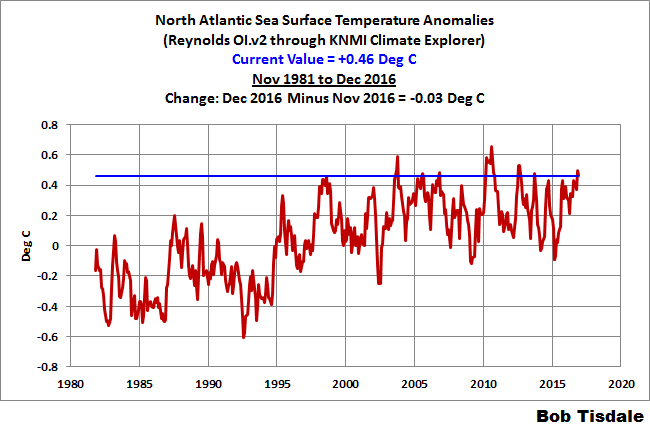
North Atlantic SST, no change in SST for the last 20 years, ie., from 1997 to end of 2016.
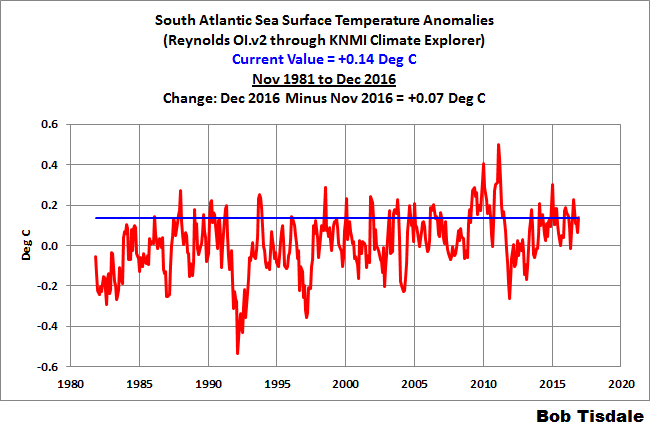
South Atlantic, no change in SST for the last 30 years, ie., from1987 to end of 2016.
Not only has there been no recent warming of SST, it appears that the North Atlantic is in now in a cooling phase, and there has been a substantial drop in the ocean heat content (0 to 700n OHC), see the recent paper: Duchez et al paper.
http://notrickszone.com/wp-content/uploads/2017/09/Holocene-Cooling-North-Atlantic-Duchez-2016.jpg
You will note the large drop in heat content of around 3.5degC (NODC measurements) and about 2.5 degC (ARGO measurements) these past 10 years between 2006 and 2016.
Hurricanes do not normally form in the US Gulf, but rather out in the Atlantic, and you will see from the above, there has been no warming for at least 20 years, ie during a time when about 30% of all manmade CO2 emissions have taken place, and if you consider the Southern Atlantic some 30 years during which time some 40% of all manmade CIO2 emissions have taken place.
Dr Judith Curry carried an article (8th September) on Hurricane Irma, and she notes that it was not due to some particularly warm SST.
It is well worth having a read of her article.
The amount of hurricanes depends more on the circulation in the Atlantic than on the ocean surface temperature on the equator.
https://weather.gc.ca/saisons/animation_e.html?id=month&bc=sea
Particularly the development of hurricanes depends on latitudial jetstream.
http://tropic.ssec.wisc.edu/real-time/mtpw2/product.php?color_type=tpw_nrl_colors&prod=natl×pan=24hrs&anim=html5
One can expect another hurricane in the Caribbean. Jose will be very close to New York.
Here is the classic MSM commentary/ editorial from WCVB, Boston, that aired this morning.
http://www.wcvb.com/editorials
Recall the headlines about the increase in earthquakes? Closer examination was due to “primarily due to changes in observational technology at the various warning centers” as well. I.E., the increase appeared after more sensitive seismographs were installed.
I see some easy money that’s been left on the table in this article. What is the supposed connection between climate change and the Mexican earthquake?? Of course, co2 does cause everything.
That would be easy rhetorical money
Much of the problem is poor town planning. In the UK they build on flood plains, and then shout ‘climate change’ when the houses get flooded. Then they intone that “Tewksbury was flooded for the first time in centuries” – ‘climate change’. Yeah, but all the new housing on flood plains prevent the rains from spreading, and push the flood-peak downstream to previously higher ground.
I see the same in the US. The flooded houses are in a hurricane zone, and should all be on stilts. Or build low-rise flats, for a greater population density and a lesser need for roads, service pipes and cables, and cars. And if everything was built from reinforced concrete, nothing would fall down and add to the flying debris that destroys other buildings.
If adequately planned for, a hurricane landfall should be a minor inconvenience – a day indoors watching crrappy daytime television.
R
Town planners these days use…computer models! GIGO!
Yup. When I moved to live in Charleston SC, I was impressed with the Bank of America opposite my place of work.
It looked like something that was built post Hurricane Hugo. The architecture was solid neo-stalinist style concrete, where you had to go up the stairs or elevator to see any banking action. Nearby streets frequently flood at high-tide and they clearly weren’t going to take any silly risks. I’ll skate over their financial performances.
I assume you didn’t even bother to refute the “earthquakes” claims because … well they are simply crazy claims to make … no refuting needed …
Kaiser,
Exactly. They were in effect self-refuting demonstrations of ignorant hysteria. Fun to read, however.
What? Since when climate change caused more earthquakes to happen? Next they probably claim that volcanic eruptions and asteroid impacts are caused by climate change. And obviously these things never happened before. Earth was a paradise with no natural disasters, and no animal deaths at all, until evil humans fell from the sky and ruined everything. And of course, the more smarter alarmists never admit that this has turned into a religion. In my country, the biggest “science” magazine put “climate change denial” next to flat-Earthers, arrogantly claimed that no “proper” scientist would ever question climate change and the “dramatic” effect it will have in the future, and that it’s the “deniers” who are blinded by their emotions. But of course you can’t say anything because it’s not “politically correct”.
Or, if the above is giving you a headache, try this nostrum: “La Nina during hurricane season, batten down the hatches.”
http://notrickszone.com/2017/09/16/analysis-by-german-scientists-concerning-hurricane-causes-more-propaganda-than-science/#sthash.BnXfpY3a.dpbs
I Joe Bastardi and the guys at Weatherbell are correct what is now Tropical depression #15 will be another storm to watch. Come late next week it will probably be in the general news as another hurricane (possibly a major) that is a threatening landfall on the US.
In two days, the hurricane will reach the Lesser Antilles. Would presumably reach over the Caribbean Sea and threaten Puerto Rico and Haiti.
I am late to this party, so forgive me if this has been covered.
First of all…great article. Of course, I want to talk about the thing that bothered me:
“But the Left immediately boldly and confidently declared Harvey and Irma to be caused (or worsened) by anthropogenic climate change. SOME OF THESE SCREEDS ARE MOSTLY RATIONAL (emphasis added), just exaggerated or imbalanced. Such as “Harvey Is What Climate Change Looks Like” by Eric Holthaus at Politico — “It’s time to open our eyes and prepare for the world that’s coming.” And “Stop talking right now about the threat of climate change. It’s here; it’s happening” by Bill McKibben at The Guardian — “Hurricane Harvey, Hurricane Irma, flash fires, droughts: all of them tell us one thing – we need to stand up to the fossil fuel industry and fast.”
There is nothing rational in claiming that a 12 year drought in major landfalling hurricanes in the US or the slow decline in global ACE values is ‘just weather’, but two terrible hurricanes in a few weeks is a sure sign of man-made climate change. That’s like trying to prove the curse of Rocky Colavito is real by pointing out that the Cleveland Indians lost last night, but the 22 games in a row they won before that…well that’s just baseball. It’s crazy stupid / or stupid crazy / or both. It doesn’t really matter how rational you are after that, or the tone of voice you use, or what your resume is, or your reputation, or how many titles you have, or Nobel Prizes or anything!
The whole point they are trying to make is irrational. You can dress up an irrational claim all you want. It is no less irrational.
The hurricane is near the Lesser Antilles.
http://www.ssd.noaa.gov/goes/east/tatl/ir4-animated.gif
That new storm is Maria. Katia disintegrated into a tropical storm. Jose is moving up the US’s Atlantic coast.
Keep an eye on the clouds coming off the African coast. That’s where they start.
Here’s a link to Accuweather’s Atlantic storm forecast, from May this year:
https://www.accuweather.com/en/weather-news/2017-atlantic-hurricane-forecast-possible-el-nino-to-limit-development-of-storms/70001271
The forecast was as follows:
10 named storms
5 hurricanes
3 major hurricanes
3 named storms making US landfall
The article specifies that an El Nino forming in the Atlantic could limit storm development. They also named 2016 as the deadliest Atlantic storm season in 10 years.
It would be nice if the howling CAGWers would take some time to review what has happened prior to this year before they crank out their tweets. On the other hand, where else would we find so much inept entertainment?
Look at the temperature of the surface of the tropical Atlantic.
http://files.tinypic.pl/i/00933/gqy6wxrhny6s.png
I have no idea what you’re trying to say. Look at the tropical sea surface temperatures? Katia was a tropical storm in the Gulf of Mexico, only achieving some rotation from Irma’s influence. The rotation quickly faded when Katia went ashore.
Atlantic storms start to form off the coast of Africa. Jose had already formed into a cyclonic storm around the time it left the general area of Cabo Verde. Maria was not far behind, off the coast of Africa as a large clump of clouds, about the same time Irma was at Puerto Rico. Jose is right now east of the North Caroling coast and Maria is hovering over Barbados. There is another large clump of clouds blowing west out of Sierra Leone now, and more coming westward from Sudan. They pick up and drop moisture as they cross the African continent. Those clumps of clouds may be two more storms crossing the Atlantic, as predicted in May 2017.
The temperature is low in addition to the Caribbean Sea.
It’s always amusing to watch AGW denies put out novels of word salad. ..while the ignote the irrefutable facts that the average temperature if the earth is warming…to include the oceans… warmer oceans make bigger hurricanes. ..and all the denier BS in the world won’t change that fact
David,
It would be helpful if you were to state your objections more specifically — rather than as a rant.
” irrefutable facts that the average temperature if the earth is warming”
Video games are binary. The real world is seldom binary. The world has been warming since the early 19th century due to both natural and anthropogenic reasons. The “skeptics” positions concern the degree of human influence on the past (more than 50% since 1950 per AR5) — and more importantly, the timing and magnitude of future warming.
“warmer oceans make bigger hurricanes.”
See the graphs provided in this post. The oceans have warmed since 1970 — with no obvious trend in global storm frequency or energy. The NOAA statement agrees – see section A.
There is debate among climate scientists on the SST – hurricane intensity relationship, but as yet no consensus. So your bold state of fact must be rated “false”.
of course the world is warming – there’s
no need to even waste time arguing that.
hurricane metrics, too. data:
http://www.aoml.noaa.gov/hrd/tcfaq/E11.html
Watching too much hurricane coverage on US TV,
I noticed not one commentator mentioned
no major (Cat. 3, 4 or 5) hurricane made landfall
in the Us (48 states) between 2005 and 2017.
Quite a few commentators mentions two Category 4 hurricanes in one year was a “record”
without mentioning we don’t have many decades of accurate records …
and neglecting to mention cyclones, as if they were not the same thing,
and of course never mentioning there were two or more
Category 5 hurricanes in that hit the Americas (North or South)
in 1932, 1933, 1961, 2005(4) and 2007
source: https://en.wikipedia.org/wiki/List_of_Category_5_Atlantic_hurricanes
Richard,
Great catch on the two Cat 4’s vs. Cat 5’s!
The news media have discovered the benefits of weather porn. It works for national news like auto accidents does for local TV — cheap frequent high-impact stories to fill the space between advertisements.
Of course not. It’s called ‘obfuscation journalism’ lol
It’s amusing to watch Trump be blamed for the hurricanes. Obama was in office for 8 years. Did he fix the climate, and then Trump undid all that in a matter of months, hence the storms?
“Weather event A, B and C occurring, WTF is going on?”
“Earthquake even linked with climate change”
Ignorant people brain washed by propaganda, some pretending they understand scientific issues.